


Top 100 - Post-Impressionism
Post-Impressionism: 100 Paintings and Their Artists
100 paintings by Van Gogh, Cézanne, Gauguin, Seurat and their contemporaries: dates, collections, analyses and sources for understanding their explorations.
This editorial selection explores expressive colour, the construction of forms, symbolism and Neo-Impressionism. Each entry presents the illustrated work and information about its original, with a reference for further exploration.
Beyond the Moment, the Vision
Understanding Post-Impressionism through 100 Paintings
Post-Impressionism brings together artists with different methods rather than a group with a shared programme. This selection also includes their precursors and successors, notably the Nabis. It allows comparisons of landscapes, portraits, still lifes and scenes of modern life.
To read a work, observe the direction of brushstrokes, outlines, colour relationships and how planes organise space.
The name is associated with the exhibition organised by Roger Fry in London in 1910. Source: National Galleries of Scotland.
Skip to the ImagesThe Selected Works
The Works in Pictures
Van Gogh, Seurat, Cézanne, Gauguin and Toulouse-Lautrec open the journey with the works that gave the movement its most famous faces.
#1 1. The Starry Night
A dark cypress connects the village with the vast blue sky, crossed by curves and yellow halos. On the right, the moon illuminates the composition; roofs and the church tower remain much calmer than the sky’s movements. Van Gogh paints this canvas in Saint-Rémy in June 1889, drawing inspiration from the view from his room at Saint-Paul-de-Mausole. Yet he makes it over several sessions during the day. The village was not visible from this window and the cypress is brought closer: observation, memory and invention combine. Thick brushstrokes and blue-yellow contrasts thus give the landscape an expressive force beyond reproducing observed light.
Source: MoMA — The Starry Night, 472.1941.
Discover → #2
2. A Sunday Afternoon on the Island of La Grande Jatte
On an island in the Seine near Paris, walkers stand, sit or recline among the trees. The large couple on the right, the girl in white in the centre and boats on the left organise this leisure scene. Close up, forms fragment into dots and small juxtaposed strokes of colour; at a distance, they regain coherence. Seurat prepares the canvas through numerous studies and works from 1884 to 1886, then adds the coloured border in 1888–1889. The figures’ stillness and rigorous construction suggest a frieze rather than a moment captured spontaneously. Shown at the last Impressionist exhibition in 1886, the work marks the emergence of Neo-Impressionism.
Sources: Art Institute of Chicago — catalogue entry 1926.224 ; Seurat and the Making of La Grande Jatte.
Discover → #3
3. Mont Sainte-Victoire — Edinburgh Version
A bare tree in the foreground crosses the view with slender branches, before the fields of the Arc valley and Sainte-Victoire’s bluish silhouette. Cézanne observes this landscape from southwest of Aix-en-Provence. Earthy ochres and greens of cultivated land echo the mountain’s blue-greys; brushstrokes construct areas of colour rather than an entirely continuous perspective. Despite its watercolour-like appearance, this work is painted in oil in thin layers, with parts of the pale ground left visible. The museum suggests dating to around 1890–1895, difficult to establish more precisely. This Edinburgh version shows how Cézanne combines observation of landscape with an exploration of structure and balance.
Source: National Galleries of Scotland — Mont Sainte-Victoire, NG 2236.
Discover → #4
4. Where Do We Come From? What Are We? Where Are We Going?
This monumental canvas brings together figures of different ages in a landscape dominated by blues and dark greens. On the right, a baby lies beside a seated group; in the centre, a standing figure raises their arms towards a fruit; on the left, a crouching person holds their hands to their head. A blue idol and several animals complete this frieze-like composition. Gauguin paints the work in Tahiti in 1897–1898 and inscribes the title’s three questions in the upper-left corner. The painting offers a meditation on origins, identity and human destiny. Its simplified forms and colours departing from naturalism support this symbolic dimension, whose interpretation remains open.
Source: Museum of Fine Arts, Boston — catalogue entry 36.270.
Discover → #5
5. At the Moulin Rouge
In At the Moulin Rouge, Toulouse-Lautrec depicts regulars at the famous Parisian venue. A table gathers several figures from his circle, while La Goulue arranges her hair in the background. The artist paints himself in the background beside his much taller cousin. On the right, singer May Milton’s face, cropped by the painting’s edge, takes on a green hue under artificial lighting. Diagonals in the balustrade and floor lead the eye towards this group. Abrupt framing and acidic colours give the scene a particular tension: this group portrait describes Montmartre’s nightlife as much as it explores the effects of electric light.
Source: Art Institute of Chicago — At the Moulin Rouge.
Discover → #6
6. Van Gogh’s Bedroom in Arles — Orsay Version
A yellow bed occupies the right of Van Gogh’s Bedroom in Arles. Two chairs, a small table holding toiletry objects and a few paintings complete this interior without figures. Bluish walls contrast with yellow wood and a red cover; the floor’s lines lead the eye towards the green window. Van Gogh seeks to suggest repose through simple furniture and coloured surfaces despite an unstable perspective. The image shown corresponds to the smaller version at the Musée d’Orsay, executed in Saint-Rémy in September 1889 for his family in the Netherlands. It reprises an initial composition painted in Arles in October 1888, now held in Amsterdam; another version is in Chicago.
Source: Musée d’Orsay — Van Gogh’s Bedroom in Arles.
Discover → #7
7. The Card Players — Courtauld Version
Two men face each other in The Card Players. The man on the left smokes a pipe; his partner lowers his eyes towards his cards. Their hands and pale cards stand out against an orange table and dark interior. Cézanne constructs the figures through coloured brushstrokes that give weight to jackets, hats and arms. No spectacular gesture interrupts their concentration: the balance of volumes sustains the scene. The illustrated version belongs to the Courtauld Gallery in London. It forms part of a group of five paintings made in the 1890s with different compositions. Farm workers from Cézanne’s family estate posed for these figures.
Source: Courtauld Gallery — The Card Players.
Discover → #8
8. Vision after the Sermon
In Vision after the Sermon, Breton women in white headdresses occupy the foreground, some with clasped hands or lowered eyes. Beyond a trunk crossing the composition diagonally, Jacob wrestles with an angel on a vast red surface. This biblical scene represents the vision the women imagine after hearing the sermon rather than an event observed before them. Gauguin paints the work in Pont-Aven in 1888. He simplifies forms, strengthens outlines and uses colour departing from the natural landscape. The contrast between luminous headdresses and the red background reveals the separation between the worshippers and their inner experience: painting gives form to religious imagination.
Source: National Galleries of Scotland — Vision after the Sermon.
Discover → #9
9. Bathers at Asnières
In Bathers at Asnières, men and boys rest beside the Seine. In the centre, a seated figure in profile keeps his legs in the water; on the right, a young bather holds his hands to his mouth. A dog accompanies the reclining man in the foreground. Bridges and factory chimneys place this leisure in Paris’s industrial suburbs. Seurat composes this large canvas in the studio from preparatory studies: the figures’ stillness gives the scene unusual solemnity. Painted in 1884, it predates his systematic pointillism, although some areas were reworked with coloured dots. Rejected from the Salon, it was subsequently shown at the Salon des Artistes Indépendants.
Source: National Gallery — Bathers at Asnières.
Discover → #10
10. Café Terrace at Night
In Café Terrace at Night, Van Gogh depicts the Place du Forum in Arles beneath a starry sky. On the left, the café’s awning and façade are bathed in yellow light; tables and chairs extend onto the paving stones while passers-by cross the street. The deep blue of the sky and houses highlights the terrace’s warm tones. Van Gogh paints this scene on site at night to observe colours under gas lighting. Dated September 1888, the work shows how he constructs a night landscape through intense colour contrasts. The street’s perspective connects the café’s activity with the dark distance, giving the painting depth.
Source: Kröller-Müller Museum — Café Terrace at Night.
Discover → #11
11. The Large Bathers — London Version
Eleven women gather in a clearing beneath a blue sky in The Large Bathers. Standing, seated or reclining, they form a compact group whose inclinations echo tree trunks. In the foreground, a small dark dog and fruit form a still life. Despite the title, no body of water appears in this version. Cézanne connects bodies with landscape through blue outlines and repeated touches of colour; the figures seem made of the same substance as the ground and foliage. The illustrated work is the one at the National Gallery in London. It belongs to the three large compositions of bathers worked on late in his life, whose dates remain approximate.
Source: National Gallery — The Large Bathers.
Discover → #12
12. The Yellow Christ
A yellow-bodied Christ dominates a Breton landscape in The Yellow Christ. At his feet, women in regional costumes and white headdresses pray, while fields and trees take on ochre and red tones. Gauguin draws inspiration from a seventeenth-century painted wooden crucifix held in the Chapel of Trémalo near Pont-Aven. He places this religious image in a contemporary environment rather than a reconstruction of the Holy Land. Strong outlines and simplified surfaces connect the figure with the landscape. Yellow becomes a means of symbolic expression: colour links Christ’s body to the autumn countryside and the inhabitants’ piety.
Source: Buffalo AKG Art Museum — The Yellow Christ.
Discover → #13
13. The Circus
A female rider stands on a white horse in The Circus, while an acrobat performs a move on the right. In the foreground, a clown seen from behind opens the scene towards the ring. Seurat contrasts the curves of horse, bodies and whip with the regular rows of spectators, whose figures remain motionless. Small red, yellow and blue brushstrokes construct light dominated by pale tones. The blue border painted on the canvas also contributes to the balance of colour. Shown at the Salon des Artistes Indépendants in 1891, the work remains unfinished at the painter’s death. It extends his explorations of popular entertainment and the expressive effects of line and colour.
Source: Musée d’Orsay — The Circus.
Discover → #14
14. Jane Avril — Clark Art Institute Portrait
Jane Avril appears from the chest up, wearing a large dark hat and wrapped in a mauve cape. Her red hair frames a pale face with half-closed eyes and red lips. Toulouse-Lautrec focuses attention on this restrained expression, while vertical brushstrokes in the background contrast with the garment’s broad folds. Cardboard remains visible between coloured marks, giving the portrait lightness of execution. Painted around 1891–1892, this Clark Art Institute work depicts the famous Moulin Rouge dancer outside a stage act. It reflects Lautrec’s lasting interest in Jane Avril, of whom he made several portraits and posters: here, costume frames the person rather than showing her dance.
Source: Clark Art Institute — catalogue of European paintings, Jane Avril entry, no. 331.
Discover → #15
15. The Basket of Apples
A tilted basket reveals its apples on the left of The Basket of Apples. A dark bottle rises in the centre, while a plate of stacked biscuits occupies the right. Fruit scattered on the white tablecloth connects these objects. Cézanne does not seek perfectly uniform perspective: the table edges shift and the bottle leans, creating a balance that seems unstable. Thick brushstrokes give volume to apples and folds of fabric; lighter marks leave some outlines open. Painted around 1893, this still life turns everyday objects into a problem of pictorial construction. The signature, visible at the lower left, is uncommon in the painter’s work.
Source: Art Institute of Chicago — The Basket of Apples.
Discover → #16
16. Sunflowers — London Version
Fifteen sunflowers fill a vase in this version of Sunflowers. Some flowers retain their petals, while others show seed-laden heads: the bouquet brings together several stages of their lives. Van Gogh explores yellows, from pale background tones to the flowers’ orange ochres, with a few green and blue accents. Thick paint gives the seeds relief, while elongated strokes follow stems and petals. This canvas is painted in Arles in August 1888 to decorate the Yellow House before Gauguin’s arrival. It belongs to the National Gallery in London; other versions are held notably in Amsterdam and Philadelphia. The signature “Vincent” appears on the vase.
Source: National Gallery — Sunflowers.
Discover → #17
17. Still Life with Apples — MoMA Version
Red, yellow and green apples are arranged on a white tablecloth in Still Life with Apples. A bowl of fruit, a glass and a pitcher raise their volumes before a patterned curtain and brown background. Folds of fabric lead the eye between these objects, but the table’s two sides do not follow a uniform perspective. Cézanne also leaves some areas of canvas visible and outlines incomplete. These discrepancies draw attention to the painting’s construction as much as to the depicted fruit. The illustrated version, painted between 1895 and 1898, belongs to MoMA in New York. It shows how a still life can become an exploration of the perception of form, light and space.
Source: MoMA — Still Life with Apples.
Discover → #18
18. When Will You Marry?
Painted during Gauguin’s first stay in Tahiti, When Will You Marry? brings together two seated women before a luminous landscape. In the foreground, a young woman wears a white flower near her ear, a pale blouse and a red garment with large patterns. Behind her, a second figure dressed in pink raises a hand. Dark outlines and broad yellow, green and blue surfaces organise space without seeking strictly realistic perspective. The Tahitian title, Nafea faa ipoipo, introduces a question about marriage without providing a certain story. This scene also expresses the idealised image of Tahiti constructed by the European painter; it is not a neutral document of Polynesian life.
Sources: Museo Reina Sofía ; The Phillips Collection, 2016 report.
Discover → #19
19. The Dream
In The Dream, a nude woman reclines on a red sofa amid a jungle: this familiar piece of furniture makes the scene immediately strange. Precisely outlined leaves, immense flowers and animals create an almost depthless setting. Two lions look towards the viewer, while a musician plays a wind instrument amid the vegetation. Rousseau explained this improbable encounter as the dream of the woman transported into the forest. The painter, who had never travelled outside France, drew inspiration notably from plants and animals observed at the Jardin des Plantes in Paris. This combination of meticulous observation and invention anticipates the Surrealists’ interest in dream imagery.
Source: Museum of Modern Art, catalogue entry for The Dream.
Discover → #20
20. The Port of Saint-Tropez
In this view of the Port of Saint-Tropez, Signac brings together fishermen in the foreground, moored sailing boats and façades dominated by the church tower. The quay’s curve guides the eye towards water whose reflections repeat the pinks, yellows and blues of sky and boats. Colour is divided into visible brushstrokes larger than tiny dots: their juxtaposition gives the surface a mosaic-like appearance. Signac discovers Saint-Tropez in 1892 and develops his Neo-Impressionist explorations there. Painted in 1901–1902, this monumental composition shows how he strengthens contrasts between brushstrokes to give colour an expressive power anticipating some Fauvist explorations.
Source: National Museum of Western Art, Tokyo.
Discover → #21
21. The Night Café
The Night Café depicts the interior of the Café de la Gare on Place Lamartine in Arles, an establishment open all night where Van Gogh lodged. The billiard table occupies the centre, while customers remain scattered along the walls and a man in white faces the viewer. Floorboard lines and angled furniture accentuate depth but also make the space unstable. Red walls contrast with the greens of ceiling and billiard table; lamps cast large yellow halos. Van Gogh explained to his brother Theo that these contrasts should express human passions and the danger of a place where one can lose oneself. Colour thus transforms an everyday scene into an image of unease.
Source: Yale University Art Gallery.
Discover → #22
22. Spirit of the Dead Watching
In Spirit of the Dead Watching, also titled Manaò tupapaú, a figure lying on a bed looks sideways while a black-clad silhouette appears behind her. The pale yellow sheet, brown-toned body and violet wall create strong contrasts. Gauguin associated the white forms in the background with supernatural lights and presented the silhouette as a spirit of the dead. This explanation should, however, be understood as the painter’s account rather than an objective description of Tahitian beliefs. The museum recalls that the model, Teha’amana, was an adolescent and highlights the power relationship between her and the artist. The ambiguous gaze prevents the painting from being reduced to a simple illustration of a legend.
Source: Buffalo AKG Art Museum.
Discover → #23
23. The Sleeping Gypsy
In The Sleeping Gypsy, a woman dressed in long colourful stripes sleeps in a moonlit desert landscape. A mandolin and jug rest beside her; a lion approaches her face, although the painting shows no attack. The reclining body, mountain line and band of water organise the composition horizontally, echoed by the animal’s detailed mane and raised tail. Sharp outlines and broad areas of colour give the scene an almost unreal stillness. The combination of these unusual presences creates tension between peaceful sleep and possible danger. Rousseau thus constructs an enigmatic image in which the viewer imagines what might happen without finding a definitive answer.
Source: Museum of Modern Art.
Discover → #24
24. Wheatfield with Crows
In Wheatfield with Crows, the very elongated format gives the landscape unusual breadth. Three paths in red and brown tones cross yellow wheat beneath a blue sky laden with dark masses. Black birds, reduced to a few brushstrokes, give rhythm to the meeting of field and sky. Thick strokes follow different directions: they agitate the ears of wheat, deepen the paths and strengthen the clouds’ movements. Painted in Auvers-sur-Oise in July 1890, this painting belongs to Van Gogh’s final weeks of work. The museum nevertheless notes that identifying it as his last painting is a persistent myth. Its visual tension is therefore insufficient to make it a certain farewell message.
Source: Van Gogh Museum, catalogue entry for the work ; permanent collection texts.
Discover → #25
25. Boy in a Red Waistcoat — MoMA Version
In this version of Boy in a Red Waistcoat, the young model sits in profile with his hands on his knees. His brilliant waistcoat contrasts with the pale shirt, bluish sleeve shadows and dark curtain. Cézanne constructs face and clothing through touches of colour that create volume without erasing the painted surface. MoMA identifies the model as Michelangelo di Rosa, a young Italian whom the artist depicted in four paintings and two watercolours. The restrained pose allows colour and outlines to carry the portrait’s expression. This canvas belonged to Claude Monet, who considered it the finest painting in his collection: testimony to his admiration for Cézanne.
Source: Museum of Modern Art.
Discover →Arles, Tahiti, Pont-Aven and Montmartre show how a palette can convey an emotion, place or idea without obediently imitating reality.
 #26
26. La Berceuse — Stedelijk Museum Version
La Berceuse depicts Augustine Roulin, wife of postman Joseph Roulin, Van Gogh’s friend in Arles. Seated in an armchair, she holds a cord used to rock a cradle outside the frame. Her green dress, orange hair and red floor stand out against floral wallpaper whose patterns give the portrait a decorative dimension. Dark outlines simplify volumes and unite figure and background. The title refers both to the woman rocking the cradle and to a musical lullaby: Van Gogh wanted to evoke consolation and motherhood. He repeated this composition in five paintings. The version reproduced here belongs to the Stedelijk Museum and bears the reference F507.
Sources: Van Gogh Museum, catalogue entry on Google Arts & Culture ; Van Gogh Museum Journal, study of the versions.
Discover → #27
27. Starry Night over the Rhône
Painted in Arles in September 1888, Starry Night over the Rhône brings together the sky, city lights and their reflections on the river. Blues dominate the canvas, while gas lights trace long yellow and orange streaks across the water. In the foreground, a couple walks along the bank; their presence gives a human scale to the vast night scene. Visible brushstrokes enliven the surface without dissolving buildings or vessels. Van Gogh was then seeking to convey the colours of night, which he considered particularly rich. This view of the Rhône predates the starry landscape painted in Saint-Rémy in 1889: it has its own composition and a more serene atmosphere.
Source: Musée d’Orsay.
Discover → #28
28. Self-Portrait with Bandaged Ear
Van Gogh paints this Self-Portrait with Bandaged Ear in January 1889, shortly after leaving the hospital in Arles. His fur-lined cap and green coat evoke winter cold; the bandage remains clearly visible. Because the image is painted using a mirror, it reverses the side of the injured ear. In the background, a canvas on an easel and a Japanese print recall his work and sources of inspiration. Short brushstrokes, dark outlines and relationships of green, blue and yellow give the face an intense presence. The Courtauld interprets these studio signs as an expression of his determination to continue painting: the portrait also shows the artist at work after the crisis.
Source: Courtauld Gallery, online collection.
Discover → #29
29. The Snake Charmer
A female flute player appears as a dark silhouette before a moonlit waterway. Around her, snakes mingle with branches and long leaves; a bird appears in the foreground. Rousseau constructs abundant vegetation through sharp outlines and numerous shades of green. The contrast between pale sky, almost motionless water and the plants’ dark mass gives the scene a silent, unsettling atmosphere. Music seems to unite the human figure and animals within the same enchantment. Painted in 1907, this imaginary jungle combines meticulous drawing with an asymmetrical composition: its strangeness explains the interest the work will inspire among the Surrealists.
Source: Musée d’Orsay, catalogue entry for The Snake Charmer.
Discover → #30
30. The Church at Auvers-sur-Oise
Van Gogh depicts the church at Auvers from its apse beneath an intensely blue sky echoed in its windows. Walls and roofs undulate, while two paths skirt the building; a woman advances along the left one. Curving sky strokes and rapid marks on the ground give movement to this otherwise massive architecture. Painted during his stay in Auvers in 1890, the painting transforms a recognisable building into an almost living presence. The contrast between the church’s shadow and pale paths strengthens this tension. As the Musée d’Orsay emphasises, Van Gogh favours a personal expression of the motif here: distortions and colour anticipate Fauvist and Expressionist explorations.
Source: Musée d’Orsay, catalogue entry for The Church at Auvers-sur-Oise, View of the Apse.
Discover → #31
31. The Potato Eaters
Five people share a meal in a modest interior beneath a hanging lamp. On the left, hands reach towards the dish of potatoes; on the right, a woman pours a drink into cups. The figure seen from behind brings the viewer closer to the table. Browns, dark greens and yellowish light emphasise faces and hands marked by work. Made in Nuenen in 1885, this painting belongs to Van Gogh’s Dutch period, before his brilliant Arles palette. The painter wanted to show peasants whose meal was the fruit of working the land. Their deliberately rough features and the restrained setting give this everyday scene dignity without idealisation.
Source: Van Gogh Museum, catalogue entry for The Potato Eaters.
Discover → #32
32. Models
Three nude figures occupy the studio: one sits with her back to us, another stands facing the viewer and the third adjusts a stocking. Clothing, shoes and accessories recall the models’ everyday work. On the left, Seurat depicts part of his own La Grande Jatte, creating a dialogue between the outdoor leisure scene and the study of the body in the studio. Small touches of colour construct flesh as well as walls and fabrics. Shown in 1888, this large canvas answers critics who limited pointillism to landscape. Seurat shows that his method can address the nude, a major subject in artistic tradition, through a considered composition and unified light.
Source: Barnes Foundation, presentation of Models.
Discover → #33
33. Almond Blossom
Almond branches covered in white blossoms spread across a turquoise-blue sky, without a horizon or surrounding landscape. Close framing and emphatic outlines give their branching forms a decorative presence informed by Van Gogh’s interest in Japanese prints. Pale flowers, sometimes tinged with pink, stand out between the branches’ winding lines. Painted in Saint-Rémy-de-Provence in February 1890, this painting is a gift for his newborn nephew Vincent Willem, son of Theo and Jo. The almond tree, which flowers early and heralds spring, symbolises a life beginning here. This family context explains the choice of motif and gives precise meaning to the work’s luminous atmosphere.
Source: Van Gogh Museum, catalogue entry for Almond Blossom.
View the work at the museum → #34
34. Portrait of Ambroise Vollard
Ambroise Vollard sits with crossed legs and a book on his knees. His brown suit, bow tie and slightly tilted face give him a restrained presence. The window on the left illuminates part of his body, which stands out against the studio’s dark background. Cézanne constructs face and clothing through brushstrokes and coloured planes: variations of ochre, green and blue create volume without erasing the paint’s material. Made in 1899, the portrait reflects the relationship between the painter and the dealer who had supported his work since 1895. According to Vollard’s account, it required 115 sittings, a sign of the patient observation Cézanne demanded.
Source: Paris Musées, catalogue entry for Portrait of Ambroise Vollard.
Discover → #35
35. The House of the Hanged Man
A sloping path crosses the foreground between an embankment and pale-walled houses. Leafless trees raise their trunks before the façades, while an opening between buildings offers a glimpse of the village and hills. Cézanne articulates space through the terrain’s diagonals, roofs and masses of vegetation. Thick brushstrokes give walls and ground a rough texture; greens, ochres and blues bring the different planes together. Painted in Auvers-sur-Oise in 1873, this landscape is one of the three works Cézanne presents at the first Impressionist exhibition in 1874. It helps explain his development: observation of landscape already accompanies an exploration of the construction of forms and space.
Source: Musée d’Orsay, catalogue entry for The House of the Hanged Man.
Discover → #36
36. A Modern Olympia
A maid lifts a sheet before a nude woman on a bed, while a black-clad man watches the scene, seated with his back to us. The curtain, red table, bouquet and small dog give this interior a theatrical air. Cézanne reprises the subject of Manet’s Olympia but adds a spectator within the painting and transforms the composition through rapid brushstrokes and luminous colours. This 1873–1874 version differs from an earlier, darker interpretation. Shown at the first Impressionist exhibition in 1874, it prompted incomprehension and mockery. Its interest lies as much in this dialogue with Manet as in its free handling: forms remain sketched, leaving visible the brush’s gesture and Cézanne’s evolution towards a lighter palette.
Source: Musée d’Orsay, catalogue entry for A Modern Olympia.
Discover → #37
37. The Talisman
Broad yellow, green, red and blue areas compose this small landscape of the Bois d’Amour in Pont-Aven. Trees, the diagonal bank, their reflections in the Aven and a mill at the back right remain recognisable. Sérusier simplifies forms and favours colour relationships over traditional modelling and depth. The inscription on the reverse places execution in October 1888 under Gauguin’s guidance. Brought back to Paris, this panel becomes a reference for the young artists who will form the Nabis. Its force lies in this new freedom given to colour. Often associated with the origins of abstraction, The Talisman nevertheless remains connected with an observed landscape: it is its pictorial translation that changes.
Source: Musée d’Orsay, catalogue entry for The Talisman.
Discover → #38
38. The Alyscamps
A pale blue canal crosses this autumn landscape, bordered by orange trees and dark green masses. Three figures walk along the bank, while the tower of Saint-Honorat church appears in the distance. Despite the title, Gauguin leaves the sarcophagi of Arles’s famous necropolis outside the painting: he favours landscape and colour. Made in 1888, this canvas belongs to the stay during which he works alongside Van Gogh. Diagonals of canal and path lead the eye towards the walkers, then the church. Hatched brushstrokes and strongly accentuated colours transform the site into a decorative composition. This personal interpretation of landscape illustrates Gauguin’s Synthetism, simplifying masses without abandoning an identifiable motif.
Source: Musée d’Orsay, catalogue entry for The Alyscamps.
Discover → #39
39. Apples and Oranges
Apples and oranges are arranged between a plate, a footed bowl and folds of a white tablecloth. On the right, a floral pitcher echoes patterned fabrics in the background. Cézanne contrasts the roundness of fruit with the angles and curves of the cloth: each object contributes to the construction of the whole. Reds, yellows and oranges stand out against whites tinted with blue and violet. The angles of the dishes and supporting surface make space slightly unstable while maintaining a balance between masses. Painted around 1899, this still life shows how Cézanne renews a familiar subject through colour, volume and the organisation of planes. Observing the folds helps trace connections between the different groups of fruit.
Source: Musée d’Orsay, catalogue entry for Apples and Oranges.
Discover → #40
40. Ia Orana Maria
On the right, a woman in a red pareo carries a child on her shoulders; their halos identify them as Mary and Jesus. Two women clasp their hands in the centre, while an angel with yellow wings appears on the left. Foreground fruit, flowering trees and broad coloured surfaces place this scene in a Tahitian landscape imagined by Gauguin. Painted in 1891 during his first stay in Tahiti, the work transposes Christian iconography into this new setting. The title, translated as “Hail Mary”, connects a Tahitian greeting with the words of the Annunciation. This meeting of religious references and Polynesian figures belongs to the painter’s invention: it should not be read as direct testimony of local beliefs.
Source: Metropolitan Museum of Art, catalogue entry for Ia Orana Maria.
Discover → #41
41. Two Tahitian Women on the Beach
Two standing women occupy almost the entire height of the canvas. The woman on the left faces forward, while the other shows her back and turns her head towards her. A black dog appears between their silhouettes. In the background, sea, foam and beach form blue, white and pink bands contrasting with the figures’ brown and green tones. Emphatic outlines and simplified areas of colour give the scene a decorative structure. Held in Honolulu and dated 1891–1894 by the museum, this painting belongs to Gauguin’s first Tahitian stay. It invites us to observe how the painter organises bodies and landscape rather than treating the scene as an objective description of local life.
Source: Honolulu Museum of Art, presentation of Two Nudes on a Tahitian Beach.
Discover → #42
42. Le Chahut
A row of dancers performs the chahut, a form of cancan, before musicians and the conductor seen in the foreground. Raised legs, lifted skirts and smiling faces form a repeated rhythm. Seurat organises this energy through a network of small touches of colour and ascending lines: the double bass’s neck, gestures, moustaches and even floral patterns extend the movement upwards. Warm tones evoke the room’s artificial lighting. Painted in 1889–1890, this scene turns performance into a carefully calculated composition. It helps explain pointillism beyond visible dots: colours, directions and repetitions together contribute to expressing music and dance.
Source: Kröller-Müller Museum, catalogue entry for Le Chahut.
Discover → #43
43. Curtain, Jug and Fruit Bowl
A stoneware jug stands to the left of a fruit-filled bowl. Between them, a white tablecloth forms large folds crossing the table and falling over the front of the furniture. The dark curtain balances the mass of fruit on the right. Cézanne constructs volumes through variations of green, red and yellow while emphasising some objects’ outlines. The tilt of the fruit bowl and the cloth’s directions create tension in this familiar arrangement. Dated 1893–1894 by the catalogue raisonné, this still life allows us to follow how colours organise space. Individual fruits connect the two main groups, while the contrast between pale fabric and dark background guides the eye through the composition.
Source: Cézanne catalogue raisonné, FWN 854.
Discover →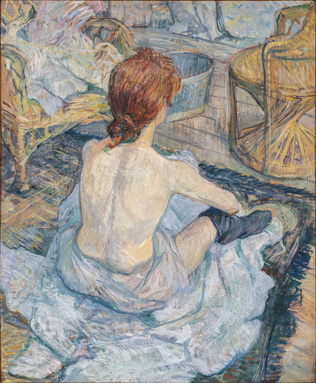 #44
44. Redhead (The Toilette)
1889 · Oil on cardboard · 67 × 54 cm · Musée d’Orsay, Paris
In Redhead, also known by the title The Toilette, Toulouse-Lautrec depicts a woman seated with her back to us, surrounded by linen and rattan chairs. Her copper hair draws the eye amid the interior’s greys, blues and yellows. The downward viewpoint and close framing reveal an everyday moment without a solemn pose. Rapid brushstrokes allow the cardboard to breathe and favour the movement of lines over smooth modelling. Degas’s influence is recognisable in this intimate subject and off-centre composition. The contrast between the pale back, crumpled textiles and furniture defines a tight space in which the model’s presence matters more than details of the setting.
Source: Musée d’Orsay, RF 2242.
View the work at the museum → #45
45. The Iris
1890 · Oil on thinned cardboard mounted on canvas · 62.2 × 48.3 cm · National Gallery of Canada, Ottawa
The Iris focuses the eye on a blue flower emerging from a tangle of leaves and grasses. In this vertical format, Van Gogh follows stems with supple lines and contrasts them with short background brushstrokes. Yellow-greens, blues and brown accents give the vegetation a vibrant presence. There is neither horizon nor vase: the framing brings the viewer close to the ground and makes plant life the painting’s entire subject. The flower in the upper-left area holds attention, while long leaves lead the eye downwards. This study held in Ottawa differs from Van Gogh’s large bed of irises held at the Getty Museum.
Source: National Gallery of Canada, on Google Arts & Culture.
Discover → #46
46. Doctor Paul Gachet
1890 · Oil on canvas · 68.2 × 57 cm · Musée d’Orsay, Paris
Van Gogh paints Doctor Paul Gachet in Auvers-sur-Oise, where the physician accompanies him during his final months. The head supported by a hand, tilted face and distant gaze create a meditative attitude. Jacket and background explore deep blues echoed by the table’s orange-red. A foxglove stem recalls the sitter’s medical work. In this version held at the Musée d’Orsay, the flower rests directly on the table and the books in the other portrait are absent. Emphatic outlines and directional brushstrokes bring tension to this still pose. Gachet, an art enthusiast and engraver himself, thus appears within a relationship extending beyond a physician’s encounter with his patient.
Source: Musée d’Orsay, RF 1949 16.
Discover → #47
47. Fatata te Miti
1892 · Oil on canvas · 67.9 × 91.5 cm · National Gallery of Art, Washington
Fatata te Miti, or By the Sea, shows two women preparing to bathe and a fisherman holding a long spear in the water. A dark trunk crosses the composition and separates the foreground figures. The pink and violet shore, orange flowers and deep green water create a landscape of bold colours rather than a naturalistic description. Simplified silhouettes and winding outlines give the scene its decorative rhythm. Painted during Gauguin’s first stay in Tahiti, this painting conveys his idealised vision of the island. It therefore reveals more about the painter’s imagination than the actual lives of the people depicted. The composition invites us to follow the trunk’s curves, then the bathers’ gestures towards the water.
Source: National Gallery of Art, 1963.10.149.
Discover → #48
48. The Loss of Virginity
1890–1891 · Oil on canvas · 89.5 × 130.2 cm · Chrysler Museum of Art, Norfolk
In The Loss of Virginity, Gauguin combines a reclining figure, a fox and a Breton coastal landscape to construct a symbolic scene. The pale body crosses the foreground, while pink fields, green hills and blue sea overlap in broad bands. A small procession follows a distant path. The museum interprets the sheaf of wheat near the feet as a sign of fertility and the fox as a threatening presence. These elements give the painting an ambiguity the landscape alone would not explain. Made before Gauguin’s departure for Tahiti, the work already shows his taste for simplified colours and images whose meaning extends beyond depicting a place.
Source: Chrysler Museum of Art, 71.510.
Discover → #49
49. The Bonaventure Pine
1893 · Oil on canvas · 65.7 × 81 cm · Museum of Fine Arts, Houston
In The Bonaventure Pine at Saint-Tropez, Opus 239, Signac gives an umbrella pine the presence of a true portrait. Its broad dark crown occupies almost the entire canvas above a green slope and a bay where a few sailing boats pass. Blue and green dots in the foliage are enlivened by yellow and orange accents; the pale sky remains visible between branches. This juxtaposition of colours characterises the painter’s Divisionist method. After a study on site, Signac makes the final composition in the studio. The silhouette organised in arabesques combines observation with stylisation. Painted shortly after he discovers Saint-Tropez, the painting shows how Mediterranean light informs his work on colour contrasts and the balance of forms.
Source: Museum of Fine Arts, Houston, 74.142.
Discover → #50
50. Day of the God
1894 · Oil on linen canvas · 68 × 91 cm · Art Institute of Chicago
Day of the God, or Mahana no atua, organises a landscape around a statue standing in the centre. Figures walk, carry offerings or rest on a pink bank. In the foreground, a bather is surrounded by two reclining figures and broad areas of water in yellow, blue, green and orange. These interlocking forms give the surface an almost abstract rhythm. Gauguin makes the painting in Paris after his first Tahitian stay: he composes from memory and imagination. He therefore does not describe a ceremony observed on site. Groups of figures, simplified landscape and unusual colours construct a symbolic world in which gestures and forms matter as much as the religious subject announced by the title.
Source: Art Institute of Chicago, 1926.198.
Discover →Cézannian volumes, Neo-Impressionist dots and Synthetist flat colours offer several answers to the same question: what comes after immediate sensation?
 #51
51. The Evening Air
Around 1893 · Oil on canvas · 116 × 166 cm · Musée d’Orsay, Paris
The Evening Air depicts women resting and walking beneath pine trees beside a sea crossed by sailing boats. Vertical trunks give rhythm to the landscape, while shore and horizon stretch the scene horizontally. Cross chooses a peaceful late afternoon and composes an ideal landscape rather than a fleeting moment. For this large format, he broadens Neo-Impressionist brushwork: small rectangles of colour produce a mosaic effect, particularly visible in dresses, ground and foliage. The work responds to the decorative project proposed by his friend Signac in 1893. Later given to Signac, it is discovered by Matisse in his house and informs his thinking for Luxury, Calm and Pleasure. Its light thus combines the figures’ repose with vibrating colour.
Source: Musée d’Orsay, RF 1976 81.
Discover → #52
52. The Gulf of Marseille Seen from L’Estaque
1878–1879 · Oil on canvas · 59.5 × 73 cm · Musée d’Orsay, Paris
In this view of The Gulf of Marseille from L’Estaque, Cézanne looks at the bay from the heights above the shore. Houses, walls and an industrial chimney occupy the foreground amid rocks and vegetation. Beyond stretch blue water, a chain of hills and a band of pale sky. These four areas organise the landscape through masses rather than regular perspective. Built elements are emphasised by dark outlines, while juxtaposed brushstrokes enliven trees and stones. The contrast between the dense shore and smoother sea gives the composition stability. Held at the Musée d’Orsay, this 1878–1879 version belongs to the Caillebotte bequest and differs from later views of the same gulf.
Source: Musée d’Orsay, RF 2761.
Discover → #53
53. In the Salon of the Rue des Moulins
1894 · Oil on canvas · 111 × 132 cm · Musée Toulouse-Lautrec, Albi
In In the Salon of the Rue des Moulins, Toulouse-Lautrec depicts women waiting in a Parisian brothel. The museum connects this scene with the time of a medical examination. A vast red divan occupies the foreground, while the seated figures each seem absorbed in their own thoughts. The nearest model’s extended leg and arm trace a diagonal organising space; the sofa’s curve encloses the composition. Reds, pinks and muted greens strengthen the impression of a closed interior. Lautrec individualises faces and attitudes rather than reducing the women to an anonymous group. The painting thus shows a time of waiting and fatigue, far from the movement of Parisian performances the painter also depicts.
Source: Musée Toulouse-Lautrec, Albi.
Discover → #54
54. Dining Room in the Country
1913 · Oil on canvas · 164.47 × 205.74 cm · Minneapolis Institute of Art
Dining Room in the Country depicts the interior of Ma Roulotte, the house Bonnard bought in Vernonnet in 1912. A large table with a white cloth occupies the foreground; cats slip among the chairs and Marthe appears at the window. The open door and window connect the room with the garden. Orange-red walls and clothing echo the landscape’s greens and blues, while free brushstrokes connect objects through colour. Bonnard paints here from memory, favouring his personal perception of this familiar space. The painting thus combines a recognisable domestic scene with an arrangement of colour in which interior and exterior seem to share the same light.
Source: Minneapolis Institute of Art, 54.15.
Discover → #55
55. Young Woman Powdering Herself
Around 1888–1890 · Oil on canvas · 95.5 × 79.5 cm · Courtauld Gallery, London
Young Woman Powdering Herself depicts Madeleine Knobloch, Seurat’s companion, before a small mirror on a table. Her hand holds a powder puff while her gaze follows the act of grooming. Her bun, bodice and skirt construct large rounded volumes echoed by the furniture’s curves. Dots of colour cover face, clothing and patterned blue background alike. This pointillist method enlivens surfaces through juxtaposed contrasting tones. The intimate subject differs from the painter’s large leisure scenes: here Seurat gives monumental breadth to an everyday gesture. Harmony between bodily forms, mirror and décor transforms this familiar scene into a carefully organised composition.
Source: Courtauld Gallery, P.1932.SC.396 ; museum commentary.
Discover → #56
56. The Englishman at the Moulin Rouge
1892 · Oil on cardboard · 85.7 × 66 cm · Metropolitan Museum of Art, New York
The Englishman at the Moulin Rouge shows William Tom Warrener, an English painter and friend of Toulouse-Lautrec, conversing with two women. His top hat and dark suit form a compact silhouette facing pale clothing and closely grouped faces. The framing crops the figures and concentrates the scene on their exchange. Rapid marks, visible areas of cardboard and yellow and violet accents give the painting the appearance of a lively study. The museum interprets Warrener’s reddened ear as a sign of embarrassment in this conversation. Made in 1892, the painting prepares a colour lithograph of the same subject. It reveals the transition between observing Moulin Rouge regulars and the graphic simplification characteristic of Lautrec’s prints.
Source: Metropolitan Museum of Art, 67.187.108.
Discover → #57
57. Breasts with Red Flowers
1899 · Oil on canvas · 94 × 72.4 cm · Metropolitan Museum of Art, New York
Held at the Metropolitan Museum under the title Two Tahitian Women, this painting is also known as Breasts with Red Flowers. Two closely grouped figures occupy almost the entire vertical format: one presents a tray of fruit, the other holds flowers and turns towards her companion. Blue fabrics, flesh tones and red accents stand out against a simplified backdrop of vegetation. Gestures and gazes give the scene a silent presence. The museum emphasises that Gauguin constructs an imaginary vision of Tahiti informed by references to the classical nude and his own gaze upon Indigenous women. The work therefore reads as an idealised composition rather than a document of their everyday lives. Tight framing focuses attention on this relationship between figures, offerings and colour.
Source: Metropolitan Museum of Art, 49.58.1.
Discover → #58
58. The Muses
Maurice Denis transposes the ancient muses into a garden populated by women in contemporary dresses. In the foreground, three seated figures form a circle of conversation; Marthe, his wife, appears twice in this group. Chestnut trunks punctuate the surface, while leaves and fabrics create patterns that echo one another. The scene draws inspiration from the terrace at Saint-Germain-en-Laye, but simplified colours and silhouettes give it the atmosphere of a sacred grove. Flat colours and assertive outlines show the Nabis’ taste for decorative painting. Notice especially how the dresses extend the foliage’s arabesques: landscape and figures together compose the same rhythm.
Source: Musée d’Orsay, The Muses.
Discover → #59
59. War
A woman brandishing a sword and torch crosses a devastated landscape on a black horse. Beneath her, victims lie scattered on the ground and crows invade the scene. Rousseau thus personifies war without recounting an identifiable battle. Broken branches, red clouds and large dark silhouettes give this allegory a violence made even more striking by his simplified drawing. The Musée d’Orsay recalls the significance of the Franco-Prussian War and the Commune in its context. Shown at the Salon des Indépendants in 1894, the work divides critics. Observe the contrast between the horse’s horizontal thrust and the bodies’ stillness: the entire composition contrasts destructive power with its human consequences.
Source: Musée d’Orsay, War.
Discover → #60
60. Bather with Outstretched Arms
On an ochre bank, a bather in shorts faces the viewer, one arm raised and the other lowered. Behind him, water and sky occupy almost the entire surface, with a few distant buildings. Cézanne models the body through thick brushstrokes and dark outlines rather than smooth gradation. The landscape’s blues and violets recur in the figure’s shadows, while warm tones connect his skin with the shore. This small canvas belongs to several studies of the same motif: the reproduced version is number FWN 912 in the catalogue raisonné. Look at the arms’ diagonals and the stance of the legs: their asymmetry gives the figure a tense, sculptural presence.
Source: Société Paul Cezanne, catalogue raisonné, FWN 912.
Discover → #61
61. Arearea no varua ino
Two women occupy the foreground: one, seated in profile, looks to the right; the other rests her head on her hand. A dark tree separates their silhouettes from distant figures and areas of vivid colour. The Tahitian title inscribed at the lower left is translated as “The Amusements of the Evil Spirit” in the Saint Louis Art Museum guide. The guide associates this presence with the carved figure dominating the scene on the left. Yet Gauguin paints this vision in Brittany after returning from Tahiti and dedicates the canvas to his hostess, Madame Gloanec. Violet shadows and pink ground transform the landscape into a symbolic setting: they express an atmosphere rather than natural light.
Source: Saint Louis Art Museum, guide to the Paul Gauguin: The Art of Invention exhibition.
Discover → #62
62. Mont Sainte-Victoire with a Large Pine
Pine trunks and branches frame a vast plain beyond which Sainte-Victoire stands out. In this version held in Washington, Cézanne arranges fields, houses and paths into small green and ochre surfaces. The cooler, paler mountain closes the view without overwhelming the landscape. On the right, viaduct arches remind us that this Provençal panorama also includes the modern railway. Brushstrokes remain visible and the canvas appears in places: construction depends as much on intervals as on painted masses. Observe how foreground branches accompany the landforms’ lines, while the plain’s diagonals gradually lead the eye towards the summit.
Source: The Phillips Collection, Mont Sainte-Victoire.
Discover → #63
63. Catholic Mystery
Maurice Denis transposes the Annunciation into a contemporary interior. On the right, the Virgin sits near a window; facing her, a deacon holding a book replaces the traditional angel, accompanied by two choirboys. Halos and the white lily retain signs of the sacred, while furniture and the landscape visible outside bring the scene closer to familiar life. Pale tones, bluish shadows and red accents organise light that is more spiritual than naturalistic. This canvas is the second of six versions of the subject and the largest according to the museum. Observe the vertical lines of candles, lily and window: they give this silent encounter an almost ceremonial structure.
Source: Musée départemental Maurice Denis, Catholic Mystery.
Discover → #64
64. A Wheatfield with Cypresses
Golden wheat occupies the foreground, while cypresses raise their dark silhouette on the right. Between them, olive trees and bluish landforms connect earth with a sky crossed by curling clouds. Van Gogh paints this landscape from life during his stay in Saint-Rémy; thick paint reveals brush movements in every part of the scene. Curved strokes in the trees echo the sky’s undulations, while ears of wheat form a broad luminous band. The reproduced version is the Metropolitan Museum’s, made during summer 1889 before reprises of the composition in autumn. Observe the contrast between vertical cypresses and the field’s horizontal rhythms: it gives this vibrant landscape its balance.
Source: Metropolitan Museum of Art, Wheatfield with Cypresses.
View the work at the museum → #65
65. Nude in the Bath
Marthe, Bonnard’s wife, lies in a bathtub seen from above. Her body gradually emerges from the water, so closely do reflections and colours connect skin with surroundings. Yellows in the wall and window contrast with floor blues and violet shadows; the bathtub’s white edge traces a diagonal maintaining the space’s legibility. This familiar scene thus becomes an exploration of light and perception. Bonnard often returns to the bath motif, working from notes and memories rather than a continuous sitting before the model. Observe the small brushstrokes in the tiles: their repetition enlivens the surface and interacts with the figure’s less certain outlines.
Source: Musée d’Art Moderne de Paris, Nude in the Bath.
Discover → #66
66. Château Noir
The ochre building appears behind dense vegetation whose trunks and foliage obscure access to the landscape. Cézanne contrasts warm façades with deep greens and sky blues, but the same broad brushstrokes run through architecture and trees. This unified treatment brings planes closer rather than creating regular perspective. Château Noir, near Aix-en-Provence, is a neo-Gothic building evoking ancient ruins; Cézanne repeatedly makes it a painting subject. The illustrated version, held at MoMA, belongs to his final years. Observe windows and sections of wall emerging between branches: a few geometric forms suffice to make the building recognisable within this network of colours.
Source: Museum of Modern Art, Château Noir.
Discover → #67
67. The Meal
A large bunch of red bananas, a wooden vessel and some fruit dominate the table before three children looking in different directions. Gauguin combines still life and human figures here, using deliberate disproportion to give objects an imposing presence. Painted in the first months of his Tahitian stay, the painting does not describe an observed meal: the Musée d’Orsay emphasises this composition’s arranged character. The white cloth, violet shadows and diagonal knife construct space, while coloured bands on the wall flatten the background. Also titled “The Bananas”, the work retains an enigmatic quality. Observe the isolated figure in the opening on the right: it extends space and accentuates the distance between the figures.
Source: Musée d’Orsay, The Bananas, also called The Meal.
Discover → #68
68. The Clown Cha-U-Kao
Toulouse-Lautrec shows Cha-U-Kao in an interior, adjusting her costume rather than performing for an audience. The large yellow ruff and ribbon on her headdress immediately draw the eye between dark clothing, red sofa and greenish wall. Close framing makes her back and arm gestures the portrait’s principal elements. A dancer, clown and sometimes acrobat, Cha-U-Kao belongs to the world of the Nouveau Cirque and Moulin Rouge; the Musée d’Orsay links her stage name to the words “chahut” and “chaos”. Rapid brushstrokes give the costume energy almost independent of the figure. Observe the small face at the upper left: whether portrait or reflection, its presence remains ambiguous.
Source: Musée d’Orsay, The Clown Cha-U-Kao.
Discover → #69
69. Pyramid of Skulls
Four skulls gather in a pyramid, with a pale head raised at the summit and darker forms supporting the group. The almost black background and white fabric accentuate their volume without distracting the eye. Cézanne modulates bony surfaces through ochre, green and grey brushstrokes: colour reveals changes of plane, while eye sockets become strongly defined hollows. The subject recalls the vanitas tradition, in which the skull invites reflection on mortality, but the construction remains primarily an exploration of relationships between forms. Observe the heads’ different orientations and overlaps: they give distinctive density to this small still life, dated 1898–1900 in the catalogue raisonné.
Source: Société Paul Cezanne, catalogue raisonné, FWN 874.
Discover → #70
70. Portrait of Alice Sèthe
Date: 1888 · Medium: oil on canvas · Dimensions: 195 × 98 cm · Collection: Musée départemental Maurice Denis, Saint-Germain-en-Laye (PMD 978.13.1).
Alice Sèthe stands in a long mauve dress before a mirror showing her hairstyle from behind. The gilded frame, console table and dark sculpture create an elegant interior, while the narrow format accentuates the figure’s verticality. Small blue, violet and yellow brushstrokes enliven fabric and décor; the face retains softer light. According to the Maurice Denis museum, this is the first portrait in which Van Rysselberghe applies the Neo-Impressionist technique he discovered through Seurat. Juxtaposed colours seek to blend in the viewer’s eye. The painting thus shows how Divisionism can construct an individual presence beyond landscape.
Source: Musée Maurice Denis — Portrait of Alice Sèthe.
Discover → #71
71. The Eiffel Tower
Date: around 1889 · Medium: oil on panel · Dimensions: 24.1 × 15.2 cm · Collection: Fine Arts Museums of San Francisco, Legion of Honor.
In this small vertical panel, the Eiffel Tower occupies almost the entire height of the image. Its pillars and levels emerge in red and orange brushstrokes against a pale blue sky, while a tree on the left balances the monument’s silhouette. Seurat reduces details of the metal structure to emphasise its lines and colour relationships. Brushstrokes remain visible throughout the sky and foreground: light is constructed through juxtaposition rather than continuous gradation. Painted around 1889, as the tower becomes the symbol of the Universal Exhibition, this view combines modern architecture with Neo-Impressionism’s explorations of colour.
Sources: Legion of Honor — catalogue entry for the work ; Fine Arts Museums of San Francisco — dating.
Discover → #72
72. The Bibémus Quarry
Date: around 1895 · Medium: oil on canvas · Dimensions: 92 × 73 cm · Collection: Barnes Foundation, Philadelphia (BF34).
In this vertical version of The Bibémus Quarry, a large rock face occupies the right, while pines and scrub cross the blocks in the foreground. Cézanne contrasts the stone’s orange ochres with green vegetation and blue-grey shadows. Cut surfaces give the landscape an angular structure, enlivened by leaning trunks and branches. The eye moves from one plane to another without following a clearly defined path: depth emerges from relationships between colours and masses. This Barnes Foundation painting belongs to the views of quarries near Aix-en-Provence, where Cézanne explores the balance between mineral solidity and the pictorial construction of landscape.
Source: Barnes Foundation — Bibémus Quarry, BF34.
Discover → #73
73. In Bed, the Kiss
Date: 1892 · Medium: peinture à l’essence on panel · Dimensions: 45.5 × 58.5 cm · Collection: private collection, documented by Christie’s in 2015.
Two women kiss in a bed, their faces close together amid pillows and sheets. Tight framing excludes almost the entire bedroom and focuses attention on intertwined arms. Red hair and warm skin tones stand out against blue-grey linen crossed by rapid marks extending the movement of the gestures. Paint thinned with turpentine allows fluid handling in which drawing remains prominent. This version of In Bed, the Kiss, listed under number Dortu P.438, belongs to the scenes of female couples painted by Toulouse-Lautrec in 1892. It combines observation of an intimate moment with a composition tightly focused on the embrace.
Source: Christie’s — In Bed: The Kiss, Dortu P.438.
Discover → #74
74. The Hungry Lion Throws Itself on the Antelope
Date: 1898/1905, according to the Fondation Beyeler · Medium: oil on canvas · Dimensions: 200 × 301 cm · Collection: Fondation Beyeler, Riehen/Basel.
In the foreground, a lion seizes an antelope, while a panther and birds appear among branches. Rousseau encloses the scene in dense vegetation, where each leaf stands out through its outline and shade of green. The red sun visible in the background adds tension to this almost motionless landscape. Violent action contrasts with the foliage’s regular precision: the jungle takes on the appearance of a constructed setting. Shown at the Salon d’Automne in 1905, this large canvas marks an important stage in Rousseau’s recognition. The Fondation Beyeler dates it to 1898/1905; its restoration study identified retouching whose materials are consistent with intervention by the painter.
Sources: Fondation Beyeler — work and restoration ; exhibition entry.
Discover → #75
75. Port-en-Bessin, Entrance to the Harbor
Date: 1888 · Medium: oil on canvas · Dimensions: 54.9 × 65.1 cm · Collection: Museum of Modern Art, New York (126.1934).
From an elevated position, Seurat looks at the harbour entrance: two breakwaters frame the passage through which several sailing boats move. A grassy slope occupies the foreground, while the horizon and harbour structures organise the upper section into horizontal bands. Pale sails punctuate water crossed by darker areas. Small green, blue and yellow brushstrokes make surfaces shimmer without erasing the composition’s clarity. Pointillism here constructs lighting effects: juxtaposed colours combine in the viewer’s eye. MoMA recalls that Alfred H. Barr Jr. compared sails and cloud shadows to independent melodies brought together in a harmonious whole.
Source: MoMA — Port-en-Bessin, Entrance to the Harbor.
Discover →Bonnard, Denis, Vuillard, Vallotton and the late works extend the experiment towards intimacy, decoration and the twentieth-century avant-garde.
 #76
76. Gray Weather, Grande Jatte
Date: around 1886–1888 · Medium: oil on canvas · Dimensions: 70.5 × 86.4 cm · Collection: Metropolitan Museum of Art, New York (2002.62.3).
Trees frame a view of the Seine from the island of La Grande Jatte. In the centre, a boat with a funnel and small vessels occupy pale water; on the opposite bank, red roofs appear beneath an overcast sky. The diagonal foreground bank connects trunks and guides the eye towards the river. Seurat enlivens this gentle light through a multitude of green, yellow, blue and violet brushstrokes: grey weather can thus produce a surface rich in colour. The painted border, also pointillist, extends these contrasts around the landscape. According to the Metropolitan Museum, it was added shortly before the work’s first exhibition in 1889.
Source: Metropolitan Museum — Gray Weather, Grande Jatte.
Discover → #77
77. Te aa no areois — The Seed of the Areoi
Date: 1892 · Medium: oil on burlap canvas · Dimensions: 92.1 × 72.1 cm · Collection: Museum of Modern Art, New York (SPC14.1990).
A figure seated on blue and white fabric occupies the centre of this Tahitian landscape. Her motionless pose contrasts with pink flowers, yellow palms and orange ground; foreground fruit strengthens the colour harmonies. Dark mountain silhouettes and broad, lightly modelled surfaces give the scene a symbolic character. According to MoMA, Gauguin depicts Vairaumati, associated with the Areoi origin myth, combining Egyptian, Japanese and Javanese references. This invented composition expresses his vision of an idealised Polynesian past: Areoi society had already disappeared on an island transformed by colonisation. Colour therefore contributes fully to constructing the narrative.
Source: MoMA — The Seed of the Areoi.
Discover → #78
78. Bonjour Monsieur Gauguin
In Bonjour Monsieur Gauguin, a wooden barrier separates a man in a beret from a Breton woman seen from behind. A small white dog occupies the lower part of the path; behind the figures, coloured fields and bare trees organise depth. Painted in autumn 1889 in Le Pouldu, Brittany, this encounter reprises the title of Bonjour Monsieur Courbet, which Gauguin had discovered in Montpellier with Van Gogh. The National Gallery Prague emphasises the contrast between Courbet’s imagined solemn reception and Gauguin’s more ordinary, ironic greeting. Notice how the barrier structures the composition: it brings the figures close within the image while maintaining distance between them.
Source: National Gallery Prague — Bonjour Monsieur Gauguin.
Discover → #79
79. The Pool at Jas de Bouffan
In The Pool at Jas de Bouffan, Cézanne frames a pool on the family estate near Aix-en-Provence. The orangery appears on the left; tall trees, flowers and sculptures border the pool. Their reflections occupy the entire foreground, where blue, green and ochre brushstrokes fragment forms. The horizontal edge stabilises the composition, while upright trunks and water jets give it rhythm. Look at the pillars’ reflections: their colours echo those of the buildings and connect the image’s two halves. This version, listed as FWN 92 and dated to around 1876, allows us to observe how Cézanne constructs a landscape through colour relationships and brushstroke directions.
Source: Société Paul Cezanne — catalogue raisonné, FWN 92. The catalogue gives 49 × 55 cm and also reports the Hermitage’s measurements: 46.1 × 56.3 cm.
Discover → #80
80. La Belle Angèle
La Belle Angèle depicts Marie-Angélique Satre, a hotelkeeper in Pont-Aven, in formal Breton dress. Gauguin places her face, headdress and clasped hands within a large medallion detached from a blue floral-patterned background. On the left, an anthropomorphic ceramic inspired by Peruvian art accompanies the portrait. The Musée d’Orsay connects this circular framing with Japanese prints: space becomes a decorative surface in which dark outlines and simplified forms matter more than traditional perspective. Look at the contrast between pale headdress and dark clothing, then the repeated curves of medallion and ceramic. The sitter rejected the painting; Degas, who admired it, bought it in 1891. These opposing reactions illuminate the portrait’s boldness.
Source: Musée d’Orsay — La Belle Angèle, RF 2617.
Discover → #81
81. The Sower — Winterthur Version
In this version of Sower, a peasant crosses a vast yellow field, a sack against his body and one arm extended to scatter seeds. Furrows and curved brushstrokes occupy almost the entire canvas; buildings and trees near Arles form a narrow band along the horizon. The dark silhouette and its shadow stand out against the ground’s yellows, ochres and bluish greys. In his letter to Theo of 27 or 28 October 1888, Van Gogh describes a new study with a very flat landscape and a small, loosely detailed figure. The scholarly edition of the letters identifies this work as F 494 / JH 1617. Notice how the sower’s small size gives the field its full breadth.
Sources: Van Gogh Museum and Huygens Institute — letter 714, note 5 ; Kunst Museum Winterthur — Villa Flora list of works, no. 18.
Discover → #82
82. View from Vincent’s Studio
View from Vincent’s Studio shows a tangle of Parisian roofs, chimneys and façades seen from above. Bluish-grey planes overlap; small orange chimney pots and a few green touches break the restrained palette. The pale sky occupies the top of the image, while vegetation encloses the foreground. Painted in Paris in June 1886, this small oil on cardboard invites us to observe the city through its volumes and surfaces. Notice how vertical chimneys interrupt the roofs’ diagonals: they provide reference points within a very dense space. Visible brushstrokes follow roof slopes and enliven façades without resorting to a street scene or figures.
Source: Van Gogh Museum — View from Vincent’s Studio, s0095V1962.
Discover → #83
83. The Open Window
In The Open Window, Bonnard brings a room in his Normandy home into dialogue with the garden outside. Sky blue and foliage greens contrast with the reds and oranges of walls and furniture. A dark blind crosses the top of the opening; the pale window panel on the right extends light into the room. A woman and cat appear discreetly in the lower-right corner. Notice how these presences are discovered after the window, which first attracts the eye. The Phillips Collection recalls that Bonnard worked from memory: this domestic scene is a pictorial reconstruction. The 2023 restoration revealed that even the apparently black cat is painted with mixtures of blue and red.
Sources: The Phillips Collection — The Open Window, no. 0172 ; Bonnard’s Worlds — examination and restoration of the painting.
Discover → #84
84. Lake Annecy
In Lake Annecy, a large tree on the left frames blue water, the castle on the shore and mountains. Reflections extend forms into the painting’s lower half, while branches cross the landscape diagonally. Cézanne paints this view during a stay in the Alps with his wife and son in 1896. According to the Courtauld Gallery, it is the only painting made during this journey. The painter reorganises a landscape he considers too picturesque: the castle becomes an assembly of geometric volumes and slopes are constructed through areas of contrasting colour. Notice how the trunk’s and buildings’ ochres echo the lake’s blues and greens: colour connects the different planes.
Source: Courtauld Gallery — Lake Annecy, P.1932.SC.60.
Discover → #85
85. Two Breton Women in a Meadow
In Two Breton Women in a Meadow, Émile Bernard places the two small figures in the lower-right corner amid a landscape dominated by trees and sky. The yellow and green meadow, bluish shadows and foliage are constructed through a multitude of small distinct brushstrokes. Notice how colours blend at a distance, then how each stroke reappears as you approach. Painted in Pont-Aven in 1886, this oil on panel reflects a phase of Bernard’s pointillist experimentation described by the Van Gogh Museum’s scholarly catalogue. The descending diagonal of the tree line leads towards the figures; their small size conveys the meadow’s extent. This painting helps explain the diversity of his explorations before the large compositions with enclosed colour areas of 1888.
Sources: Van Gogh Museum — Two Breton Women in a Meadow ; scholarly catalogue — Bernard’s explorations in 1886.
Discover → #86
86. The Yellow House
The Yellow House depicts Place Lamartine in Arles, where Van Gogh rents four rooms in May 1888. Green shutters identify his accommodation in the corner building. Yellow façades and roadway contrast with an intense blue sky; the street’s lines lead towards the railway bridge and train on the right. Small passers-by and seated figures enliven the surroundings of the house. The Van Gogh Museum recalls that the artist called this painting The Street : it also shows the restaurant where he ate on the left and his friend Joseph Roulin’s neighbourhood beyond the second bridge. Look at the meeting of yellow and blue: it gives visual unity to the place where Van Gogh hoped to bring painters together to live and work.
Source: Van Gogh Museum — The Yellow House (The Street), s0032V1962.
Discover → #87
87. The Channel at Gravelines, Evening
In The Channel at Gravelines, Evening, Seurat organises a harbour view around broad horizontal bands: the dark quay in the foreground, pale water, opposite bank and sky. A post on the left and diagonal anchors on the right frame sailing boats whose silhouettes and reflections punctuate the channel. Notice the difference between these very dark nearby objects and paler boats: it makes distance legible despite a surface entirely covered in small brushstrokes. Dated to summer 1890 by MoMA, this oil on canvas shows how pointillism can combine firm geometric structure with delicate light. Pink, blue, green and yellow dots enliven even areas appearing almost white at a distance.
Source: MoMA — The Channel at Gravelines, Evening, 785.1963.
View the work at MoMA → #88
88. Portrait of Eugène Boch
In the Portrait of Eugène Boch, Van Gogh contrasts the Belgian painter’s pale head and yellow jacket with a deep blue background dotted with stars. The narrow face, green eyes and striped tie give the sitter a precise presence; yet the sky transforms the portrait into an imaginary image. The Musée d’Orsay explains that Van Gogh wanted to express affection for this artist friend by replacing an ordinary wall with an evocation of infinity. He called the work The Poet. Notice how the yellows of face and clothing echo the stars: colour unites the person with this symbolic background. Van Gogh framed the painting and hung it in his bedroom in the Yellow House; it appears in the first version of The Bedroom.
Source: Musée d’Orsay — Eugène Boch, RF 1944 9.
Discover → #89
89. The Red Vineyard
In The Red Vineyard, Van Gogh transforms the grape harvest near Arles into a confrontation of colours: red and orange vines echo the workers’ blue and green clothing beneath a large yellow sun. The row of trees on the left and pale path on the right lead the eye into the background, while bent figures convey the labour of harvesting. Observe the thick, directional brushstrokes: they give the ground movement extending beyond simply describing the landscape. Painted in November 1888, this canvas is held at the Pushkin Museum. Anna Boch bought it in Brussels in 1890; it is among the few works sold during Van Gogh’s lifetime and should not be presented as his only sale.
Sources: Pushkin Museum — current catalogue, Ж-3372 ; historical museum entry.
Discover → #90
90. Harlequin
In Harlequin, Cézanne paints his son Paul in the costume of a commedia dell’arte character. Red and black diamonds define the silhouette against a blue-green wall, while a pale hat and wooden sword add luminous accents. Look at the sword’s long diagonal, staggered legs and large hand: these details give the pose a tension the impassive face seems to restrain. The drapery above the figure recalls theatre, but no audience or partner enlivens the scene. This version held in Washington belongs to a group including Mardi Gras and several individual Harlequins. Visible brushstrokes construct body and setting through coloured surfaces rather than meticulous drawing.
Source: National Gallery of Art — Harlequin, 1985.64.7.
Discover → #91
91. The White Horse
In The White Horse, Gauguin imagines a Tahitian landscape enclosed by vegetation, without sky or horizon. The foreground horse drinks from a dark stream; its coat takes on green hues harmonising with the foliage. Two smaller riders extend the scene upwards, while winding branches and flowers construct a decorative frame. Notice how deep blues, greens and orange accents organise space: colour matters more than realistic perspective. Painted during Gauguin’s second Tahitian stay, this composition is a reconstructed vision rather than a faithful record. The museum reports that its commissioner rejected the canvas because the horse seemed too green: a concrete example of the painter’s chromatic boldness.
Source: Musée d’Orsay — The White Horse, RF 2616.
Discover → #92
92. Homage to Cézanne
In Homage to Cézanne, Maurice Denis gathers artists and critics in Ambroise Vollard’s gallery. Cézanne is evoked through Fruit Bowl, Glass and Apples, the still life on the easel. On the left, Odilon Redon listens to Paul Sérusier, whose open hands give the discussion visible presence. Other figures include Vuillard, Vollard, Denis, Ranson, Roussel, Bonnard and Marthe Denis. Look at the contrast between dark clothing and faces, then between these silhouettes and the colourful paintings in the background: it organises this group portrait around painting and its advocates. Made in 1900, the work affirms the artistic references of some of the Nabis. André Gide bought it before donating it to the French state in 1928.
Source: Musée d’Orsay — Homage to Cézanne, RF 1977 137.
Discover → #93
93. Alone
In Alone, Toulouse-Lautrec captures a woman stretched on an unmade bed, her head on the right and legs falling towards the foreground. Black stockings form two dark accents among white sheets; a few blue lines suffice to indicate body, mattress and folds. Look at the large ochre areas left visible: cardboard contributes to the colour of this study, whose rapid execution creates an impression of immediate gesture. Made in 1896, it prepares Weariness, a lithograph in the album Elles, devoted to the everyday lives of women in brothels. The scene shows a moment of rest without a society pose or moral judgement. Its small format and light handling focus attention on the model’s attitude.
Source: Musée d’Orsay — Alone, RF 1984 30.
Discover → #94
94. Self-Portrait with a Straw Hat
In this Self-Portrait with a Straw Hat, Van Gogh contrasts the hat’s yellow and the beard’s reddish tones with the jacket’s blues and greens. Small brushstrokes follow the curves of face and headwear, while those in the background create vibration around the gaze. Notice how colours remain distinct close up but together construct volumes at a distance: this 1887 version reflects the artist’s Parisian explorations of brushwork and colour. Lacking funds to hire a model regularly, Van Gogh made numerous self-portraits during his stay in Paris. The canvas held at the Met bears an earlier study of a peasant on its reverse, The Potato Peeler, painted in 1885.
Source: Metropolitan Museum of Art — Self-Portrait with a Straw Hat, 67.187.70a.
Discover → #95
95. Public Gardens: Girls Playing
In Public Gardens: Girls Playing, Vuillard uses a tall, narrow format to bring children into view between a large trunk and foliage. Red, blue and yellow dresses punctuate the lower composition, while pale brushstrokes in ground and trees unite figures with the garden. Look at the trunk concealing part of the group: this framing transforms a play scene into a decorative arrangement of forms and colours. The panel belongs to the cycle of nine Public Gardens commissioned in 1894 by Alexandre Natanson for his Parisian interior. The Orsay entry specifies that Vuillard reworked it in 1936. Its composition can thus be understood within a decorative scheme intended to surround a room’s inhabitants.
Sources: Musée d’Orsay — panel RF 1978 46 ; presentation of the cycle.
Discover → #96
96. Circus Sideshow
In Circus Sideshow, Seurat depicts an attraction performed outside the Cirque Corvi to encourage passers-by to buy a ticket. The central trombonist, musicians on the left and figures on the right appear beneath a row of gas jets, while audience hats define the bottom of the painting. Look at the railing’s horizontal lines and the figures’ verticals: they give this performance scene an almost motionless structure. Small coloured brushstrokes produce diffuse light, very different from the full sunshine of La Grande Jatte. Begun from sketches in 1887 and completed in 1888, this composition is Seurat’s first major night painting devoted to popular entertainment.
Source: Metropolitan Museum of Art — Circus Sideshow, 61.101.17.
Discover → #97
97. The Ball
In The Ball, Vallotton looks at the garden from an elevated position. A child in a white smock and yellow hat runs towards a small red ball on an ochre path crossed by tree shadows. Two tiny women, in blue and white, stand further away near foliage. Notice the difference between their size and the child’s, then the large curve separating the pale path from dark vegetation: these choices create depth while making the landscape an almost flat surface. Painted in 1899, the work combines a familiar scene with bold framing. Simplified forms and areas of colour give the garden’s empty space as much importance as the figures.
Source: Musée d’Orsay — The Ball, RF 1977 353.
Discover → #98
98. Myself, Portrait-Landscape
In Myself, Portrait-Landscape, Rousseau depicts himself standing in a black suit and beret, holding a palette and brush. His monumental silhouette dominates a Parisian quay, a flag-decked boat, a bridge and the Eiffel Tower; a hot-air balloon floats in the sky. Look at the two small walkers beside the water: their scale emphasises the place the painter assigns himself in this reconstructed landscape. Sharp outlines and carefully separated details give the scene distinctive solemnity. The title explicitly combines portrait and landscape, and painting tools affirm Rousseau’s professional identity. Dated 1890, the canvas belongs to the National Gallery Prague following its acquisition by the Czechoslovak state in 1923.
Sources: National Gallery Prague — portrait O 3221 ; Musée de l’Orangerie — Rousseau 2026 booklet, dimensions and medium.
Discover → #99
99. Orchards in Blossom, View of Arles
In Orchards in Blossom, View of Arles, Van Gogh places a large pruned tree on the right, so close to the eye that its branches extend beyond the frame. Behind it, flowering trees, orange roofs and Arles’s towers overlap above a green meadow. Look at the flowers’ small white and yellow brushstrokes against the branches’ blue and violet outlines: they make spring shimmer without erasing the trees’ structure. Dated April 1889, this version held in Amsterdam bears the number F515; it differs from view F516 held in Munich. The museum emphasises the influence of Japanese prints in the framing of the foreground tree, which transforms the landscape into a deliberately off-centre composition.
Sources: Van Gogh Museum — catalogue entry distributed on Google Arts & Culture ; museum shop — original dimensions, s0036V1962.
Discover → #100
100. Tahitian Landscape
In Tahitian Landscape, a pink path crosses a yellow and green meadow before reaching trees at the foot of a red mountain. A figure carrying a load advances along this passage, while a small dog stands out on the left. Look at the palms’ slender trunks: their verticals connect foreground with pale clouds, while coloured masses simplify the terrain. Painted in 1891 during Gauguin’s first Tahitian stay, this canvas favours winding outlines and intense colours over faithfully reproducing light. The Minneapolis museum sees an exploration of tropical serenity in it: the landscape thus expresses a vision constructed by the painter rather than a neutral document of the island.
Source: Minneapolis Institute of Art, catalogue entry and dimensions of the work.
Discover →What the Works Reveal
One Hundred Works, Three Decisive Freedoms
The works reveal several ways of organising colour, form and subject. Comparing their methods helps explain the diversity of Post-Impressionism.
Colour Stops Obeying
It can intensify an emotion, separate planes or construct a harmony without exactly reproducing the observed hue.
The Painting Asserts Its Surface
Outlines, flat colours, dots and rhythms reveal the organisation of the painted surface.
Each Artist Invents a Method
Series, Synthetism, Divisionism, construction and decoration become personal programmes rather than a shared doctrine.
A Timeline of Diverging Paths
Five Dates for Leaving the Same Path
The eighth Impressionist exhibition welcomes Seurat and Signac as the group’s paths diverge.
Van Gogh works in southern France while Gauguin, Bernard and Sérusier develop Synthetist painting in Brittany.
Van Gogh paints in Saint-Rémy as new expressive colours acquire lasting historical power.
Gauguin seeks new motifs and constructs imagery whose visual strength also demands a critical view of the colonial context.
Roger Fry organises Manet and the Post-Impressionists in London and retrospectively establishes the term.
The Movement in Depth
Why Does Post-Impressionism Matter So Much?
Post-Impressionism describes diverse explorations emerging from Impressionism. It is better understood by comparing works than by seeking a shared technique. The comparisons offered here help reveal differences in construction, colour and subject.
In Van Gogh’s work, the directions of brushstrokes and colour contrasts give landscapes and portraits distinctive intensity. Cézanne examines volumes and relationships between planes. Gauguin simplifies forms and sometimes connects depicted scenes with symbolic content. Seurat and Signac separate colours into organised brushstrokes.
The selection also presents artists close to or inheriting these approaches. Decorative works by Bonnard, Vuillard and Maurice Denis notably show that attention can focus on the painted surface as much as on a scene’s depth. Their inclusion broadens the journey beyond the four figures usually associated with Post-Impressionism.
Several titles refer to series or different versions. Each entry’s collection, date and image specify which one is presented. Rounded dimensions or an old attribution should not be used to confuse two works: references provide access to museum and catalogue information.
Not all originals are painted on canvas. Some works in this journey use cardboard, panel or burlap. Technical information describes the original; a reproduction’s size and support should be consulted on its own product page.
Four Keys to Reading the Paintings
Looking beyond the First Impression
Compare structure, colour, outline and rhythm in the images to identify each artist’s individual choices.
Identifying Volumes
In Cézanne’s work, planes, lines and masses give the motif a solidity that no longer depends on anecdote.
Observing Departures
A hue departing from reality can express tension, a memory or the intensity of a place.
Following Flat Colours
Strong outlines and simplified surfaces connect some works with prints, stained glass or posters.
Comparing Brushstrokes and Dots
Repetitions, directions and coloured intervals organise the eye’s movement across the entire canvas.
Mapping the Studios
Continuing beyond the Last Colour
Consult artist collections and museum resources to continue the comparisons.
Within Alpha Reproduction
01Vincent van GoghThe Masters of Post-Impressionism02Georges SeuratThe Masters of Post-Impressionism03Paul CézanneThe Masters of Post-Impressionism04Paul GauguinThe Masters of Post-Impressionism05Henri de Toulouse-LautrecThe Masters of Post-Impressionism06Henri RousseauThe Masters of Post-Impressionism07Paul SignacThe Masters of Post-Impressionism08Paul SérusierThe Masters of Post-Impressionism09Henri-Edmond CrossThe Masters of Post-Impressionism10Pierre BonnardThe Masters of Post-Impressionism11Post-ImpressionismCollections & guides12Post-Impressionist reproductionsCollections & guides13Famous paintingsCollections & guides14All famous painting rankingsCollections & guides15Vincent van Gogh reproductionsCollections & guides16Paul Cézanne reproductionsCollections & guides17All painting reproductionsCollections & guidesMuseums and References
01Wikipedia - Post-ImpressionismMuseum & reference02Wikidata - Post-ImpressionismMuseum & reference03Wikimedia Commons - Post-ImpressionismMuseum & reference04Musée d’Orsay - Post-Impressionist collectionsMuseum & reference05Van Gogh Museum - collectionMuseum & reference06MoMA - Post-ImpressionismMuseum & reference07National Gallery - Post-ImpressionismMuseum & reference08Wikipedia - Georges SeuratMuseum & referenceFrequently Asked Questions
Questions and Answers about Post-Impressionism
Essential answers for understanding its boundaries, distinguishing its movements and recognising its truly central works.
What is Post-Impressionism?
Post-Impressionism encompasses several approaches extending or transforming Impressionist explorations. It is not a single school: construction of forms, expressive colour, symbolism and divided brushstrokes take different places according to the artist.
Who are the principal Post-Impressionist painters?
Cézanne, Van Gogh, Gauguin and Seurat are major reference points. This selection also presents Signac, Toulouse-Lautrec, Émile Bernard, Sérusier, Cross and artists close to these explorations, notably the Nabis Bonnard, Vuillard and Maurice Denis.
What are the differences between Impressionism and Post-Impressionism?
Impressionists explore changing light and scenes of modern life, among other subjects. Artists grouped under Post-Impressionism continue these explorations while emphasising structure, expressive choices or symbolic content. Boundaries remain flexible: some painters participate in several movements.
Is pointillism part of Post-Impressionism?
Seurat and Signac’s Neo-Impressionism belongs within this overview. Pointillism describes juxtaposed small coloured dots; Divisionism concerns separating colours into distinct brushstrokes. Not all Post-Impressionist painting therefore uses dots.
When does the term Post-Impressionism appear?
Roger Fry uses the term for Manet and the Post-Impressionists, an exhibition organised in London in 1910. The name retrospectively brings together explorations already developed in the late nineteenth century; 1910 therefore does not mark the beginning of the works’ creation.
Which paintings help explain Post-Impressionism?
Compare The Starry Night for Van Gogh’s expressive brushwork, Mont Sainte-Victoire for Cézanne’s construction, La Grande Jatte for Seurat’s divided colour and Vision after the Sermon for Gauguin’s Synthetism. Entries specify the illustrated version when several paintings have similar titles.
Do the 100 paintings form an official ranking?
No. This is an editorial selection combining major works, less-known paintings and artists close to Post-Impressionism. Numbers make navigation easier and measure neither market value nor museum consensus.
Does the information concern the original or its reproduction?
Dates, collections, media and dimensions stated in the entries concern the original works. Dimensions are given as height × width. Reproduction links lead to separate commercial product pages; some entries direct readers to a museum to consult the original.
0 comments