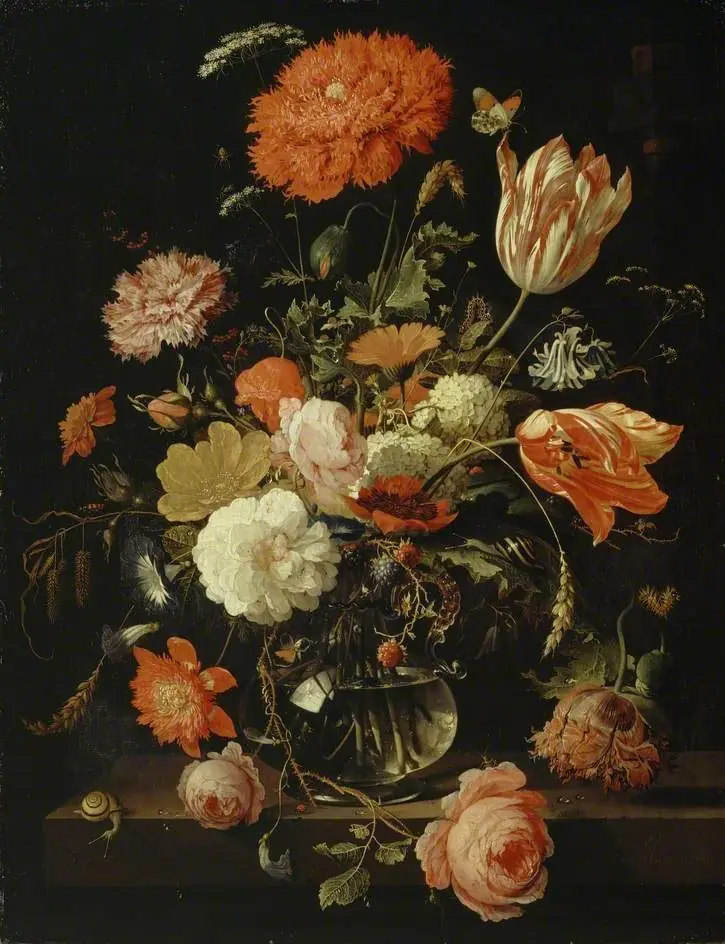
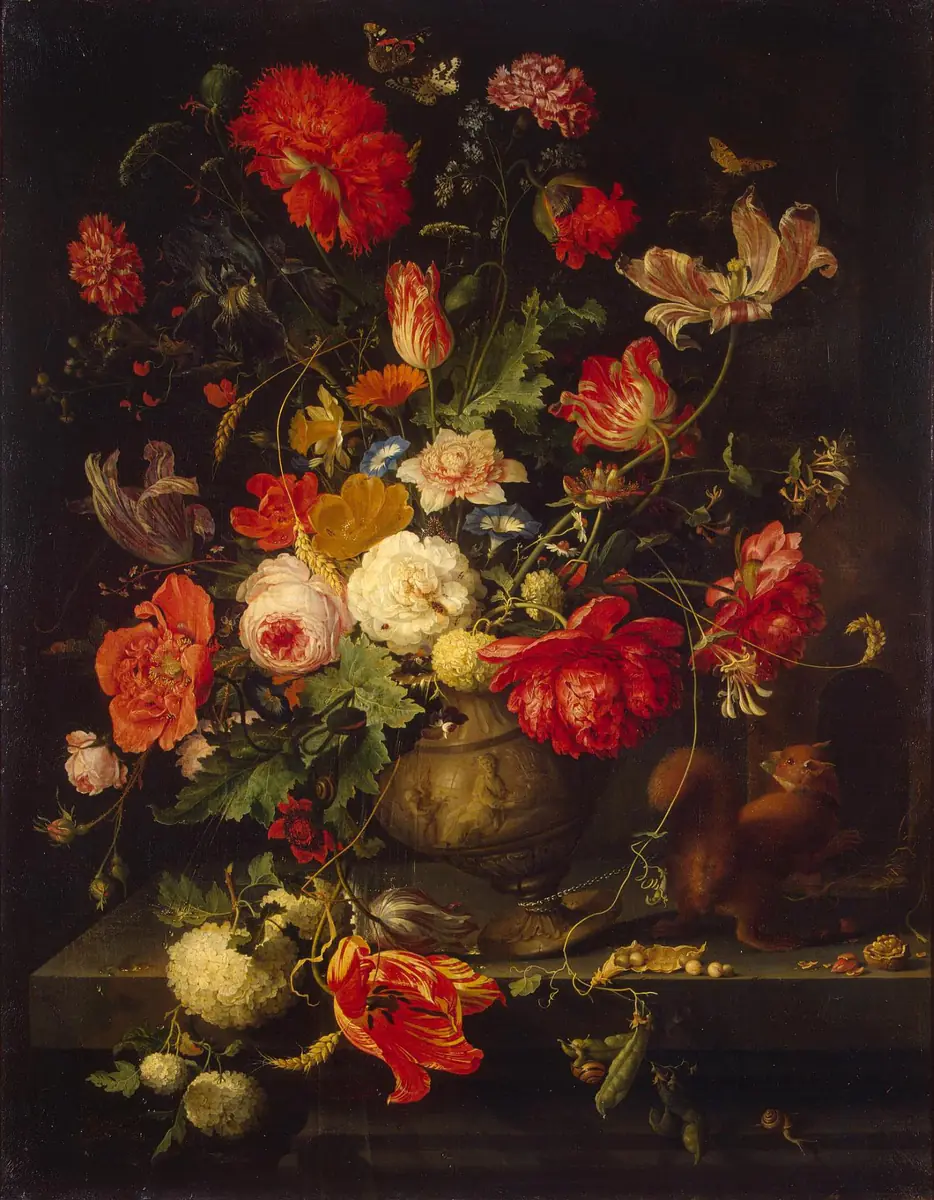
Abraham Mignon was born in Frankfurt in 1640 into a family of Calvinist traders. When his parents settled in Wetzlar in 1649, he remained in Frankfurt with the painter and art dealer Jacob Marrel, who became his master. Marrel quickly recognized his abilities, entrusted him with the management of his affairs during his travels and asked him to teach still life to his daughter-in-law Maria Sibylla Merian, a future naturalist and illustrator. This proximity to Merian sheds light on Mignon's extraordinary attention to insects, caterpillars, snails, nests and small transformations of life. In 1664, Marrel and Mignon reached Utrecht. Both were registered in the guild of Saint-Luc in 1669. Mignon then meets the tradition of Jan Davidsz. of Heem, whose brilliant colors, ample construction and light effects he adopts. However, he maintains a very personal way. His bouquets are never simple botanical inventories. Tulips, roses, poppies and peas wrap around a vase or niche; fruits, birds and insects build a fragile world where every detail suggests growth, consumption and disappearance. He also paints caves, ruins and undergrowth where every detail suggests growth, consumption and disappearance. He also paints caves, ruins and undergrowth where natural wealth becomes almost fantastic. He also paints caves, ruins and undergrowth where natural wealth becomes almost fantastic. He also paints caves, ruins and undergrowth where natural wealth becomes almost fantastic. He also paints caves, ruins and undergrowth where natural wealth becomes almost fantastic. He also paints caves, ruins and undergrowth where natural wealth becomes almost fantastic. He also paints caves, ruins and undergrowth where natural wealth becomes almost fantastic. He also paints caves, ruins and undergrowth where natural wealth becomes almost fantastic. In Flowers and fruits of the Mauritshuis, petals, clusters and stems stand out from a dark background with a precision that does not never suppress the atmosphere. In his nest compositions, the tenderness of the chicks rubs shoulders with the dangers of the environment. Mignon also led an active religious life: elected deacon of the Walloon church of Utrecht in 1672, he exercised this function for several years. He married Maria Willaerts in 1675 and died very young, buried in Utrecht in March 1679. Despite a short career, his success was considerable. Around four hundred paintings were attributed to him, a number which probably included works of workshops and followers. This diffusion testifies to the lasting fascination exerted by his compositions, collected in particular by the elector of Saxony and Louis XIV. The selection Abraham Mignon notably compares Flowers in a Crystal Carafe and Flowers, Fruits, Birds and Insects in a Landscape. His reading favors the story.
Cute transforms still life into an ecosystem: behind each bright petal, an insect, a nest or a shadow reminds us that beauty is alive.