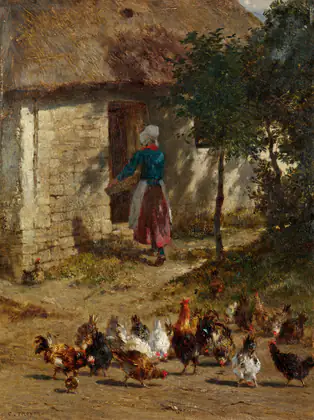
Sèvres and the Dutch landscape
The precision acquired on porcelain is released through contact with Ruisdael and outdoor observation. This milestone illuminates the "Constant Troyon" collection by favoring movement.
1810 -1865 · Barbizon School and Animal Painting
Discover Constant Troyon, hand reproduced in oil on canvas.
1810 -1865 · Barbizon School and Animal Painting
Born in Sèvres in 1810, Constant Troyon began as a porcelain painter at the factory where his father worked. He quickly turned to landscape and studied Dutch masters, notably Jacob van Ruisdael. In the 1830s, his meeting with Théodore Rousseau, Jules Dupré and Barbizon's future painters encouraged him to work directly in the Fontainebleau forest. His first landscapes sought a more faithful nature, built by trees, humidity and sky effects. A trip to the Netherlands in 1847 transformed his career: the animals of Paulus Potter and Aelbert Cuyp revealed to him the possibility of uniting anatomical study, light and a large landscape. Troyon then became one of the most famous animal painters in Europe. Oxen going to plow, cows to pasture and herds crossing a ford combine collective movement, dust, reflections and atmospheric scale. Decorated with the Legion of Honor in 1849, he also continued his research on the Normandy coast before dying in Paris in 1865. The "Constant Troyon" selection notably compares oxen going to plowing and Herd passing the ford. His reading favors movement.
Troyon does not simply place animals in a setting: the herd, the light and the ground advance together in the same living landscape.
Course & style
Born in Sèvres in 1810, Constant Troyon began as a porcelain painter at the factory where his father worked. He quickly turned to landscape and studied Dutch masters, notably Jacob van Ruisdael. In the 1830s, his meeting with Théodore Rousseau, Jules Dupré and Barbizon's future painters encouraged him to work directly in the Fontainebleau forest. His first landscapes sought a more faithful nature, built by trees, humidity and sky effects. A trip to the Netherlands in 1847 transformed his career: the animals of Paulus Potter and Aelbert Cuyp revealed to him the possibility of uniting anatomical study, light and a large landscape. Troyon then became one of the most famous animal painters in Europe. Oxen going to plow, cows to pasture and herds crossing a ford combine collective movement, dust, reflections and atmospheric scale. Decorated with the Legion of Honor in 1849, he also continued his research on the Normandy coast before dying in Paris in 1865.
The precision acquired on porcelain is released through contact with Ruisdael and outdoor observation. This milestone illuminates the "Constant Troyon" collection by favoring movement.
Rousseau and Dupré accompany a painting of undergrowth, skies and directly observed terrain.
After Holland, oxen and cows become the main players in an admired European landscape.
The animals form a mobile mass whose differences in appearance and character remain precisely observed. This trait guides a reading of "Constant Troyon" centered on movement.
Low sun, dust and reflections give atmospheric depth to paths and pastures.
Mud, grass, shore and undergrowth are worked like materials that carry the real weight of animals.
Plowing, fording or returning to the stable naturally organize the composition.
Explore by universe
Works, visual language and historical landmarks make up a journey exclusively devoted to Constant Troyon.
The slow march of the oxen, the land and the morning light give agricultural work a monumental grandeur.
Reference work by Constant Troyon. Reading of "Constant Troyon" through movement.Reflections, splashes and moving silhouettes connect each animal to the general rhythm of the landscape.
Landmark work by Constant TroyonImmobile animals measure open space and establish serenity based on observation of the outdoors.
Landmark work by Constant TroyonThe dark water, the trunks and the gaps in light remind us that Troyon was first a great landscaper.
Landmark work by Constant TroyonThe animals form a mobile mass whose differences in appearance and character remain precisely observed. This trait guides a reading of "Constant Troyon" centered on movement.
Reading key for Constant TroyonLow sun, dust and reflections give atmospheric depth to paths and pastures.
Reading key for Constant TroyonWorks to discover
Each card refers directly to its reproduction available on Shopify.


Our method
Each painting is made in oil on canvas by a specialized artist, then checked with you before shipping.
Each reproduction is unique. Slight variations of touch and material testify to the painter's manual work.
Choose wisely
Constant Troyon's subjects and tones call for a format, place and framing chosen for the precise work.
Frequently asked questions
Yes. Each reproduction is hand painted in oil on canvas, without printing.
The painter uses the composition, values, colors and materials visible in the chosen work from the Constant Troyon collection, with particular attention paid to movement.
Yes. The dimensions are adapted respecting the proportions and balance of the selected work.
Detailed photographs are sent before shipping; you can request edits before sending.
Custom reproduction
Send us an image, a museum reference, or the name of an artwork: we can create a custom reproduction.
Buying guide
A simple and reassuring process to order a handmade painted canvas, with validation before shipping.
Select a painting from the collection or send us a reference.
Choose the size and options that suit your interior.
Our artists create your oil reproduction, entirely handmade.
We send you a photo before shipping for validation.
Questions & Guide
Find answers to frequently asked questions and essential information about our hand-painted reproductions.
These answers reassure visitors who are discovering the concept of hand-painted reproductions.
Yes, our reproductions are oil paintings on canvas by experienced artists. Each canvas is hand-painted, not printed.
Yes. Before shipping, we send you a photo of the completed painting. You can then request adjustments if necessary.
The time depends on the format and complexity of the artwork. The painting generally takes several weeks, then the canvas is shipped with tracking.
Yes, you can choose a standard format or request a custom size adapted to your space.
Depending on the options available, the canvas can be delivered alone, mounted on a stretcher, or prepared for framing. Details are indicated on the product page.
Yes. You can send us an image, a museum reference, the name of an artwork, or a photo to request a custom reproduction.
Some guidelines for choosing a reproduction from this collection, comparing similar styles, and preparing your order.
This selection brings together artworks designed for art lovers who want to recapture the spirit of a famous painting in a hand-painted canvas. Each reproduction can be adapted to the desired format and validated by photo before shipping.
The available formats allow the artwork to be adapted to a living room, bedroom, office, or a more specific decorative project. The painting is executed in oil on canvas with particular attention to colors, textures, and overall balance.
If you are looking for a similar artwork, a similar artist, or a specific format, you can ask for advice. Reproductions can be adjusted before shipping thanks to photo validation.