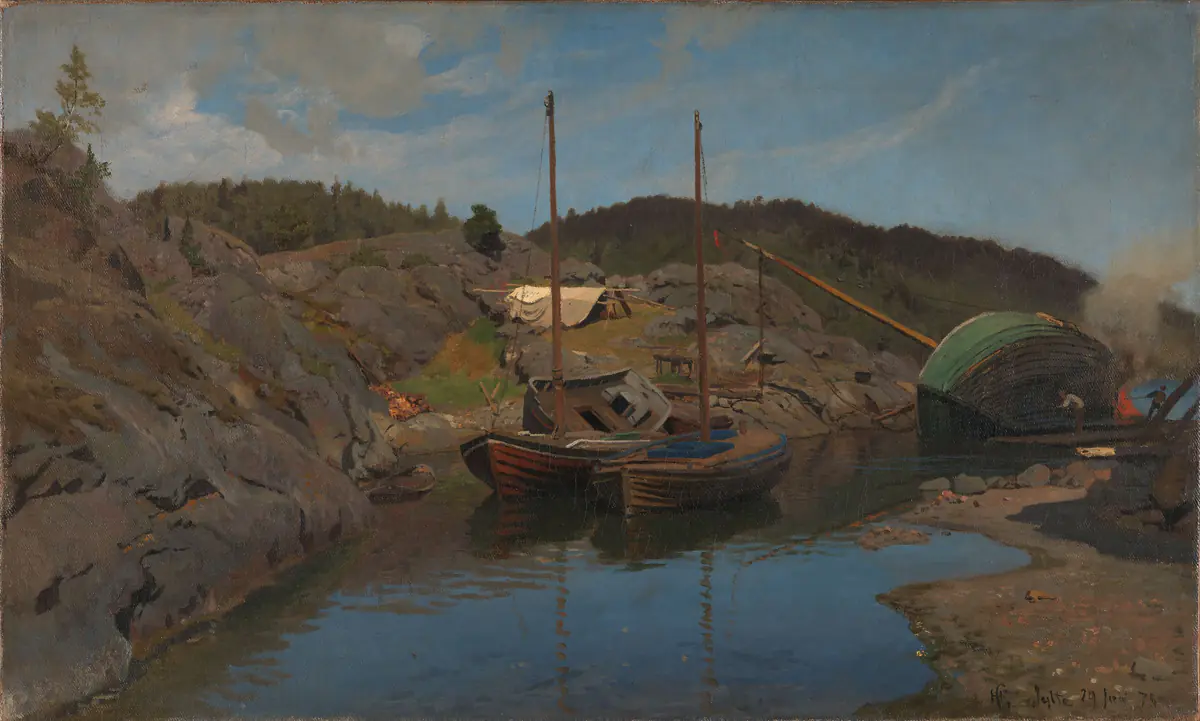
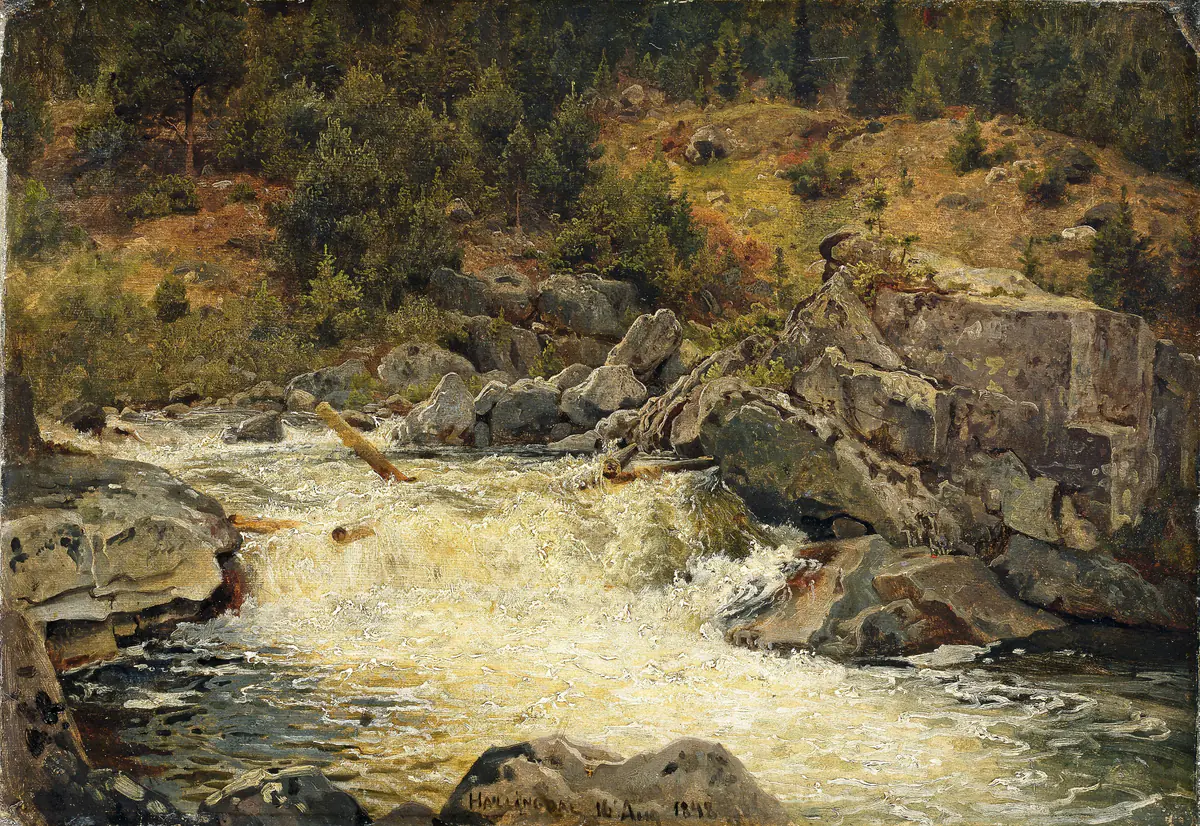
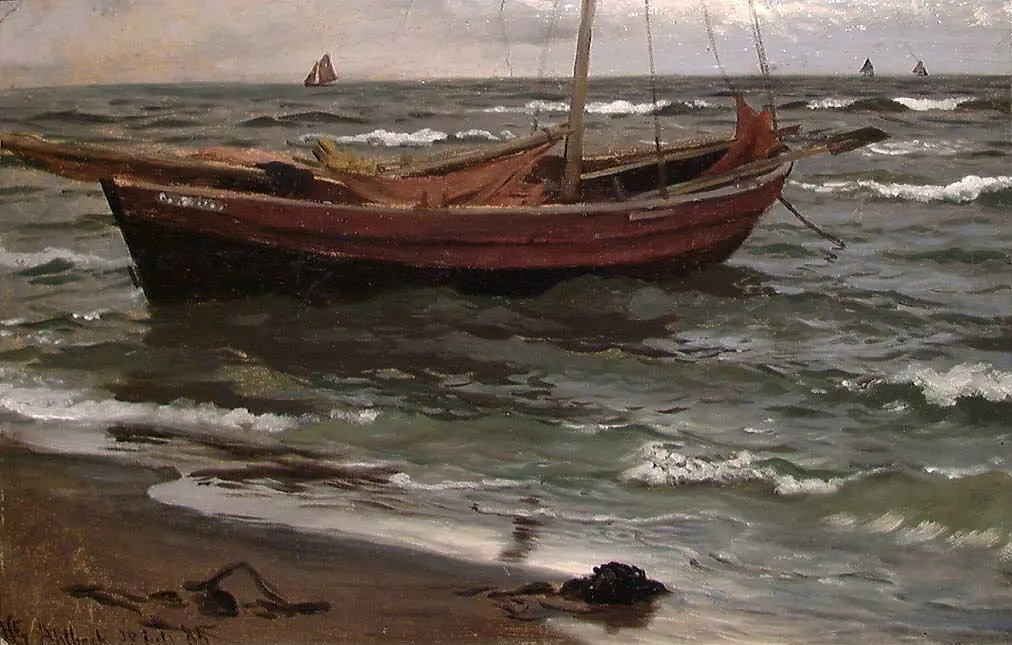
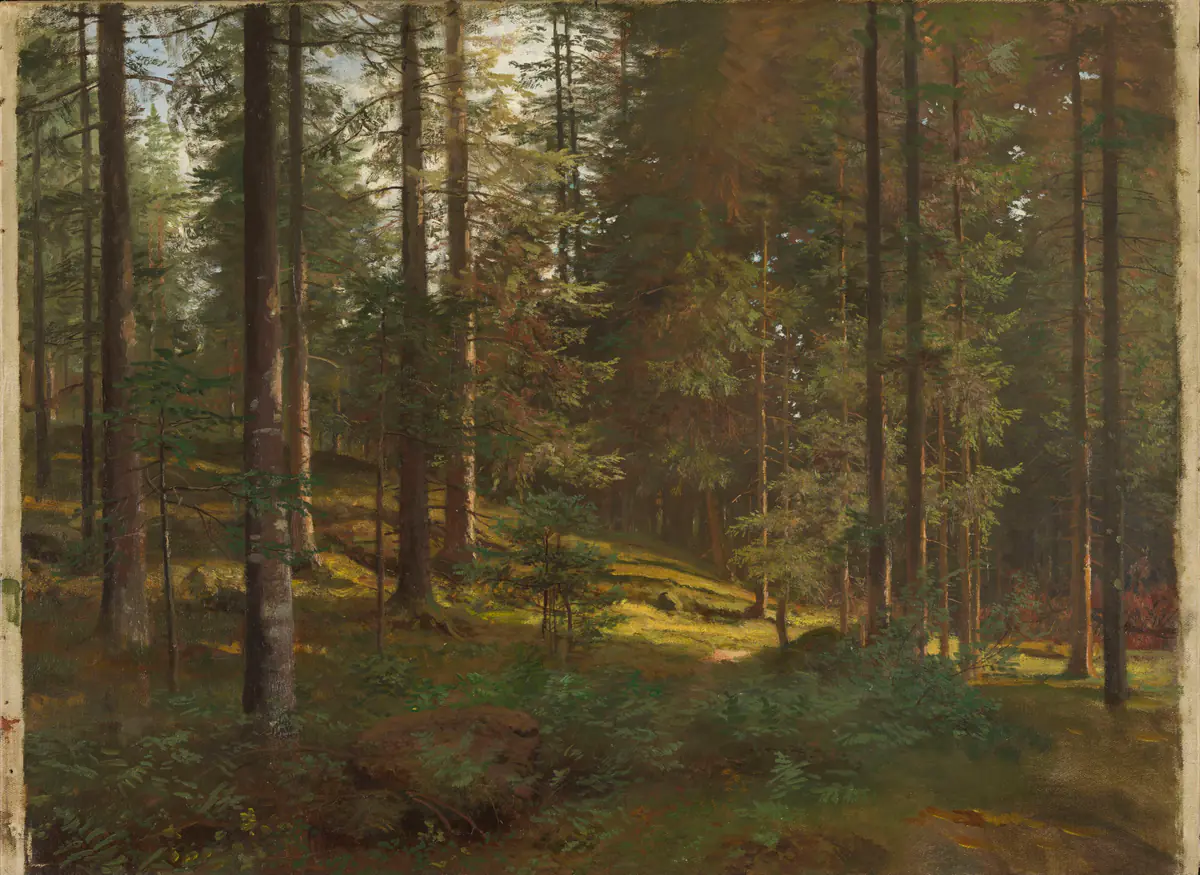
Hans Fredrik Gude was born in Christiania, today Oslo, in 1825. At a very young age, he received artistic training then left in 1841 for the Academy of Düsseldorf, a major European center of romantic landscape. A student of Andreas Achenbach then Johann Wilhelm Schirmer, he learned to construct nature with precision: succession of plans, balance of masses, atmospheric effects and topographical details give the landscape a credible monumentality. Gude regularly returned to Norway to draw mountains, plateaus, waterfalls, fjords and coasts. His studies on the motif were then developed at the workshop. Gude returned regularly to Norway to draw mountains, plateaus, waterfalls, fjords and coasts. His studies on the motif were then developed at the workshop. Gude returned regularly to Norway to draw mountains, plateaus, waterfalls, fjords and coasts. His studies on the motif were then developed at the workshop. In 1848, his collaboration with Adolph Tidemand produced Wedding Procession on the Hardangerfjord: Gude paints the landscape and Tidemand the figures, uniting popular custom and national nature in an image that has become iconic. Høifjell and Winter Afternoon show another, quieter dimension of his art, where the human scale fades before the relief and light. Gude teaches in Düsseldorf, then leads landscape classes in Karlsruhe and Berlin. He encouraged outdoor study while maintaining rigorous composition. Several generations of Norwegian, German and international artists passed through his studio. In late works, coasts, storms and water movements gained freedom. In late works, coasts, storms and water movements gained freedom. In the late works, the coasts, storms and movements of the water gained freedom. In the late works, the coasts, storms and movements of the water gained freedom. norwegian national romanticism with a European pedagogy of landscape. The "Hans Gude" selection notably compares Winter Afternoon and Wedding Procession on the Hardangerfjord. His reading favors the story.
Gude composes Norway as a lived and monumental space: the fjord leads the gaze, the mountain gives it a measure and the light transforms geography into identity.