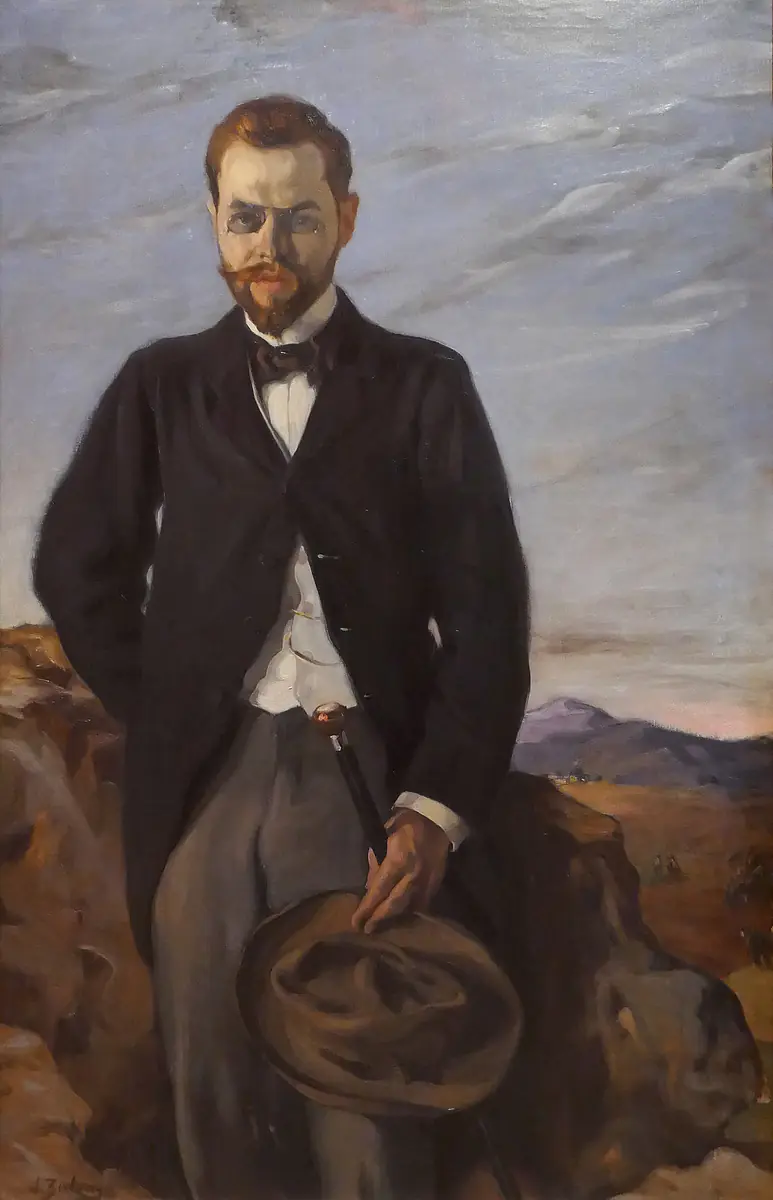
Eibar, family crafts and masters of the Prado
Damascination, ceramics, copies of Velázquez, Ribera, Goya and Greco establish a living relationship with tradition. This milestone sheds light on the "Ignacio Zuloaga" collection by favoring figures.
1870 -1945 · Eibar, Paris, Castile and Spanish portrait
Discover Ignacio Zuloaga, hand reproduced in oil on canvas.
1870 -1945 · Eibar, Paris, Castile and Spanish portrait
Ignacio Zuloaga y Zabaleta was born in Eibar in 1870 into an important family of Basque artisans. His father Plácido is a damascener and his uncle Daniel a ceramist; the family workshop transmitted to him very early on a taste for materials, objects and tradition. In 1887, Zuloaga copied at Prado Velázquez, Ribera, Goya and Le Greco. These masters remained the basis of a painting which never confused modernity and a break with history. After trips to Italy and England, he moved to Paris in 1890. He attended the La Palette academy, symbolist circles and artists like Rusiñol, Casas, Dethomas and Rodin. He occasionally experimented with impressionism and pointillism, but sought soon a darker language, based on drawing, lands and the authority of the figure. Her stays in Andalusia, then her exploration of Castile, provided her with a popular Spanish repertoire: dancers, dwarves, bullfighters, processions, villages and austere landscapes. This vision meets the sensitivity of writers of the Generation of 98, while sparking debate around "black Spain". The Victim of the Festival refuses the easy heroism of bullfighting: the injured body and the aftermath of the show expose its violence. Corrida in Eibar, on the contrary, organizes the crowd, the arena and the movement like a local memory. Zuloaga is also one of the great portraitists internationals of his time. Countess Mathieu de Noailles stands out with theatricality, intelligence and control of pose; Carlos de Beistegui embodies cosmopolitan elegance. In the Self-portrait with the Basque beret, costume, look and material build a claimed identity. From 1909, his American exhibitions reinforced an already European reputation. Passionate collector of Greco and Goya, he actively contributed to their rediscovery. After the First World War, he shared his life between the Basque Country, Madrid and Pedraza. He died in Madrid in 1945 and left a work whose power today requires distinguishing observation, cultural construction and context politics. The "Ignacio Zuloaga" selection notably compares Self-portrait with Basque beret and Portrait of Countess Mathieu de Noailles. His reading favors figures.
Zuloaga composes identity like a serious theater: the model advances, but behind him the landscape, the costume and the memory of the masters speak just as much.
Course & style
Damascination, ceramics, copies of Velázquez, Ribera, Goya and Greco establish a living relationship with tradition. This milestone sheds light on the "Ignacio Zuloaga" collection by favoring figures.
Symbolism, naturalism, popular Spain and large Salons installed a painter recognized in Europe then in America.
Portraits, landscapes, collections of Greco and Goya and workshops of Zumaia and Pedraza extend a personal vision of Spain.
The model stands out with a firm silhouette, often full-length, which transforms the pose into a statement of character. This line guides a reading of "Ignacio Zuloaga" centered on the figures.
Blacks, browns, grays and deep reds connect modern painting to Velazquez, Goya and Castilian tones.
Cities and plateaus do not only serve as a setting: they amplify solitude, dignity or tension of the character.
Popular costumes and types are observed but also organized into a cultural vision that must be placed in its time.
Explore by universe
Works, visual language and historical landmarks make up a route exclusively devoted to Ignacio Zuloaga.
Direct gaze, beret and dark material construct an identity that is both personal, Basque and fully aware of tradition.
Landmark work by Ignacio Zuloaga. Reading of "Ignacio Zuloaga" through the figures.Pose, dress and gaze give the poet a theatrical presence where worldliness and intelligence remain inseparable.
Landmark work by Ignacio ZuloagaThe injured body and heavy atmosphere shift the gaze of the spectacle towards its physical and human cost.
Landmark work by Ignacio ZuloagaArena, spectators and collective movement transform a local tradition into a stage dense with memory and tension.
Landmark work by Ignacio ZuloagaThe model stands out with a firm silhouette, often full-length, which transforms the pose into a statement of character. This line guides a reading of "Ignacio Zuloaga" centered on the figures.
Reading key for Ignacio ZuloagaBlacks, browns, grays and deep reds connect modern painting to Velazquez, Goya and Castilian tones.
Reading key for Ignacio ZuloagaWorks to discover
Each card refers directly to its reproduction available on Shopify.


Our method
Each painting is made in oil on canvas by a specialized artist, then checked with you before shipping.
Each reproduction is unique. Slight variations of touch and material testify to the painter's manual work.
Choose wisely
Ignacio Zuloaga's subjects and tones call for a format, place and framing chosen for the precise work.
Frequently asked questions
Yes. Each reproduction is hand painted in oil on canvas, without printing.
The painter uses the composition, values, colors and materials visible in the chosen work from the Ignacio Zuloaga collection, with particular attention paid to the figures.
Yes. The dimensions are adapted respecting the proportions and balance of the selected work.
Detailed photographs are sent before shipping; you can request edits before sending.
Custom reproduction
Send us an image, a museum reference, or the name of an artwork: we can create a custom reproduction.
Buying guide
A simple and reassuring process to order a handmade painted canvas, with validation before shipping.
Select a painting from the collection or send us a reference.
Choose the size and options that suit your interior.
Our artists create your oil reproduction, entirely handmade.
We send you a photo before shipping for validation.
Questions & Guide
Find answers to frequently asked questions and essential information about our hand-painted reproductions.
These answers reassure visitors who are discovering the concept of hand-painted reproductions.
Yes, our reproductions are oil paintings on canvas by experienced artists. Each canvas is hand-painted, not printed.
Yes. Before shipping, we send you a photo of the completed painting. You can then request adjustments if necessary.
The time depends on the format and complexity of the artwork. The painting generally takes several weeks, then the canvas is shipped with tracking.
Yes, you can choose a standard format or request a custom size adapted to your space.
Depending on the options available, the canvas can be delivered alone, mounted on a stretcher, or prepared for framing. Details are indicated on the product page.
Yes. You can send us an image, a museum reference, the name of an artwork, or a photo to request a custom reproduction.
Some guidelines for choosing a reproduction from this collection, comparing similar styles, and preparing your order.
This selection brings together artworks designed for art lovers who want to recapture the spirit of a famous painting in a hand-painted canvas. Each reproduction can be adapted to the desired format and validated by photo before shipping.
The available formats allow the artwork to be adapted to a living room, bedroom, office, or a more specific decorative project. The painting is executed in oil on canvas with particular attention to colors, textures, and overall balance.
If you are looking for a similar artwork, a similar artist, or a specific format, you can ask for advice. Reproductions can be adjusted before shipping thanks to photo validation.