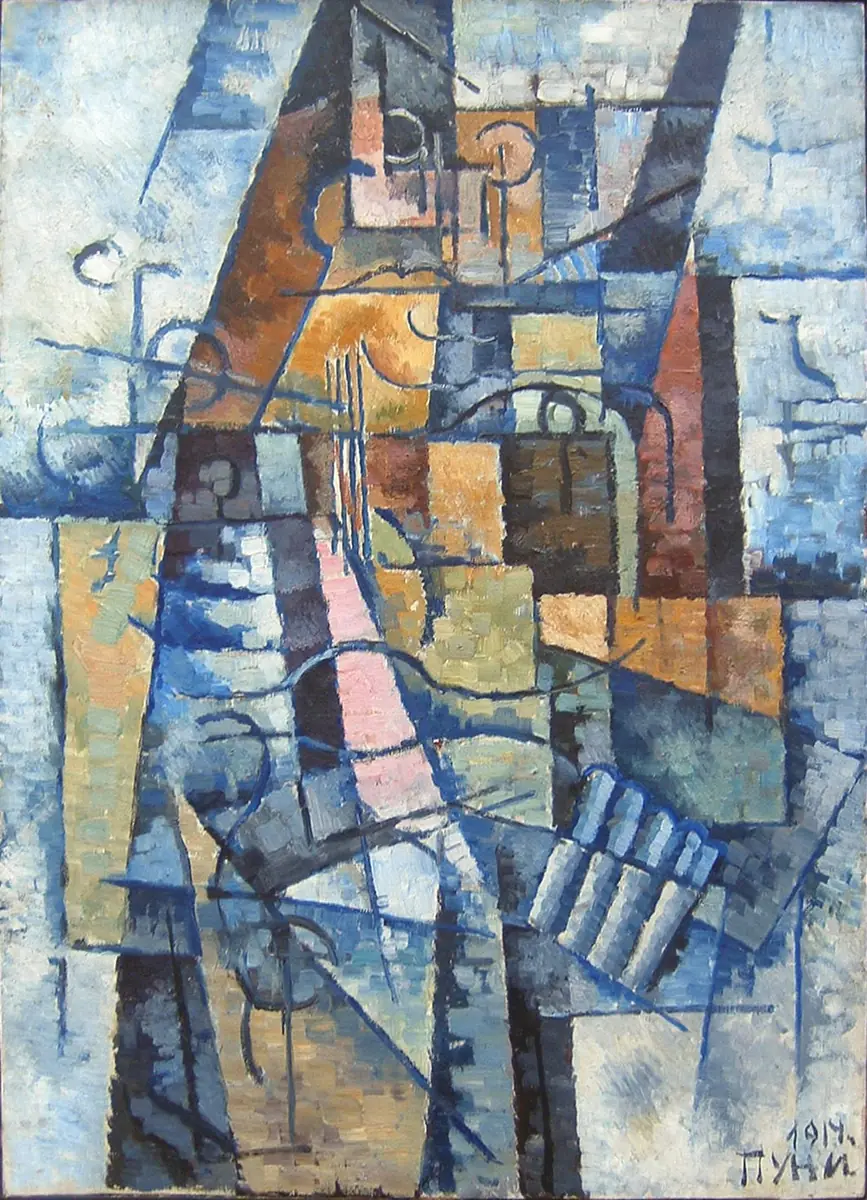
Ivan Albertovitch Puni, who adopted the name Jean Pougny in France, was born in 1892 in Kuokkala, then in the Grand Duchy of Finland. Coming from a family linked to music and the arts, he stayed young in Paris and took courses at the Académie Julian. Back in Saint Petersburg, he joined the most radical experiences of the Russian avant-garde with his wife, the artist Xenia Bogouslavskaya. Puni participated in the organization of the Tramway V and 0.10 exhibitions in 1915. Around Malevich, Tatlin, Rozanova and other creators, these events confronted Cubo-futurism, suprematism, painting and objects. Pictorial relief belongs to this period of invention: colorful plans, materials and real Shadows moves the work from the wall to space. Puni, however, did not transform any doctrine into definitive identity. After the Revolution, he taught and contributed to public decorations, then left Russia in 1919. In Berlin, he exhibited at the Der Sturm gallery and developed works where letters, everyday objects and signs condensed the urban experience. Installed in Paris in 1923, he Frenchified his name as Jean Pougny and gradually abandoned geometric abstraction. Installed in Paris in 1923, he Frenchified his name as Jean Pougny and gradually abandoned geometric abstraction. Installed in Paris in 1923, he Frenchified his name as Jean Pougny and gradually abandoned geometric abstraction. Interiors, streets, characters, still lifes and familiar scenes returned in an increasingly flexible painting. Interiors, streets, characters, still lifes and familiar scenes returned in an increasingly flexible painting. Interiors, streets, characters, still lifes and familiar scenes returned in an increasingly flexible painting. Interiors, streets, characters, still lifes and familiar scenes returned in an increasingly flexible painting. Colors, streets, characters, still lifes and familiar scenes returned in an increasingly flexible painting. Colors, streets, characters, still lifes and familiar scenes returned in an increasingly flexible painting. Colors, streets, characters, still lifes and familiar scenes returned in an increasingly flexible painting. Colors, streets, characters, still lifes and signs gradually abandoned geometric abstraction. Installed in Paris in 1923, he French Naturalized French in 1946, Pougny continued this research until his death in Paris in 1956. His journey is not limited to a succession of styles: each rupture tests the relationship between the surface, the thing represented and life daily. The "Ivan Puni" selection notably compares Pictorial Relief. His reading favors the story.
At Puni, changing style does not mean erasing the past: the relief, the sign and the everyday object continue to dialogue even in the poetic painting of Jean Pougny.