Ostend, academy and Les Vingt
Family shop, Brussels training, light from the North Sea and founding of the avant-garde group prepare its independence. This milestone illuminates the "James Ensor" collection by favoring figures.
1860 -1949 · Ostend, Brussels and Belgian avant-garde
Discover James Ensor, hand reproduced in oil on canvas.
1860 -1949 · Ostend, Brussels and Belgian avant-garde
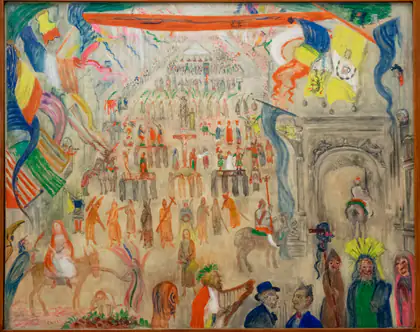
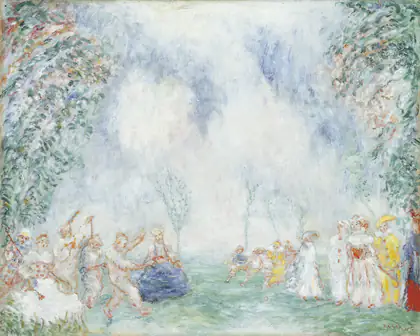
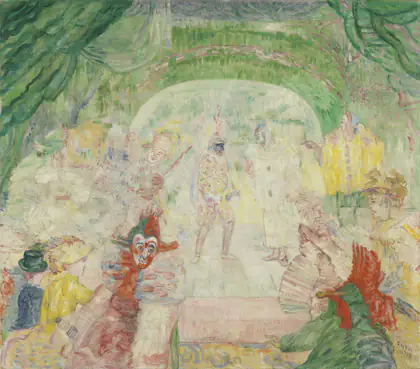
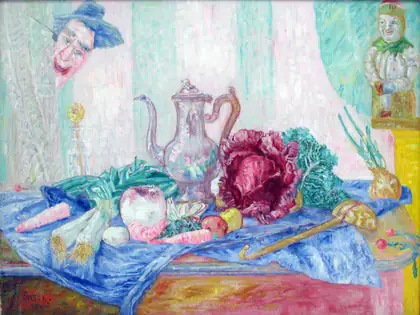
James Ensor was born in Ostend in 1860 to an English father and a Belgian mother. He grew up above the family store of souvenirs and curiosities, where carnival shells, costumes and masks later provided an essential repertoire for his art. From 1877 to 1880, he studied at the Royal Academy of Fine Arts in Brussels, then returned to work in a workshop set up above the boutique. From 1877 to 1880, he studied at the Royal Academy of Fine Arts in Brussels, then returned to work in a workshop set up above the boutique. Ostend remained his city, its light and its theater: beach, port, bourgeoisie on walks, carnival crowds and the North Sea nourished his entire career. His early paintings explored dark interiors, portraits, still lifes and landscapes treated in free material. In 1883, Ensor participated in the founding of the avant-garde group Les Vingt. However, his independence quickly distanced him from dominant trends, notably neo-impressionism. From the mid-1880s, masks, skeletons, caricatures and biblical subjects invaded his work. The mask does not only hide a face: it reveals the social hypocrisy, vanity and aggressiveness of the group. Ensor learns etching alone in 1886 and finds in the print an ideal means to disseminate his satirical visions. The Entry of Christ into Brussels, undertaken in 1888 and dated 1889, constitutes his manifesto. A huge crowd of clowns, soldiers, bourgeois and masked figures submerges almost the haloed Christ, to whom the artist lends his own features. The religious episode becomes critical of the Church, the State, capitalism and mass society. The singular Masks and Skeletons competing for a saur herring transform domestic comedy into a disturbing farce; the Self-portrait with the flowered hat combines provocation, irony and self-construction. Long contested, Ensor received increasing recognition in the 20th century and became a baron in 1929. Died in Ostend in 1949, he left a work which anticipated fauvism, expressionism, surrealism and modern satire without allowing himself to be locked into any movement. The "James Ensor" selection notably compares The Entry of Christ into Brussels and The Singular Masks. His reading favors figures.
Ensor drops faces to show masks: beneath the dazzling party appears a grotesque, cruel and strangely familiar society.
Course & style
Family shop, Brussels training, light from the North Sea and founding of the avant-garde group prepare its independence. This milestone illuminates the "James Ensor" collection by favoring figures.
Etching, social satire and Entry of Christ into Brussels radically transformed his initial naturalism.
Exhibitions, baron titles, music and repetitions of motifs accompany the consecration of the painter who remained faithful to Ostend.
Color, grimace and blank stare expose collective hypocrisy more than they hide identity. This trait guides a reading of "James Ensor" centered on the figures.
Death plays, argues and costumes, turning anxiety into a dark prank.
Banners, faces and diagonals saturate the space to the point of threatening the isolated character and the viewer.
Acidic yellows, violent reds and raw whites no longer describe only reality: they judge and transfigure it.
Explore by universe
Works, visual language and historical landmarks make up a journey exclusively devoted to James Ensor.
Banners, masks and compact crowds almost absorb Christ in a monumental vision of modern society.
Landmark work by James Ensor. Reading of "James Ensor" through the figures.Shrill colors and frozen faces transform the carnival meeting into a psychological portrait of the group.
Landmark work by James EnsorTwo paltry deaths replay human greed in a scene as funny as it is fierce.
Landmark work by James EnsorThe extravagant hat transforms the self-portrait into a provocative affirmation of an identity constructed against conventions.
Landmark work by James EnsorColor, grimace and blank stare expose collective hypocrisy more than they hide identity. This trait guides a reading of "James Ensor" centered on the figures.
Reading key for James EnsorDeath plays, argues and costumes, turning anxiety into a dark prank.
Reading key for James EnsorWorks to discover
Each card refers directly to its reproduction available on Shopify.


Our method
Each painting is made in oil on canvas by a specialized artist, then checked with you before shipping.
Each reproduction is unique. Slight variations of touch and material testify to the painter's manual work.
Choose wisely
James Ensor's subjects and tones call for a format, place and framing chosen for the precise work.
Frequently asked questions
Yes. Each reproduction is hand painted in oil on canvas, without printing.
The painter uses the composition, values, colors and materials visible in the chosen work from the James Ensor collection, with particular attention paid to the figures.
Yes. The dimensions are adapted respecting the proportions and balance of the selected work.
Detailed photographs are sent before shipping; you can request edits before sending.
Custom reproduction
Send us an image, a museum reference, or the name of an artwork: we can create a custom reproduction.
Buying guide
A simple and reassuring process to order a handmade painted canvas, with validation before shipping.
Select a painting from the collection or send us a reference.
Choose the size and options that suit your interior.
Our artists create your oil reproduction, entirely handmade.
We send you a photo before shipping for validation.
Questions & Guide
Find answers to frequently asked questions and essential information about our hand-painted reproductions.
These answers reassure visitors who are discovering the concept of hand-painted reproductions.
Yes, our reproductions are oil paintings on canvas by experienced artists. Each canvas is hand-painted, not printed.
Yes. Before shipping, we send you a photo of the completed painting. You can then request adjustments if necessary.
The time depends on the format and complexity of the artwork. The painting generally takes several weeks, then the canvas is shipped with tracking.
Yes, you can choose a standard format or request a custom size adapted to your space.
Depending on the options available, the canvas can be delivered alone, mounted on a stretcher, or prepared for framing. Details are indicated on the product page.
Yes. You can send us an image, a museum reference, the name of an artwork, or a photo to request a custom reproduction.
Some guidelines for choosing a reproduction from this collection, comparing similar styles, and preparing your order.
This selection brings together artworks designed for art lovers who want to recapture the spirit of a famous painting in a hand-painted canvas. Each reproduction can be adapted to the desired format and validated by photo before shipping.
The available formats allow the artwork to be adapted to a living room, bedroom, office, or a more specific decorative project. The painting is executed in oil on canvas with particular attention to colors, textures, and overall balance.
If you are looking for a similar artwork, a similar artist, or a specific format, you can ask for advice. Reproductions can be adjusted before shipping thanks to photo validation.