Hungary, war and Berlin constructivism
Drawing, exile, Der Sturm and geometry open a practice based on light and technology. This milestone illuminates the "László Moholy-Nagy" collection by favoring composition.
1895 -1946 · Hungary, Berlin, Bauhaus, London and New Bauhaus of Chicago
Discover Laszló Moholy-Nagy, hand-reproduced in oil on canvas.
1895 -1946 · Hungary, Berlin, Bauhaus, London and New Bauhaus of Chicago
Laszló Moholy-Nagy was born in 1895 in Bácsborsod, Hungary. Injured during the First World War, he began drawing and then joined the constructivist networks of Budapest, Vienna and Berlin after 1918. His geometric paintings explored transparent, diagonal planes and color relationships such as light phenomena. Walter Gropius invited him in 1923 to the Bauhaus, where he directed the metal workshop and participated in the preliminary course. Moholy-Nagy defended a new unity of art, technology and life in 1923. With Lucia Moholy, he defended the photogram, an image obtained without a camera by direct exposure of objects on sensitive paper. He also works on film typography, scenography, design and kinetic sculpture. His Space-Light Modulator transformed mechanical movement, reflections and shadows into an autonomous show. After Berlin, Amsterdam and London, he moved to Chicago in 1937 to direct the New Bauhaus, then founded the School of Design, now the Institute of Design. Until his death in 1946, he taught experimentation as a method for understanding materials and building a more human modern environment. Until his death in 1946, he taught experimentation as a method for understanding materials and building a more human modern environment. Until his death in 1946, he taught experimentation as a method for understanding materials and building a more human modern environment. Until his death in 1946, he taught experimentation as a method for understanding materials and building a more human modern environment. Until his death in 1946, he taught experimentation as a method for understanding materials and building a more human modern environment. Until his death in 1946, he taught experimentation as a method for understanding materials and building a more human modern environment. Until his death in 1946, he taught experimentation as a method for understanding materials and building a more human modern environment. Until his death in 1946, he taught experimentation as a method for understanding materials and building a more human modern
For Moholy-Nagy, light not only illuminates the work: it becomes a material that can be constructed, moved and learned.
Course & style
Drawing, exile, Der Sturm and geometry open a practice based on light and technology. This milestone illuminates the "László Moholy-Nagy" collection by favoring composition.
Metal workshop, preliminary course, photograms and books establish an experimental pedagogy.
Design, film, exile, New Bauhaus and Institute of Design broadcast his modern project.
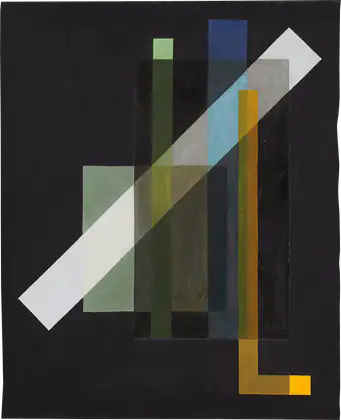
The superimposed planes create depth and light without traditional modeling. This line guides a reading of "László Moholy-Nagy" centered on composition.
The oblique sets circle, bar and surface in motion in an unstable space.
Reflection, shadow and photogram are treated as autonomous plastic elements.
Metal, plastic, photography and machines combine painting and pedagogy.
Explore by universe
Works, visual language and historical landmarks make up a route exclusively devoted to Laszló Moholy-Nagy.
Transparent, circle and diagonal planes give the surface a luminous depth.
Landmark work by Laszló Moholy-Nagy. Reading of "László Moholy-Nagy" through composition.Simple shapes balance like the moving elements of a visual device.
Landmark work by Laszló Moholy-NagyColor, bar and circle organize a precise but open abstract space.
Landmark work by Laszló Moholy-NagyPainting presents itself as a rational assembly of forces, materials and light.
Landmark work by Laszló Moholy-NagyThe superimposed planes create depth and light without traditional modeling. This line guides a reading of "László Moholy-Nagy" centered on composition.
Reading key for Laszló Moholy-NagyThe oblique sets circle, bar and surface in motion in an unstable space.
Reading key for Laszló Moholy-NagyWorks to discover
Each card refers directly to its reproduction available on Shopify.


Our method
Each painting is made in oil on canvas by a specialized artist, then checked with you before shipping.
Each reproduction is unique. Slight variations of touch and material testify to the painter's manual work.
Choose wisely
The subjects and tones of Laszló Moholy-Nagy call for a format, a place and a frame chosen for the precise work.
Frequently asked questions
Yes. Each reproduction is hand painted in oil on canvas, without printing.
The painter uses the composition, values, colors and materials visible in the chosen work from the Laszló Moholy-Nagy collection, with particular attention paid to composition.
Yes. The dimensions are adapted respecting the proportions and balance of the selected work.
Detailed photographs are sent before shipping; you can request edits before sending.
Custom reproduction
Send us an image, a museum reference, or the name of an artwork: we can create a custom reproduction.
Buying guide
A simple and reassuring process to order a handmade painted canvas, with validation before shipping.
Select a painting from the collection or send us a reference.
Choose the size and options that suit your interior.
Our artists create your oil reproduction, entirely handmade.
We send you a photo before shipping for validation.
Questions & Guide
Find answers to frequently asked questions and essential information about our hand-painted reproductions.
These answers reassure visitors who are discovering the concept of hand-painted reproductions.
Yes, our reproductions are oil paintings on canvas by experienced artists. Each canvas is hand-painted, not printed.
Yes. Before shipping, we send you a photo of the completed painting. You can then request adjustments if necessary.
The time depends on the format and complexity of the artwork. The painting generally takes several weeks, then the canvas is shipped with tracking.
Yes, you can choose a standard format or request a custom size adapted to your space.
Depending on the options available, the canvas can be delivered alone, mounted on a stretcher, or prepared for framing. Details are indicated on the product page.
Yes. You can send us an image, a museum reference, the name of an artwork, or a photo to request a custom reproduction.
Some guidelines for choosing a reproduction from this collection, comparing similar styles, and preparing your order.
This selection brings together artworks designed for art lovers who want to recapture the spirit of a famous painting in a hand-painted canvas. Each reproduction can be adapted to the desired format and validated by photo before shipping.
The available formats allow the artwork to be adapted to a living room, bedroom, office, or a more specific decorative project. The painting is executed in oil on canvas with particular attention to colors, textures, and overall balance.
If you are looking for a similar artwork, a similar artist, or a specific format, you can ask for advice. Reproductions can be adjusted before shipping thanks to photo validation.