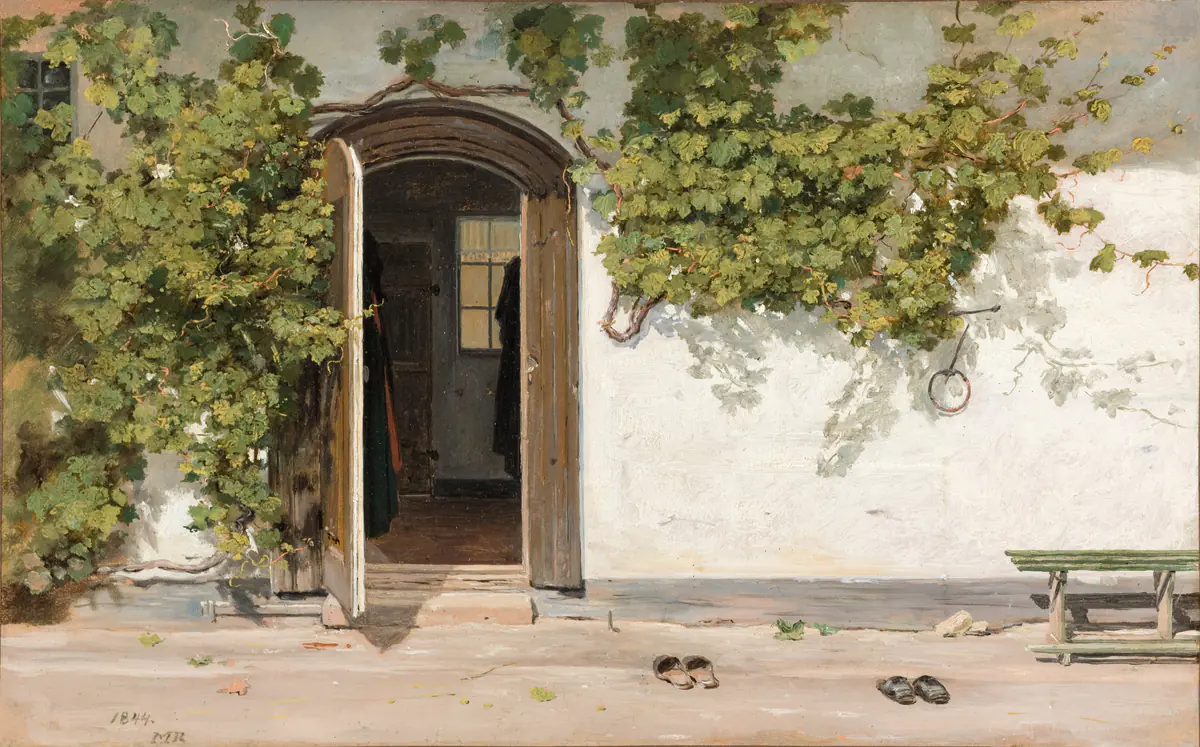
Martinus Christian Wesseltoft Rørbye was born in 1803 in Drammen, Norway then united with Denmark, and died in Copenhagen in 1848. His family settled very early in the Danish capital. He studied at the Royal Academy of Fine Arts then with Christoffer Wilhelm Eckersberg, from whom he learned the rational construction of space, the clarity of observation and work from nature. His first works describe Copenhagen, its streets, its windows and its inhabitants with a precision that is never purely documentary. His first works describe Copenhagen, its streets, its windows and its inhabitants with a precision that is never purely documentary. His first works describe Copenhagen, its streets, its windows and its inhabitants with a precision that is never purely documentary. His first works describe Copenhagen, its streets, its windows and its inhabitants with a precision that is never purely documentary. His first works describe Copenhagen, its streets, its windows and its inhabitants with a precision that is never purely documentary. His first works describe Copenhagen, its streets, its windows and its inhabitants with a precision that is never purely documentary. His first works describe Copenhagen, its streets, its windows and its inhabitants with a precision that is never purely documentary. His first works describe Copenhagen, its streets, its windows and its inhabitants with a precision that is never purely documentary. His first works describe Copenhagen, its streets, its trade and the threat of confinement respond to each other in the same space. Rørbye is also the great traveler of the Danish golden age. He traveled through Jutland, Norway, Italy, Greece and the Ottoman Empire, going further than most of his contemporaries. His journals, drawings and paintings record ports, ships, costumes, architecture and lifestyles encountered. A large ship caulking in Frederikshavn shows his attention to maritime work, the structure of the building and the light of the North. Between domestic proximity and desire for the distant, Rørbye transforms travel into a method of knowledge and gives Danish painting a truly international perspective. There selection "Martinus Rørbye" notably compares The Copenhagen Prison and A Large Ship with Caulking in Frederikshavn. His reading favors the material.
Rørbye looks at the world like an open window: every architecture is exact, but it always leads to a story, a journey or a possibility of departure.