Franconian training and return to Nuremberg
Panel painting and studio culture prepare a career in the heart of a thriving trading city. This milestone sheds light on the "Michael Wolgemut" collection by favoring drawing.
1434 -1519 · Nuremberg and German Renaissance
Discover Michael Wolgemut, hand reproduced in oil on canvas.
1434 -1519 · Nuremberg and German Renaissance
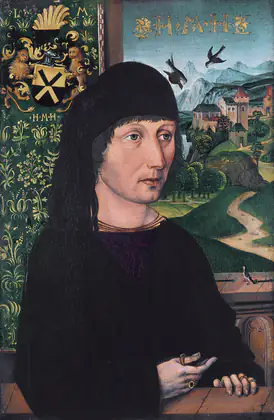
Michael Wolgemut was born in Nuremberg in 1434 and died there in 1519. Trained in the world of Franconian workshops, he probably worked in Munich before returning to his hometown. By marrying Barbara, widow of the painter Hans Pleydenwurff, in 1472, he took over and developed an important workshop. Wolgemut produced altarpieces, portraits, religious panels and models intended for wood engraving. His organization brought together apprentices and companions capable of responding to vast commissions where painting, sculpture, gilding and printing complemented each other. His organization brought together apprentices and companions capable of responding to vast commissions where painting, sculpture, gilding and printing complemented each other. His organization brought together apprentices and companions capable of responding to vast commissions where painting, sculpture, gilding and printing complemented each other. His organization brought together apprentices and companions capable of responding to vast commissions where painting, sculpture, gilding and printing complemented each other. His organization brought together apprentices and companions capable of responding to vast commissions where painting, sculpture, gilding and printing complemented each other. His organization brought together apprentices and companions capable of responding to vast commissions where painting, sculpture, gilding and printing complemented each other. His organization brought together apprentices and companions capable of responding give the face a firm individuality. Between 1486 and 1489, the young Albrecht Dürer completed his apprenticeship in the workshop, where he discovered painting, drawing and preparation of engraved wood. The most famous printed project associated with Wolgemut is the Nuremberg Chronicle by Hartmann Schedel, published by Anton Koberger in 1493. Produced with Wilhelm Pleydenwurff and a vast workshop, it brings together hundreds of compositions and more than a thousand images taken from numerous blocks, representing cities, sovereigns, biblical stories and universal history. Some views are observed, others reused for several places. Wolgemut thus embodies the passage between the large workshop medieval and the printed culture of the German Renaissance. The "Michael Wolgemut" selection notably compares Portrait of Hans Tucher. His reading favors drawing.
Michael Wolgemut leads the image like a collective workshop: from the patrician face to the engraved city, each form must be clear, transmissible and durable.
Course & style
Panel painting and studio culture prepare a career in the heart of a thriving trading city. This milestone sheds light on the "Michael Wolgemut" collection by favoring drawing.
Religious and patrician commissions made Wolgemut the main workshop manager of Nuremberg.
Learning from the future master and immense engraved program link painting, books and European distribution.
Contour, eye and mouth individualize the model with a clarity adapted to the patrician portrait. This line guides a reading of "Michael Wolgemut" centered on drawing.
Reds, golds and blues structure religious stories intended for the church.
Clear silhouette and readable detail effectively prepare the translation of the engraved wooden drawing.
Master, companions and apprentices assemble painting, sculpture, gilding and printing in large projects.
Explore by universe
Works, visual language and historical landmarks make up a journey exclusively devoted to Michael Wolgemut.
The rigorous profile, dark costume and stripped-down background affirm the rank and character of a Nuremberg patrician.
Landmark work by Michael Wolgemut. Reading "Michael Wolgemut" through drawing.Contour, eye and mouth individualize the model with a clarity adapted to the patrician portrait. This line guides a reading of "Michael Wolgemut" centered on drawing.
Reading key for Michael WolgemutReds, golds and blues structure religious stories intended for the church.
Reading key for Michael WolgemutClear silhouette and readable detail effectively prepare the translation of the engraved wooden drawing.
Reading key for Michael WolgemutMaster, companions and apprentices assemble painting, sculpture, gilding and printing in large projects.
Reading key for Michael WolgemutPanel painting and studio culture prepare a career in the heart of a thriving trading city. This milestone sheds light on the "Michael Wolgemut" collection by favoring drawing.
Historical landmark of Michael WolgemutWorks to discover
Each card refers directly to its reproduction available on Shopify.
Our method
Each painting is made in oil on canvas by a specialized artist, then checked with you before shipping.
Each reproduction is unique. Slight variations of touch and material testify to the painter's manual work.
Choose wisely
Michael Wolgemut's subjects and tones call for a format, place and framing chosen for the precise work.
Frequently asked questions
Yes. Each reproduction is hand painted in oil on canvas, without printing.
The painter uses the composition, values, colors and materials visible in the chosen work from the Michael Wolgemut collection, with particular attention paid to drawing.
Yes. The dimensions are adapted respecting the proportions and balance of the selected work.
Detailed photographs are sent before shipping; you can request edits before sending.
Custom reproduction
Send us an image, a museum reference, or the name of an artwork: we can create a custom reproduction.
Buying guide
A simple and reassuring process to order a handmade painted canvas, with validation before shipping.
Select a painting from the collection or send us a reference.
Choose the size and options that suit your interior.
Our artists create your oil reproduction, entirely handmade.
We send you a photo before shipping for validation.
Questions & Guide
Find answers to frequently asked questions and essential information about our hand-painted reproductions.
These answers reassure visitors who are discovering the concept of hand-painted reproductions.
Yes, our reproductions are oil paintings on canvas by experienced artists. Each canvas is hand-painted, not printed.
Yes. Before shipping, we send you a photo of the completed painting. You can then request adjustments if necessary.
The time depends on the format and complexity of the artwork. The painting generally takes several weeks, then the canvas is shipped with tracking.
Yes, you can choose a standard format or request a custom size adapted to your space.
Depending on the options available, the canvas can be delivered alone, mounted on a stretcher, or prepared for framing. Details are indicated on the product page.
Yes. You can send us an image, a museum reference, the name of an artwork, or a photo to request a custom reproduction.
Some guidelines for choosing a reproduction from this collection, comparing similar styles, and preparing your order.
This selection brings together artworks designed for art lovers who want to recapture the spirit of a famous painting in a hand-painted canvas. Each reproduction can be adapted to the desired format and validated by photo before shipping.
The available formats allow the artwork to be adapted to a living room, bedroom, office, or a more specific decorative project. The painting is executed in oil on canvas with particular attention to colors, textures, and overall balance.
If you are looking for a similar artwork, a similar artist, or a specific format, you can ask for advice. Reproductions can be adjusted before shipping thanks to photo validation.