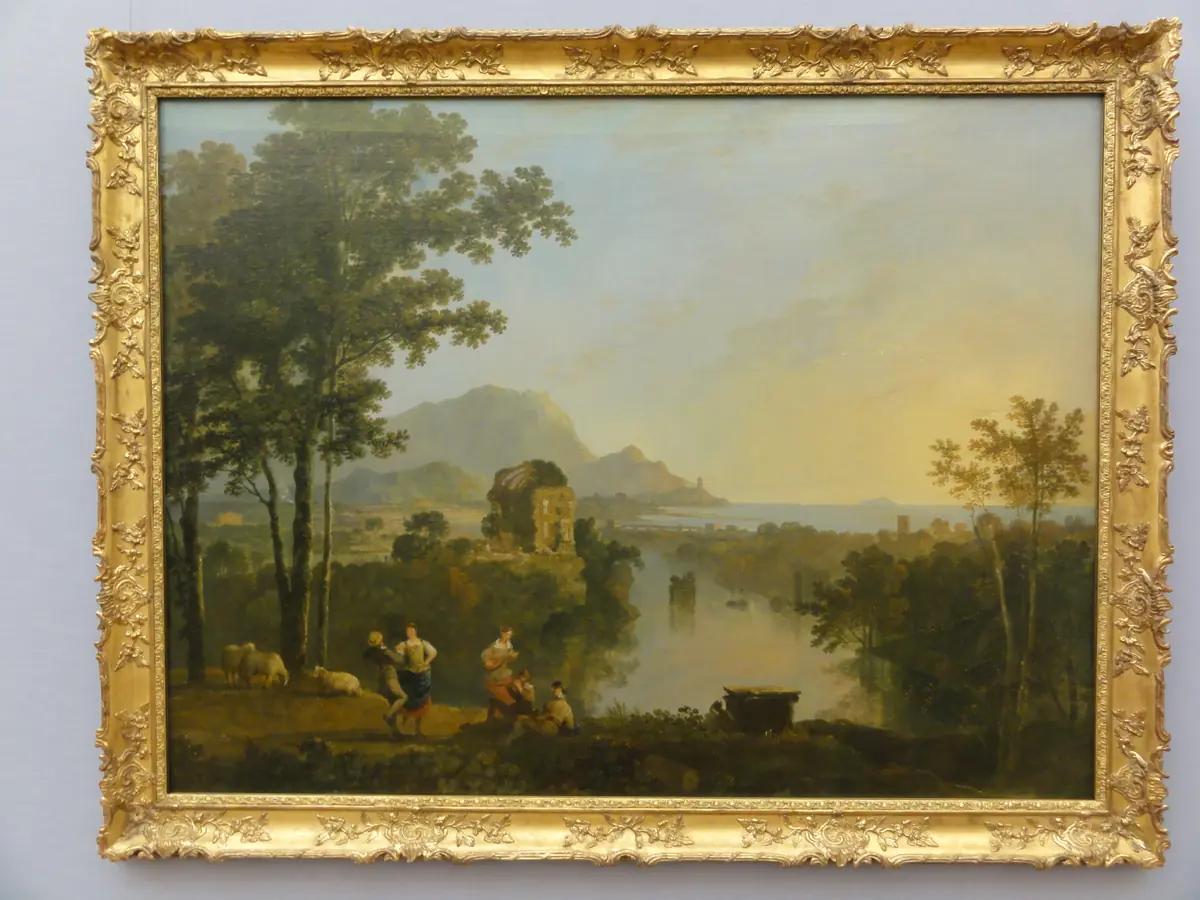
Richard Wilson was born in Wales in 1713 and died in 1782. Supported by his uncle Sir George Wynne, he moved to London in 1729 and first trained as a portrait painter to Thomas Wright. The decisive turning point came in 1750 when he traveled to Italy. In Venice then in Rome, the advice of Francesco Zuccarelli and Claude-Joseph Vernet encouraged him to gradually abandon portraiture for landscape. Wilson studied Claude Lorrain, Poussin and the Roman countryside, where ruins, water, trees and sky were balanced in ample light. Wilson studied Claude Lorrain, Poussin and the Roman countryside, where ruins, water, trees and sky were balanced in ample light. Wilson studied Claude Lorrain, Poussin and the Roman countryside, where ruins, water, trees and sky were balanced in ample light. Wilson studied Claude Lorrain, Poussin and the Roman countryside, where ruins, water, trees and sky were balanced in ample light. Wilson studied Claude Lorrain, Poussin and the Roman countryside, where ruins, water, trees and sky were balanced in ample light. Wilson studied Claude Lorrain, Poussin and the Roman countryside, where ruins, water, trees and sky were balanced in ample light. Wilson studied Claude Lorrain, Poussin and the Roman countryside Snowdon from Llyn Nantlle give the Welsh relief a nobility hitherto reserved for Italian landscapes. The lakes lead the gaze, the dark masses frame the space and the atmosphere connects the plans. Wilson opened a workshop in Covent Garden, notably trained Thomas Jones and participated in the founding of the Royal Academy in 1768. Despite this major role, his last years were marked by financial difficulties and a withdrawal to Wales. Despite this major role, his last years were marked by financial difficulties and a withdrawal to Wales. His influence was affirmed after his death: Constable and Turner recognized in him a predecessor who made the national landscape worthy of great painting. His work thus unites observation of the place, ancient memory and meteorological poetry. The "Richard Wilson" selection notably compares Cader Idris and Snowdon seen from Llyn Nantlle. His reading favors movement.
Wilson looks at the Welsh mountain with the memory of Rome: classical light does not idealize him, it gives him new grandeur.