

Top 100 - Pop Art: 100 essential works
Pop Art: 100 essential works
From the soup can to the comic, from the flag to the monumental object: one hundred works to understand how Pop Art transformed mass culture into art history
Pop Art is not just a world of bold colors, stars and familiar products. The journey begins with the icons who imposed this new vocabulary, returns to the British and European laboratory, follows it american diversification then observed its legacies in Kusama, Haring, Basquiat, Koons, Axell and Weber.
Mass culture enters the museum
One hundred works to look at Pop beyond bright colors
Start by looking for the source. A press photograph, packaging, comic book box or sign is never innocently taken up. Her movement to the museum modifies her function and reveals the visual habits she already carried.
Pop Art doesn't just celebrate products and stars: it examines how their images create our desires, our memories and our vision of reality.Switch to images
Classification in images
Soups, Marilyn, flags, comics, soft objects and schemes install the immediately recognizable signs of movement.
#1
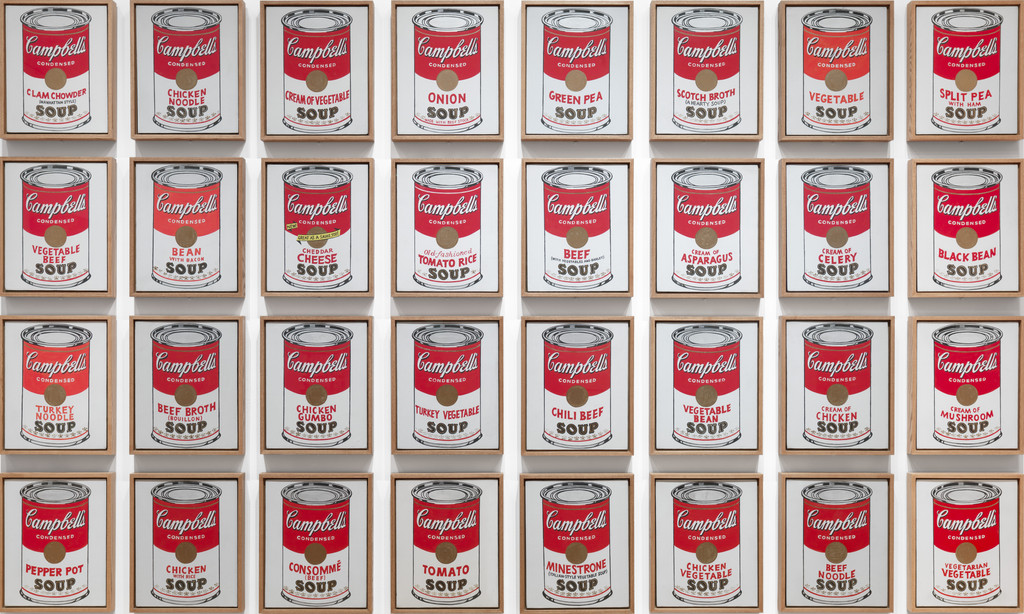
Campbell's Soup Cans
The series transforms an ordinary product into a collective portrait of American consumption: each box keeps its identity while joining a repetition mechanism. Warhol treats fame, merchandise and disaster with it the same framing and repetition processes, revealing the proximity between public desire and industrial circulation of images. With its founding icons, Pop Art replaces heroic uniqueness with the shared sign, series or object common. The framing isolates the pattern to the point of making it both immediately recognizable and strangely detached from its daily use. Dated 1962, the work combines Acrylic with metallic enamel paint on canvas, 32 panels with a reflection on the circulation, repetition and transformation of ordinary images.
See at the museum →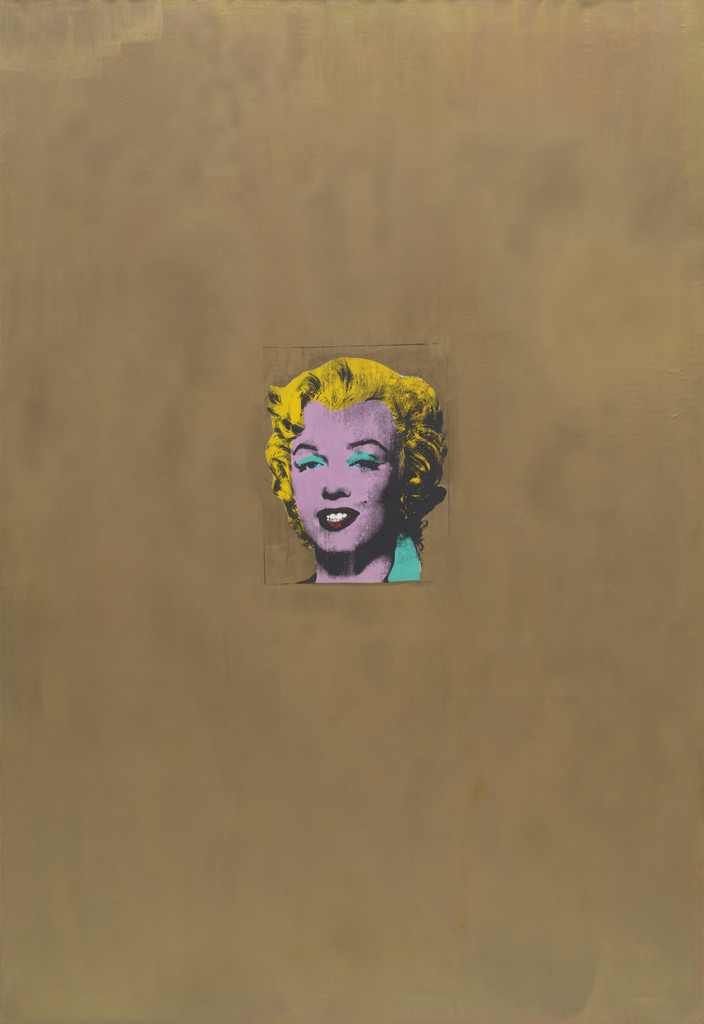 #2
#2
Gold Marilyn Monroe
Marilyn's face stands out like a sacred icon on a field of gold, while the screen print reminds us that this celebrity is already a reproduced image. Warhol treats fame, merchandise and disaster with the same framing and repetition processes, revealing the proximity between public desire and industrial circulation of images. With its founding icons, Pop Art replaces heroic uniqueness with the shared sign, series or common object. There repetition transforms resemblance into rhythm and reveals the gaps that the industrial image usually claims to erase. Dated 1962, the work associates Silkscreen ink and acrylic on canvas with a reflection on circulation, the repetition and transformation of ordinary images.
See at the museum →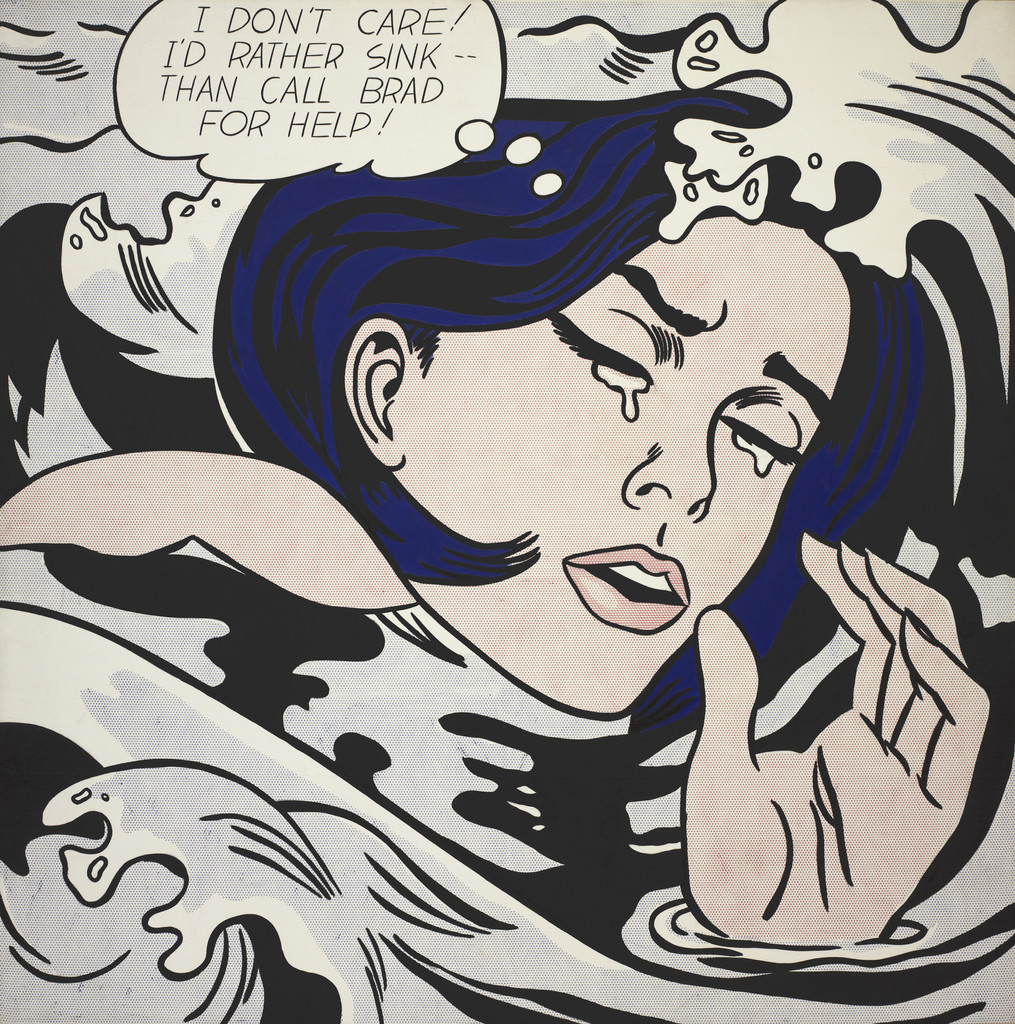 #3
#3
Drowning Girl
The dramatic framing, mechanical points and suspended sentence condense an entire romance printed in a single second of danger. Lichtenstein doesn't just copy the comic: he reconstructs his signs by hand for analyze how print creates emotion, movement and authority. With its founding icons, Pop Art replaces heroic uniqueness with the shared sign, series or common object. The change of scale moves the subject of the ordinary world towards a physical confrontation with the spectator. Dated 1963, the work combines Oil and acrylic on canvas with a reflection on the circulation, repetition and transformation of ordinary images.
See at the museum →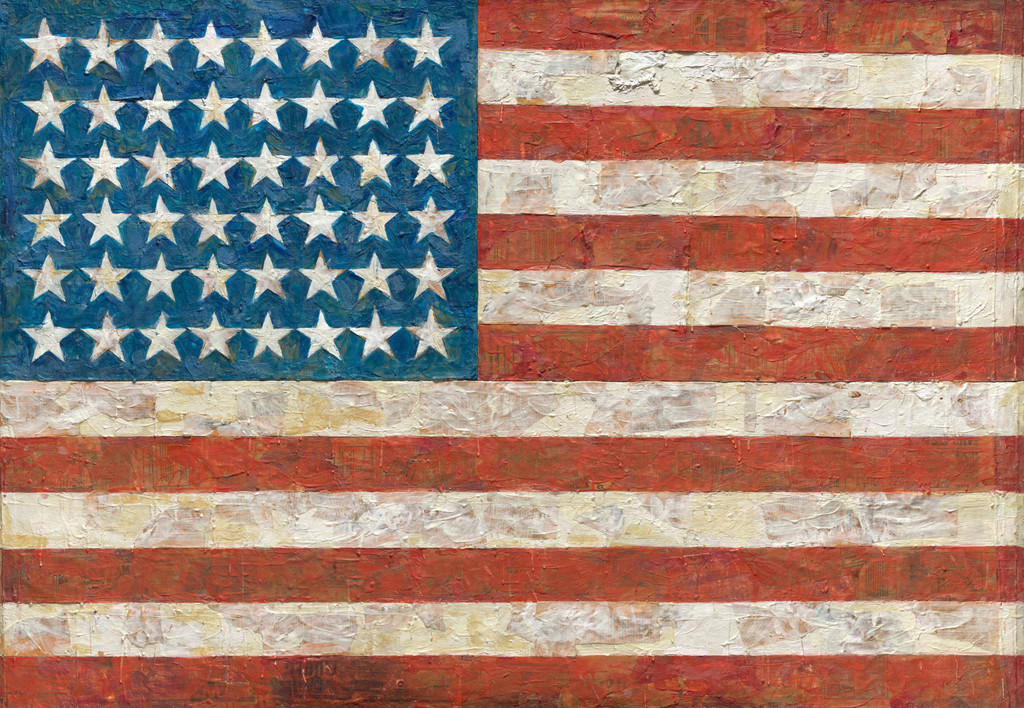 #4
#4
Flag
The encaustic thickens the flag and blurs the line between national emblem, painted surface and instantly recognizable everyday object. Johns chooses signs that the eye already knows in order to shift attention to them material manufacturing, their memory and their contradictions. With its founding icons, Pop Art replaces heroic uniqueness with the shared sign, series or common object. Color simplifies reading while accentuating tension between visual seduction, critical distance and the creation of desire. Dated 1954-55 (dated on reverse 1954), the work combines Encaustic, oil, and collage on fabric mounted on plywood, three panels with a reflection on circulation, the repetition and transformation of ordinary images.
See at the museum →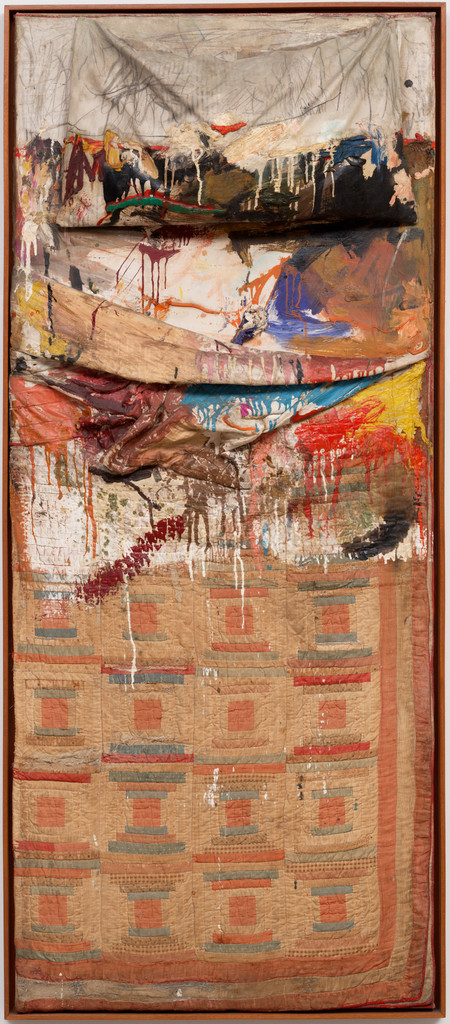 #5
#5
Bed
Sheets, pillows, paint and body marks bring the painting out of the wall: the intimate space becomes a surface where real life adheres to art. Rauschenberg brings objects, photographs and scraps into the space of the painting, where painting and the everyday world remain deliberately impossible to separate. With its founding icons, Pop Art replaces heroic uniqueness with the shared sign, series or common object. The surface retains traces of transfer, of collage or assembly which prevents the image from being reduced to a simple reproduction. Dated 1955, the work combines Oil and pencil on pillow, quilt, and sheet on wood supports with a reflection on circulation, repetition and transformation of ordinary images.
See at the museum →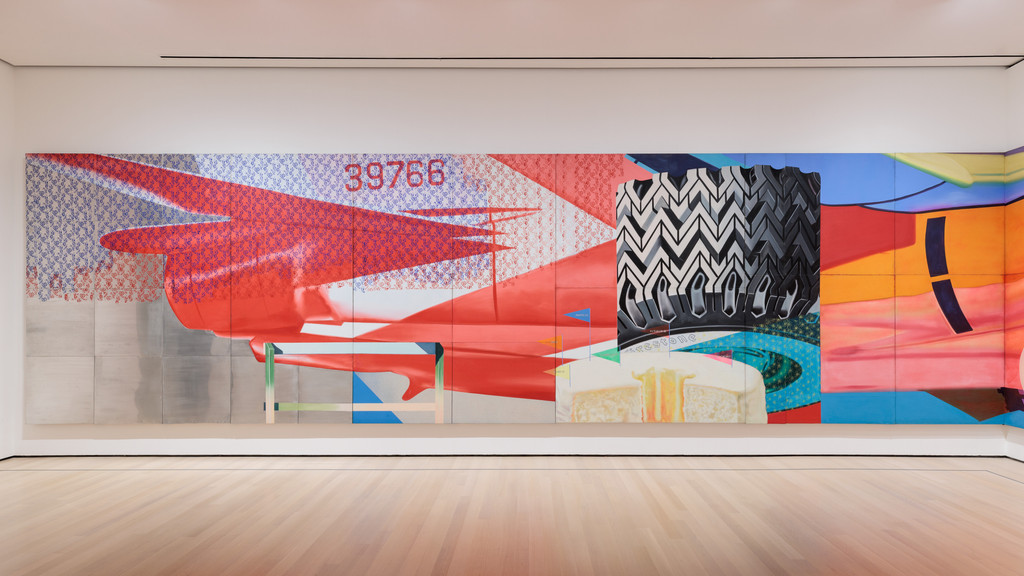 #6
#6
F-111
The immense panorama combines a military plane, advertising, light bulb, food and a child under a hairdryer, as if the whole of America were parading on a road sign. A former sign painter, Rosenquist uses enlargement advertising and editing fragments to transform visual abundance into critical experience. With its founding icons, Pop Art replaces heroic uniqueness with the shared sign, series or common object. The framing isolates it pattern until it is both immediately recognizable and strangely detached from its daily use. Dated 1964-65, the work combines Oil on canvas with aluminum, twenty-three sections with a reflection on circulation, the repetition and transformation of ordinary images.
See at the museum →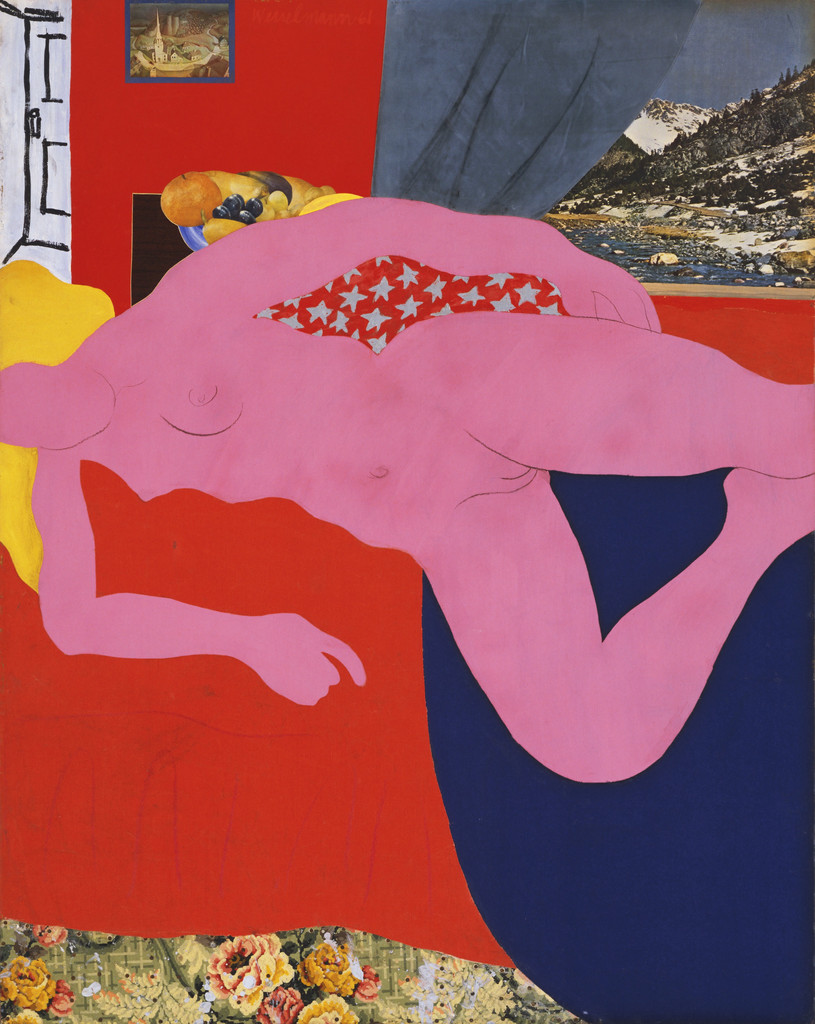 #7
#7
Great American Nude, 2
The female body, cut and smooth, meets the flag, the landscape and domestic fragments in an image that exposes both desire and its commercial fabrication. Wesselmann reinvents the nude and still life with the clear codes of advertising, while exposing the way in which modern desire is framed and consumed. With its founding icons, Pop Art replaces heroic uniqueness with the shared sign, series or common object. Repetition transforms resemblance in rhythm and reveals the gaps that the industrial image usually claims to erase. Dated 1961, the work combines Synthetic polymer paint, gesso, charcoal, enamel, oil, and collage on plywood with a reflection on the circulation, repetition and transformation of ordinary images.
See at the museum →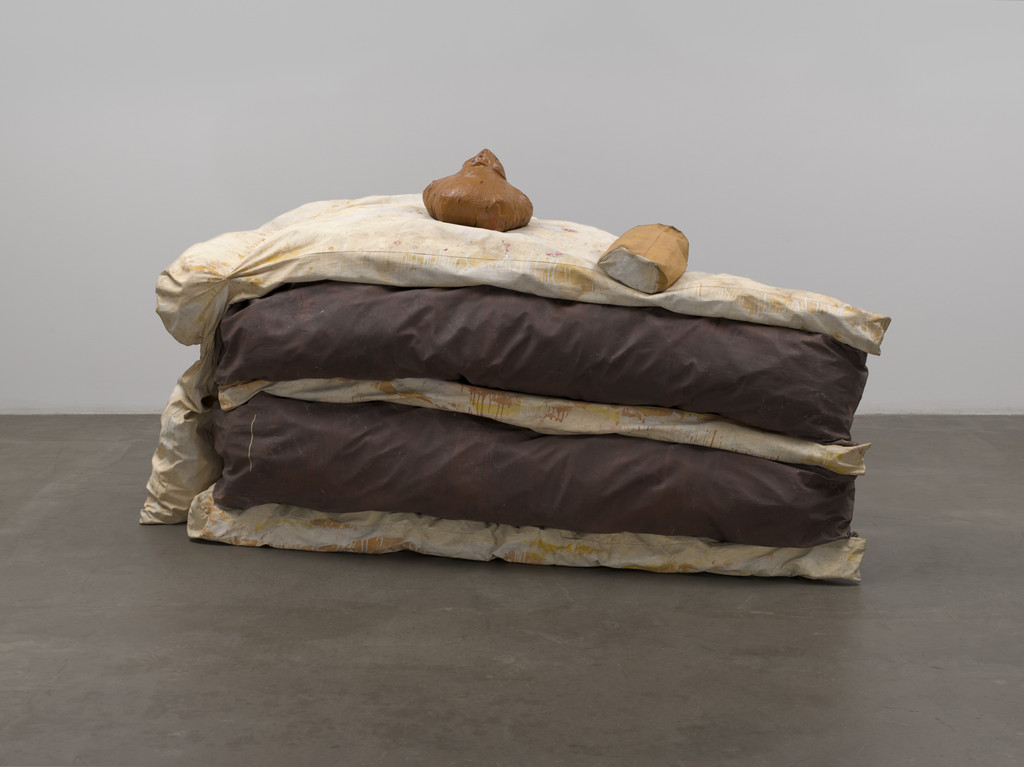 #8
#8
Floor Cake
The enlarged cake sags under its own weight: soft vinyl transforms a familiar pastry into soft, funny and slightly disturbing architecture. Oldenburg changes the scale, material and rigidity of ordinary objects in order to make strange what habit made seem transparent. With its founding icons, Pop Art replaces heroic uniqueness with the shared sign, series or common object. The change of scale moves the subject of the world ordinary towards a physical confrontation with the spectator. Dated 1962, the work combines Synthetic polymer paint and latex on canvas filled with foam rubber and cardboard boxes with a reflection on circulation, repetition and transformation of ordinary images.
See at the museum →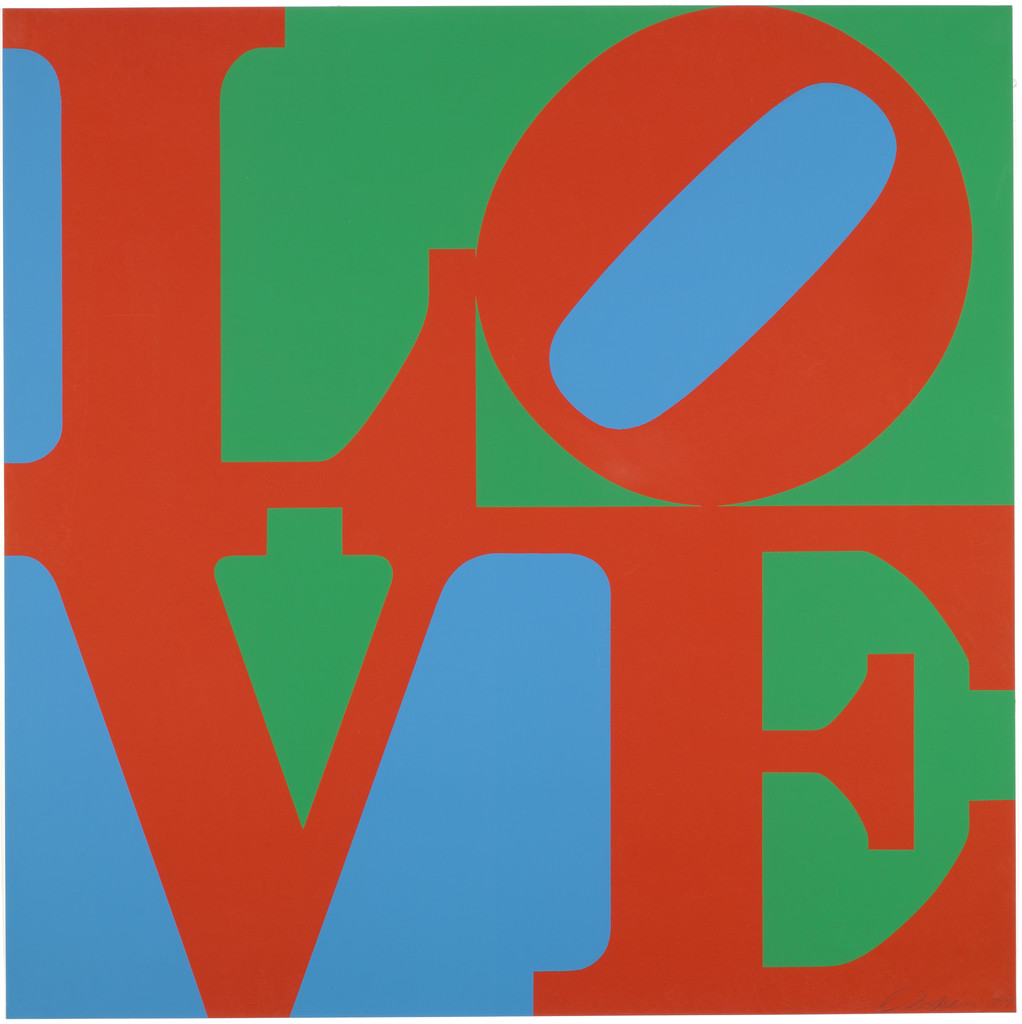 #9
#9
LOVE
Four letters are enough to make language an image. The inclined O animates the square and gives the word a presence as immediate as a logo. Indiana constructs public poetry from short words, numbers and similar shapes from the sign, between personal memory and collective language. With its founding icons, Pop Art replaces heroic uniqueness with the shared sign, series or common object. Color simplifies reading while accentuating tension between visual seduction, critical distance and the creation of desire. Dated 1967, the work combines Screenprint with a reflection on the circulation, repetition and transformation of ordinary images.
See at the museum →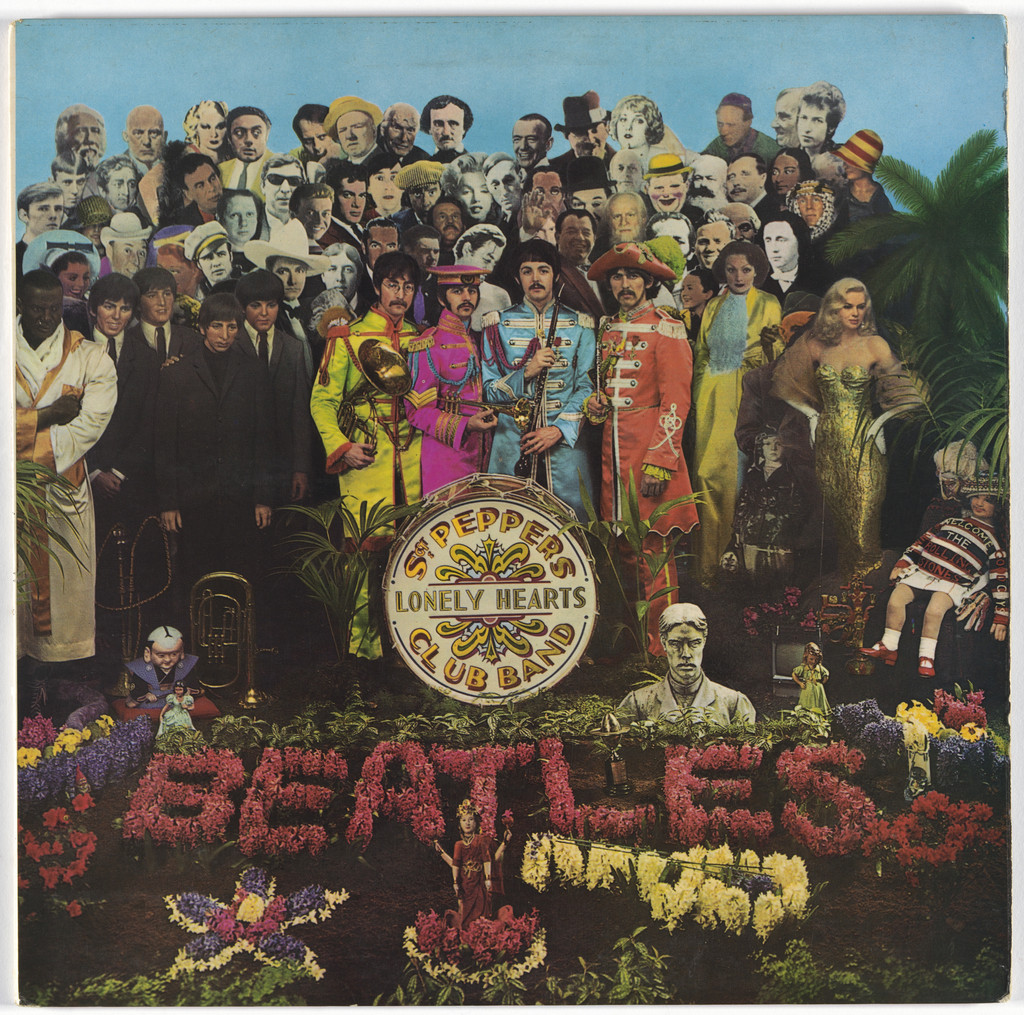 #10
#10
Album cover for The Beatles, Sgt. Pepper's Lonely Hearts Club Band
The cover brings together group portraits, celebrity collages, flowers and typography in a total scene where the album becomes an object of folk art. Blake approaches popular stars, collections and memorabilia with the affectionate precision of a painter of the history of ordinary cultures. With its founding icons, Pop Art replaces heroic uniqueness with the shared sign, series or common object. The surface preserves traces of transfer, collage or assembly which prevent the image from being reduced to a simple reproduction. Dated 1967, the work associates Lithograph with a reflection on the circulation, repetition and transformation of ordinary images.
See at the museum →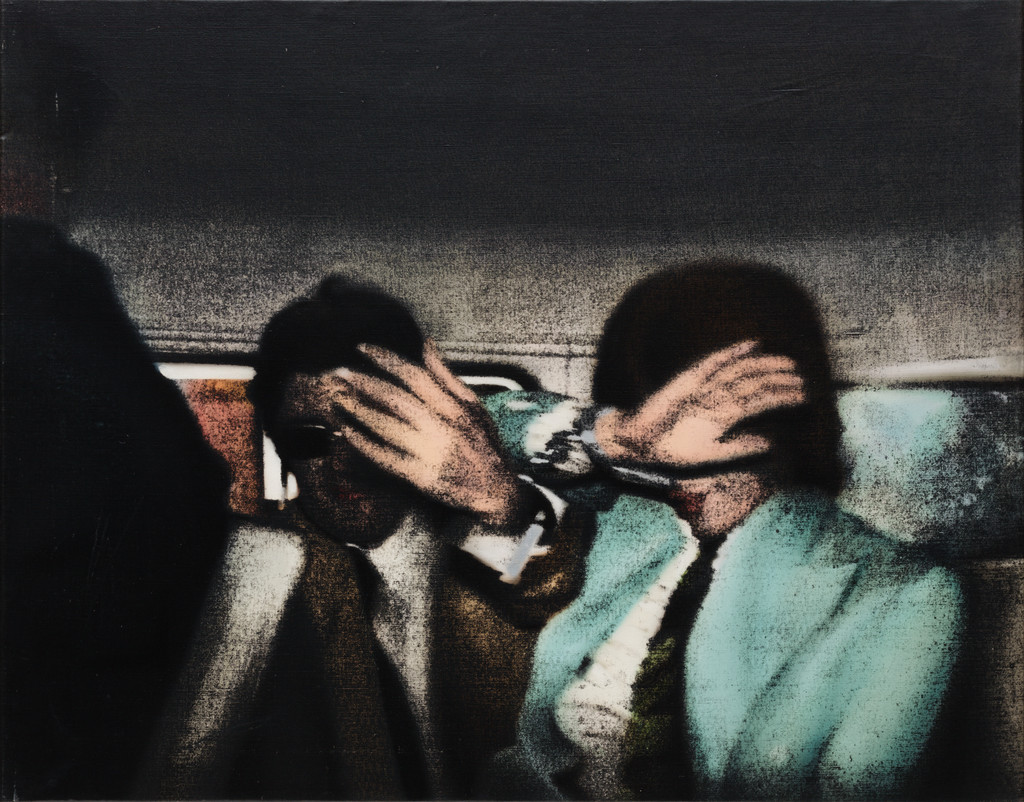 #11
#11
Swinging London 67 (c)
From a press photograph, Hamilton transforms a social arrest into a reflection on media spectacle, fame and the violence of the public eye. Hamilton considers the interior, fashion, television and the automobile as a system of images that shapes modern identity as much as fine arts. With its founding icons, Pop Art replaces heroic uniqueness with the shared sign, series or common object. Framing isolates the pattern until making it both immediately recognizable and strangely detached from its daily use. Dated 1968-69, the work combines Silkscreen ink and oil on canvas with a reflection on circulation, repetition and transformation ordinary images.
See at the museum →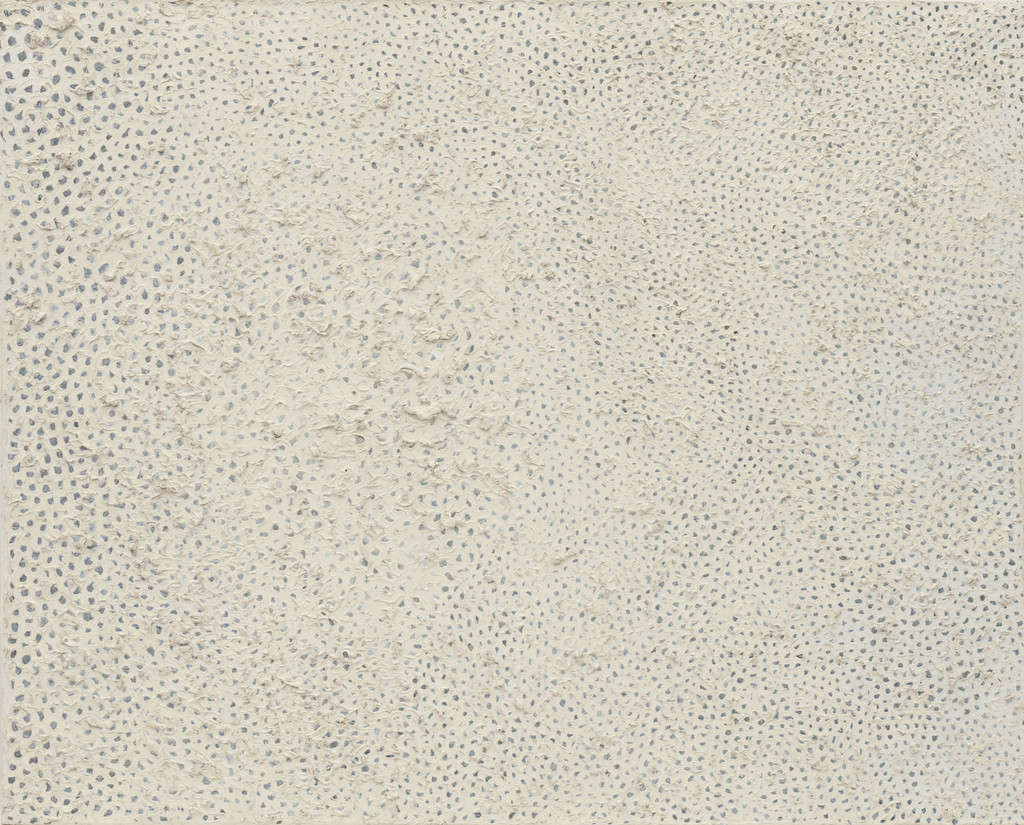 #12
#12
No. F
The white network propagates without center or hierarchy against the dark background; obsessive repetition meets the visual environment of Pop here without being reduced to commercial imagery. Kusama transforms repetition and proliferation into psychic experience; his work joins Pop through the object and the series while retaining a deeply personal logic. With its founding icons, Pop Art replaces heroic uniqueness with the shared sign, series or object common. Repetition transforms resemblance into rhythm and reveals the gaps that the industrial image usually claims to erase. Dated 1959, the work associates Oil on canvas with a reflection on circulation, repetition and the transformation of ordinary images.
See at the museum →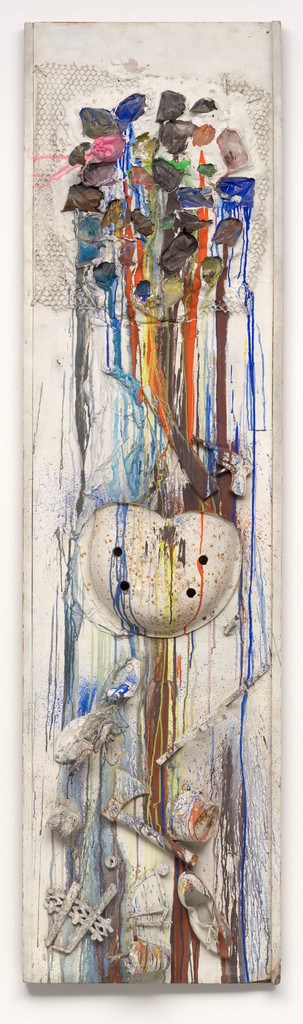 #13
#13
Shooting Painting American Embassy
Pigments, objects and rifle impacts make the surface the result of real action; the work transforms the destructive gesture into a collective event. Saint Phalle literally attacks the surface and the imposed roles, giving the spectacle of the work a physical, political and collective scope. With its founding icons, Pop Art replaces heroic uniqueness with the shared sign, series or common object. The change of scale moves the subject of the world ordinary towards a physical confrontation with the spectator. Dated 1961, the work combines Paint, plaster, wood, plastic bags, shoe, twine, metal seat, axe, metal can, toy gun, wire mesh, shot pellets, and other objects on wood with one reflection on the circulation, repetition and transformation of ordinary images.
See at the museum →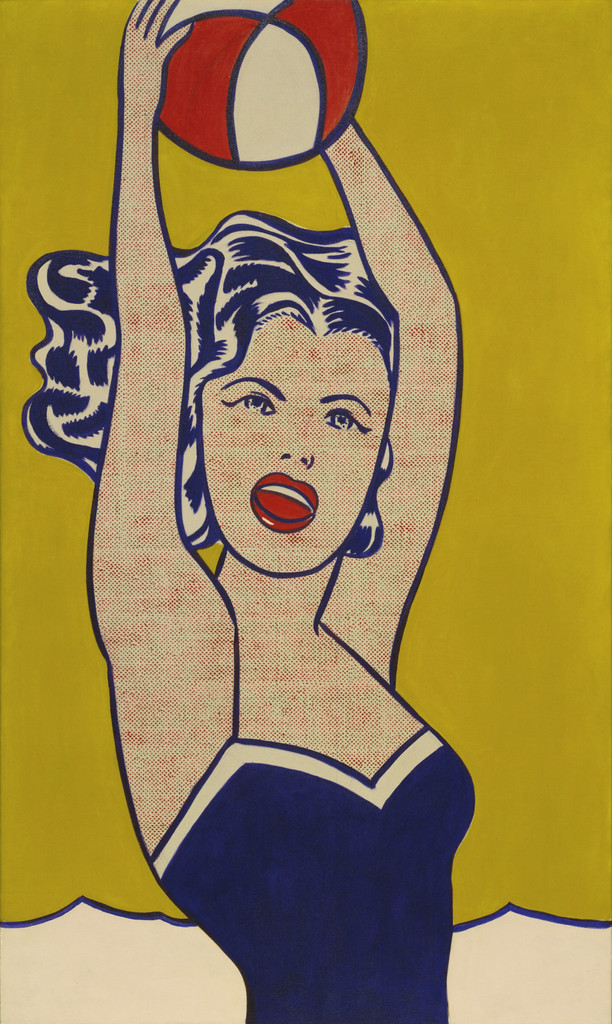 #14
#14
Girl with Ball
The red and white balloon, isolated against a simplified figure, conveys a leisure photograph into the clear language of the poster and the comic strip. Lichtenstein does not simply copy the comic strip: he reconstructs its hand signs to analyze how print creates emotion, movement and authority. With its founding icons, Pop Art replaces heroic uniqueness with the shared sign, series or common object. Color simplifies it reading while accentuating the tension between visual seduction, critical distance and the creation of desire. Dated 1961, the work combines Oil on canvas with a reflection on the circulation, repetition and transformation of images ordinary.
See at the museum →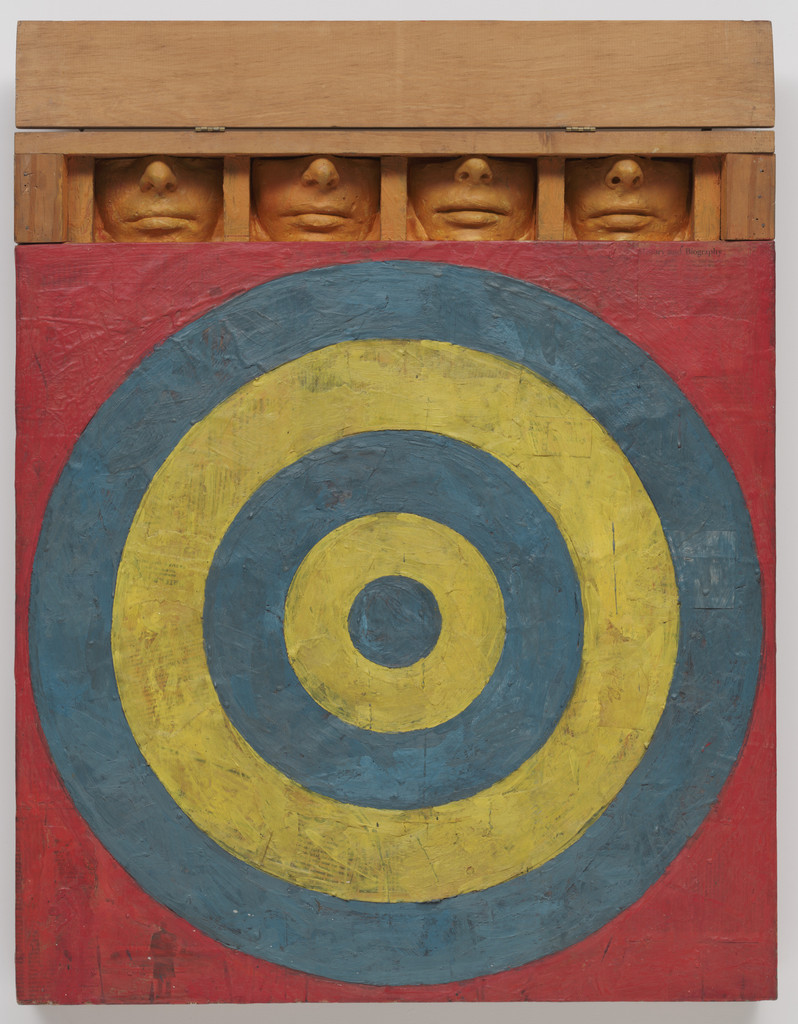 #15
#15
Target with Four Faces
The target promises a neutral and impersonal image, but the four molded faces bring the body, memory and enigma behind the sign. Johns chooses signs that the eye already knows in order to shift attention to them material manufacturing, their memory and their contradictions. With its founding icons, Pop Art replaces heroic uniqueness with the shared sign, series or common object. The surface retains traces of transfer, collage or assembly which prevents the image from being reduced to a simple reproduction. Dated 1955, the work combines Encaustic on newspaper and cloth over canvas mounted by four tinted-plaster faces in wood box with hinged front with a reflection on the circulation, repetition and transformation of ordinary images.
See at the museum →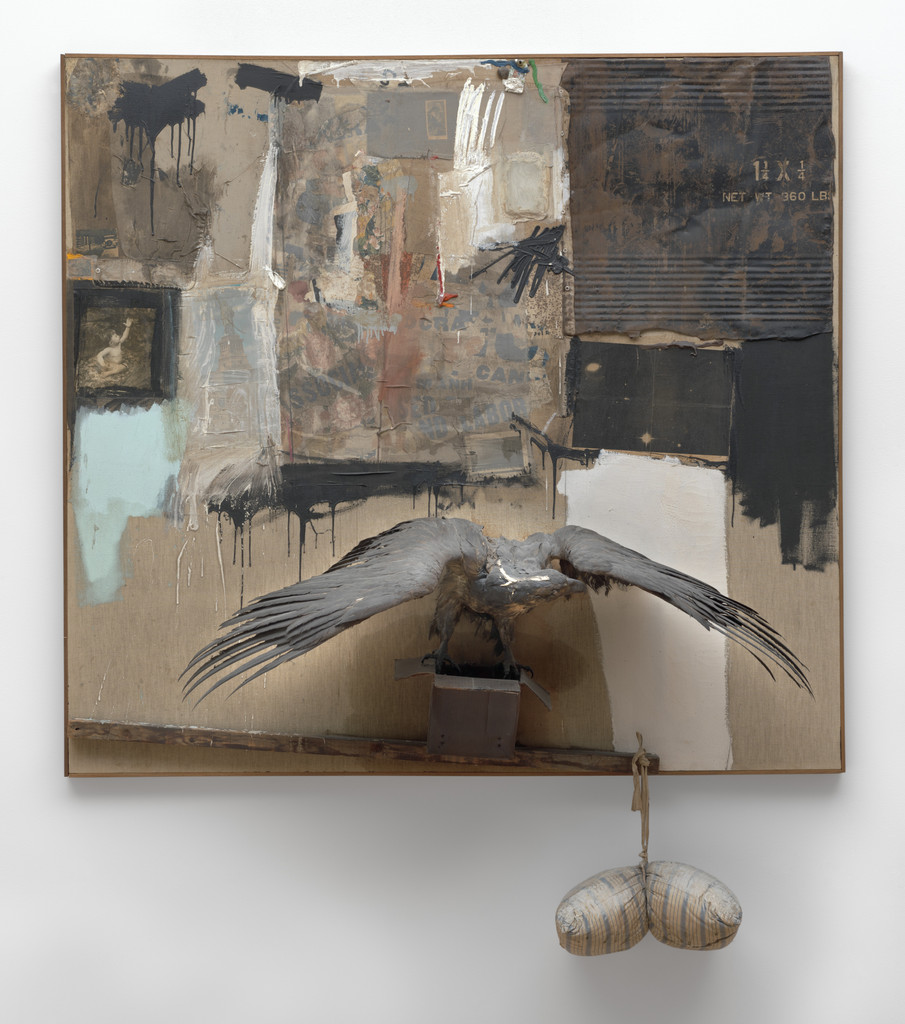 #16
#16
Canyon
A stuffed eagle emerges from an assembly of paint, fabric, photography and objects; the painting becomes a material territory where reality never ceases to interrupt the image. Rauschenberg brings objects, photographs and scraps into space of the painting, where painting and everyday world remain deliberately impossible to separate. With its founding icons, Pop Art replaces heroic uniqueness with the shared sign, series or common object. The framing isolates the pattern up to making it both immediately recognizable and strangely detached from its daily use. Dated 1959, the work combines Oil, pencil, paper, metal, photograph, fabric, wood, canvas, buttons, mirror, taxidermied eagle, cardboard, pillow, paint tube and other materials to a reflection on the circulation, repetition and transformation of ordinary images.
See at the museum →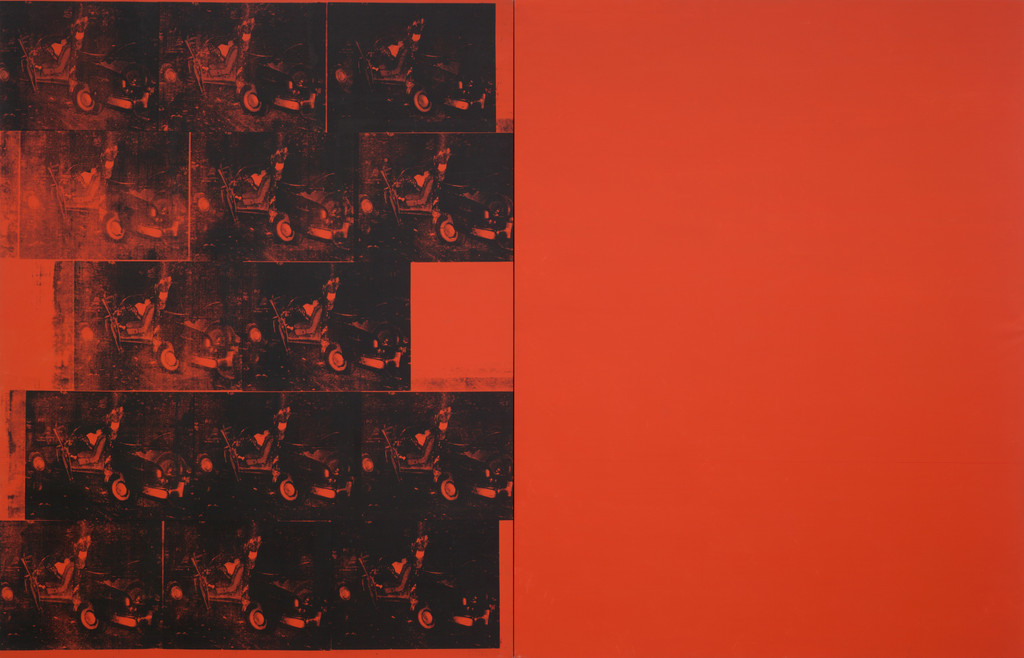 #17
#17
Orange Car Crash Fourteen Times
The same accident photograph repeats itself to the point of wearing out its violence. The orange field first attracts, then makes the coldness of the information more unbearable. Warhol treats fame, merchandise and disaster with the same framing and repetition processes, revealing the proximity between public desire and industrial circulation of images. With its founding icons, Pop Art replaces heroic uniqueness with the shared sign, series or common object. There repetition transforms resemblance into rhythm and reveals the gaps that the industrial image usually claims to erase. Dated 1963, the work associates Silkscreen ink on acrylic on two canvases with a reflection on circulation, the repetition and transformation of ordinary images.
See at the museum →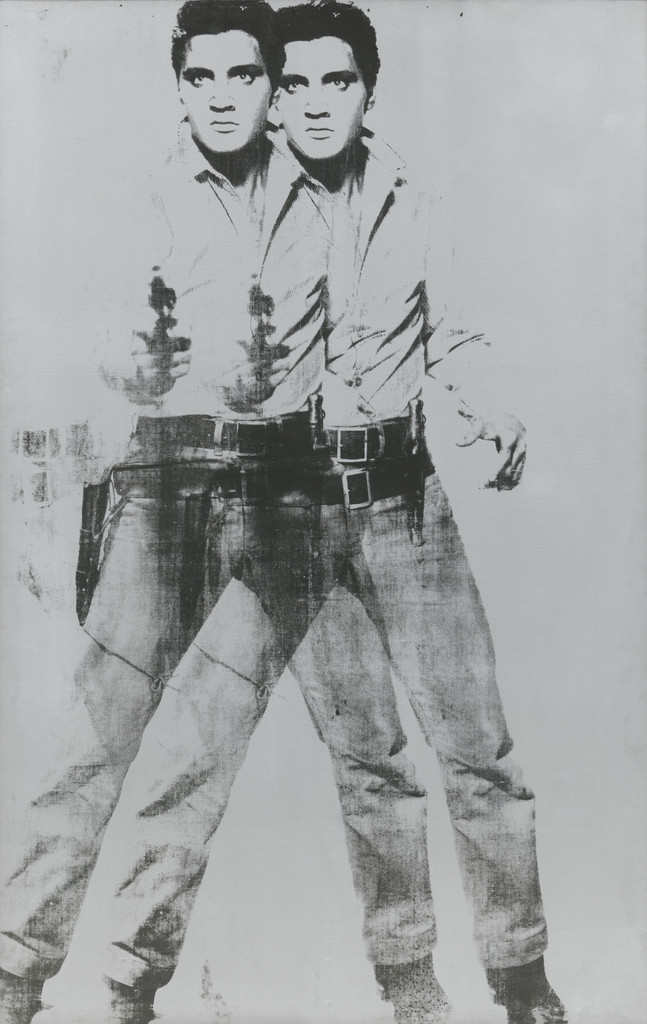 #18
#18
Double Elvis
Elvis' silhouette, multiplied like poorly positioned film, mixes Hollywood glamour, threat of a revolver and gradual disappearance of the star. Warhol treats fame, merchandise and disaster with the same processes framing and repetition, revealing the proximity between public desire and industrial circulation of images. With its founding icons, Pop Art replaces heroic uniqueness with the shared sign, series or common object. THE change of scale moves the subject from the ordinary world to a physical confrontation with the viewer. Dated 1963, the work combines Silkscreen ink on acrylic on canvas with a reflection on circulation, repetition and transformation of ordinary images.
See at the museum →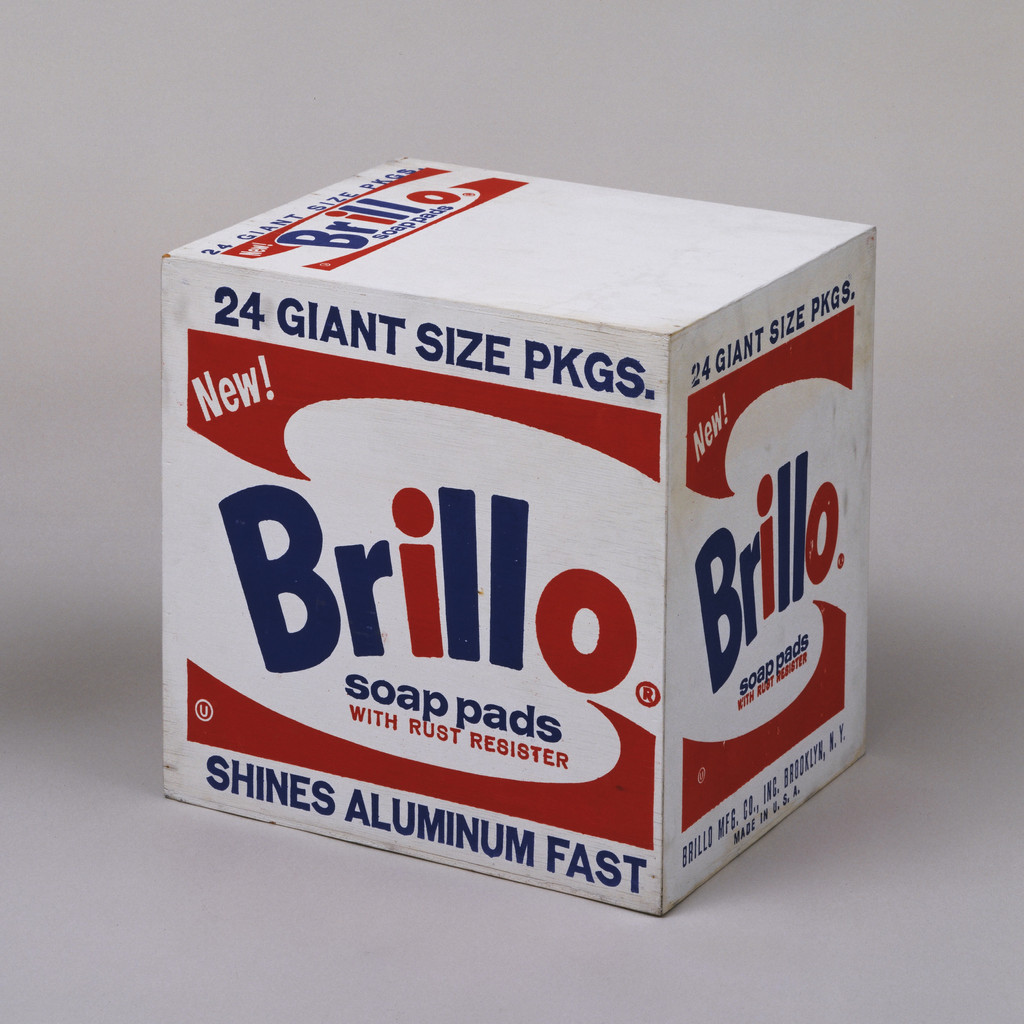 #19
#19
Brillo Box (Soap Pads)
The supermarket cardboard is reconstructed as a sculpture. The object appears identical to its industrial model, but its artisanal manufacturing destabilizes all certainty. Warhol treats fame, merchandise and disaster with them same framing and repetition processes, revealing the proximity between public desire and industrial circulation of images. With its founding icons, Pop Art replaces heroic uniqueness with the shared sign, series or object common. Color simplifies reading while accentuating the tension between visual seduction, critical distance and the creation of desire. Dated 1964, the work combines Polyvinyl acetate and silkscreen ink on wood with a reflection on circulation, repetition and transformation of ordinary images.
See at the museum →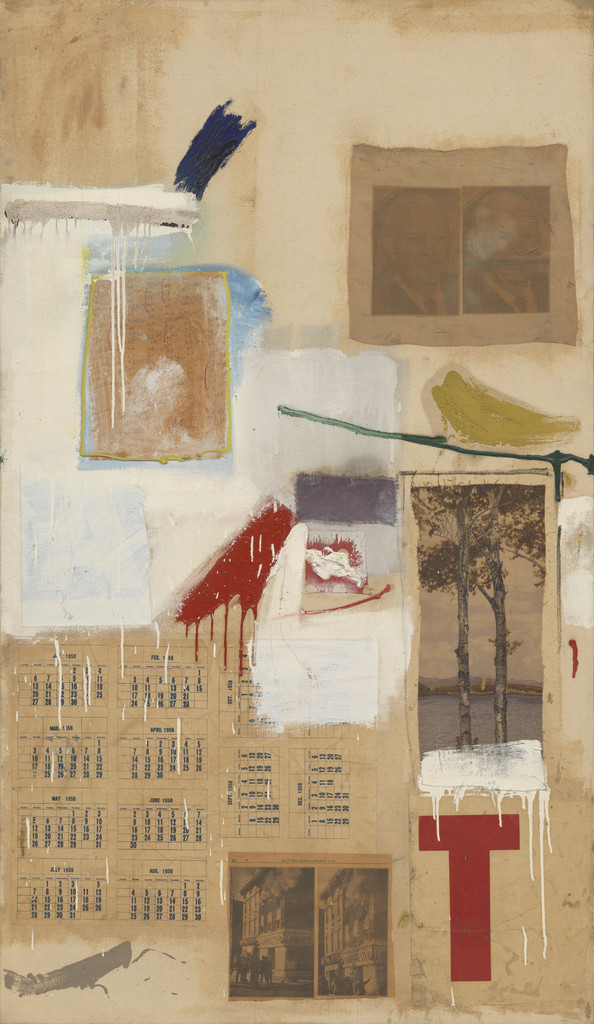 #20
#20
Factum II
Rauschenberg almost reproduces the composition of Factum I in order to show that spontaneity itself can be replayed, cited and manufactured. Rauschenberg brings objects, photographs and scraps into the space of the painting, where painting and everyday world remains deliberately impossible to separate. With its founding icons, Pop Art replaces heroic uniqueness with the shared sign, series or common object. The surface retains traces of transfer, collage or assembly which prevents the image from being reduced to a simple reproduction. Dated 1957, the work combines Oil, ink, pencil, pencil, paper, fabric, newspaper, printed reproductions, and painted paper on canvas with a reflection on the circulation, repetition and transformation of ordinary images.
See at the museum →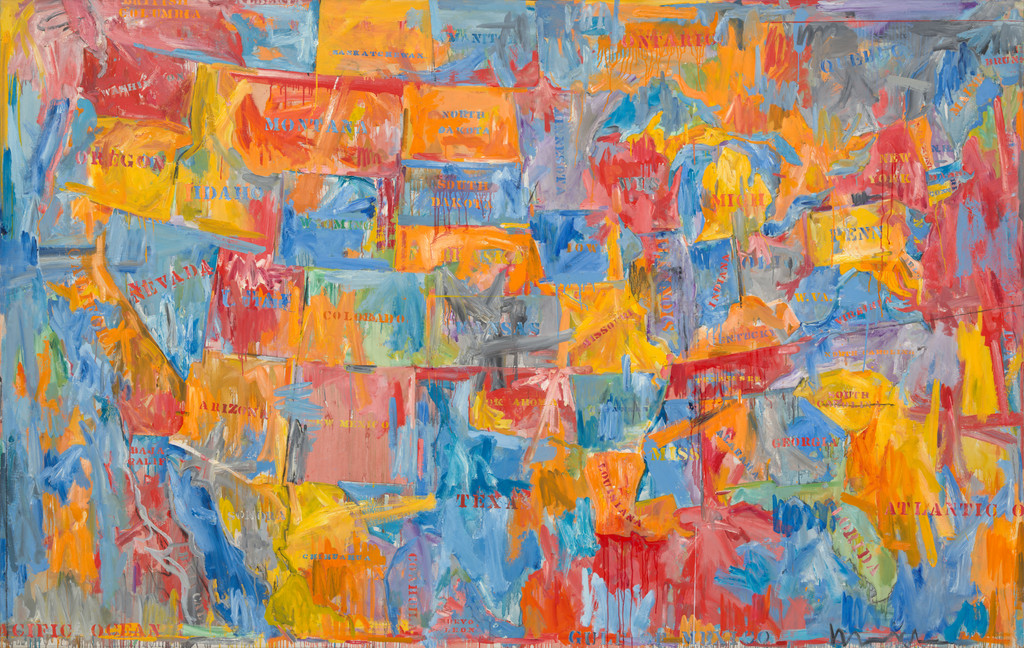 #21
#21
Map
The map of the United States becomes a matter of colors, names and gestures. The known territory thus resists the stable reading that cartography normally imposes. Johns chooses signs that the eye already knows in order to move attention to their material fabrication, their memory and their contradictions. With its founding icons, Pop Art replaces heroic uniqueness with the shared sign, series or common object. The framing isolates the pattern until the making it both immediately recognizable and strangely detached from its daily use. Dated 1961, the work combines Oil on canvas with a reflection on the circulation, repetition and transformation of ordinary images.
See at the museum →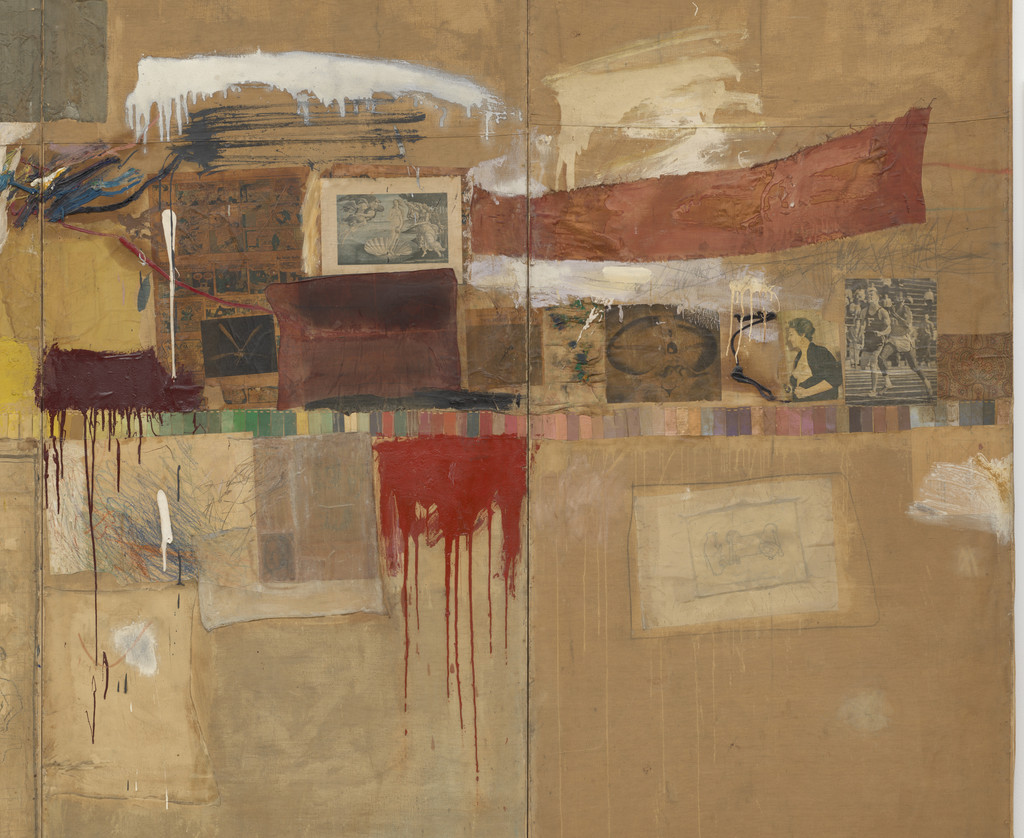 #22
#22
Rebus
Printed images, words, flat areas and gestures overlap like fragments of urban memory; the gaze advances by associations rather than by narrative. Rauschenberg brings objects, photographs and scraps into the space of the painting, where painting and the everyday world remain deliberately impossible to separate. With its founding icons, Pop Art replaces heroic uniqueness with the shared sign, the series or the common object. Repetition transforms resemblance into rhythm and reveals the gaps that the industrial image usually claims to erase. Dated 1955, the work combines Oil, alkyd paint, pencil, pencil, pastel, cut-and-pasted printed and painted papers, and fabric on canvas mounted and staped to fabric, three panels reflect on the circulation, repetition and transformation of ordinary images.
See at the museum →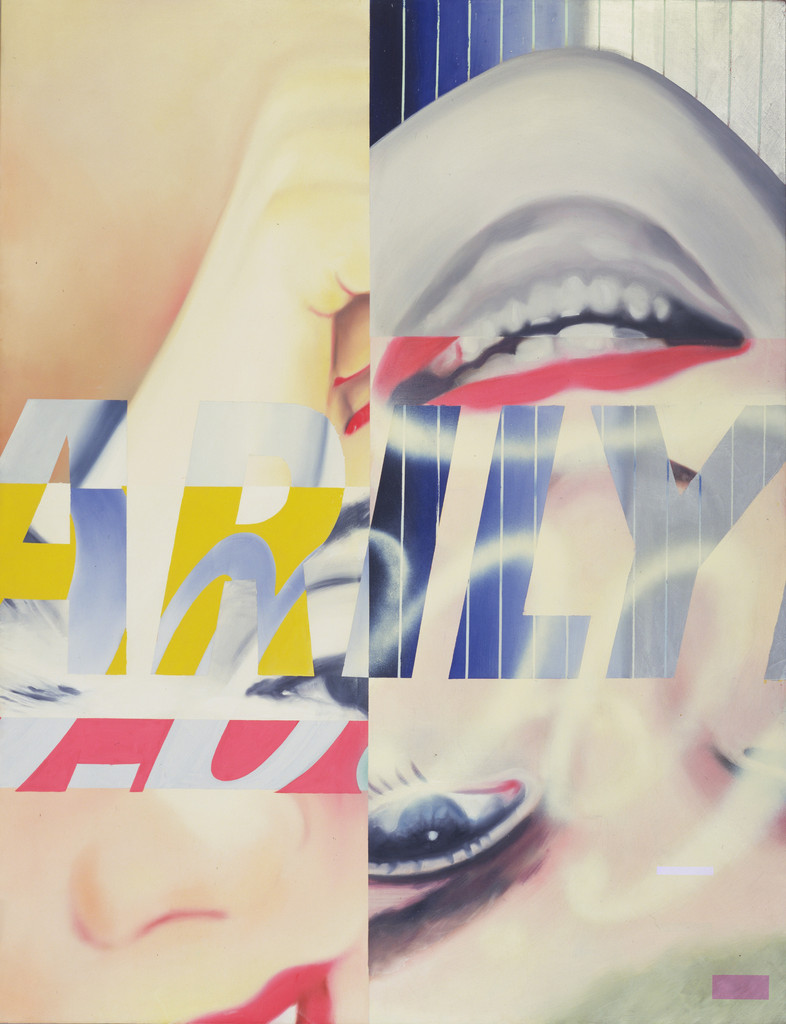 #23
#23
Marilyn Monroe, I
Rosenquist fragments Marilyn's face into hair, lips and smile. The star is no longer a portrait, but an advertising montage pushed to the point of strangeness. A former sign painter, Rosenquist uses advertising enlargement and the editing of fragments to transform visual abundance into critical experience. With its founding icons, Pop Art replaces heroic uniqueness with the shared sign, series or common object. The change of scale moves the subject of the ordinary world towards a physical confrontation with the spectator. Dated 1962, the work combines Oil and spray enamel on canvas with a reflection on the circulation, repetition and transformation of ordinary images.
See at the museum →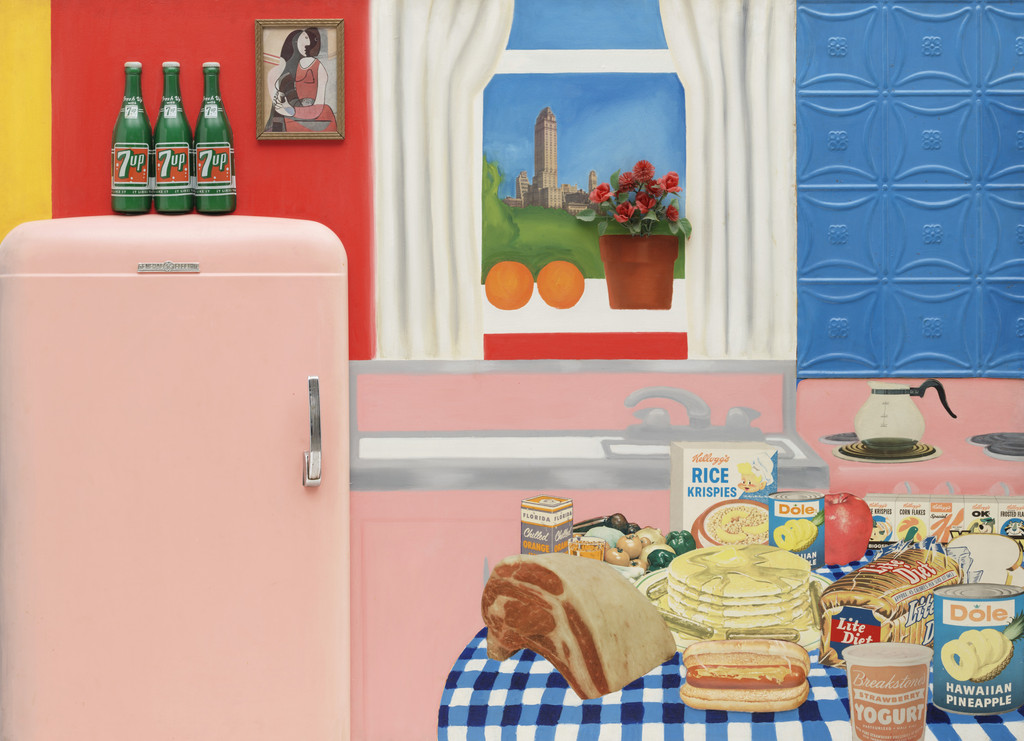 #24
#24
Still Life #30
A table, packaged foods, a refrigerator and reproductions of old masters make up a monumental inventory where the American home absorbs art history. Wesselmann reinvents the nude and still life with codes net of advertising, while exposing the way modern desire is framed and consumed. With its founding icons, Pop Art replaces heroic uniqueness with the shared sign, series or common object. Color simplifies it reading while accentuating the tension between visual seduction, critical distance and the creation of desire. Dated April 1963, the work combines Oil, enamel and acrylic on board with collage of printed advertisements, plastic flowers, refrigerator door, plastic replicas of 7-Up bottles, glazed and framed color reproduction, and stamped metal to a reflection on the circulation, repetition and transformation of ordinary images.
See at the museum →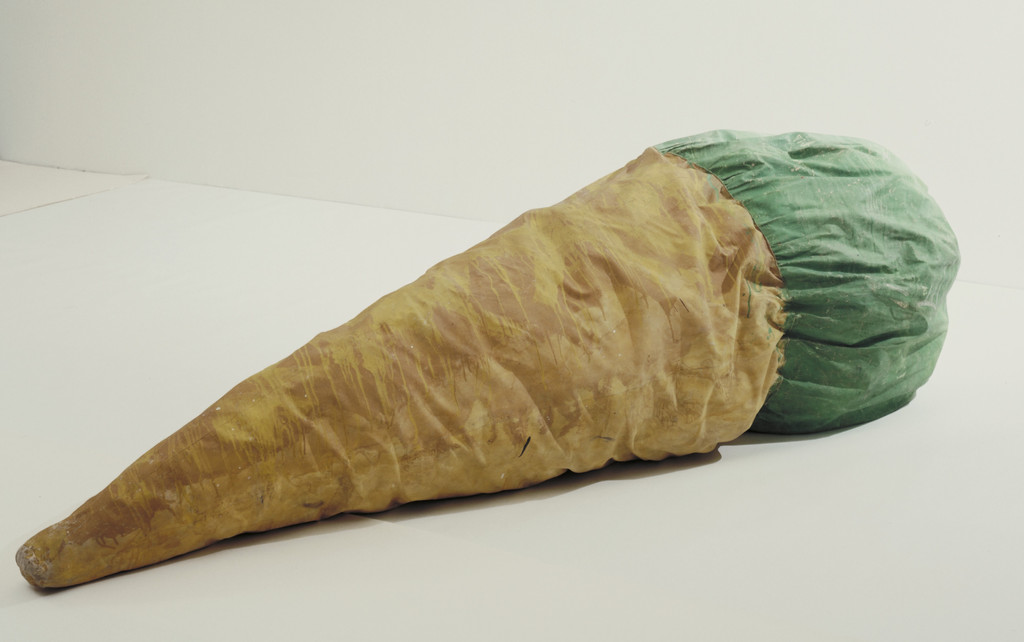 #25
#25
Floor Cone
The inverted horn becomes a monumental volume whose flexibility contradicts the scale; the rapid pleasure of consumption takes the form of an unstable monument. Oldenburg changes the scale, material and rigidity of ordinary objects in order to make strange what habit made appear transparent. With its founding icons, Pop Art replaces heroic uniqueness with the shared sign, series or common object. The surface retains traces of transfer, of collage or assembly which prevents the image from being reduced to a simple reproduction. Dated 1962, the work combines Synthetic polymer paint on canvas filled with foam rubber and cardboard boxes with a reflection on circulation, the repetition and transformation of ordinary images.
See at the museum →Hamilton, Paolozzi, Blake, Caulfield, Saint Phalle and their contemporaries show that Pop was also born from collage, music and political criticism.
 #26
#26
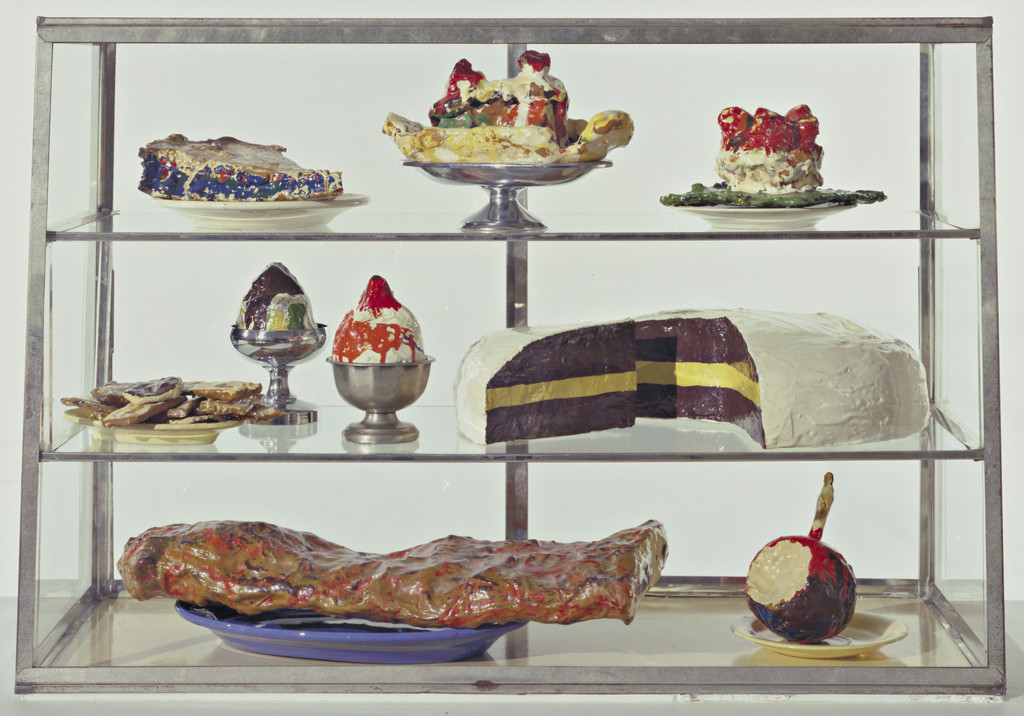
Pastry Case, I
Painted and modeled pastries occupy a real window. The view of the museum joins that of the customer in front of a counter, between desire, illusion and choice. Oldenburg modifies the scale, material and rigidity of ordinary objects in order to make strange what habit made seem transparent. In British and European homes, Pop does not have a unique style: collage, press, music and politics produce very different responses. Framing isolates the pattern until it is both instantly recognizable and strangely detached from its everyday use. Dated 1961-62, the work combines Burlap and muslin soaked in plaster, painted with enamel, metal bowls, and ceramic plates in glass-and-metal case for a reflection on the circulation, repetition and transformation of ordinary images.
See at the museum →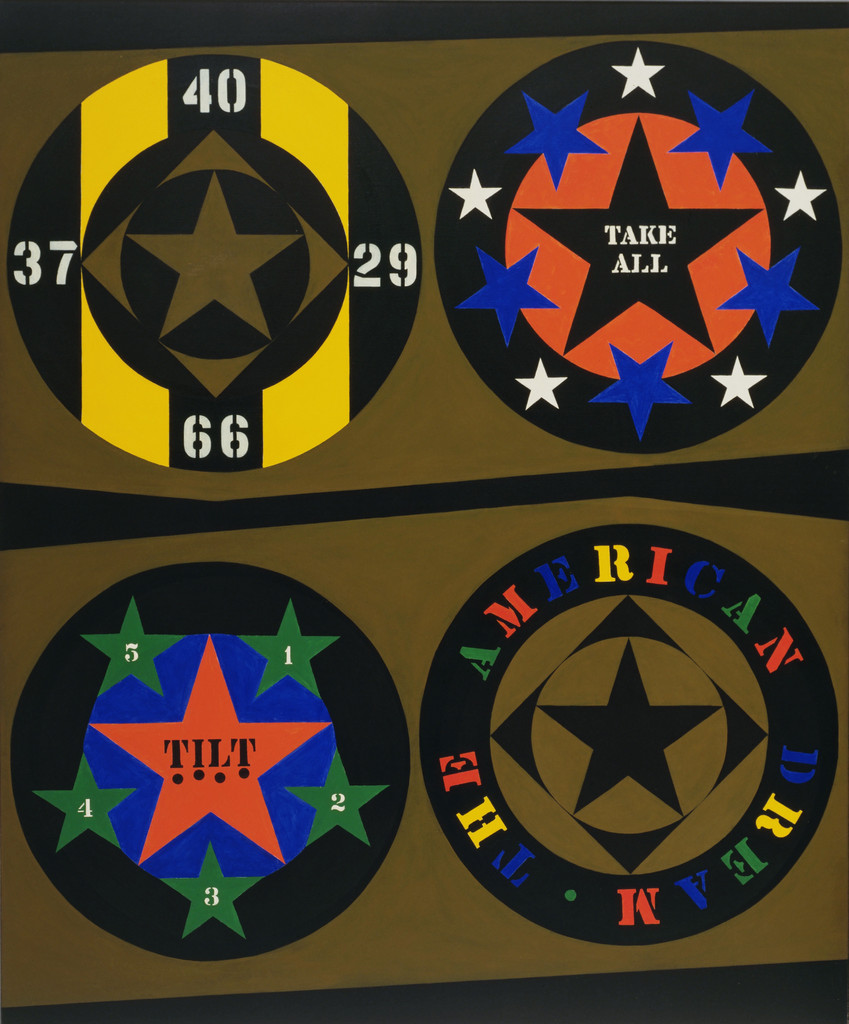 #27
#27
The American Dream, I
Circles, stars, words and numbers organize an American mythology made of slogans. The painting reads like a sign in which each sign retains a poetic ambiguity. Indiana constructs public poetry from short words, numbers and shapes close to the sign, between personal memory and collective language. In British and European homes, Pop does not have a single style: collage, press, music and politics produce answers very different. Repetition transforms resemblance into rhythm and reveals the gaps that the industrial image usually claims to erase. Dated 1961, the work associates Oil on canvas with a reflection on circulation, the repetition and transformation of ordinary images.
See at the museum →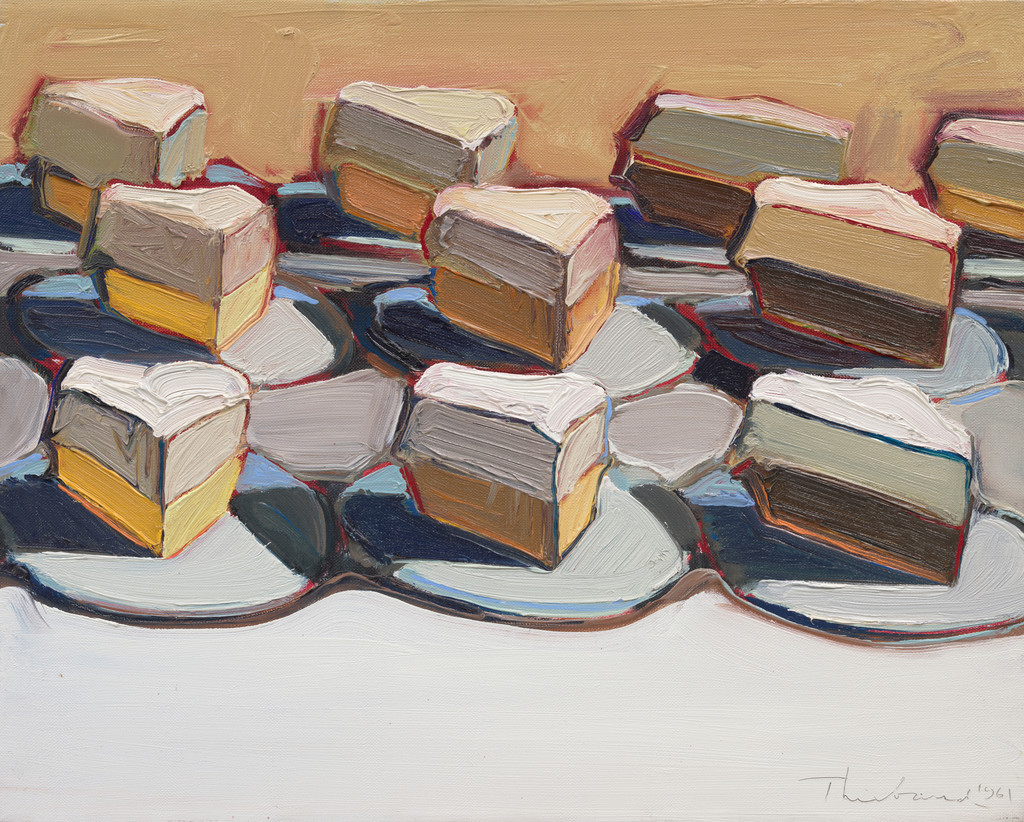 #28
#28
Cut Meringues
The pie slices are painted with an almost architectural density; their gourmet alignment also becomes a subtle study of light, material and repetition. Thiebaud paints ordinary foods with one material and one attentive light, now together commercial seduction and pictorial observation. In British and European homes, Pop does not have a unique style: collage, press, music and politics produce very answers different. The change of scale moves the subject from the ordinary world towards a physical confrontation with the spectator. Dated 1961, the work combines Oil on canvas with a reflection on circulation, repetition and transformation ordinary images.
See at the museum →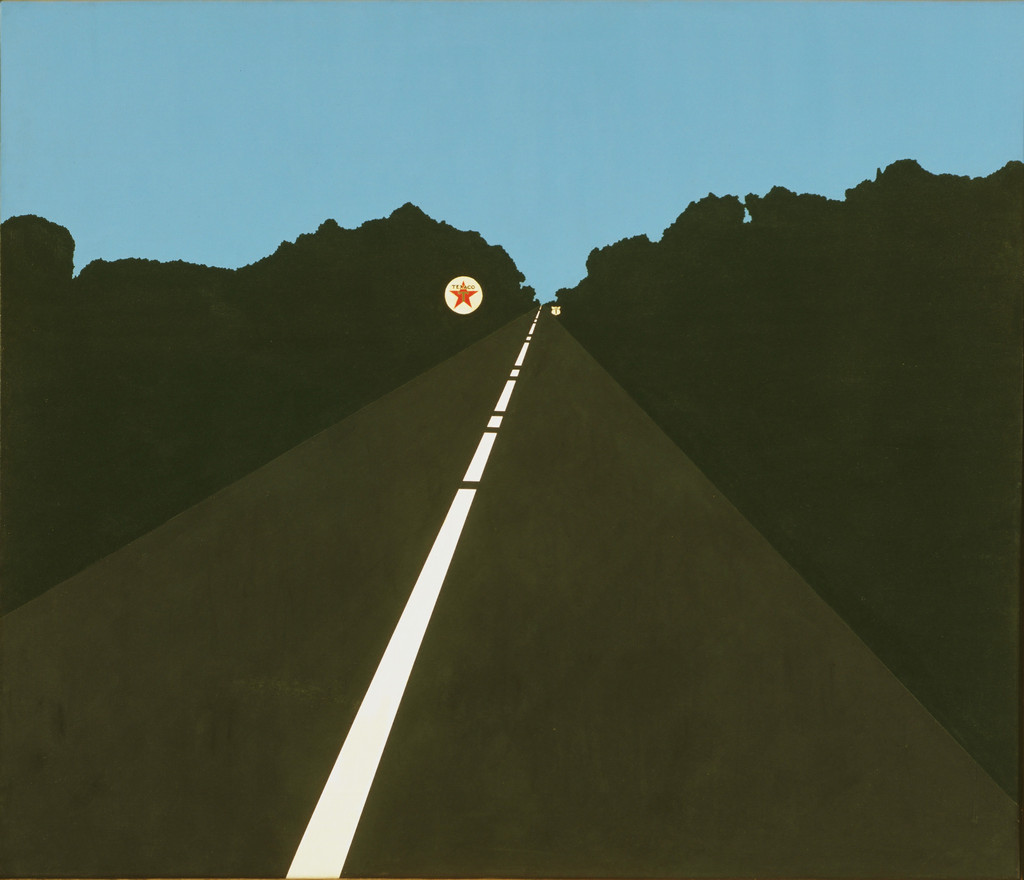 #29
#29
US Highway 1, Number 5
The road shield floats in a simplified space where the road sinks towards the horizon. American travel is reduced to its most effective signal. D'Arcangelo makes the road and its signage a pictorial alphabet where the landscape american merges with its infrastructure. In British and European homes, Pop does not have a single style: collage, press, music and politics produce very different responses. Color simplifies it reading while accentuating the tension between visual seduction, critical distance and the creation of desire. Dated 1962, the work combines Acrylic on canvas with a reflection on the circulation, repetition and transformation of images ordinary.
See at the museum →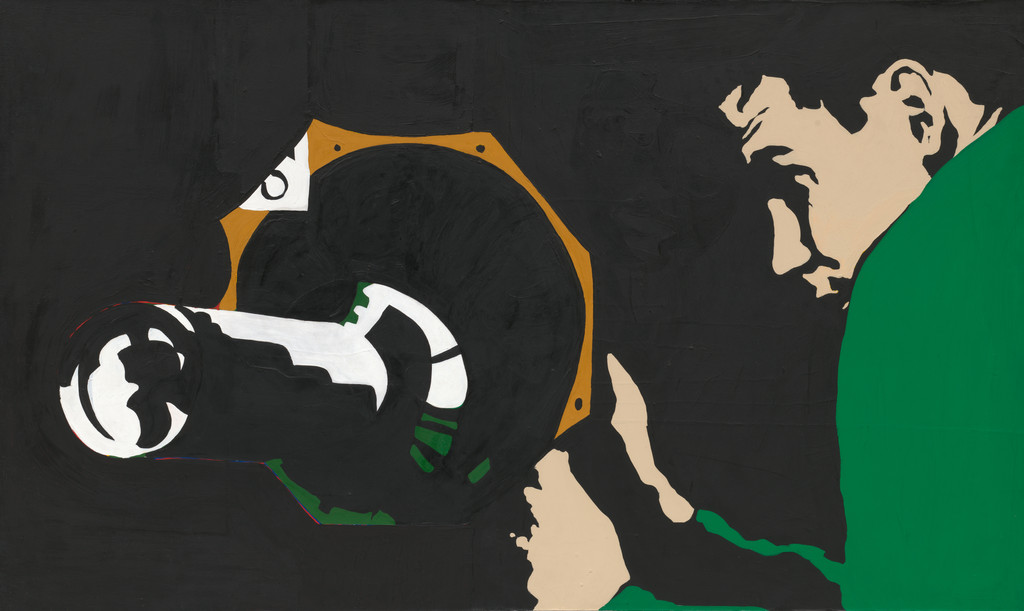 #30
#30
Hold your Fire (Men and Machines)
Drexler takes a scene of male violence and isolates it in colorful areas. The seductive Pop vocabulary becomes a dry critique of stories of domination. Drexler diverts press and cinema images in order to show the violence hidden beneath their spectacular effectiveness. In British and European homes, Pop does not have a unique style: collage, press, music and politics produce very different responses. The surface preserves them traces of transfer, collage or assembly which prevent the image from being reduced to a simple reproduction. Dated 1966, the work combines Acrylic and paper on canvas with a reflection on circulation, repetition and transformation ordinary images.
See at the museum →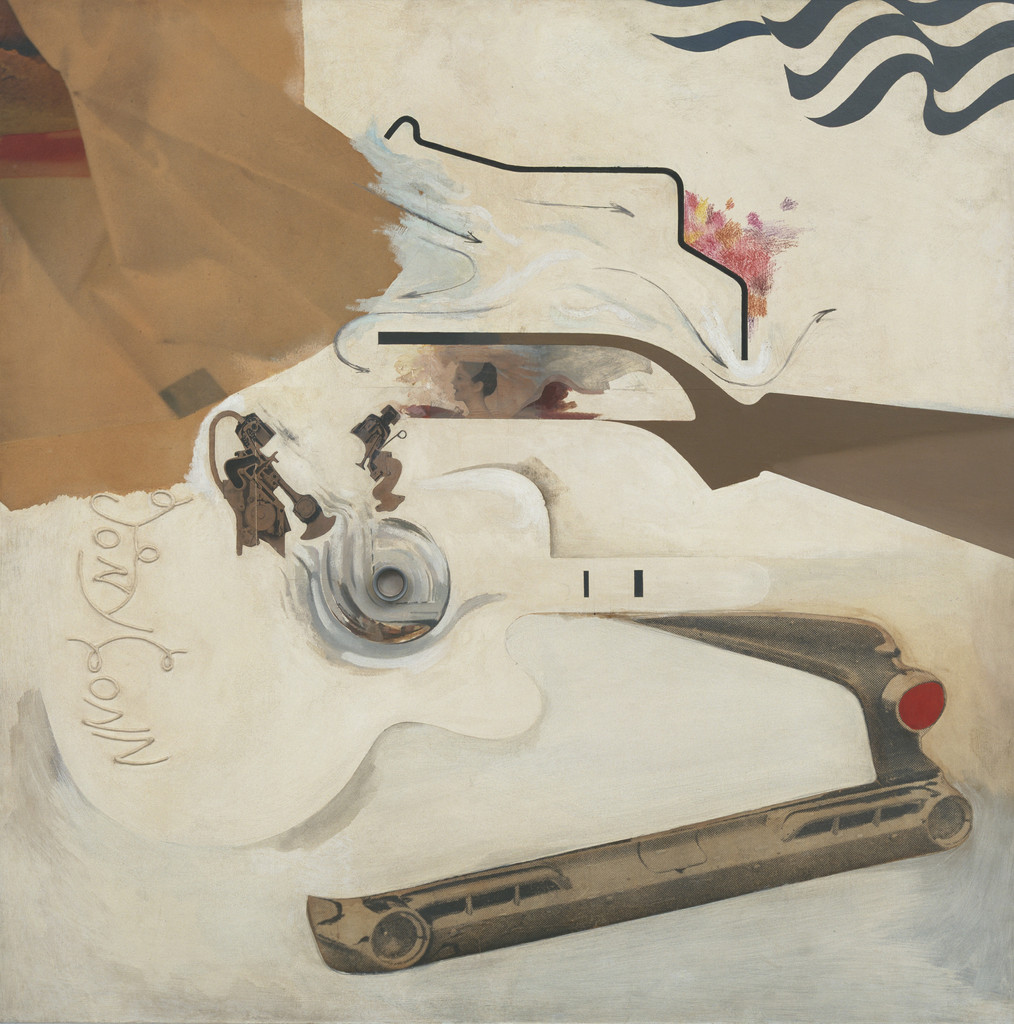 #31
#31
Glorious Techniculture
Hamilton juxtaposes automobile, pin-up, household appliances and futuristic architecture to show how modern desire is produced by the assembly of goods. Hamilton views interior, fashion, television and automobiles as an image system that shapes modern identity as much as fine arts. In British and European homes, Pop does not have a single style: collage, press, music and politics produce very different responses. The framing isolates the pattern until it is both immediately recognizable and strangely detached from its daily use. Dated 1961-64, the work combines Oil and collage on panel with a reflection on circulation, repetition and the transformation of ordinary images.
See at the museum →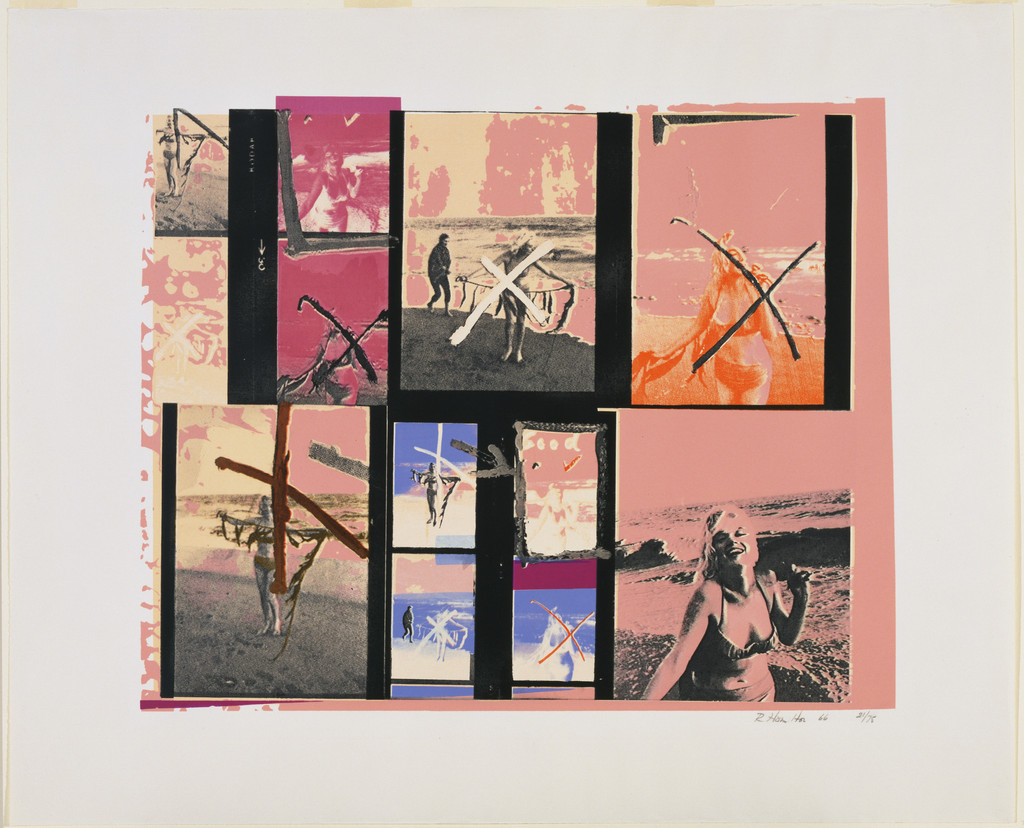 #32
#32
My Marilyn
Marilyn's photographs are repeated, crossed out and manipulated like on a contact sheet; the work confronts public fantasy and media selection. Hamilton views the interior, fashion, television and automobiles as one image system that shapes modern identity as much as fine arts. In British and European homes, Pop does not have a unique style: collage, press, music and politics produce very different responses. There repetition transforms resemblance into rhythm and reveals the gaps that the industrial image usually claims to erase. Dated 1965, published 1966, the work associates Screenprint with a reflection on circulation, repetition and the transformation of ordinary images.
See at the museum →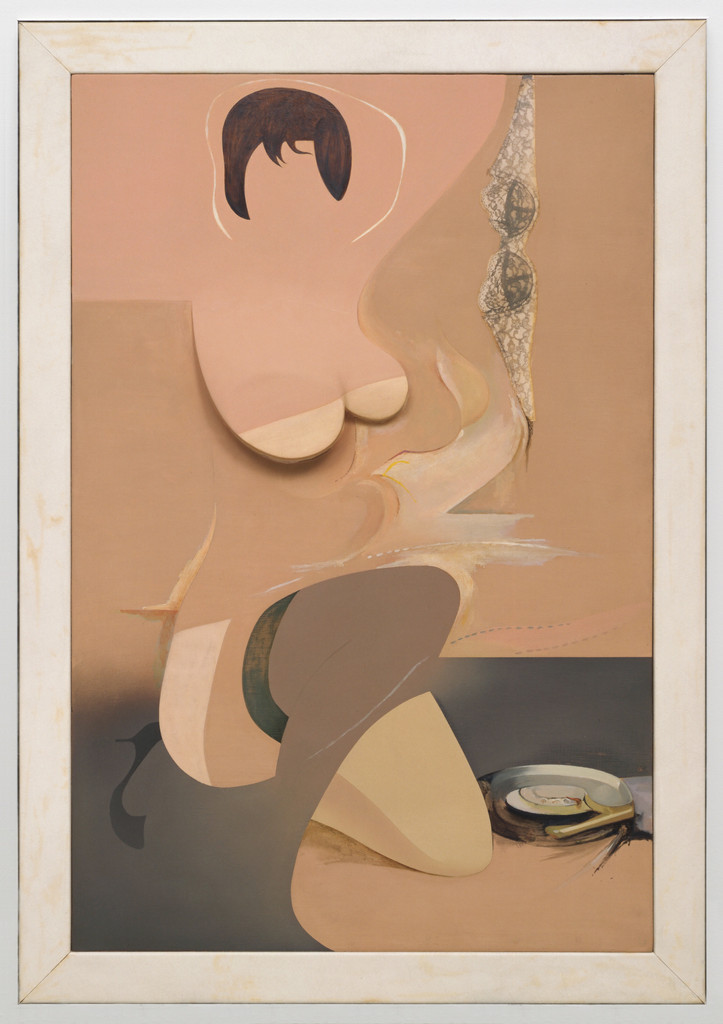 #33
#33
Pin-up
The pin-up body and graphic signs occupy an artificial space that hesitates between painting, magazine page and billboard. Hamilton views the interior, fashion, television and automobiles as a system of images which shapes modern identity as much as fine arts. In British and European homes, Pop does not have a single style: collage, press, music and politics produce very different responses. The change scale moves the subject from the ordinary world to a physical confrontation with the viewer. Dated 1961, the work combines Oil, cellulose, and collage on panel with a reflection on the circulation, repetition and transformation of ordinary images.
See at the museum →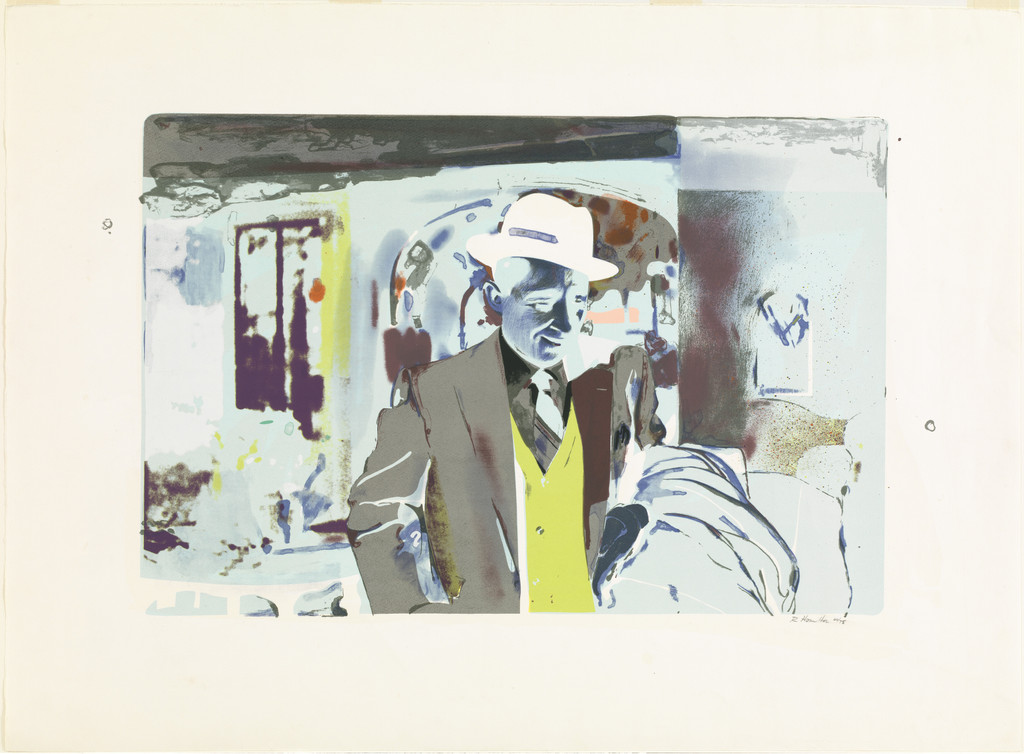 #34
#34
I'm dreaming of a white Christmas
Bing Crosby's television image becomes a grainy, spectral surface; Christmas nostalgia is filtered by the device that broadcasts it. Hamilton views the interior, fashion, television and automobile as a system of images which shapes modern identity as much as fine arts. In British and European homes, Pop does not have a unique style: collage, press, music and politics produce very different responses. Color simplifies reading while accentuating the tension between visual seduction, critical distance and the creation of desire. Dated 1967, the work combines Screenprint with a reflection on the circulation, repetition and transformation of ordinary images.
See at the museum →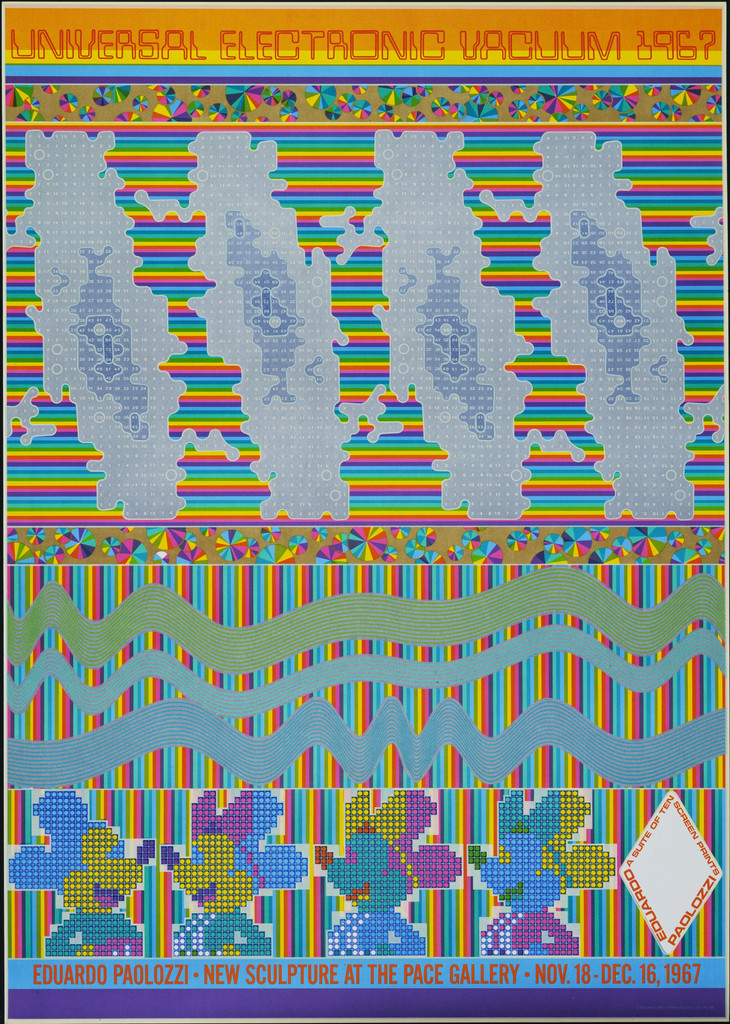 #35
#35
Universal Electronic Vacuum 1967
Paolozzi organizes circuits, typography and technical fragments like an imaginary control board; the modern machine becomes both subject and method of composition. Paolozzi assembles science, advertising, cinema and machine into compositions where collage becomes an instrument of knowledge of the contemporary world. In British and European homes, Pop does not have a unique style: collage, press, music and politics produce very answers different. The surface retains traces of transfer, collage or assembly which prevent the image from being reduced to a simple reproduction. Dated 1967, the work associates Silkscreen and offset lithograph with a reflection on the circulation, repetition and transformation of ordinary images.
See at the museum →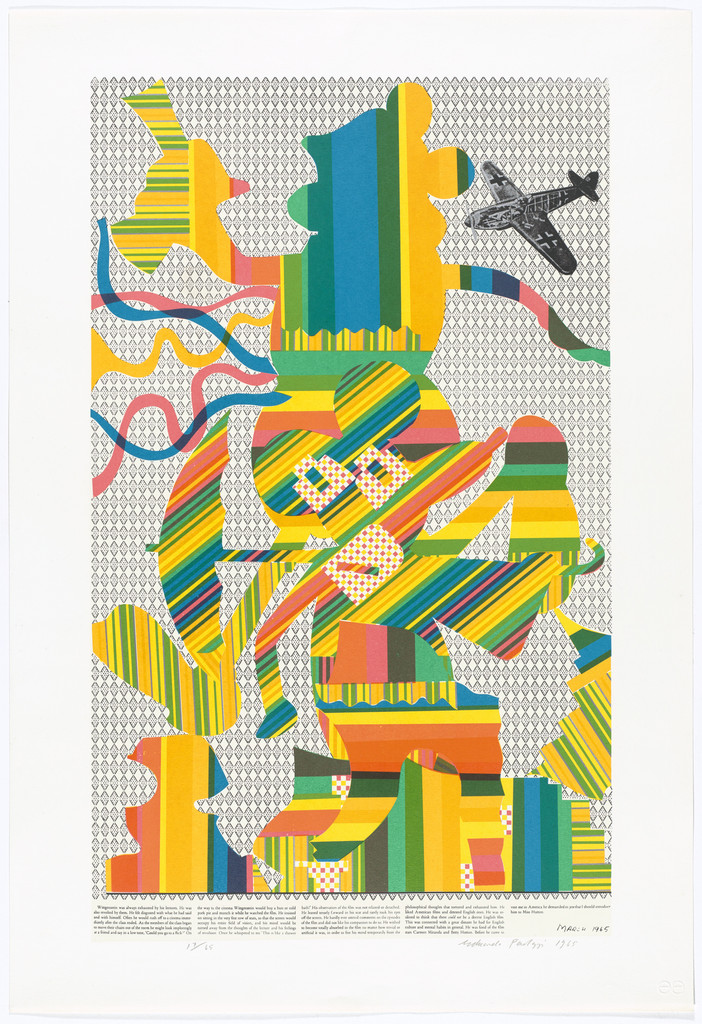 #36
#36
Wittgenstein at the Cinema Admires Betty Grable (plate, folio 15) from As Is When
The philosopher and the film actress meet in a saturated collage where scholarly culture, glamor and mechanical reproduction refuse any hierarchy. Paolozzi assembles science, advertising, cinema and machine in compositions where the collage becomes an instrument of knowledge of the contemporary world. In British and European homes, Pop does not have a unique style: collage, press, music and politics produce very different responses. THE framing isolates the pattern until it is both immediately recognizable and strangely detached from its daily use. Dated 1965, the work combines One from an illustrated book with thirteen screenprints with a reflection on the circulation, repetition and transformation of ordinary images.
See at the museum →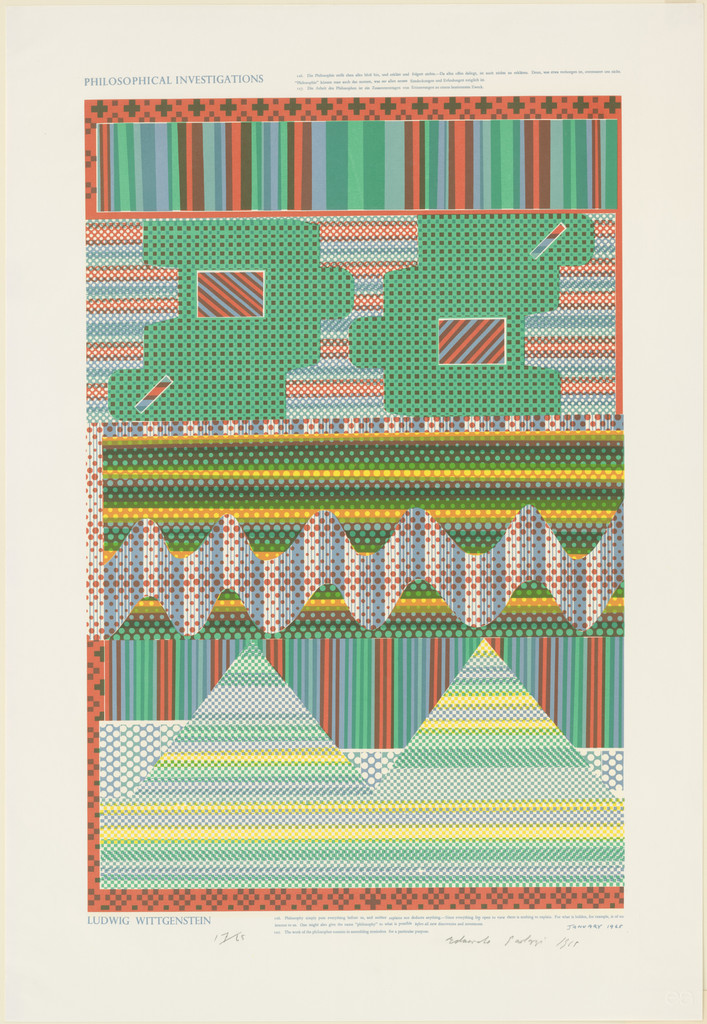 #37
#37
Assembling Reminders for a Particular Purpose (plate, folio 12) from As Is When
The printed fragments come together like a memory under construction; the title reminds us that collecting images is already a way of thinking. Paolozzi assembles science, advertising, cinema and machine in compositions where the collage becomes an instrument of knowledge of the contemporary world. In British and European homes, Pop does not have a unique style: collage, press, music and politics produce very different responses. There repetition transforms resemblance into rhythm and reveals the gaps that the industrial image usually claims to erase. Dated 1965, the work associates One from an illustrated book with thirteen screenprints with a reflection on the circulation, repetition and transformation of ordinary images.
See at the museum →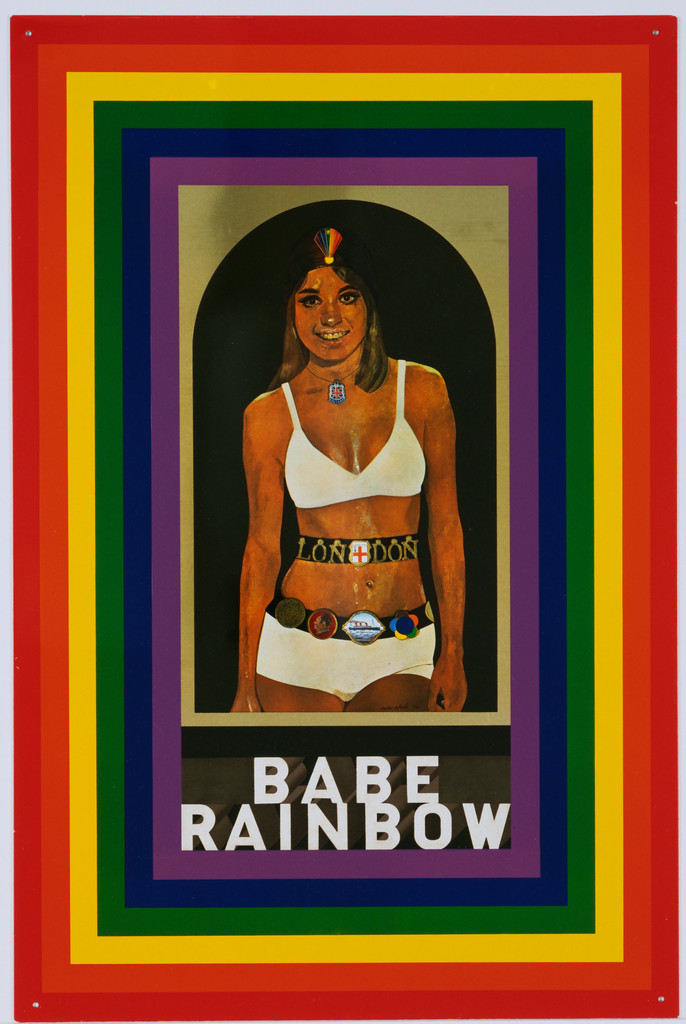 #38
#38
Babe Rainbow
The smiling face, bold colors and badge shape bring together popular portrait, toy and icon; fame becomes a reproducible talisman. Blake approaches popular stars, collections and memorabilia with precision affectionate of a history painter of ordinary cultures. In British and European homes, Pop does not have a unique style: collage, press, music and politics produce very different responses. The change scale moves the subject from the ordinary world to a physical confrontation with the viewer. Dated 1968, the work combines Screenprint on tin with a reflection on the circulation, repetition and transformation of ordinary images.
See at the museum →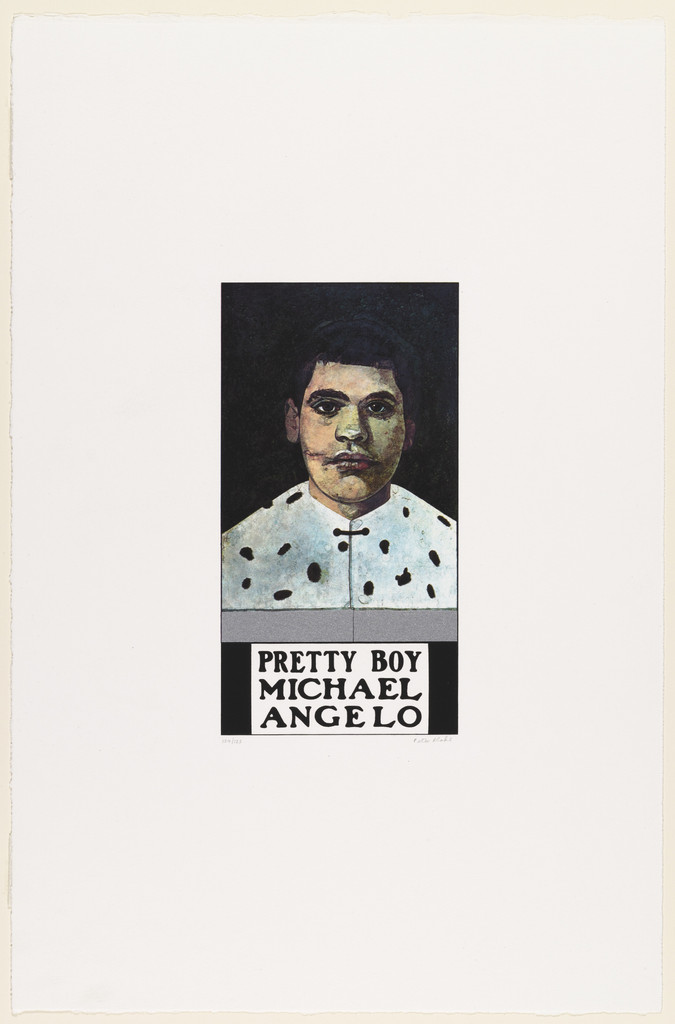 #39
#39
Pretty Boy Michaelangelo
Blake treats the popular culture hero with the frontality of a master portrait, deliberately blurring admiration, collection and irony. Blake approaches popular stars, collections and memorabilia with the affectionate precision of a history painter of ordinary cultures. In British and European homes, Pop does not have a unique style: collage, press, music and politics produce very different responses. Color makes reading easier while accentuating the tension between visual seduction, critical distance and the creation of desire. Dated 1972, the work combines Screenprint with a reflection on the circulation, repetition and transformation of ordinary images.
See at the museum →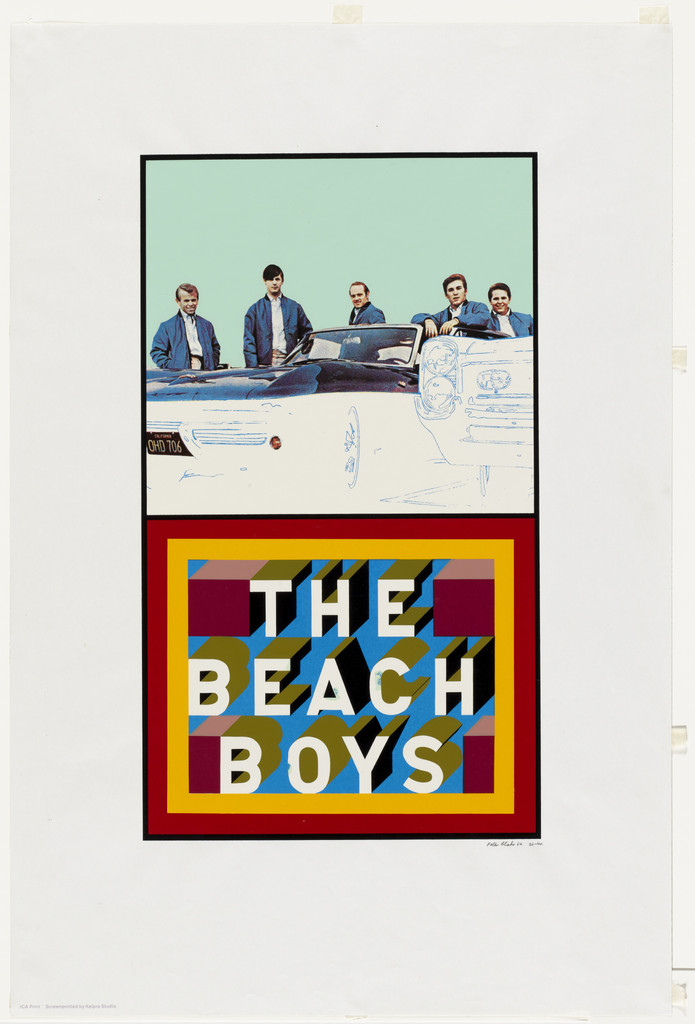 #40
#40
The Beach Boys from The Institute of Contemporary Arts Portfolio
The musical group is converted into a flat, bright and collectible image, halfway between fan photography, badge and print. Blake approaches popular stars, collections and memorabilia with the loving precision of one history painter of ordinary cultures. In British and European homes, Pop does not have a unique style: collage, press, music and politics produce very different responses. The surface retains traces of transfer, collage or assembly which prevent the image from being reduced to a simple reproduction. Dated 1964, the work associates Screenprint with a reflection on the circulation, repetition and transformation of ordinary images.
See at the museum →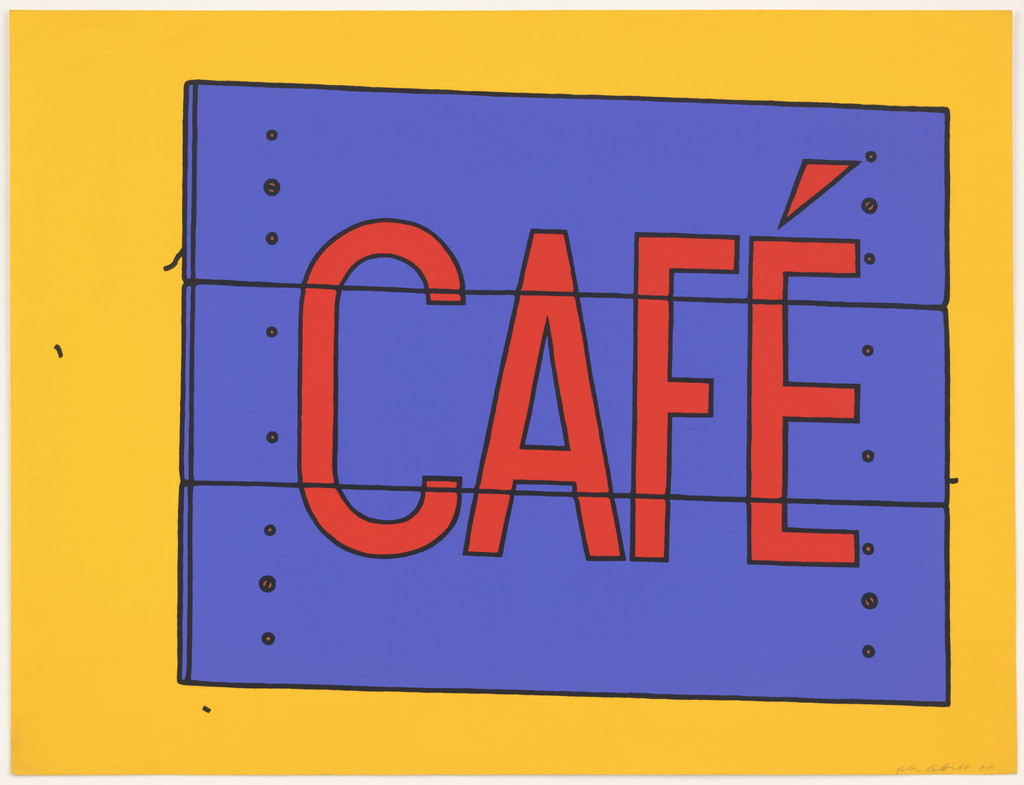 #41
#41
Cafe Sign
A simple coffee sign becomes mental still life: sharp contours, flat areas and shadows reduce space to a syntax of signs. Caulfield reduces interiors to contours and flat areas of deceptive precision, between evidence graphic and impossible space. In British and European homes, Pop does not have a unique style: collage, press, music and politics produce very different responses. The framing isolates the pattern until it returns it to both instantly recognizable and strangely detached from its daily use. Dated 1968, the work combines Screenprint with a reflection on the circulation, repetition and transformation of ordinary images.
See at the museum →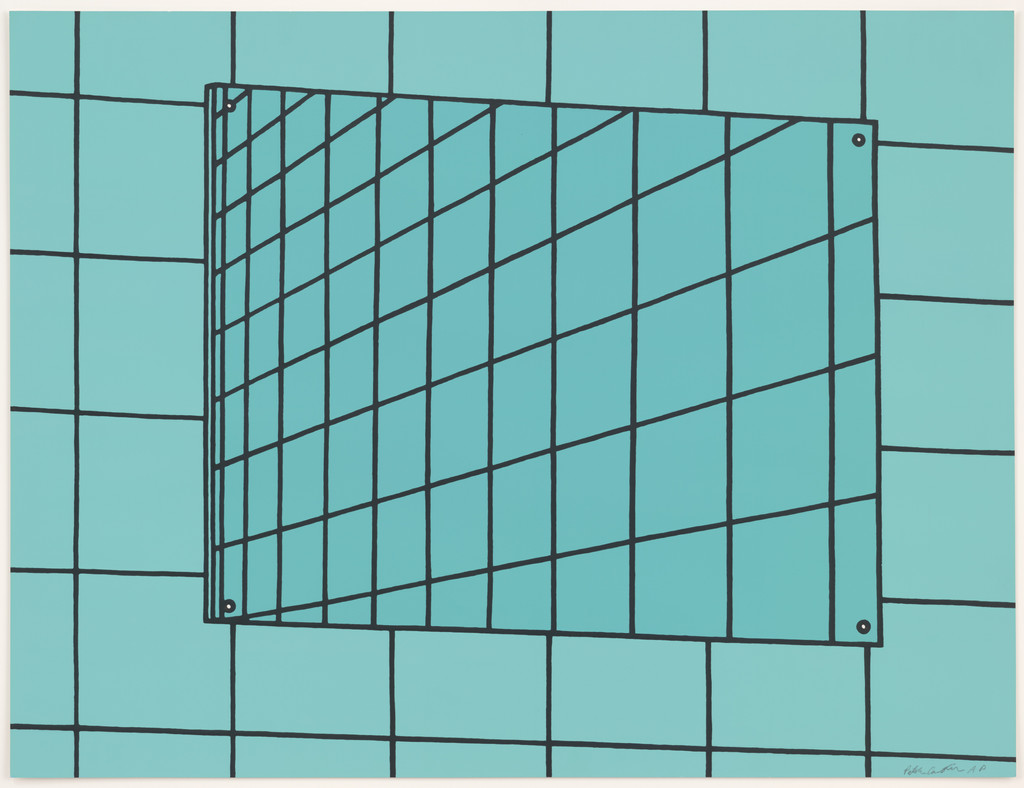 #42
#42
Bathroom Mirror
The mirror, sink and toiletries are depicted with cold graphic precision that makes the everyday interior strangely abstract. Caulfield reduces interiors to contours and flat areas of deceptive precision, between graphic evidence and impossible space. In British and European homes, Pop does not have a unique style: collage, press, music and politics produce very different responses. Repetition transforms it resemblance in rhythm and reveals the gaps that the industrial image usually claims to erase. Dated 1968, the work associates Screenprint with a reflection on the circulation, repetition and transformation of images ordinary.
See at the museum →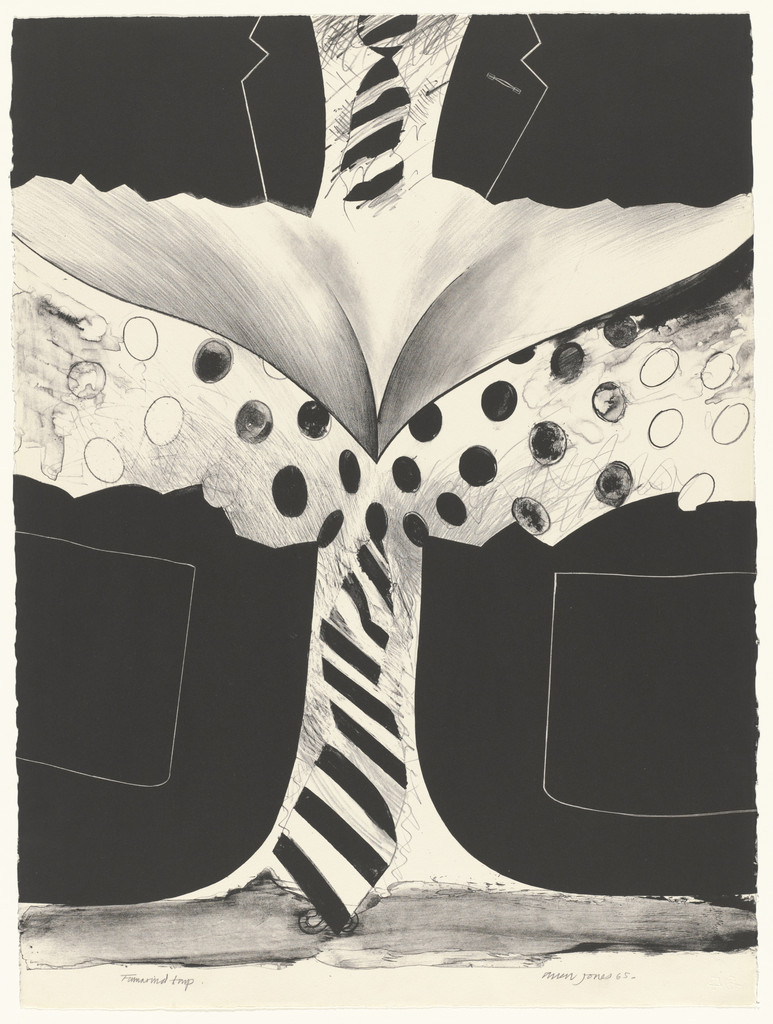 #43
#43
Man Woman
Two bodies intersect in a tense construction where advertising design and modern eroticism become a problem of position and gaze. Jones pushes the body's advertising codes to the point of discomfort, making their conventions of pose, framing and power. In British and European homes, Pop does not have a single style: collage, press, music and politics produce very different responses. The change of scale moves the subject from the ordinary world to a physical confrontation with the viewer. Dated 1965, the work associates Lithograph with a reflection on the circulation, repetition and transformation of ordinary images.
See at the museum →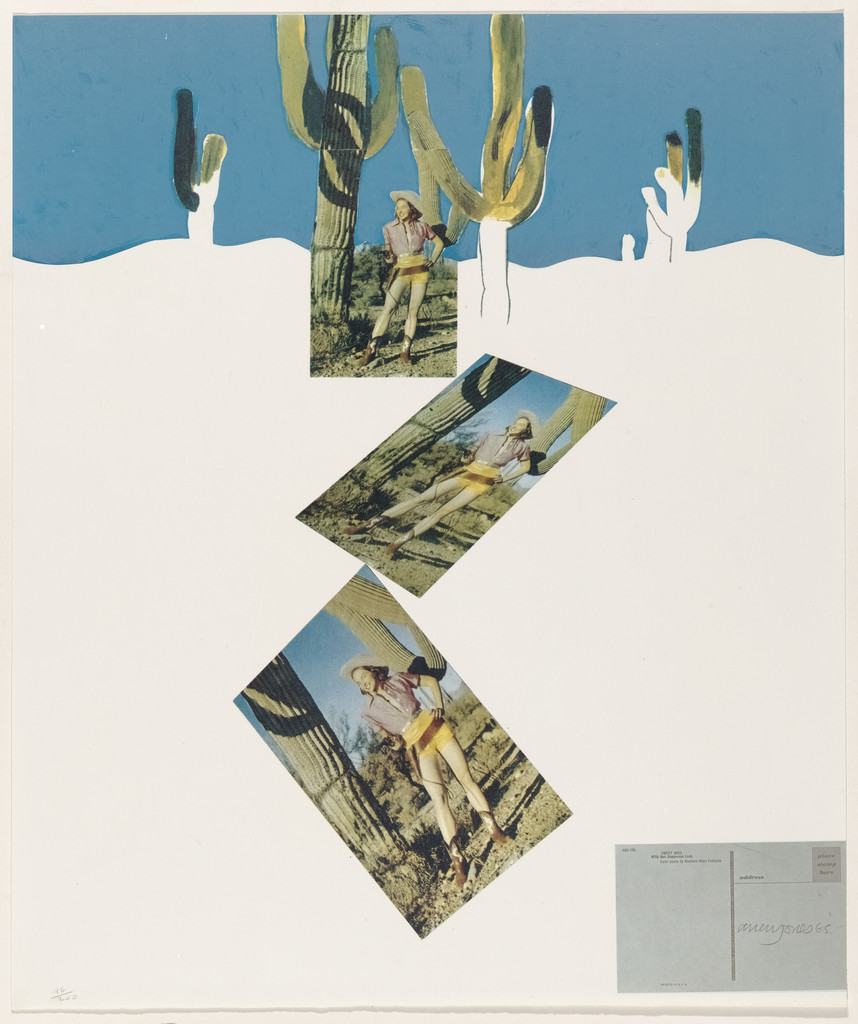 #44
#44
Miss America from 11 Pop Artists, Volume I
The figure of Miss America condenses beauty pageants, patriotism and consumption; the brilliant image deliberately keeps the uneasiness of the stereotype. Jones pushes the body's advertising codes to the point of discomfort, making their visible conventions of pose, framing and power. In British and European homes, Pop does not have a unique style: collage, press, music and politics produce very different responses. Color simplifies it reading while accentuating the tension between visual seduction, critical distance and the creation of desire. Dated 1965, published 1966, the work combines Lithograph from a portfolio of ten screenprints (one with collage additions), and one lithograph to a reflection on the circulation, repetition and transformation of ordinary images.
See at the museum →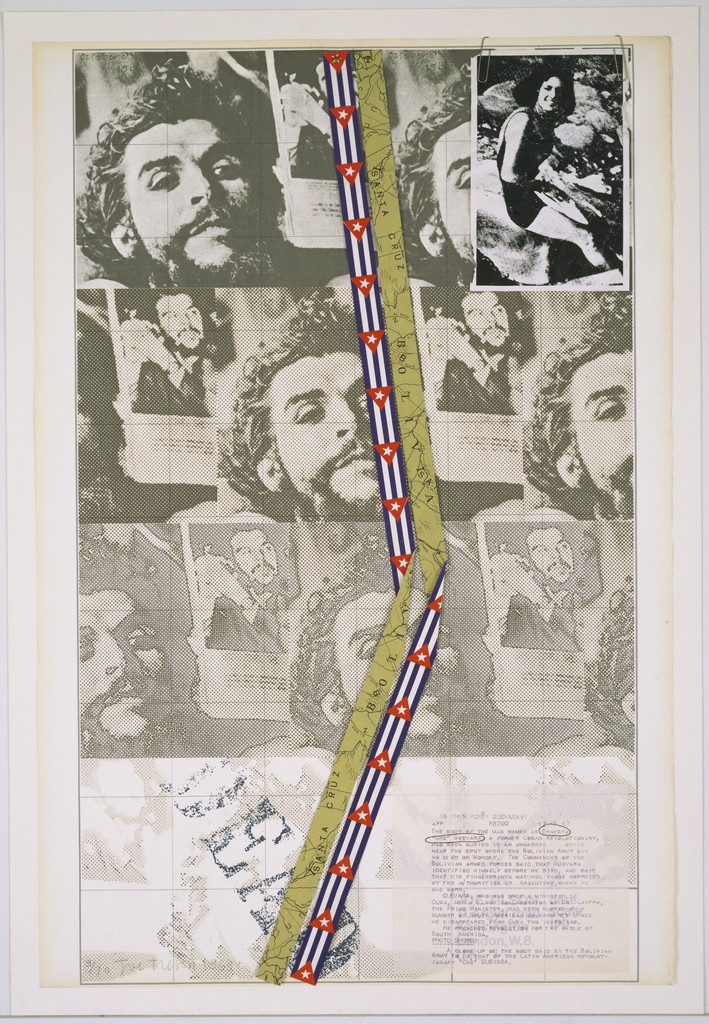 #45
#45
Is This Che Guevara?
Che Guevara's portrait becomes a printed question. Tilson questions the speed with which a revolutionary figure can be transformed into an available icon. Tilson transforms the layout, slogan and political news into participatory structures that refuse the passivity of the gaze. In British and European homes, Pop does not have a single style: collage, press, music and politics produce very different responses. The surface retains traces of transfer, collage or assembly which prevent the image from being reduced to a simple reproduction. Dated 1969, the work combines Screenprint with collage additions with a reflection on circulation, repetition and the transformation of ordinary images.
See at the museum →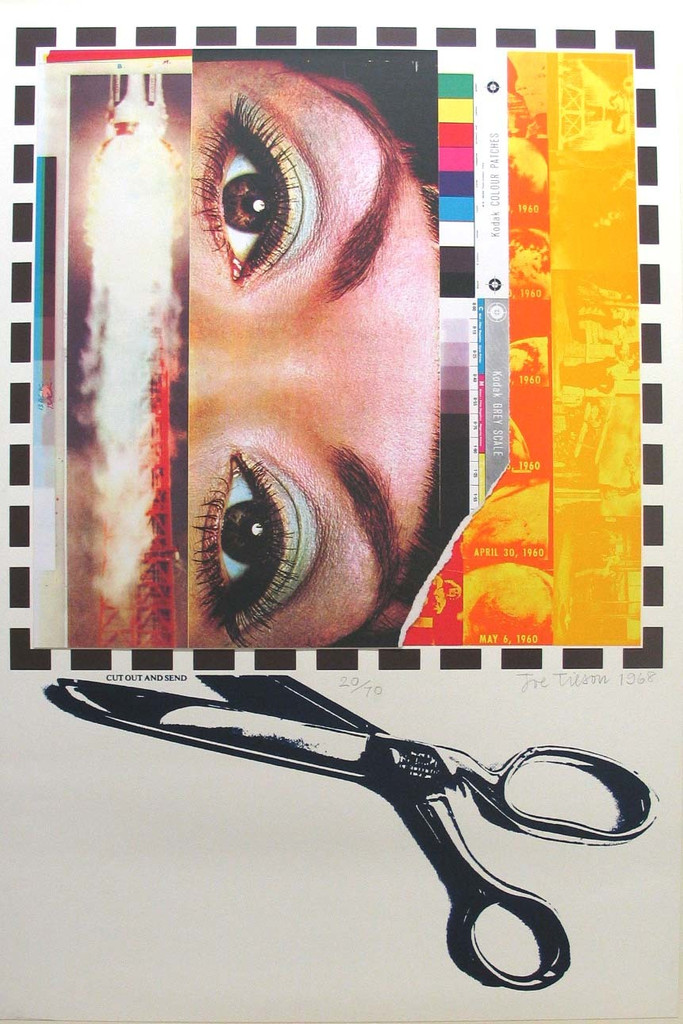 #46
#46
Cut Out and Send
The imperative of the title imitates the language of the magazines to be cut out; the work places the viewer in the active role of consumer and image editor. Tilson transforms layout, slogan and political news into structures participatory people who refuse the passivity of the gaze. In British and European homes, Pop does not have a single style: collage, press, music and politics produce very different responses. The framing isolates the motif until making it both immediately recognizable and strangely detached from its daily use. Dated 1968, the work combines Screenprint with screenprinted collage additions with a reflection on circulation, repetition and transformation of ordinary images.
See at the museum →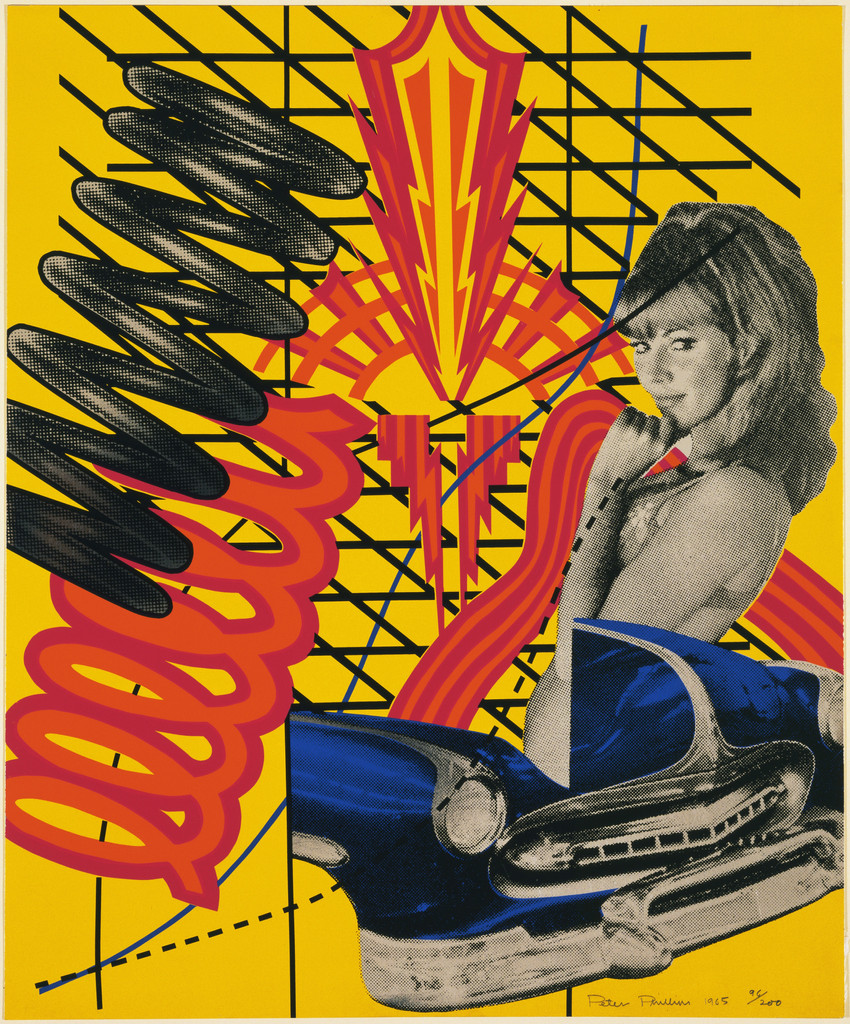 #47
#47
Custom Print I from 11 Pop Artists, Volume I
Automotive chromes, dials and fragments construct an attractive visual machine whose very excess reveals the rhetoric of industrial desire. Phillips composes a British Pop with automobile surfaces and technical signs fascinated by speed as much as by artificial sound. In British and European homes, Pop does not have a unique style: collage, press, music and politics produce very different responses. Repetition transforms resemblance into rhythm and reveals the gaps that the industrial image usually claims to erase. Dated 1965, published 1966, the work combines Screenprint from a portfolio of ten screenprints (one with collage additions), and one lithograph to a reflection on the circulation, repetition and transformation of ordinary images.
See at the museum →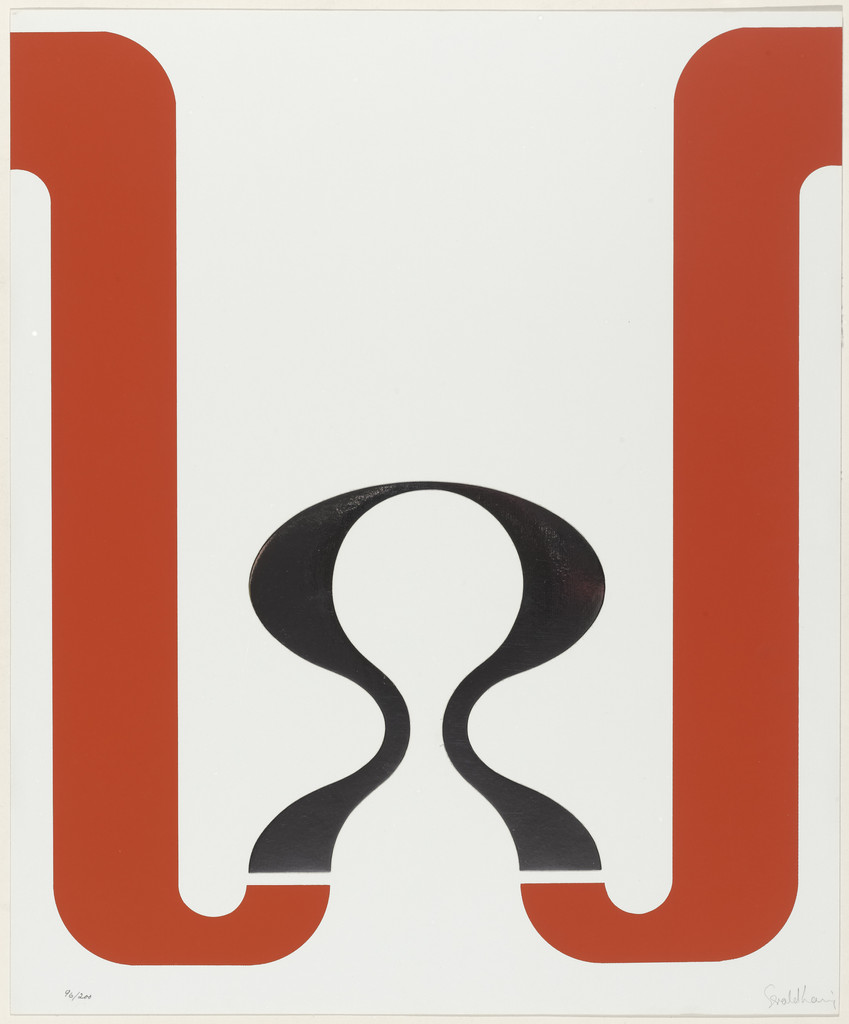 #48
#48
Compact from 11 Pop Artists, Volume I
The female face, framed as in an advertisement, is crossed by the cold logic of printing; glamor and anonymity work together. Laing translates press photographs, stars and machines into clear contrasts that raise questions the media fabrication of the icon. In British and European homes, Pop does not have a unique style: collage, press, music and politics produce very different responses. The change of scale moves it subject of the ordinary world towards a physical confrontation with the spectator. Dated 1966, the work associates Screenprint with collage additions from a portfolio of ten screenprints (one with collage additions), and one lithograph with a reflection on the circulation, repetition and transformation of ordinary images.
See at the museum →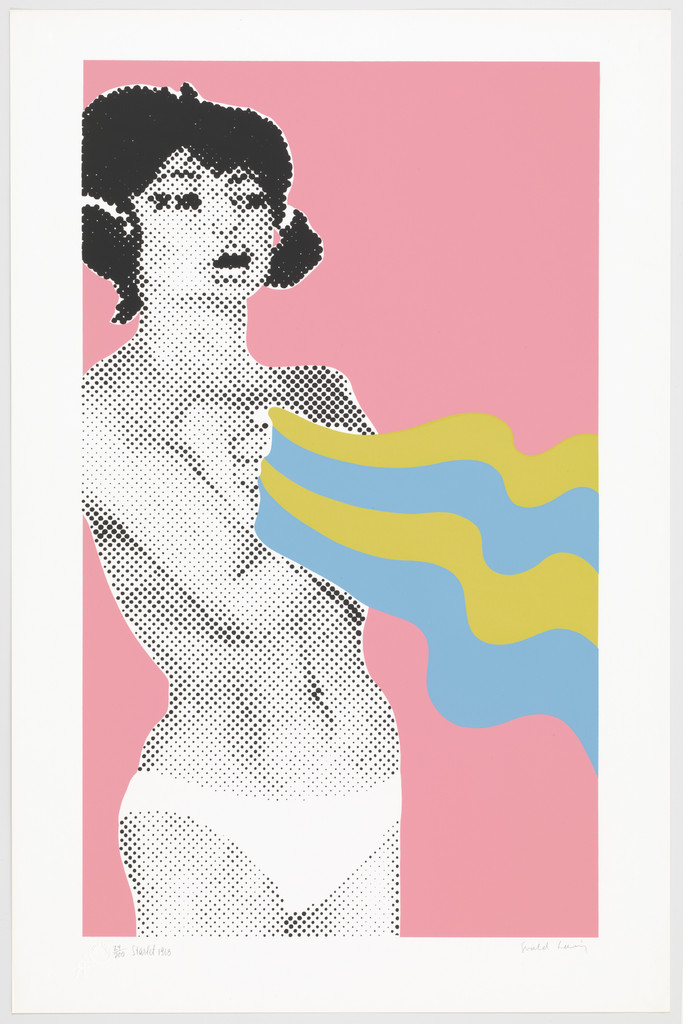 #49
#49
Starlet from Baby Baby Wild Things
The starlet appears as a press image stopped on the threshold of fame; Laing accentuates the contrast between facial singularity and mechanical diffusion. Laing translates press photographs, stars and machines into clear contrasts which question the media production of the icon. In British and European homes, Pop does not have a unique style: collage, press, music and politics produce very different answers. Color simplifies it reading while accentuating the tension between visual seduction, critical distance and the creation of desire. Dated 1968, the work combines One from a portfolio of six screenprints with a reflection on circulation, repetition and transformation of ordinary images.
See at the museum →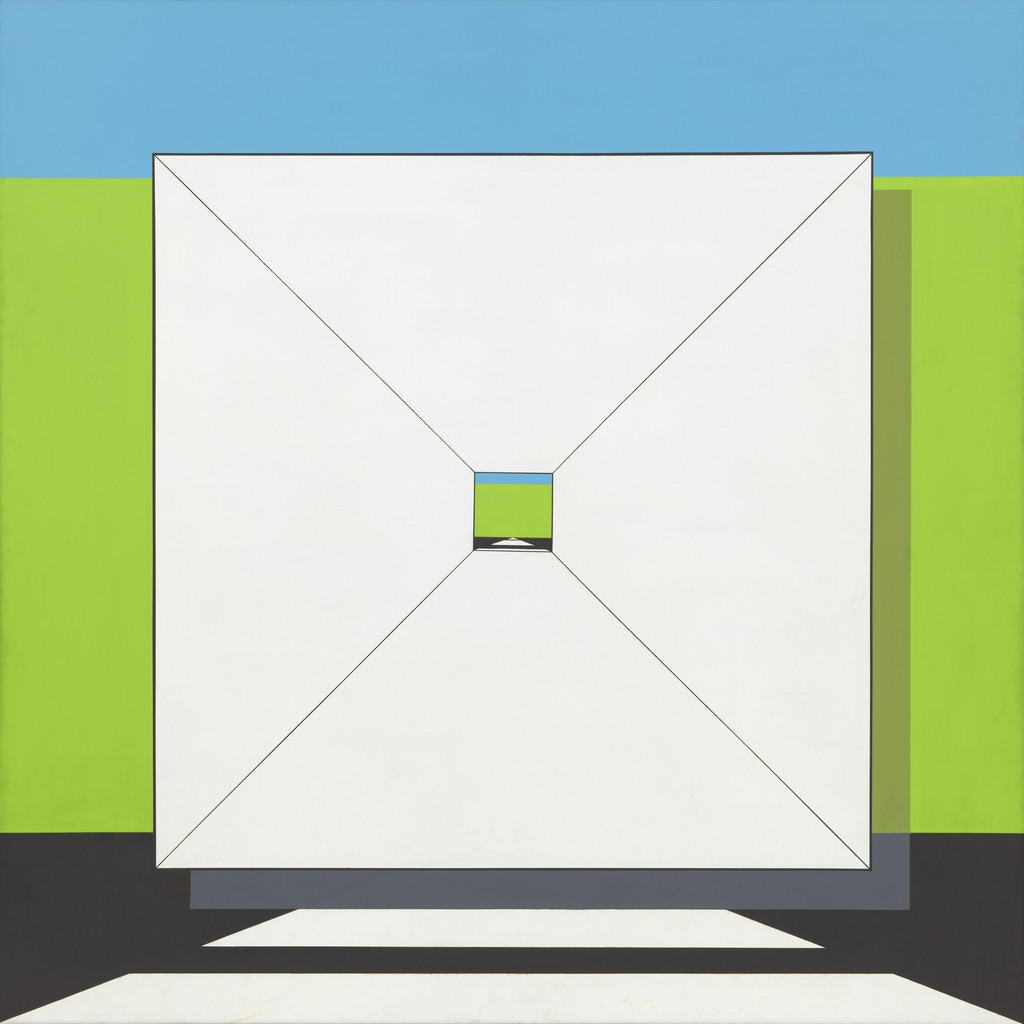 #50
#50
Proposition Number 1
The racing car and directional bands transform the canvas into a traffic sign; speed, road and painting share the same vocabulary. D'Arcangelo makes the road and its signage a pictorial alphabet where the american landscape merges with its infrastructures. In British and European homes, Pop does not have a unique style: collage, press, music and politics produce very different responses. The surface preserves traces of transfer, collage or assembly which prevent the image from being reduced to a simple reproduction. Dated 1966, the work combines Synthetic polymer paint on canvas with a reflection on circulation, repetition and transformation of ordinary images.
See at the museum →Roads, interiors, food, weapons, tools and celebrities make up a visual archeology of the affluent society.
 #51
#51
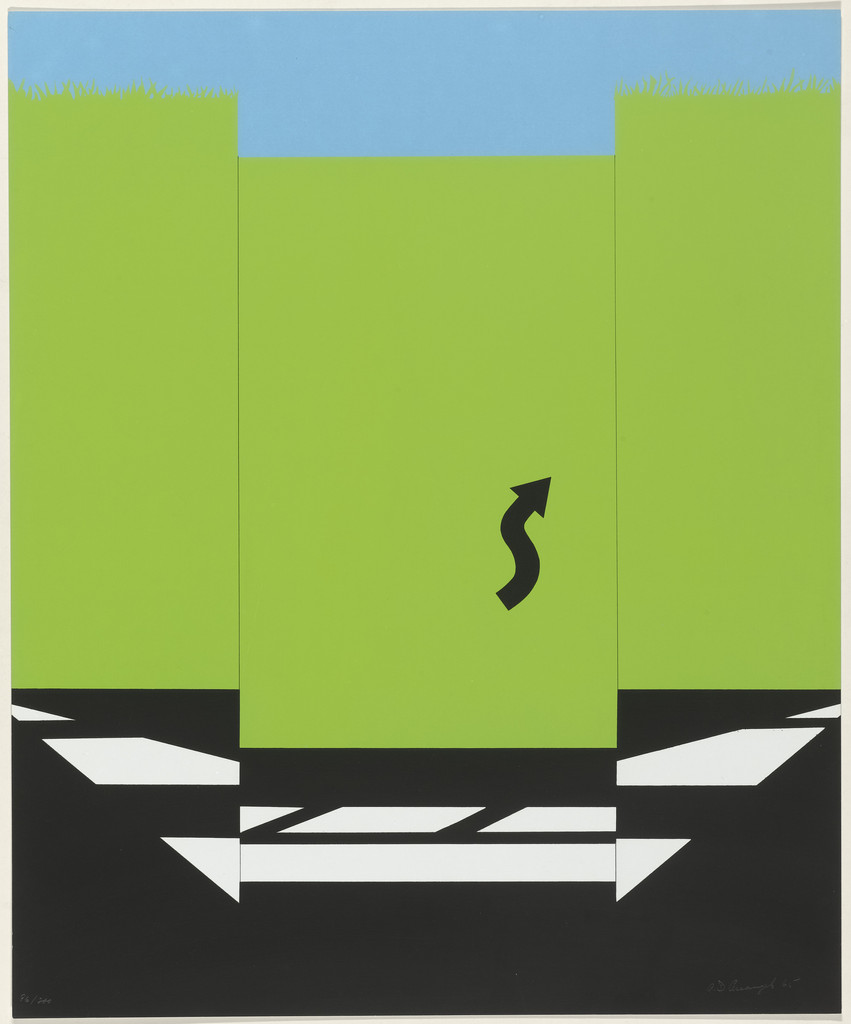
Landscape I from 11 Pop Artists, Volume I
D'Arcangelo reduces the American landscape to a roadway, a horizon and a few signs. Perspective becomes a graphic experience of movement. D'Arcangelo makes the road and its signage a pictorial alphabet where the landscape american merges with its infrastructures. This work belongs to the moment when the Pop vocabulary diversifies: interior, body, food, road and language become laboratories of framing and repetition. Framing isolates the pattern to the point of making it both immediately recognizable and strangely detached from its daily use. Dated 1965, published 1966, the work combines Screenprint from a portfolio of ten screenprints (one with collage additions), and one lithograph to a reflection on the circulation, repetition and transformation of ordinary images.
See at the museum →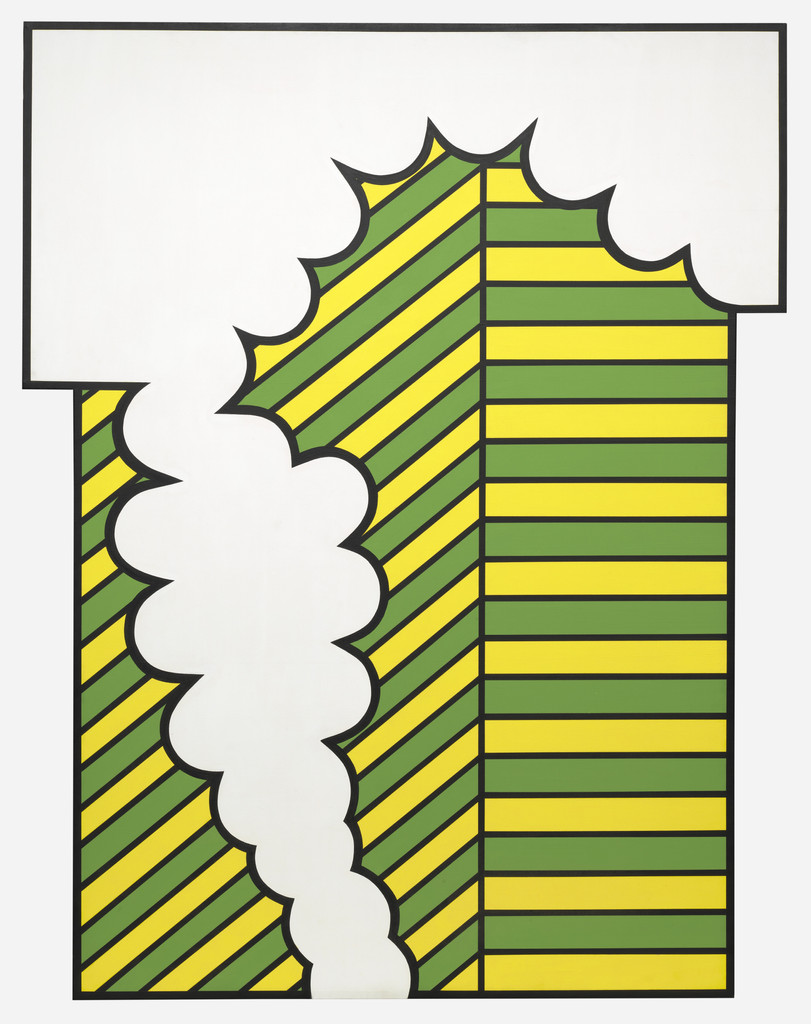 #52
#52
The Red Baron
Hard shapes, acidic colors and internal framing give the surface the energy of a poster without imposing a precise advertising narrative. Krushenick combines acidic flat areas, powerful contours and poster energy in an abstraction close to Pop language without an obligatory commercial subject. This work belongs to the moment when the Pop vocabulary diversifies: interior, body, food, road and language become laboratories of framing and repetition. Repetition transforms resemblance into rhythm and reveals the gaps that the industrial image usually claims to erase. Dated January 1967, the work associates Synthetic polymer paint on shaped canvas with one reflection on the circulation, repetition and transformation of ordinary images.
See at the museum →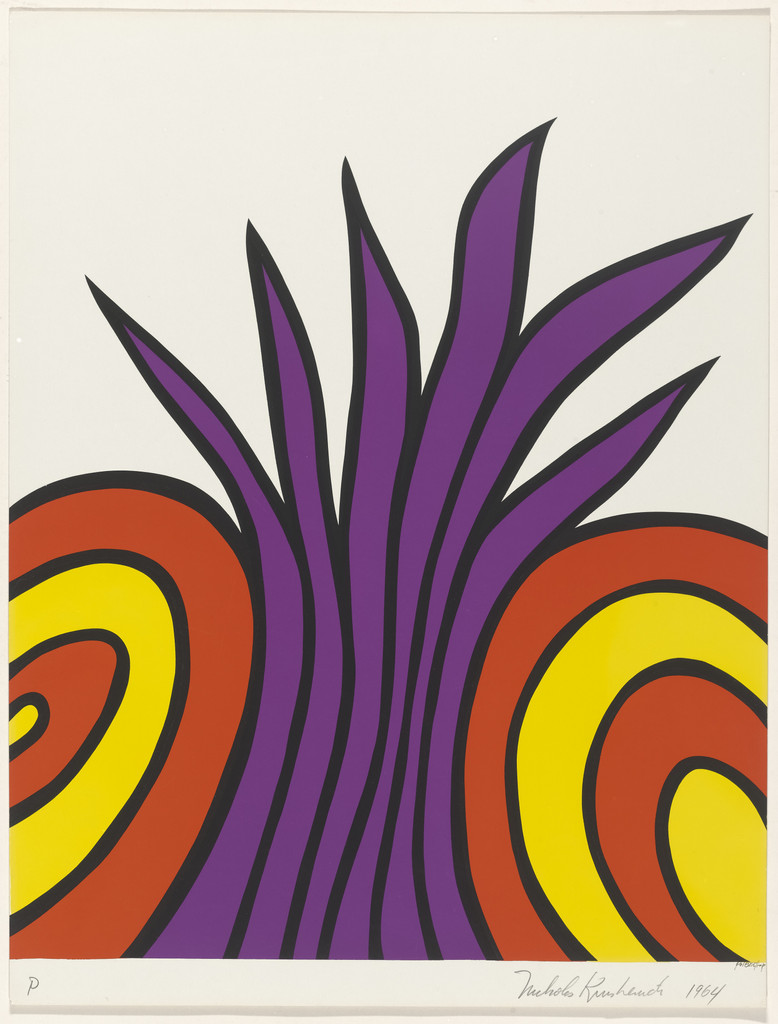 #53
#53
James Bond Meets Pussy Galore from New York Ten
The title borrowed from James Bond meets a dazzling and frontal design; Krushenick captures the speed, humor and visual aggressiveness of mass culture. Krushenick combines acidic flat areas, powerful contours and poster energy in an abstraction close to Pop language without obligatory commercial subject. This work belongs to the moment when the Pop vocabulary diversifies: interior, body, food, road and language become laboratories of framing and repetition. The change of scale moves the subject from the ordinary world towards a physical confrontation with the spectator. Dated 1964, published 1965, the work combines Screenprint from a portfolio with seven screenprints, one etching, one lithograph, and one embossing a reflection on the circulation, repetition and transformation of ordinary images.
See at the museum →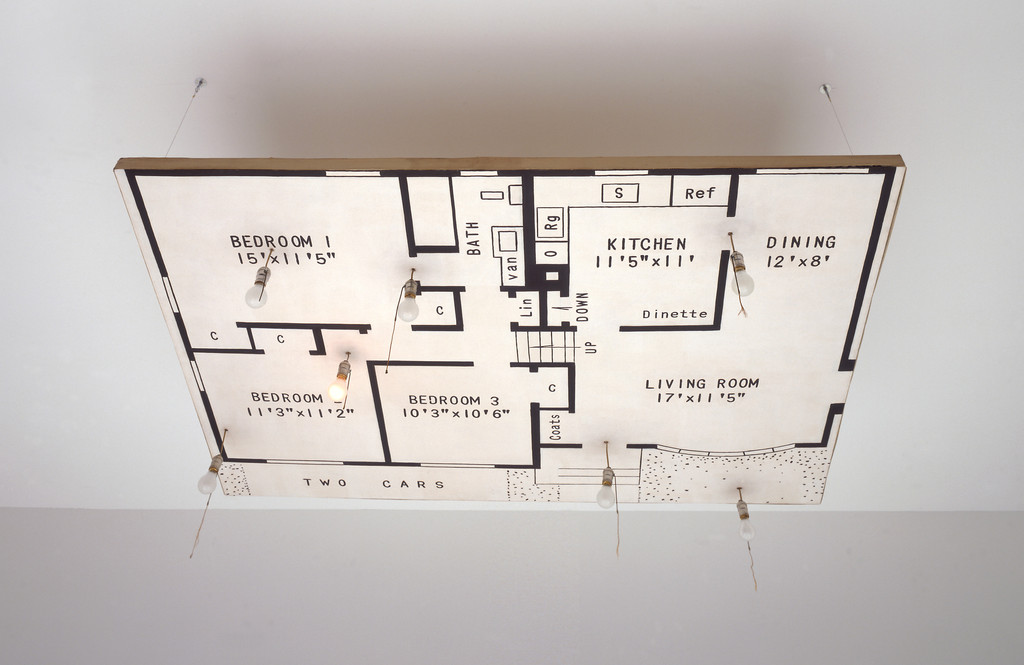 #54
#54
Doorstop
An almost insignificant object is isolated and enlarged until it becomes an enigmatic presence; Rosenquist reveals the abstract power of the commercial fragment. A former sign painter, Rosenquist uses advertising enlargement and editing fragments to transform visual abundance into critical experience. This work belongs to the moment when the Pop vocabulary diversifies: interior, body, food, road and language become framing laboratories and repetition. Color simplifies reading while accentuating the tension between visual seduction, critical distance and the creation of desire. Dated 1963, the work combines Oil on canvas with light bulbs with a reflection on circulation, repetition and transformation of ordinary images.
See at the museum →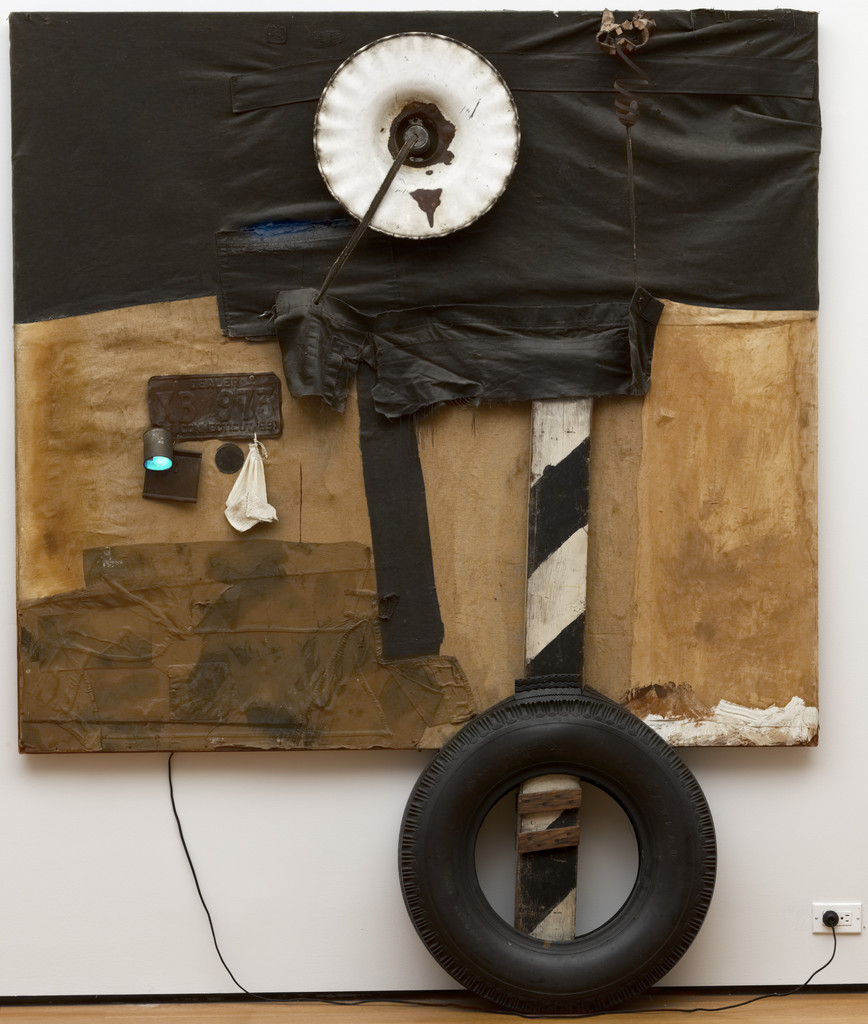 #55
#55
First Landing Jump
Tire, light bulb, plate and paint follow one another like the remains of an urban machine; the assembly retains the energy of a stopped jump. Rauschenberg brings objects, photographs and scraps into the space of the painting, where painting and everyday world remains deliberately impossible to separate. This work belongs to the moment when the Pop vocabulary diversifies: interior, body, food, road and language become laboratories of framing and repetition. There surface retains traces of transfer, collage or assembly which prevent the image from being reduced to a simple reproduction. Dated 1961, the work combines Cloth, metal, leather, electric fixture, cable, and oil paint on board, with automobile pulls and wood plank to a reflection on the circulation, repetition and transformation of ordinary images.
See at the museum →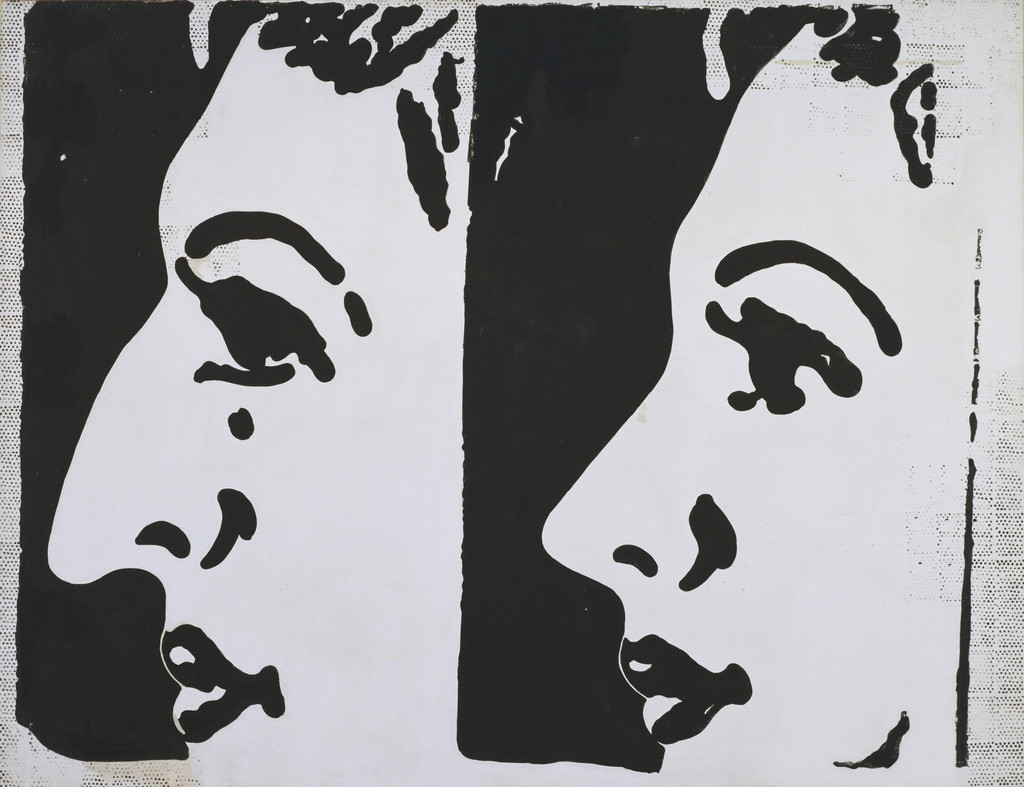 #56
#56
Before and After
The advertising scheme of an aesthetic operation is separated before and after; Warhol exposes the promise of transformation as a simple graphic device. Warhol treats fame, merchandise and disaster with the same framing and repetition processes, revealing the proximity between public desire and industrial circulation of images. This work belongs to the moment when the Pop vocabulary diversifies: interior, body, food, road and language become framing and repetition laboratories. The framing isolates the pattern until it is both immediately recognizable and strangely detached from its daily use. Dated 1961, the work combines Casein and pencil on canvas to a reflection on the circulation, repetition and transformation of ordinary images.
See at the museum →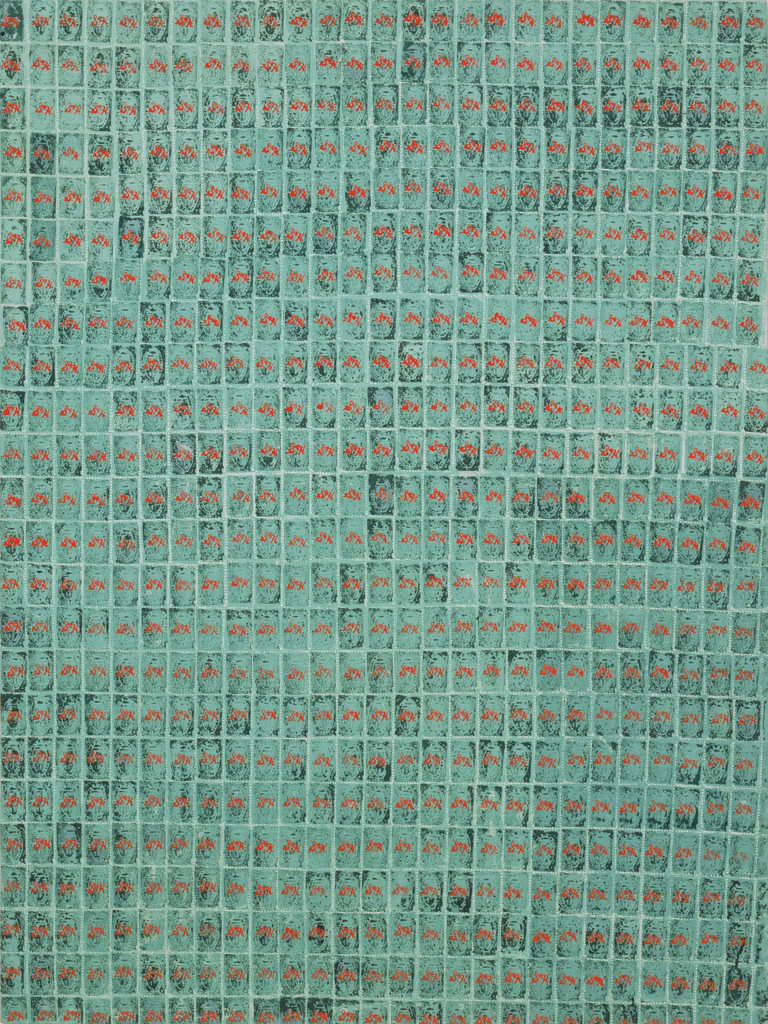 #57
#57
S&H Green Stamps
The commercial stamp grid confuses painting and loyalty bonus. Artistic value is ironically measured by a sign designed to encourage purchase. Warhol treats fame, merchandise and disaster with the same framing and repetition processes, revealing the proximity between public desire and industrial circulation of images. This work belongs to the moment when the Pop vocabulary diversifies: interior, body, food, road and language become framing and rehearsal laboratories. Repetition transforms resemblance into rhythm and reveals the gaps that the industrial image usually claims to erase. Dated 1962, the work combines Silkscreen ink on synthetic polymer paint on canvas to reflect on the circulation, repetition and transformation of ordinary images.
See at the museum →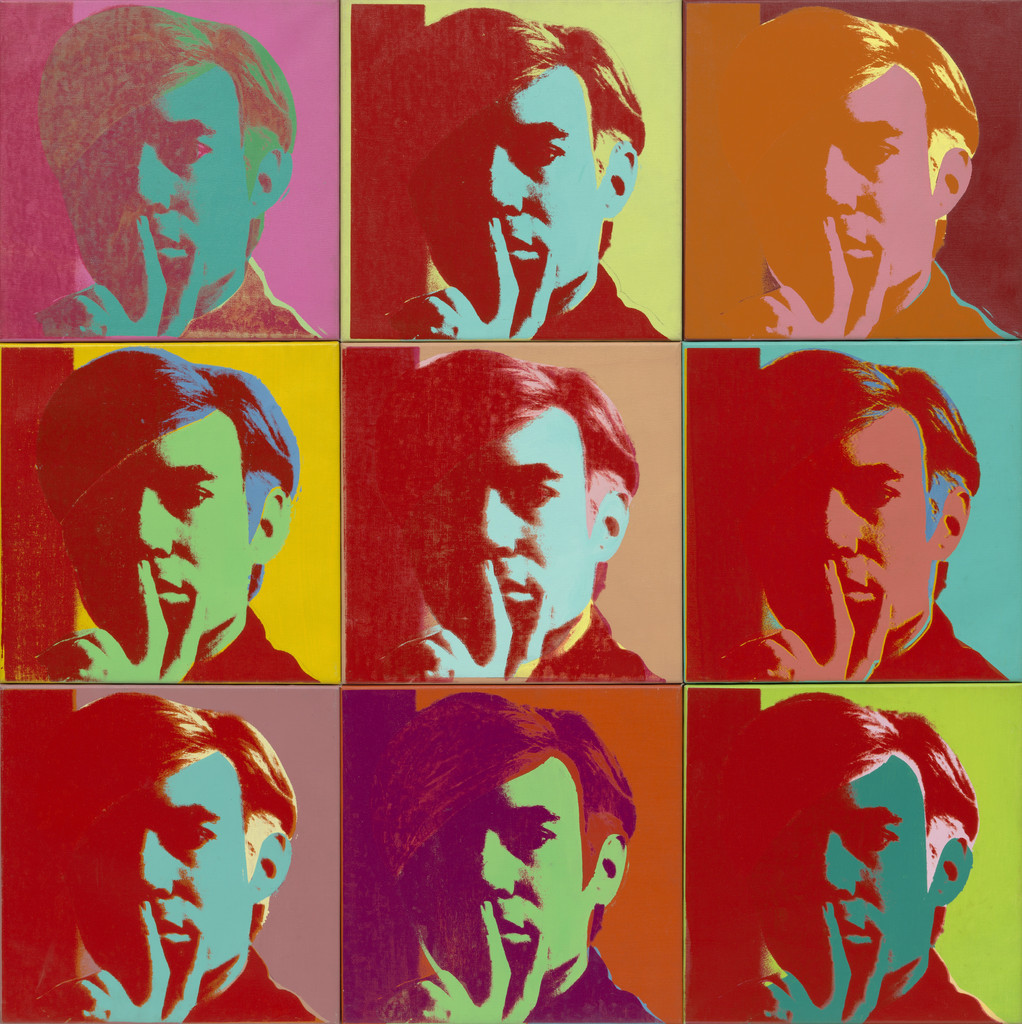 #58
#58
Self-portrait
The artist's face emerges in violent contrasts, but the screen printing keeps him at bay; the self-portrait already presents itself as a public mark. Warhol treats fame, merchandise and disaster with the same processes framing and repetition, revealing the proximity between public desire and industrial circulation of images. This work belongs to the moment when the Pop vocabulary diversifies: interior, body, food, road and language become framing and rehearsal laboratories. The change of scale moves the subject from the ordinary world towards a physical confrontation with the spectator. Dated 1966, the work combines Silkscreen ink on synthetic polymer paint on nine canvases to a reflection on the circulation, repetition and transformation of ordinary images.
See at the museum →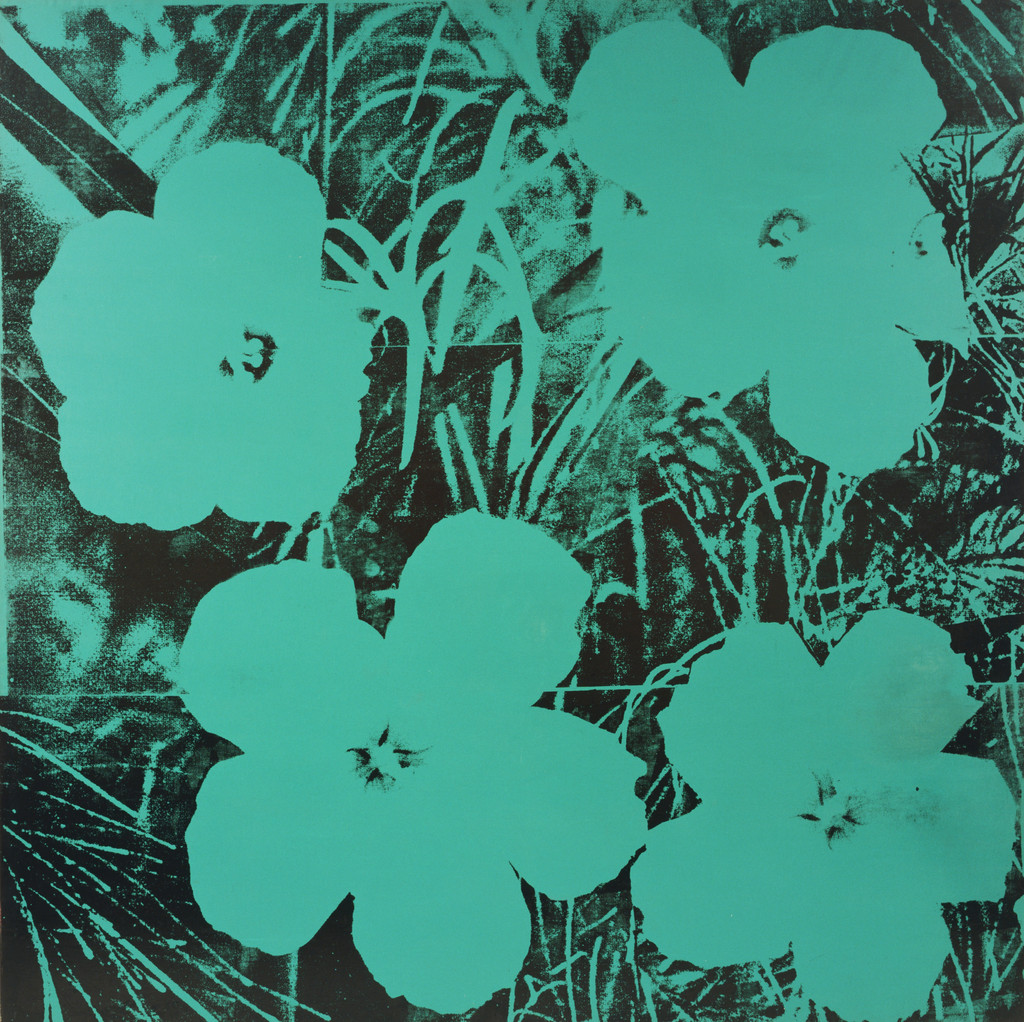 #59
#59
Ten-Foot Flowers
The flowers, enlarged and repeated, seem immediately decorative. Their flat beauty, however, masks a reflection on the series, the color and the erasure of the author. Warhol treats fame, merchandise and disaster with it the same framing and repetition processes, revealing the proximity between public desire and industrial circulation of images. This work belongs to the moment when the Pop vocabulary diversifies: interior, body, food, road and language becomes laboratories for framing and repetition. Color simplifies reading while accentuating the tension between visual seduction, critical distance and the creation of desire. Dated 1967, the work combines Silkscreen ink on synthetic polymer paint on canvas to reflect on the circulation, repetition and transformation of ordinary images.
See at the museum →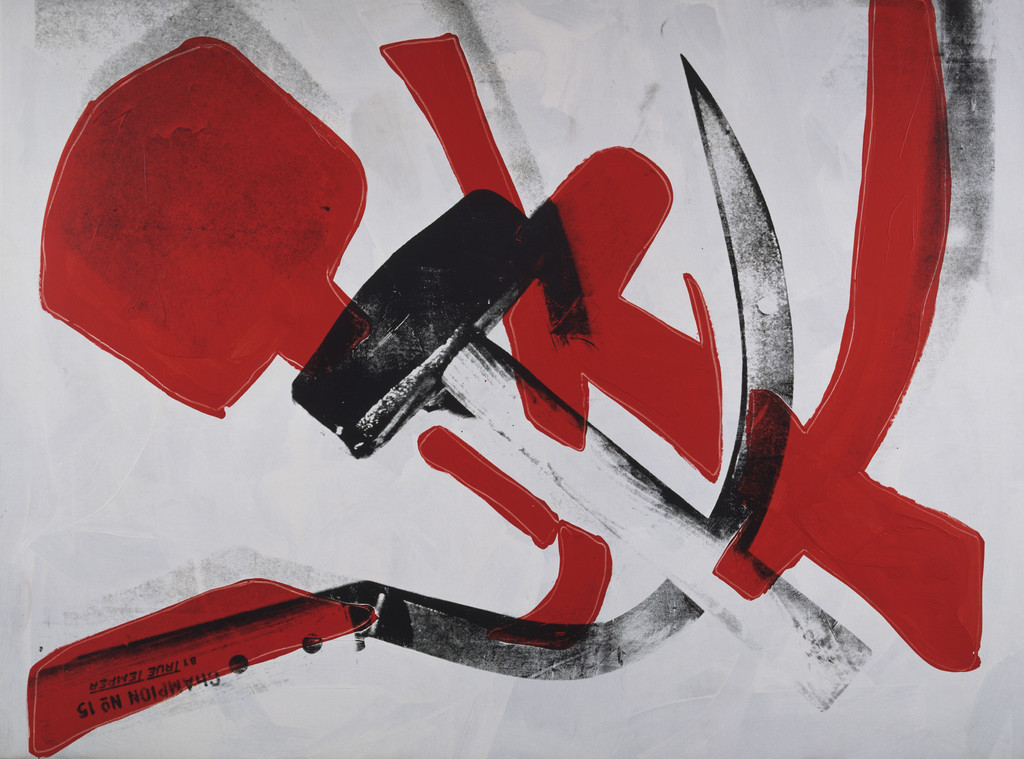 #60
#60
Hammer and Sickle
The political symbol is framed like a product and repeated like a brand; ideology thus joins the same visual economy as soup or the star. Warhol treats fame, merchandise and disaster with the same processes framing and repetition, revealing the proximity between public desire and industrial circulation of images. This work belongs to the moment when the Pop vocabulary diversifies: interior, body, food, road and language become framing and rehearsal laboratories. The surface retains traces of transfer, collage or assembly which prevent the image from being reduced to a simple reproduction. Dated 1976, the work combines Silkscreen ink on synthetic polymer paint on canvas to a reflection on the circulation, repetition and transformation of ordinary images.
See at the museum →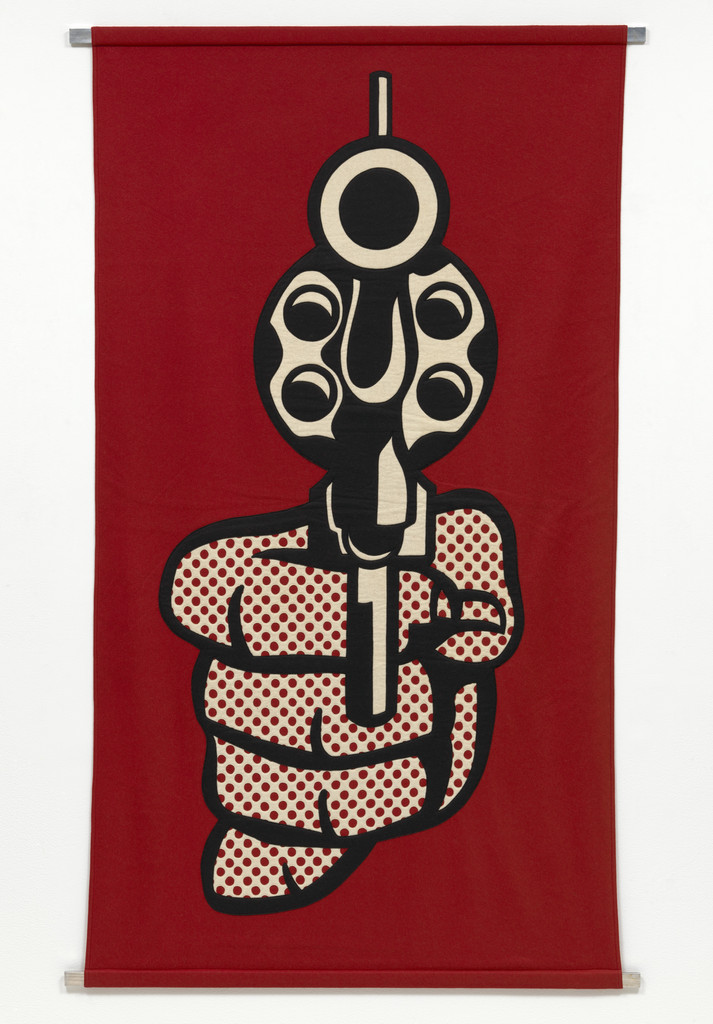 #61
#61
Pistol
The weapon is isolated in a precise, depthless vocabulary borrowed from print. Apparent neutrality makes his threat more direct. Lichtenstein doesn't just copy the comic: he reconstructs his signs by hand for analyze how print creates emotion, movement and authority. This work belongs to the moment when the Pop vocabulary diversifies: interior, body, food, road and language become laboratories of framing and repetition. The framing isolates the motif to the point of making it both immediately recognizable and strangely detached from its daily use. Dated 1964, the work associates Felt with a reflection on circulation, repetition and transformation of ordinary images.
See at the museum →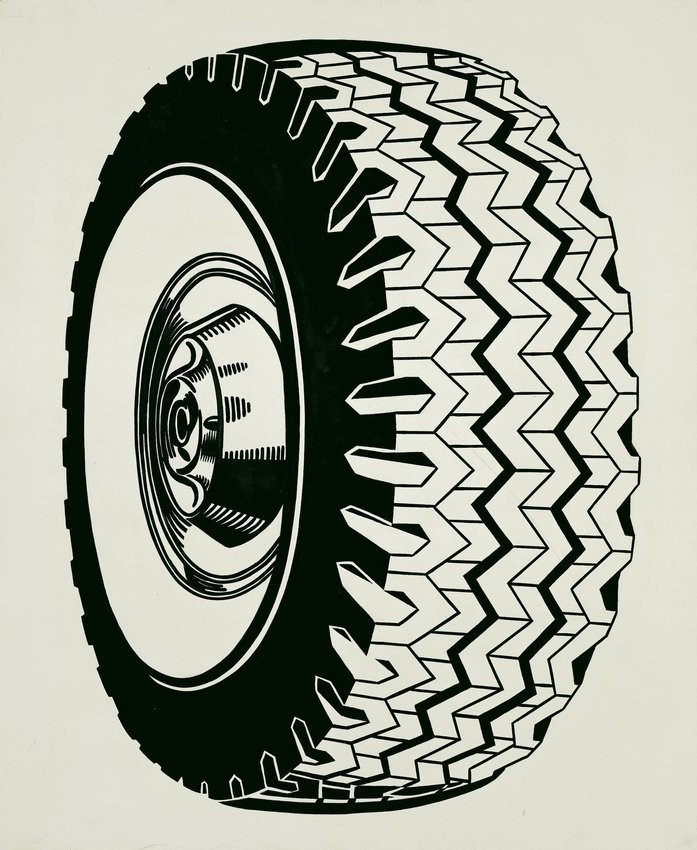 #62
#62
Shoot
The tire occupies almost the entire field like a black sign. Its banal industrial realism paradoxically produces an image close to abstraction. Lichtenstein does not simply copy the comic strip: he reconstructs his signs by hand to analyze how print creates emotion, movement and authority. This work belongs to the moment when the Pop vocabulary diversifies: interior, body, food, road and language become framing laboratories and repetition. Repetition transforms resemblance into rhythm and reveals the gaps that the industrial image usually claims to erase. Dated 1962, the work associates Oil on canvas with a reflection on circulation, the repetition and transformation of ordinary images.
See at the museum →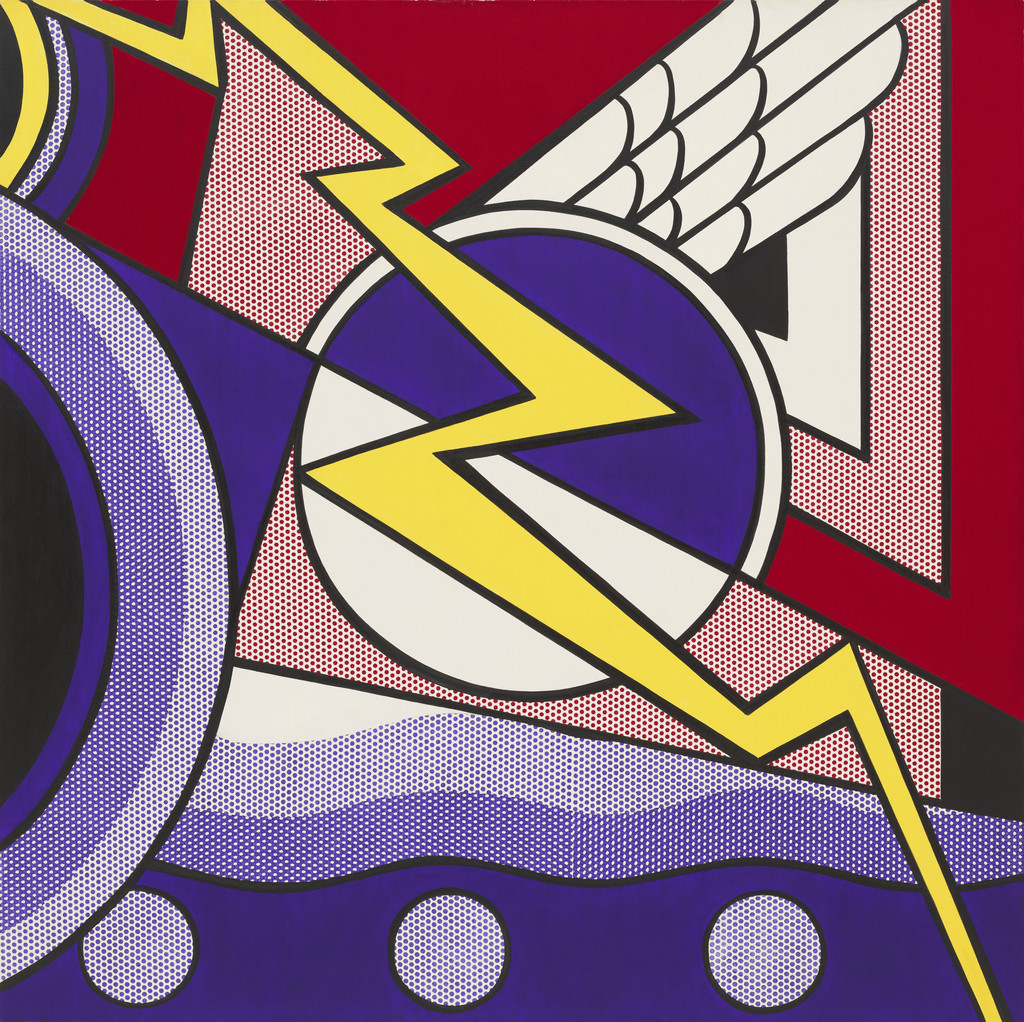 #63
#63
Modern Painting with Bolt
The bolt becomes the event of a painting that cites the language of the machine and that of modern abstraction with the same ironic distance. Lichtenstein doesn't just copy the comic strip: he reconstructs his signs by hand to analyze how print creates emotion, movement and authority. This work belongs to the moment when the Pop vocabulary diversifies: interior, body, food, road and language become framing laboratories and repetition. The change of scale moves the subject from the ordinary world towards a physical confrontation with the spectator. Dated 1967, the work associates Magna and oil on canvas with a reflection on circulation, repetition and transformation of ordinary images.
See at the museum →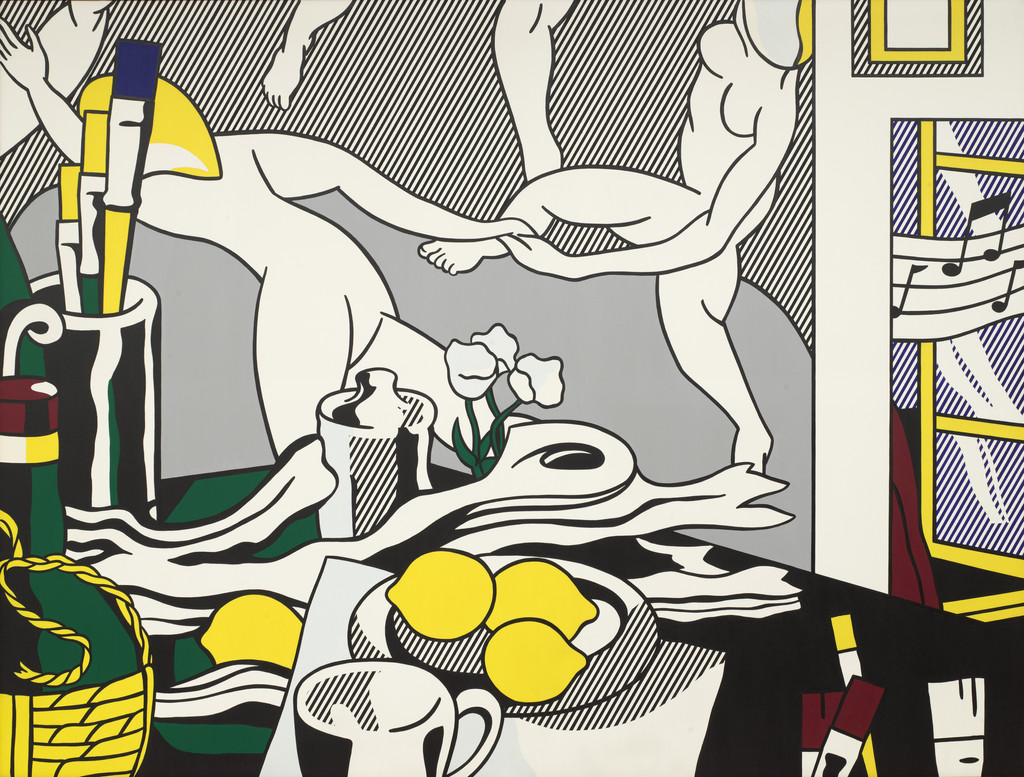 #64
#64
Artist's Studio "The Dance"
Lichtenstein reconstructs the workshop through quotes from Matisse and his own vocabulary; art history enters into the logic of printed decor. Lichtenstein does not simply copy the comic strip: he reconstructs his hand signs to analyze how print creates emotion, movement and authority. This work belongs to the moment when the Pop vocabulary diversifies: interior, body, food, road and language become framing and rehearsal laboratories. Color simplifies reading while accentuating the tension between visual seduction, critical distance and the creation of desire. Dated 1974, the work combines Oil and magna on canvas with reflection on the circulation, repetition and transformation of ordinary images.
See at the museum →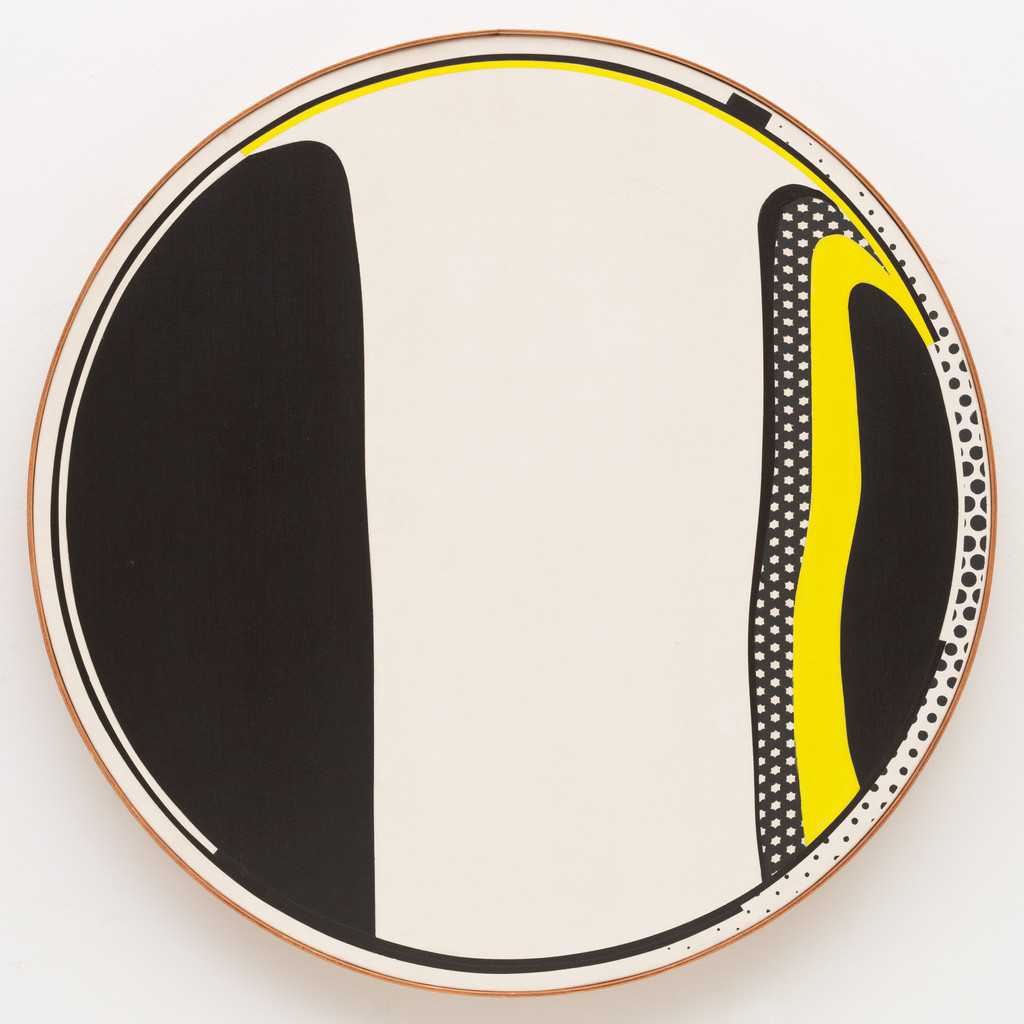 #65
#65
Mirror #10
The mirror does not reflect anything specific: circles, frames and arcs are enough to represent its brilliance. The object becomes a visual convention laid bare. Lichtenstein does not simply copy the comic strip: he reconstructs his signs in style hand to analyze how print creates emotion, movement and authority. This work belongs to the moment when the Pop vocabulary diversifies: interior, body, food, road and language become laboratories of framing and repetition. The surface retains traces of transfer, collage or assembly which prevent the image from being reduced to a simple reproduction. Dated 1970, the work combines Oil and magna on canvas with a reflection on the circulation, repetition and transformation of ordinary images.
See at the museum →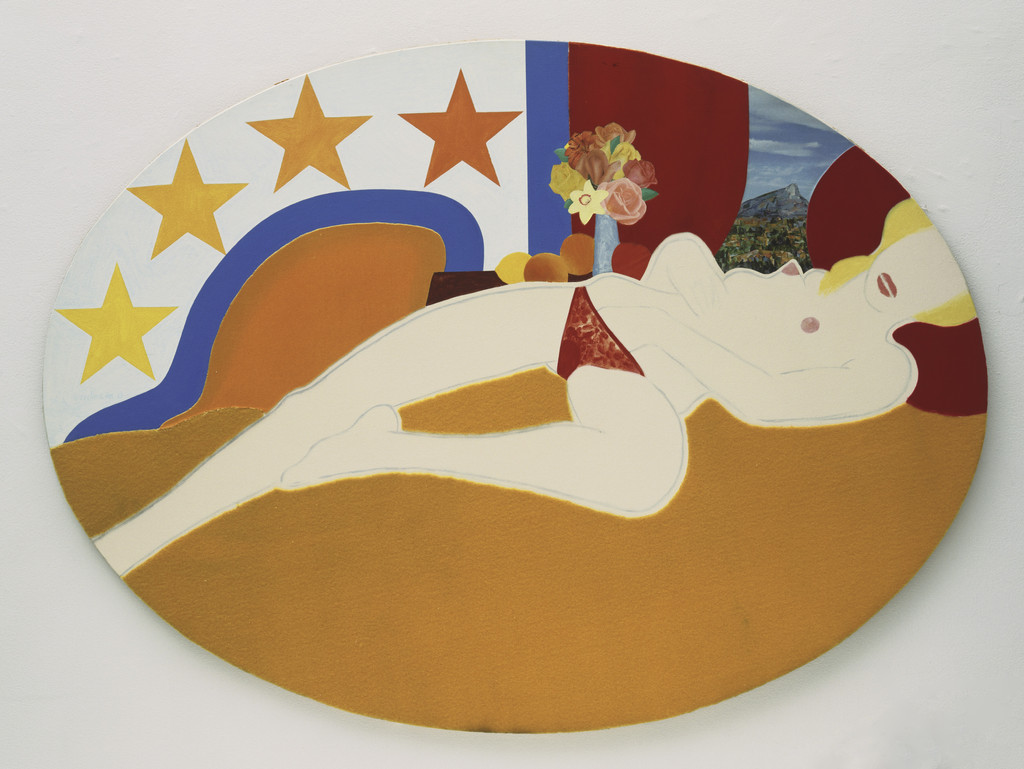 #66
#66
Great American Nude, 47
The American nude series varies in framing, scale and accessories; this version shows how the body can be constructed by the same codes as an ad. Wesselmann reinvents the nude and still life with the clear codes of advertising, while exposing the way modern desire is framed and consumed. This work belongs to the moment when the Pop vocabulary diversifies: interior, body, food, road and language become laboratories of framing and repetition. The framing isolates the pattern until it is both immediately recognizable and strangely detached from its daily use. Dated 1963, the work combines Acrylic with cut-and-pasted paper and fabric on wood panel with a reflection on the circulation, repetition and transformation of ordinary images.
See at the museum →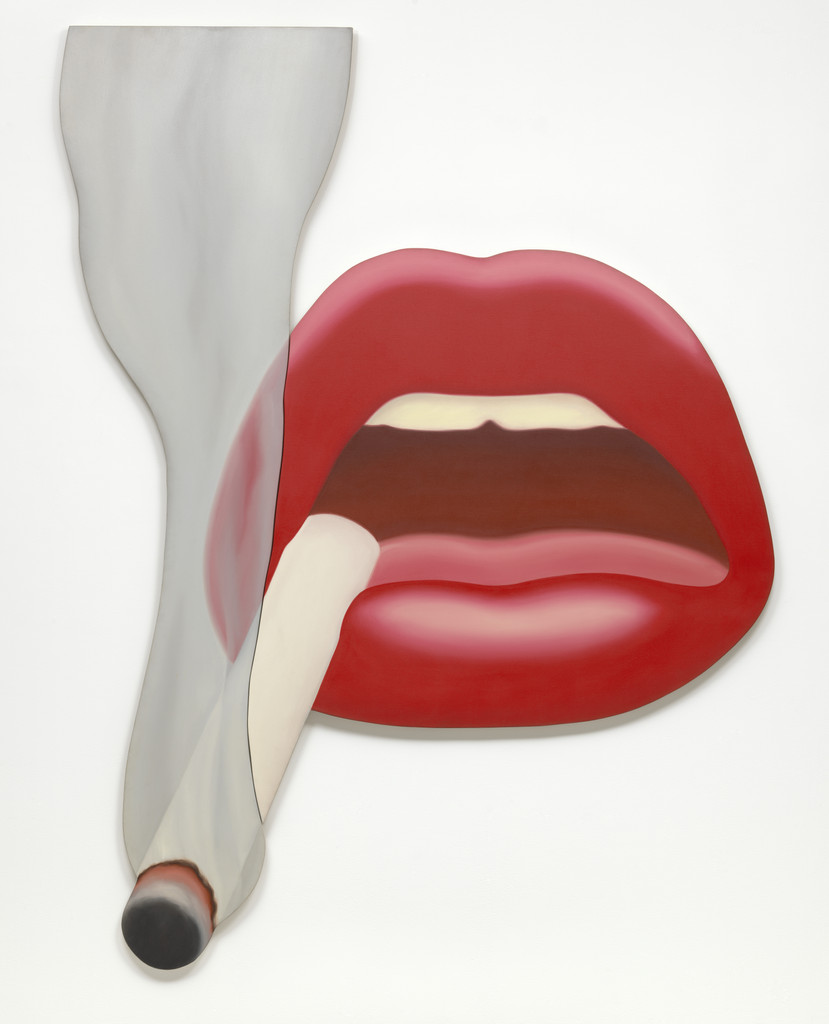 #67
#67
Smoker, 1 (Mouth, 12)
The mouth and the cigarette are cropped until they become an autonomous emblem; sensuality, habit and advertising merge in the same fragment. Wesselmann reinvents the nude and still life with the clear codes of advertising, while exposing the way modern desire is framed and consumed. This work belongs to the moment when the Pop vocabulary diversifies: interior, body, food, road and language become laboratories of framing and repetition. Repetition transforms resemblance into rhythm and reveals the gaps that the industrial image usually claims to erase. Dated 1967, the work associates Oil on canvas, in two parts with a reflection on circulation, the repetition and transformation of ordinary images.
See at the museum →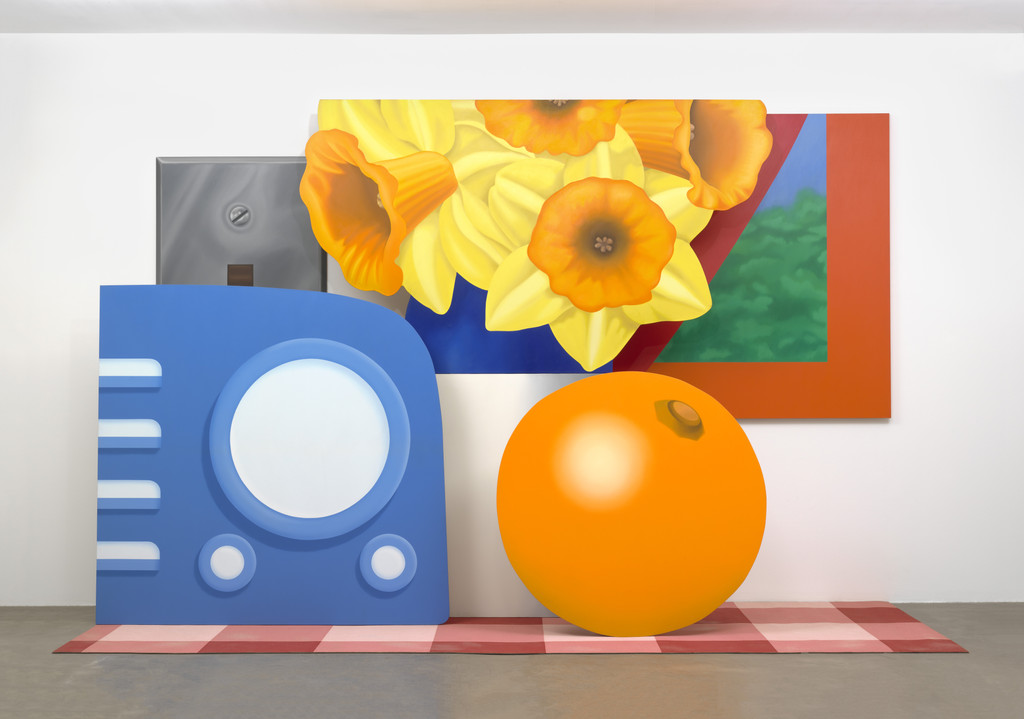 #68
#68
Still Life #57
Television, food and household items pile up in compressed depth. Classic still life becomes an inventory of modern abundance. Wesselmann reinvents the nude and still life with the clear codes of advertising, while exposing the way modern desire is framed and consumed. This work belongs to the moment when the Pop vocabulary diversifies: interior, body, food, road and language become laboratories of framing and repetition. The change of scale moves the subject from the ordinary world to a physical confrontation with the viewer. Dated 1969-70, the work combines Oil on canvas and base of acrylic paint on carpet, in six sections, with a reflection on the circulation, repetition and transformation of ordinary images.
See at the museum →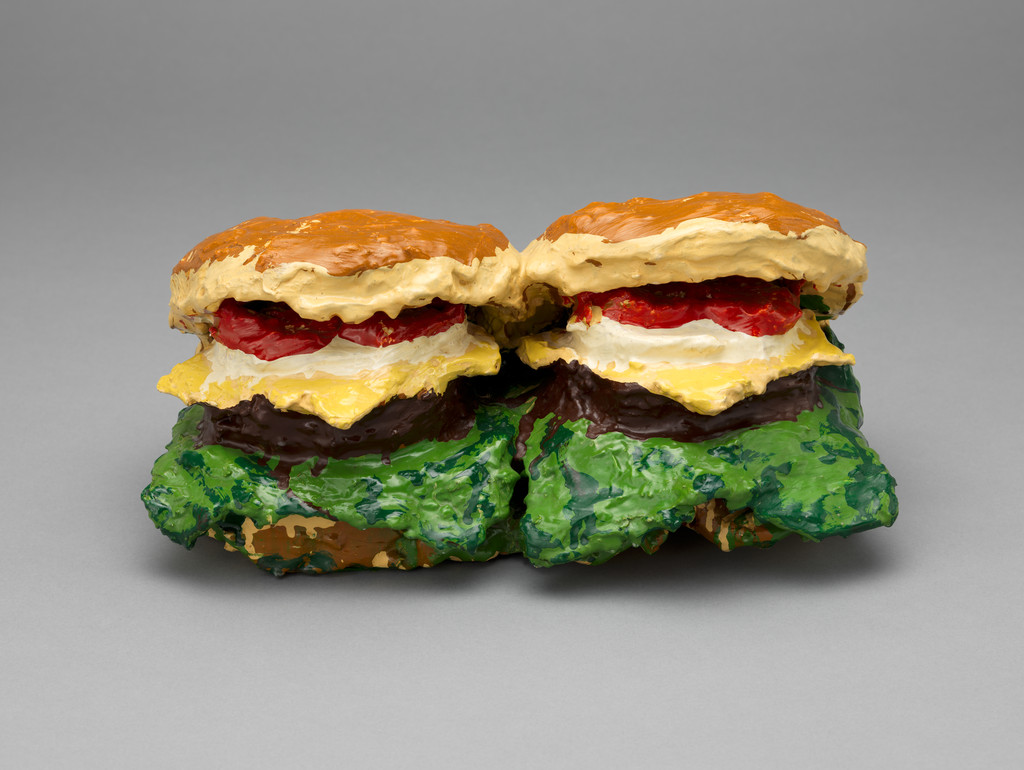 #69
#69
Two Cheeseburgers, with Everything (Dual Hamburgers)
Two fully garnished hamburgers are enlarged and rendered in painted canvas. The quick meal acquires the tactile presence of a couple of sculptures. Oldenburg changes the scale, material and rigidity of ordinary objects in order to render strange what habit made seem transparent. This work belongs to the moment when the Pop vocabulary diversifies: interior, body, food, road and language become laboratories of framing and repetition. There color simplifies reading while accentuating the tension between visual seduction, critical distance and the creation of desire. Dated 1962, the work combines Burlap soaked in plastic, painted with enamel with a reflection on circulation, the repetition and transformation of ordinary images.
See at the museum →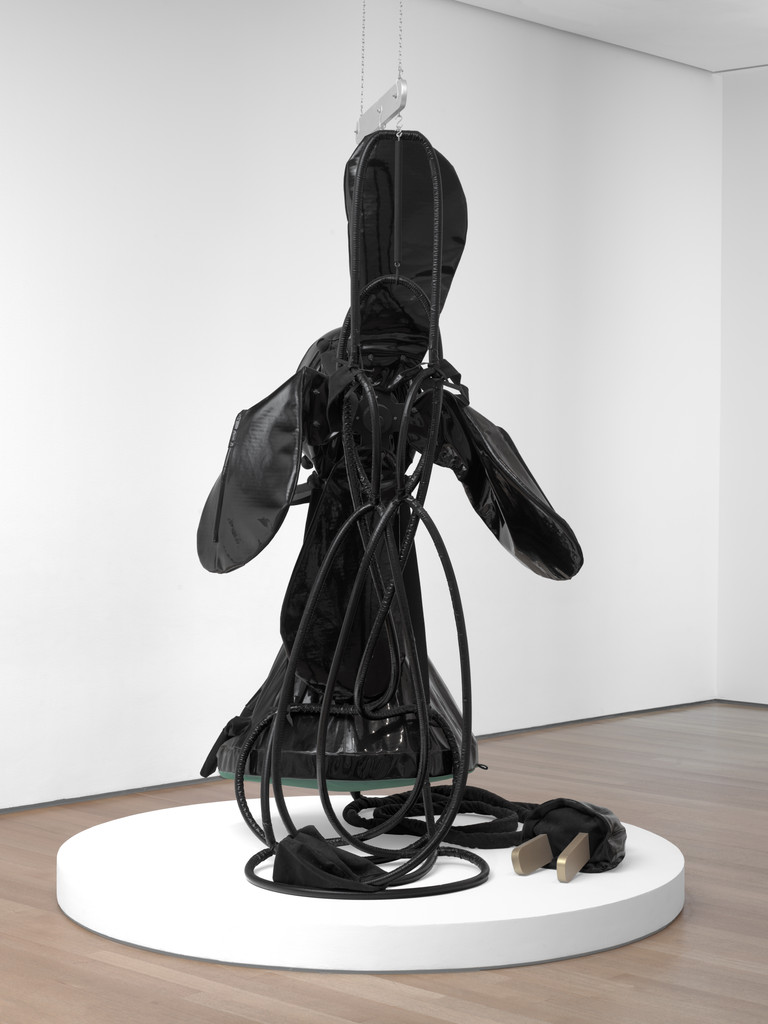 #70
#70
Giant Soft Fan
The giant fan bends and sags, as if deprived of its mechanical function; the domestic monument becomes a vulnerable body. Oldenburg modifies the scale, material and rigidity of ordinary objects in order to make strange what habit made it appear transparent. This work belongs to the moment when the Pop vocabulary diversifies: interior, body, food, road and language become laboratories of framing and repetition. The surface preserves them traces of transfer, collage or assembly which prevent the image from being reduced to a simple reproduction. Dated 1966-67, the work associates Vinyl filled with foam rubber, wood, metal, and plastic tubing with a reflection on circulation, the repetition and transformation of ordinary images.
See at the museum →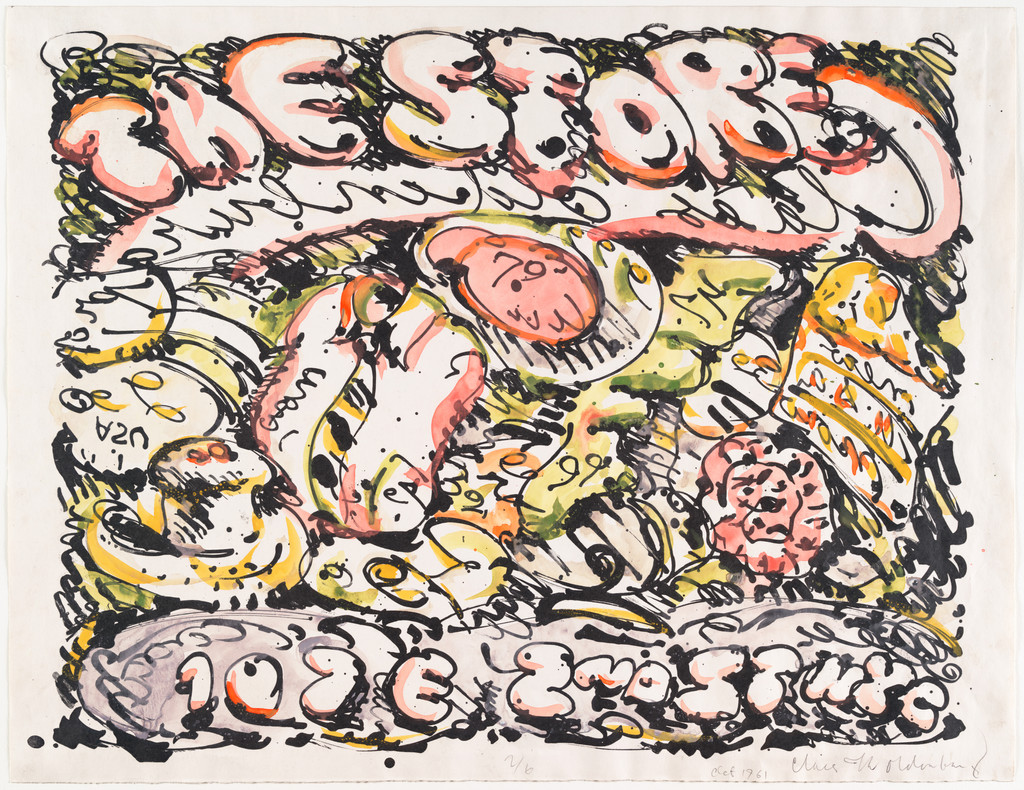 #71
#71
Store Poster
The poster announces The Store with the harshness of a painted storefront. It marks the moment when Oldenburg transforms commerce into an exhibition and exhibition into a boutique. Oldenburg modifies the scale, material and rigidity of objects ordinary in order to make strange what habit made appear transparent. This work belongs to the moment when the Pop vocabulary diversifies: interior, body, food, road and language become framing laboratories and repetition. The framing isolates the pattern until it is both immediately recognizable and strangely detached from its daily use. Dated 1961, the work combines Lithograph with watercolor additions with a reflection on the circulation, repetition and transformation of ordinary images.
See at the museum →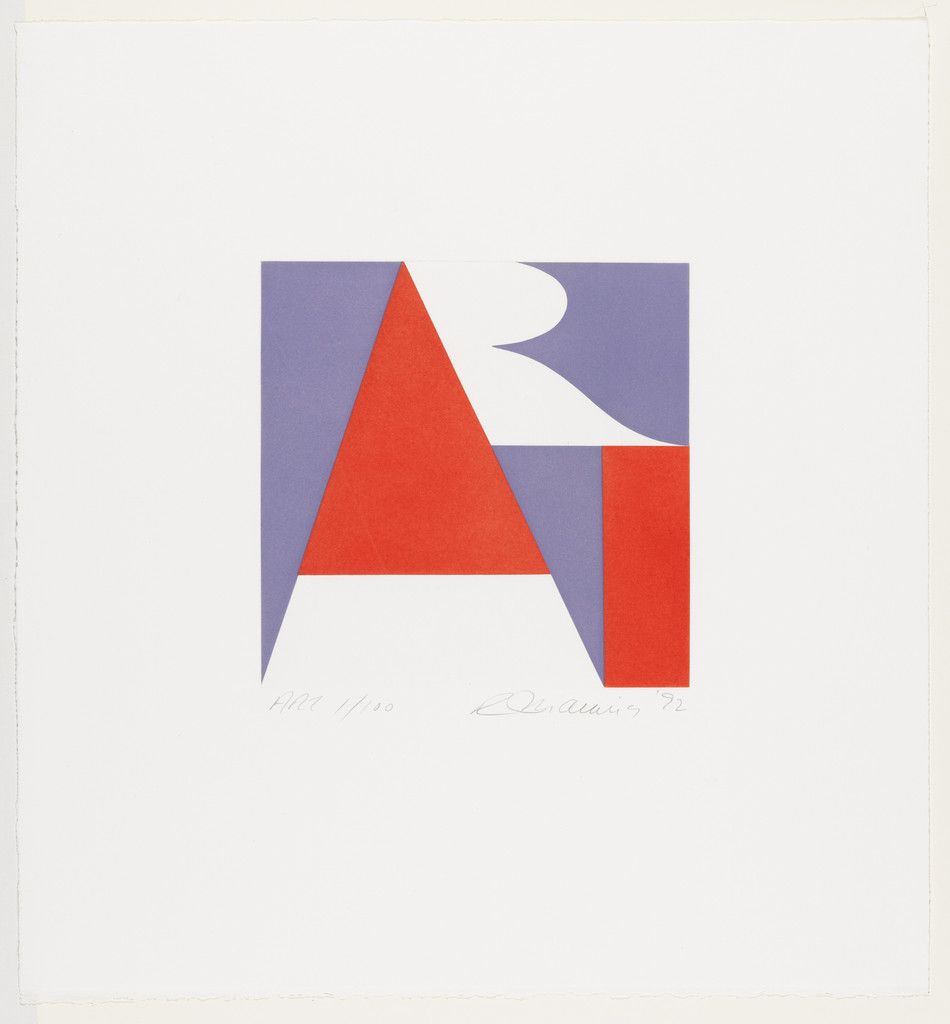 #72
#72
Art
The word ART adopts the colorful monumentality of a logo. Indiana thus brings the artistic institution back to the same visual regime as LOVE or a sign. Indiana constructs public poetry from short words, numbers and shapes close to the brand, between personal memory and collective language. This work belongs to the moment when the Pop vocabulary diversifies: interior, body, food, road and language become laboratories of framing and repetition. Repetition transforms resemblance into rhythm and reveals the gaps that the industrial image usually claims to erase. Dated 1992, the work associates Etching and aquatint with a reflection on circulation, the repetition and transformation of ordinary images.
See at the museum →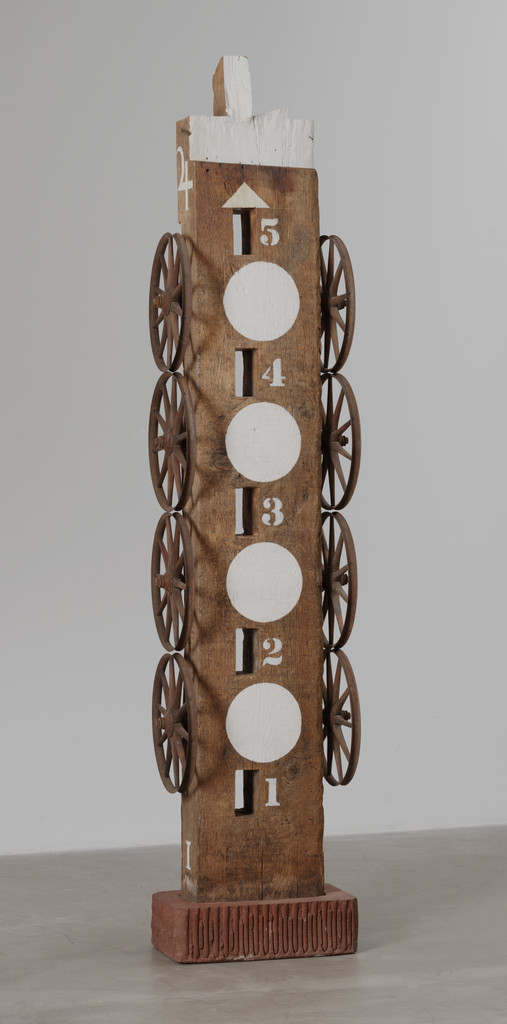 #73
#73
Moon
The crescent moon is constructed as a form of worn sign; cosmic poetry and materiality of the found object remain inseparable. Indiana constructs public poetry from short words, numbers and shapes close to the sign, between personal memory and collective language. This work belongs to the moment when the Pop vocabulary diversifies: interior, body, food, road and language become laboratories of framing and repetition. THE change of scale moves the subject from the ordinary world to a physical confrontation with the viewer. Dated 1960, the work combines Acrylic gesso on wood beam with wood-and-iron wheels and concrete with a reflection on circulation, the repetition and transformation of ordinary images.
See at the museum →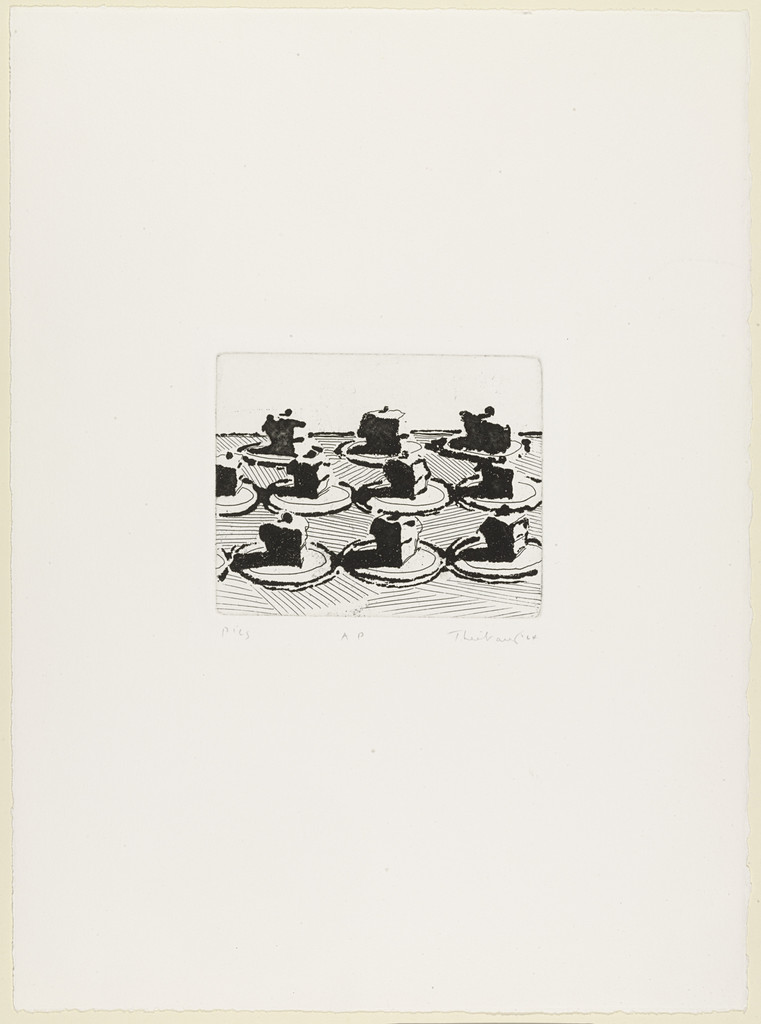 #74
#74
Pies from Delights
The pies are arranged like display units, but their surface differences prevent the series from becoming mechanical. Thiebaud paints ordinary foods with attentive material and light, now together seduction commercial and pictorial observation. This work belongs to the moment when the Pop vocabulary diversifies: interior, body, food, road and language become laboratories of framing and repetition. Color simplifies it reading while accentuating the tension between visual seduction, critical distance and the creation of desire. Dated 1964, published 1965, the work combines Etching and aquatint from a portfolio of seventeen etchings with a reflection on circulation, repetition and transformation of ordinary images.
See at the museum →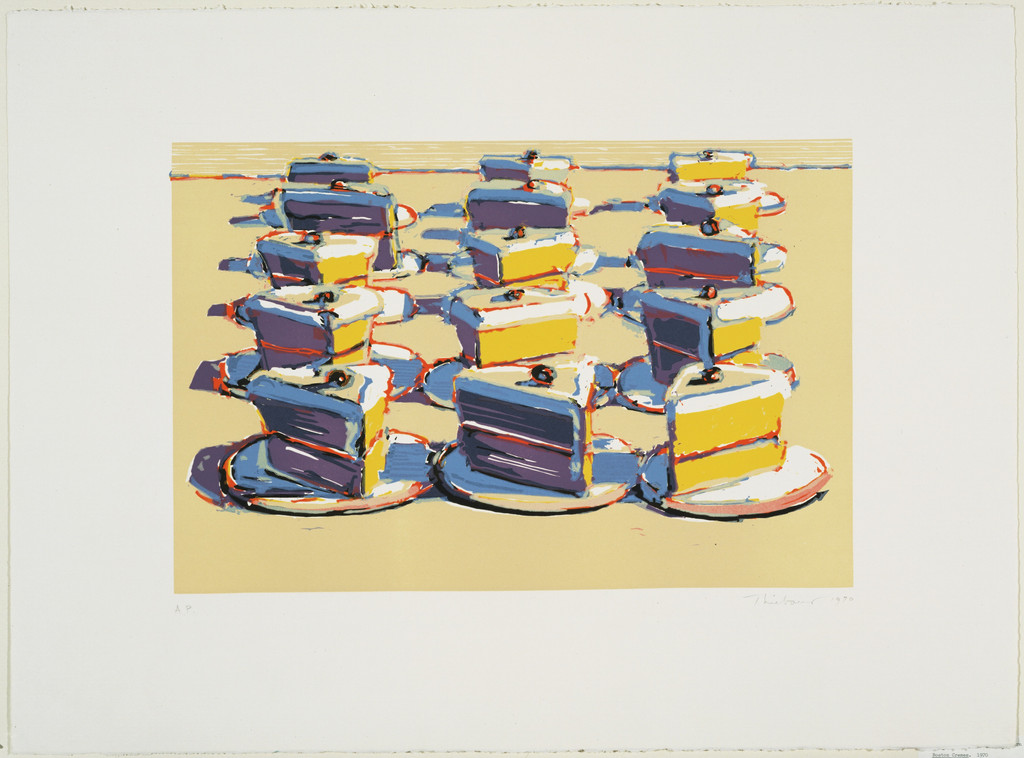 #75
#75
Boston Cremes from Seven Still Lifes and a Silver Landscape
Circular pastries, viewed with precision, transform nutritional sweetness into a study of volumes, shadows and rhythms. Thiebaud paints ordinary foods with attentive material and light, now together commercial seduction and pictorial observation. This work belongs to the moment when the Pop vocabulary diversifies: interior, body, food, road and language become laboratories of framing and repetition. The surface retains traces of transfer, collage or assembly which prevent the image from being reduced to a simple reproduction. Dated 1970, published 1971, the work combines Linoleum cut from a portfolio of two etchings, two linoleum cuts, two lithographs, and two screenprints to a reflection on the circulation, repetition and transformation of ordinary images.
See at the museum →From Dine, Segal and Kusama to Haring, Basquiat, Koons and Axell, Pop vocabulary moves towards the body, the street, identity and value.
 #76
#76
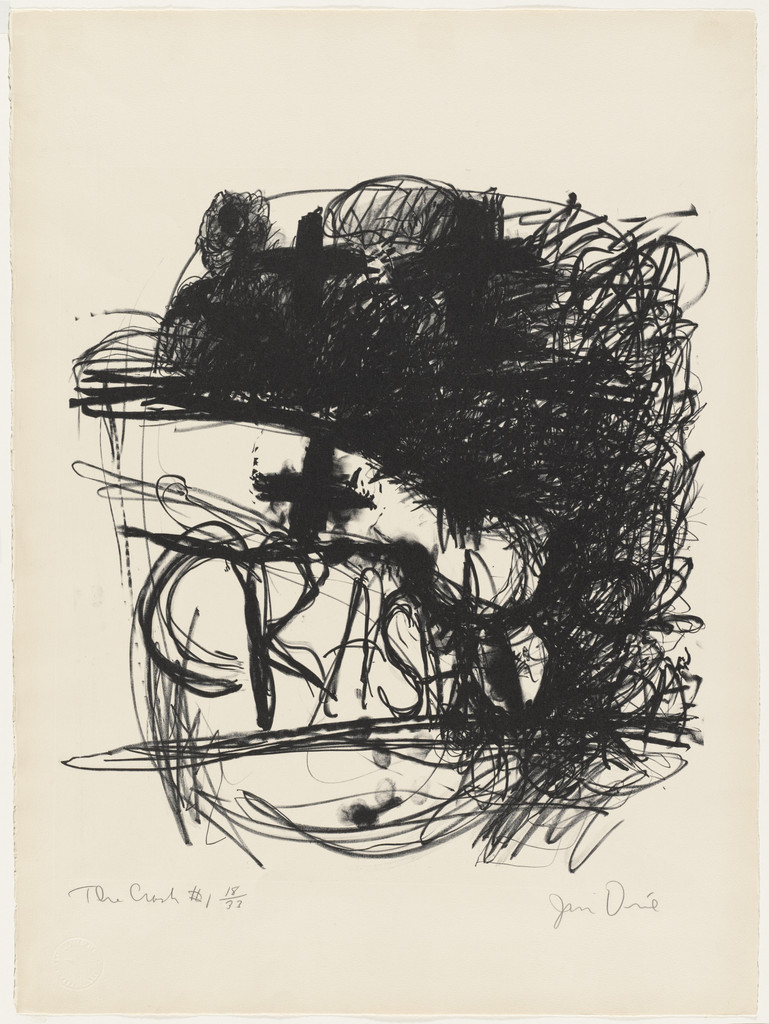
Because Crash I
Dine treats the accident through a series of offending signs rather than a narration; the car becomes the dark emblem of a desired and dangerous modernity. Dine returns to some personal items - tool, palette, heart or bathrobe - which he subjects to repetition without erasing their autobiographical charge. In the extensions of the movement, it shows that appropriation, popular culture and industrial objects continue to act well beyond the 1960s. The framing isolates the pattern until it is both immediately recognizable and strangely detached from its daily use. Dated 1960, the work combines One from a series of six lithographs with a reflection on circulation, the repetition and transformation of ordinary images.
See at the museum →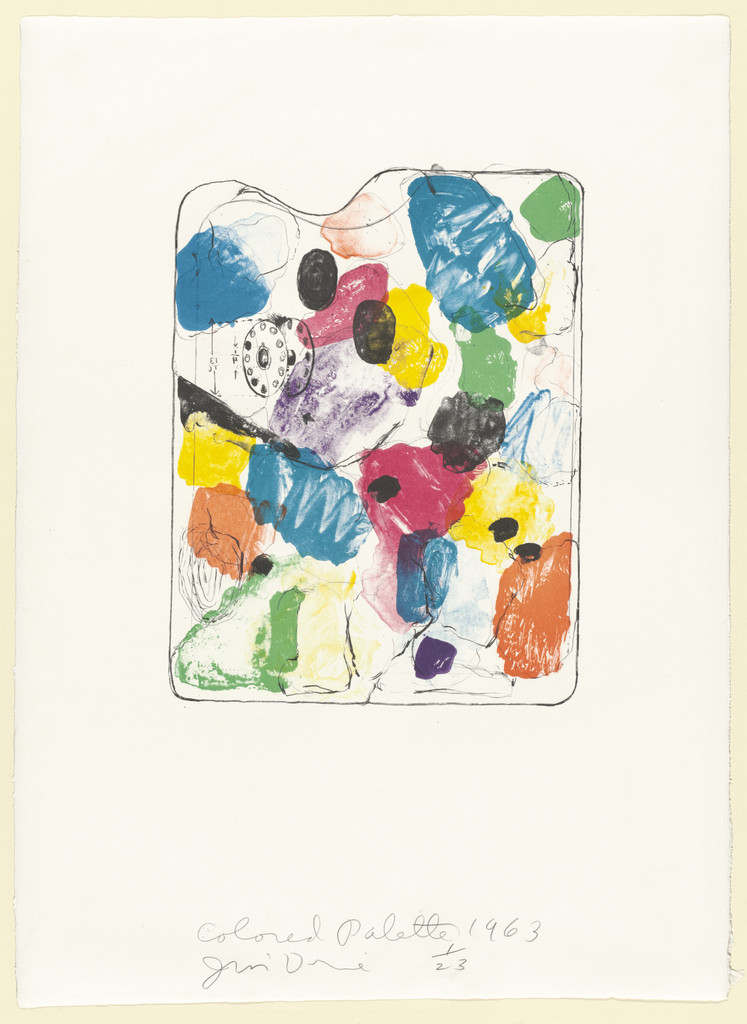 #77
#77
Colored Palette
The artist's palette is represented as a signature object. The traditional tool joins the franchise of industrial colors and reproducible pattern. Dine goes back to some personal items - tool, palette, heart or bathrobe - which he subjects to repetition without erasing their autobiographical charge. In the extensions of the movement, it shows that appropriation, popular culture and industrial objects continue to act well beyond the 1960s. The repetition transforms resemblance into rhythm and reveals the gaps that the industrial image usually claims to erase. Dated 1963, the work associates Lithograph with a reflection on circulation, repetition and transformation of ordinary images.
See at the museum →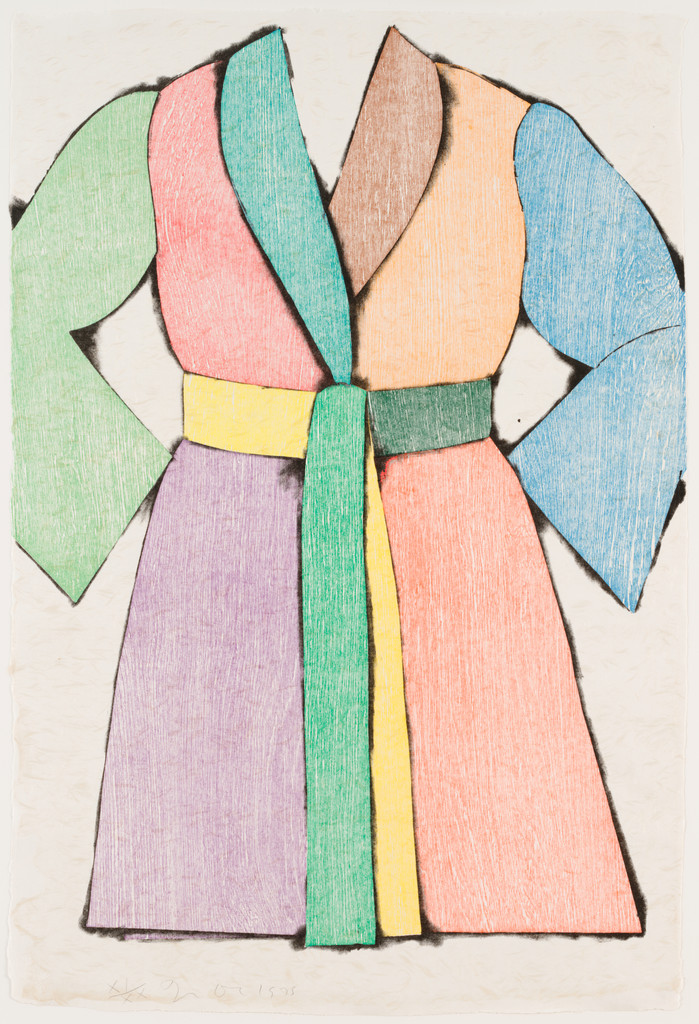 #78
#78
The Woodcut Bathrobe
The empty bathrobe serves as a monumental self-portrait; its familiar silhouette allows Dine to unite intimacy, series and graphic power. Dine returns to some personal objects - tool, palette, heart or bathrobe - which he submits to the repetition without erasing their autobiographical charge. In the extensions of the movement, it shows that appropriation, popular culture and the industrial object continue to act well beyond the 1960s. The change of scale moves the subject from the ordinary world to a physical confrontation with the viewer. Dated 1975, the work combines Woodcut and lithograph with a reflection on the circulation, repetition and transformation of ordinary images.
See at the museum →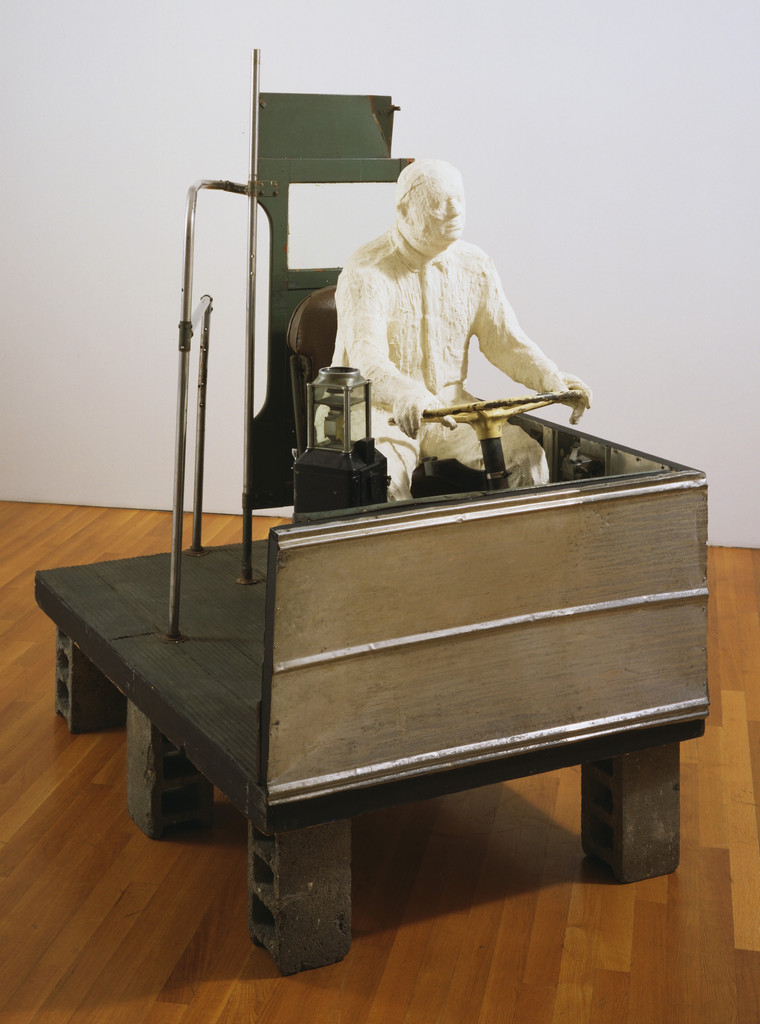 #79
#79
The Bus Driver
The life-size driver and his real position give a silent presence to everyday life. Segal transforms the anonymous into a monument without idealization. Segal gives anonymous everyday gestures the scale of public sculpture while maintaining their silence and vulnerability. In the extensions of the movement, it shows that appropriation, popular culture and industrial objects continue to act well beyond the 1960s. Color simplifies reading while accentuating the tension between visual seduction, critical distance and the creation of desire. Dated 1962, the work combines Plaster over cheesecloth; bus parts including coin box, steering wheel, driver's seat, railing, and dashboard, over wood and cinder blocks to a reflection on the circulation, repetition and transformation of ordinary images.
See at the museum →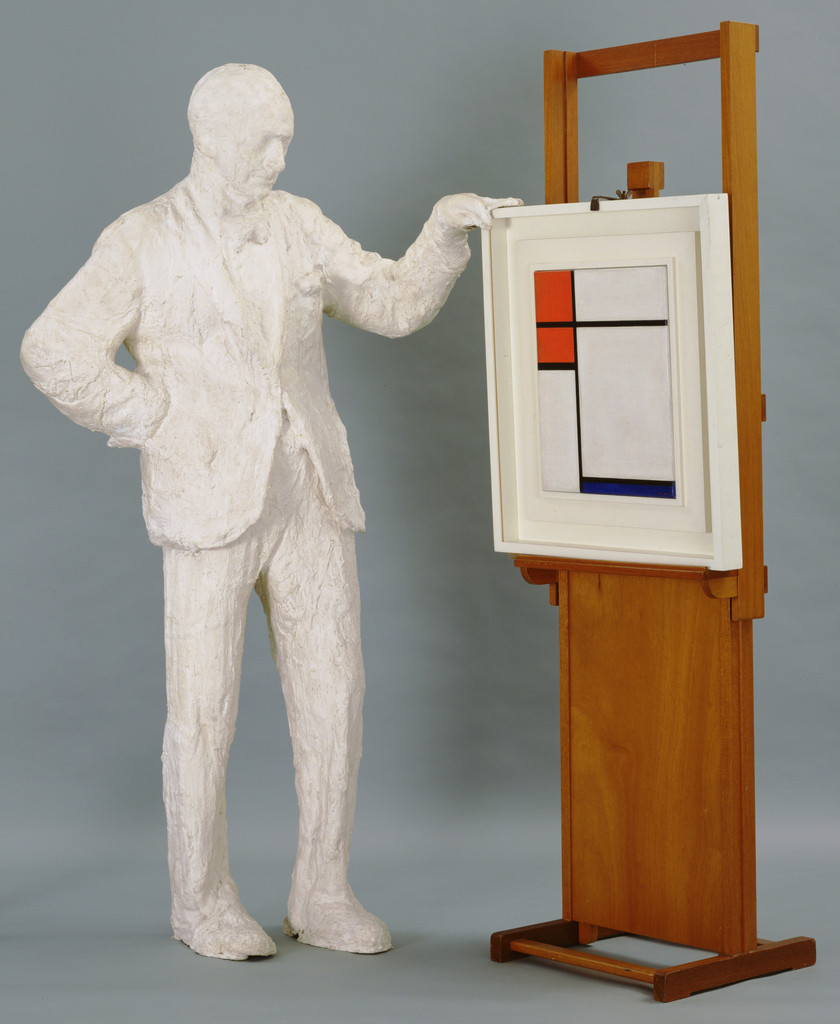 #80
#80
Portrait of Sidney Janis with Mondrian Painting
The sculpted portrait dialogues with a painting by Mondrian; the real collector physically enters the history of abstraction and its market. Segal gives anonymous everyday gestures the scale of public sculpture while maintaining their silence and vulnerability. In the extensions of the movement, it shows that appropriation, popular culture and industrial objects continue to act well beyond the 1960s. The surface preserves the traces transfer, collage or assembly which prevent the image from being reduced to a simple reproduction. Dated 1967, the work associates Plaster figure with Mondrian's "Composition," 1933, on an easy with a reflection on circulation, the repetition and transformation of ordinary images.
See at the museum →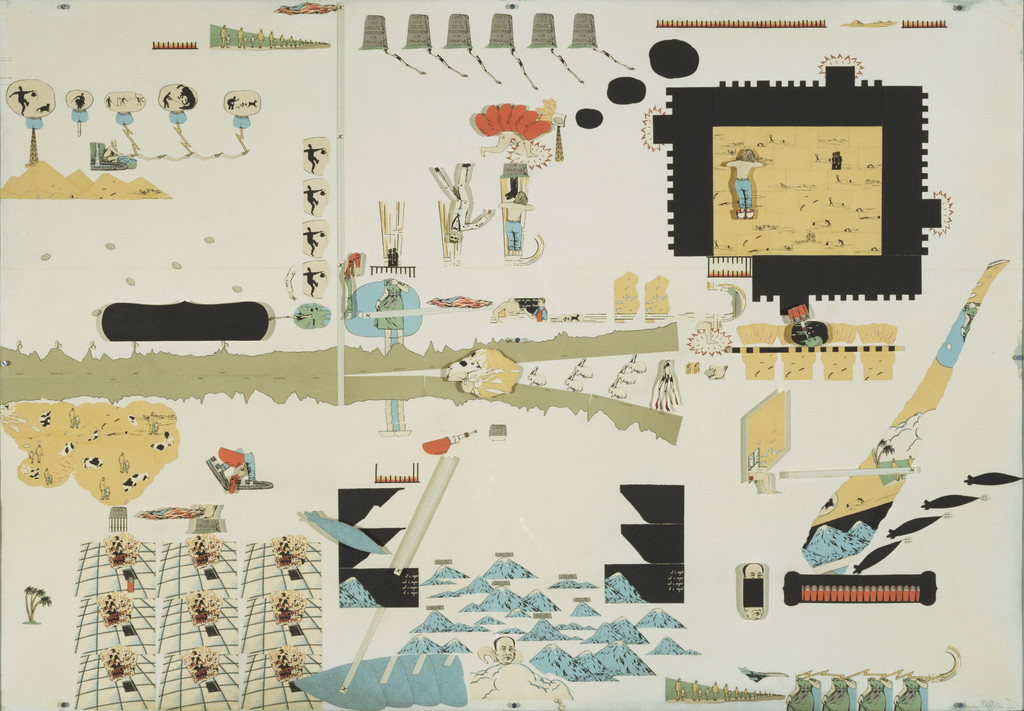 #81
#81
Eddie (Sylvie's brother) in the Desert (Variable Collage)
Characters, words and moving elements make up an unstable political landscape. Fahlstrom treats current events like a game whose rules remain questionable. Fahlstrom transforms political information into maps and variable elements, making the image a system to manipulate rather than a message to receive. In the extensions of the movement, it shows that appropriation, popular culture and the industrial object continue to act well beyond the 1960s. The framing isolates the pattern until it is both immediately recognizable and strangely detached from its daily use. Dated New York 1966, the work combines Movable screenprinted paper cutouts over screenprinted cutouts pasted on painted wood panel reflects on the circulation, repetition and transformation of ordinary images.
See at the museum →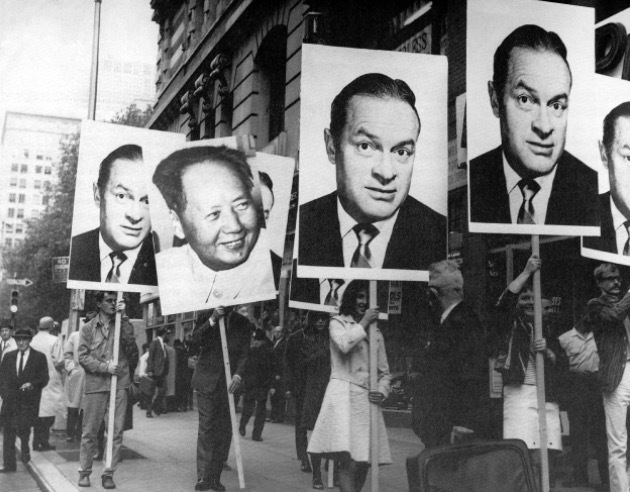 #82
#82
Mao Hope March
Mao's figure, the march and the idea of hope are organized as manipulable elements; propaganda and critical play overlap. Fahlstrom transforms political information into variable maps and elements, making the image one system to manipulate rather than a message to receive. In the extensions of the movement, it shows that appropriation, popular culture and the industrial object continue to act well beyond the 1960s. Repetition transforms the resemblance in rhythm reveals the gaps that the industrial image usually claims to erase. Dated 1966, the work associates 16mm film transferred to video (black and white, sound) with a reflection on circulation, the repetition and transformation of ordinary images.
See at the museum →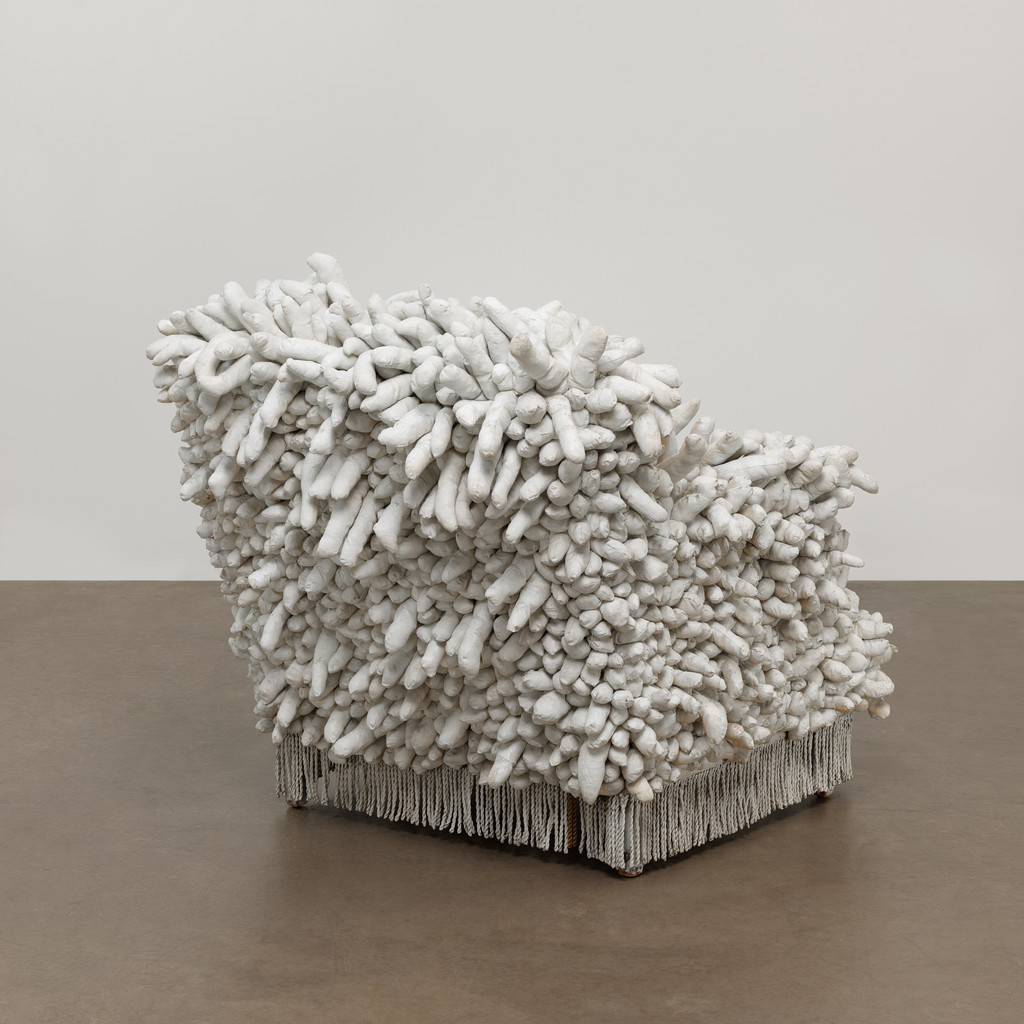 #83
#83
Accumulation No. 1
The armchair covered with flexible growths becomes at the same time furniture, body and obsessive proliferation; the servant falls into an organic world. Kusama transforms repetition and proliferation into psychic experience; his work joins Pop through the object and the series while retaining a deeply personal logic. In the extensions of the movement, it shows that appropriation, popular culture and the industrial object continue to act well beyond from the 1960s. The change of scale moves the subject from the ordinary world towards a physical confrontation with the viewer. Dated 1962, the work combines Sewn stuffed fabric, paint, and flesh fringe with a reflection on circulation, the repetition and transformation of ordinary images.
See at the museum →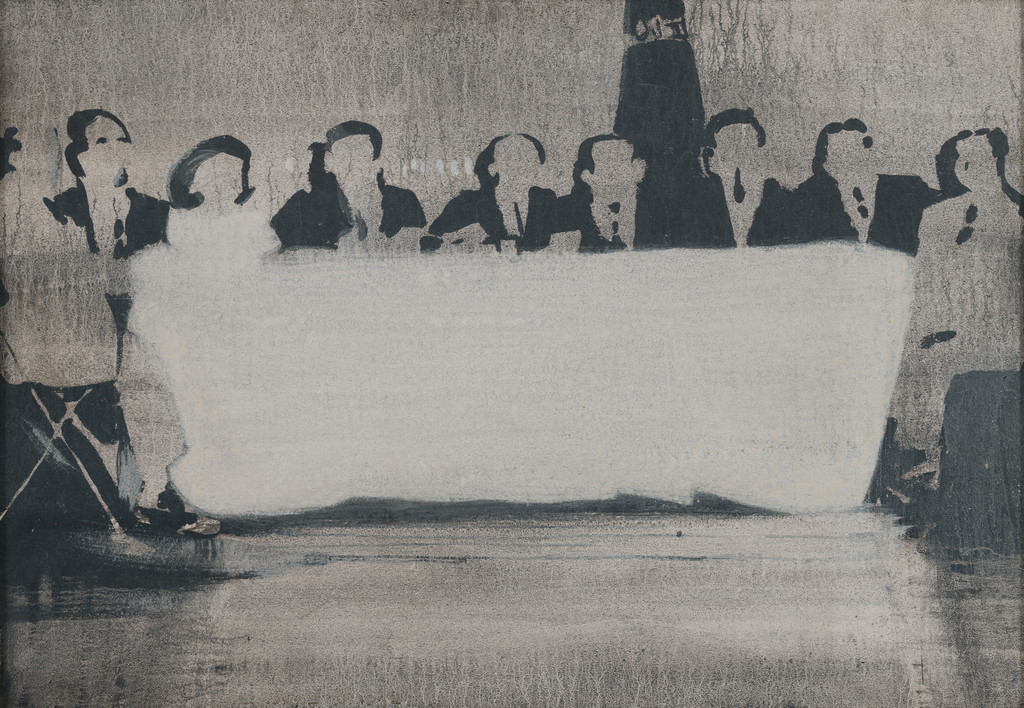 #84
#84
Seated Group
The seated group is reduced to a cold and compact image where faux wood makes the familiar space artificial, like a photograph that has become furniture. Artschwager blurs painting, sculpture, furniture and photography by covering the shapes familiar with artificial materials. In the extensions of the movement, it shows that appropriation, popular culture and industrial objects continue to act well beyond the 1960s. Color simplifies reading while accentuating the tension between visual seduction, critical distance and the creation of desire. Dated 1962, the work combines Charcoal and synthetic polymer paint on Celotex with a reflection on circulation, repetition and transformation ordinary images.
See at the museum →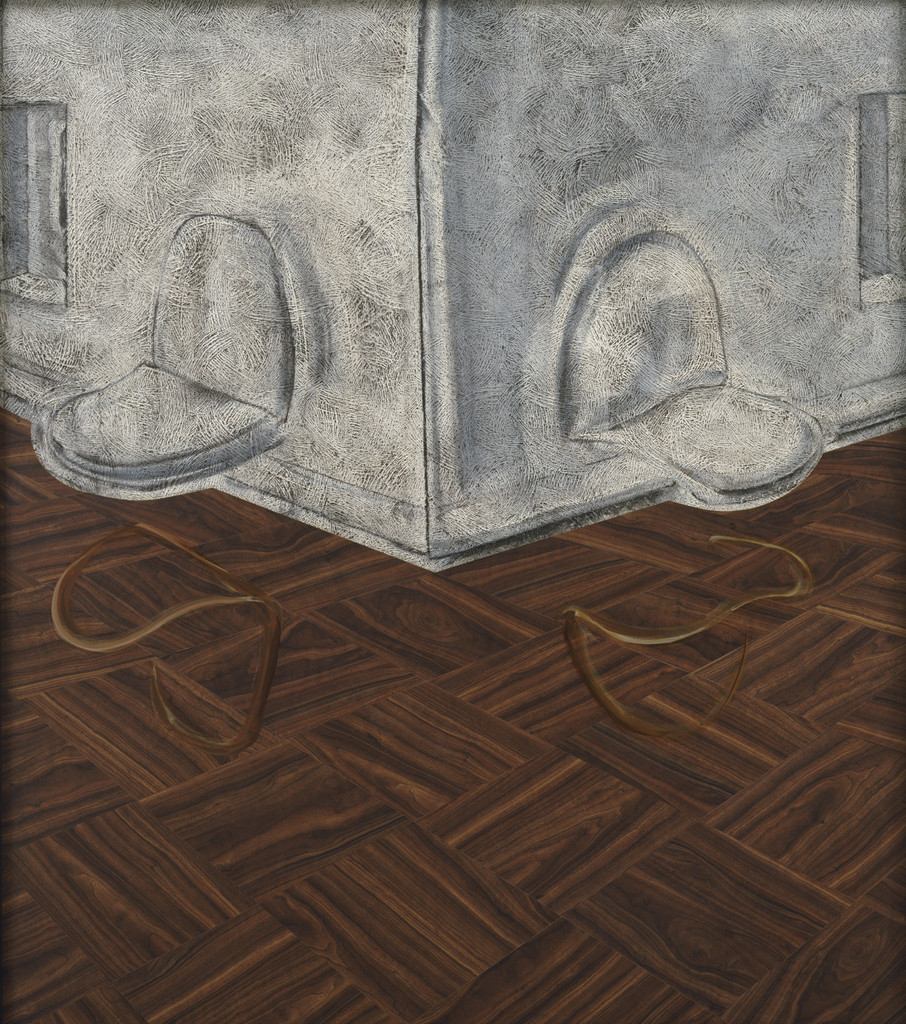 #85
#85
Double Sitting
Two silhouettes face each other in a compressed setting; the material imitating furniture transforms the scene into a mental object rather than a habitable interior. Artschwager blurs painting, sculpture, furniture and photography by covering them familiar forms of artificial materials. In the extensions of the movement, it shows that appropriation, popular culture and industrial objects continue to act well beyond the 1960s. The surface retains traces of transfer, collage or assembly which prevent the image from being reduced to a simple reproduction. Dated 1988, the work combines Synthetic polymer paint on board and paint on formica with a reflection on circulation, repetition and transformation of ordinary images.
See at the museum →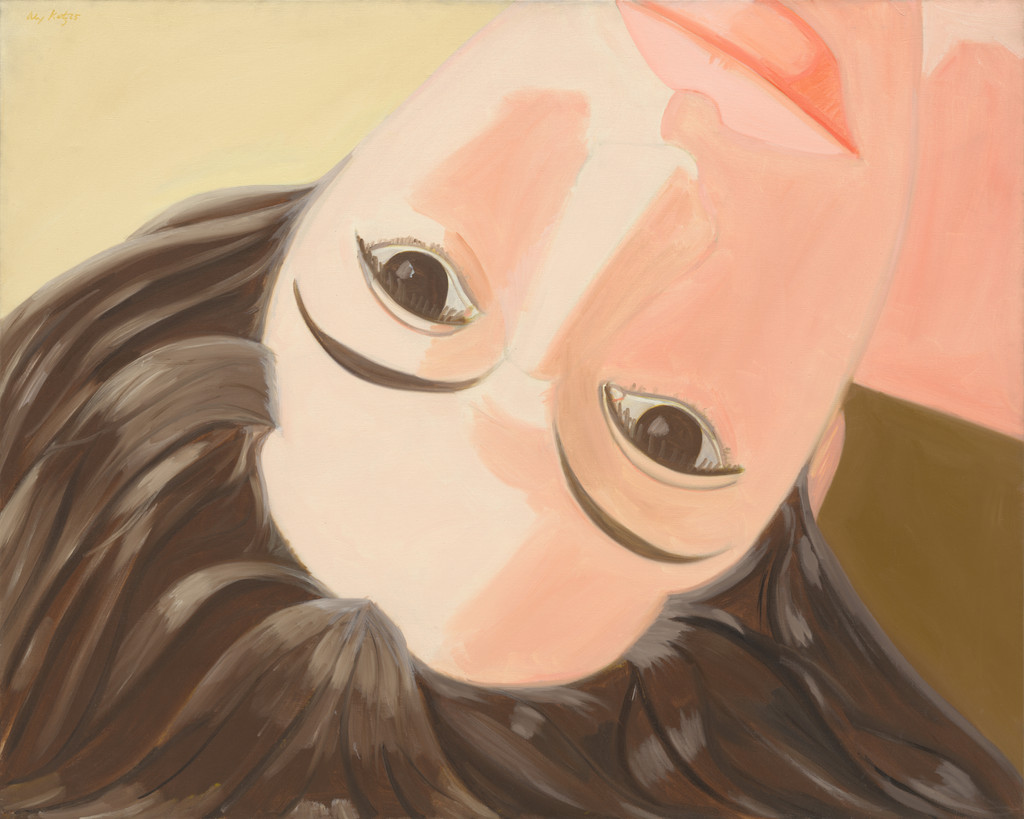 #86
#86
Upside Down Ada
Ada's portrait is turned upside down without losing her presence. Katz demonstrates that a few sharp areas are enough to maintain an identity despite the disruption of the frame. Katz simplifies the portrait to the flat without giving up presence individual; its apparent coldness is based on very precise observation. In the extensions of the movement, it shows that appropriation, popular culture and industrial objects continue to act well beyond the 1960s. The framing isolates the pattern to the point of making it both immediately recognizable and strangely detached from its daily use. Dated 1965, the work associates Oil on linen with a reflection on circulation, repetition and transformation ordinary images.
See at the museum →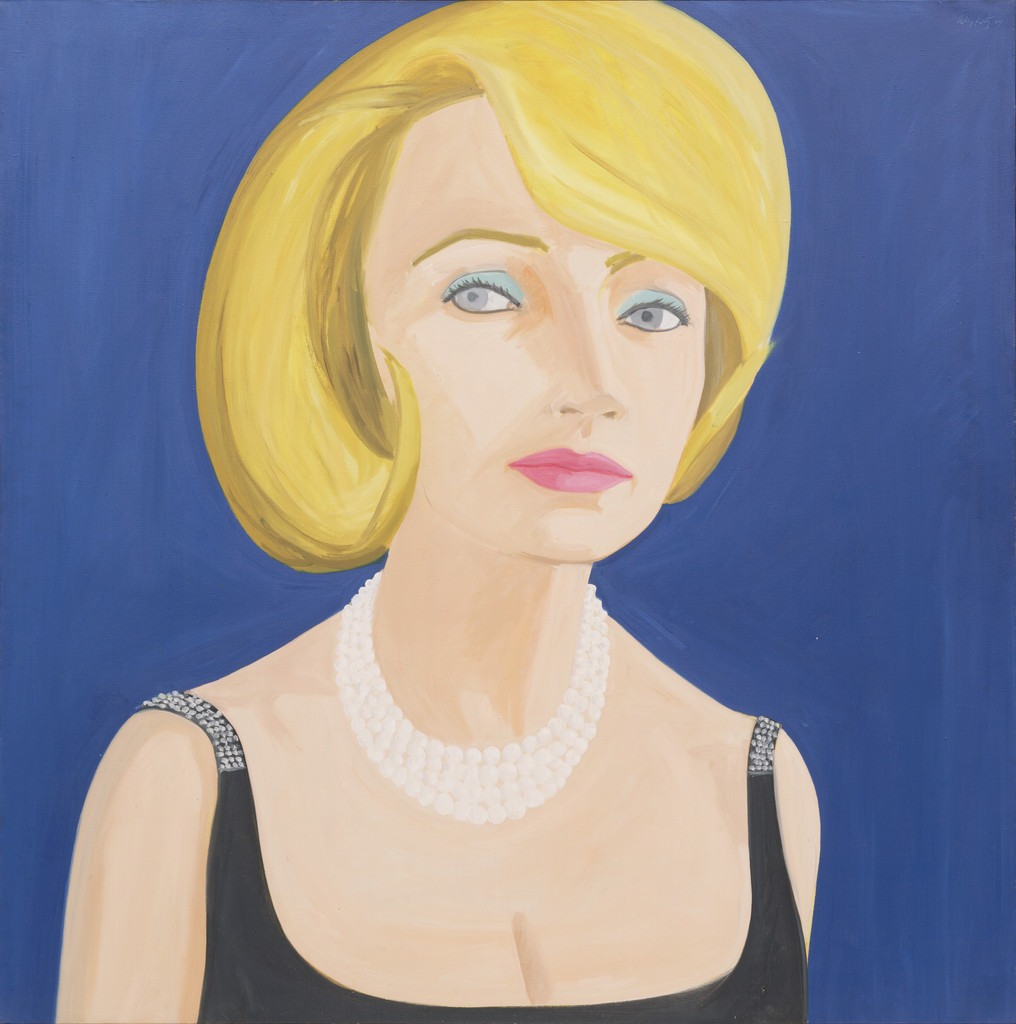 #87
#87
Lita
The monumental and calm face escapes the anecdote; the close framing borrows from advertising while preserving a meditative distance. Katz simplifies the portrait to the flat without renouncing individual presence; his coldness apparent is based on a very precise observation. In the extensions of the movement, it shows that appropriation, popular culture and the industrial object continue to act well beyond the 1960s. Repetition transforms the resemblance in rhythm and reveals the gaps that the industrial image usually claims to erase. Dated 1964, the work associates Oil on canvas with a reflection on the circulation, repetition and transformation of images ordinary.
See at the museum →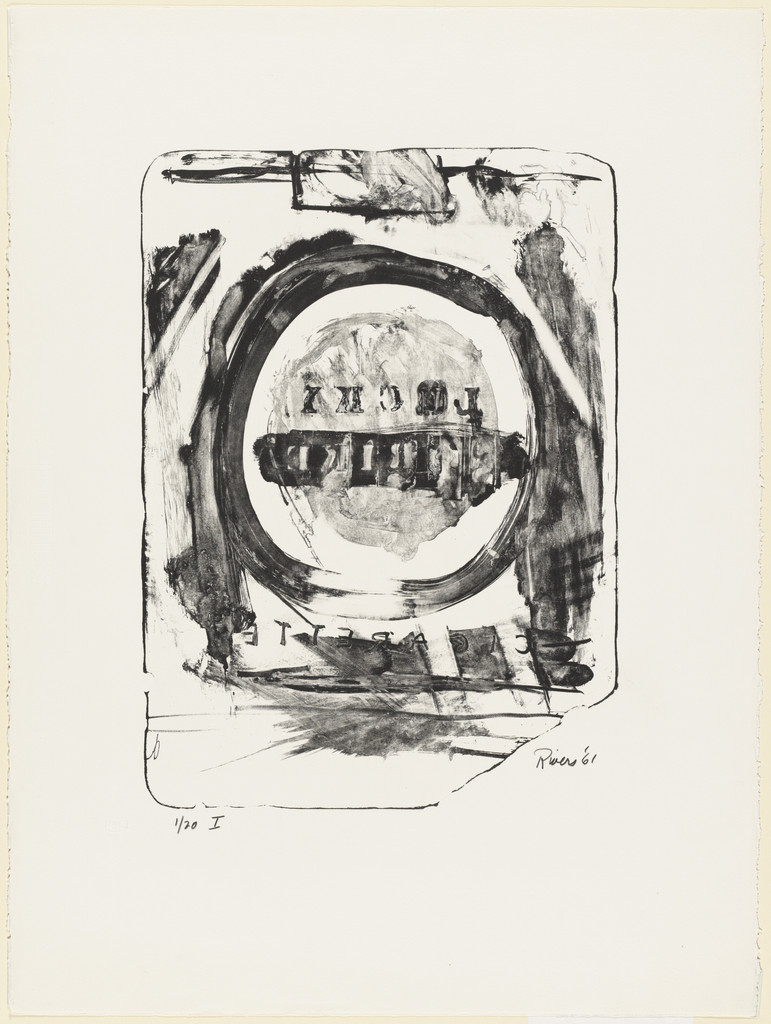 #88
#88
Lucky Strike in the Mirror (Lucky Strike I)
The pack of cigarettes and its reflection become a modern still life where brand, memory and pictorial illusion respond to each other. Rivers combines drawing virtuosity, trademarks and historical quotes in a painting that preserves the instability of collage. In the extensions of the movement, it shows that appropriation, popular culture and the industrial object continue to act well beyond the 1960s. The change of scale moves the subject of the world ordinary towards a physical confrontation with the spectator. Dated 1961, the work associates Lithograph with a reflection on the circulation, repetition and transformation of ordinary images.
See at the museum →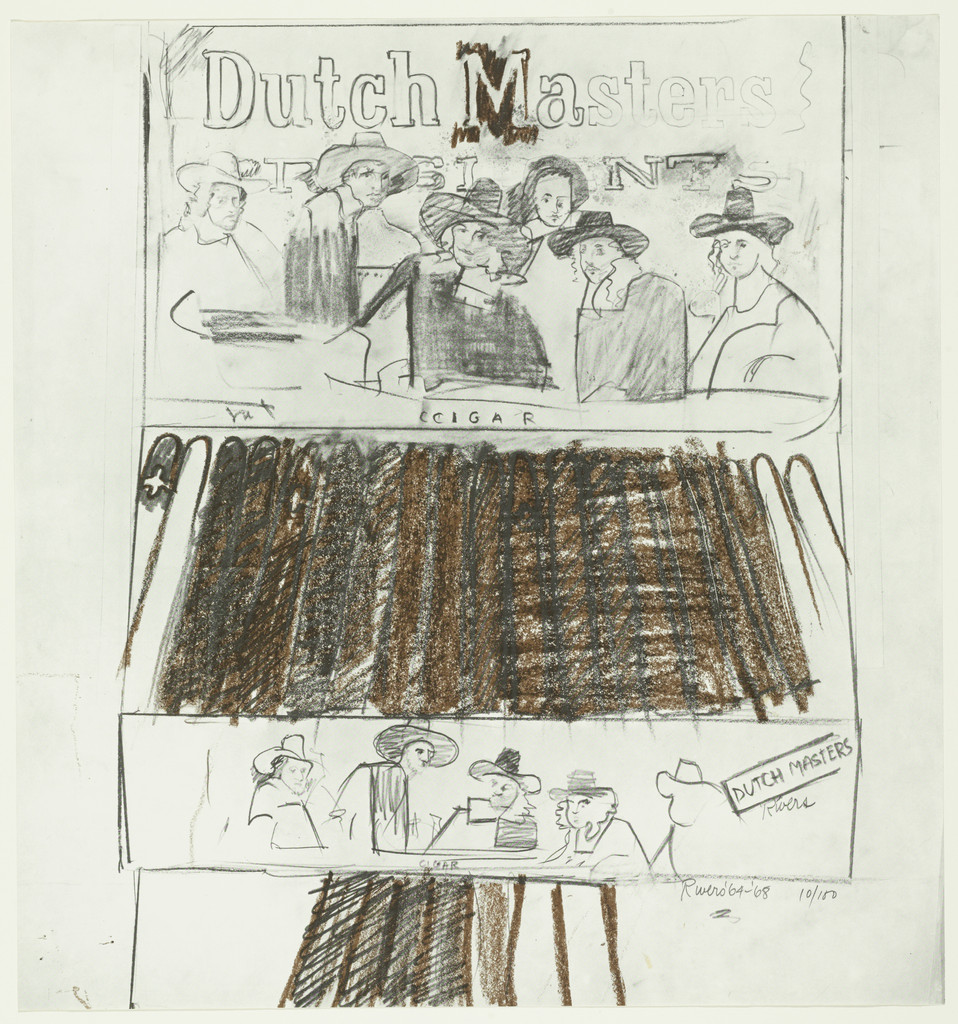 #89
#89
Dutch Masters
Rivers diverts cigar imagery and advertising to construct a composition where the merchandise also serves as commentary on the painting. Rivers combines drawing virtuosity, trademarks and historical quotes in one painting that retains the instability of collage. In the extensions of the movement, it shows that appropriation, popular culture and industrial objects continue to act well beyond the 1960s. Color simplifies reading while accentuating the tension between visual seduction, critical distance and the creation of desire. Dated 1964-68 (published 1968)., the work combines Lithograph, offset printed with a reflection on circulation, repetition and transformation of ordinary images.
See at the museum →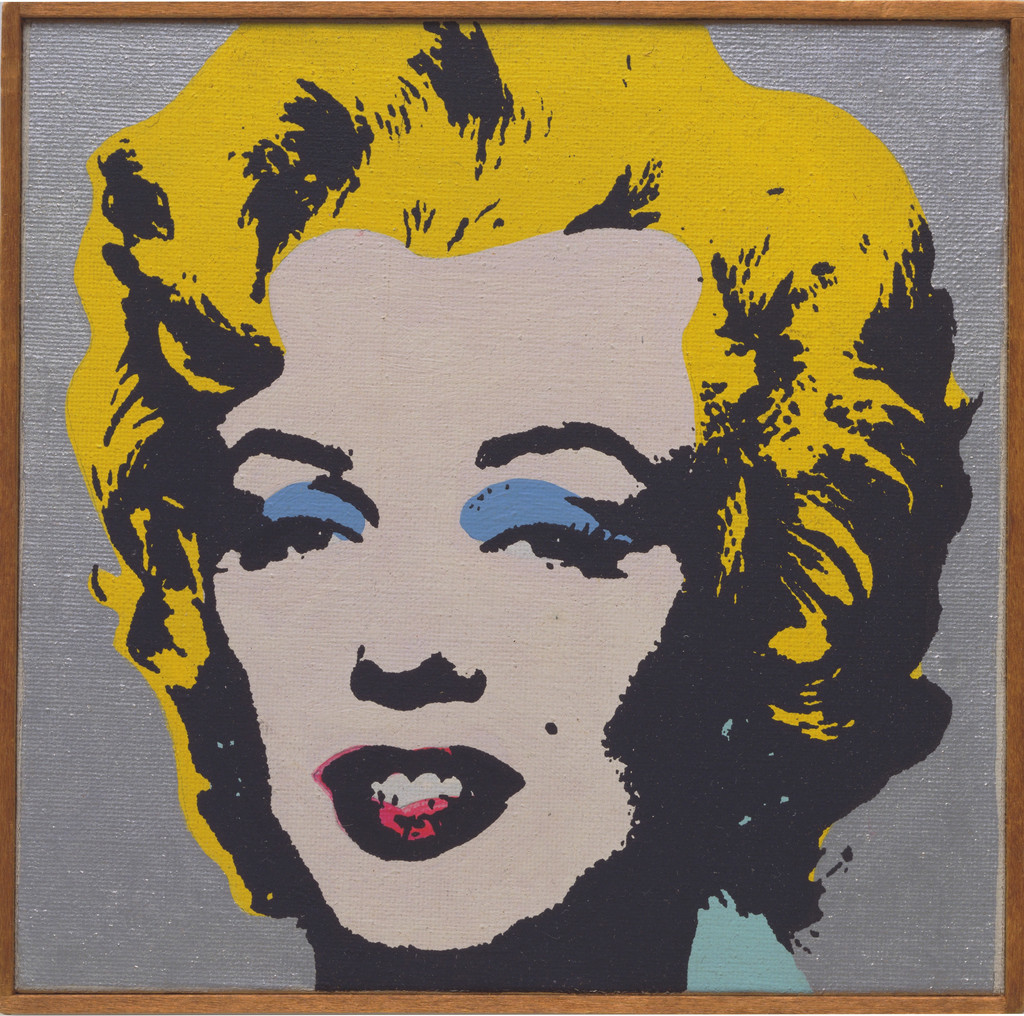 #90
#90
Andy Warhol, "Marilyn Monroe", 1964
Pettibone reduces Warhol's Marilyn to a small, careful replica; appropriation becomes a question of scale, author and circulation of icons. Pettibone makes reduced copying a critical tool: resemblance, signature and value turns out to depend on context. In the extensions of the movement, it shows that appropriation, popular culture and the industrial object continue to act well beyond the 1960s. The surface retains traces of transfer, collage or assembly which prevent the image from being reduced to a simple reproduction. Dated 1968, the work combines Silkscreen ink on canvas with a reflection on the circulation, repetition and transformation of images ordinary.
See at the museum →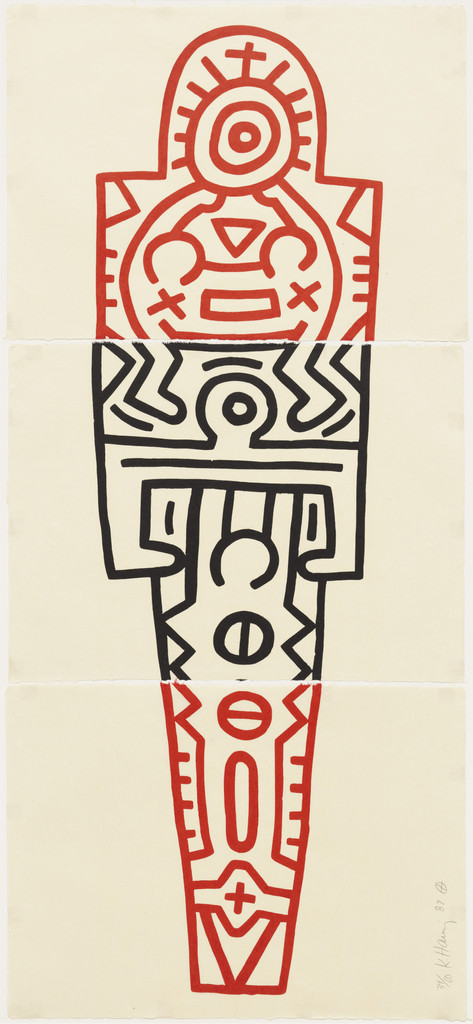 #91
#91
Totem
The schematic figures fit together in energetic verticality. The immediate readability of the sign allows Haring to unite dance, body and public space. Haring develops an immediately readable sign language to inscribe body, energy and social issues in public space. In the extensions of the movement, it shows that appropriation, popular culture and the industrial object continue to act well beyond the 1960s. The framing isolates the motif until making it both immediately recognizable and strangely detached from its daily use. Dated 1989, the work associates Woodcut on three sheets with a reflection on the circulation, repetition and transformation of images ordinary.
See at the museum →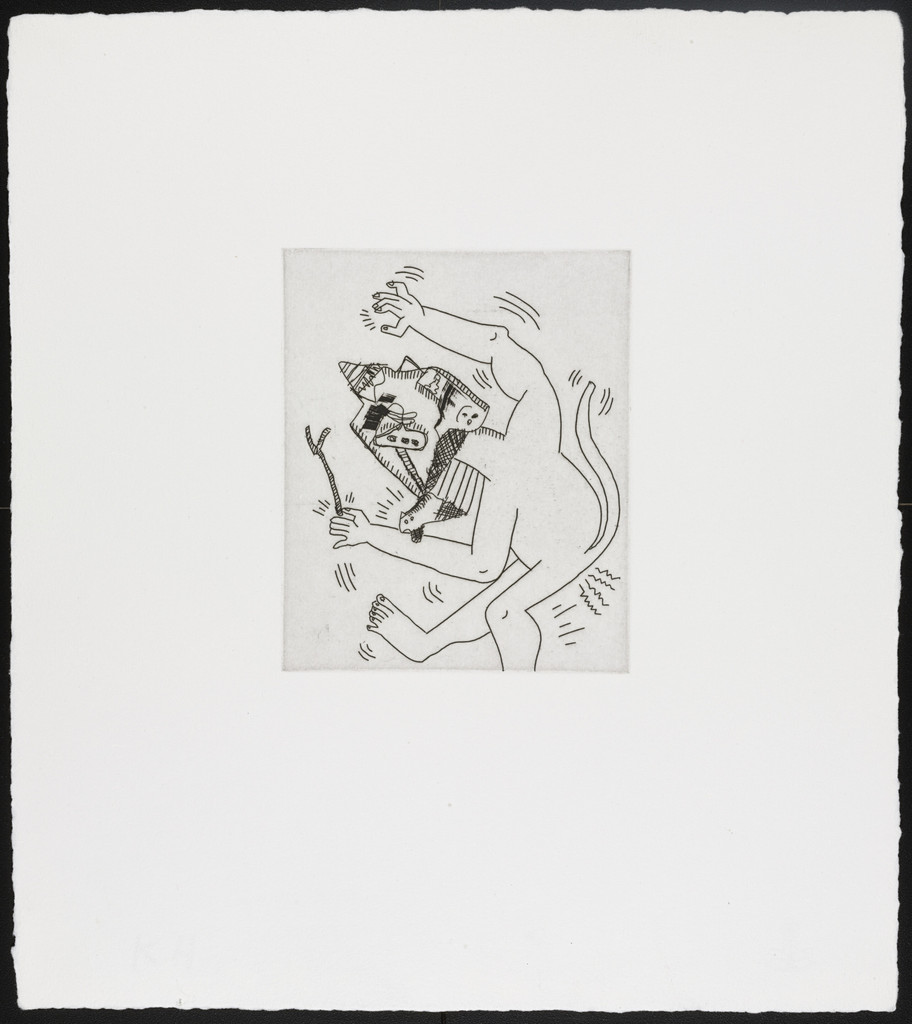 #92
#92
Untitled from an untitled series
The continuous line organizes characters and movements without hierarchy; the image appears spontaneous but is based on an extremely mastered vocabulary. Haring develops an immediately readable sign language to inscribe body, energy and social issues in public space. In the extensions of the movement, it shows that appropriation, popular culture and the industrial object continue to act well beyond the 1960s. Repetition transforms resemblance in rhythm and reveals the gaps that the industrial image usually claims to erase. Dated 1989, the work associates One from a series of eleven etchings with a reflection on circulation, repetition and transformation of ordinary images.
See at the museum →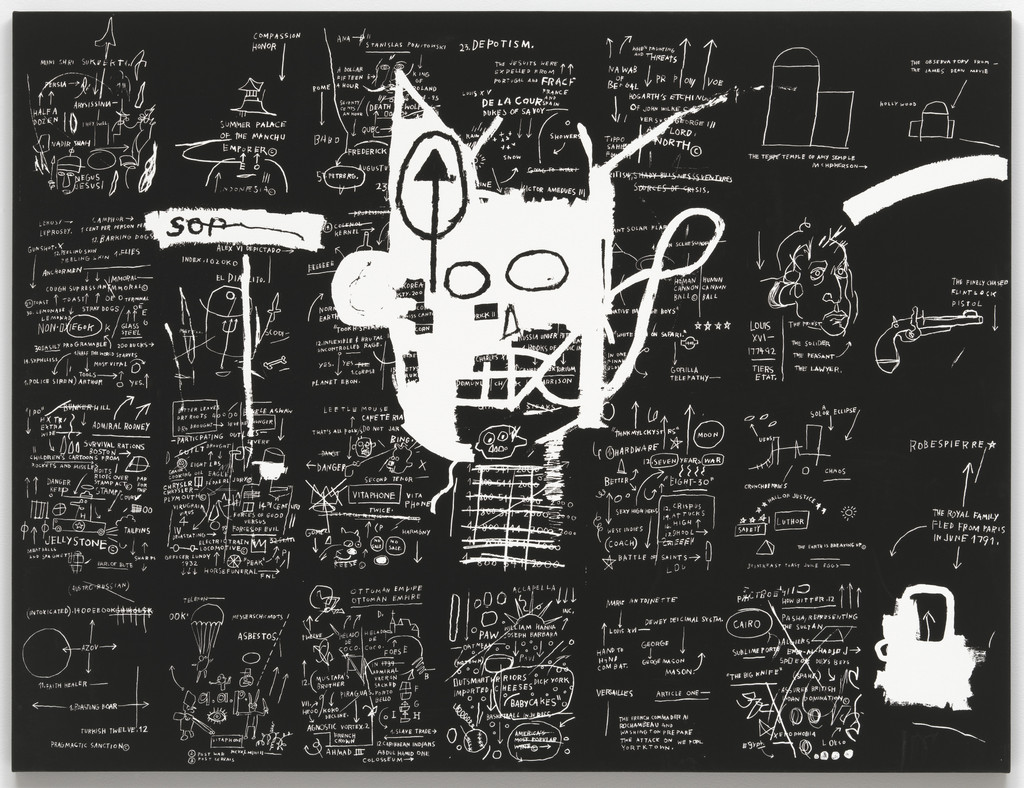 #93
#93
Untitled
Basquiat superimposes bodies, words and signs as if on a wall of memory. The surface refuses the advertising finish while directly confronting the circulation of images. Basquiat brings in art history, anatomy, music, economics and dark experience in surfaces where words and figures challenge each other. In the extensions of the movement, it shows that appropriation, popular culture and industrial objects continue to act well beyond the years 1960. The change of scale moves the subject from the ordinary world towards a physical confrontation with the spectator. Dated 1983, the work combines Screenprint on canvas with a reflection on circulation, repetition and transformation ordinary images.
See at the museum →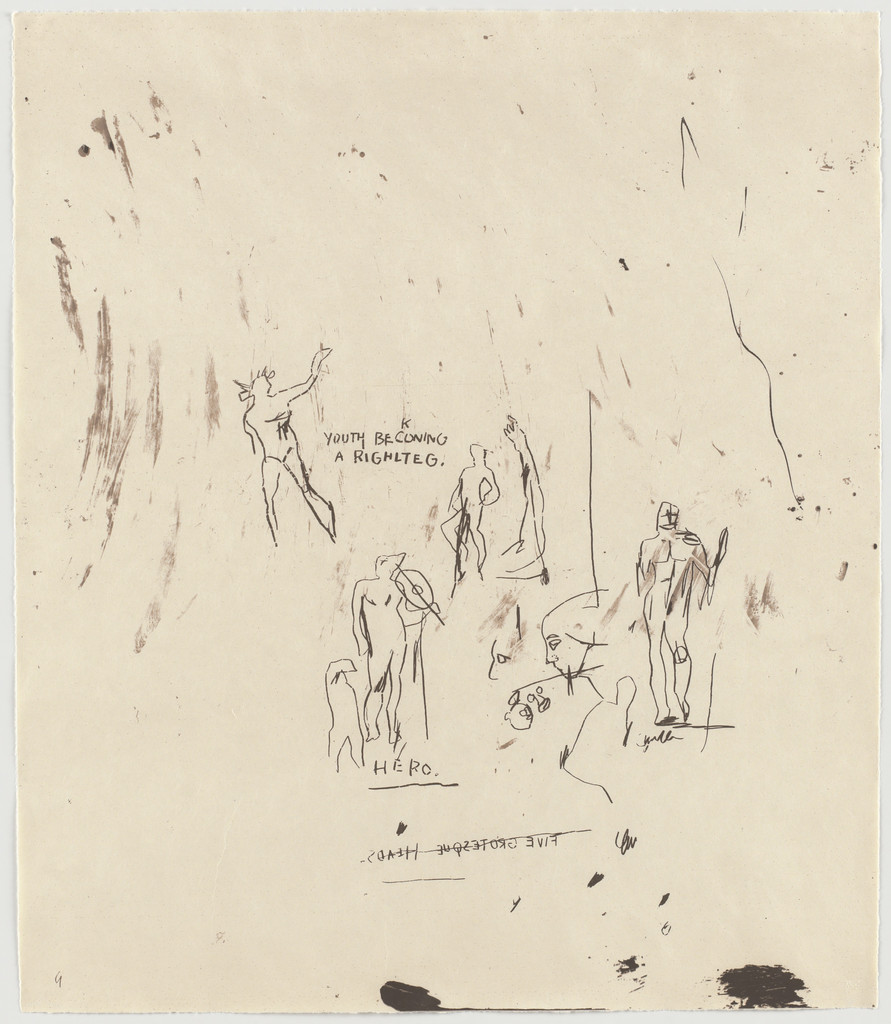 #94
#94
Untitled, From Leonardo
Leonardo's anatomical references are fragmented, annotated and reinvented; scholarly knowledge, street and autobiography meet without stable order. Basquiat brings in art history, anatomy, music, economics and dark experience in surfaces where words and figures challenge each other. In the extensions of the movement, it shows that appropriation, popular culture and industrial objects continue to act well beyond the 1960s. Color simplifies reading while accentuating the tension between visual seduction, critical distance and the creation of desire. Dated 1983, the work combines Series of five screenprints with a reflection on circulation, repetition and transformation of ordinary images.
See at the museum →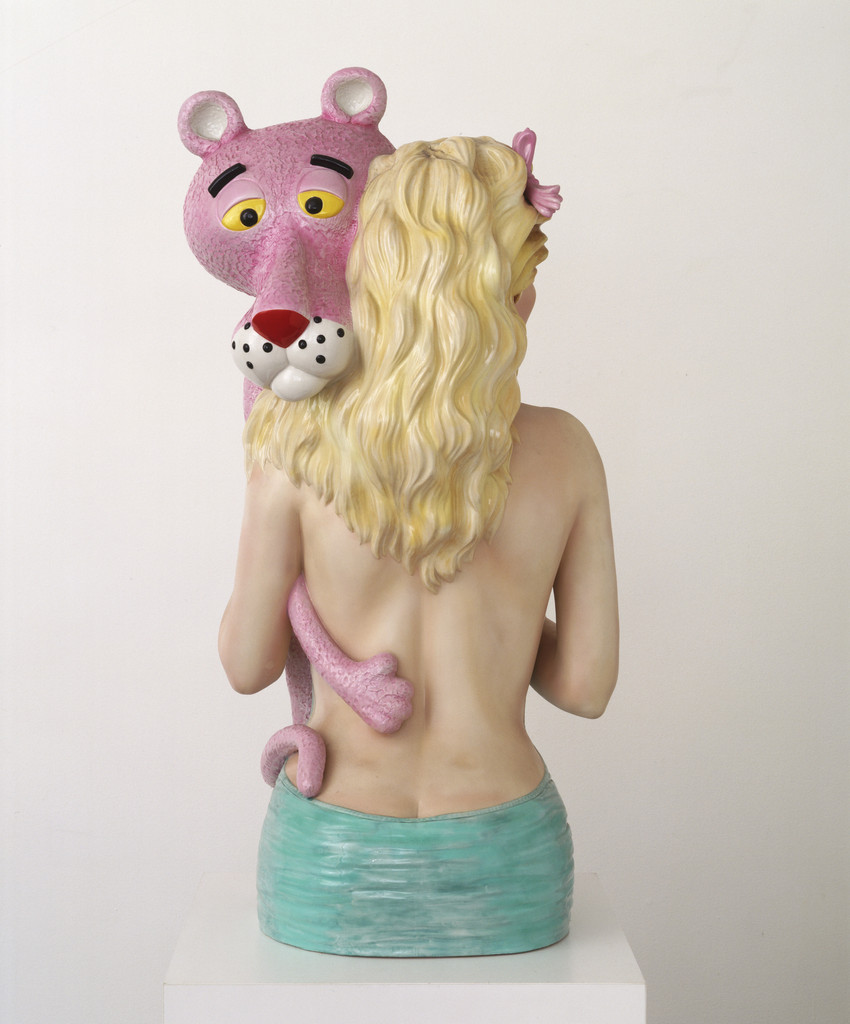 #95
#95
Pink Panther
The cartoon star hugs a glamorous woman in deliberately luxurious porcelain; popular taste, desire and commercial prestige are caught in the same smile. Koons pushes the industrial finish and seduction of the object to the point of revealing the mechanisms of taste, luxury and value. In the extensions of the movement, it shows that appropriation, popular culture and industrial objects continue to act well beyond the 1960s. The surface retains traces of transfer, collage or assembly which prevent the image from being reduced to a simple reproduction. Dated 1988, the work combines Porcelain on formica base with a reflection on circulation, repetition and transformation of ordinary images.
See at the museum →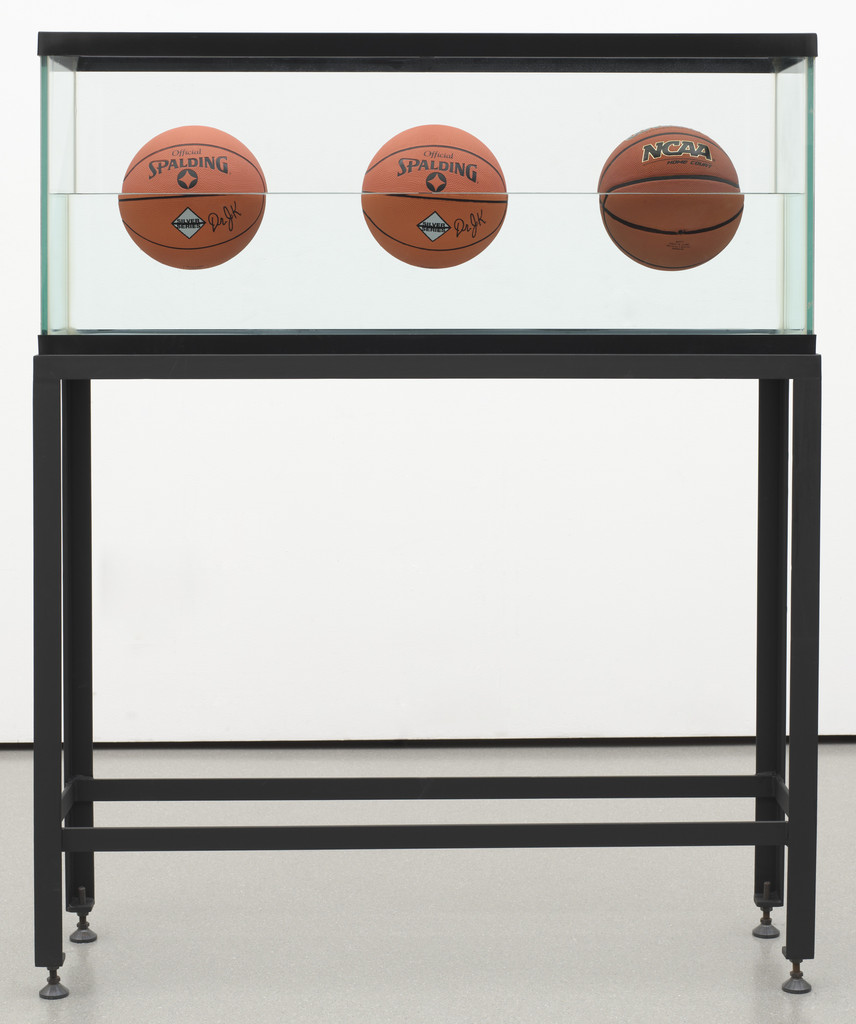 #96
#96
Three Ball 50/50 Tank (Two Dr. J. Silver Series, One Wilson Supershot)
Three basketballs remain suspended in perfectly balanced aquariums. The ordinary sporting object acquires the distant authority of a specimen. Koons pushes the industrial finish and seduction of the object to the point of revealing the mechanisms of taste, luxury and value. In the extensions of the movement, it shows that appropriation, popular culture and the industrial object continue to act well beyond the 1960s. The framing isolates the motif until making it both immediately recognizable and strangely detached from its daily use. Dated 1985, the work associates Glass, painted steel, distilled water, plastic, and three basketballs with a reflection on circulation, the repetition and transformation of ordinary images.
See at the museum →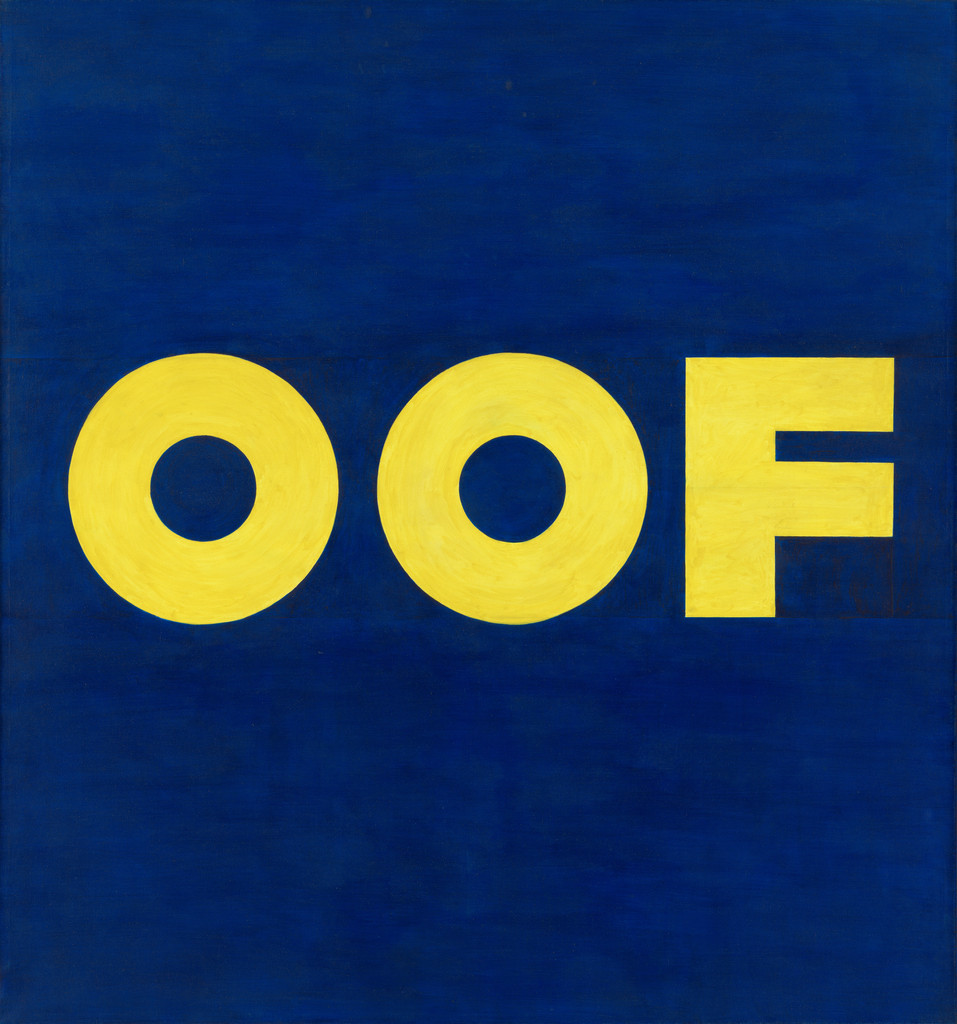 #97
#97
OOF
Three massive letters occupy almost the entire canvas. The word becomes noise, shape and color, without losing the brutal humor of an interjection. Ruscha treats words, roads and commercial architecture as motifs capable of uniting humor dry, cinematic space and memory of the West. In the extensions of the movement, it shows that appropriation, popular culture and industrial objects continue to act well beyond the 1960s. Repetition transforms the resemblance in rhythm and reveals the gaps that the industrial image usually claims to erase. Dated 1962 (reworked 1963), the work associates Oil on canvas with a reflection on circulation, repetition and transformation of ordinary images.
See at the museum →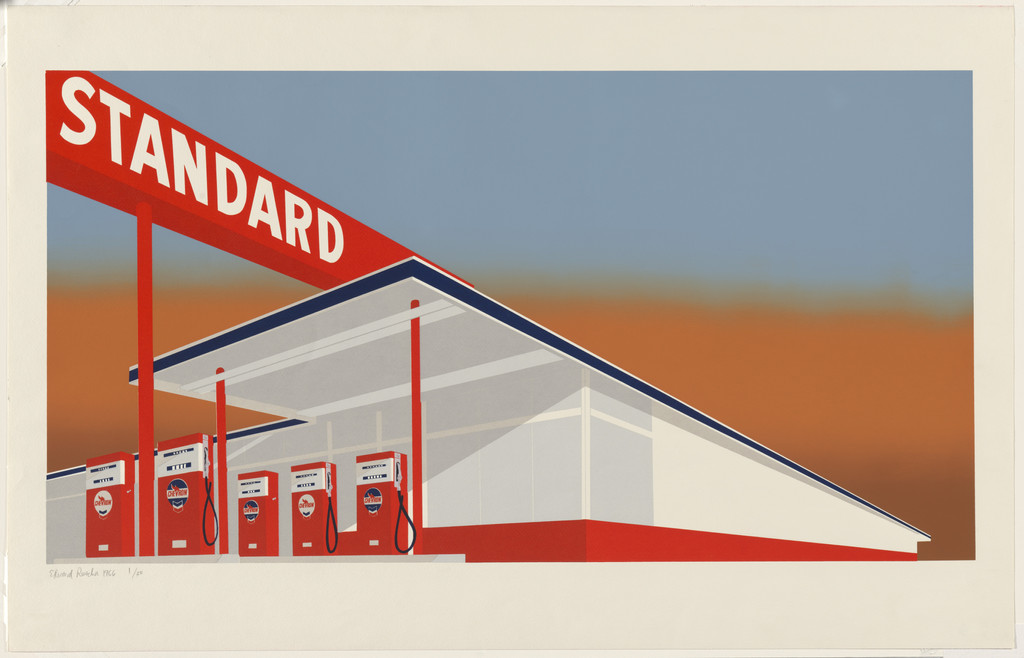 #98
#98
Standard Station
The gas station is stretched by a spectacular diagonal and incandescent sky; commercial architecture becomes a mythical landscape of the West. Ruscha treats words, roads and commercial architecture as motifs capable of uniting dry humor, cinematic space and memory of the West. In the extensions of the movement, it shows that appropriation, popular culture and industrial objects continue to act well beyond the 1960s. Change scale moves the subject from the ordinary world to a physical confrontation with the viewer. Dated 1966, the work combines Screenprint with a reflection on the circulation, repetition and transformation of ordinary images.
See at the museum →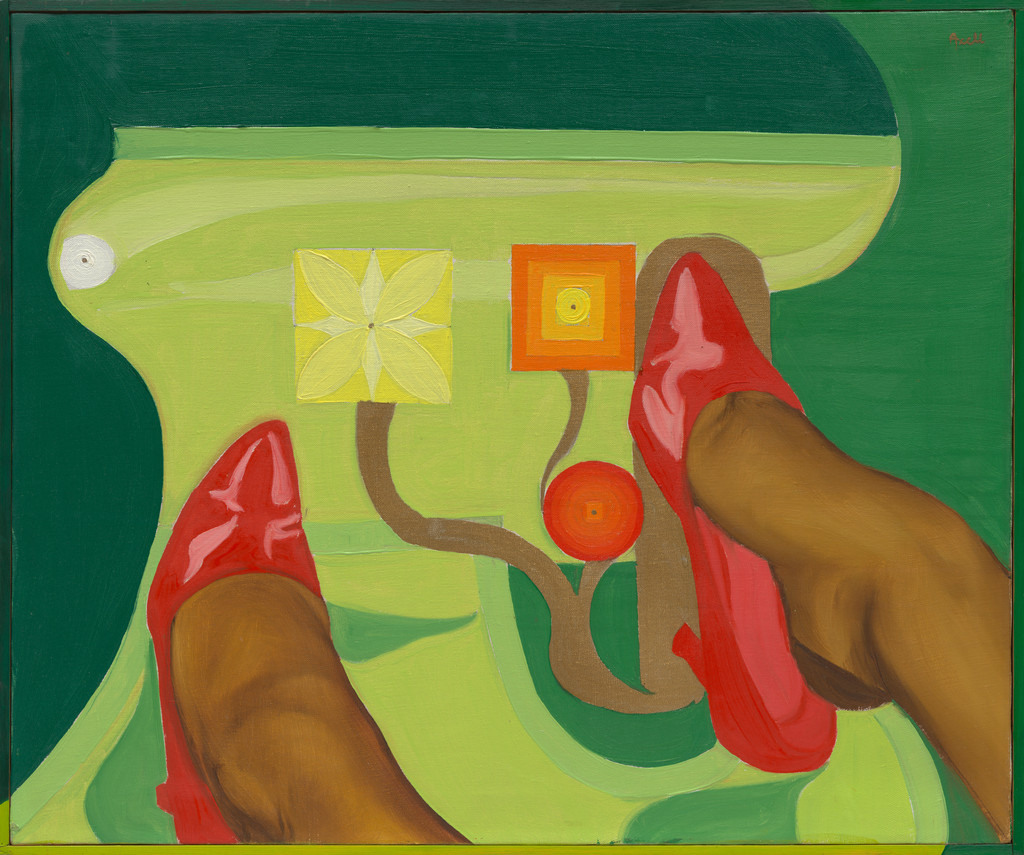 #99
#99
Axell-eration
Axell transforms speed, body and color into an image freed from the male advertising gaze; Pop painting becomes a space for sensual affirmation. Axell reinvests the brilliant vocabulary of Pop from female desire, by refusing that the body remains a simple product of the male gaze. In the extensions of the movement, it shows that appropriation, popular culture and the industrial object continue to act well beyond the 1960s. Color simplifies reading while accentuating the tension between visual seduction, critical distance and the creation of desire. Dated 1965, the work combines Oil on canvas in artist's frame with a reflection on circulation, repetition and transformation ordinary images.
See at the museum →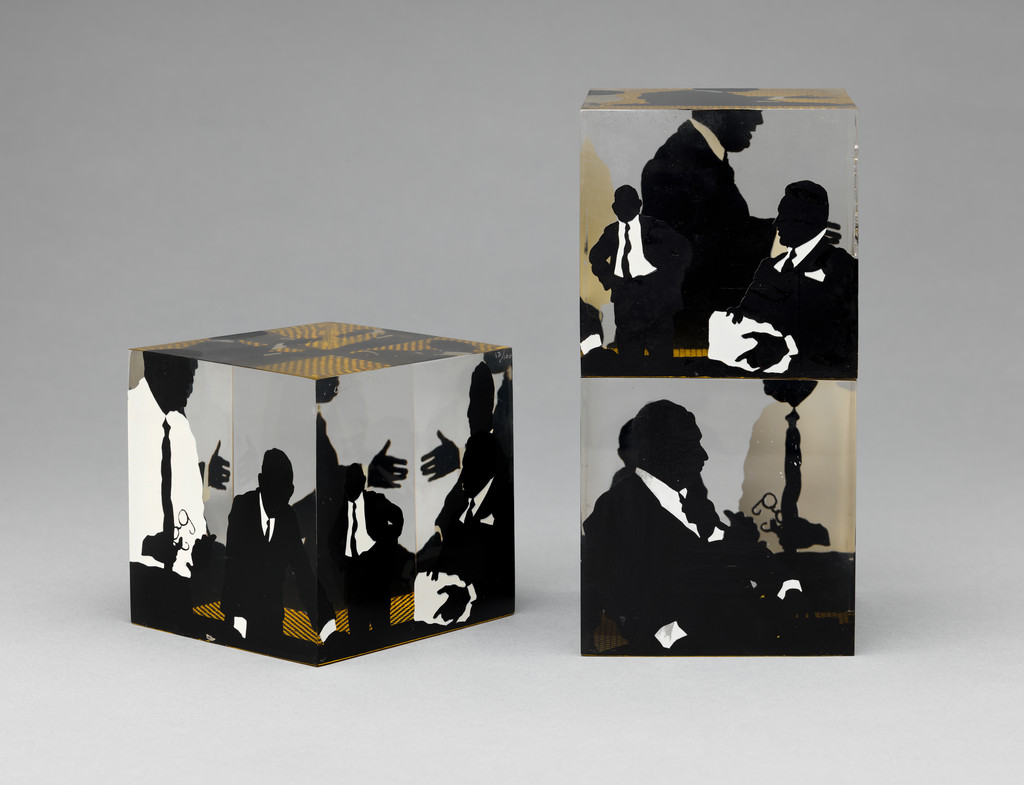 #100
#100
Untitled
Anonymous silhouettes, taken in the transparency of a cube, transform the language of offices and urban flows into social volume. Weber observes the standardized silhouettes of modern work and transforms administrative anonymity in visual rhythm. In the extensions of the movement, it shows that appropriation, popular culture and the industrial object continue to act well beyond the 1960s. The surface retains traces of transfer, collage or assembly which prevents the image from being reduced to a simple reproduction. Dated 1968 -1970, the work combines Multiple of screenprint on acrylic cube with a reflection on the circulation, repetition and transformation of images ordinary.
See at the museum →What the ranking reveals
Pop Art is less a style than a method of looking
Sharp solids and bold colors are only the most visible part of the movement. Its true coherence comes from the sampling, editing, repetition and change of scale applied to images already present in daily life.
Image precedes work
Press photographs, packaging, comic boxes and logos are chosen because they already have a public history.
The series shifts the value
Repeating the same shape brings the workshop closer to the factory, but also makes gaps, accidents and eye wear visible.
Seduction remains critical
Brilliance, humor and colors attract before revealing the relationships between consumption, violence, celebrity and power.
Historical landmarks
Five dates to understand Pop Art
The collages from the Bunk! assemble American magazines, pin-ups, aviation, food and advertising.
The London exhibition makes the media and domestic environment a central subject of the British avant-garde.
Warhol, Lichtenstein, Rosenquist, Wesselmann and Oldenburg imposed goods, comics and everyday objects almost simultaneously.
Brillo Box, F-111 and soft sculptures show that the Pop image can occupy the entire museum space.
Appropriation, street, luxury and media extend Pop to Haring, Basquiat, Koons and many contemporary artists.
Pop in depth
How to watch a Pop work?
Start by looking for the source. A press photograph, packaging, comic book box or sign is never innocently taken up. Her movement to the museum modifies her function and reveals the visual habits she already carried.
Observe the framing. Warhol, Lichtenstein, Rosenquist and Wesselmann often isolate a fragment - mouth, weapon, face or product - until it loses its original story. The image becomes more readable and stranger at the same time.
Compare repetitions. Two screen prints or two similar objects are never perfectly identical. Variations in inking, color, alignment and scale show that the industrial series remains crossed by accident and decision.
Finally look at the material. Encaustic, soft canvas, assembly, vinyl, porcelain, painted wood and real display prevent Pop from being reduced to a flat reproduction. The most famous image always retains its own weight, texture and space.
Four reading keys
Look behind the logo
Source, framing, repetition and material make it possible to distinguish a simple colorful image from a work which truly analyzes mass culture.
Identify the image taken
Look for the photograph, the advertisement, the comic or the object whose language the work uses and ask what the new context makes it say.
Observe what is cut
Pop often enlarges a detail until it removes the original story; the fragment then becomes an autonomous sign.
Compare the gaps
Repetition does not mean perfect identity: color, inking, position and density change the charge of each occurrence.
Distinguish image and object
Encaustic, flexible canvas, assembly, screen printing or porcelain remind us that the reproduced icon always has a material body.
Sources and collections
Continue after the hundredth work
Frequently asked questions
Pop Art without clichés
The essential answers on its British origins, its relationship to advertising, screen printing, the object and its contemporary extensions.
When and where does Pop Art appear?
Its beginnings developed in Great Britain at the end of the 1940s and during the 1950s, notably around Eduardo Paolozzi, Richard Hamilton and the Independent Group. The movement took on spectacular proportions in New York in the early 1960s.
Why are Richard Hamilton and Eduardo Paolozzi essential?
Their collages examine the abundance of American magazines, advertising, technology, film and domestic goods early on. They give Pop a critical framework before its American commercial explosion.
Does Pop Art celebrate the consumer society?
He may seem fascinated by its colors and its effectiveness, but this seduction remains ambiguous. Repetition, framing and change of scale also make standardization, media violence and the fabrication of desire visible.
Why is screen printing becoming so important?
It allows you to transfer and repeat a photograph quickly. Warhol uses it to bring the workshop closer to the production line, while revealing discrepancies, lack of ink and differences between copies.
What is the difference between British and American Pop Art?
The British household first favors collage, media analysis and a certain ironic distance. In the United States, scale, frontality and the direct relationship to the commodity become more spectacular, even if the exchanges between the two scenes are numerous.
Are Jasper Johns and Rauschenberg Really Pop?
They are often considered precursors or neo-Dada artists. Their flags, targets, schemes and found objects, however, make Pop's attention to already known signs and the everyday world possible.
Why include Kusama, Haring, Basquiat and Koons?
They show the legacies of the movement rather than strict historical Pop. Series, urban culture, appropriation, industrial object and celebrity continue to produce new issues linked to identity, luxury or public space.
Why does Pop Art remain current?
Because its questions - repetition, celebrity, consumption, appropriation and accelerated circulation of images - still structure contemporary visual culture. Social networks have changed the tools, not the tension between private image, public sign and merchandise.
0 comments