

1910 to 2010 · a century of oil painting
Chinese painting modern
One hundred oils to follow cosmopolitan workshops, Taiwan landscapes, history painting, avant-garde, Political Pop and contemporary figurations.

A modern story
When oil changes China's image
Oil painting does not belong to the historical mediums of the Chinese literate tradition. It truly established itself at the turn of the 20th century, when artists studied in Japan, Europe or America, then founded schools and adapted portraiture, nudes, observed landscapes and history painting to their own experience.
In Shanghai, Canton, Tokyo, Paris and New York, this imported material quickly ceases to be a simple foreign lesson. Xu Beihong entrusts him with the great national stories; Li Tiefu delves deeper into portraiture and still life; Chen Cheng-po and Li Mei-shu give him the streets, ports, mountains and faces of Taiwan.
After the political upheavals of the middle of the century, a new generation is turning official images, advertisements and Western masterpieces against their old certainties. From Geng Jianyi to Wang Guangyi, Fang Lijun and Liu Xiaodong, oil becomes memory, satire, organic matter and critical screen in turn.
Oil does not erase Chinese visual traditions: it offers them new material to confront portraiture, the city, political history and the global world.
Japan, Paris, New York and the new Chinese academies are renewing drawing, color and composition.
Streets, ports, schools and mountains give the oil a local memory, particularly strong in Taiwan.
History painting successively serves national drama, ideological criticism and the rereading of official images.
Impasto, glacis, flat areas and cold surfaces become all positions in the face of modernity.
The 100 essential oils of Chinese painting
From Xu Beihong to Political Pop1—20
Twenty images that changed the outlook

Xu Beihong
Lower your whip
Painted in Singapore during the Sino-Japanese War, the scene shows actress Wang Ying playing a young refugee. Xu Beihong transforms a militant spectacle into an immediately readable image: the suspended gesture, the bare feet and the red of the clothing concentrate the urgency of the story. The academic style here serves as a public painting, intended to move as much as to convince.
See reproduction →
Xu Beihong
The Five Hundred Braves by Tian Heng
Xu Beihong chooses the moment when Tian Heng refuses to submit, surrounded by his companions. The monumental group, the diagonals of the bodies and the oppositions of light give the ancient episode the gravity of a modern manifesto. The work imposes in China an oil history painting capable of competing with large European formats.
See reproduction →
Chen Cheng-po
Tamsui
Chen Cheng-po looks down on Tamsui from the heights and narrows the harbor, houses and hills into an almost vibrant space. The reds of the roofs, the deep greens and the curves of the road make the eye travel to the sea. The landscape becomes the emotional portrait of a city rather than a docile description.
See reproduction →
Chen Cheng-po
Chiayi Street
The familiar street is reconstructed by a high viewpoint, compressed facades and almost calligraphic vegetation. Chen Cheng-po adapts the lessons of Japanese and European oil to a very local memory. The warmth of color gives Chiayi a new visual identity in Taiwanese painting.
See reproduction →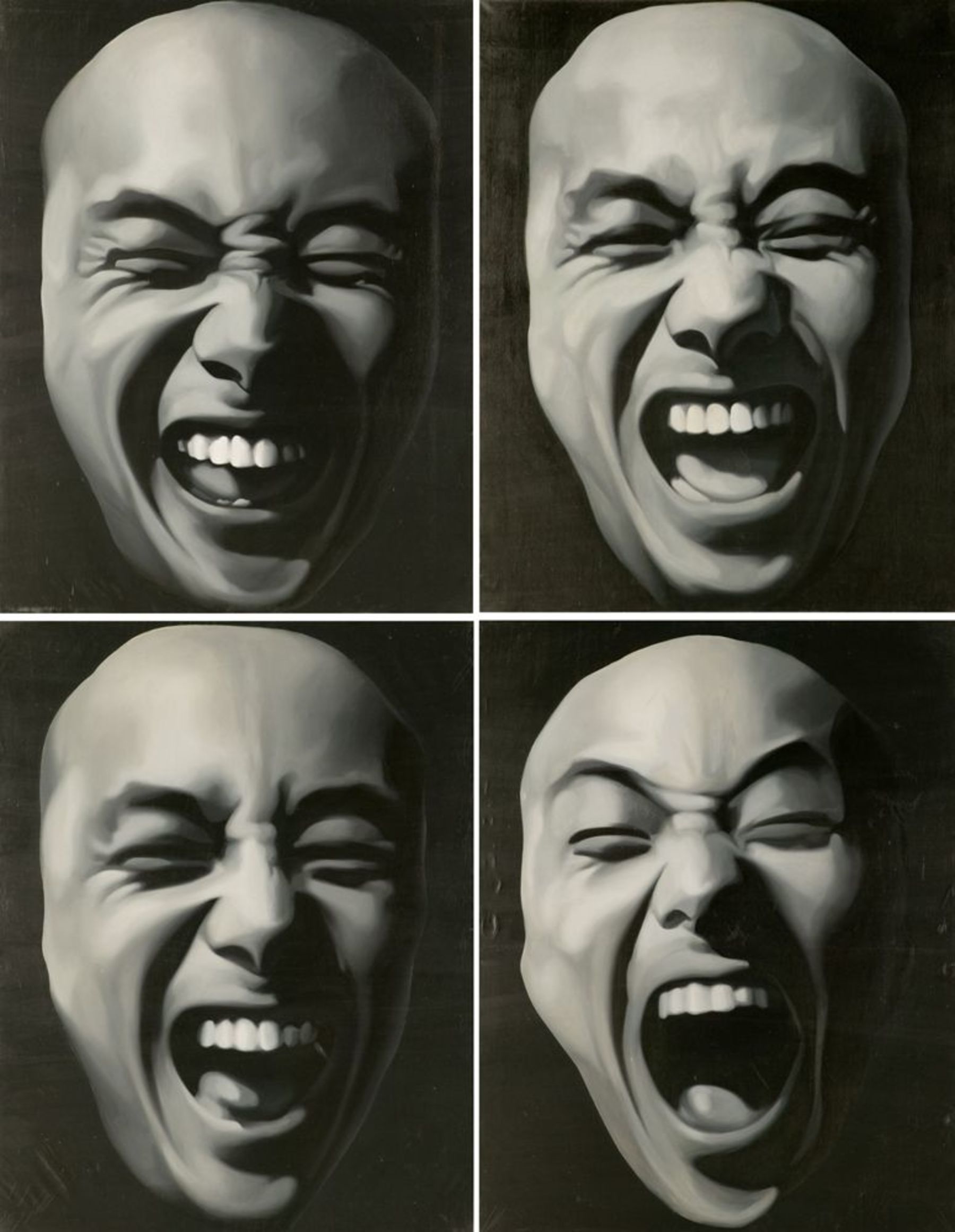
Geng Jianyi
The Second State
Four faces break down the stages of a laugh, but the gray palette and black background transform the expression into a mask. Geng Jianyi refuses heroism and subjects emotion to almost cold observation. Presented in 1989, this series has become a founding image of the Chinese avant-garde.
See the work at the museum →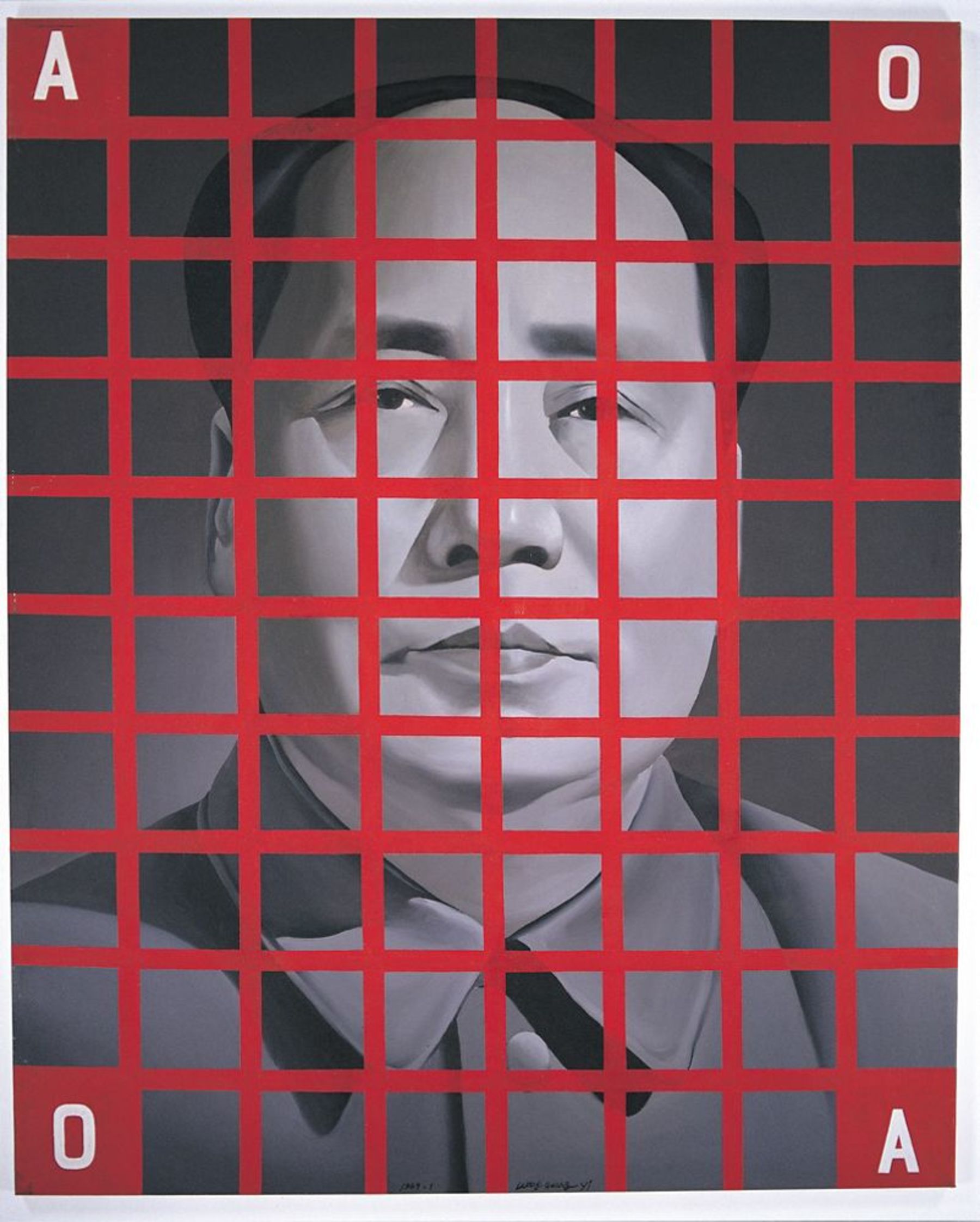
Wang Guangyi
Mao Zedong: red grid no. 2
A red grid covers Mao's official portrait and returns it to reproducible image status. Wang Guangyi superimposes calligraphic exercise, enlargement technique and political icon. The painting paves the way for Political Pop by treating propaganda as a visual material to be dismantled.
See the work at the museum →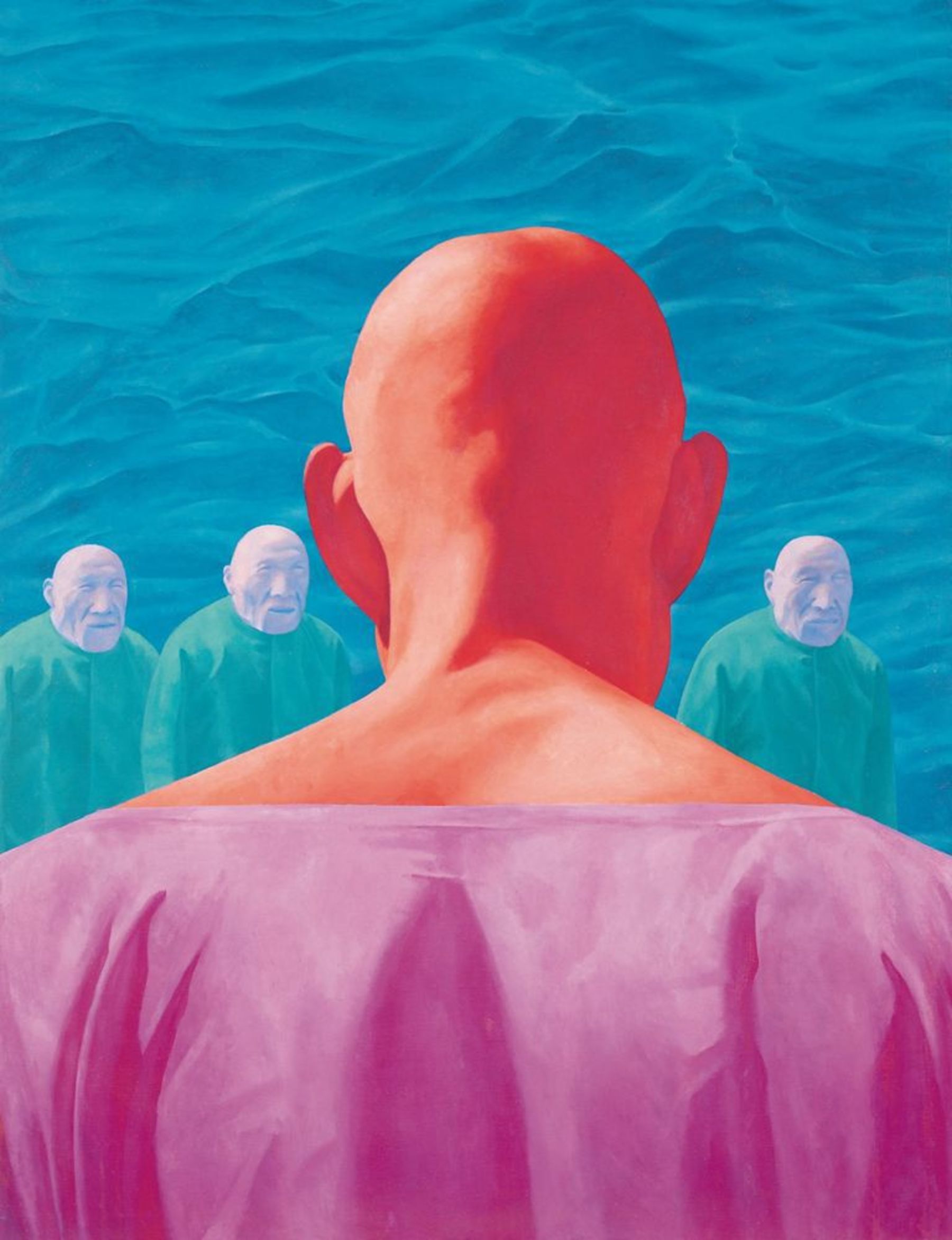
Fang Lijun
1995.2
A man in pink turns his back on the viewer as three nearly identical figures emerge a liquid blue. Fang Lijun combines academic precision, artificial colors and a dead end situation. His bald character becomes the emblem of a generation skeptical of the accelerated transformations of society.
See the work at the museum →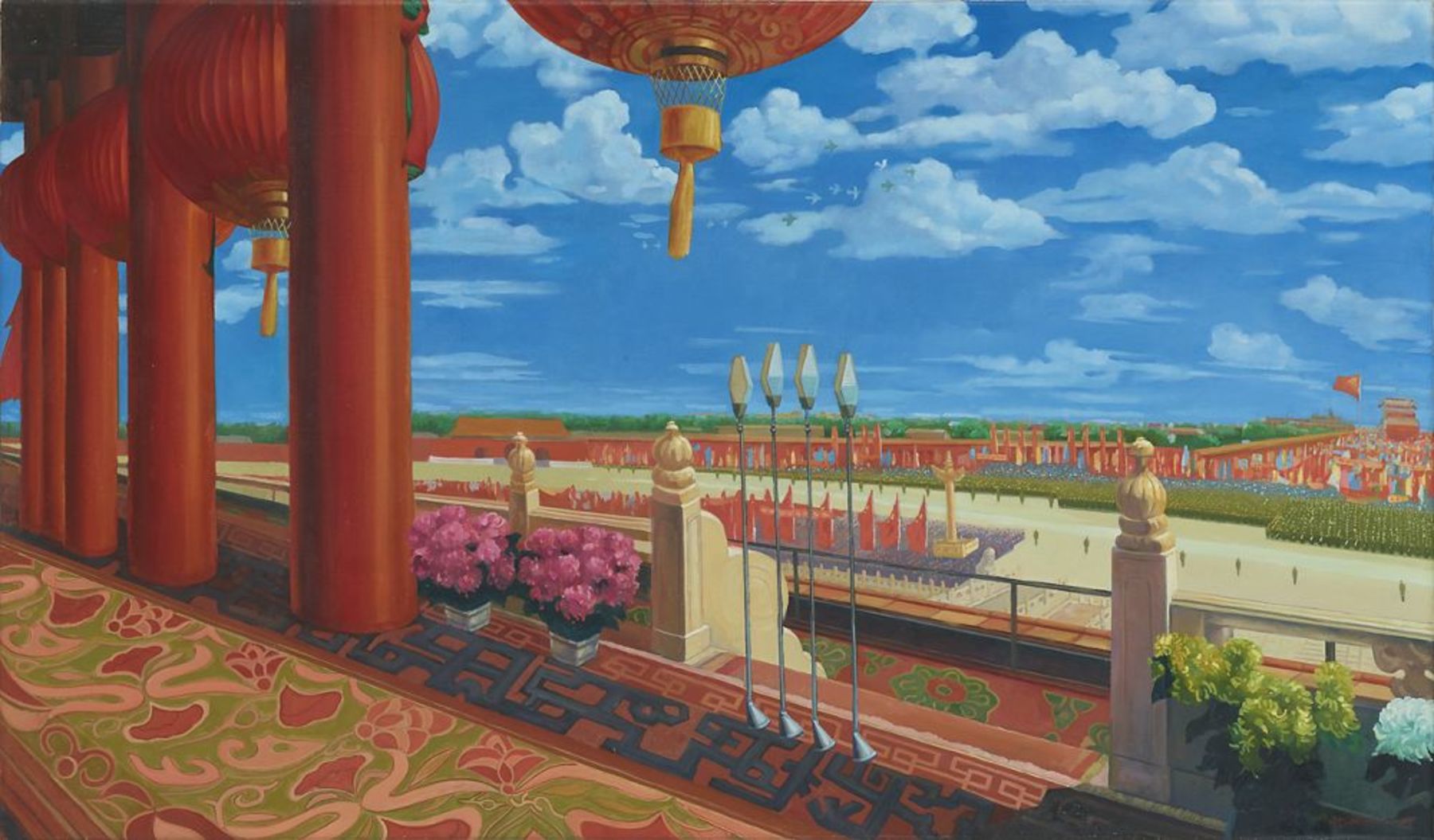
Yue Minjun
Foundation ceremony
Yue Minjun replays a central image of Chinese political history by emptying it of its solemnity. The uniform laughter of its characters functions like a grimace, both euphoric and disturbing. The painting measures the distance between official memory, spectacle and private irony.
See the work at the museum →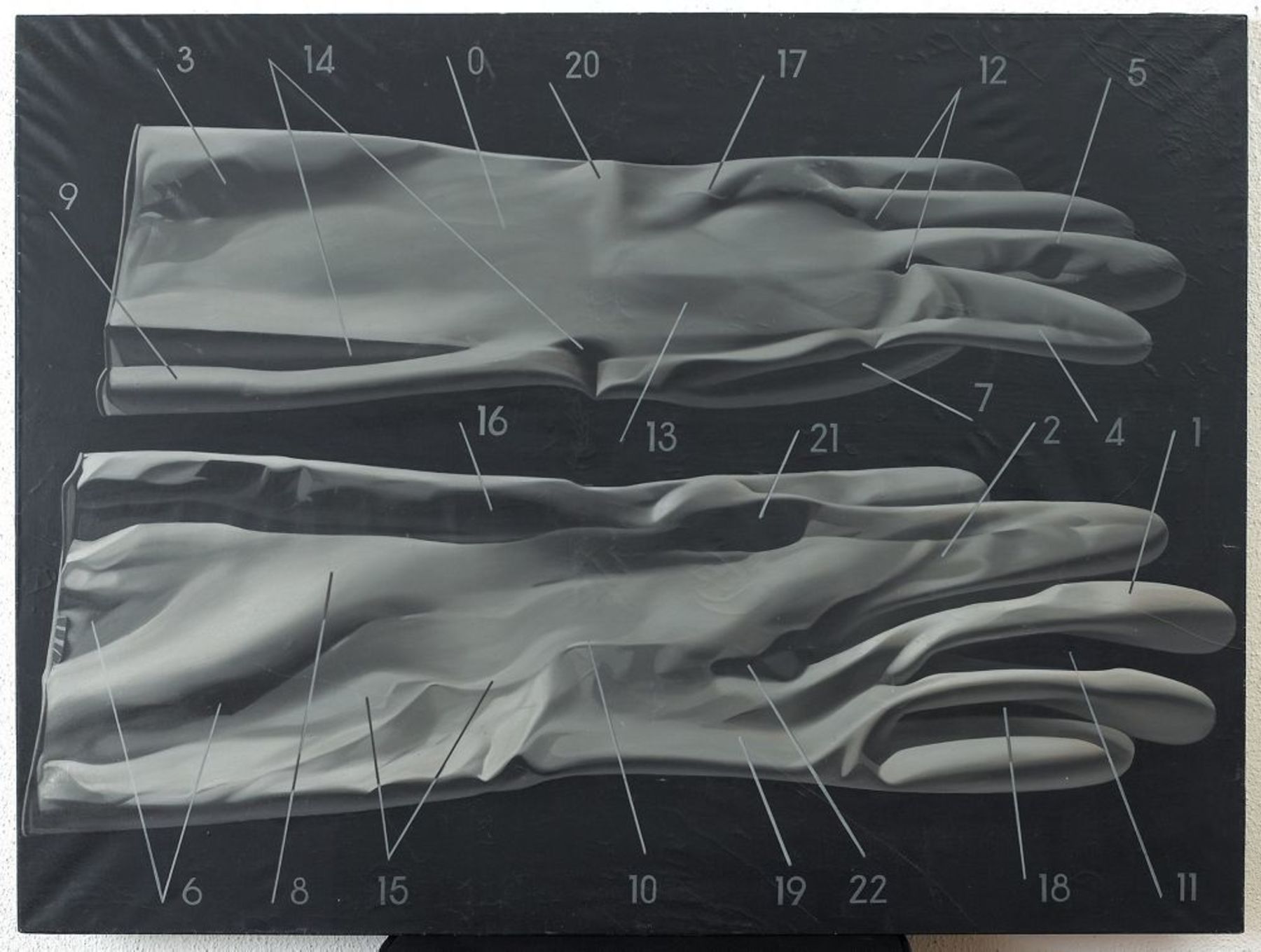
Zhang Peili
X?
The letter and question mark dominate a painted surface with deliberately impersonal precision. Zhang Peili reduces the image to an ambiguous sign, between information, order and enigma. This simplicity breaks with the expected expressiveness of the painting and announces a decisive conceptual attitude.
See the work at the museum →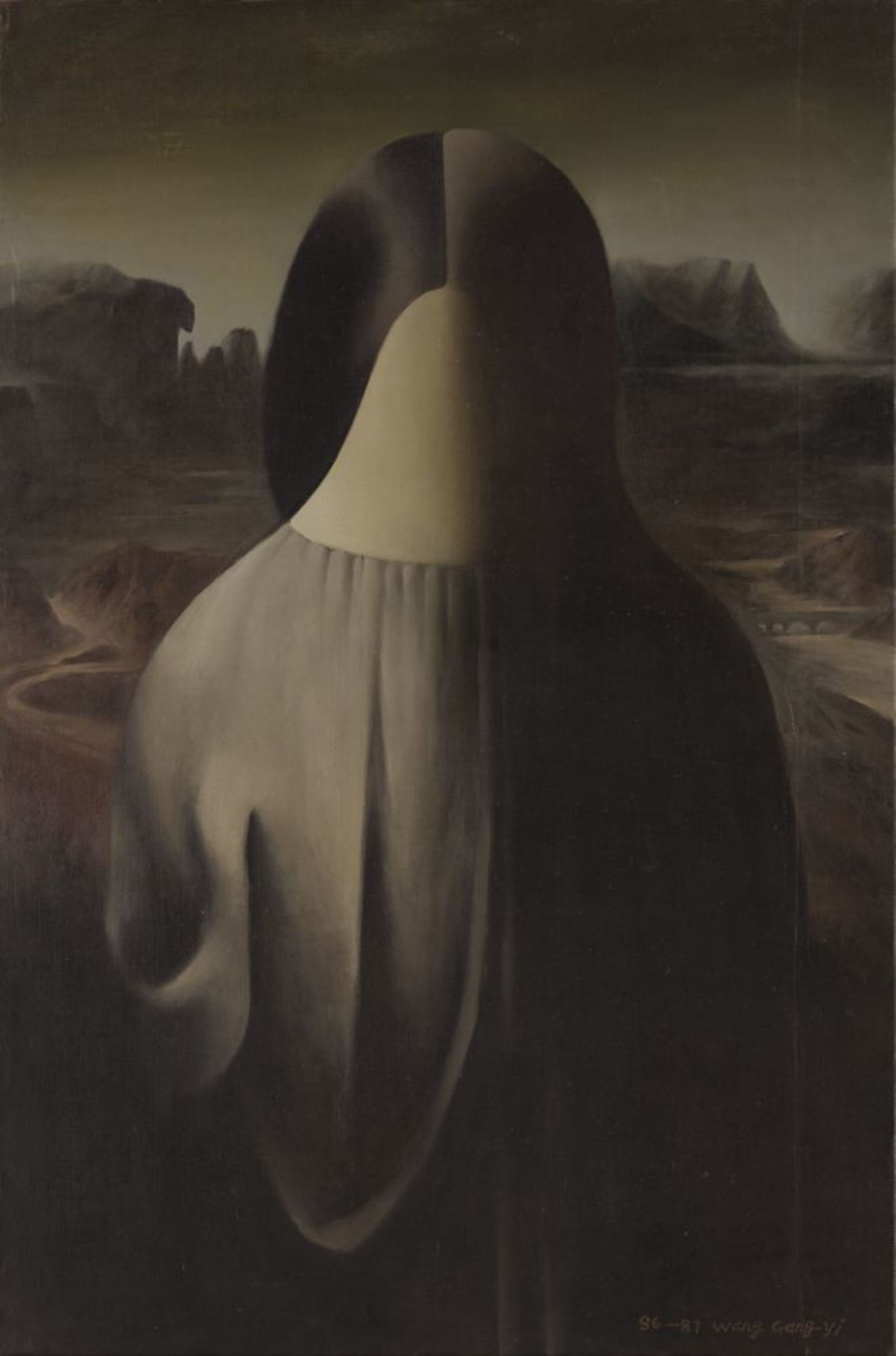
Wang Guangyi
Post-classic - After Mona Lisa A
The Mona Lisa remains recognizable even though her face has disappeared. Wang Guangyi retains the pose and the landscape, but neutralizes the masterpiece to the point of making it a mental silhouette. The history of Western art becomes a repertoire to be analyzed rather than a model to be imitated.
See the work at the museum →
Li Mei-shu
Excursion
Li Mei-shu organizes the walk as a balance between figures, light and vegetation. The scholarly composition never cools the scene: the bodies retain their weight, the fabrics their shine and the landscape its warmth. The work affirms the maturity of a Taiwanese modernity based on observation.
See the work at the museum →
Chen Cheng-po
Summer Street
A central post, rounded trees and a road burned with light give the street an almost abstract structure. Chen Cheng-po contrasts the yellow of the ground with the green masses to make the heat physically sensitive. This bold construction makes everyday life a laboratory of color.
See reproduction →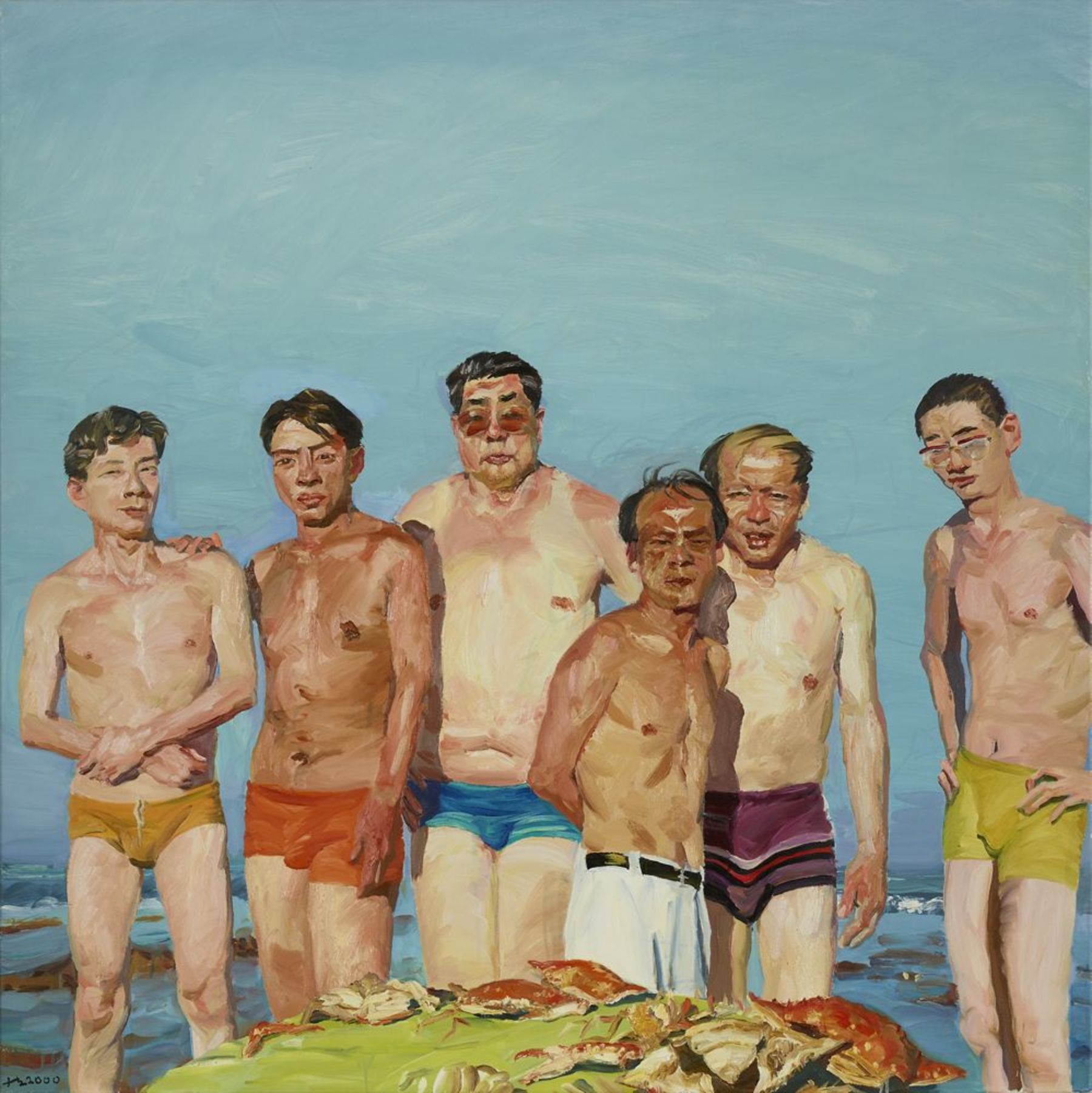
Liu Xiaodong
Eat
Six men pose in front of a seafood meal, halfway between vacation photography and a carefully composed scene. Liu Xiaodong paints familiarity without idealizing it: each body retains its differences, its unease and its presence. The large format gives an ordinary moment the density of a history painting.
See the work at the museum →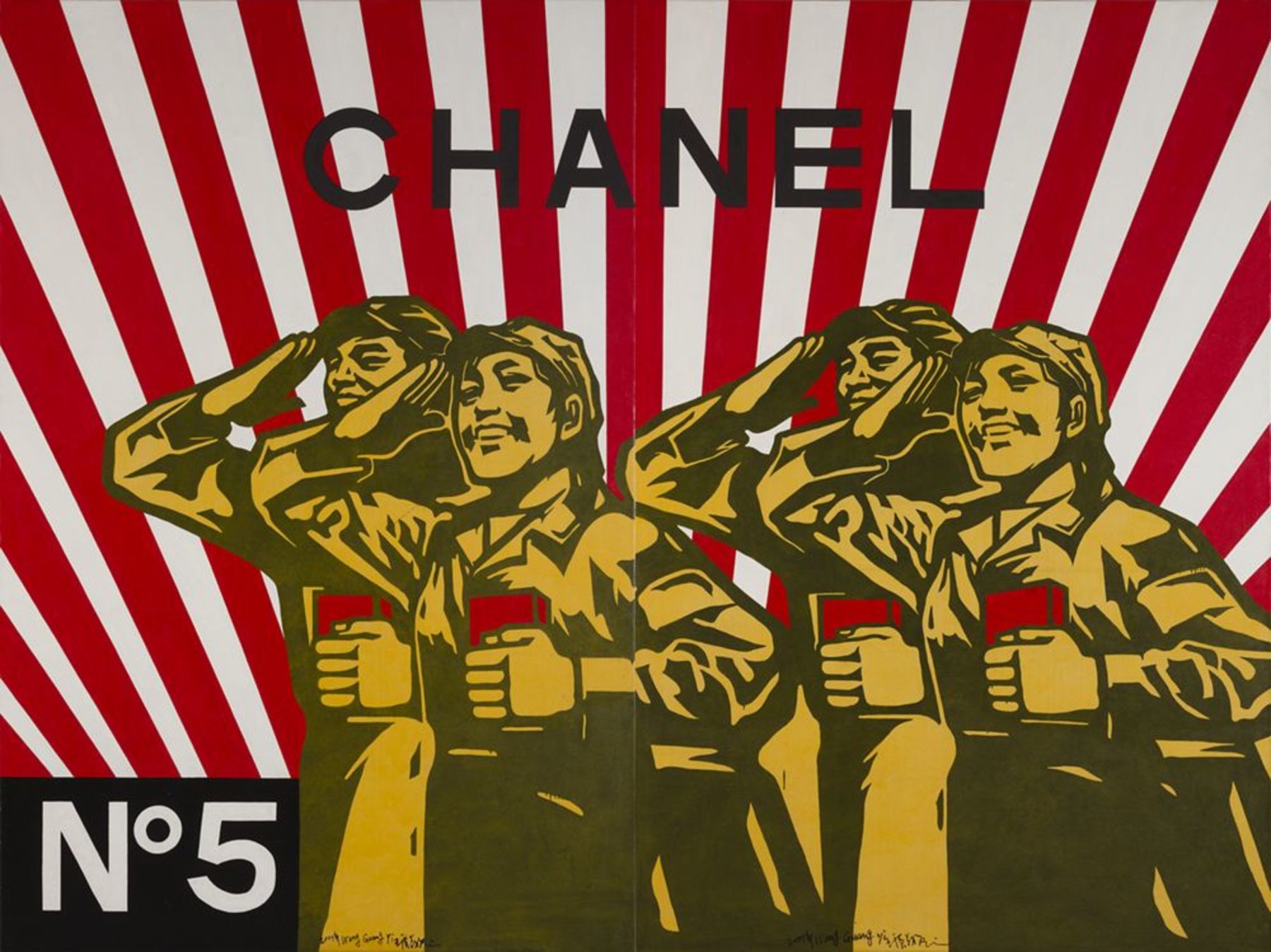
Wang Guangyi
Great Review: Chanel
Revolutionary figures salute at the name of a luxury perfume. Wang Guangyi superimposes two systems of desire - propaganda and advertising - whose visual resemblance suddenly becomes evident. The painting is one of the clearest emblems of Chinese Political Pop.
See the work at the museum →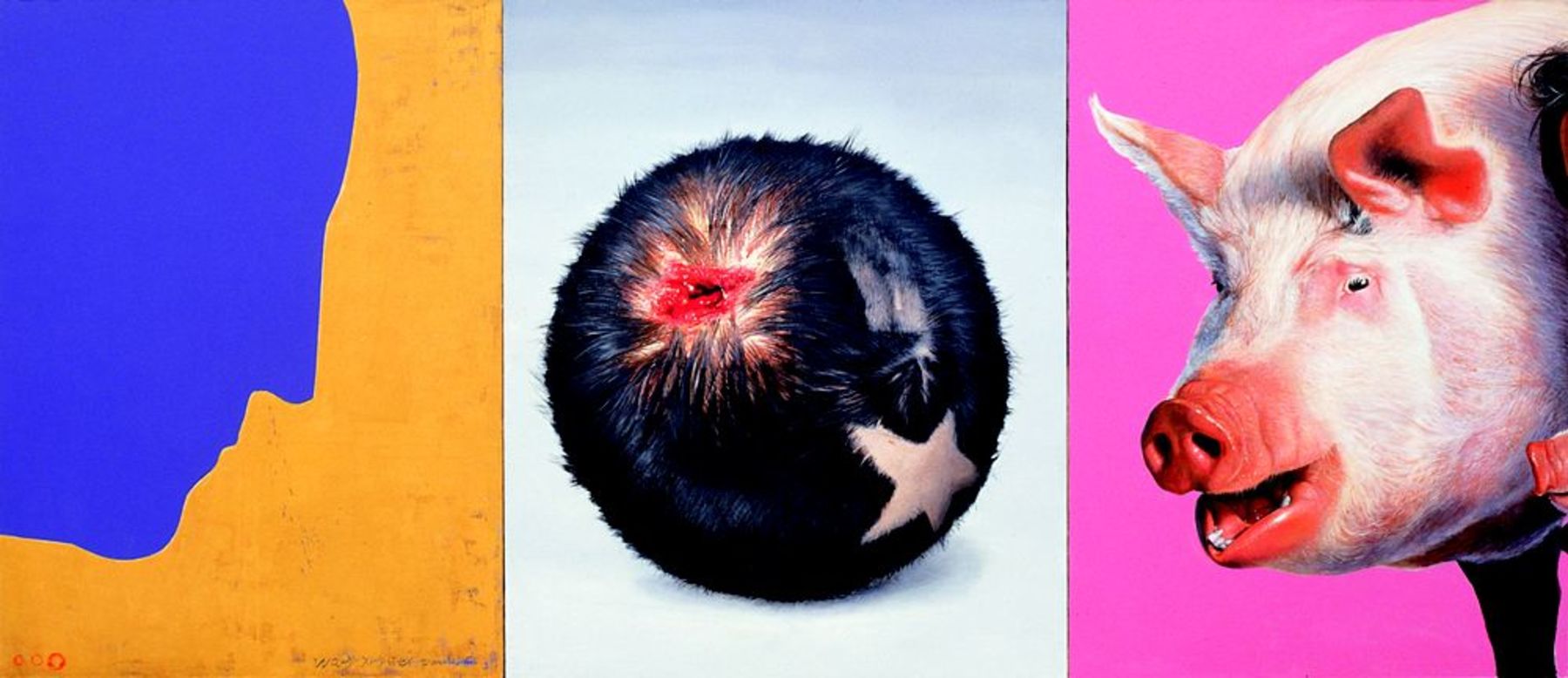
Wang Xingwei
Abstract
Wang Xingwei assembles Duchamp, Man Ray, Jeff Koons and other references into a deliberately dislocated art history. The virtuosity of the oil makes this impossible collage credible, then reveals its artifice. The work questions the way in which Western canons were received, reproduced and reclassified in China.
See the work at the museum →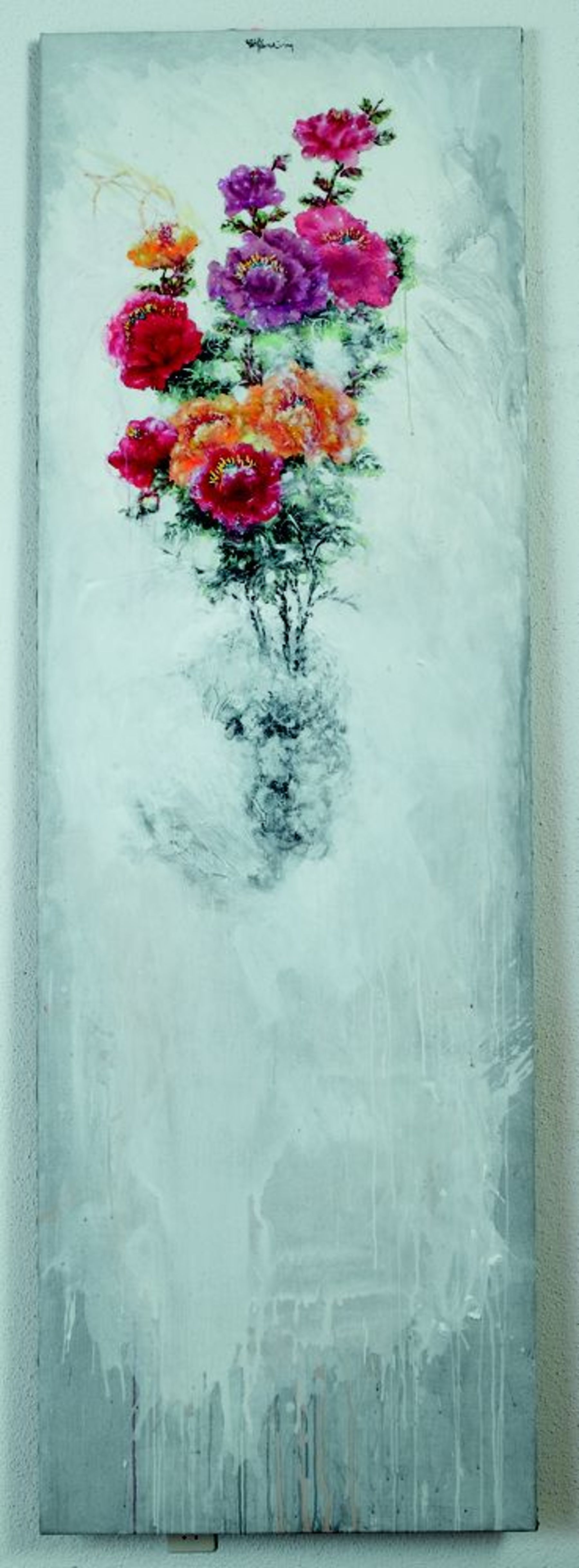
Liu Wei
Flowers
The plant rises in a gray space where the touch appears decorative, carnal and corrosive at the same time. Liu Wei slides the floral pattern towards an almost organic material. The beauty of the bouquet remains, but it is crossed by the instability which characterizes all its painting.
See the work at the museum →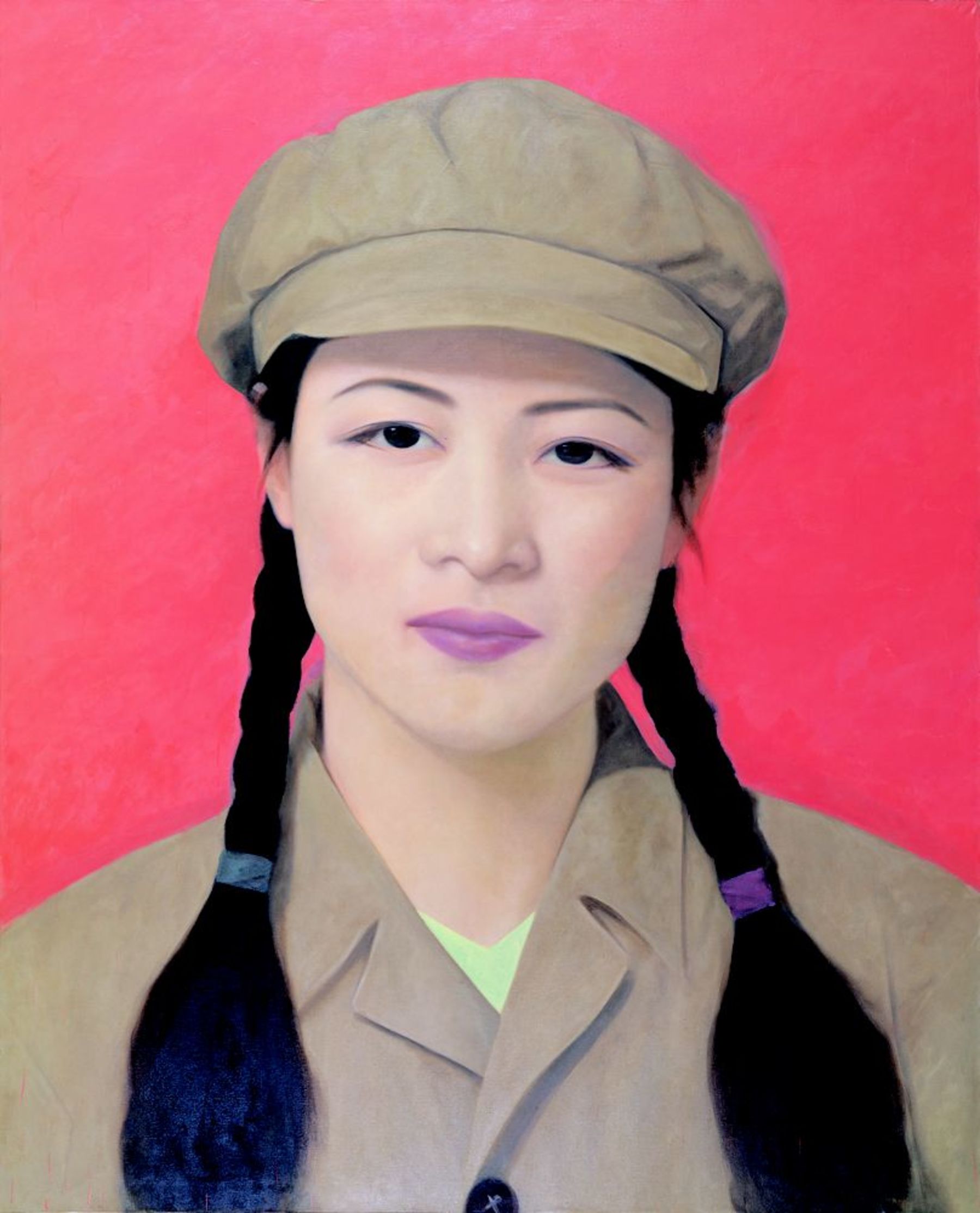
Qi Zhilong
Chinese woman
Qi Zhilong takes the heroic pose of the propaganda portrait and combines it with the smooth face of a contemporary model. The Maoist uniform becomes a costume, a nostalgic sign and a visual product. The canvas condenses the contradictions between collective identity, consumption and media seduction.
See the work at the museum →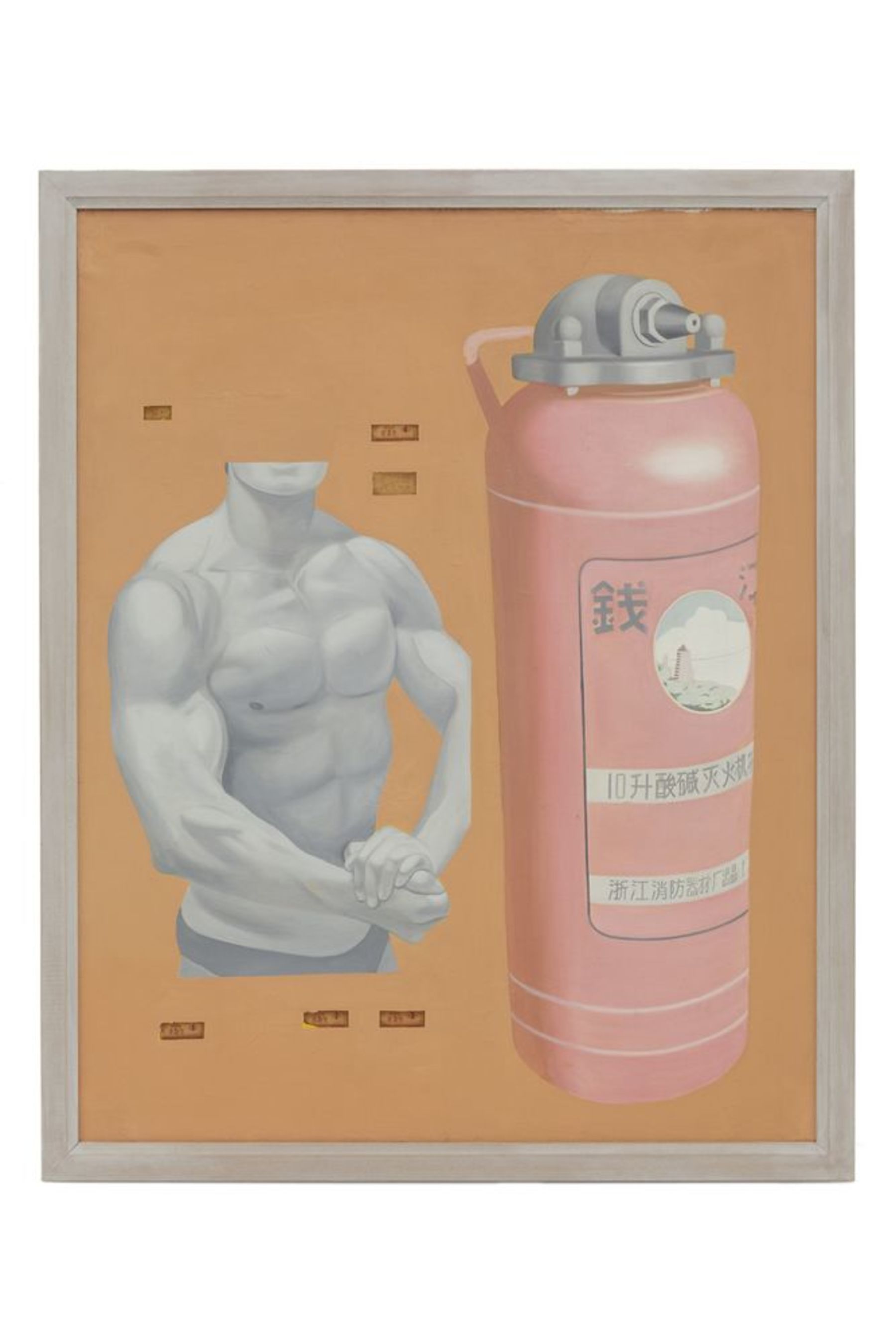
Zhang Peili
Standard posture from 1989
Zhang Peili paints a posture extracted from media and administrative codes as if it were a protocol. Repetition, tight framing and neutrality of the bill reduce individual expression. The image becomes the analysis of learned behavior rather than the portrait of a person.
See the work at the museum →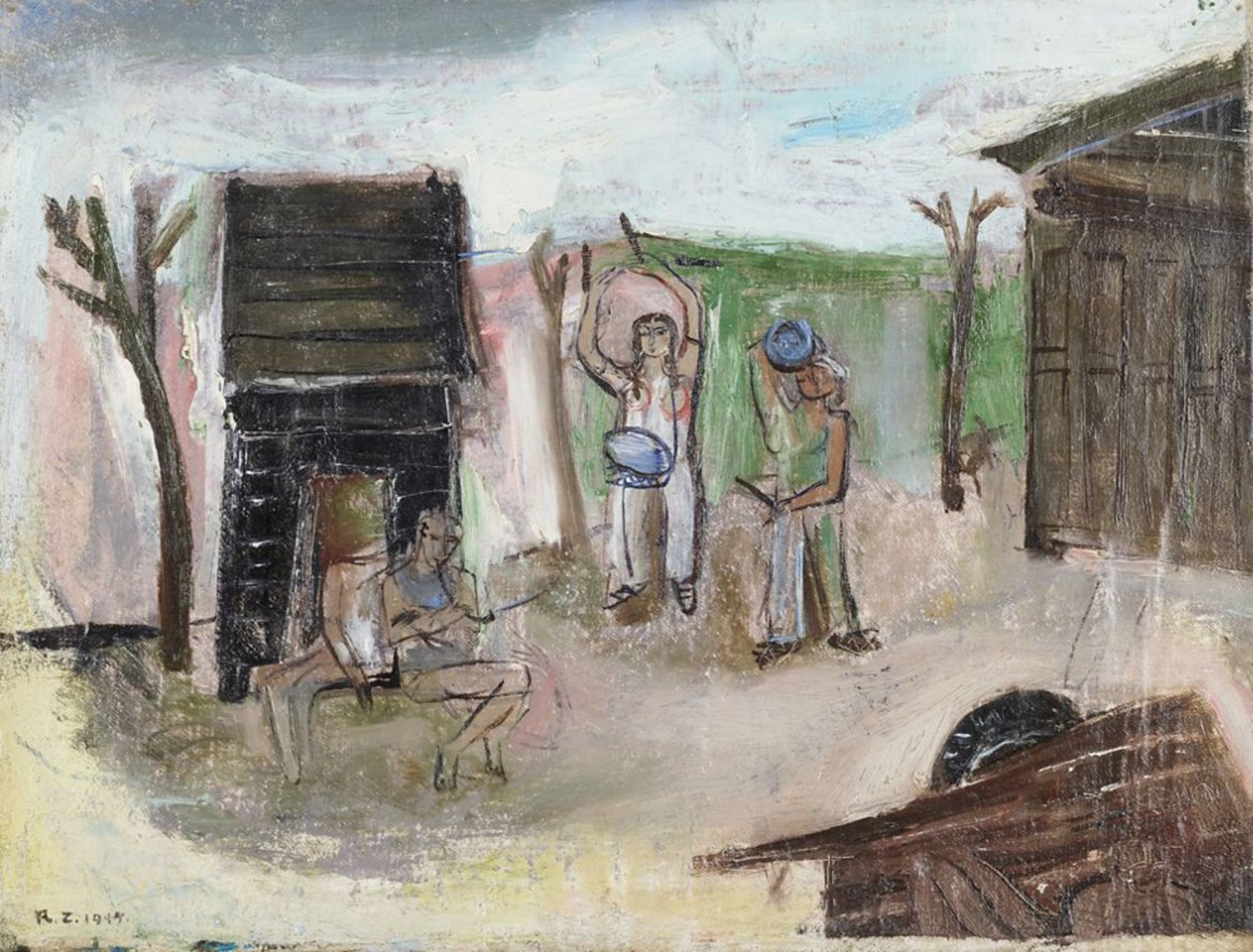
Zao Wou-Ki
Open-air theater
Before his departure for Paris, Zao Wou-Ki represents a street scene already freed from academic perspective. The characters, the facade and the space are simplified into nervous flat areas. This rare oil shows the moment when the artist seeks personal modernity before the shift towards abstraction.
See the work at the museum →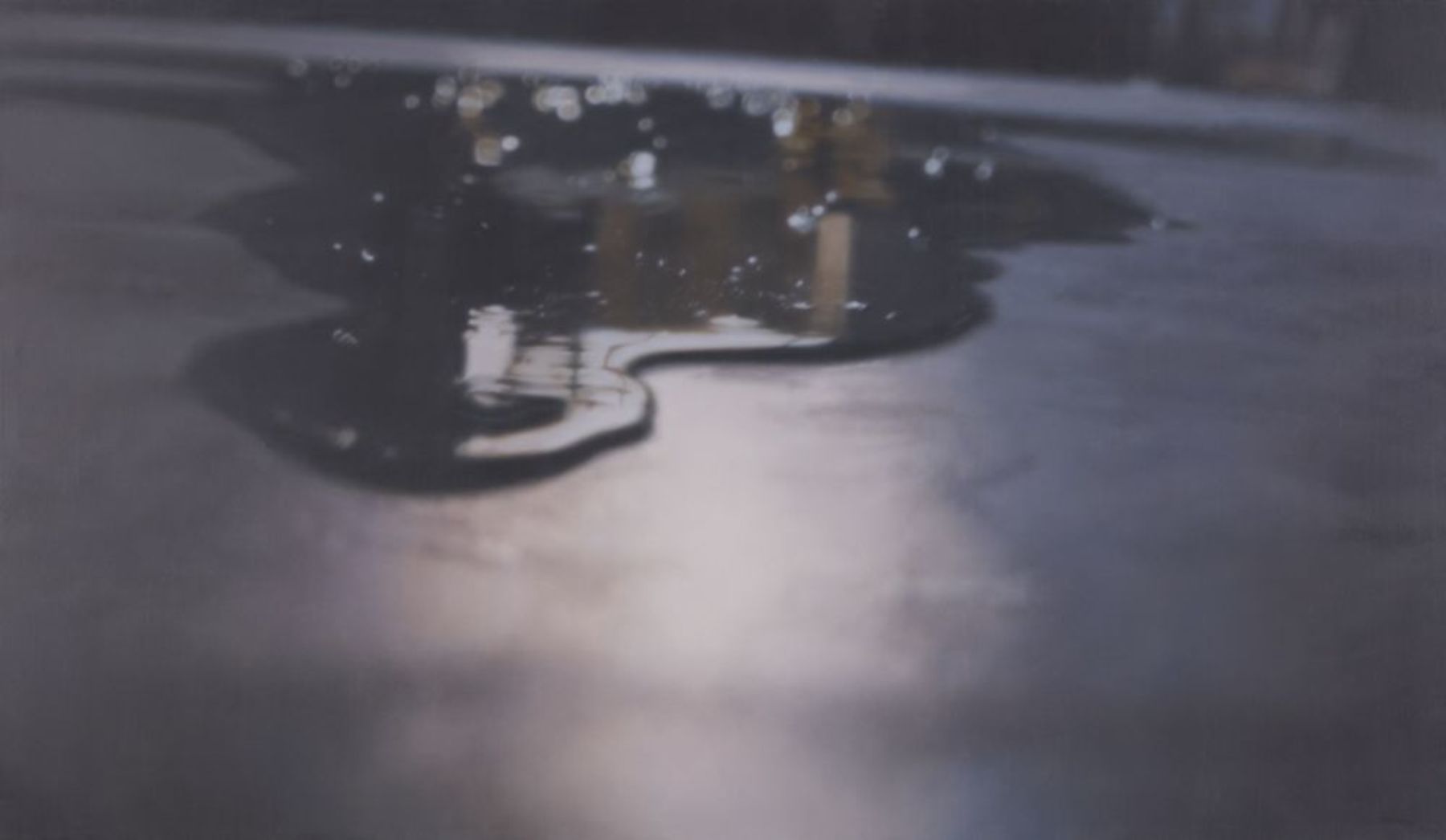
Xie Nanxing
Untitled (Liquid)
Xie Nanxing dilutes the body and space in a surface that seems at once seen, dreamed and deteriorated. The painting retains figurative clues while refusing to stabilize them. The viewer must reconstruct a scene whose very material questions reality.
See the work at the museum →21—40
The pioneers of modern oil

Li Tiefu
The Young Man with Blue Eyes
The Young Man with Blue Eyes belongs to the portraits taken by Li Tiefu after his long training in North America. The light face emerges from a brown background, modeled by passages of light which recall Western academicism without smoothing its presence. The direct gaze gives the model an almost worried reserve; Li thus shows that the novelty of the oil is less due to the costume than to the psychological density.
See reproduction →
Li Tiefu
The gray-bearded Professor
In The Gray-Bearded Professor, Li Tiefu focuses attention on a face marked by age and study. The beard, forehead and dark clothing are constructed with restrained material, inherited from the academic portrait learned abroad. No accessory explains the character: his authority is born from pose and light, as if an entire library had agreed to fit into an expression.
See reproduction →
Li Tiefu
The bullfighter
The Bullfighter bears witness to the Western subjects encountered by Li Tiefu during his decades spent outside China. The dark costume, white collar and proud posture identify the model without transforming the portrait into a folk scene. The touch remains serious and attentive to the face. The artist is less interested in the spectacle of the arena than in the man who prepares for it, with this mixture of mastery and tension that the costume cannot entirely hide.
See reproduction →
Li Tiefu
Portrait of a young girl
Portrait of a young girl shows Li Tiefu working on a feminine presence through the color of the garment, the inclination of the bust and a gently lit face. The composition takes up the conventions of Western easel portraiture, still rare in China in the 1910s. However, the model never becomes a school exercise: its restrained expression and the freedom of colorful passages give the image a silent life.
See reproduction →
Li Tiefu
The Musician
Dated 1918, The Musician places a man in profile in a dark light which highlights the forehead, mustache and concentration of the gaze. Li Tiefu does not represent an instrument or concert stage; the title invites you to read the listening in the posture itself. This economy reinforces the character of the model and shows how the painter adapts the Western tradition of portraiture to a more inner sensitivity.
See reproduction →
Xu Beihong
Jiang Biwei near a table
Jiang Biwei near a table was painted in 1925, during the years when Xu Beihong and his partner lived between Europe and China. The young woman, absorbed in her reading or her thoughts, is surrounded by domestic objects which place the portrait in a modern intimacy. Xu combines precise drawing and soft light; the table not only serves as a setting, it creates the calm distance of a moment that was not intended for the audience.
See reproduction →
Chen Cheng-po
The exit
The Release dates from Chen Cheng-po's training period in Japan. A woman in a light kimono stands with an almost ceremonial reserve, isolated in a shallow space. The artist observes the clothing and posture without treating them as simple exoticism. This 1926 figure recalls that his modernism was built between Taiwan and Tokyo, before streets and landscapes became his most famous subjects.
See reproduction →
Chen Cheng-po
Mount Yu
Mount Yu, or Yushan, represents the highest peak in Taiwan, a motif charged with strong geographical and cultural value. Chen Cheng-po does not transform it into an icy panorama: the mountain rises behind vegetation and dwellings covered with touches of green, brown and blue. Painted in 1927, the work makes the relief a lived territory. The summit dominates, but the paths in the foreground already tell how we live there.
See reproduction →
Li Mei-shu
Village on burlap
Burlap Village reveals Li Mei-shu's taste for ordinary media and scenes early in his career. Low houses, paths and vegetation are placed in a material where the coarse framework remains sensitive. The village is neither idealized nor described house by house; it appears as a set of rhythms and colors. The modest support gives the landscape a particularly fair roughness.
See the work at the museum →
Xu Beihong
Portrait of Kang Youwei
The Portrait of Kang Youwei fixes one of the great Chinese reformers of the late Qing, exiled and then returned to China after decades of political activity. Xu Beihong depicts him as elderly, sitting in a long blue robe, with particular attention to his face and hands. Painted in 1927, the painting combines the solemnity of the official portrait with the vulnerability of a man whose projects had repeatedly met history head-on.
See reproduction →
Xu Beihong
Portrait of Kang Youwei's wife
In Kang Youwei's Portrait of the Wife, Xu Beihong chooses a standing pose and a light qipao which lengthens the silhouette. The plant decor and the small table accompany the model without competing with her gaze. Created in 1927, the work forms a discreet counterpart to the reformer's portrait. It also reminds us that, in family groups, history readily retains the big name while painting can restore everyone's presence.
See reproduction →
Chen Cheng-po
East Taiwan Coastal Road
Coastal road in eastern Taiwan follows a narrow path taken between the mountains and the sea. Chen Cheng-po uses the curves of the shore to lead the gaze, while the thick touches give the relief an almost meteorological instability. Around 1930, the road became the concrete sign of a territory in transformation. She does not conquer the landscape; she clings to it with the prudence of a traveler who knows the slope.
See reproduction →
Li Mei-shu
Port of Tamsui
Tamsui Port takes a place that Li Mei-shu and Chen Cheng-po have often painted, each with their own rhythm. The houses descend towards the water, the boats punctuate the bay and the hills close the horizon. Li favors a large construction where the colors of the port respond to each other from one shot to another. Tamsui appears less like a maritime setting than like a city entirely organized by its departures and returns.
See the work at the museum →
Li Mei-shu
Portrait of Doctor Liu Ching-Kan
The Portrait of Doctor Liu Ching-Kan pays tribute to a figure in Taiwanese medicine and public life. Li Mei-shu installs the model in a soberly lit frontal pose, where the costume and the gaze express both profession and character. In 1930, the oil portrait became a tool of civic memory here. Dignity comes not from a pompous setting, but from a presence that clearly doesn't need it.
See the work at the museum →
Li Mei-shu
Self-portrait
In his 1931 Self-Portrait, Li Mei-shu appears without studio props or heroic staging. The face stands out against a dark, attentive and slightly tense background, while the touch retains the hesitations of direct observation. Produced at the start of his career, the image asserts an identity as a modern painter trained in Japan. The gaze examines the viewer with the same rigor as its own reflection.
See the work at the museum →
Li Tiefu
At anchor
At anchor shows Li Tiefu leaving the portrait to observe a few boats motionless on brown water. The hulls, masts and their reflections are captured by a freer touch than in his almost atmospheric figures. Dated 1932, the navy transforms port waiting into a study of light. The boats aren't going anywhere, but the water surface is very busy keeping the picture moving.
See reproduction →
Chen Cheng-po
The Shanghai Shipyard
The Shanghai Shipyard was painted in 1933, when Chen Cheng-po worked on the mainland after his Japanese years. Cranes, hulls and industrial buildings are mixed with a vibrant touch that refuses documentary coldness. The site becomes a modern landscape, marked by the growth of the port and technical traffic. The artist looks at the construction as he would look at a street: a place where the city reveals its energy.
See reproduction →
Xu Beihong
Jiang Biwei in qipao
Jiang Biwei in qipao belongs to the intimate portraits that Xu Beihong devotes to his partner. The dark embroidered dress, the red train and the armchair build a silhouette that is both elegant and very stable. The painter combines academic drawing learned in Europe with clothing emblematic of Chinese modernity. Behind the pageantry, the familiarity of the model prevents the painting from becoming a simple worldly demonstration.
See reproduction →
Li Mei-shu
Naked
The Nude of 1934 is part of the modern teaching of drawing and painting that Li Mei-shu received in Japan. The body is observed without mythological subject or anecdote, according to an academic practice still discussed in Asia at the time. The seated pose and the colored material give the model real weight, far from idealization. The painting also recounts the gradual entry of the studio nude into Taiwanese modernity.
See the work at the museum →
Chen Cheng-po
The Yiyuan Garden
Yiyuan Garden organizes pavilions, rocks, trees and paths to a dense depth where the oil meets a sensitivity inherited from the Chinese landscape. Chen Cheng-po does not copy the garden's order: he follows its detours, vegetation screens and changes of scale. Painted in 1935, the work shows a place designed for walking. The gaze therefore advances in stages, with less fatigue than real visitors.
See reproduction →41—60
Taiwan, portraiture and daily life

Li Mei-shu
Woman resting in the garden
Woman resting in the garden places a worker near the fields, in the very temporary shelter of a basket or a tool. Li Mei-shu reduces the landscape to large strips of earth and sky which give all its importance to the break. The 1935 work does not transform rural work into a heroic scene; rather, it retains the moment when the body demands a few minutes, a social right that painting grants it without form.
See the work at the museum →
Li Mei-shu
The harvest
The Harvest follows agricultural work in small figures distributed across a clear plain. Li Mei-shu builds space with short touches and a light that unites workers to the landscape without dissolving them. In 1935, this daily subject joined the search for a Taiwanese painting attentive to its territory and its professions. The field is not a country background: it is the true measure of time and effort.
See the work at the museum →
Li Mei-shu
The Knitter
The Knitter isolates a young woman busy with her work in a cold, close light. The hands, thread and inclination of the face impose a calm rhythm, while Li Mei-shu avoids any domestic picturesqueness. The 1935 painting gives a repetitive activity the concentration of a portrait. Nothing spectacular happens, and that's precisely what makes the model's attention so compelling.
See the work at the museum →
Li Mei-shu
Portrait of the artist's sister
The Portrait of the artist's sister benefits from the proximity between Li Mei-shu and her model. The young woman sits in a light dress, her shoulders slightly turned, with an expression that seeks neither worldly smile nor solemnity. Painted in 1935, the painting shows how intimacy can soften the convention of portraiture. Family connection not explained; it can be read in the time given to the face.
See the work at the museum →
Xu Beihong
Portrait of the Yang Zhongzi family
The Portrait of the Yang Zhongzi Family brings together the musician and teacher with his loved ones in an interior loaded with familiar objects. Xu Beihong distributes looks and gestures in such a way as to preserve the individuality of each person while forming a group. The work of the 1930s modernizes the Chinese family portrait with oil. No one seems to be posing at exactly the same time, which is often the mark of credible families.
See reproduction →
Xu Beihong
Portrait of Sun Duoci
The Portrait of Sun Duoci represents a young painter trained by Xu Beihong, of whom she was the most noted student. The pose, the light clothing and the reduced background give the face a direct presence, without the attribute of an artist. Around 1935, the painting also belongs to a complex personal story between master, student and Jiang Biwei. Xu, however, holds the painter herself, attentive and determined, before the stories that will surround her.
See reproduction →
Chen Cheng-po
Tamsui High School
Tamsui High School shows Chen Cheng-po looking at a modern establishment from sloping terrain. The red buildings, trees and paths respond to each other in a very lively composition, where the architecture never crushes the site. Painted in 1936, the work combines education, landscape and urban transformation. The school appears like a small town within a city, with trees that fortunately refuse uniforms.
See reproduction →
Chen Cheng-po
Chiayi Park
Chiayi Park belongs to the most personal views of Chen Cheng-po, born in this city. The gnarled trunks, paths and buildings are brought together by a nervous touch that gives the garden an almost moving depth. In 1937, the park was both a modern public place and a landscape of memory. Chen doesn't put it away carefully: he retains its abundance, detours and attachment.
See reproduction →
Li Mei-shu
Boy chasing turkeys
Boy chasing turkeys transforms a rural scene into a lively and immediately readable story. Li Mei-shu places the child, the birds and the yard on a diagonal that makes you feel the race without freezing the gestures. Painted in 1937, the work observes daily life with humor and precision. Turkeys have no intention of facilitating composition, which precisely gives the painting its energy.
See the work at the museum →
Chen Cheng-po
Old houses in Hangzhou
Old Hangzhou Houses was painted in 1938, during Chen Cheng-po's travels to mainland China. The tight roofs, walls, water and hills make up a neighborhood that seems to carry several eras at once. The artist avoids the postcard and favors worn materials, narrow passages and damp light. Hangzhou remains famous; here, she also agrees to appear inhabited.
See reproduction →
Li Mei-shu
Young girl in a red dress
Young girl in a red dress installs the model in a frontal pose whose color immediately controls the composition. Li Mei-shu matches the red of the garment to the greens and browns of the background, without reducing the young woman to a decorative accord. Painted in 1939, the portrait captures a modern, attentive but straightforward confidence. Dress first catches the eye; the expression then takes care to hold him back.
See the work at the museum →
Chen Cheng-po
Entrance to a temple
Entrance to a temple shows Chen Cheng-po concentrating religious architecture in a tangle of roofs, columns and trees. The facade is not isolated like a monument: it belongs to the neighborhood, the light and the uses that surround it. The exact date remains unknown, but the touch and palette match his Taiwanese views. The threshold becomes the real subject, a passage between ordinary street and ritual space.
See reproduction →
Li Mei-shu
Young Girl with Flowers
In 1940, Young Girl with Flowers associated a full-length portrait with a bouquet that extended the colors of the garment. Li Mei-shu contrasts the stable presence of the model with the freer material of the petals and the background. The scene retains something of the workshop, without losing its intimacy. The flowers give their name to the painting, but the young woman never gives up the main role on them.
See the work at the museum →
Li Tiefu
Crab and shrimp
Crab and Shrimp shows Li Tiefu working ordinary foods with the attention once reserved for precious objects. The red shell, shrimp and white dish stand out from a dark background with quick touches. The composition appears simple, but each weight is calculated to prevent the table from becoming flat. Meal hasn't started yet; the paint has already been used.
See reproduction →
Li Tiefu
Two ducks
In Two Ducks, Li Tiefu brings together birds, vegetables and tableware in a still life where the materials respond to each other. The gray feathers, the skin of the onions and the metal of the container each require a different touch. The artist does not seek the abundance of a banquet: he observes the gravity of the bodies and the silence of the workshop. Two ducks are more than enough when they take up so seriously the space.
See reproduction →
Li Tiefu
Two fish on a blue dish
Two fish on a blue dish rests on the opposition between light flesh, cold ceramic and brown background. Li Tiefu arranges the fish head to tail, giving the scene a circular movement despite the immobility of the subject. A few red vegetables punctuate the whole and prevent the palette from going out. Painting thus transforms a kitchen preparation into a precise study of weight, reflection and color.
See reproduction →
Li Tiefu
Vegetables, pot and dish
Vegetables, pot and dish brings together modest objects whose surfaces Li Tiefu varies: matte terracotta, smooth ceramics, crumpled leaves and shiny fruits. The close framing gives everything an almost monumental presence. In the 1930s and 1940s, these still lifes allowed the painter to freely explore the oil outside the portrait. The pantry becomes an excellent teacher of matter.
See reproduction →
Li Tiefu
Raw fish and shrimp
Raw fish and shrimp places a large fish on a white dish, accompanied by shellfish and some red accents. Li Tiefu avoids the decorative effect by maintaining the moist heaviness of the subject and the coldness of the dishes. The diagonals of the body and the knife lead the gaze across the table. The scene remains very concrete: the workshop observes the kitchen here before the kitchen takes over.
See reproduction →
Li Tiefu
Fish and eggplant
Fish and eggplant contrast the silver surface of the fish with the almost black purples of the vegetables. Li Tiefu uses the dark background to bring objects closer to the viewer, then distributes a few tomatoes as hot light spots. This still life tells of no particular meal; it shows how a limited palette can make each texture distinct. Eggplant, often discreet, finally obtains real chromatic responsibility.
See reproduction →
Li Tiefu
Fish and celery
In Fish and Celery, the long green stems extend the direction of the fish and organize the table diagonally. Li Tiefu brings flesh, leaves, ceramics and metal into dialogue with a dense material, without smoothing out their differences. The image retains the simplicity of a market or a kitchen. Above all, it reminds us that the modernity of Chinese oil was also built in front of everyday objects, far from grand narratives.
See reproduction →61—80
War-postwar

Li Tiefu
Fish and copper ladle
Fish and copper ladle brings together two reflective surfaces that do not obey the same light. The fish's damp skin absorbs cold tones, while copper reflects warm bursts. Li Tiefu places these objects on a dark table where each reflection becomes a marker of depth. The ladle seems incidental, but it holds the chromatic balance with the seriousness of an orchestral instrument.
See reproduction →
Li Tiefu
Chicken and pumpkin
Chicken and pumpkin confront the gray plumage of the bird with the round, light mass of the vegetable. The red onions, the dishes and the neutral background complete a composition organized by shapes rather than by story. Li Tiefu paints the material frankly, without embellishing the subject. The pumpkin stabilizes the whole scene; rarely has a vegetable carried so many architectural responsibilities.
See reproduction →
Li Tiefu
Fishtail
Fishtail chooses a fragment rather than the entire animal, a framing that transforms fin, scales and red flesh into almost abstract shapes. Li Tiefu places the piece on a blue dish and surrounds it with some fruits, reinforcing the contrast of colors. The work shows his interest in the cut and the material as much as in the object represented. Title's literal, painting's much less so.
See reproduction →
Xu Beihong
Portrait of Christina Li Huiwang
The Portrait of Christina Li Huiwang, dated 1940, features a young woman sitting in a dark floral dress. Xu Beihong constructs the face precisely while leaving the background and the armchair freer, so that the figure retains all its sharpness. The model looks slightly to the side, between confidence and distance. The modernity of the portrait here is due to this individual presence, not to a symbol added afterwards.
See reproduction →
Xu Beihong
Portrait of Miss Jenny
In the Portrait of Miss Jenny, Xu Beihong paints a woman dressed in light, sitting near a window or dark piece of furniture. The light brings out the hands, face and folds of the garment, while the interior remains deliberately discreet. Around 1940, the painter further adapted the lessons of European portraiture to cosmopolitan models. Jenny is not an allegory: her calmness is enough to fill the picture.
See reproduction →
Chen Cheng-po
Changrong Girls' High School Campus
Campus of Changrong Girls' High School represented in 1941 the Tainan establishment where modern education meets architecture inherited from the Japanese period. Chen Cheng-po places the red building behind large trees that filter light and liven up the facade. The campus is not empty: the paths and silhouettes suggest its daily use. The school becomes a landscape, with trunks for additional columns.
See reproduction →
Chen Cheng-po
Changrong Girls' High School Dormitory
Dormitory at Changrong Girls' High School complements Chen Cheng-po's views of the campus in 1941. The low building slides behind soft-branched trees, connected in the foreground by a clear path. The artist is less interested in symmetry than in the way architecture is installed in vegetation. The dormitory seems calm, but the quick touches prevent the memory from freezing.
See reproduction →
Chen Cheng-po
Nostalgia
Nostalgia, painted in 1941, brings together an old house, a path and trees that already seem to belong to the past. Chen Cheng-po uses muffled greens and warm browns to give the place an emotional presence rather than documentary precision. The title guides the reading without explaining the memory. The house remains there, but the painting knows that time has begun to fade away.
See reproduction →
Chen Cheng-po
View of the new building
View of the new building shows red architecture beyond a lawn and tall trees. In 1941, Chen Cheng-po contrasted the novelty indicated by the title with ancient vegetation which took up almost more space. The construction therefore integrates into the landscape instead of dominating it. Progress comes with a fresh facade; the branches, visibly, do not feel obliged to give up the entire frame to it.
See reproduction →
Li Mei-shu
Autumn fruits
Autumn Fruits places a young woman standing in front of trees laden with color, a basket in her hand. Li Mei-shu connects the red garment to the tones of the orchard, but retains a distinct presence of the landscape for the model. Painted in 1941, the work combines season, harvest and portrait without brutally prioritizing them. The basket indicates the work; the break transforms a few seconds into a painting.
See the work at the museum →
Chen Cheng-po
The New Building
In 1943, the New Building took up an architectural motif already observed by Chen Cheng-po. The building appears at the bottom of a planted plot of land, behind trunks which divide the view and give the measure of the site. New construction does not become a technical manifesto: it enters the visual memory of the neighborhood. The title emphasizes novelty, the painting patiently checks how it ages with the landscape.
See reproduction →
Li Mei-shu
Still life
Still Life from 1945 brings together fruits, containers and fabrics in a composition where Li Mei-shu favors color relationships. After the war years, the domestic subject offered a calmer, but by no means secondary, research space. The objects respond to each other with their volumes and surfaces. Nothing moves, yet the eye circulates constantly; the table clearly prepared its route very well.
See the work at the museum →
Li Tiefu
Portrait of the painter Feng Gangbai
The Portrait of the Painter Feng Gangbai brings two oil pioneers to face in China. Li Tiefu represents his elderly colleague, three-quarters seated, his face and hands marked by sober light. Created in the 1940s, the painting is as valuable as a psychological portrait as as a document of a generation trained abroad. A painter observes another painter, a situation where the slightest shortcut would be immediately spotted.
See reproduction →
Li Tiefu
The Martyrdom of Cai Tingrui
Cai Tingrui's Martyrdom, dated 1946, belongs to Li Tiefu's rare history paintings. The extended body and dramatic light transform the character's death into an image of political sacrifice. Unlike neighboring still lifes, the composition here seeks public and memorial emotion. Academicism learned in the West serves a contemporary Chinese narrative, with all the gravity that a broken destiny demands.
See reproduction →
Chen Cheng-po
Snow on Mount Yu
Snow on Mount Yu was painted in 1947, the year Chen Cheng-po died in the February 28 incident in Taiwan. The dark mountain, crossed by light areas, seems almost uninhabitable under heavy skies. The landscape is not a pleasant winter view: the layers of color give the relief an austere force. The late work thus carries, without directly illustrating it, the weight of an interrupted story.
See reproduction →
Li Mei-shu
Early summer
Early summer depicts a woman lying or sitting in a landscape whose greens become denser. Li Mei-shu associates seasonal heat with body relaxation, far from the more active work scenes of pre-war. Painted in 1952, the work observes suspended time in the Taiwanese countryside. Summer hasn't imposed all its force yet; he has already convinced the model to slow down.
See the work at the museum →
Li Mei-shu
Spring
Spring, dated 1953, features a young woman in a landscape renewed by foliage and light. Li Mei-shu constructs the season with the accords of greens, pinks and whites rather than with a single symbol. The figure belongs to the decor without dissolving into it. The title seems simple, but the painting reminds us that a successful spring requires many more nuances than a calendar.
See the work at the museum →
Li Mei-shu
Rest after tea picking
Rest after tea picking showed workers interrupting their work on a plantation in 1959. The baskets, clothes and rows of tea plants tell the story of the work before the actions even resume. Li Mei-shu attaches all its importance to the fatigue and sociability of the break. The landscape produces agricultural wealth; the painting does not forget the bodies that make it possible.
See the work at the museum →
Li Mei-shu
Suao Port
Suao Port, painted in 1964, stretches docks, boats and mountains around a bay on Taiwan's eastern coast. Li Mei-shu organizes the port in large colored masses, holding together maritime activity and monumental relief. The modernization of the site remains visible without erasing its geography. Ships occupy water; the mountains calmly retain the last line of the horizon.
See the work at the museum →
Li Mei-shu
View of Sanxia
View of Sanxia belongs to the late works of Li Mei-shu, deeply linked to this city where he also participated in the restoration of the Zushi temple. In 1975, he painted houses, rivers and hills as familiar territory transformed by time. The composition remains precise without becoming inventory. Sanxia is not just a landscape: it is a place of work, memory and civic responsibility.
See the work at the museum →81—100
Avant-garde, consumption and the global world
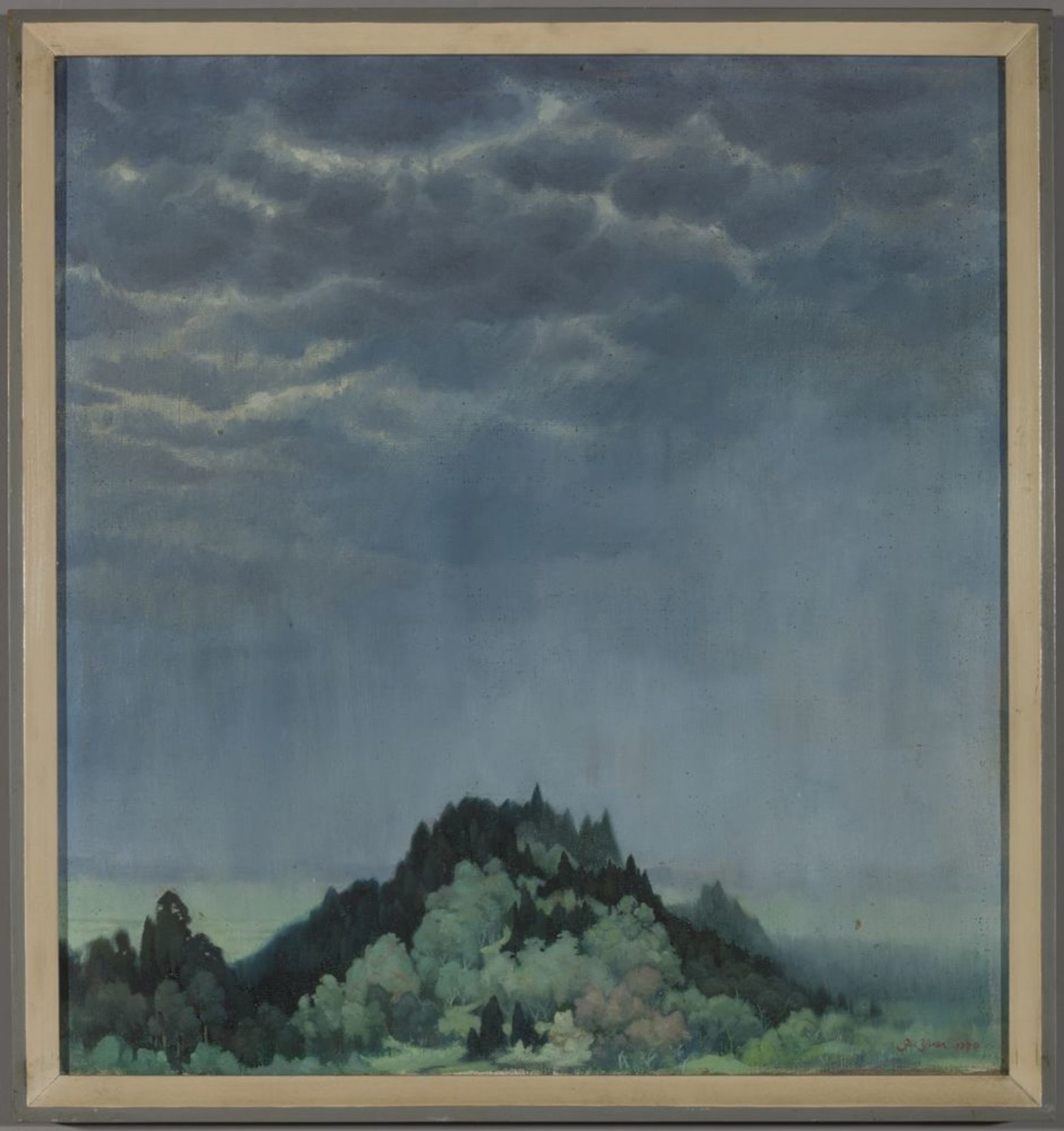
Unknown artist (mainland China)
Untitled
This anonymous landscape from 1979 shows a heavy sky suspended above dark relief and almost still water. At the end of the Cultural Revolution, landscape painting gradually regained a place that no longer depended solely on the heroic narrative. The author remains unknown, but the work retains the tension of this transition: nature seems silent, as if it was still waiting for permission to speak for itself.
See the work at the museum →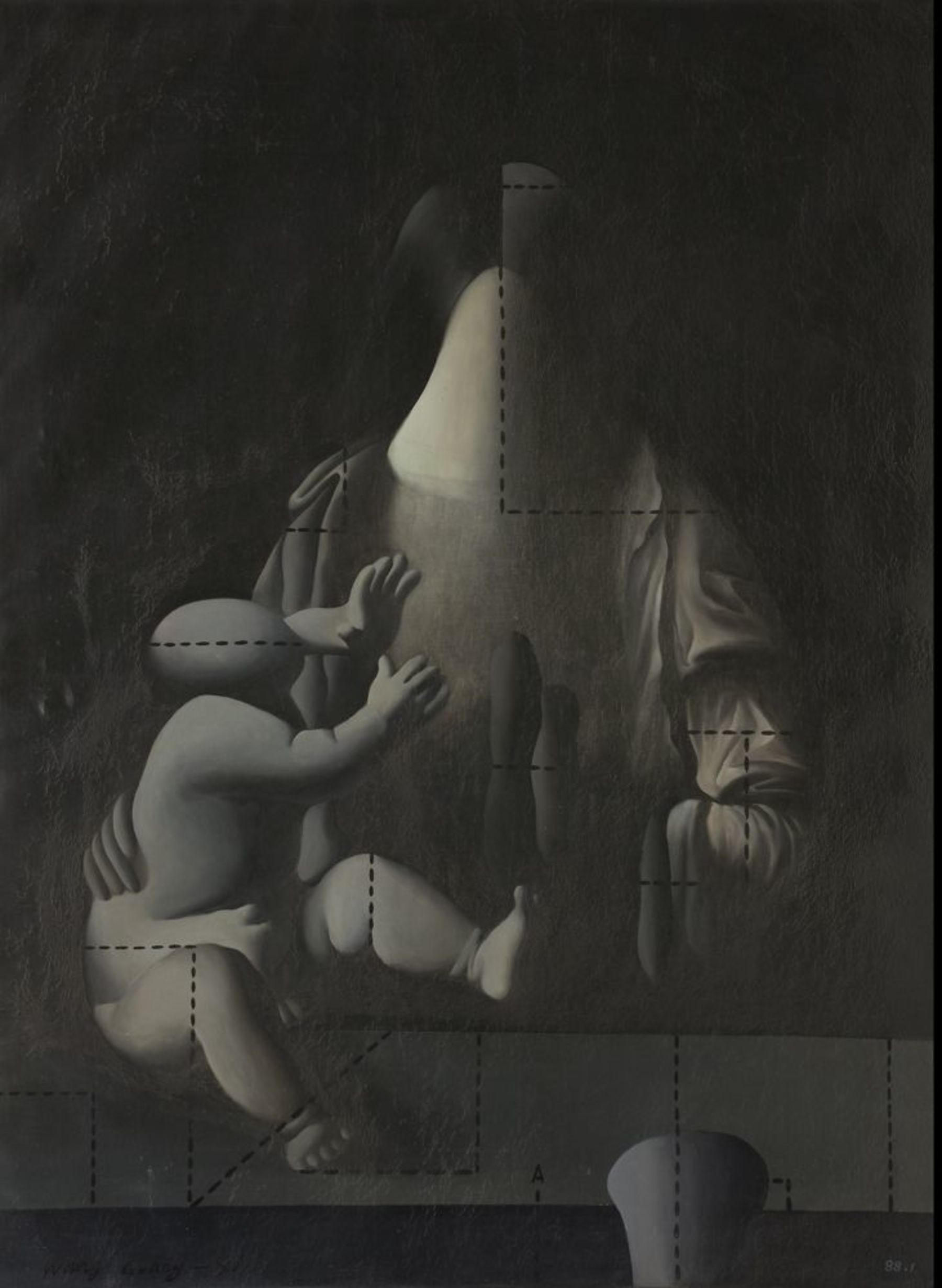
Wang Guangyi
Post-classical - The Virgin and Child
Post-classical - The Virgin and Child belongs to the series where Wang Guangyi takes Western masterpieces in a gray palette, like reproductions already worn by history. The sacred scene loses its devotional warmth and becomes an image examined from a distance. In 1988, this coldness questioned the authority of imported models as much as that of Chinese political icons. Even tradition comes here under surveillance.
See the work at the museum →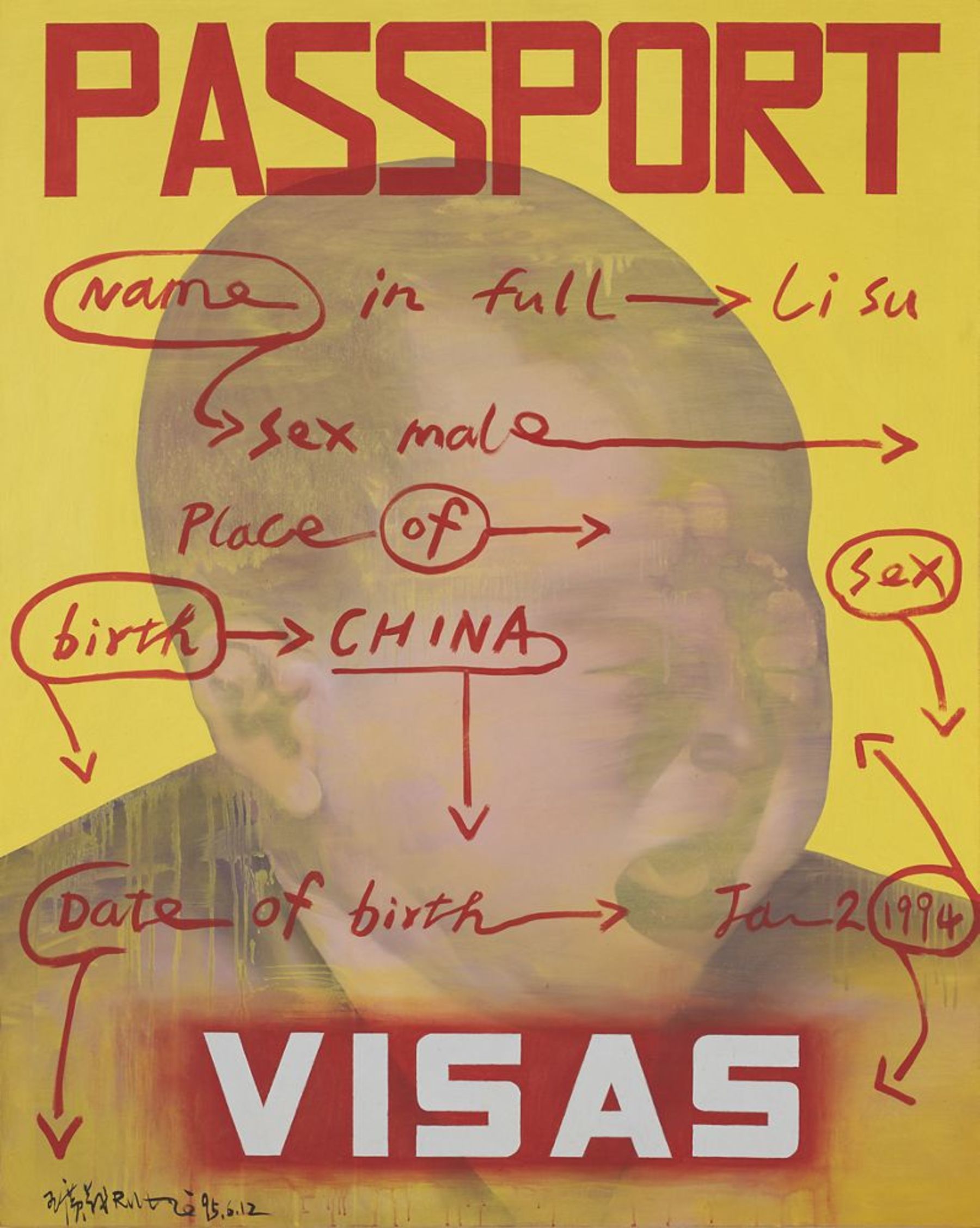
Wang Guangyi
Visas
Visas transform the passport into a political surface. Wang Guangyi enlarges inscriptions, arrows and stamps until he makes the administrative document an almost advertising painting. Created in 1995, the work evokes China's new mobility as much as the borders that control it. The words promise the journey, but the signs are a reminder that an international trip often begins with a much less poetic conversation with a form.
See the work at the museum →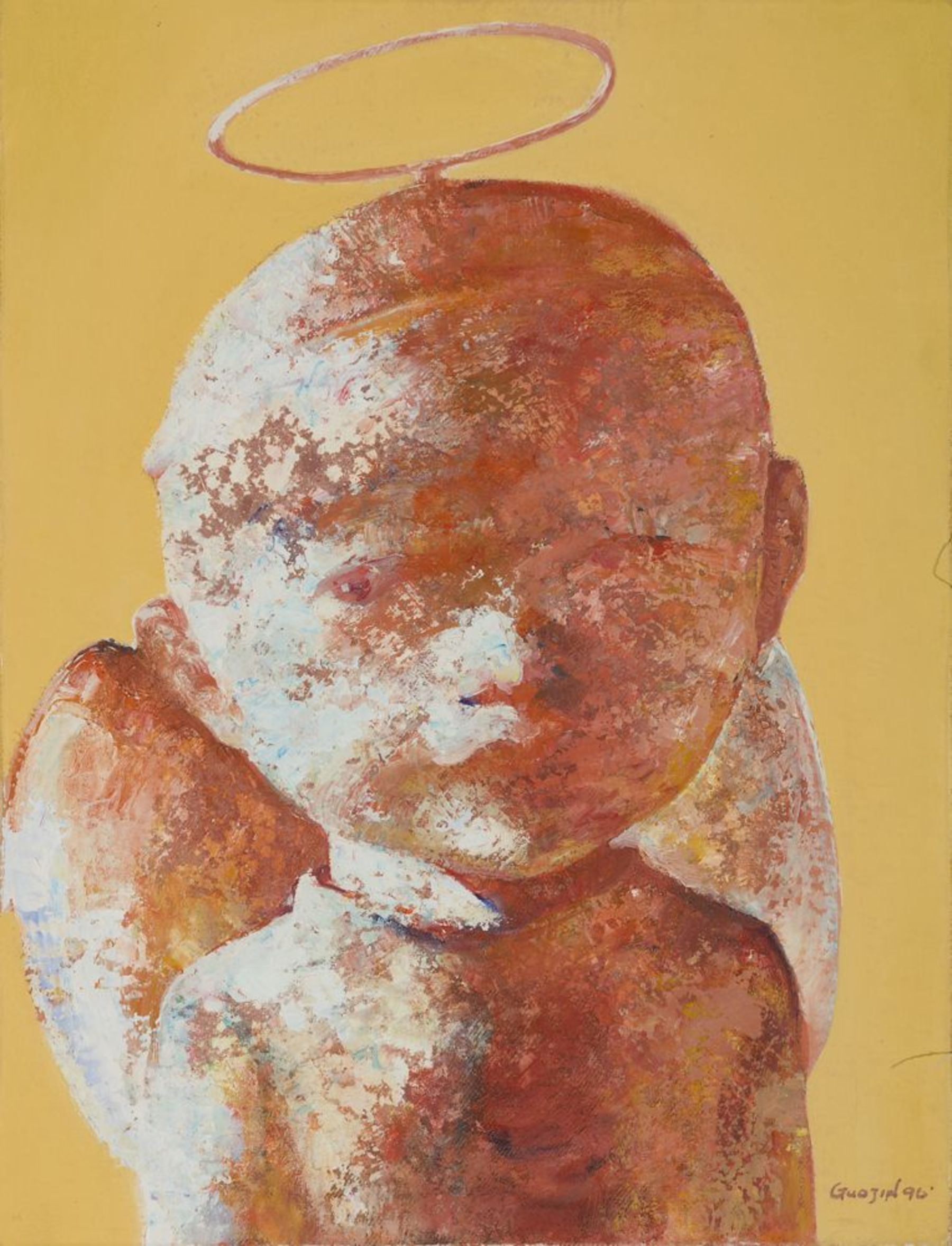
Guo Jin
Untitled
In this Untitled from 1996, Guo Jin paints a reddish baby figure, isolated on a yellow background and topped with a halo. The child appears at once fragile, ancient and strangely monumental, far from any touching image. The artist uses this ambiguity to disturb the symbols of innocence and rebirth. The halo perhaps promises a revelation; the model's expression clearly prefers to keep it a secret.
See the work at the museum →
Liu Wei
Untitled
Liu Wei's Untitled stretches a pink and blue surface where organic shapes appear and then dissolve. In 1997, the artist moved away from the most readable cynical realism to let the material produce its own accidents. The painting oscillates between landscape, flesh and abstraction, without choosing a single identity. This instability is the subject: looking is like accepting that the image changes before you finish naming it.
See the work at the museum →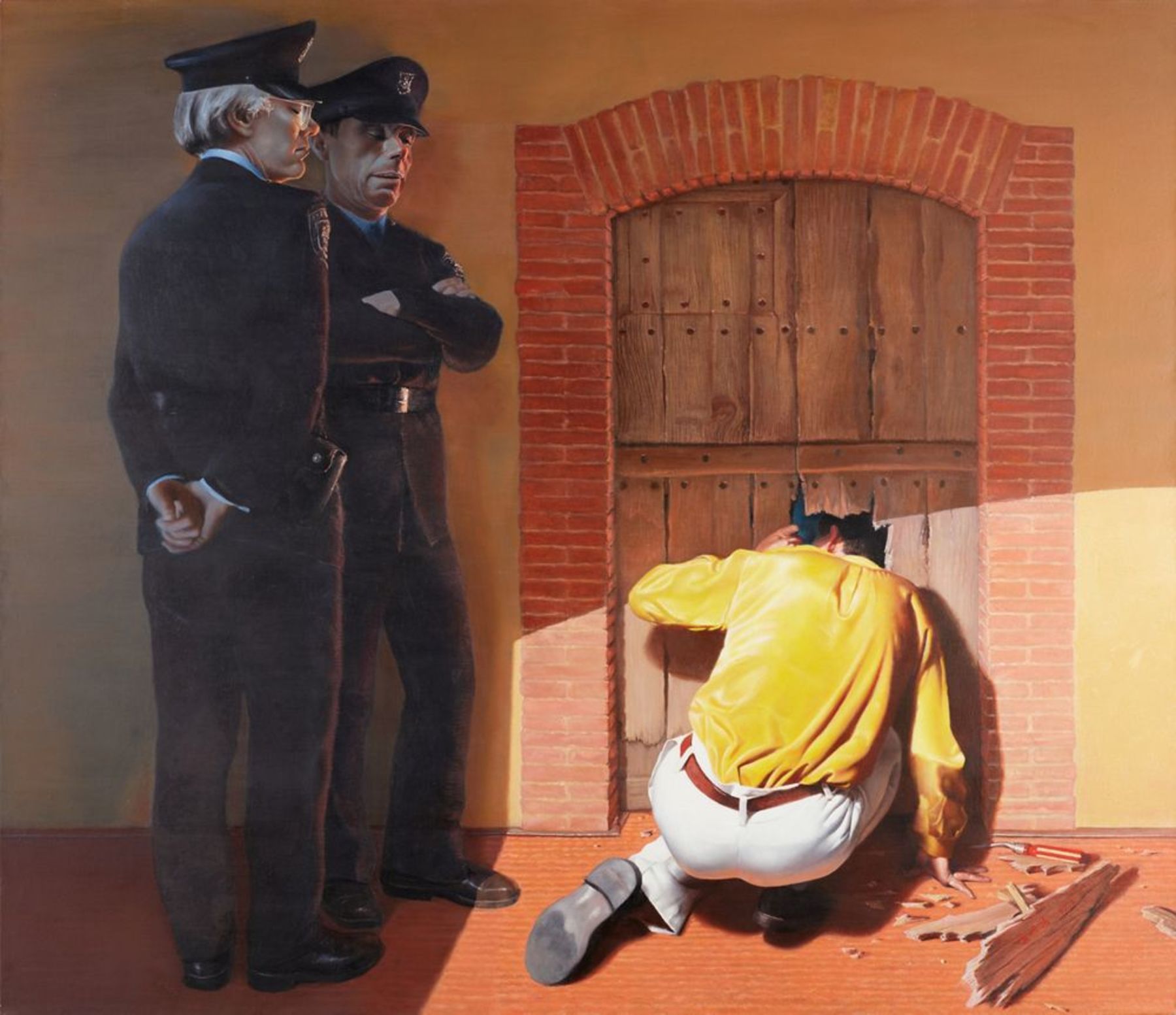
Wang Xingwei
Saint Thomas
Saint Thomas, painted in 1997, takes up a Western religious scene with a voluntary shift. Wang Xingwei places figures in dark suits in front of a door while a kneeling man seems to replay the saint's doubt or recognition. Appropriation does not explain his model; it transports him into a theatrical and contemporary situation. The sacred story becomes an enigma where everyone seems to know a different text.
See the work at the museum →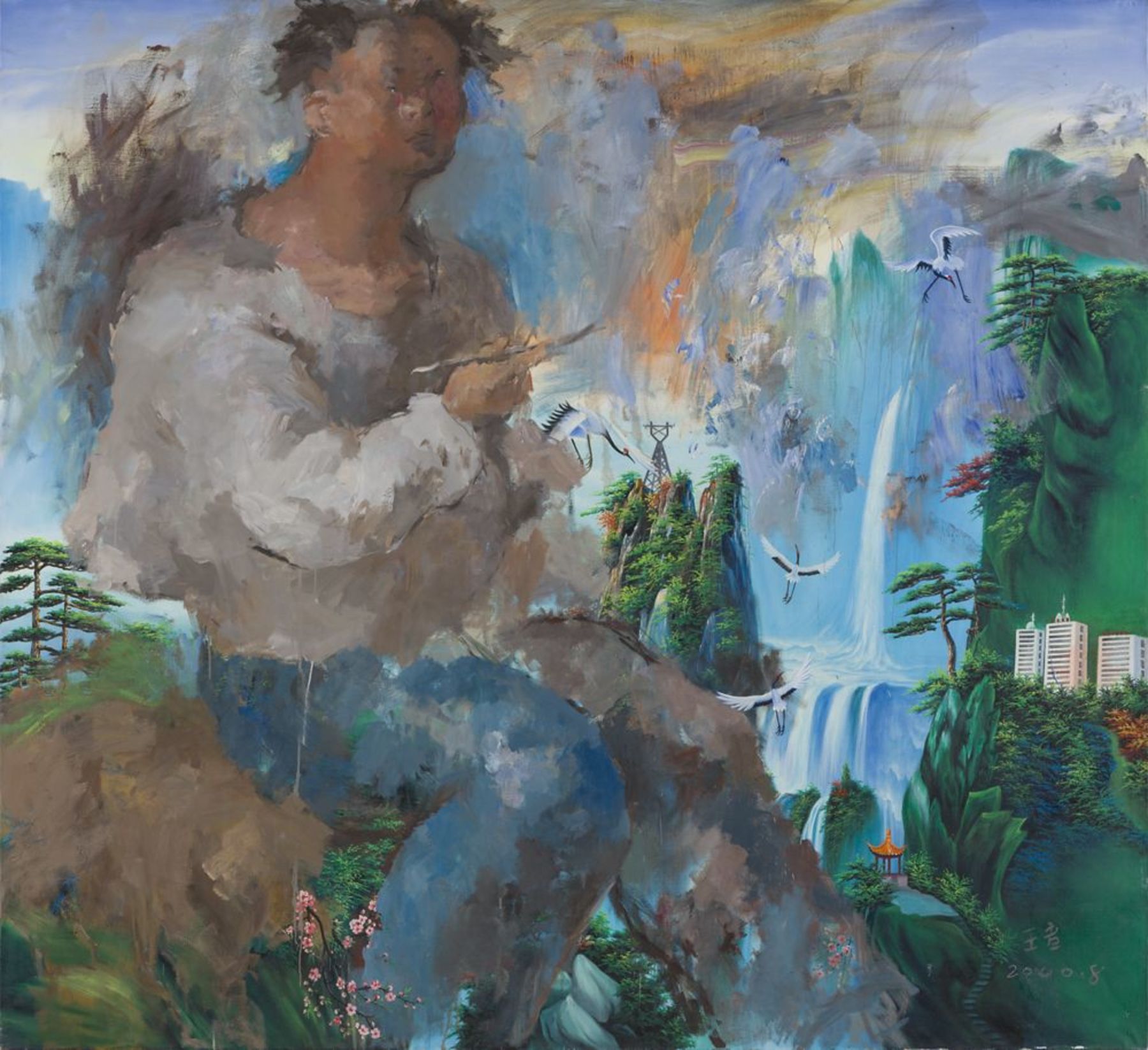
Wang Yin
Untitled
In this Untitled 2000, Wang Yin constructs a landscape in rapid layers of blue, green and brown. The shapes evoke mountains, vegetation and clouds without being fixed in geographical view. The artist returns to modern Chinese painting as to an already historical memory, which he cites without reproducing it. The landscape seems familiar then slips away, like a memory whose colors would have held up better than the details.
See the work at the museum →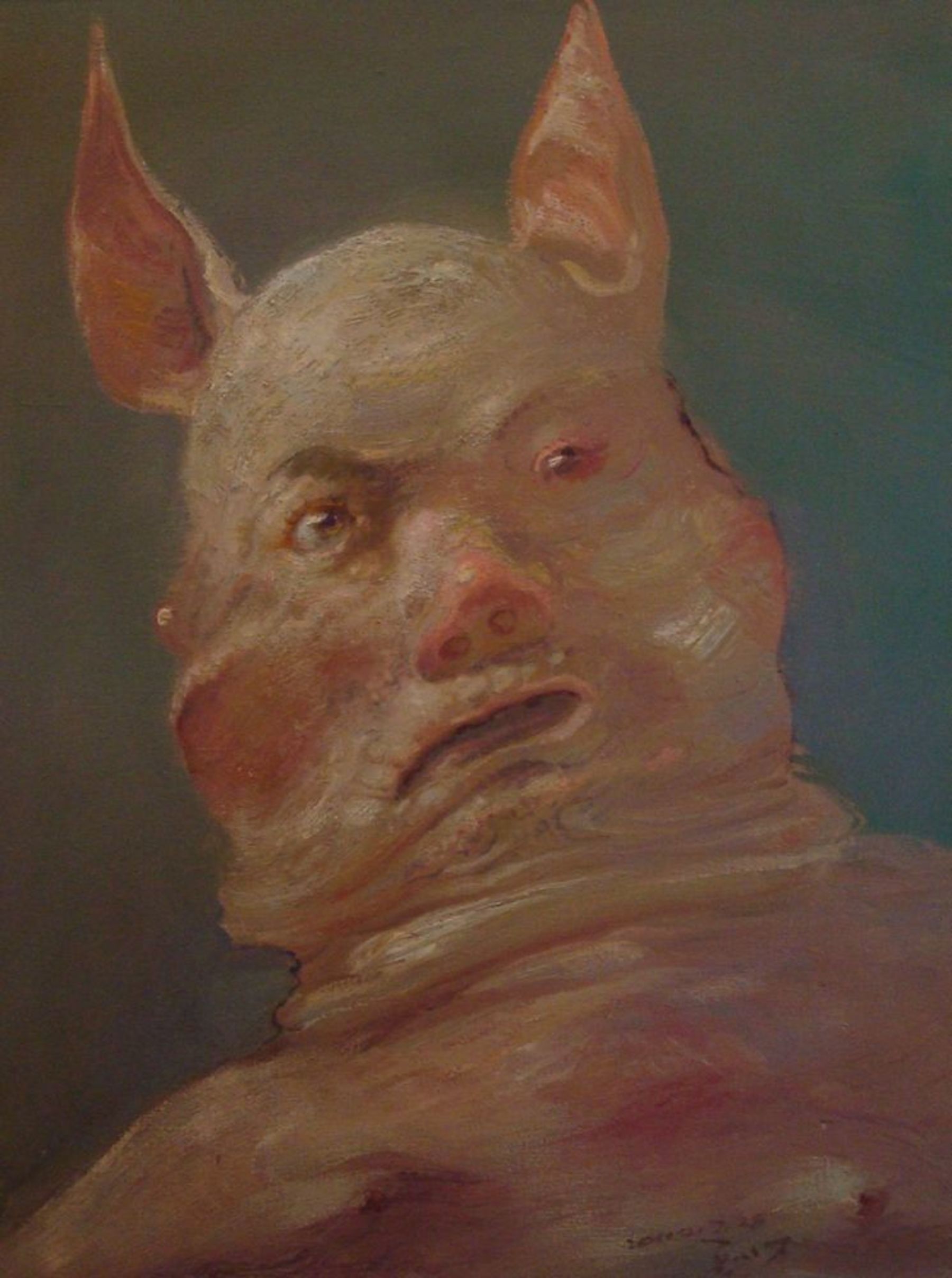
Xia Xiaowan
Untitled
Xia Xiaowan's Untitled shows a hybrid head, human and porcine, standing against a dark background. The flesh, painted with almost classical precision, makes the metamorphosis more disturbing than a spectacular fantastic effect. Around 2000, the artist explored a body subjected to psychic and physical mutations. The character seems to want to speak; its anatomy has just seriously complicated pronunciation.
See the work at the museum →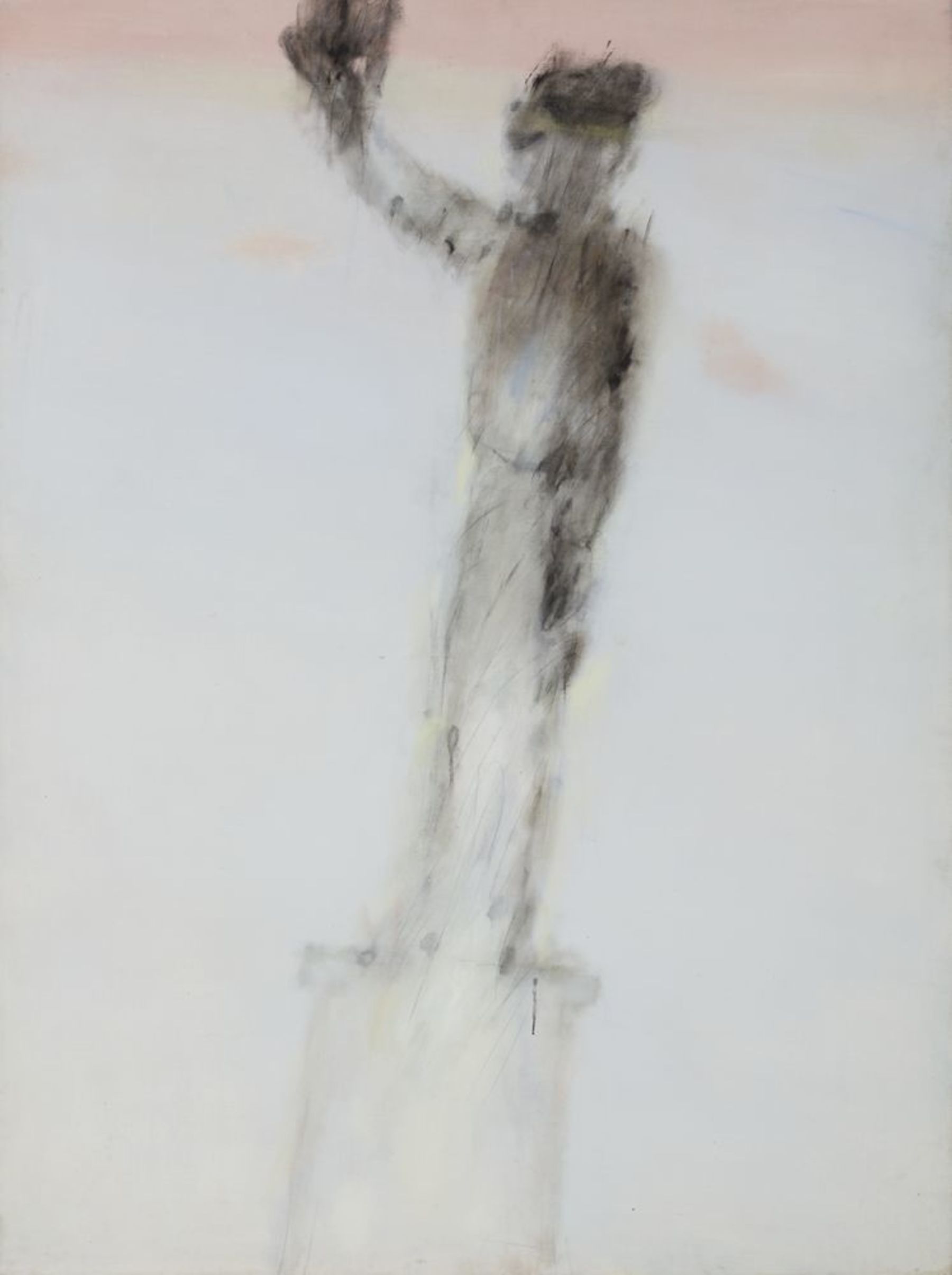
Xie Qi
Gift 01
Gift 01 reduces the figure to a vertical apparition, almost erased by white light. Xie Qi works by veils, friction and dissolutions which transform the body into a trace rather than a portrait. Painted in 2000, the work associates the generous title with a presence that is difficult to grasp. The gift may not be an object: it's that brief moment when a figure agrees to remain visible.
See the work at the museum →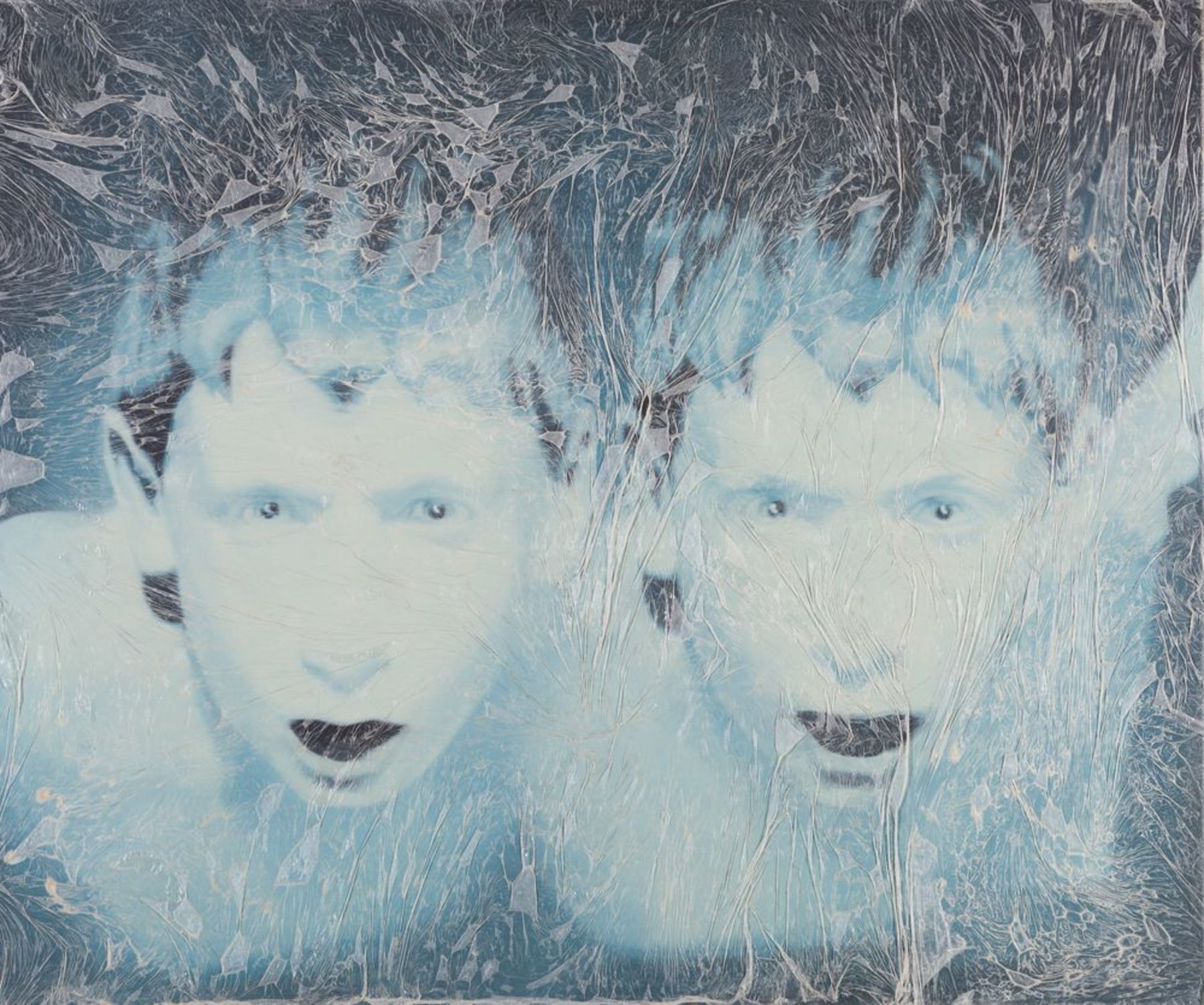
Xu Wentao
Untitled
In this Untitled from 2000, Xu Wentao repeats two bluish faces under a streaked material which blurs their features. Duplication evokes photography, screen and collective memory, while painting refuses the mechanical clarity of these sources. The figures look similar without becoming identical. The painting thus observes an era saturated with images, where recognizing someone no longer completely guarantees knowing who you are looking at.
See the work at the museum →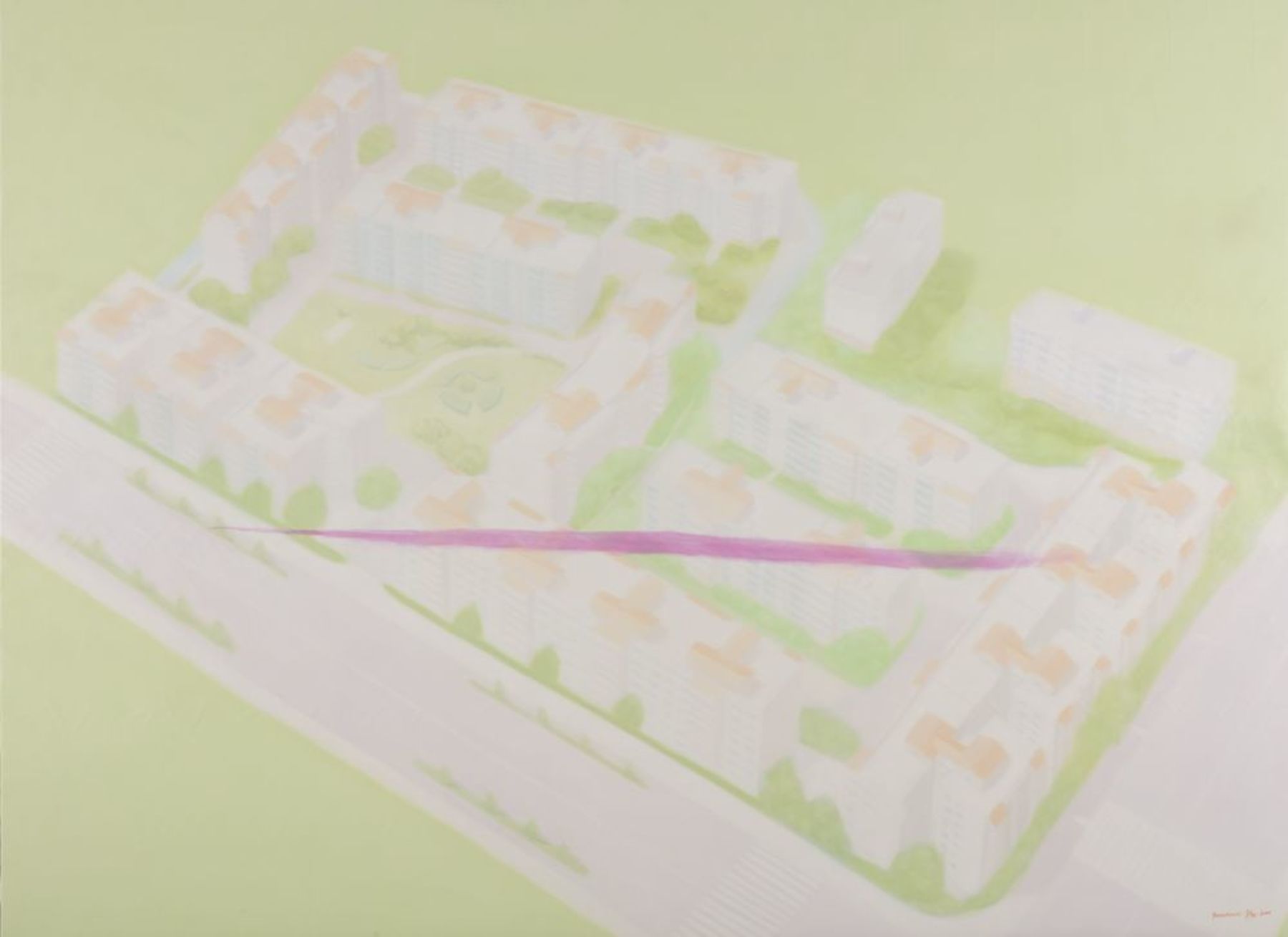
Yang Mian
Untitled
Yang Mian's Untitled transforms a familiar object, close to a keyboard or control device, into an almost whitened appearance. The pink and green contours remain like the remains of an overexposed image. In 2000, the artist became interested in the visual codes produced by media and technology. The object remains usable in theory; the painting has simply removed its instructions for use.
See the work at the museum →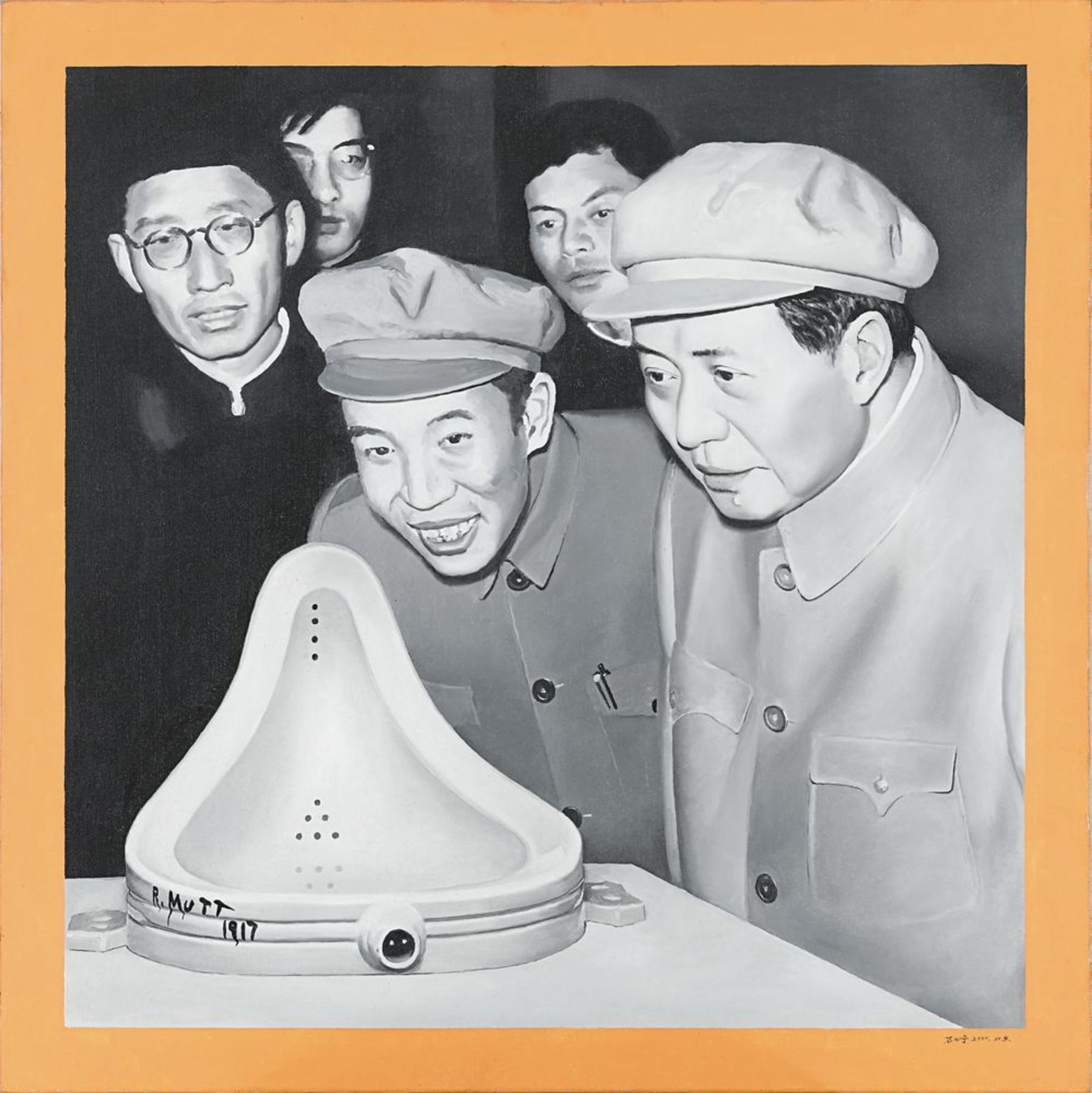
Shi Xinning
Duchamp retrospective in China
Retrospective Duchamp in China imagines Mao Zedong and other leaders gathered around Fountain, the urinal that became Marcel Duchamp's emblem. Shi Xinning paints the scene in gray with the seriousness of a historical photograph, while the meeting never took place. Produced in 2000-2001, the work creates an impossible archive and confronts two revolutions of very different nature. The false document keeps a remarkably official face.
See the work at the museum →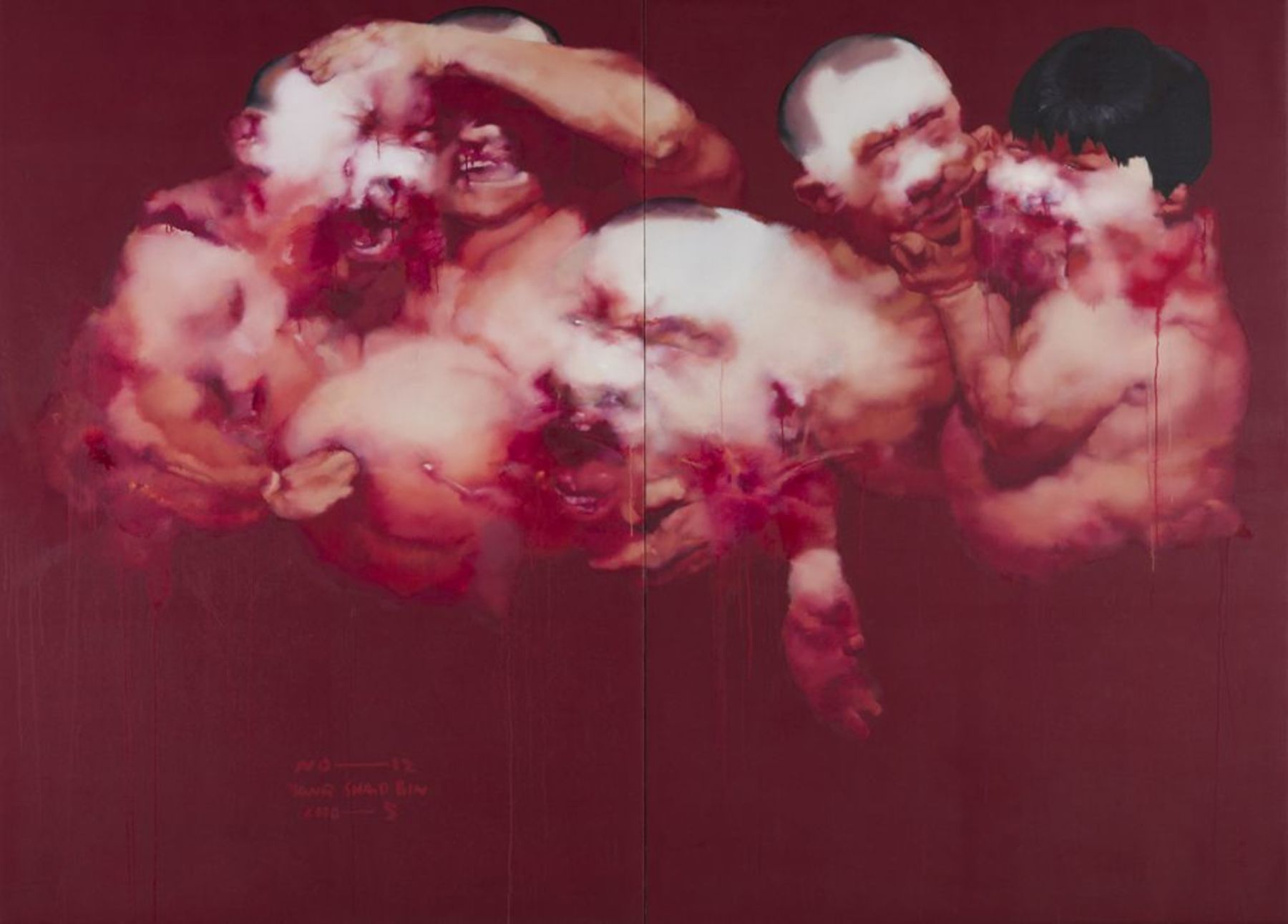
Yang Shaobin
Untitled No. 12
Untitled No. 12 belongs to paintings where Yang Shaobin distorts bodies with a red, thick and almost vaporous material. The figures seem to struggle, fall or merge in a space that refuses any stability. Between 2000 and 2005, this pictorial violence continued his view of the social balance of power. Red does not serve as an ideological background: it becomes the very temperature of the scene.
See the work at the museum →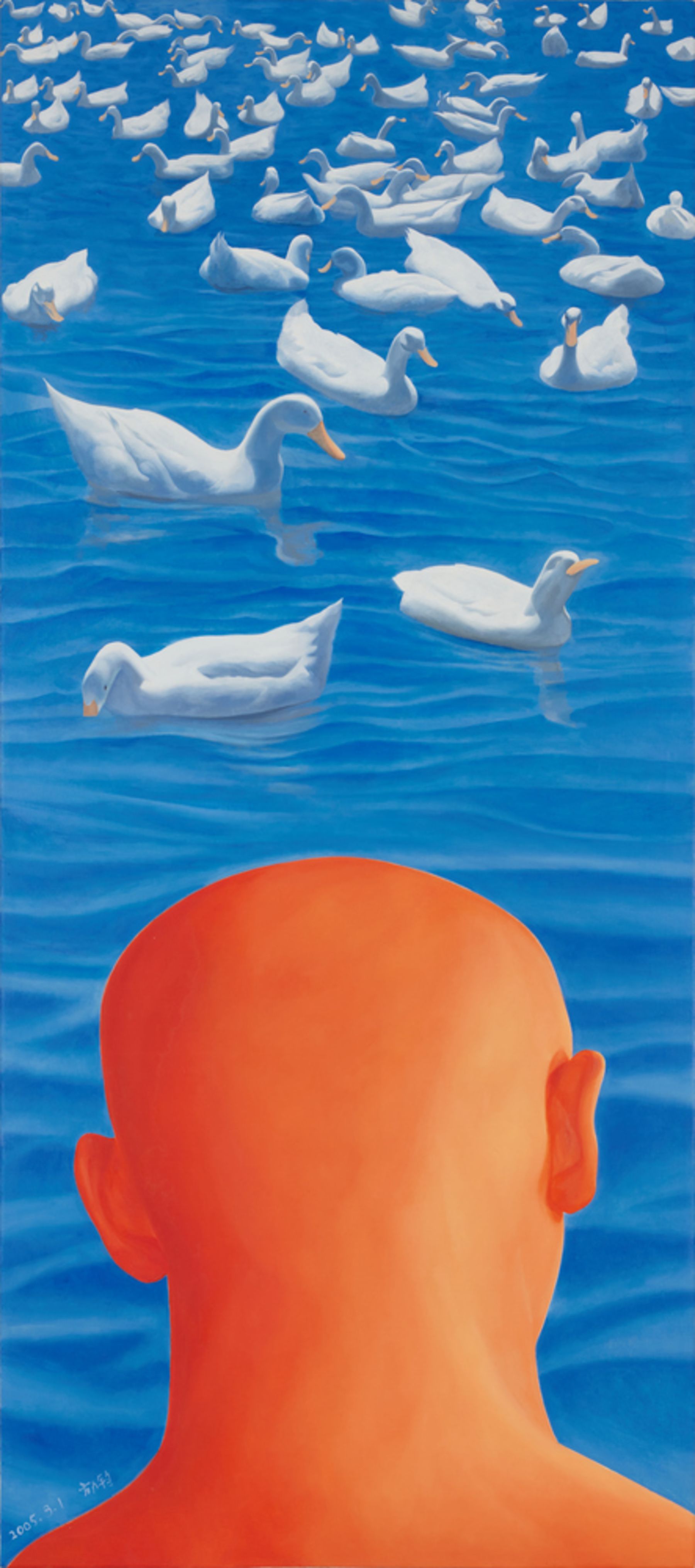
Fang Lijun
Portrait of Uli Sigg
The Portrait of Uli Sigg represents the Swiss collector from behind, bald and dressed in orange, in front of a multitude of small figures floating on a blue sky. Fang Lijun thus reverses the honorary portrait: the famous man becomes a spectator of the pictorial universe that he helped to bring together. Painted in 2005, the work plays with their relationship from collector to artist. Sigg has a lot of images; here one of them observes him back.
See the work at the museum →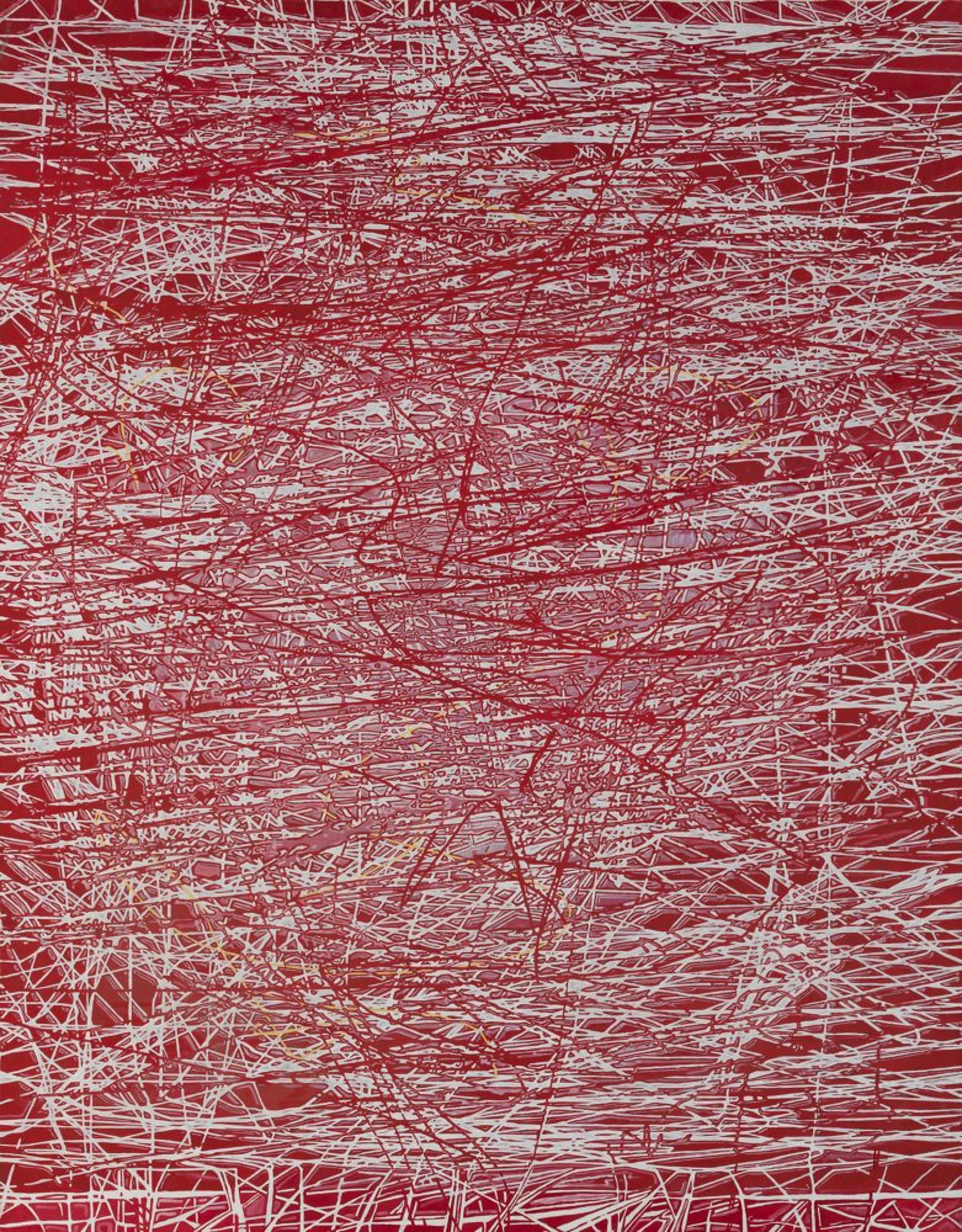
Xu Ruotao
Chinese red 99%
Chinese red 99% covers the surface with a tight texture where red appears color, material and statistical data at the same time. Xu Ruotao avoids the instantly recognizable emblem to work on the cultural and political depth of a tone associated with modern China. The 2005 title retains an ironic percentage: the last percent prevents color from becoming a complete definition.
See the work at the museum →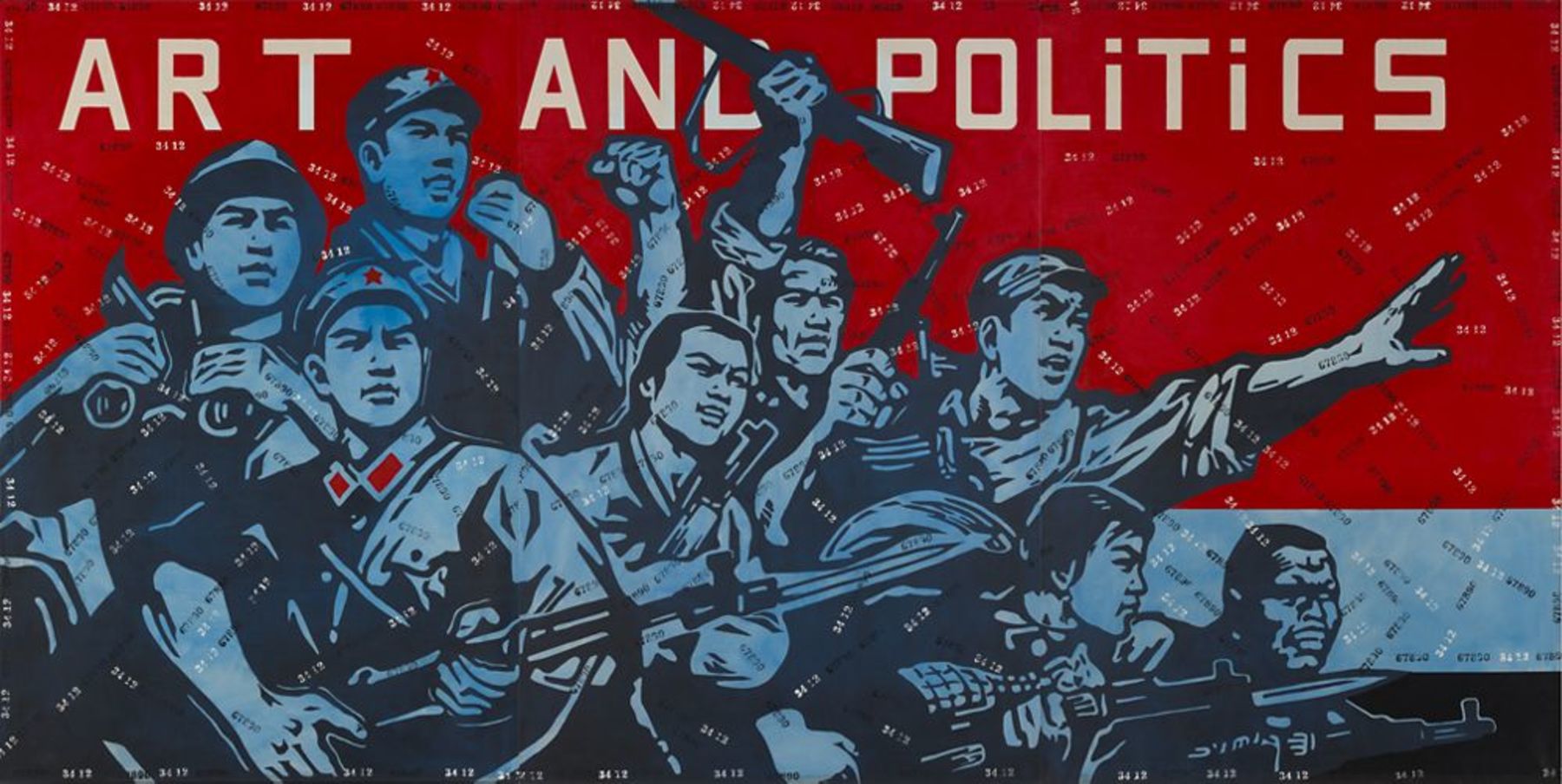
Wang Guangyi
Art and politics
In 2006, Art and Politics superimposed Chinese propaganda figures on an English title drawn like a commercial banner. Wang Guangyi puts collective enthusiasm, international communication and the art market in the same space. The work extends its Political Pop without confusing the two systems: rather it shows how everyone knows how to create convincing images. The slogan changes language, not necessarily profession.
See the work at the museum →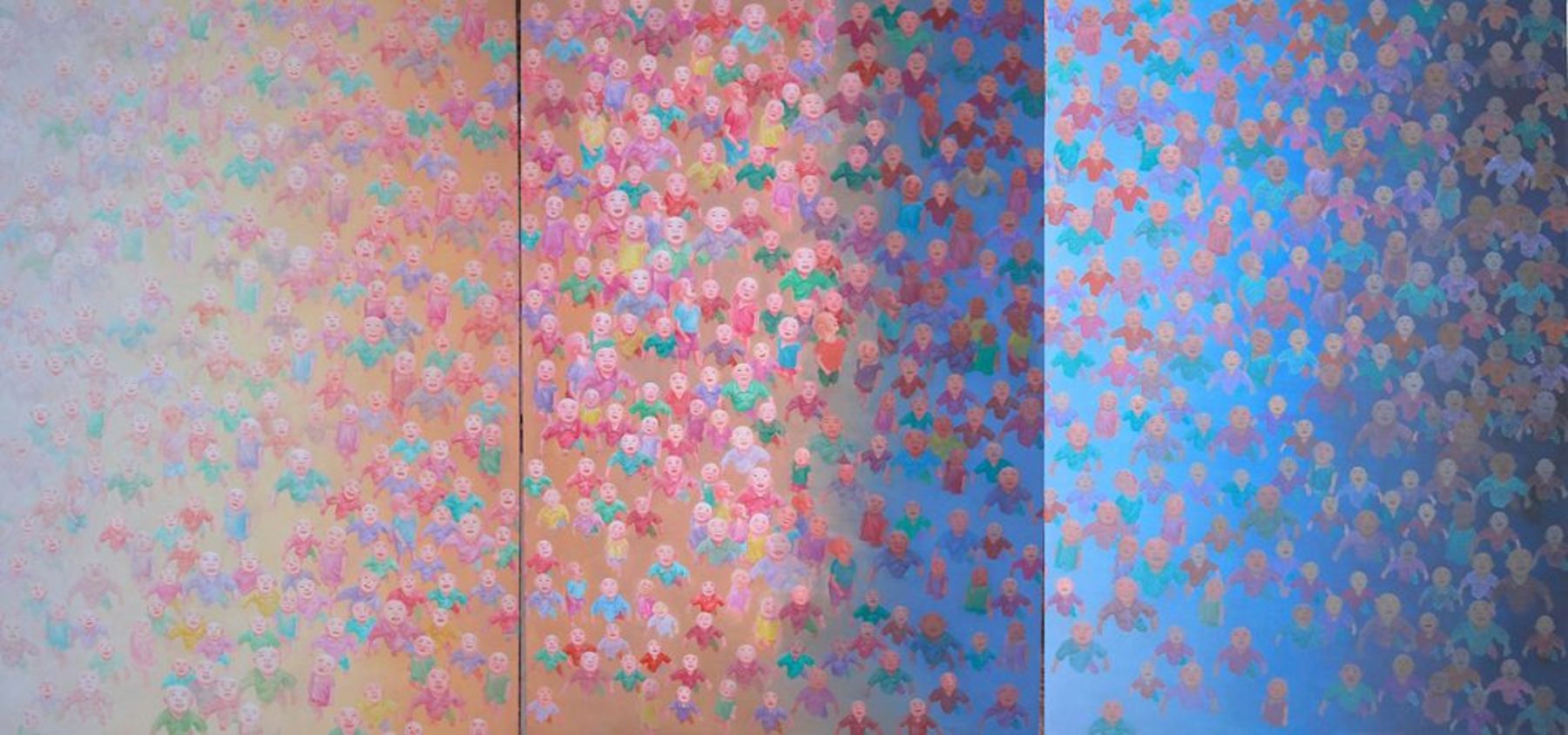
Fang Lijun
Untitled
In this Untitled from 2007, Fang Lijun abandons the large isolated figure in favor of three fields saturated with pink, blue and red patterns. The repetitions evoke textiles, digital screens and crowds seen from afar. The image appears decorative before its density becomes almost oppressive. Color provides a visual celebration; the number of signs discreetly reminds us that there are far too many guests.
See the work at the museum →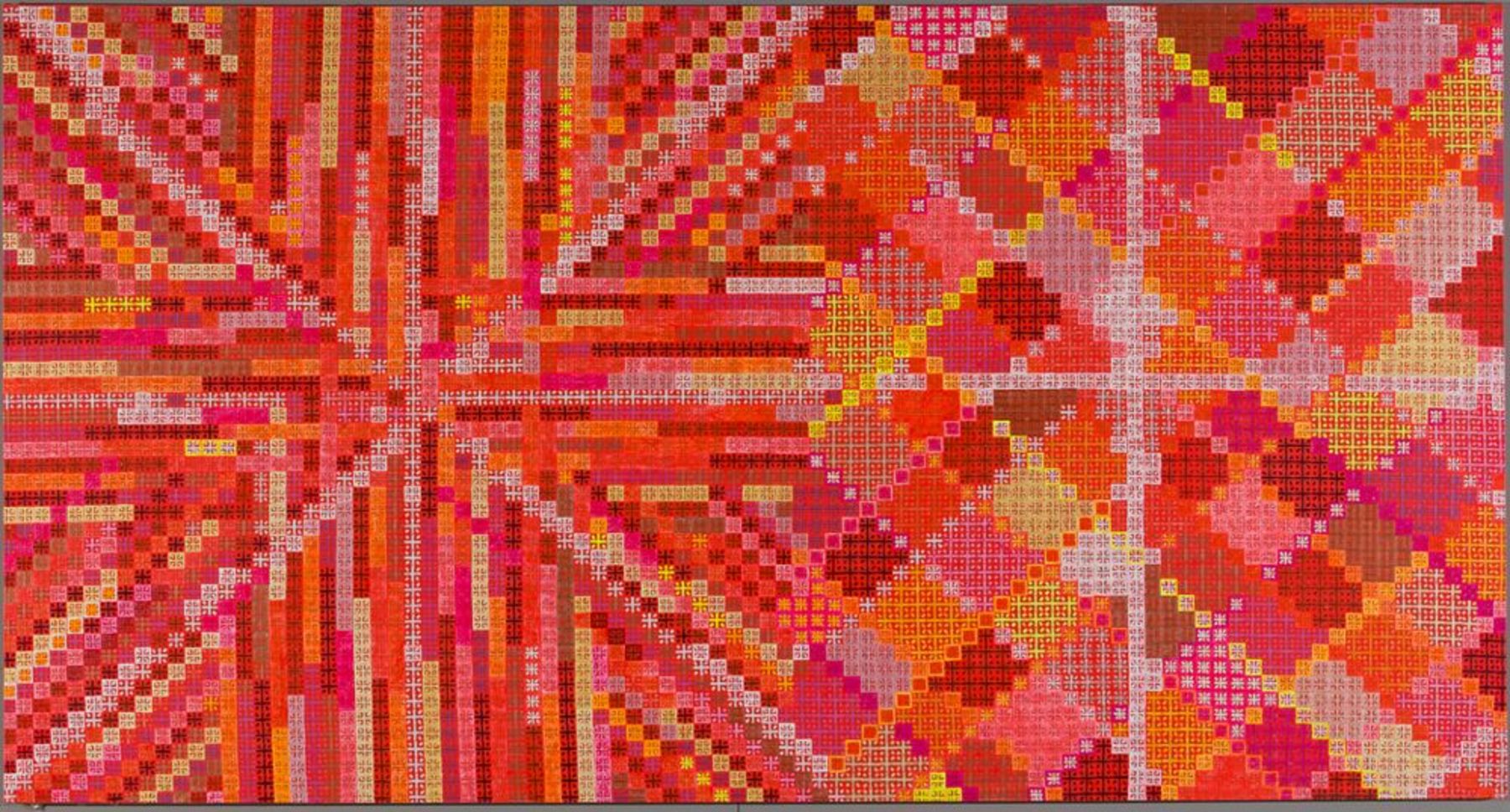
Ding Yi
Appearance of crosses 2008-1
Appearance of the 2008-1 crosses belongs to the series that Ding Yi has been pursuing since the 1980s based on a single sign, the cross. Small "x" and "+" cover the canvas like an urban grid, a fabric or a screen subject to variations in density. Repetition does not abolish difference: each zone has its own rhythm. Ding chooses a harsh rule, then spends years demonstrating everything it allows.
See the work at the museum →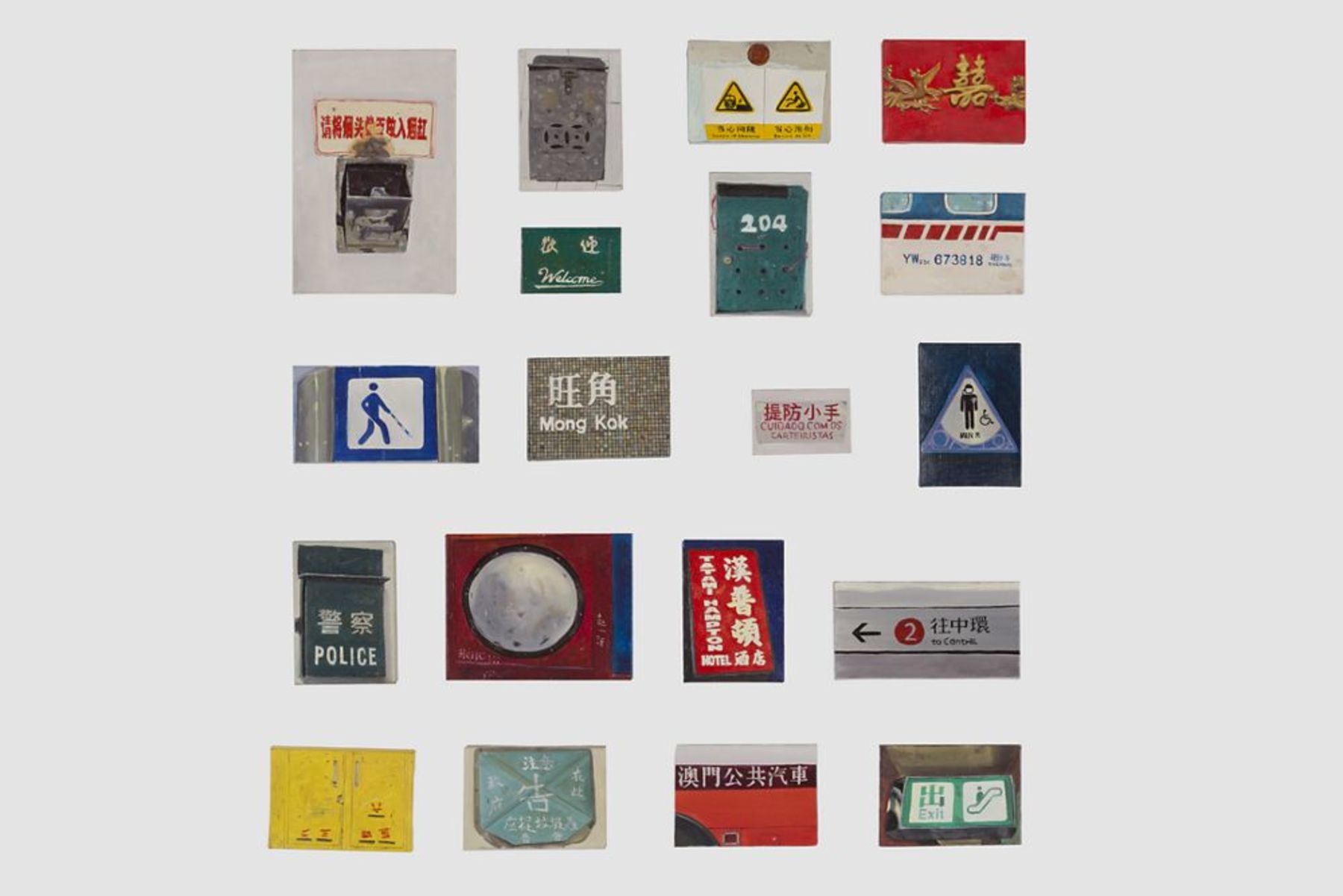
Zhao Yiqian
Chinese cities
In 2008, Chinese cities brought together a constellation of panels, plaques and pictograms collected in the urban environment. Zhao Yiqian does not paint a recognizable skyline; he composes the city by the signs which direct, prohibit, sell and identify. The painting becomes a daily traffic inventory. The buildings remain off-camera, but their visual language has already occupied the entire wall.
See the work at the museum →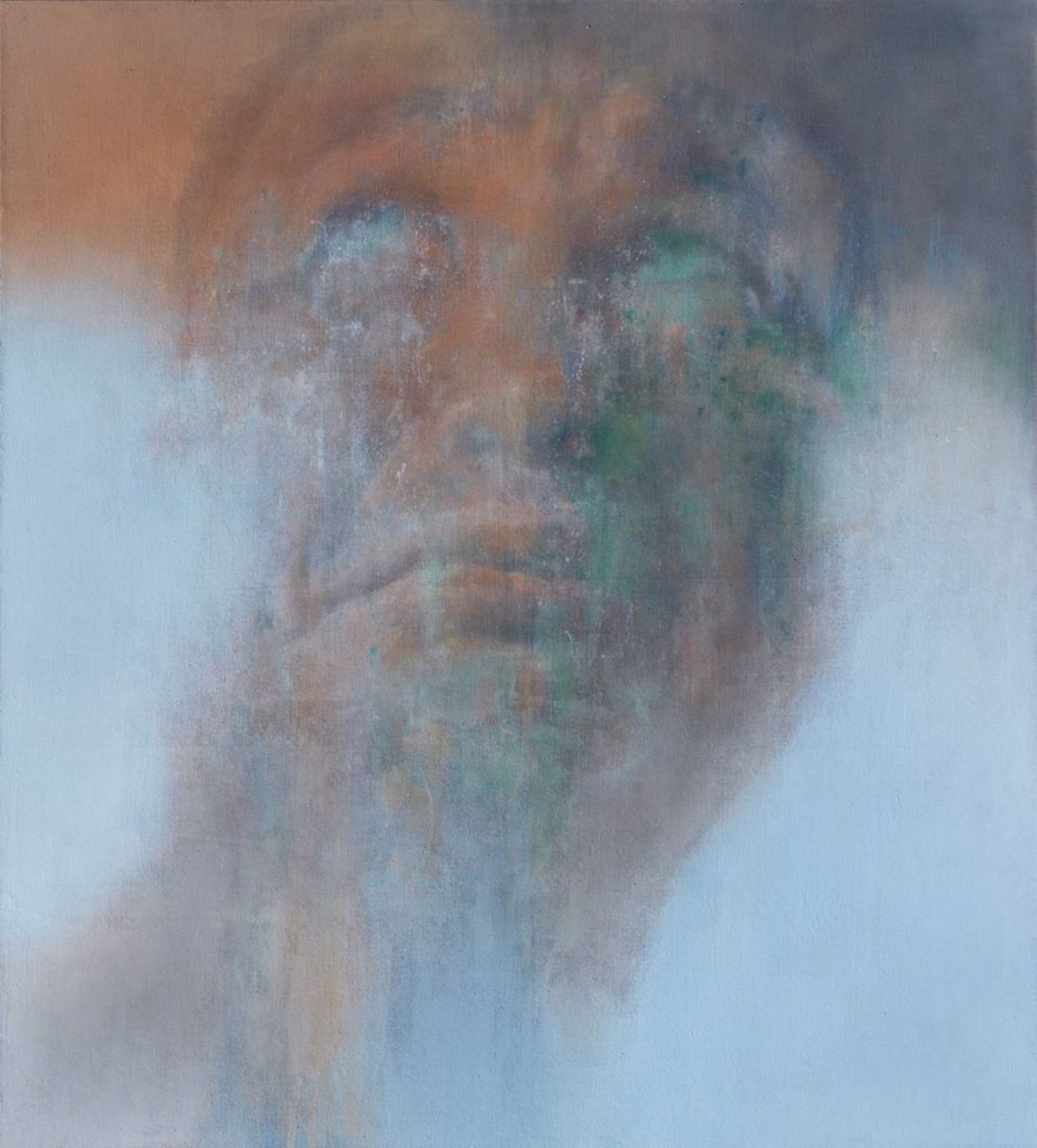
Xie Qi
Alas!
Alas! shows a vertical figure almost dissolved in blues, grays and browns. Xie Qi lets the body emerge from transparent layers, like a memory that hesitates between appearance and erasure. Painted in 2010, the work closes the journey without triumphant conclusion. Its brief title gives voice to the silhouette, but the material keeps the exact cause of this sigh to itself.
See the work at the museum →Historical landmarks
A century of appropriations and ruptures
Li Tiefu was one of the first Chinese artists to gain in-depth knowledge of oil painting in North America. In the 1920s and 1930s, Xu Beihong defended an ambitious academic background, while Chen Cheng-po and Li Mei-shu developed landscapes, portraits and everyday scenes in Taiwan where Japanese and European influences met experience local.
After 1949, oil became a major medium of official painting on the continent, but it also remained the field of independent research. From the 1980s, Geng Jianyi, Zhang Peili and Wang Guangyi neutralized or diverted heroic codes. In the 1990s and 2000s, cynical realism, Political Pop, new realism and abstraction placed Chinese painting at the heart of international trade.
Portraits and still lifes require technical mastery of oil.
National history, city, landscape and Taiwanese identity are renewed.
Academy and official realism largely structure the medium.
Painting deconstructs gesture, portrait and political image.
Advertising, photography and mass culture enter the web.
Three reading threads
Matter, territory and public images
Learn oil
The first workshops combine academic drawing, chiaroscuro and painting on the motif. Very quickly, these tools served models, stories and sensitivities that no longer resembled their schools of origin.
Painting a territory
Tamsui ports, Chiayi streets, campuses, mountains and rural scenes give the canvas a local memory. The modern landscape is born as much from travel as from attachment to a place.
Hijack icons
From the 1980s, official portraits, brands, photographs and masterpieces became a material to cite, cool or contradict. Painting teaches us to look at the images that govern the gaze.
Frequently asked questions
Understand the corpus
Why is there no ink painting?
This story deliberately follows oil painting. Ink on paper or silk has its own centuries, schools and masterpieces; it calls for a journey entirely devoted to its gestures, its formats and its way of inhabiting the void.
Why does the journey begin in the 20th century?
The oil was introduced earlier in China, but its teaching, institutions and modern use developed especially from the end of the 19th and beginning of the 20th century.
Is Taiwan included in this course?
Yes. Chen Cheng-po and Li Mei-shu are essential for understanding artistic circulations between China, Japan and Europe, as well as the local roots of oil painting.
What role do academies play in this story?
They spread model drawing, portraiture, nude and monumental painting, while linking Chinese artists to Japanese, European and American schools. Several painters then became teachers themselves and passed on these tools to new generations.
0 comments