


HISTORY · LANDSCAPE · CUBISM · SURREALISM
Czech painting: 100 works from Mucha to Kupka and Toyen
Two centuries of visual invention
From the great historical visions of Mucha to the first abstractions of Kupka, then to the mental landscapes of Toyen, Czech painting advances in leaps and bounds. The ranking now opens with the most famous works before unfolding history, landscapes, Prague cubism and surrealism.
Prague in the heart of Europe
From national memory to modern invention
In the 19th century, Josef Manes, Vaclav Brozík and Jakub Schikaneder gave Czech painting lasting images of history, people, city and intimacy. Antonín Slavícek then liberates the landscape with a touch sensitive to wind, climate and industrial transformations.
Czech painting does not follow a single school: it transforms history, landscape and the unconscious into profoundly singular European languages.
Around 1908, Kubišta, Filla and Čapek confronted Prague with expressionism and cubism. Mucha enlarges Slavic history to the monument, Kupka conquers abstraction through color and movement, while Toyen unites poeticism, desire and concern in an unparalleled surrealist work.
Enter the rankingOne hundred Czech paintings, icons in the lead
Icons first
Works that gave Czech painting its place in world art history.
 #1
#1
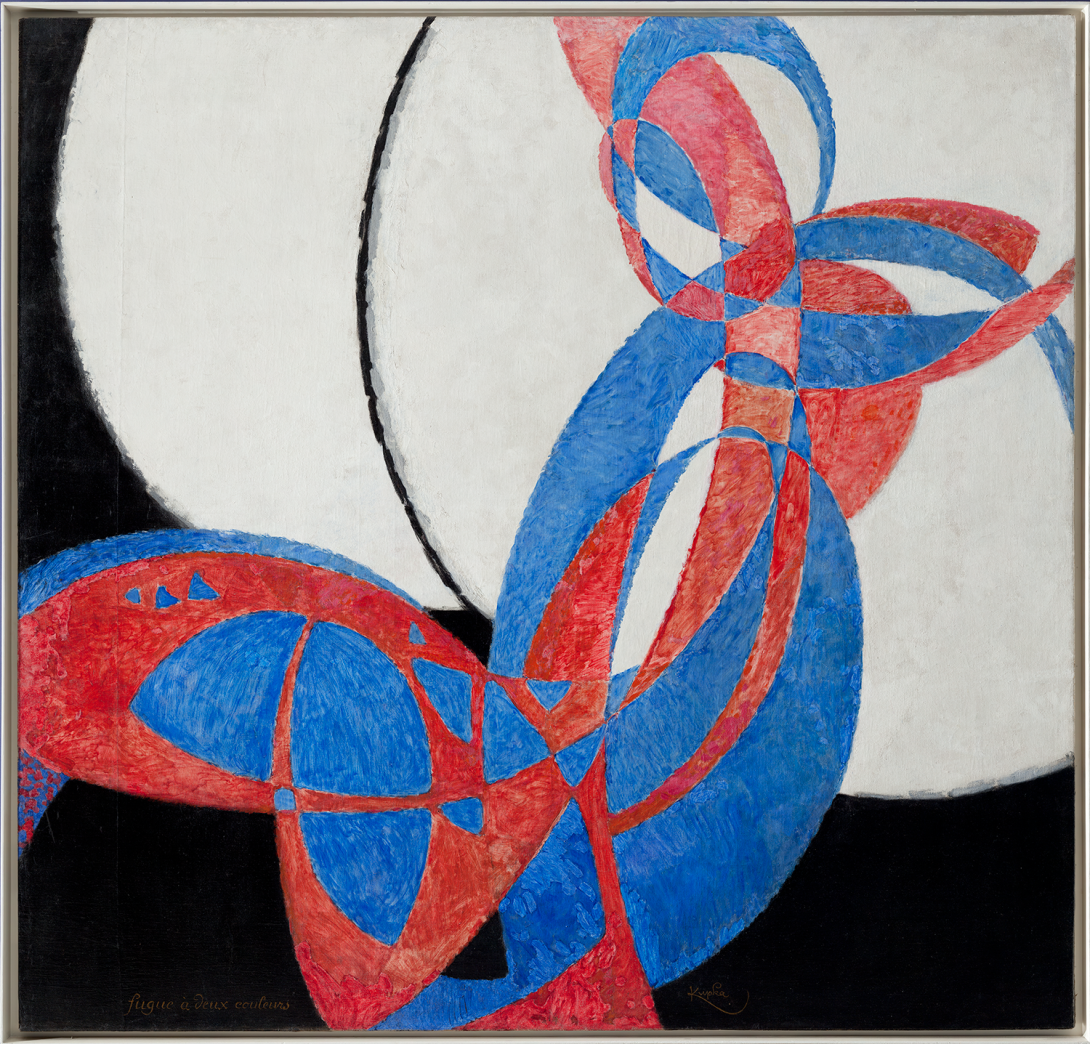
Amorpha, two-color fugue
Presented at the Salon d'Automne in 1912, this painting was among the first abstractions publicly exhibited in Paris. Kupka starts from the movement of a red and blue ball observed in the hands of his daughter-in-law, then transforms the game in counterpoint to curves, like a Bach fugue turned color.
See the museum notice →#2
The Apotheosis of the Slavs
The last panel of the cycle, the work brings together oppression, war, liberation and hope in a luminous architecture of Slavic history. Dated 1928, this painting by Alfons Mucha combines tempera with egg and oil on canvas and a collection history today linked to Prague City Gallery.
Discover this reproduction → #3
#3
San Sebastian
Kubišta borrows the Christian martyr to compose a symbolic self-portrait of the modern artist, injured but standing in the face of incomprehension. Cubist geometry does not cool the scene: funeral greens, tense facets and arrows transform the body into spiritual architecture, on the verge of rupture.
See the museum notice →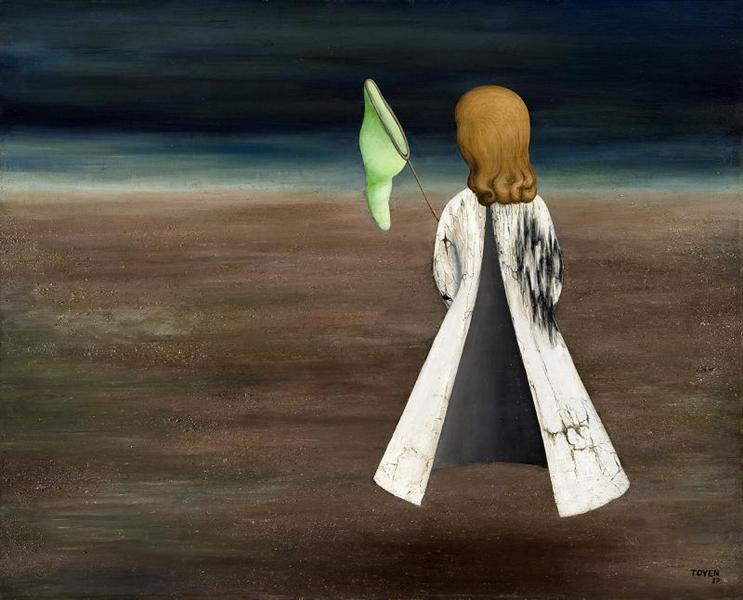 #4
#4
Sleeping territory
A solitary figure crosses bare ground with its net. The sleep of the title belongs as much to the landscape as to the consciousness of the character. Attached to the National Gallery in Prague, the work is dated 1937. The choice of Oil on canvas specifies how Toyen constructs light, shapes and depth.
Discover this reproduction → #5
#5
Murder in the house
A body lies in the dark courtyard as the city continues around it. This social scene refuses the spectacular and lets silence carry violence. 1890 provides the first landmark, Oil on Canvas the second and National Gallery from Prague the third: together they place this painting in the real work of Jakub Schikaneder.
Discover this reproduction →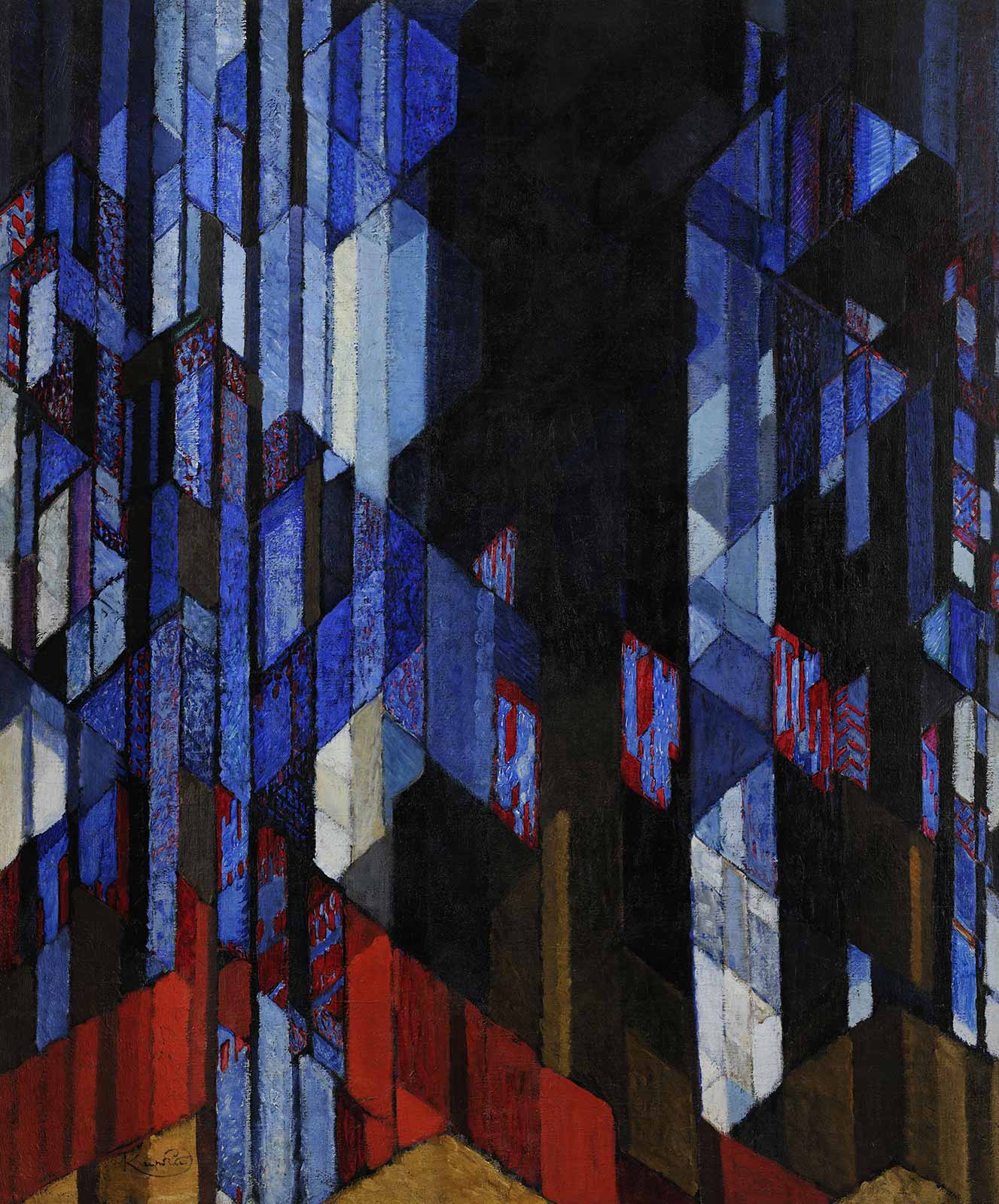 #6
#6
The Cathedral
After his research on vertical planes, Kupka added diagonals to introduce tension and elevation. The colored bands evoke less a specific building than the experience of a Gothic stained glass window crossed by light; architecture and music come together in a 180 centimeter high painting.
See the museum notice → #7
#7
Still life with skull
The old memento mori enters Czech cubism here: a skull, a vase and leaves break into angular planes without losing their symbolic weight. Kubišta opposes the organic and the mineral, the green growth of the plant and the bony fixity, in a severely calculated balance.
See the work sheet →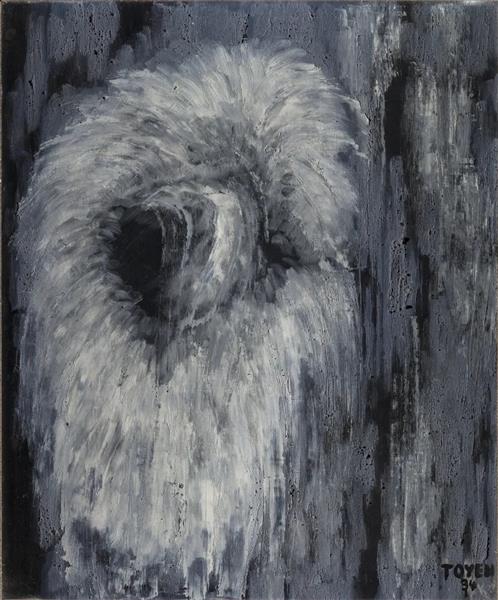 #8
#8
The Voice of the Forest
A hollowed-out torso emerges from a landscape without an explicit narrative. The fragmented body becomes a disturbing presence, as if the forest spoke through an apparition. The material journey leads from Toyen's workshop, in 1934, to the National Gallery of Prague; between the two remains a surface executed in Oil on canvas.
Discover this reproduction →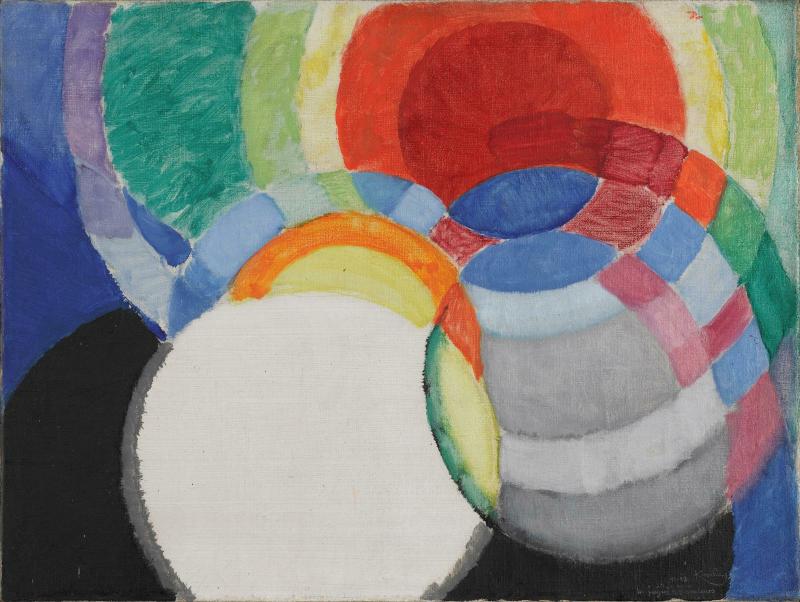 #9
#9
Newton's records, study for Fugue in two colors
Kupka takes up the decomposition of light described by Newton and vibrates the entire spectrum in concentric rings. This study prepares the decisive passage towards Amorpha: color ceases to dress an object and itself becomes movement, duration and subject of the painting.
See the museum notice → #10
#10
Coastal batteries fighting the navy
An artillery officer during the First World War, Kubišta transformed a military scene observed on the Adriatic into a clash of beams, smoke and trajectories. The exploded perspective is not an exercise in style: it recreates the mechanical violence of modern combat seen from the coast.
See the museum collection →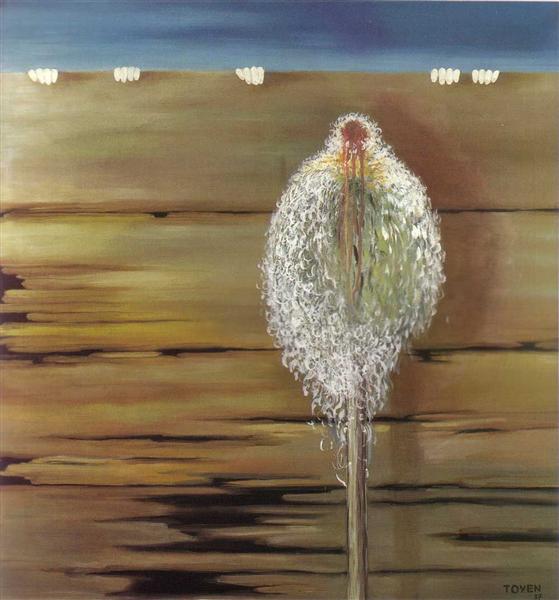 #11
#11
Dread
A feathery, wounded form stands in front of a barrier where a hand is missing. Toyen gives political anxiety a precise image without closing its meaning. This 1937 painting, worked in Oil on canvas, today belongs to National Gallery in Prague. It offers a concrete point of support in the evolution of Toyen.
Discover this reproduction → #12
#12
Triple portrait
Feigl, Kubišta and Pittermann-Longen represent themselves as a self-aware generation. The three presences condense the energy of the Osma group. Bohumil Kubišta painted this scene in 1907. The support worked in Oil on canvas, now attached to the National Gallery in Prague, gives the subject its lasting presence.
Discover this reproduction → #13
#13
Jan Hus before the Council of Constance
Jan Hus stands alone before the assembly which will condemn him. Brozík organizes the room as a political theater of conscience and power. The date of 1883 and the Oil on Canvas technique are not simple labels: they precisely locate this stage of Vaclav Brozík, preserved in Documented Collection.
Discover this reproduction → #14
#14
Josephine Crane-Bradley in Slavia
Joséphine Crane-Bradley lends her features to Slavia, a female personification of the Slavic world dear to Mucha and her patron Charles Richard Crane. The ceremonial dress, circular motifs and calm gaze transform the portrait into political allegory, without completely erasing the presence of the young woman behind the symbol.
Discover this reproduction → #15
#15
Maude Adams as Joan of Arc
American actress Maude Adams appears as Joan of Arc, a role she played on stage in the early 20th century. Mucha avoids military assault: light armor, collected profile and decorative halo give the character gravity silent, halfway between theater portraiture and votive image.
Discover this reproduction → #16
#16
Pre-spring at Okorigr Creek
The melting and still cold soils herald spring without idealizing it. Slavícek paints the season as a slow transformation of matter. Antonín Slavícek completed the work in 1893; his presence at the National Gallery in Prague allows still to precisely follow the material, described as Oil on canvas.
Discover this reproduction → #17
#17
The Kladno Forges
Smoke, buildings and industrial land replace the intact landscape. Slavícek recognizes in the factory a modern motif capable of pictorial grandeur. The notice from the National Gallery in Prague dates the painting to 1909 and specifies it technique, Oil on canvas, two useful points of reference for understanding Antonín Slavícek's choices.
Discover this reproduction → #18
#18
Dostoyevsky's Reader
Reading becomes a physical experience: the body folds, the face closes and the space seems charged with the psychological gravity of the Russian novelist. At Emil Filla, the year 1907 corresponds here to an oil production on canvas or cardboard; conservation at the National Gallery in Prague helps preserve its nuances and scale.
Discover this reproduction → #19
#19
The Accordionist
The instrument deploys its rhythm even in the musician's body. Popular music becomes a compact and syncopated construction. In Josef Čapek's chronology, 1913 gives this painting a clear place. National Gallery of Prague preserves the production in Oil on canvas.
Discover this reproduction →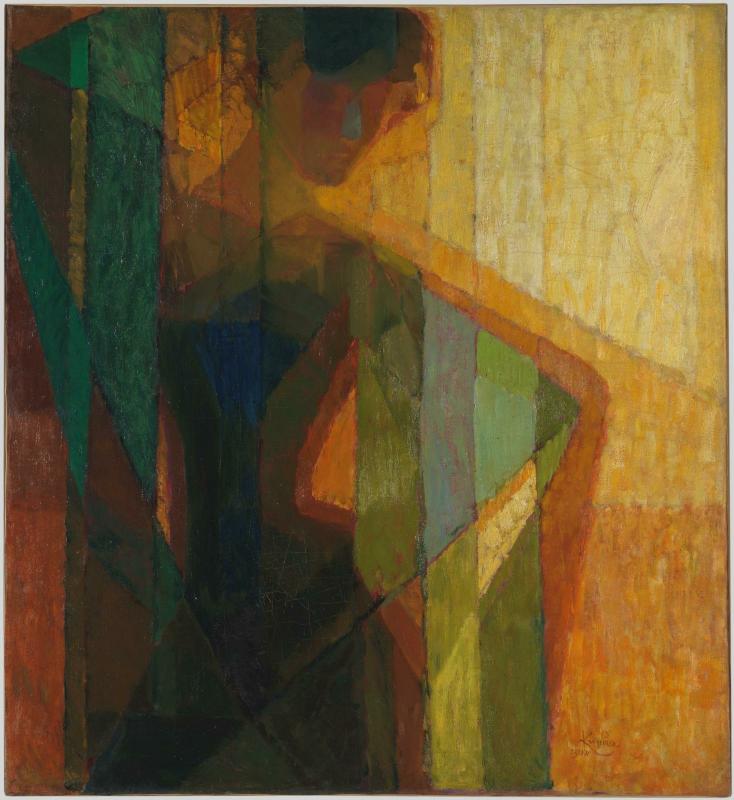 #20
#20
Plans by colors
A female figure crossed by rays is broken down into vertical planes: this pivotal stage shows Kupka moving from the observed body to the autonomy of color. This work in Oil on canvas dates back to 1910 -1911. She inscribes František Kupka in a Czech story that the Center Pompidou, Paris collection makes directly visible.
Discover this reproduction →National history takes the stage
Mucha, the reformers and the sovereigns made the painting a theater of collective memory.
 #21
#21
The Slavs in their original homeland
Threatened populations hide in a nocturnal landscape, while a priestly figure announces the spiritual survival of a people still stateless. Produced in 1912, the image belongs to a well-identified moment in the career of Alfons Mucha; Prague City Gallery today keeps the material trace in tempera with egg and oil on canvas.
Discover this reproduction → #22
#22
The Preaching of Master Jan Hus
Hus's words radiate from the chapel of Bethlehem to an attentive crowd, making the sermon a political as well as a religious event. Alfons Mucha painted this scene in 1916. The support worked in tempera with egg and oil on toile, now attached to the Prague City Gallery, gives the subject its lasting presence.
Discover this reproduction → #23
#23
The Introduction to the Slavic Liturgy
Mucha celebrates the liturgical language as an instrument of cultural emancipation, contrasting the solemnity of the ceremony with the luminous surge of symbolic figures. Alfons Mucha completed the work in 1912; his presence at Galerie de la Ville from Prague still allows you to precisely follow the material, described as egg tempera and oil on canvas.
Discover this reproduction → #24
#24
The Celebration of Svantovît
The pagan sanctuary of Rügen becomes a scene of collective fervor where the crowd, the idol and the warlike visions overlap. The 1912 vintage places this painting in the journey of Alfons Mucha, while the City Gallery of Prague canned the version made in egg tempera and oil on canvas.
Discover this reproduction → #25
#25
The emancipation of Russian peasants
Snow, fog and uncertain waiting prevent easy celebration: legal freedom does not immediately erase poverty. Prague City Gallery preserves this composition by Alfons Mucha, dated 1914; his execution in tempera with egg and oil on canvas illuminates the particular density of its surface.
Discover this reproduction → #26
#26
The Fraternal School in Ivancice
Printing and teaching become the true heroes of this composition dedicated to the dissemination of texts and memory. This work in tempera with egg and oil on canvas dates back to 1914. It places Alfons Mucha in a czech history that the Prague City Gallery collection makes directly visible.
Discover this reproduction → #27
#27
Jan Milíc de Kromoutirichíz
The preacher renounces his privileges and transforms a place of vice into a refuge, an episode that Mucha builds around conversion and collective care. In 1916, Alfons Mucha fixed this motif in tempera with egg and oil on canvas; her route took him to Prague City Gallery, where its construction can be compared to other works of the period.
Discover this reproduction → #28
#28
The Defense of Szigetvár
The women of the fortress choose resistance and fire rather than capture, in a composition governed by smoke and resolution. The Prague City Gallery notice dates the painting to 1916 and specifies it technique, egg tempera and oil on canvas, two useful points of reference for understanding Alfons Mucha's choices.
Discover this reproduction → #29
#29
Reunion in Krichizky
In an open landscape, Hus's radical followers gather around an orator; the immense sky gives their expectation a prophetic intensity. Preserved by Prague City Gallery, this 1916 painting shows how Alfons Mucha works tempera with egg and oil on canvas in the service of an immediately recognizable pattern.
Discover this reproduction → #30
#30
The Last Day by Jan Amos Komenskÿ
The exiled teacher looks out to sea from his chair, surrounded by silent friends; the collective story here focuses on a meditative end of life. The work was documented in 1918 in the career of Alfons Mucha. Its realization in tempera with egg and oil on canvas and its conservation at Prague City Gallery set the concrete context.
Discover this reproduction → #31
#31
Petr Chelčickÿ in VodULSany
Faced with victims and ruins, Chelčickÿ condemns revenge, giving compassion a more lasting force than military victory. The painting joins Prague City Gallery with a dating from 1918; at Alfons Mucha, the tempera technique with egg and oil on canvas gives the story its physical weight here.
Discover this reproduction → #32
#32
After the Battle of Vitkov Hill
Mucha shows less the fight than its moral impact: a liturgy of gratitude rises above a city still threatened. Painted in 1923, the composition is today associated with Prague City Gallery. Alfons Mucha y use egg tempera and oil on canvas without letting virtuosity take precedence over the subject.
Discover this reproduction → #33
#33
The Hussite King Jirichí z Podoutibrad
The king refuses papal authority in a tense scene where each group, each banner and each gesture defines a political position. 1923 marks the place of this work in the chronology of Alfons Mucha. Preserved at Galerie de la City of Prague, it is based on work in tempera with egg and oil on canvas.
Discover this reproduction → #34
#34
King Prichemysl Otakar II of Bohemia
The dynastic and diplomatic alliance is staged like a vast political theater, organized by the architecture and lines of the procession. The material counts as much as the motif: egg tempera and oil on canvas, put in work by Alfons Mucha in 1923, then transmitted to the collections of the Prague City Gallery.
Discover this reproduction → #35
#35
Simeon, Tsar of the Bulgarians
Simeon's court is presented as a center of writing and transmission, where manuscripts and scholars are worth as much as sovereign power. Prague City Gallery links this painting to the year 1923. This landmark places Alfons Mucha's work in egg tempera and oil on canvas in its exact historical sequence.
Discover this reproduction → #36
#36
After the Battle of Grunwald
The painter abandons the din of victory to show the human cost of the conflict, around a king meditating among the dead. At Alfons Mucha, the year 1924 corresponds here to a creation in tempera with egg and oil on canvas; there conservation at Prague City Gallery helps preserve its nuances and scale.
Discover this reproduction → #37
#37
The Coronation of Stefan Dušan
The coronation of the Serbian sovereign takes the form of a monumental ceremony where religious unity already faces the tensions of history. This 1926 painting, worked in tempera with egg and oil on canvas, belongs today at Prague City Gallery. It offers a concrete point of support in the evolution of Alfons Mucha.
Discover this reproduction → #38
#38
Mount Athos, sacred mountain
Architecture, icons and pilgrims are ordered around a spiritual vision that connects Orthodox traditions to the project of Slavic unity. The date of 1926 and the technique of tempera with egg and oil on canvas are not simple tags: they precisely locate this stage of Alfons Mucha, kept at Prague City Gallery.
Discover this reproduction → #39
#39
The Omladina Oath
Under the Slavic lime tree, the young activists take the oath while allegorical figures broaden the episode to the idea of national freedom. Alfons Mucha created the painting in 1926, in egg tempera and oil on canvas. His entrance within the perimeter of Prague City Gallery now gives it a verifiable museum context.
Discover this reproduction → #40
#40
Czech heart
Painted during World War I, Czech Heart condenses national attachment into a female figure hugging the symbol to her. Mucha chooses allegory rather than reporting: collective pain passes through the face, the folds and the color, as if the whole story had to fit into a protective gesture.
Discover this reproduction →Portraits, stories and ordinary lives
The great story is close to faces, readings, professions and domestic silences.
 #41
#41
Self-portrait of Mucha in his apartment in Paris
Mucha represents himself in his Parisian apartment at a time when his international career has not yet found its emblem. The tight decor, the objects of work and the direct gaze tell less of established glory than of a young painter building his place, six years before the Gismonda poster.
Discover this reproduction → #42
#42
Virgin of the lilies
The Virgin stands among lilies almost as present as her, while the child remains snuggled against her body. Mucha takes up an ancient religious subject without transforming it into a cold icon: the decorative line, the white of the flowers and the softness of the faces makes devotion slide towards a very modern intimacy.
Discover this reproduction → #43
#43
Bohemian Song
At a time when Czechoslovakia became independent, Bohemian Song made music a metaphor for cultural continuity. Mucha combines figure, ornament and dream landscape to suggest that a nation is not just born of a border: it is also recognized in the stories and songs it preserves.
Discover this reproduction → #44
#44
The Kiss of France to Bohemia
After the creation of Czechoslovakia, this allegory celebrates the rapprochement with France with an almost ceremonial embrace. Mucha brings together politics and tenderness without transforming the scene into a diplomatic poster: the two figures carry the idea of alliance, but the gesture retains a human and slightly theatrical warmth.
Discover this reproduction → #45
#45
Sunset in the mountains
The fading sky transforms the reliefs into silent masses: Manes makes twilight an interior state as much as a landscape motif. This work in Oil on canvas or panel dates back to 1840. It inscribes Josef Manes in a czech history that the collection of the National Gallery in Prague makes directly visible.
Discover this reproduction → #46
#46
The Gmunden Chapel
The small architecture stands out in a precisely observed Alpine landscape; this Austrian stay helped Manes free his gaze from history painting alone. In 1842, Josef Manes fixed this pattern in Oil on canvas or panel; his route took him to the National Gallery in Prague, where its construction can be compared to other works of the period.
Discover this reproduction → #47
#47
The Last Moments by Lucas de Leiden
Manes imagines the death of the Dutch engraver as a scene of artistic transmission, attentive to the faces, the bed and the objects surrounding the dying man. The notice from the National Gallery in Prague dates the painting to 1843 and specifies it technique, Oil on canvas or panel, two useful points of reference for understanding Josef Manes' choices.
Discover this reproduction → #48
#48
Petrarch meets Laure in Avignon
The legendary meeting of the poet and Laure becomes a troubadour scene where historical costume serves above all to make visible the birth of an idealized love. Josef Mânes painted this scene in 1845. The support worked in Oil on canvas or panel, now attached to the National Gallery in Prague, gives the subject its lasting presence.
Discover this reproduction → #49
#49
Forest stream rapids
White water fractures the shadows of rocks and trees. This nature study shows how much Manes' romanticism is based on concrete observation of the terrain. Preserved by the National Gallery in Prague, this 1848 painting shows how Josef Mânes works Oil on canvas or panel in the service of an immediately recognizable motif.
Discover this reproduction → #50
#50
Reading
The book suspends the action and brings the group together in calm intimacy; Manes grants everyday gesture the dignity of a poetic scene. The work was documented in 1850 in the career of Josef Manes. Its creation in Oil on canvas or panel and its conservation at the National Gallery in Prague set the concrete context.
Discover this reproduction → #51
#51
Josefina
Josefina's portrait reveals a direct presence, without demonstrative decoration. The sobriety of the framing and the attention to the face have made it an icon of Czech portraiture. The painting joins the National Gallery of Prague with a dating of 1855; in Josef Manes, the technique of Oil on canvas or panel gives the story its physical weight here.
Discover this reproduction → #52
#52
Julie Šamberková as Messaline
The actress still seems inhabited by her role. Brozík transforms the theater portrait into a study of ambition, costume and outlook. The material matters as much as the motif: Oil on canvas, used by Vaclav Brozík in 1876, then passed on to the collections of the National Gallery in Prague.
Discover this reproduction → #53
#53
The Goose Keeper
The young guardian and the animals place the scene in rural life, while the clear light avoids the sentimental anecdote. National Gallery of Prague links this painting to the year 1880. This landmark places the work in Oil on canvas by Vaclav Brozík in his exact historical sequence.
Discover this reproduction → #54
#54
Portrait of a young rabbi
The face and beard are treated with contained precision; Brozík seeks less the picturesque than the gravity of an individual he meets. At Vaclav Brozík, the year 1880 corresponds here to an achievement in Oil on canvas; there conservation at Galeria umenia Ernesta Zmetaka v Novÿch Zámkoch allows its nuances and scale to be preserved.
Discover this reproduction → #55
#55
The Ballad Singer
The song circulates popular memory in a collective space. The listeners, more than the decor, give its narrative rhythm to the painting. This painting from 1882, worked in Oil on canvas, now belongs to Galerie national of Prague. It offers a concrete point of support in the evolution of Vaclav Brozík.
Discover this reproduction → #56
#56
The Herbalist
The character, plants and objects make up a modest world observed with empathy; Schikaneder gives everyday life an almost symbolist depth. Jakub Schikaneder created the painting in 1882, in Oil on canvas. His entry into the scope of Documented Collection now gives it a verifiable museum context.
Discover this reproduction → #57
#57
The Sad Path
The procession advances in a darkened landscape. The title leaves the story open and transforms the movement into meditation on loss. The material journey leads from Jakub Schikaneder's workshop in 1886 at the National Gallery in Prague; between the two remains a surface executed in Oil on canvas.
Discover this reproduction → #58
#58
All Saints' Day
The visit to the cemetery combines collective rite and private pain. The faint lights bring out the figures of darkness without dissipating their solitude. Attached to the National Gallery in Prague, the work is dated 1888. The choice of Oil on canvas specifies how Jakub Schikaneder constructs light, shapes and depth.
Discover this reproduction → #59
#59
The evening - Old woman sitting
The immobile woman, almost absorbed by the darkness, gives the interior a psychological density that Schikaneder constructs by very small gaps in light. This composition by Jakub Schikaneder is set in 1897 and described in Oil on canvas; its conservation at the National Gallery in Prague completes a story that does not stop at the subject depicted.
Discover this reproduction → #60
#60
Snow - Winter twilight
The snow retains the last light and suffocates the street. Schikaneder makes the urban landscape a space of memory, silence and waiting. In Jakub Schikaneder's chronology, 1899 gives this painting a clear place. National Gallery of Prague preserves the creation in Oil on canvas.
Discover this reproduction →Prague breaks perspective
Landscape, industry, expressionism and cubism shift the center of gravity towards modernity.
 #61
#61
Winter evening in town
The facades, the snow and the rare silhouettes organize a mental Prague where poverty and evening beauty become inseparable. Dated 1905, this painting by Jakub Schikaneder combines Oil on canvas and a collection story now linked to the National Gallery in Prague.
Discover this reproduction → #62
#62
Birch mood
The light trunks punctuate a moving light. The title clearly says that the landscape here is as a mood rather than as a simple topographical survey. The 1897 vintage places this painting in the journey of Antonín Slavícek, while Galerie nationale de Prague preserves the version made in Oil on canvas.
Discover this reproduction → #63
#63
Sun in the forest
The bursts of sunlight pierce the undergrowth and dissolve the contours; the quick touch reflects a physical experience of light. Produced in 1898, the image belongs to a well-identified moment in Antonín Slavícek's career; Gallery moderního umroixní v Roudnici nad Labem today keeps the material trace in Oil on canvas.
Discover this reproduction → #64
#64
House in Kamenicky
The house is not isolated from the land: walls, sky and vegetation are linked by the same vibrant touch, attentive to the climate of the plateau. National Gallery of Prague preserves this composition by Antonín Slavícek, dated 1904; his execution in Oil on canvas illuminates the particular density of its surface.
Discover this reproduction → #65
#65
At our place in Kamenicky
Slavícek transforms a familiar place into a manifesto of the modern Czech landscape, based on immersion, wind and changes in the sky. This work in Oil on canvas dates back to 1904. It places Antonín Slavícek in Czech history which the collection of the National Gallery in Prague makes directly visible.
Discover this reproduction → #66
#66
The Eliska Bridge
The bridge and river give Prague a monumental structure, but the reflections and atmosphere prevent the urban view from becoming rigid. In 1906, Antonín Slavícek fixed this pattern in Oil on canvas; his journey took him to National Gallery of Prague, where its construction can be compared to other works of the period.
Discover this reproduction → #67
#67
Third class travelers
The tight space of the wagon brings together tired bodies without a spectacular story. Kubišta makes the modern condition a construction of volumes and views. Preserved by Moravian Gallery, Brno, this 1908 painting shows how Bohumil Kubišta works Oil on canvas in the service of an immediately recognizable motif.
Discover this reproduction → #68
#68
Walk in the Rieger gardens
The social walk fragments into silhouettes and colorful tensions; public space becomes a laboratory for new Prague painting. The work was documented in 1908 in the journey of Bohumil Kubišta. Its creation in Oil on canvas and its conservation at the National Gallery in Prague set the concrete context.
Discover this reproduction → #69
#69
The Factory
Industrial buildings are reduced to angular masses that appear to compress space. The factory becomes the sign of a modernity that is both energetic and threatening. The painting joins the National Gallery in Prague with a dating of 1908; at Bohumil Kubišta, the Oil on Canvas technique gives the story its physical weight here.
Discover this reproduction → #70
#70
The players
Around the table, gestures and faces are caught in a tight construction. The game is used to study concentration, chance and collective tension. Painted in 1909, the composition is today associated with National Gallery of Prague. Bohumil Kubišta uses Oil on Canvas without letting virtuosity take precedence on the subject.
Discover this reproduction → #71
#71
Still life with a lamp
The lamp, table and ordinary objects become a system of colorful plans. Kubišta transforms the interior into cubist architecture. 1909 marks the place of this work in the chronology of Bohumil Kubišta. Preserved at Moravian Gallery, Brno, it is based on work in Oil on canvas.
Discover this reproduction → #72
#72
Blue self-portrait
The unreal blue and the face cut by shadows give the self-portrait an almost spiritual intensity, far from simple resemblance. The material matters as much as the pattern: Oil on canvas, implemented by Bohumil Kubišta in 1909, then transmitted to the collections of Západoceska gallery v Plzni.
Discover this reproduction → #73
#73
Landscape at the small church
The church and the relief are subject to nervous geometry. The landscape remains recognizable while switching to an expressionist construction. Österreichische Galerie Belvedere links this painting to the year 1910. This landmark replaces the work in Oil on canvas by Bohumil Kubišta in its exact historical sequence.
Discover this reproduction → #74
#74
Self-portrait with cigarettes
Filla asserts herself as a modern painter through direct pose and dark material; the cigarette brings a calculated casualness to the manifesto. This painting from 1908, worked in Oil on canvas or cardboard, today belongs to Galerie national of Prague. It offers a concrete point of support in the evolution of Emil Filla.
Discover this reproduction → #75
#75
The Comforter
The close-up bodies form a supporting scene rather than an explicit narrative. The expressive distortion makes the emotion more tangible than the anecdote. The date of 1911 and the technique of Oil on canvas or cardboard are not simple tags: they precisely locate this step by Emil Filla, kept at Documented Collection.
Discover this reproduction → #76
#76
Still life with herring
Herring, glass and table objects are compressed in a deliberately unstable space; the modesty of the meal becomes a cubist experience. The material journey leads from Emil Filla's workshop in 1915 to Galerie Morave, Brno; between both remain a surface executed in Oil on canvas or cardboard.
Discover this reproduction → #77
#77
Young girl with a mandolin
The mandolin combines body, music and geometric construction. Filla uses a classic cubist motif in a personal palette. Attached to Documented Collection, the work is dated 1929. The choice of Oil on canvas or cardboard specifies how Emil Filla constructs light, shapes and depth.
Discover this reproduction → #78
#78
The reader
The book and face fit together in simplified shapes. Reading remains identifiable while becoming a rhythm of shots and colors. 1930 provides the first reference, Oil on canvas or cardboard the second and Documented collection the third: together, they place this painting in the real work of Emil Filla.
Discover this reproduction → #79
#79
Riverfront house
Čapek simplifies house, water and bank into large, readable shapes. The daily landscape is already approaching Cubism without losing its calm presence. This composition by Josef Čapek is located in 1913 and described in Oil on Canvas; her conservation at the National Gallery in Prague completes a story that does not stop at the subject depicted.
Discover this reproduction → #80
#80
Head
The face of 1914 is reduced to a few sharp volumes; this radical economy affirms one of the most personal Czech responses to Cubism. Dated 1914, this painting by Josef Čapek combines Oil on canvas and a story collection today linked to National Gallery in Prague.
Discover this reproduction →Color leaves reality
Kupka, Toyen and their contemporaries lead painting towards abstraction and dreams.
 #81
#81
Head - 1915
A year later, Čapek further pushed for simplification: the mask retained a human presence despite the breakdown of plans. Josef Čapek completed the work in 1915; his presence at the National Gallery in Prague still allows us to precisely follow the material, described as Oil on canvas.
Discover this reproduction → #82
#82
Mother and child
The traditional theme of motherhood is stripped of all decor. The joined shapes express protection and dependence with great simplicity. The 1915 vintage places this painting in the journey of Josef Čapek, while Gallery nationale de Prague preserves the version made in Oil on canvas.
Discover this reproduction → #83
#83
The sailor
The frontal silhouette, face mask and uniform give the sailor an immediately readable identity, between popular type and modern icon. Created in 1917, the image belongs to a well-identified moment in Josef's career Čapek; National Gallery of Prague today keeps the material trace in Oil on canvas.
Discover this reproduction → #84
#84
The Drinker
The glass and the leaning body are enough to define the scene. Čapek avoids the picturesque and concentrates the image on an elementary human gesture. Documented collection preserves this composition by Josef Čapek, dated 1919; its execution in Oil on canvas illuminates the particular density of its surface.
Discover this reproduction →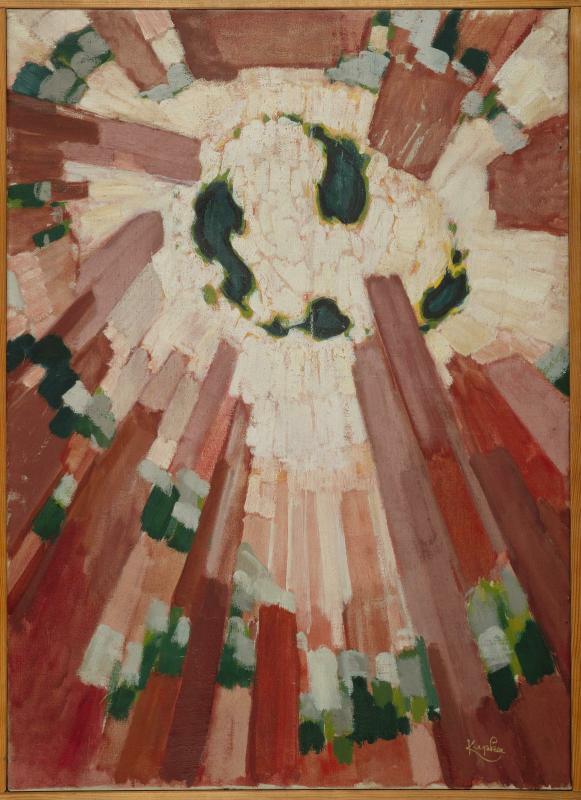 #85
#85
The Primitive
Shards of light no longer describe an object; they become the very subject of the painting, on the threshold of Orphic abstraction. In 1911 -1913, František Kupka fixed this motif in Oil on canvas; his journey took him to Center Pompidou, Paris, where its construction can be compared to other works of the period.
Discover this reproduction →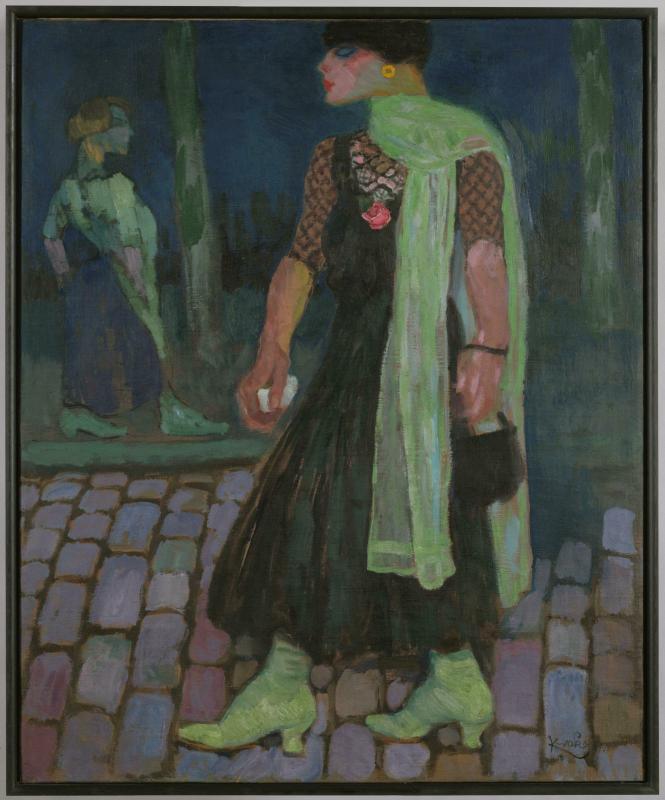 #86
#86
The Archaic
The monumental figure is filtered by an almost mineral light. Kupka confronts symbolist memory and the search for a new order. The notice from Center Pompidou, Paris dates the painting to 1910 and specifies the technique, Oil on canvas, two useful benchmarks for understanding the choices of František Kupka.
Discover this reproduction →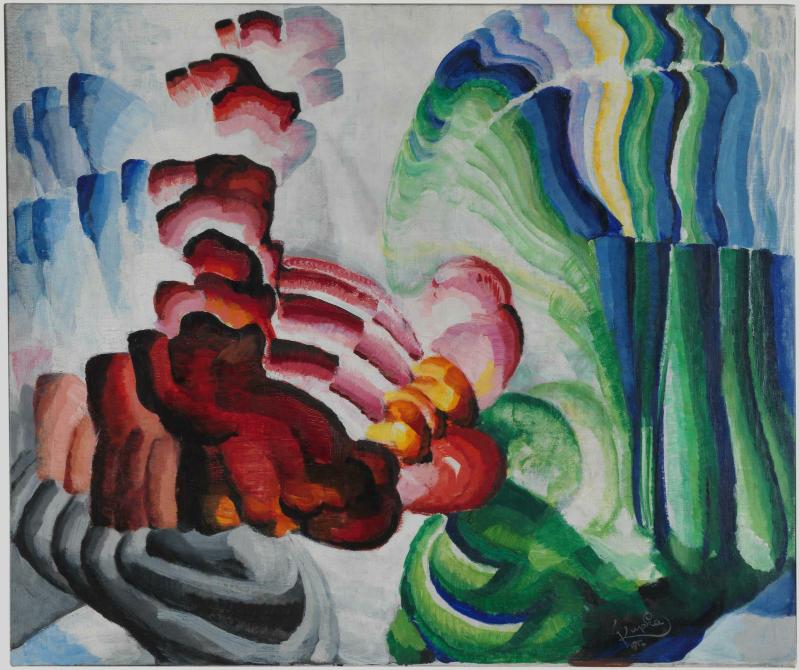 #87
#87
Compliment
Two colorful shapes bow like people greeting each other; the social movement is translated into pure vibration. František Kupka painted this scene in 1912. The support worked in Oil on canvas, now attached to Center Pompidou, Paris, gives the subject its lasting presence.
Discover this reproduction →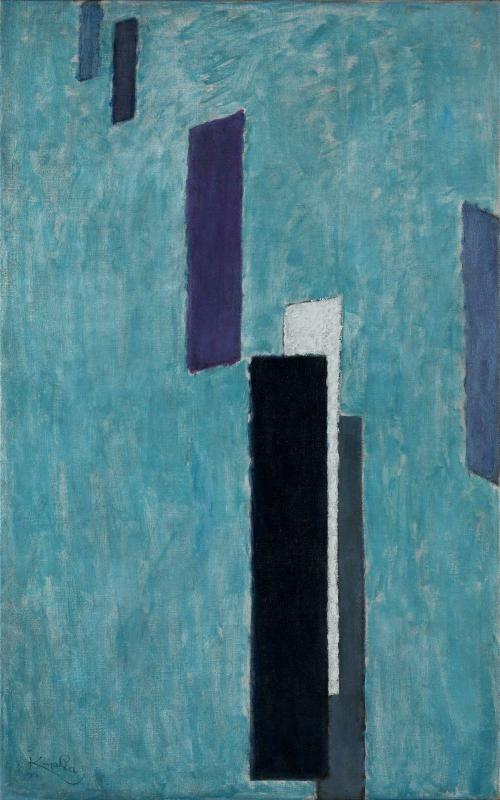 #88
#88
Vertical planes I
The first abstract painting acquired by the French state, the work transforms verticality into an upward thrust, without direct reference to nature. Preserved by Center Pompidou, Paris, this 1912 painting shows how František Kupka works Oil on canvas in the service of an immediately recognizable motif.
Discover this reproduction →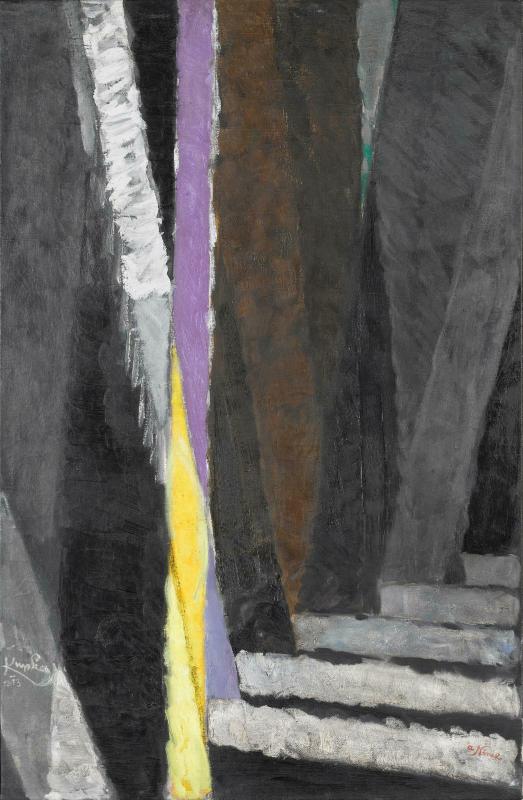 #89
#89
Vertical planes
Slightly inclined bands appear to float and move away. Kupka makes depth an effect of rhythm rather than a traditional perspective. The work was documented in 1912 -1913 in the career of František Kupka. His realization in Oil on Canvas and its conservation at Center Pompidou, Paris sets the concrete context.
Discover this reproduction →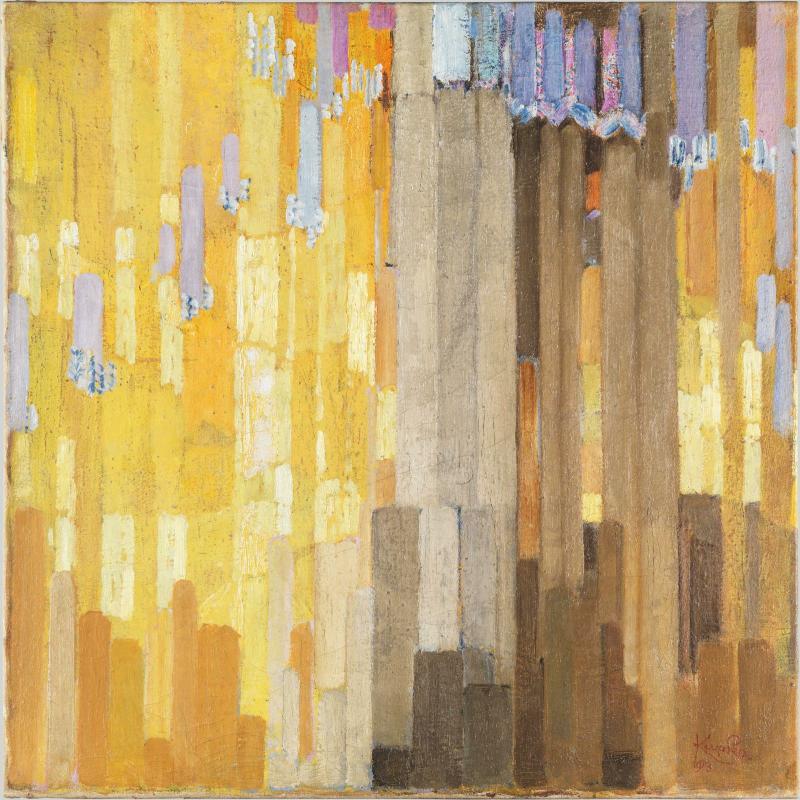 #90
#90
Prescription on verticals in yellow
The colored bands evoke the keys of a piano: light intensity and alternation of tones construct a real visual music. The painting joins Center Pompidou, Paris with a dating from 1913; at František Kupka, the oil on Canvas Technique gives the story its physical weight here.
Discover this reproduction →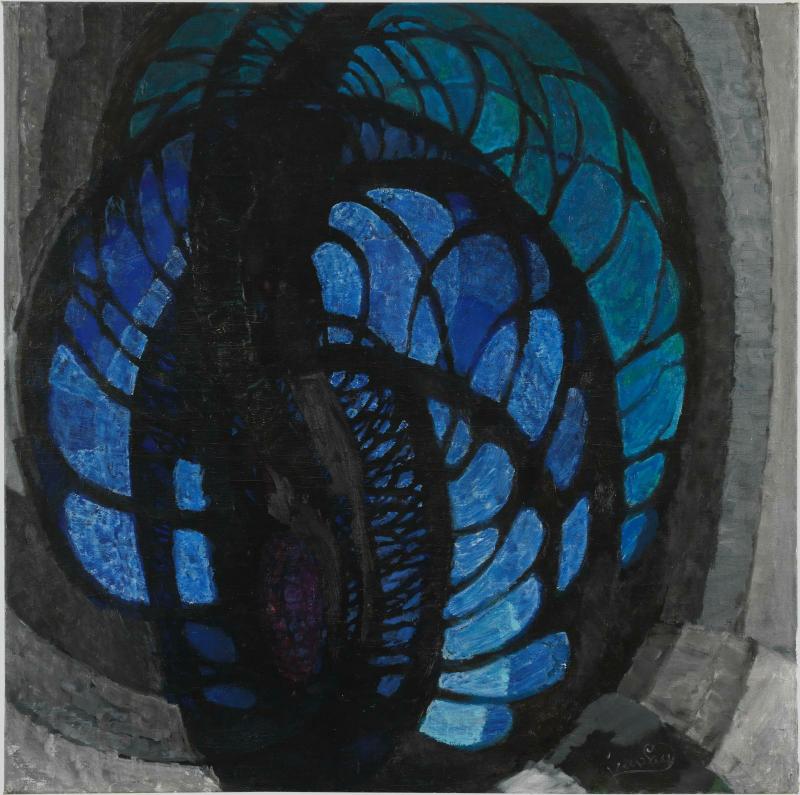 #91
#91
Features, planes and depth I
This stained glass-like painting transposes circulating cardiovascular structures of lines, colors and energy. Painted in 1920 -1922, the composition is today associated with Center Pompidou, Paris. František Kupka y use Oil on Canvas without letting virtuosity take precedence over the subject.
Discover this reproduction →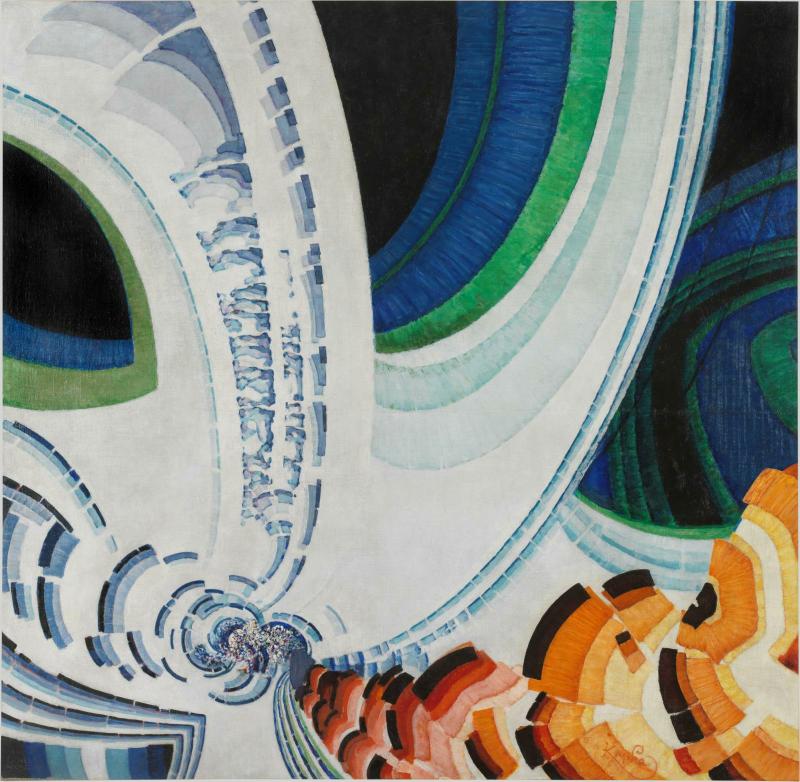 #92
#92
Animated lines
Curves and colors converge as if towards the eye of a storm. Resumed over several years, the work condenses Kupka's interest in astronomy. 1920 -1933 marks the place of this work in the chronology of František Kupka. Preserved at Center Pompidou, Paris, it is based on work in Oil on canvas.
Discover this reproduction →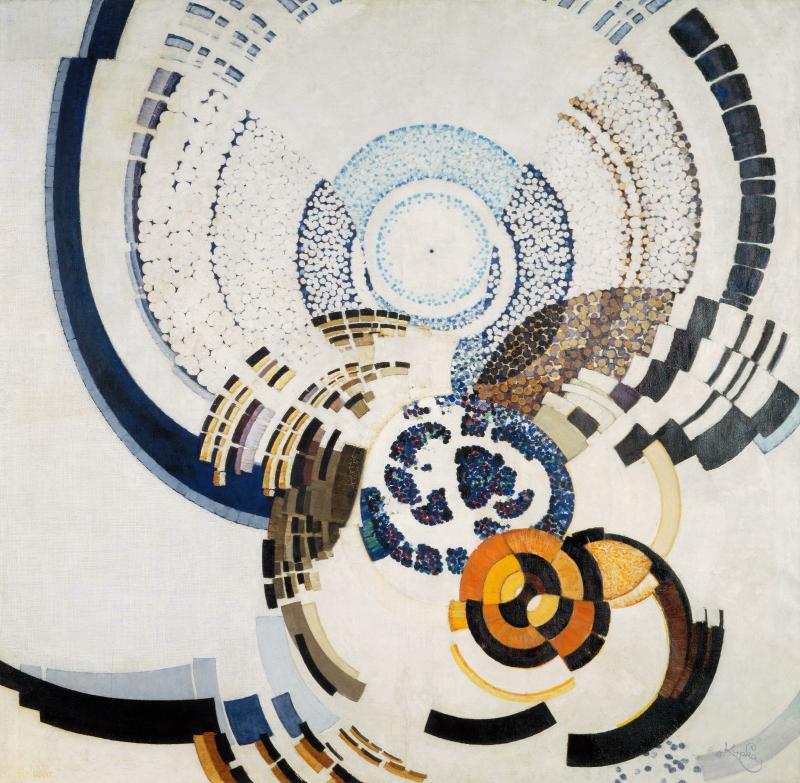 #93
#93
Around a point
Circles and semi-circles are organized around a tiny center, at once lotus, cosmic energy and model of living movement. The material counts as much as the motif: Oil on canvas, used by František Kupka in 1920 -1930, then transmitted to the collections of Center Pompidou, Paris.
Discover this reproduction →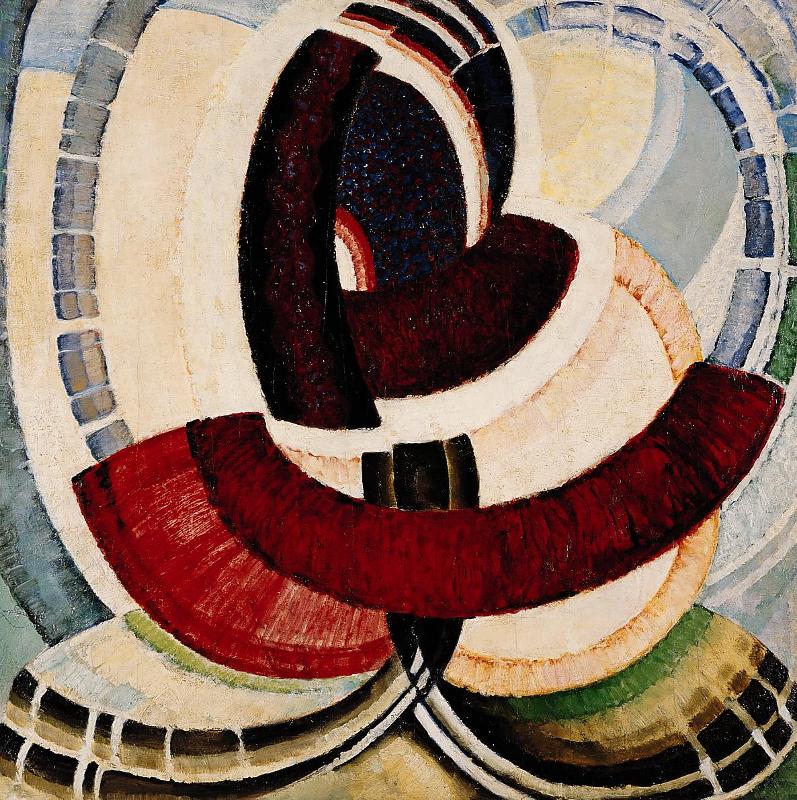 #94
#94
Flower
The floral pattern is no longer described in a naturalistic way: it becomes symmetrical expansion, colorful embroidery and abstract growth. Center Pompidou, Paris links this painting to the year 1925. This landmark places the work in Oil on canvas by František Kupka in its exact historical sequence.
Discover this reproduction →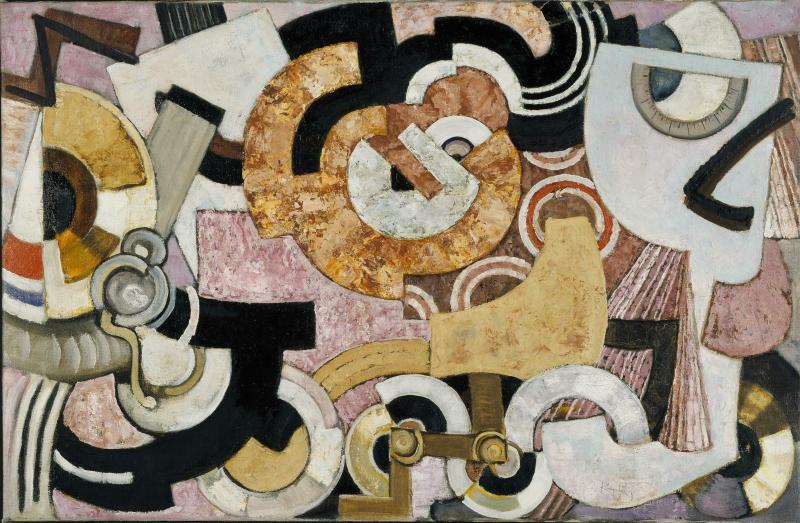 #95
#95
Jazz-hot n° I
Discs and mechanical elements translate jazz into geometric tensions. Music becomes a syncopated visual organization. At František Kupka, the year 1935 corresponds here to a creation in Oil on canvas; conservation at Center Pompidou, Paris helps preserve its nuances and scale.
Discover this reproduction →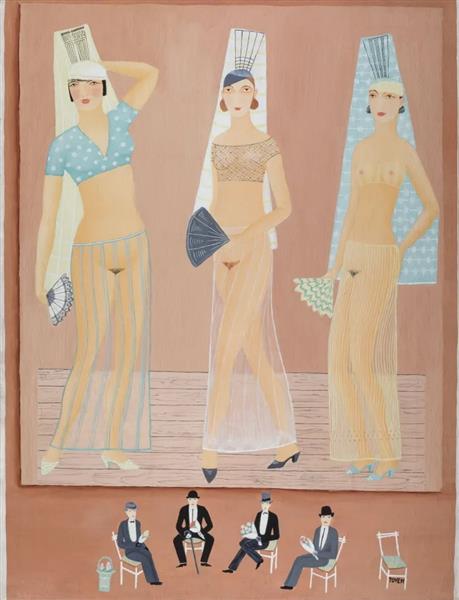 #96
#96
Three dancers
Three figures punctuate the surface like a mechanical and joyful choreography. Poetism transforms the modern spectacle into a play of forms. The date of 1925 and the Oil on Canvas technique are not simple labels: they precisely locate this stage of Toyen, preserved at the National Gallery in Prague.
Discover this reproduction →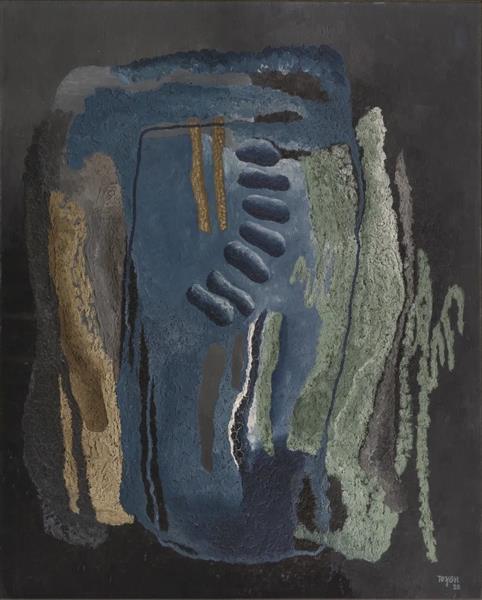 #97
#97
Fjords
The Nordic landscape is reconstructed in plans and floating materials. Toyen places the fjord between real geography and interior space. Toyen created the painting in 1928, in Oil on canvas. Its entry into the perimeter of the Gallery nationale de Prague now gives it a verifiable museum context.
Discover this reproduction →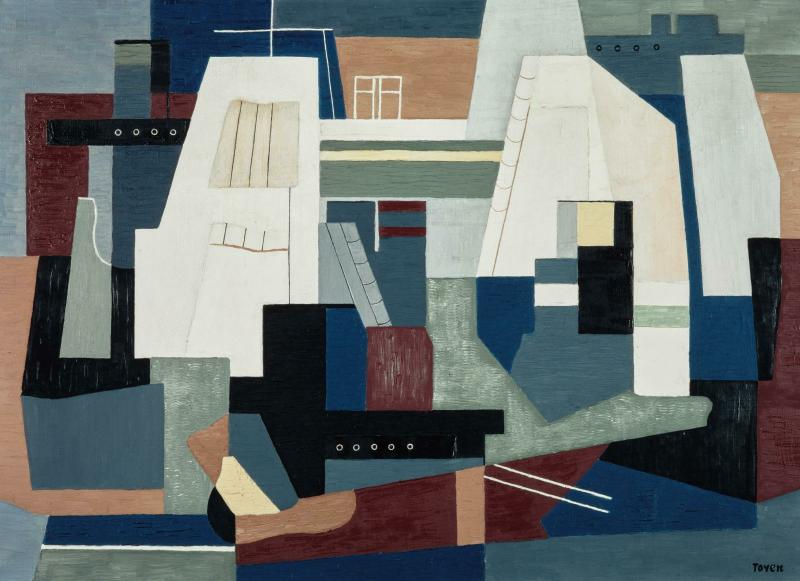 #98
#98
Port
Boats, quays and port signs are reduced to a poetic construction. Toyen associates modern travel with a mental space already detached from realism. 1925 provides the first landmark, Oil on canvas the second and Center Pompidou, Paris the third: together, they place this painting in Toyen's actual work.
Discover this reproduction →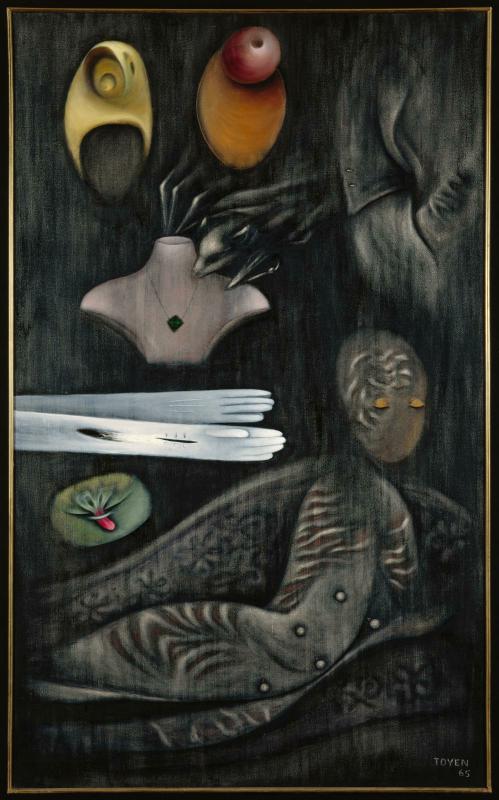 #99
#99
All in each other
Objects linked to desire and anxiety float on a velvety background. The title comes from a surrealist game imagined by André Breton on cross-definitions. This composition by Toyen is set in 1965 and described in Oil on canvas and fake emerald; its conservation at Center Pompidou, Paris completes a story that does not stop at the subject represented.
Discover this reproduction →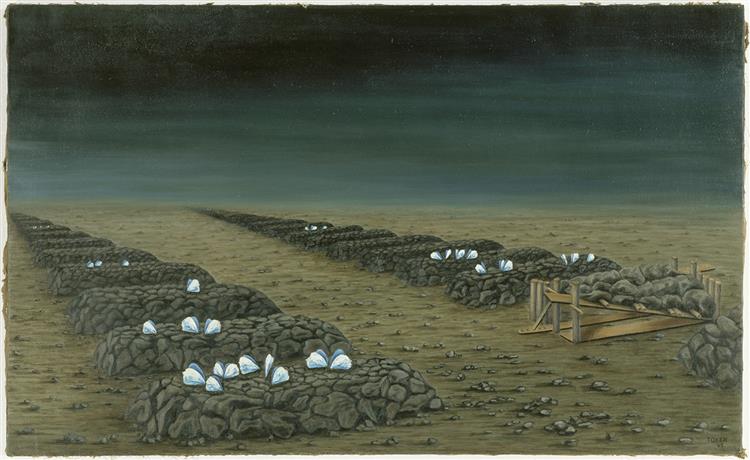 #100
#100
The Pre-Spring
At the end of the war, poor stone tombs are repeated under a gloomy light. The predicted spring remains a fragile hope in a landscape of desolation. In Toyen's chronology, 1945 gives this painting a place net. Center Pompidou, Paris preserves the creation in Oil on canvas.
Discover this reproduction →The notices from the National Gallery of Prague, the Museum Kampa and the Center Pompidou provide dates, techniques and places of conservation. When a painting exists in the Alpha Reproduction catalog, the map leads directly to its sheet; the others open the corresponding institutional source.
Museums, collections and works available
The 80 paintings in the public domain use Alpha Reproduction images and links. The 12 Kupka and 8 Toyen are presented for documentary purposes only: each image opens the corresponding notice from the Center Pompidou or the National Gallery in Prague, and none of these works are offered for reproduction.
Czech painting from the 19th century
National Gallery of Prague - collectionsThe reference catalog for paintings by Manes, Brozík, Schikaneder and Slavícek.Jan Hus - Vaclav BrozíkThe great Czech history painting in the Alpha store.Frequently asked questions
Questions about Czech painting
Some benchmarks to situate artists, movements and the status of protected works.
Why is Mucha placed at the beginning?
The thirty selected paintings show a lesser known part of his work: large historical compositions, portraits and painted allegories. They allow us to enter the Czech story before returning to the generations of the 19th century and the avant-gardes.
What place does Prague occupy in Cubism?
Prague developed an original interpretation of Cubism very early on, visible in Kubišta, Filla and Čapek, but also in architecture and applied arts. The artists combine geometric structure, expression and local culture.
Is Kupka a pioneer of abstraction?
Yes. From the observation of movement, color, music and science, Kupka created non-figurative paintings in the 1910s parallel to the research of Kandinsky and Delaunay.
Who is Toyen?
Toyen is the name adopted by Marie Çermínová. Member of Devoutitsil then of the Czech surrealist group, the artist constructs a work where desire, war, eroticism and the mental landscape take deliberately enigmatic forms.
Are the works of Kupka and Toyen offered for reproduction?
No. They are protected and appear for documentary purposes only. Images and buttons open the corresponding museum records.
0 comments