

Why does Van Gogh paintso much in yellow?
Industrial pigments, southern light, "high yellow note" and solar symbolism: what is hidden behind the nervous suns, the fiery harvests and the luminous facades of Vincent van Gogh.

 Paul Gauguin, 1888
Vincent van Gogh painting sunflowers
Gauguin represents Van Gogh at work in front of a bouquet of sunflowers in the Yellow House in Arles.
In two words
Van Gogh yellow is not a color: it is the crossing of a new industrial pigment, a Mediterranean light and a state of artistic exaltation documented by the letters to Theo (902 known letters, including 819 written by Vincent, 83 received).
Three reasons intersect: one new pigment, a unique light, a symbolic choice
To understand Van Gogh's yellow, you have to look at chemistry, the sky and the letter at the same time.
The yellow chrome, a synthetic pigment invented in 1809 and produced industrially since 1818, offers Van Gogh a new intensity, opacity and industrial availability compared to traditional palettes. In Arles, the southern Light - direct light, deep sky, colored shadows - multiplies the opportunities to use this color. And in his correspondence, Van Gogh explicitly associates yellow with joy, in the sun, in friendship and in life, while evoking the "high yellow note" as a state of artistic exaltation.
These three planes - chemical, optical, symbolic - do not add up. They strengthen: a new pigment, perceived in a new light, becomes the support of an emotion that no other color carries so strongly. The rest of this article covers each of these planes, drawing on research published by the Van Gogh Museum (Amsterdam), theuniversity of Antwerp, the ESRF Synchrotron from Grenoble, the DESY Research Center (Hamburg, which notably operates the PETRA III synchrotron), and the scholarly edition of Vincent's letters to his brother Theo (902 documents, vangoghletters.org).
The yellows from the Van Gogh palette
This painting brings together the yellow pigments identified by the Van Gogh Museum, the scholarly edition of letters and scientific publications on the degradation of yellow chromium (2011, 2015, 2024). Hexadecimal values are visual approximations for screens, not colorimetric measurements of tables. The actual behavior of a pigment depends on the dosage, binder, mixtures, thickness, aging and lighting observed.
| Color | Pigment | Formulation | Visual approximation for screen | Historical landmark | Van Gogh use | Documented risk | |
|---|---|---|---|---|---|---|---|
| Light yellow chrome | Solid solution of lead chromate and sulfate (partial substitution with sulfates) | #F0C846 | Synthesized in 1809 by Vauquelin, produced industrially since 1818 | Sunflower petals, luminous backgrounds | Possible sensitivity to photoreduction | ||
| Medium yellow chrome | Lead chromate | #D6A212 | 1809 | Yellow house, facades | Generally more stable, depending on the formulation | ||
| Orange-chrome | Orange variety of chromium pigment, the exact composition of which may vary depending on manufacturing | # B98421 | 1818 | Warm details, accents | To be documented according to the works analyzed | ||
| Cadmium yellow | Cadmium sulfide | #E8A93C | Integrated into merchant catalogs around 1840 | Highlights, lively accents | Stability varies depending on conditions and composition | ||
| Yellow ocher | Hydrated iron oxide (FeO(OH)·nH2O) | #C69437 | Prehistoric | Lands, brown backgrounds | Generally stable pigment | ||
| Yellow of Naples | Historical pigment based on lead antimonate | #D8B560 | Around 1700 | Chair/fund transitions | To be documented according to the works analyzed | ||
| Zinc yellow | Zinc chromate | #C79A2E | 1809 | Green mixtures, thicknesses | Cheap | Average | |
| Barium yellow | Barium chromate | #A8902F | XIXe century | Secondary details | To be documented according to the works analyzed |
The exact palette: yellow chromium, cadmium, ocher, Naples, zinc

Yellow chromium (PbCrO4), industrial pigment since 1818
The Van Gogh Museum confirms: van Gogh's favorite yellow is yellow chrome, available in three shades - light lemon, medium and orange. It is this pigment which gives the Sunflowers their intensity, the Yellow House its incandescent facade, the Room in Arles its dazzling furniture. Yellow recurs very frequently in correspondence from the Arles period, particularly regarding pigments, landscapes and works in progress.

Ochres, cadmium, zinc, Naples: the extended family
Van Gogh does not use a single yellow. It combines chromium withyellow ocher (natural, earthy), the cadmium yellow (more expensive, more stable), the zinc yellow and the naples yellow (based on lead antimonate). This palette explains the variety of yellows in the same work: bright chromium in the petals, ocher in the earth, cadmium in the accents. The superimposed layers can be at the origin of the characteristic vibration of van gogh surfaces, without having a systematic stratigraphic analysis.
See the SunflowersPale chrome
Sulfur lead chromate. Synthetic, opaque, luminous pigment. Gives lemon petals and sunflower bottoms.
Cadmium
Cadmium sulfide. More expensive, more stable to light than chromium. Used for accents and highlights.
Ocher
Natural, earthy, age-old pigment. Gives the depth of the brown yellows and the grain of the land. This is the yellow that Van Gogh already used in Nuenen.
Naples
Historical pigment based on lead antimonate. Pale yellow, slightly gray. Serves as a transition between flesh and backgrounds, particularly in portraits.
Zinc
Zinc chromate. Bright yellow but covering less than chrome. Used as a mixture for greens and certain thicknesses.
Barium
Barium chromate. Minor pigment in the work, sometimes detected in mixtures. Yellow green, little coverage.
Arles, February 20, 1888: the bright shock


Belgium, The Hague, Nuenen
Van Gogh gradually adopted an artistic career. In Nuenen, his palette remains dark and earthy; Potato Eaters (1885) constitute the culmination. Yellow is not yet the subject.
Paris · color is released
With Theo, Van Gogh met the Impressionists and the Neo-Impressionists. The palette becomes lighter, the touch fragments, the yellow enters in touches then in flat areas.
Arles · color is essential
On February 20, Van Gogh arrived in Arles. Yellow house, Sunflowers, Café terrace: everything invites him to push the yellow and to dialogue with his complements.
Saint-Rémy · Auvers · the high yellow note
The suns become more unstable, the blues more electric. In Auvers, during the summer of 1890, Van Gogh mentioned in a letter the "high yellow note" achieved. The Harvests and the Crow Wheat Field bring this color to a high degree.
A symbolism that goes from sun to anxiety
Sunflowers: solar icon
Van Gogh wants to make it "a symphony in yellow". Homage, gratitude, light, friendship: a bouquet that became the universal symbol of his Arlesian period (1888 -1889). This reading associates the sunflower with the Yellow House project and friendship with Gauguin, without it being possible to establish it as an explicit and documented intention of the artist.
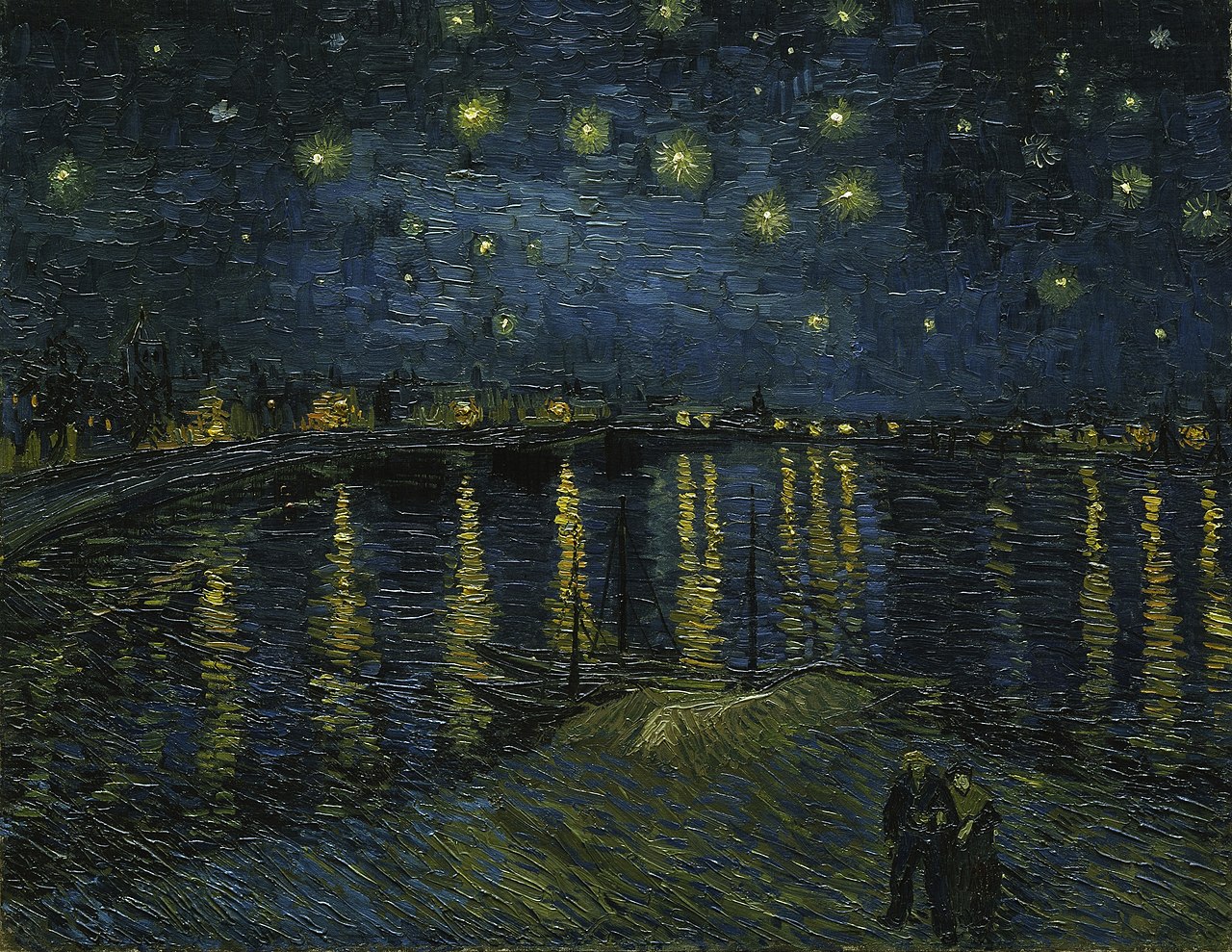
Starry Night: another reading of yellow
In Saint-Rémy, yellow can be interpreted like a sign of nervous intensity rather than appeasement: a crescent, burning stars, a village asleep under a convulsive sky. The light no longer consoles, it electrifies. This reading remains an interpretative hypothesis and not an established fact.
How Van Gogh uses yellow in his masterpieces
The pale lilac wall, the broken red floor
Letter to Theo, mid-October 1888, describing the Room in Arles. "The pale lilac walls, the broken and faded red floor, the chrome yellow chairs and bed, the very pale lime pillows and sheet, the blood red blanket, the orange dressing table, the blue bowl, the green window." Adapted French translation.
A symphony in yellow
Letter to Theo on Sunflowers: "I want these paintings to be like a symphony in yellow and blue." Adapted French translation. The funds are from the same family as the flowers.
The facade as manifesto
The Yellow House is described by Van Gogh as painted "inside and outside with yellow chrome". Color becomes, in the context of the collective project of the Maison jaune, the standard of a workshop in the South.
The night is never dark
In Café terrace in the evening, yellow is amplified by its contrast with the blue of the sky and the street. Night without black, in the letter to Willemien.
Wheat, straw, bread
The Harvests, the sheaves, the Wheat field with crows : van Gogh yellow dialogues with the Provençal countryside, agricultural work and the cycle of the seasons.
Yellow as a state
La high yellow note designates a state of artistic exaltation, in the tradition of a musician seeking the right note. Van Gogh associates this moment with physical expenditure.
A modern pigment
Yellow chromium dates from 1809 (Vauquelin) and has been produced industrially since 1818. Pigment of the industrial era, consistent with the taste of the time for chemical colors.
A precise pictorial heritage
Van Gogh admires the Japanese, the Impressionists, Delacroix. Its yellows are part of Turner, Monticelli, the Dutch masters of the 17th centurye century.
Why some yellow brown today
The study of the degradation of yellow chromium has been the subject of several international publications, coordinated by the Van Gogh Museum, theuniversity of Antwerp, the ESRF Synchrotron from Grenoble and the DESY Research Center (Hamburg, which notably operates the PETRA III synchrotron). Here are the main results published, without extrapolating beyond what is documented.
Synchrotron analyzes show that the alteration is concentrated in the surface layer of the paint. The exact thickness varies depending on the work and the area considered.
Monico et al., 2015The measurements detect trivalent chromium (Cr(III)) in browned areas, in varying proportions depending on the samples. The exact distribution is not uniform.
Monico et al., 2015Experiments with accelerated aging under irradiation have reproduced certain browning phenomena observed on the works, without allowing a simple equivalence between laboratory duration and actual aging.
Monico et al., 2015The process depends on the spectrum, intensity, duration of exposure and exact composition of the pigment. Museums adapt their lighting to preserve the original yellows, favoring low illumination and limited exposure. This conservation policy is documented; it would be unwise to isolate a particular type of LED as more damaging without controlled data.
Lemon petals are the most fragile
DESY's PETRA III synchrotron showed that lemon yellow zones contain sulfur-rich yellow chromium (PbCr1−xSxO4), more sensitive to UV. Orange zones use pure chromium, more stable. The experiment makes it possible to establish this difference in composition between zones of the painting.

Lighting that preserves yellow
Museums adapt their lighting to preserve the original yellows. Control concerns the spectrum (little blue), intensity (low illumination) and duration of exposure.

A layering of yolks
Microscopic analyzes show that Van Gogh superimposes several layers of yellows in the same work. The practice is documented; the conscious artistic intention of a superimposed "symphony" is partly reading.
Five letters on color and light in Arles
This selection brings together five passages where Van Gogh evokes, from Arles, color, light and material. The number, date and recipient refer to the scholarly edition vangoghletters.org. The translation is adapted; the original English text appears on the reference site.
We perfectly starry night - it is perfectly possible to paint a starry sky. The night is more richly colored than the day, in most intense violets, blues and greens.
To Willemien van Gogh, his sister. The passage outlines the idea of the "starry sky", but the Café terrace in the evening (F467) will be completed after September 16. Adapted French translation.
The first painting this week is the night café. Then the second will be a self-portrait. Then the third, a direct experiment with the effect of night.
To Theo. There Café terrace in the evening is explicitly referred to as the "first painting of the week". Adapted French translation.
Just now we are in the grip of a stark, cold spring. The small studies I've done show that the effect of snow is something quite other than white.
In Theo, ~April 11, 1888. The extract is selected to show the work of color in Arles in spring, in a season where the palette remains cold. Adapted French translation.
The sun here is extraordinary - one would think oneself in Japan. The fields are already of a beautiful green, the contrast with the intense sulfur yellow of the broom is delicious.
In Theo, ~May 4, 1888. The passage cites the sulfur yellow of the broom in bloom, the first documented mention of a bright yellow in Arles' correspondence. Adapted French translation.
The walls are of a pale violet, the floor of red tiles, the bedstead and the chairs fresh butter yellow, the sheet and pills very bright lemon green, the blanket scarlet red, the window green, the dressing table orange, the basin blue, the doors lilac.
In Theo, mid-October 1888. The exact number of the letter must be checked in the scholarly edition (series 580) before stable citation. Adapted French translation.
Three myths to overcome about the yellow Van Gogh
"Van Gogh only painted yellow."
The palette is much wider
The palette also includes intense blues, greens, purples, reds and earths. Van Gogh yellow is dominant, never exclusive. He constantly dialogues with his complements.
See the House
"The yellow of the terrace is that of a real facade."
It's a lighting effect, not a wall color
The yellow of Café terrace in the evening is an effect of gas light amplified by contrast with deep blue. It is not the description of a painted wall, but a recomposed visual experience.
See reproduction
"Van Gogh painted for himself, without a spectator."
Van Gogh yellow is also turned towards the other
The Yellow House, the Sunflowers for Gauguin, the portraits of the Roulins: some historians see this yellow as a color facing each other, even if Van Gogh painted largely alone. This reading remains interpretative.
See the Yellow HouseWhere to see the works originals ?

Portrait of Dr. Gachet
Van Gogh made two painted versions of the Portrait of Doctor Gachet in Auvers, one kept at the Musée d'Orsay, the other having had one of the most resounding private collections in the history of the art market. The yellow-blue background is typical in its latest way.
See reproduction
Wheat field with cypresses
Summer 1889, in Saint-Rémy. Several versions are known: the National Gallery in London (acquired in 1939), the Metropolitan Museum of Art from New York, and a private collection. It is one of Van Gogh's yellowest landscapes, with swirling skies.
See the landscapesThe works Van Gogh from the store
A narrow selection around yellow, then thematic collections to broaden the look. These links complete the article without reproducing the list.
Van Gogh's yellow: understanding everything
What pigment did Van Gogh use for yellow?
The main pigment is yellow chrome (lead chromate, PbCrO4), industrial pigment first synthesized in 1809 and produced since 1818. Van Gogh used it in three shades: light lemon, medium and orange. It also combined this pigment with yellow ocher, cadmium yellow, zinc yellow and Naples yellow (lead antimonate).
Why did yellow become Van Gogh's iconic color?
Three reasons intersect: a very intense new pigment, the Lumière du Midi in Arles from February 1888, and a personal artistic project which made yellow a state of exaltation high yellow note which he talks to Theo about. The word "yellow" appears about a hundred times in his correspondence from the year 1888.
What is "high yellow note"?
It is an expression that Van Gogh uses in a letter to his brother Theo, towards the end of his life, to designate a state of artistic exaltation necessary to obtain the most intense yellow. The exact number and date of the letter must be verified word for word in the scholarly edition vangoghletters.org before any stable quote. Yellow is not just a color, it is an effort and a risk assumed for the truth of the painting.
Why do some Van Goghs' yellow turn brown over time?
Some light yellow chromium, mixed with white lead white, is sensitive to light: chromium changes from Cr(VI) to Cr(III), producing a green-brown compound. Research published in 2011 and 2015 by the University of Antwerp, the ESRF synchrotron and the Van Gogh Museum documented this process.
Was the Yellow House really painted yellow?
Yes: Van Gogh writes that the interior and exterior of the house located on Place Lamartine in Arles were painted yellow chrome. The house was destroyed by the bombings of 1944, but the painting helps to understand the project. The Yellow House served as a workshop, accommodation and manifesto for a community of artists from the South.
Is the yellow of the Sunflowers the same as that of the Yellow House?
Synchrotron analyzes show that Van Gogh was able to use several yellows in the same work. For the Sunflowers, the superposition of shades creates a vibration. For the Yellow House, the wall color is more uniform. Both express light, but through distinct pictorial means.
What does yellow mean in Van Gogh's symbolism?
Yellow is associated in correspondence with the sun, joy, life, friendship and vital energy. Van Gogh also uses it to talk about the light of the South and domestic happiness. More in-depth symbolic interpretations (anxiety, sweat, collective project) are contextual readings, not documented words of the artist.
Was Van Gogh's yellow painted on the pattern?
For the landscapes of Arles, yes: Van Gogh sets up his easel outside and paints the light of the South live. For the Sunflowers, the work is done in the workshop, from a cut bouquet, but with the yellows observed on the pattern. There Café terrace in the evening is also painted on site, in the dark, by the light of street lamps.
What is Van Gogh's yellowest painting?
The Sunflowers are often presented as the pinnacle of van gogh yellow. THE Harvests, the Wheat field with crows, The Yellow House and there Room in Arles also carry this color to a high degree. No work alone sums up yellow.
How to recognize a real "van gogh yellow" today?
The pictorial criterion is three points: a bright yellow often associated with its complementary blue, a thick material which catches the light, and a vibration by juxtaposition of nuances rather than by flatness. On the originals, it is also a state of conservation to monitor, the light lemon areas being able to brown by photoreduction of chromium.
Searches and images used
- Van Gogh Museum - What is Yellow? : pigments used (yellow chromium, cadmium, ocher, Naples, zinc), period, symbolic, degradation.
- Monico et al. - Evidence for Degradation of the Chrome Yellows in Van Gogh's Sunflowers : synchrotron study, Van Gogh Museum, 2015 (Angewandte Chemie, figures and additional material).
- Kroeller-Müller Museum - Terrace of a Café at Night : worksheet, Otterlo.
- Letter 678 to Willemien : Sunday September 9 and ~Friday September 14, 1888, Arles. Letter 681 to Theo : Sunday September 16, 1888, Arles.
- Vincent van Gogh Arles Foundation - The Yellow High Note : press kit, 2024 exhibition.
- CORDIS/European Commission - Sophisticated technology and mystery of colors : ESRF analysis, European research project.
- Echosciences Grenoble - Chromium and sunflowers : popularization of synchrotron results.
- National Gallery - Sunflowers : worksheet, London.
- Musée d'Orsay - Portrait of Doctor Gachet : worksheet, Paris.
- Museum of Modern Art - The Starry Night : worksheet, New York.
- Art Institute of Chicago - Bedroom in Arles : worksheet, Chicago.
- Metropolitan Museum of Art - Wheat Field with Cypresses : worksheet, New York.
Images of the works are in the public domain. The photographic reproductions used in the article come from Wikimedia Commons files hosted by partner institutions (Van Gogh Museum, Kroeller-Müller, Musée d'Orsay, MoMA, National Gallery, Met, National Gallery of Art Washington). Exact file references are available in the description of each image.
Vincent van Gogh painting sunflowers (1888) - Paul Gauguin, oil on canvas, Van Gogh Museum, public domain via Wikimedia Commons.

The Chamber in Arles (1888) - Van Gogh Museum, public domain via Wikimedia Commons.

Sunflowers (1888) - National Gallery, London, public domain via Wikimedia Commons.

Sunflowers (1889) - Van Gogh Museum, Amsterdam, public domain via Wikimedia Commons.

The Yellow House (1888) - Van Gogh Museum, public domain via Wikimedia Commons.
.jpg)
Café terrace in the evening (1888) - Kroeller-Müller Museum, public domain via Wikimedia Commons.
.jpg)
Starry Night (1889) - MoMA New York, public domain via Wikimedia Commons.

Cornfield with Crows (1890) - Van Gogh Museum, public domain via Wikimedia Commons.

Wheat field under storm clouds (1890) - Van Gogh Museum, public domain via Wikimedia Commons.

Portrait of Dr. Gachet (1890) - Musée d'Orsay, public domain via Wikimedia Commons.

Wheat field with cypresses (1889) - Metropolitan Museum of Art, public domain.
-Vincent-van-Gogh-Met.jpg)
Works of Vincent van Gogh: public domain. Museum files are the source of the dimensions, dates and techniques cited.
0 comments