

Rembrandt · 1661 · Louvre
Saint Matthew and the Angel
A whispered inspiration at shoulder height.
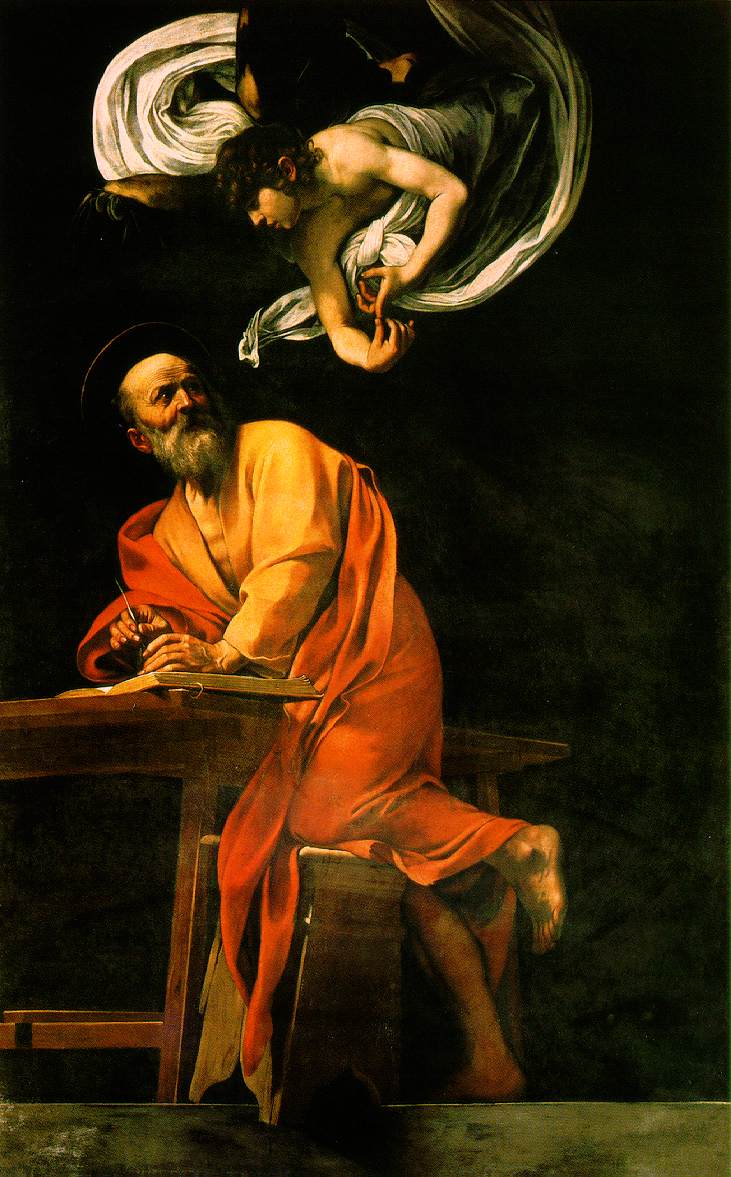
Rembrandt reduces the revelation to an almost domestic proximity: an old man suspends his gesture, while a young angel speaks to him without celestial brilliance.

The short answer
Inspiration becomes a human relationship
Saint Matthew and the Angel, painted in 1661, belongs to the late Rembrandt style. The evangelist is neither seated on a throne nor surrounded by sacred architecture. He is an absorbed old man, his hand lost in his beard, a book open before him.
The angel appears behind his shoulder as a real and fragile presence. His mouth approaches the ear; his fingers touch the fabric. Inspiration is therefore not an order from heaven, but a word received in silence.
La painting she herself participates in this intimacy: open contours, deep browns, clear impasto on the hands and face. Rembrandt makes thought felt through matter.
I · A close-up scene
Two faces, an almost abolished distance
The framing cuts Matthieu's body and brings his face closer to the plan painting. The angel does not enter with outstretched wings: he slips behind him, into the same narrow space. This proximity transforms a doctrinal scene into conversation.
Matthew looks neither at the book nor at the angel. His gaze descends towards an indecisive zone. He listens and thinks before writing. The hand in the beard materializes this inner time.
The angel, younger and smoother, contrasts with the evangelist's aged skin. Yet Rembrandt avoids the simple opposition between celestial and terrestrial. The two figures share the same warm light and the same air.
The essential detail: the angel's hand on the shoulder. It does not constrain Matthew; it guarantees a presence.

II · Inspiration and writing
Does the angel really dictate the gospel?
Receive
Angel's mouth approaches, but words remain invisible. The viewer must imagine the voice.
Think
Matthew interrupts writing. Inspiration comes through human consciousness.
Compose
The open page is massive and concrete. The revelation must still become text.
Accompany
The hand placed on the shoulder replaces the authoritarian gesture of dictation.
In Christian tradition, Matthew is associated with the winged man or angel. This symbol refers in particular to the opening of his Gospel through the human genealogy of Christ. Rembrandt transforms this iconographic sign into a sensitive character.
III · Pictorial touch
Painting thought with uneven material
Matthieu's face is not finished evenly. Wrinkles, eyelids and beard emerge from visible touches. Some areas are rubbed, others loaded with paste. This variety directs the eye to places where thought becomes sensation.
The hands are particularly important. The one that supports the beard appears heavy, almost sculpted. The angel's fingers are lighter, placed on the shoulder like a clear note.
Brown clothing is not a neutral background: it absorbs and restarts light. Impasto from the forehead, nose, knuckles and page produces irregular breathing.
This process belongs to last Rembrandt, where the resemblance depends less on the contour than on the density of the painting.

IV · Around 1661
A constellation of apostles


Several figures of apostles painted around 1661 share close-up format, dark background, reduced accessories and meditative faces. They are often read as an intellectual whole, but we must avoid imagining a complete series whose program would be perfectly documented.
What unites them is above all a method: Rembrandt chooses older models, brings bodies together, minimizes attributes and makes pictorial touch the main vector of spirituality.
V · Old age and presence
Why does Matthew seem so close?

Matthew is shown as a man subject to time: marked forehead, irregular beard, heavy posture. The sacred does not eliminate fatigue. It comes to inhabit a body that hesitates, listens and starts again.
This humanity explains the modern force of painting. Inspiration there resembles less a visible miracle than the familiar experience of an idea that arrives through a presence, a voice or a hand.
VI · See the work
Saint Matthew at the Louvre

Start two or three meters away to read the meeting of the two heads. Then approach the hands and the edge of the page. Move slightly: the impasto catches the light differently and makes the making of the face perceptible.
Don't look for clearly drawn wings. The angel is recognized by his youth, his position and his function. This discretion is precisely the originality of the work.
To extend
Product, collections and articles
Saint Matthew and the Angel
See it reproduction in oil.
CollectionRembrandt at the Louvre
Works preserved in Paris.
CollectionRembrandt van Rijn
Biblical paintings and scenes.
TechniqueImpasto
Relief, material and brushstrokes.
TechniqueThe chiaroscuro
How the light tells.
ContextRembrandt and religion
Bible and confessional Amsterdam.
Frequently asked questions
Understanding Saint Matthew and the Angel
When did Rembrandt paint Saint Matthew and the Angel?
In 1661, during the last decade of his career.
Where is the painting ?
At the Louvre Museum in Paris, Paintings Department. The notice currently links it to room 844.
What are its dimensions?
L'oil on canvas measures 96 cm high by 81 cm wide.
What's the angel doing?
He leans behind Matthew and seems to whisper a word to him. His hand gently touches the evangelist's shoulder.
Why does Matthew seem so human?
Rembrandt replaces the idealized apostle with an absorbed old man, with heavy hands and a face worked by age.
What does Matthew's angel symbolize?
In the tradition of the four evangelists, Matthew is associated with the winged man or the angel, in connection with the humanity and genealogy of Christ.
Does the angel dictate the text?
The image suggests inspiration, but not mechanical dictation. Matthieu listens, thinks and remains responsible for the writing.
The painting does it belong to a series?
It is compared to other apostles painted around 1661, notably Bartholomew, Simon and James. However, no complete and intact set is documented.
How does Rembrandt paint hands?
By thick touches, clear accents and deliberately incomplete contours which give weight to the gesture.
Is there a reproduction ?
Yes there reproduction oil is linked directly in the article.
Verified sources
Louvre Museum - official notice INV 1738Wikimedia Commons - category of workWikimedia Commons - Religious Rembrandt at the LouvreInformation checked on August 11, 2026.
0 comments