

Top 100 · Black paintings and diasporic worlds
Black painters and the African diaspora
One hundred artists to travel through centuries of creation, resistance and visual invention.
Talking about black painters and the African diaspora does not amount to designating a single style. The term brings together trajectories shaped by Africa, the Atlantic slave trade, colonizations, independence and voluntary or forced migrations. Harlem, Chicago, Washington, London, Paris, Havana, Port-au-Prince, Dakar, Lagos, Nsukka, Kinshasa and Johannesburg become so many centers linked by studies, exhibitions, political struggles and family circulations. From Tanner and Douglas to Basquiat, Marshall, Mehretu or Mutu, artists are taking up portraiture, history, abstraction, collage, graffiti and spiritual traditions to resume control of images. The classification combines historical importance, formal invention, influence, richness of the corpus, international influence and the ability to transform the representation of black experiences.

From Harlem workshops to African modernisms, each scene shifts the center of the story.
Definition
Is the African diaspora forming an artistic movement?
No: it first describes a history of displacement and connections. An African-American Harlem Renaissance painter, a Sudanese modernist, a British artist of Nigerian origin, and a Haitian painter do not necessarily share the same techniques or references. However, they may encounter common questions: how to represent long-caricatured lives, how to work with fragmentary archives, how to connect African legacies and contemporary contexts, or how to negotiate the expectation of an immediately readable identity.
Visibility and institutions
Why were so many of these artists recognized late?
Academies, museums, galleries and historical stories have long limited black artists' access to training, commissions and collections. Tanner seeks professional freedom in Paris; Douglas and Lawrence construct historical images in Harlem; Lewis and Gilliam participate in the abstract avant-gardes without receiving the same visibility as their white contemporaries. African independence, civil rights movements, the Black Arts Movement, postcolonial studies and the work of specialized museums gradually made these corpora more accessible, without erasing market and institutional imbalances.
Classification method
How did we choose these 100 painters?
The rank takes into account the influence on the history of painting, plastic invention, the importance of the corpus, the role in a scene or a movement and the capacity to renew black representations. The selection brings African-American, Caribbean, African and European artists from diasporas into dialogue. It includes easel painting, abstraction, collage, textiles, muralism and graffiti when the practice remains linked to pictorial construction. The result is not a definitive list, but a critical map intended to reveal often separate connections.
The founding figures
Top 10 - Languages that have become essential
From Basquiat to Ofili, these artists have transformed history, portraiture, abstraction and memory into major languages of modern and contemporary art.
 #1
#1
Jean-Michel Basquiat
Crowns, anatomy, fragments of words and references to black history collide in an electric painting. His urgent line connects the street, jazz, scholarship and criticism of the art market.
Discover the artist #2
#2
Kerry James Marshall
Marshall places black figures at the center of formats and genres long dominated by white narratives. Domestic scenes, gardens, workshops and history paintings become the places of a fully constructed presence.
Discover the artist #3
#3
Jacob Lawrence
His series tell of migrations, struggles and historical lives in flat, colorful areas and angular rhythms. Each panel remains autonomous while participating in a collective narrative of great force.
Discover the artist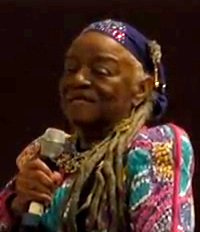 #4
#4
Faith Ringgold
His painted quilts bring together text, fabric and image to tell racism, family, history and emancipation. It transforms a devalued artisanal practice into a powerful political medium.
Discover the artist #5
#5
Romare Bearden
Collage allows him to assemble memory of the South, Harlem life, jazz and mythology. Breakdowns in scale and point of view give the dark experience a complex visual structure.
Discover the artist #6
#6
Aaron Douglas
Silhouettes, radiant circles and profiles inspired by ancient Egypt construct a visual history of the diaspora. He became one of the great graphic inventors of the Harlem Renaissance.
Discover the artist #7
#7
Wifredo Lam
Lam combines cubist fragmentation, surrealist automatism and Afro-Cuban cosmologies without reducing them to folklore. The Jungle invents a hybrid space where bodies, sugar cane and spirits merge.
Discover the artist #8
#8
Ibrahim El-Salahi
El-Salahi articulates Arabic calligraphy, African forms and modernist abstraction in a work deeply linked to Sudanese memory. His journey between Khartoum, London and exile made him a major reference in African modernism.
Discover the artist #9
#9
Julie Mehretu
Maps, architectures, diagrams and superimposed gestures form accelerating spaces. His large canvases give a complex image of the migrations, conflicts and flows of the contemporary world.
Discover the artist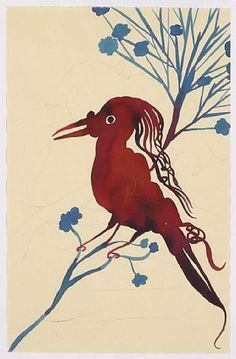 #10
#10
Chris Ofili
Ofili combines painting, collage, decorative motifs and unexpected materials to question spirituality, popular culture and black representation. Its dense color and humor have renewed the British scene since the 1990s.
Discover the artistHarlem, abstraction and representation
Ranks 11 to 25 - Building a presence in American art
Harlem Renaissance, migrations, Color Field and portrait make up a story where creating also means conquering exhibition spaces, subjects and visual authority.
 #11
#11
William edward scott
Trained in Chicago then in Paris with Henry Ossawa Tanner, Scott painted portraits, Haitian scenes and wall compositions. He seeks to represent black figures with dignity, ambition and historical presence.
Discover the artist #12
#12
Lynette Yiadom-Boakye
Yiadom-Boakye invents black characters without a direct model or biographical story. Painted quickly in a chosen palette, they seem to belong to a larger story that the painting deliberately leaves open.
Discover the artist #13
#13
Kehinde Wiley
He entrusts black models with the heroic poses of European painting, in front of invasive decorative motifs. The portrait becomes a debate about power, visibility and desire.
Discover the artist #14
#14
Amy Sherald
His black models pose in front of colorful backgrounds, with skin tones treated in gray. This chromatic distance shifts the codes of the official portrait towards a calm and sovereign presence.
Discover the artist #15
#15
Njideka Akunyili Crosby
Akunyili Crosby composes interiors where painting, drawing and photographic transfers intertwine Lagos and Los Angeles. Intimate scenes make visible a diasporic identity made of layers, memories and shared references.
Discover the artist #16
#16
Toyin Ojih Odutola
Ojih Odutola treats the skin as a territory of lines, streaks and light. His portraits and narrative cycles imagine families, classes, and alternate worlds that shift immediate readings of race and power.
Discover the artist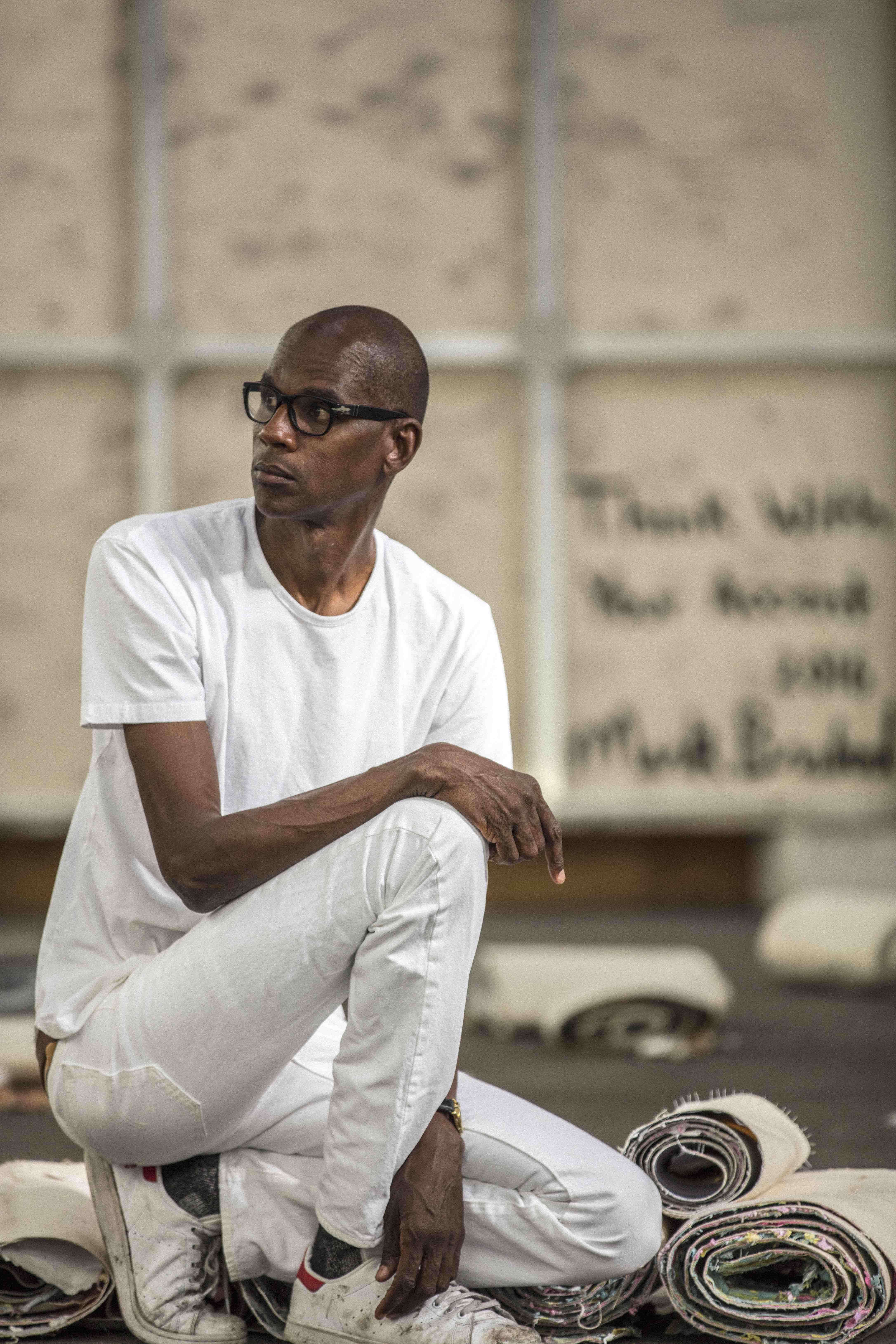 #17
#17
Mark Bradford
Posters, urban papers and sanded layers produce vast abstract maps. The city's visual network reveals circulation, segregation, economy and erasure of memory.
Discover the artist #18
#18
Kara Walker
Silhouettes, drawings and installations take the elegant forms of the 19th century to confront slavery, sexuality and violence. The decorative contrast makes the stories all the more difficult to dodge.
Discover the artist #19
#19
Malangatana Ngwenya
Malangatana populates his canvases with tight figures, animals and signs which translate colonial violence, war and Mozambican memory. His painting transforms political experience into visions of great chromatic intensity.
Discover the artist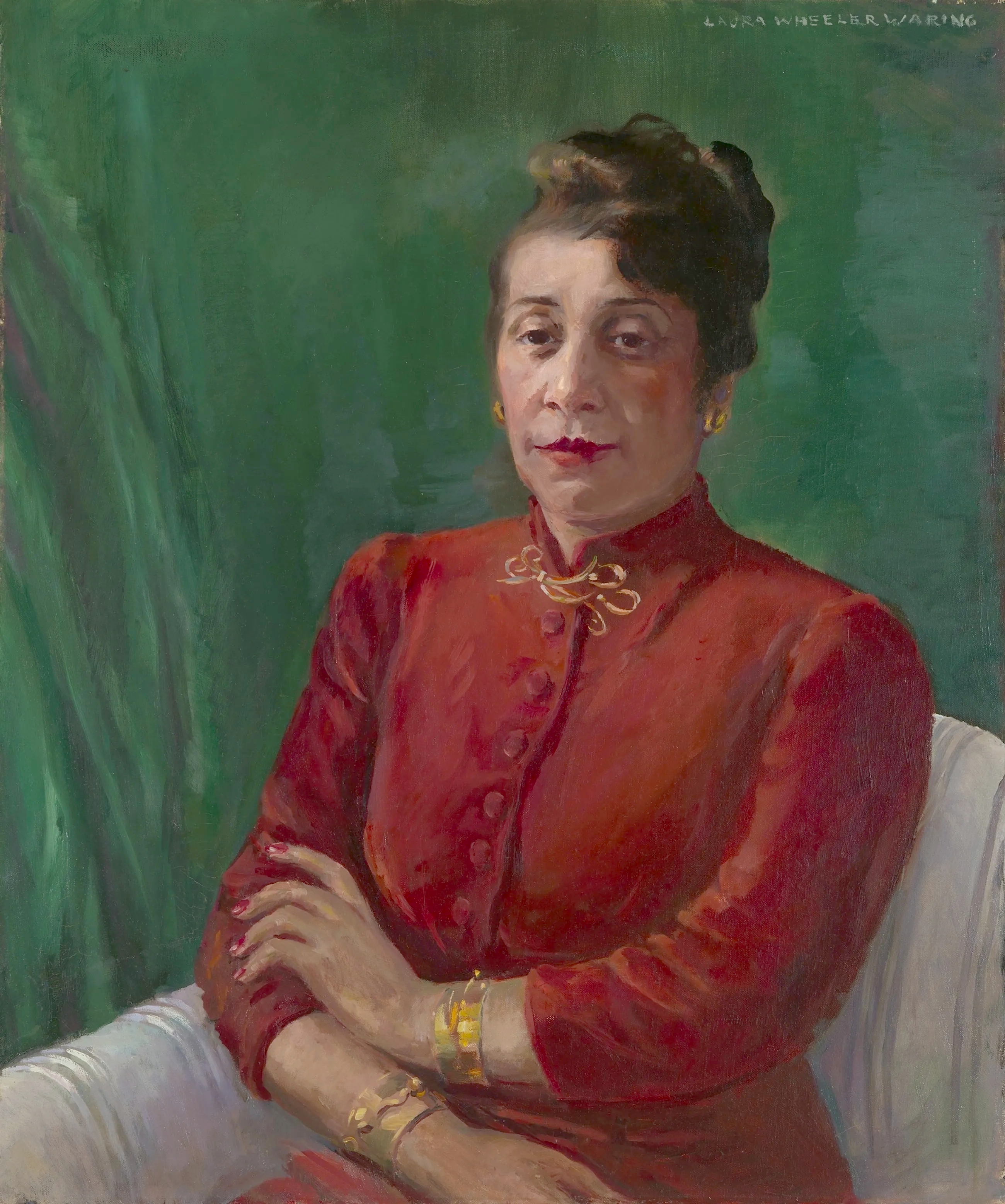 #20
#20
Alma Thomas
Small rectangular touches assembled in arches, bands and halos give the color a luminous rhythm. His late work connects garden, cosmos and optimism without ignoring the obstacles of his career.
Discover the artist #21
#21
Norman lewis
Lewis makes gestural abstraction a language capable of evoking crowds, marches, urban nights and collective struggle. Long kept away from the dominant narrative of abstract expressionism, it is today recognized as an essential voice.
Discover the artist #22
#22
Beauford Delaney
Delaney moves from portraiture and the streets of Harlem to a luminous abstraction developed in Paris. Its vibrant yellows and moving surfaces give color a dimension that is both spiritual and deeply intimate.
Discover the artist #23
#23
Henry Ossawa Tanner
Tanner built an international career between the United States and France, where his religious scenes and landscapes were noticed at the Salon. His mastery of light opens a decisive path for the generations of African-American artists who follow him.
See the works #24
#24
Horace Pippin
A former self-taught soldier, he paints interiors, war memories and historical episodes with a striking formal economy. Its apparent calm reveals memory, violence and dignity.
See the works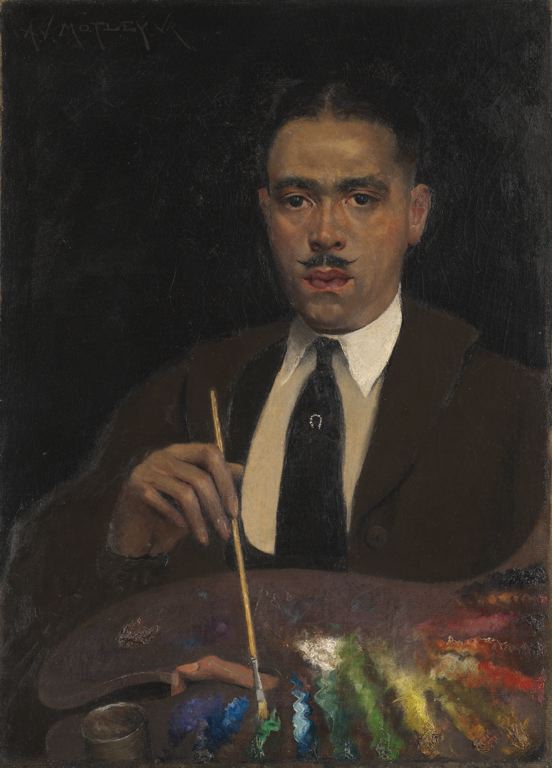 #25
#25
Archibald Motley
A subtle portraitist of skin nuances, he also became the great painter of Chicago's clubs and night streets. Its electric color reveals social energy, spectacle and racial tensions.
Discover the artistNew stories and visual culture
Ranks 26 to 50 - Corps, archives and public space
Painting, collage, text, graffiti and photography rewrite images of power, family memory and representations of the black body.
 #26
#26
Lois Mailou Jones
Jones links academic training, Harlem Renaissance, Parisian stays and discoveries of Africa and Haiti. Portraits, landscapes and compositions with textile motifs tell the story of a black modernity deliberately open to several continents.
Discover the artist #27
#27
William H. Johnson
After Europe and the American South, Johnson simplified shapes and colors to paint families, musicians, workers and biblical stories. His frontal language gives African-American life an immediate monumentality.
Discover the artist #28
#28
Sargent Claude Johnson
Sculptor as well as painter and engraver, Johnson seeks a dignified and modern image of the black body. His refined profiles, masks and maternal figures combine Art Deco, African references and West Coast experience.
Discover the artist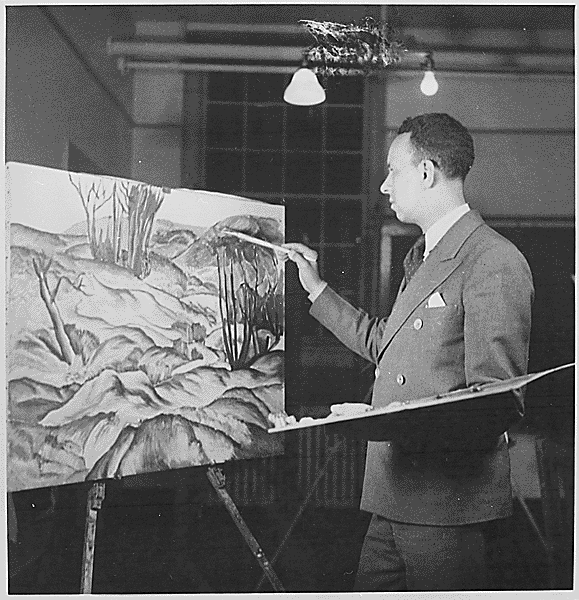 #29
#29
Hale Woodruff
Hale Aspacio Woodruff, born August 26, 1900 in Cairo and died September 6, 1980 in New York, is an American painter and engraver best known for his murals as well as his paintings.
Discover the artist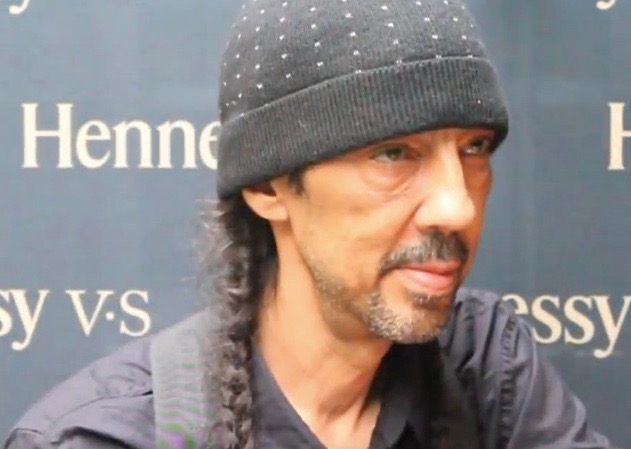 #30
#30
Futura 2000
Futura 2000, born Leonard Hilton McGurr, known as Lenny McGurr, in 1955 in Brooklyn, New York, is an American "graffiti artist".
Discover the artist #31
#31
Rosana Paulino
Paulino sews, prints and draws on fabrics and photographic archives to make visible the wounds left by slavery and scientific racism in Brazil. The bodies of black women become a place of memory, repair and knowledge.
Discover the artist #32
#32
Robert Colescott
Colescott diverts Western masterpieces by replacing white heroes with caricatured and unstable black figures. His deliberately uncomfortable humor exposes the stereotypes that structure American art history.
Discover the artist #33
#33
Heitor dos Prazeres
Heitor dos Prazeres, born September 23, 1898 in Rio de Janeiro and died October 4, 1966 in the same city, is a Brazilian composer, singer and painter. He is one of the pioneers in the composition of sambas and participated in the founding of the first samba schools in Brazil.
Discover the artist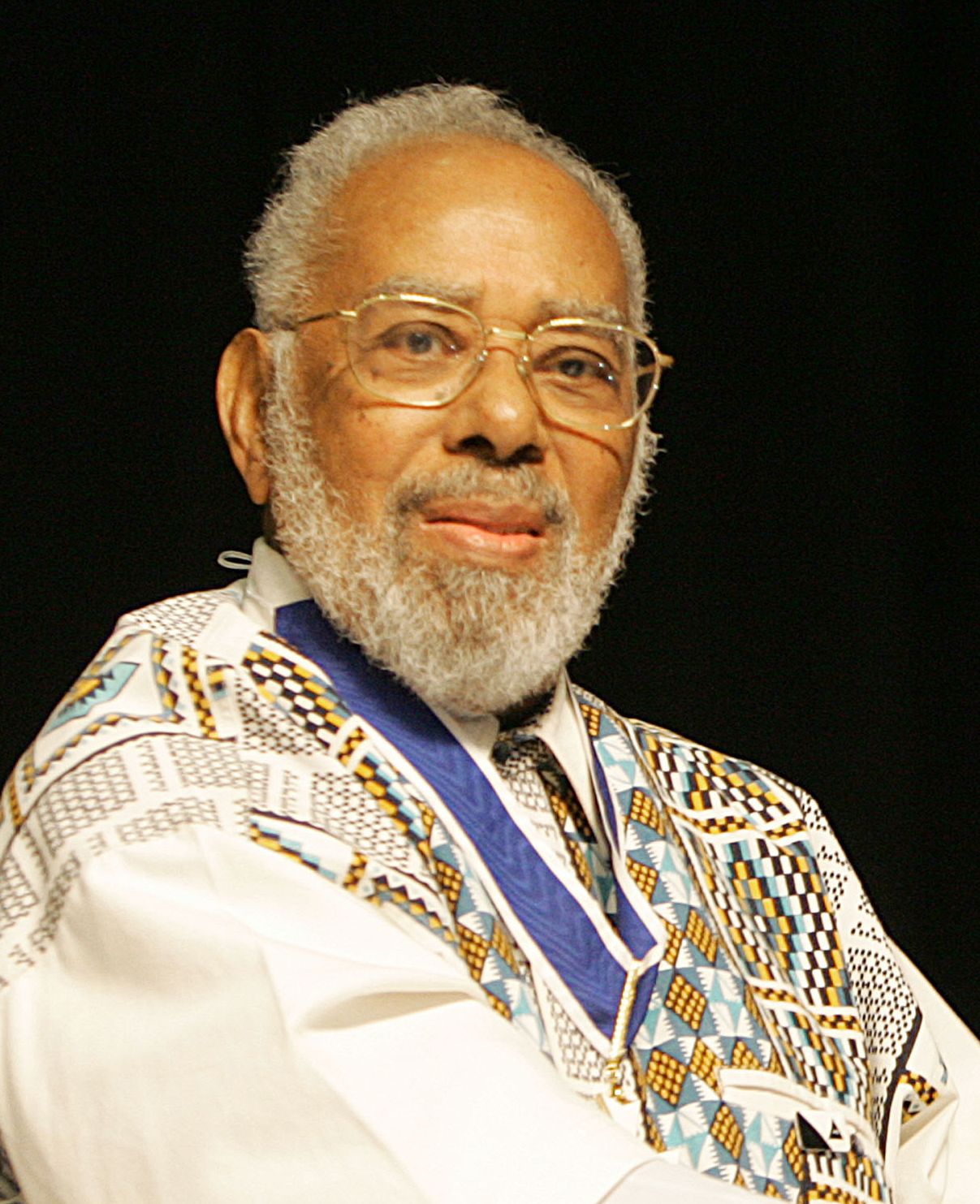 #34
#34
Obadias do Nascimento
Abdias do Nascimento (born March 18, 1914 in Franca, Sao Paulo State, Brazil and died May 23, 2011 in Rio de Janeiro) is a Brazilian politician and anti-racism activist, writer, painter, actor, highlighting his African origins, as well as those of several of his compatriots.
Discover the artist #35
#35
JonOne
John Andrew Perello, known as JonOne, Jonone or Jon156, is an American graffiti artist and painter, born in 1963 in New York. Founder of 156 All Starz, he moved to Paris towards the end of the 1980s.
Discover the artist #36
#36
Rammellzee
Rammellzee transforms the letter graffiti into armor and a visual combat system. Canvases, costumes and theories of "futuristic Gothic warfare" make language a territory to be reconquered.
Discover the artist #37
#37
Fab Five Freddy
Fred Brathwaite (born 1959), better known as Fab Five Freddy (often written Fab 5 Freddy), is a graffiti artist of the 1970s. Freddy appeared and signed the music video for Blondie's Rapture in 1981, which was the first cut of MTV.
Discover the artist #38
#38
Howardena Pindell
Howardena Pindell (born April 4, 1943) is an American painter and visual artist. Her work explores texture, color, structures and the process of artistic creation. He is often political and addresses the intersecting issues of racism, feminism, violence, slavery and exploitation.
Discover the artist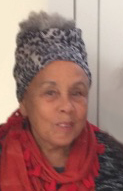 #39
#39
Betye Saar
Betye Irène Saar, born Betye Irene Brown (July 30, 1926, in Los Angeles), is an African-American artist, known for her works with a political dimension, denouncing the discrimination experienced by African-Americans, notably thanks to assemblages.
Discover the artist #40
#40
Phase 2
A pioneer of New York writing, Phase 2 developed bubble letters and then ever more complex shapes in the 1970s. His graphic innovations gave graffiti a shared grammar well beyond the subway.
Discover the artist #41
#41
Mickalene Thomas
Rhinestones, textile motifs, painting and photography compose lush portraits of black women in Thomas. She takes up poses from art history to shift the focus to beauty, desire and autonomy.
Discover the artist #42
#42
Tschabalala Self
Self assembles paint, printed fabric and sewn fragments to construct black bodies with free proportions. His figures occupy space with confidence and refuse to be reduced to an outside perspective.
Discover the artist #43
#43
Castera Bazile
Castera Bazile is a Haitian painter and engraver born October 7, 1923 in Jacmel and died February 27, 1966 in Port-au-Prince.
Discover the artist #44
#44
Henry Taylor
Taylor paints friends, neighbors, strangers and historical figures with a freedom of framing that keeps the liveliness of the encounter alive. His portraits connect daily observation, African-American history and social commentary without losing their individual presence.
Discover the artist #45
#45
Titus Kaphar
Kaphar folds, cuts, whitens or covers images inspired by ancient painting in order to reveal their absences. The material gesture becomes a method of bringing black people erased from archives back to the forefront.
Discover the artist #46
#46
Kossi Assou
Assou associates painting, sculpture and installation with signs drawn from Togolese cultures. His figures and assemblages question transmission, the environment and the tensions between local memory and globalization.
Discover the artist #47
#47
Firelei Baez
Firelei Baez was born in Santiago de los Caballeros in the Dominican Republic and lives and works in New York. She creates works on paper, canvas, and large-scale sculptures. Through her interests in anthropology, science fiction, black female subjectivity, and women's work, her art explores humor and identity creation within diasporic societies as well as their defenses against invasions and cultural appropriations.
Discover the artist #48
#48
Ellen Gallagher
Ellen Gallagher, born December 16, 1965, in Providence, Rhode Island, is an African-American visual artist, known for her political works denouncing the stereotypes experienced by African-Americans.
Discover the artist #49
#49
Glenn Ligon
Glenn Ligon (born 1960) is an American conceptual artist whose work explores notions of language, desire, sexuality, racial issues and identity. Ligon often draws his sources from the literature and speeches of 20th-century cultural figures such as James Baldwin, Zora Neale Hurston, Gertrude Stein, Jean Genet, and Richard Pryor.
Discover the artist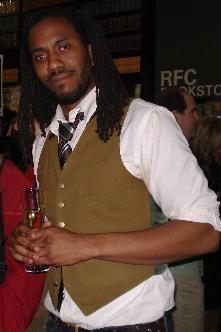 #50
#50
Rashid Johnson
Black soap, wax, plants, ceramics and grid surfaces make up a vocabulary where painting and installation come together. Johnson explores anxiety, care, social success and building African-American identity.
Discover the artistDiasporas on the move
Ranks 51 to 75 - London, Caribbean, Americas and Africa connected
The trajectories between islands, metropolises and continents show that the diaspora is a network of exchanges, languages, traditions and political experiences.
 #51
#51
Harmonia Rosales
Harmonia Rosales is an American artist of Afro-Cuban origin, born in 1984, in Chicago, where she lives and works. Through her pictorial art, she reinterprets the main works of the Renaissance, from which she draws inspiration to highlight black women as main subjects.
Discover the artist #52
#52
Koko Komegné
Koko Komégné, artist name of Gaston Komegne, born October 2, 1950 in Batoufam and died October 28, 2025 in Douala (Cameroon), is a Cameroonian painter and sculptor.
Discover the artist #53
#53
Boris Nzebo
Boris Nzebo, born in Port-Gentil in Gabon in 1979, is a visual artist who lives and works in Douala, Cameroon.
Discover the artist #54
#54
Lubaina Himid
Himid paints black characters in theatrical and colorful settings while working on found media. His work reveals the erased African presences of British history and connects everyday life, colonialism and imagination.
Discover the artist #55
#55
Hervé Youmbi
Hervé Gabriel Ngamago Youmbi, born March 25, 1973 in Bangui (Central African Republic), is a Cameroonian artist who lives and works in Douala. He is a founding member of the Cercle Kapsiki, a collective of five Cameroonian visual artists, founded in 1998.
Discover the artist #56
#56
Levoy Exile
A founding member of Saint Soleil, Exil populates its paintings with faces, stars and voodoo signs clutched in intense rhythms. Color builds a spiritual space where ancestors, loa and natural forces respond to each other.
Discover the artist #57
#57
Aubrey Williams
Aubrey Williams is a painter born May 8, 1926 in Georgetown, British Guiana and died April 17, 1990 in London. He is a leading figure among postcolonial Caribbean artists who flocked to London in the mid-20th century.
Discover the artist #58
#58
Derek Fordjour
Fordjour features athletes, artists and performers in surfaces constructed in layers of paper, cardboard, metal foil and paint. It examines the rules of spectacle, black visibility and the pressure placed on those who must constantly succeed.
Discover the artist #59
#59
Ouattara Watts
Watts superimposes large colored fields, numbers, diagrams, African signs and musical references. Between Abidjan, Paris and New York, his painting invents an abstract cosmology crossed by history and jazz.
Discover the artist #60
#60
Eugene james martin
Eugene James Martin (born Washington DC July 24, 1938 - died January 1, 2005 in Lafayette, Louisiana, United States) was a prolific African-American painter of paintings, drawings and collages.
Discover the artist #61
#61
Bill Kouelany
Bill Kouélany, born Eulalie-Brigitte Kouélany on October 31, 1965 in Brazzaville, is a Congolese artist, author and scenographer. In 2007, she participated in documenta 12 in Cassel.
Discover the artist #62
#62
Ablade Glover
Ablade Glover, born in 1934 in Accra, Ghana, is a contemporary Ghanaian artist. He has exhibited numerous times and built an international reputation, while being considered a prominent figure on the West African art scene. His works are part of numerous prestigious private and public collections, including the Imperial Palace in Tokyo, UNESCO headquarters in Paris and Chicago's O'Hare International Airport.
Discover the artist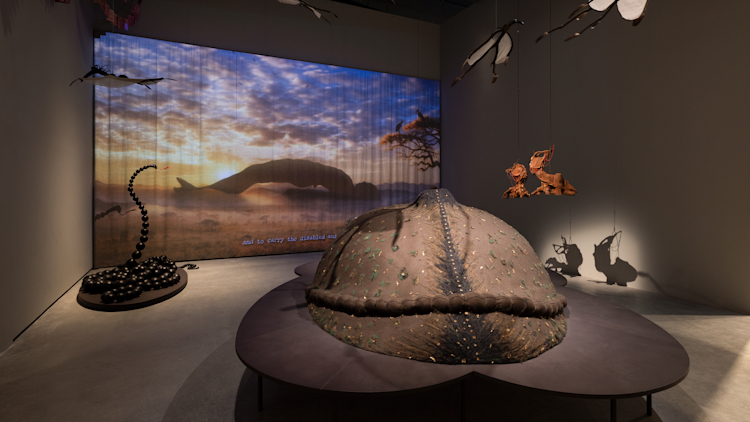 #63
#63
Wangechi Mutu
Mutu composes hybrid bodies from painting, collage, ink and sculptural materials. His figures question gender, colonial violence, science fiction and the images imposed on the black female body.
Discover the artist #64
#64
Amoako Boafo
Amoako Boafo, is a Ghanaian painter born in 1984 in Accra who lives and works in Vienna (Austria).
Discover the artist #65
#65
Clementine Hunter
Hunter recounts the life of Louisiana plantations on canvas, wood, bottles and recovered objects. Harvests, weddings, baptisms and vigils form a precise visual chronicle of a world she knew from the inside.
Discover the artist #66
#66
Ben Enwonwu
Ben Enwonwu is a Nigerian painter and sculptor born in 1917 and died in 1994. Influential nationally but also internationally, he is often considered the father of Nigerian modernism.
Discover the artist #67
#67
Yinka Shonibare
Shonibare uses wax fabric, a product of exchanges between Europe, Asia and Africa, to revisit portraits and historical scenes. His living paintings and headless figures make visible the contradictions of empire, class and identity.
Discover the artist #68
#68
Pascal Kenfack
Kenfack constructs his images from myths, proverbs and Cameroonian rituals which he confronts with contemporary crises. His dense painting makes tradition a critical tool rather than a folkloric setting.
Discover the artist #69
#69
Bruce Onobrakpeya
Bruce Onobrakpeya, born August 30, 1932 in Agbara-Otor (in), is a Nigerian engraver, painter and sculptor. A major figure in the Zaria Art Society at the turn of the 1960s and the independence of Nigeria, Onobrakpeya stands out for having invented new printmaking techniques, notably "lino bronze relief", "hydrochloric acid accident" and "plastography".
Discover the artist #70
#70
Yusuf Grillo
Grillo combines elongated silhouettes, deep blues, Yoruba patterns and modernist geometries. A figure of the Zaria school, he participated in defining Nigerian modernity freed from colonial academic models.
Discover the artist #71
#71
Bill Traylor
Born into slavery in Alabama, Traylor began drawing at an advanced age on the streets of Montgomery. On boxes found, he reduces animals, arguments and daily gestures to silhouettes of exceptional graphic energy.
See the works #72
#72
Nike Davies-Okundaye
Davies-Okundaye transposes Yoruba adire, its indigo reserves and symbolic motifs into large textile and painted compositions. Her artistic work is accompanied by workshops that have passed on these skills to generations of women.
Discover the artist #73
#73
Victor Ehikhamenor
Ehikhamenor covers its surfaces with networks of lines inspired by shrines, Edo stories and contemporary writing. Drawing, painting and light perforations connect family memory, spirituality and political history of Nigeria.
Discover the artist #74
#74
George Lilanga
George Lilanga is an internationally renowned Makonde Tanzanian painter and sculptor, born in Kikwetu in Masasi district in 1934 and died in Dar es Salaam on June 27, 2005, where he lived and worked.
Discover the artist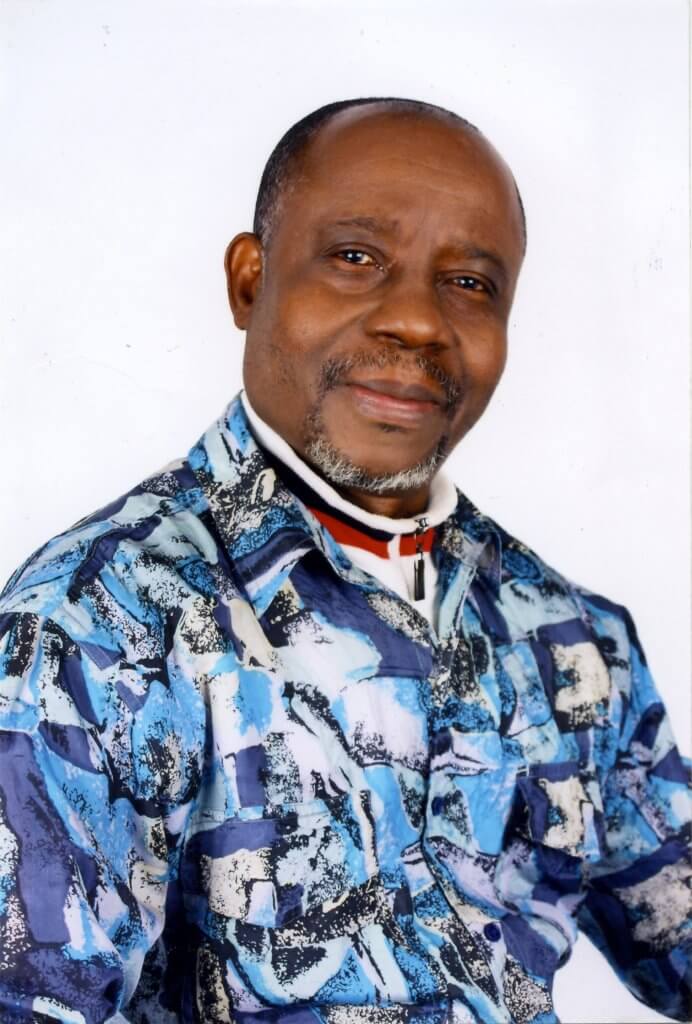 #75
#75
Darling Samba
Samba mixes bold colors, self-portraits, bubbles and texts to comment on daily life in Kinshasa, politics and the world of art. His direct address to the viewer has made popular Congolese painting an international language.
Discover the artistAfrican modernisms and Caribbean legacies
Ranks 76 to 100 - Dakar, Lagos, Kinshasa, Johannesburg and Port-au-Prince
National schools, popular workshops, independence, spiritualities and contemporary scenes radically broaden the geography of modern painting.
 #76
#76
Nnenna Okore
Okore braids, crumples and hangs paper, canvas, clay and fibers to evoke growth, decomposition and renewal. His works inherit gestures learned in Nigeria while responding to current ecological challenges.
Discover the artist #77
#77
Darling Cherin
Chéri Chérin, artist name of Joseph Kinkonda, born February 16, 1955 in Léopoldville and died October 19, 2025, is a painter from the Democratic Republic of Congo. One of the main representatives of contemporary Congolese popular painting - with Chéri Samba and Moké -, he willingly addresses themes such as resourcefulness, power or daily life in Kinshasa.
Discover the artist #78
#78
Mose Tolliver
After an accident which limited his mobility, Tolliver painted animals, plants and characters on boards recovered. Its direct flat areas, often suspended by a simple ring, keep the freshness of the sign without becoming naive.
Discover the artist #79
#79
Palmer Hayden
Hayden paints sailors, Harlem streets, musicians and rural scenes in a vivid palette and deliberately direct drawing. His images, sometimes controversial for their types, document the contradictions of black American life in the 20th century.
Discover the artist #80
#80
Kudzanai Chiurai
Kudzanai Chiurai, born in 1981 in Harare, is a Zimbabwean visual artist who now lives in South Africa.
Discover the artist #81
#81
Laura Wheeler Waring
Laura Wheeler Waring, born May 16, 1887 - February 3, 1948, is an African-American artist and teacher, best known for her paintings of prominent African Americans that she created during the Harlem Renaissance. She taught art for over 30 years at Cheyney of the University of Pennsylvania.
See the works #82
#82
Tchif
Tchif works in layers of pigments, signs and silhouettes in compositions that are both narrative and abstract. From Cotonou, he brings together urban memory, Beninese spiritualities and gestural energy.
Discover the artist #83
#83
Gerard Sekoto
Sophiatown and District Six are painted from the inside, through streets, houses and residents; its colors affirm urban vitality in the face of apartheid violence.
Discover the artist #84
#84
Romuald Hazoumè
Hazoumè is famous for his masks made with cans of gasoline, but his language extends to drawing, painting and installation. It transforms materials from border traffic into satire of world trade and colonial legacies.
Discover the artist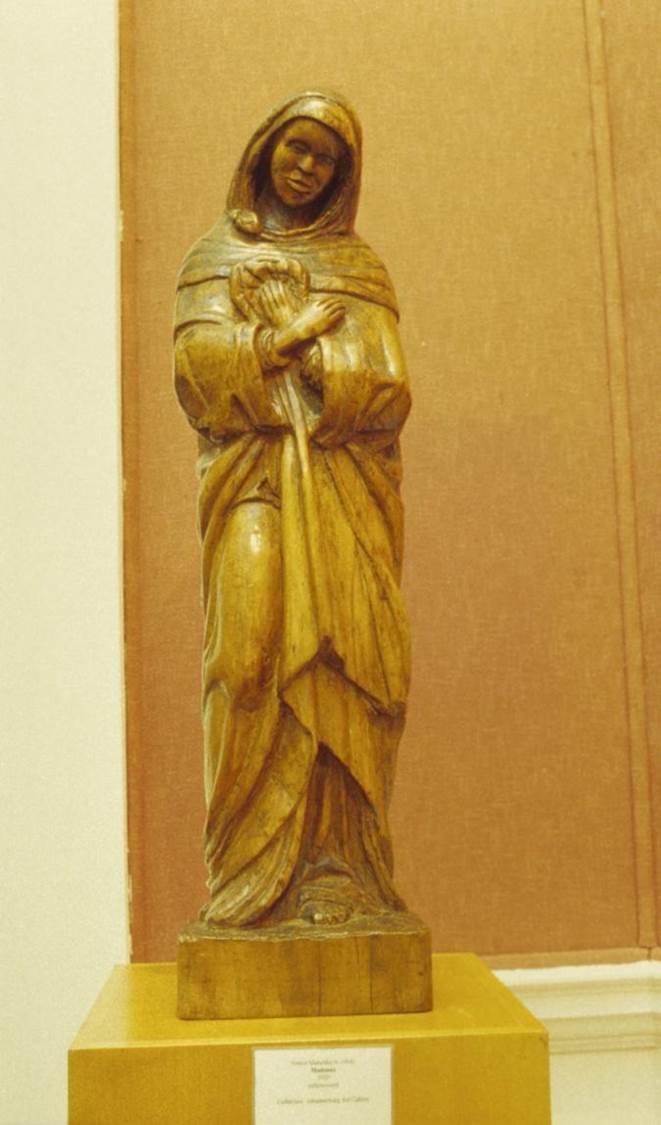 #85
#85
Ernest Mancoba
Ernest Mancoba is a Franco-South African artist born in Johannesburg on August 29, 1904 and died in Clamart on October 25, 2002.
Discover the artist #86
#86
Esther Mahlangu
Esther Mahlangu, born in 1935 in the former province of Transvaal (South Africa), is a South African artist of Ndebele culture. She is known for her contemporary, large-scale paintings in a geometric style referring to this Ndebele heritage.
Discover the artist #87
#87
Iba N'Diaye
Iba N'Diaye, born May 28, 1928 in Saint Louis (Senegal) and died October 4, 2008 in Clamart, is a Senegalese painter.
Discover the artist #88
#88
Joel Mpah Dooh
Joël Mpah Dooh, born in Cameroon in 1956, is a contemporary Cameroonian artist and sculptor who lives and works in Douala.
Discover the artist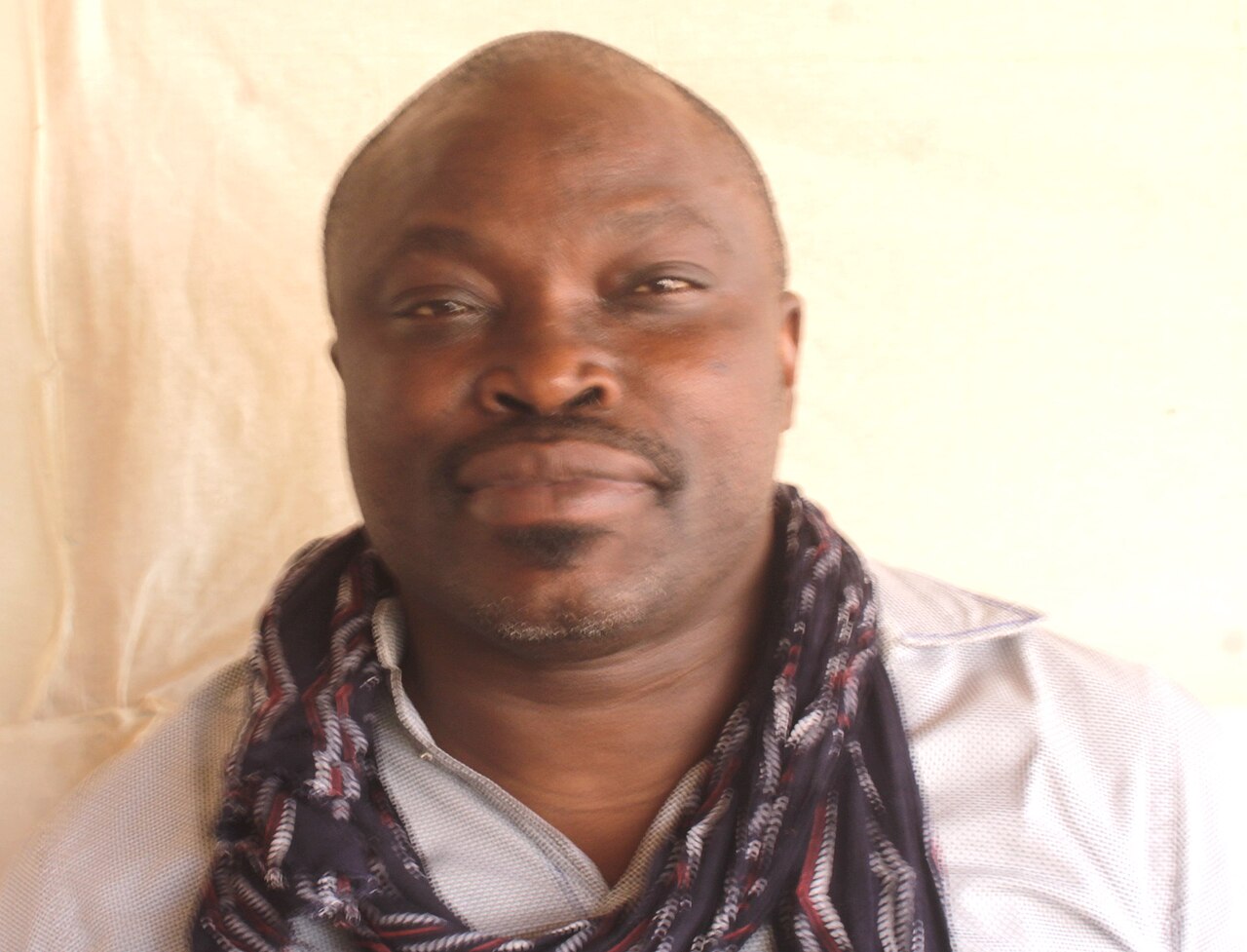 #89
#89
Soly Cisse
Cissé brings out from thick colored backgrounds bodies, animals and creatures caught in a continuous metamorphosis. His painting responds to the upheavals of Dakar with a nocturnal world where violence and vitality remain inseparable.
Discover the artist #90
#90
Bertina Lopes
Bertina Lopes, also known by her nickname Mama B (Lourenço Marques, 1924 - Rome, 2012), is a Mozambican painter and sculptor. Exiled in Italy in 1964, she spent most of her career there.
Discover the artist #91
#91
El Hadji Sy
El Hadji Sy (or El Sy, full name El Hadji Moussa Babacar Sy, born September 9, 1954 in Dakar) is a contemporary Senegalese painter. He is linked to the second generation from the "Dakar School", but he preferred - literally - "kicking" this legacy by starting by painting with his feet and giving the body its place again in painting.
Discover the artist #92
#92
Barthélémy Toguo
Barthélémy Toguo, born in 1967 in M'Balmayo (Cameroon), is a Cameroonian artist. He lives between Paris and Bandjoun Station.
Discover the artist #93
#93
Alexander Boghossian
Alexander Bhogossian known as Skunder Bhogossian is an Ethiopian artist (Addis Ababa, July 22, 1937 - Washington, May 4, 2003). Considered a pioneer of modern art in Ethiopia and one of the leading African artists of the 20th century, he is often associated with surrealism.
Discover the artist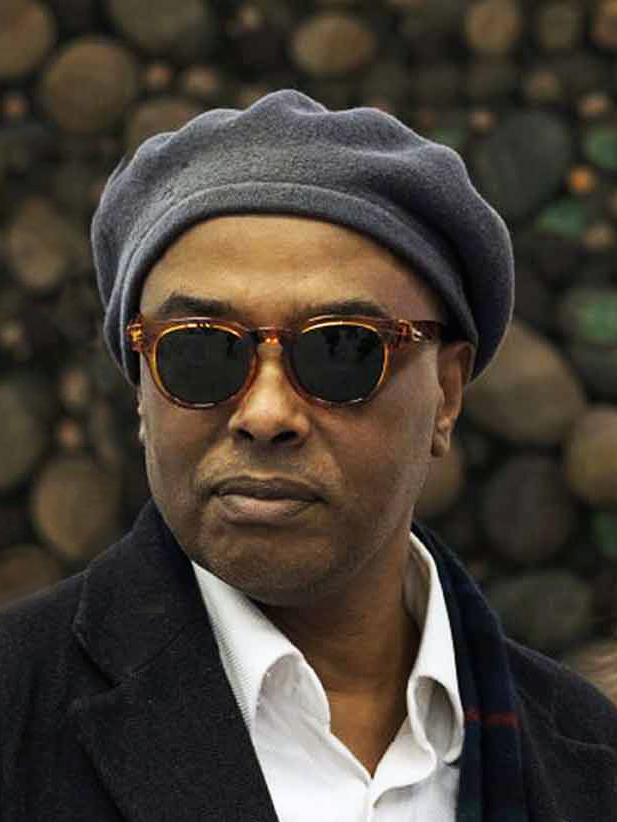 #94
#94
Fathi Hassan
Fathi Hassan (born 1957) is an African painter, born into a family in Egypt and Sudan. Known as one of the leading representatives of contemporary African art, he lives in the United States and Italy. In 1988, he was the first artist to represent the African continent at the Venice Biennale.
Discover the artist #95
#95
Abdoulaye Konaté
Abdoulaye Konaté, born February 1, 1953 in Diré, is one of the great figures of the visual arts in Mali. Addressing tapestry, tailoring, painting and sculpture, he makes fabric his main creative material and draws his inspiration from both African spiritualities and world news.
Discover the artist #96
#96
Hector Hyppolite
Voodoo deities, birds and spiritual figures form a pictorial cosmology whose strength impressed André Breton during his stay in Haiti.
See the works #97
#97
Philome Obin
Obin paints with calm precision the streets of Cap-Haitien, the ceremonies, the political events and the episodes of independence. His ordered compositions constitute an exceptional visual memory of northern Haiti.
Discover the artist #98
#98
Viyé Diba
Diba incorporates burlap, paper and worn materials into surfaces where color and material carry the memory of Dakar. His practice links abstraction, recycling and reflection on urban and social space.
Discover the artist #99
#99
Edouard Duval-Carrié
Duval-Carrié combines paint, resin, glitter and light to revisit the Haitian revolution, exile and voodoo. His sumptuous images restore Caribbean stories to their historical and spiritual complexity.
Discover the artist #100
#100
Manuel Mendive
Manuel Mendive, born in Havana in 1944, is a Cuban visual artist. Several of his works, including Barco negrero (1976), are in the National Museum of Fine Arts of Cuba.
Discover the artistSources and extensions
Deepen black arts and African modernisms
Public collections and specialized institutions make it possible to place works in their networks, their struggles and their historical contexts, without reducing artists to a single identity.
Read on Alpha Reproduction
Bringing these painters together changes the map of art history
Tanner, Douglas, Lawrence, Bearden, Lewis and Thomas are not margins of American art: they modify its subjects, color and way of telling the country. Lam, Hyppolite and Mendive connect Caribbean modernity, memory of slavery and spiritualities. El-Salahi, Enwonwu, Mancoba, Sekoto, N'Diaye and Malangatana show that African modernisms are neither copies nor a single school, but situated responses to colonization, independence and local visual traditions.
Basquiat, Marshall, Ringgold, Mehretu, Ofili, Mutu, Bradford, Walker, Wiley, Sherald and Yiadom-Boakye extend this trip to museums, streets and the world market. Their works not only ask who is represented: they question who looks, who preserves, who classifies and who writes history. Browsing these hundred artists means understanding that black and diasporic painting does not add a peripheral chapter; it requires us to reread the entire modern and contemporary story.
0 comments