

Top 50 · Informal art and tachism
Matter, stain and gesture after 1945
From Fautrier, Wols and Soulages to Tàpies, Burri, Saura and Gutaï.
Informal art appears in the disrupted post-war Europe as a way of reconstructing painting without returning to the certainties of classical composition. In Paris, the critic Michel Tapié brings together very different practices under this expression: thick pastes, stains, rapid signs, lacerated surfaces, automatisms, calligraphies and colors freed from drawing. The terms "lyrical abstraction", "tachism", "matterism" or "other art" overlap without being perfectly synonymous. The terms "lyrical abstraction", "tachism", "matterism" or "other art" overlap without being perfectly synonymous. The movement radiates from the New School of Paris to Italy, Spain, Germany, the Benelux and Japan, while dialoguing with American abstract expressionism. This classification assesses historical importance, technical invention, strength of works, role in founding exhibitions, international influence and the ability of each artist to renew the relationship between gesture, material, sign and space.

Painting as trace, material, energy and event.
Words close, but not interchangeable
Informal art, tachism, lyrical abstraction and materialism
"Informal art" is the broadest term: it designates works which refuse the pre-established geometric form and give rise to the image during work. "Lyrical abstraction", defended in particular by Georges Mathieu from 1947, insists on freedom of gesture and immediate expression. "Tachismo", popularized in the early 1950s, emphasizes stain, dripping and spontaneous marking. "Matterism", popularized in the early 1950s, emphasizes stain, dripping and spontaneous marking. "Matterism" concerns more artists who load the surface with sand, jute, tar, dust, metal or burns. "matterism" concerns more artists who load the surface with sand, jute, tar, dust, metal or burns. In practice, Wols, Hartung, Fautrier, Tàpies or Burri cross several of these categories, which is why this classification favors works rather than a rigid definition.
Paris after the war
Galleries, reviews and exhibitions build a new scene
Paris remains an essential home thanks to the Drouin, René Drouin, Nina Dausset, Stadler and de France galleries, the Salons des Réalités Nouvelles and de Mai, and the positions taken by Michel Tapié, Charles Estienne and Michel Ragon. Fautrier and Dubuffet move painting towards high pastes and poor materials; Wols opens the surface to stain and automatic network; Mathieu, Hartung, Schneider and Soulages impose the sign on a body scale. Artists from Russia, Portugal, China, Canada, Hungary and Japan make the Nouvelle École de Paris an international environment rather than a homogeneous national school.
An international story
From Rome and Madrid to Düsseldorf, Osaka and New York
The informal is transformed through contact with each context. In Italy, Burri burns, sews and cracks the surface, while Vedova, Afro or Santomaso favor the conflict of gesture and color. In Spain, Tàpies, Saura, Millares and Canogar respond to the isolation of Francoism with walls, torn figures and arpilleras. In West Germany, Schumacher and Götz invented a physical painting that broke with the official languages of the past. In West Germany, Schumacher and Götz invented a physical painting that broke with the official languages of the past. In West Germany, Schumacher and Götz invented a physical painting that broke with the official languages of the past. In Japan, Imai facilitated exchanges with Paris, while Shiraga, Shimamoto and Tanaka, members of Gutaï, transformed the spot into bodily, sound or technological action. In Japan, Imai facilitated exchanges with Paris, while Shiraga, Shimamoto and Tanaka, members of Gutaï, transformed the spot into bodily, sound or technological action. In Japan, Imai facilitated exchanges with Paris, while Shiraga, Shimamoto and Tanaka, members of Gutaï, transformed the spot into bodily, sound or technological action. The ranking includes these extensions when they directly shed light on the issues of informal art and tachism.
The Top 10
The ten artists who best define informal art
Fautrier, Wols, Dubuffet, Soulages, Mathieu, Hartung, Tàpies, Burri, Riopelle and Francis condense the main paths of movement: matter, spot, sign, color and action.
#1
Jean Fautrier
With the "Otages" series, Jean Fautrier makes pictorial paste a wounded surface. The pale impasto, fragile contours and muted colors evoke threatened bodies without describing them. This tension between material, memory and erasure places his work at the heart of emerging informal art.
Read the biography of Jean Fautrier on Wikipedia #2
#2
Wols
Wols transforms the sheet then the canvas into a nervous field covered with filaments, spots and drips. Its shapes seem simultaneously cellular, vegetal and cosmic. Michel Tapié sees in this freedom without prior composition one of the essential starting points of informal art.
See the Wols collection #3
#3
Jean Dubuffet
Jean Dubuffet refuses the academic finish and mixes sand, tar, dust or gravel with painting. His characters and landscapes appear scratched in a wall or extracted from the ground. This valorization of banal material and raw energy broadens the informal beyond strict abstraction.
Read the biography of Jean Dubuffet on Wikipedia #4
#4
Pierre Soulages
Pierre Soulages built vast black signs in the 1940s which block light backgrounds. From 1979, the "outrenoir" made the relief of black paint an instrument for reflecting light. His rigor keeps him at a distance from labels, but his gesture and his material interact strongly with the informal.
Read the biography of Pierre Soulages on Wikipedia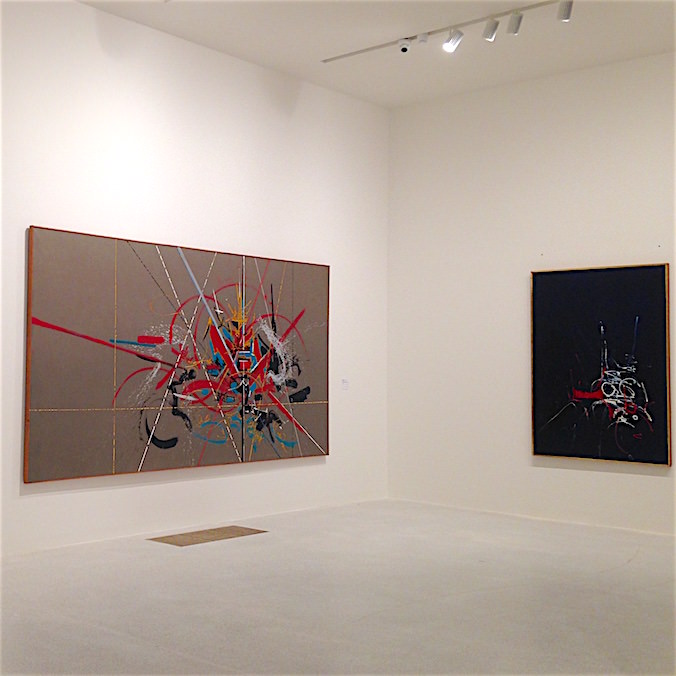 #5
#5
Georges Mathieu
Georges Mathieu claimed lyrical abstraction from 1947 and sometimes painted in front of the public with spectacular speed. Tubes pressed directly onto the canvas, lines thrown and colored bursts give the painting the tension of a battle. His work makes the gesture an event, without renouncing a very conscious composition.
Read the biography of Georges Mathieu on Wikipedia #6
#6
Hans Hartung
Hans Hartung develops a vocabulary of rapid lines, sheaves and scratches which immediately seems improvised. However, many of his paintings methodically enlarge preparatory drawings. This alliance between control and energy makes him a central figure in European gestural abstraction.
Read Hans Hartung's biography on Wikipedia #7
#7
Antoni Tàpies
Antoni Tàpies builds thick surfaces with sand, marble powder, varnish and modest objects. Crosses, letters, prints or body fragments appear as traces on an old wall. His materialism links the Catalan experience of the post-war period to the international dimension of informal art.
Read the biography of Antoni Tàpies on Wikipedia #8
#8
Alberto Burri
A former doctor, Alberto Burri often replaces paint with jute bags, wood, plastic or metal. Seams, burns and cracks become the real events of the work. It thus imposes an art of matter where destruction and repair remain visible in each surface.
Read Alberto Burri's biography on Wikipedia #9
#9
Jean Paul Riopelle
Jean-Paul Riopelle covers the canvas with thick touches applied with a knife until it forms a continuous mosaic. Color circulates without a fixed center, between mineral bursts and memories of nature. Installed in Paris, he became a major link between Canadian automatisms and European lyrical abstraction.
Read the biography of Jean-Paul Riopelle on Wikipedia #10
#10
Sam Francis
Sam Francis lets color float, burst or flow around large white reserves. His stays in Paris, Tokyo and Bern nourish a painting as attentive to emptiness as to saturation. In Europe, his paintings were quickly associated with tachism and international lyrical abstraction.
Read Sam Francis' biography on WikipediaChapter I · Ranks 11 to 20
Paris, calligraphy and spaces of color
From Zao Wou-Ki to Manessier, these artists show that the informal is not reduced to the violence of gesture: it can become breath, labyrinth, light, silence or landscape.
 #11
#11
Zao Wou-Ki
Zao Wou-Ki transforms archaic signs, mental landscapes and atmospheric movements into vast colorful spaces. Oil painting allows him to superimpose transparencies, sparkles and depths, while Chinese tradition nourishes the breath of composition. His work lastingly renews the School of Paris.
Read Zao Wou-Ki's biography on Wikipedia #12
#12
Emilio Vedova
Emilio Vedova attacks the surface with diagonals, black and white shards and violent repetitions. His paintings and mobile panels refuse decorative calm to maintain a political and existential dimension. The informal becomes for him a physical confrontation with European history.
Read Emilio Vedova's biography on Wikipedia #13
#13
Maria Helena Vieira da Silva
Maria Helena Vieira da Silva builds cities, libraries and chessboards whose lines escape any regular perspective. The fragmented touch transforms space into a mobile labyrinth. Close to lyrical abstraction, it always retains a subtle dialogue with the architecture and memory of the visible world.
Read the biography of Maria Helena Vieira da Silva on Wikipedia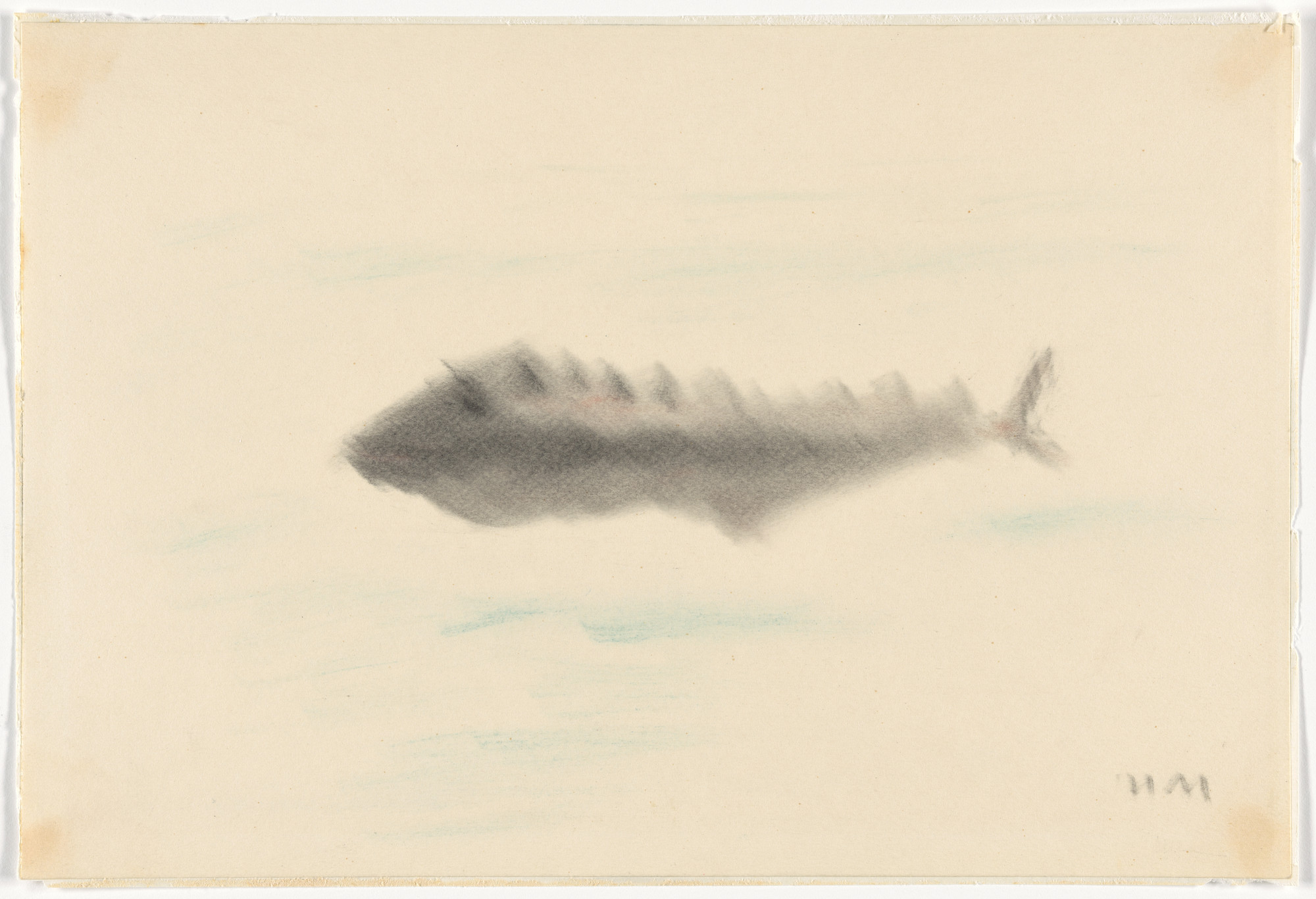 #14
#14
Henri Michaux
Poet as much as painter, Henri Michaux invents languageless alphabets, crowds of signs and figures crossed by impulses. Ink, watercolor and gouache record the speed of the hand and variations in consciousness. His work gives tachism a unique mental and scriptural dimension.
Read the biography of Henri Michaux on Wikipedia #15
#15
Nicholas of Stael
Nicolas de Staël superimposes colored blocks on the knife which can become wall, sea, sky, stadium or still life. His paintings maintain a constant tension between recognition of the motif and autonomy of the painting. This independent position makes him an essential figure in the informal climate of the 1950s.
See the Nicolas de Staël collection #16
#16
Chu Teh-Chun
Chu Teh-Chun transforms memories of Chinese landscapes into whirlwinds of light, mist and color. Calligraphic gestures structure depths that are neither Western perspective nor a direct imitation of nature. He becomes one of the great international representatives of lyrical abstraction.
Read Chu Teh-Chun's biography on Wikipedia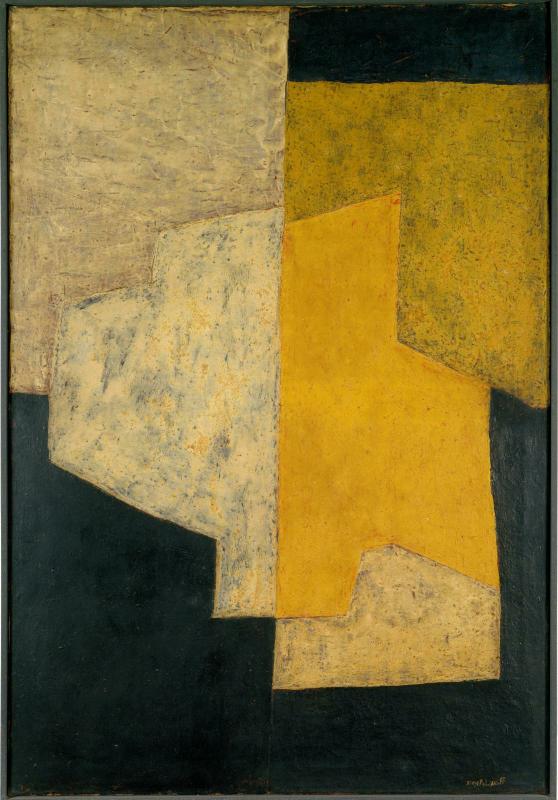 #17
#17
Serge Poliakoff
Serge Poliakoff assembles large irregular shapes that fit together without rigid contours. The layers of pigment produce a deep, almost powdery color, where each area modifies its neighbor. More constructed than gestural, his work nevertheless belongs to the vast field of informal Parisian abstraction.
Read Serge Poliakoff's biography on Wikipedia #18
#18
Bram van Velde
Bram van Velde reveals vast colored shapes which seem to come undone at the very moment they are formed. Transparencies, unstable contours and areas left open give the canvas great fragility. This painting without a fixed program finds a natural reception space in the informal sector.
Read Bram van Velde's biography on Wikipedia #19
#19
Roger Bissière
Roger Bissière organizes the canvas like a mosaic of signs, windows and muffled colors. Abstraction remains linked to the seasons, the garden, familiar objects and artisanal work. His teaching and work play a discreet but decisive role in the New School of Paris.
Read the biography of Roger Bissière on Wikipedia #20
#20
Alfred Manessier
Alfred Manessier transforms marshes, nights, religious festivals and political events into colorful rhythms. His stained glass practice deepens his understanding of a light that passes through rather than covers. His lyrical abstraction remains structured by a spiritual and sensitive experience of the landscape.
Read the biography of Alfred Manessier on WikipediaChapter II · Ranks 21 to 30
Stains, signs and methods of the New School of Paris
Atlan, Bryen, Schneider, Degottex, Debré, Hantaï and their contemporaries shift the boundary between improvisation and method, physical presence and erasure.
 #21
#21
Jean-Michel Atlan
Jean-Michel Atlan constructs totemic silhouettes surrounded by black and animated by intense colors. Its shapes are neither fully figurative nor entirely abstract; they evoke dance, mask and ritual energy. His brief work deeply marks the post-war Parisian scene.
Read the biography of Jean-Michel Atlan on Wikipedia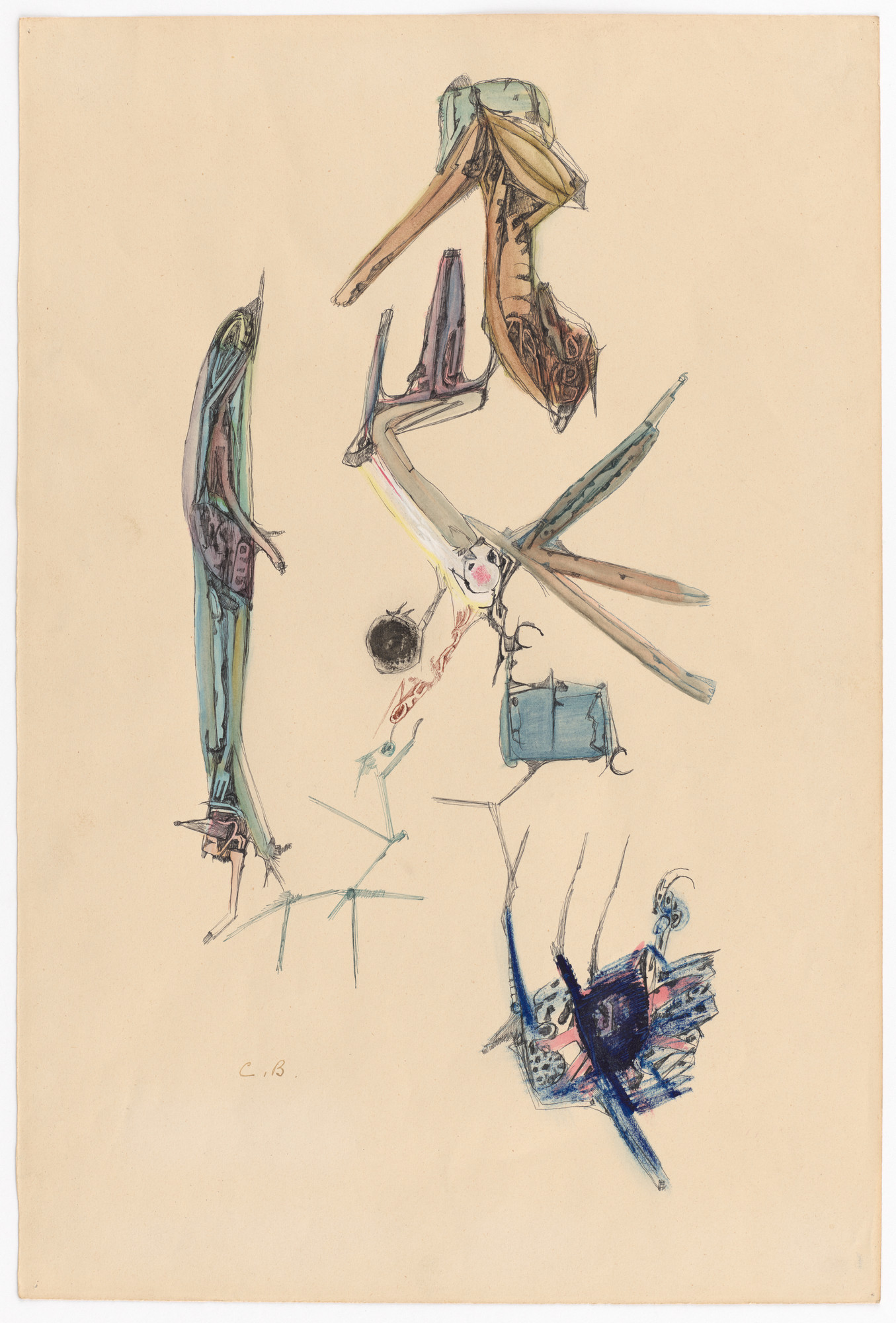 #22
#22
Camille Bryen
Camille Bryen moved from experimental poetry to automatic drawing then to painting made of splashes and colored networks. He participated in the first manifestations of lyrical abstraction and in the exhibitions of Michel Tapié. With him, the stain retains the irony and freedom of a poetic language.
Read Camille Bryen's biography on Wikipedia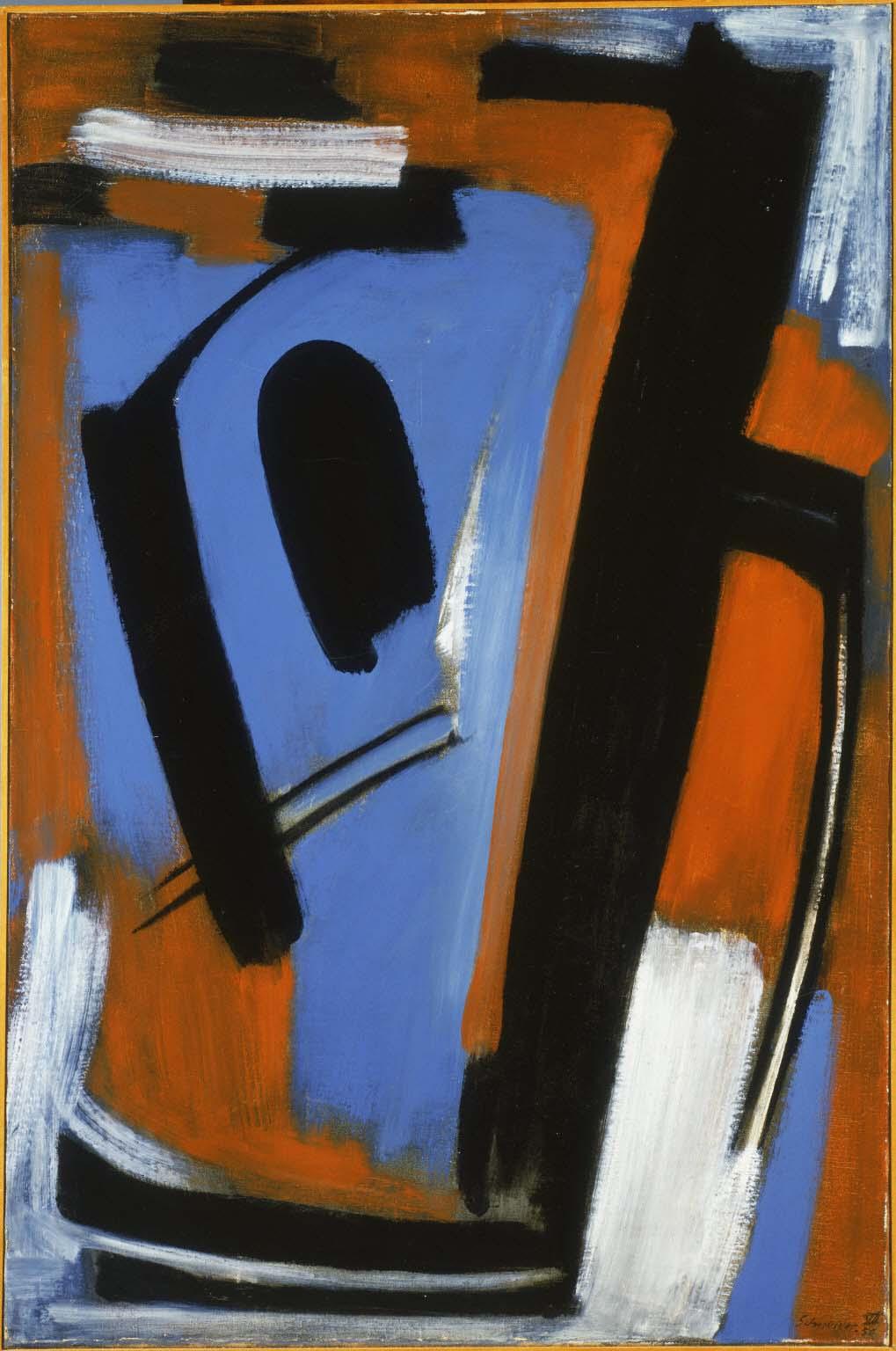 #23
#23
Gerard Schneider
Gérard Schneider paints in successive bursts, opposing large dark shapes, bold colors and luminous reserves. The canvas becomes the place of a balance achieved during the action rather than before it. From the end of the 1940s, he was among the main representatives of lyrical abstraction in Paris.
Read Gérard Schneider's biography on Wikipedia #24
#24
Jean Degottex
Jean Degottex gradually reduces painting to the energy of a sign, a wave or an imprint. Far Eastern calligraphy and Zen thought help him favor the right act rather than demonstrative expression. His late works even explore the traces produced by the medium itself.
Read the biography of Jean Degottex on Wikipedia #25
#25
Olivier Debré
Olivier Debré extends fluid fields of color where a few impastos mark the edges or the horizon. Its large formats reflect less a precise landscape than the physical sensation of a river, a sky or a light. It thus extends lyrical abstraction towards a meditative magnitude.
Read Olivier Debré's biography on Wikipedia #26
#26
Simon Hantaï
After a gestural phase close to informal, Simon Hantaï invented folding: the canvas was crumpled, knotted, painted then unfolded. The white reserves result from a protocol which divides the author between decision and chance. This method profoundly renews the question of gesture after tachism.
Read Simon Hantaï's biography on Wikipedia #27
#27
Pierre Tal-Coat
Pierre Tal-Coat gradually simplifies landscape, water, stone, bird or silhouette down to a few traces in a luminous surface. Painting does not renounce reality; she seeks the moment when a presence arises before being named. His restraint offers an essential counterpoint to the spectacular gestures of tachism.
Read the biography of Pierre Tal-Coat on Wikipedia #28
#28
Maria Manton
Maria Manton develops an abstraction where organic shapes, linear networks and transparent colors evoke germination, water or growth. Co-founder of the Salon des Réalités Nouvelles, she defends free painting without seeking spectacular effect. Its place in Parisian abstraction is today rightly re-evaluated.
Read Maria Manton's biography on Wikipedia #29
#29
Judit Reigl
Judit Reigl throws the material onto the canvas, pushes it with improvised tools and then sometimes uses the deposits accumulated on the ground. The "Bursting" and "Guano" series make the painting the result of action and physical transformation. Later, the human figure reappears as energy crossing the surface.
Read Judit Reigl's biography on Wikipedia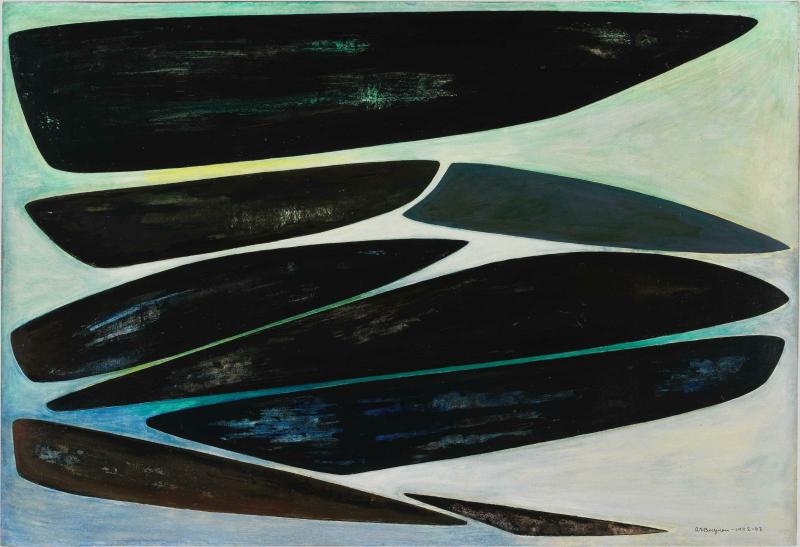 #30
#30
Anna Eva Bergman
Anna-Eva Bergman applies gold, silver or copper leaves to simple shapes evoking mountains, boats, horizons or planets. Metallic material captures a changing light and transforms the landscape into a monumental sign. His work links Nordic sensitivity to the informal Parisian context.
Read the biography of Anna-Eva Bergman on WikipediaChapter III · Ranks 31 to 40
CoBrA, Spain and international traffic
The free figure of CoBrA, the darkness of El Paso and the exchanges between Paris, Rome and New York prove that the informal sector is a European and transatlantic constellation.
 #31
#31
Asger Jorn
Asger Jorn mixes rapid gestures, earthy colors and grotesque creatures in deliberately unstable surfaces. Founder of CoBrA, he defends experimentation, popular imagination and collective creation. His free expressionism joins the informal through his refusal of polite forms and authoritarian systems.
Read Asger Jorn's biography on Wikipedia #32
#32
Karel Appel
Karel Call model birds, children and screaming figures in thick paint in bold colors. The spontaneity claimed by CoBrA does not mean absence of construction: each form is born from additions, overlays and resistance of the material. His work gives the informal an immediate figurative power.
Read Karel Appel's biography on Wikipedia #33
#33
Cornelius
Corneille retains after CoBrA a recognizable world of birds, women, suns and landscapes seen from above. The serpentine line and the bright color, however, prevent any descriptive stability. His imagination shows that the informal can accommodate the story and the figure without returning to naturalism.
Read Corneille's biography on Wikipedia #34
#34
Peter Alechinsky
Pierre Alechinsky associates CoBrA's freedom with ink and calligraphy discovered in Japan. On mounted paper, a central image often dialogues with peripheral vignettes which extend the story. His lively line transforms the informal gesture into writing full of humor and metamorphoses.
Read the biography of Pierre Alechinsky on Wikipedia #35
#35
Antonio Saura
Antonio Saura keeps the figure at the center of a gestural painting dominated by black, white and earth. Crucifixions, ladies and famous portraits are dismantled with rapid brush strokes. Co-founder of El Paso, he gives Spanish informalism a critical and tragic force.
Read Antonio Saura's biography on Wikipedia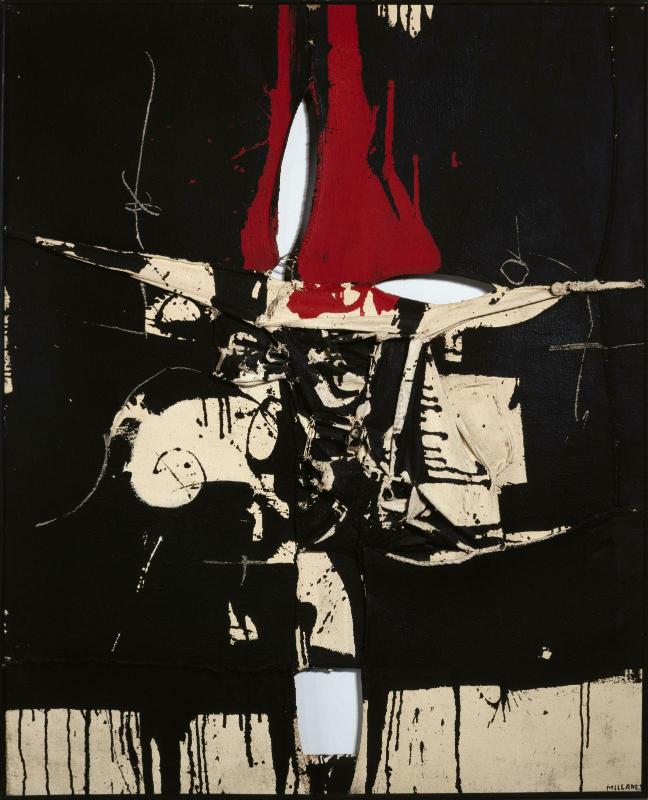 #36
#36
Manolo Millares
Manolo Millares tears, folds and sews the burlap before covering it with black, white and red. The "Homunculos" resemble bandaged bodies, mummies or devastated landscapes. Its poor material directly bears the memory of the Spanish war and repression.
Read the biography of Manolo Millares on Wikipedia #37
#37
René Duvillier
René Duvillier discovered the movement of the sea in Brittany and produced series of inks and paintings crossed by jets, waves and whirlpools. Supported by Charles Estienne, he fully belongs to the tachism of the Nouvelle École de Paris. His gesture remains linked to a physical sensation of the marine world.
Read the biography of René Duvillier on Wikipedia #38
#38
Rafael Canogar
Rafael Canogar covers his first canvases with black gestures, scratches and drips that vibrate an almost monochrome surface. At the end of the 1960s, he reintroduced silhouettes and crowds to respond more directly to political violence. His journey reveals the limits and extensions of the informal.
Read Rafael Canogar's biography on Wikipedia #39
#39
Jose Guerrero
José Guerrero brings together large colored masses separated by unstable borders. His American experience brings him closer to abstract expressionism, while the light and memory of Granada persist in its colors. He embodies the transatlantic circulation of gestural abstraction.
Read the biography of José Guerrero on Wikipedia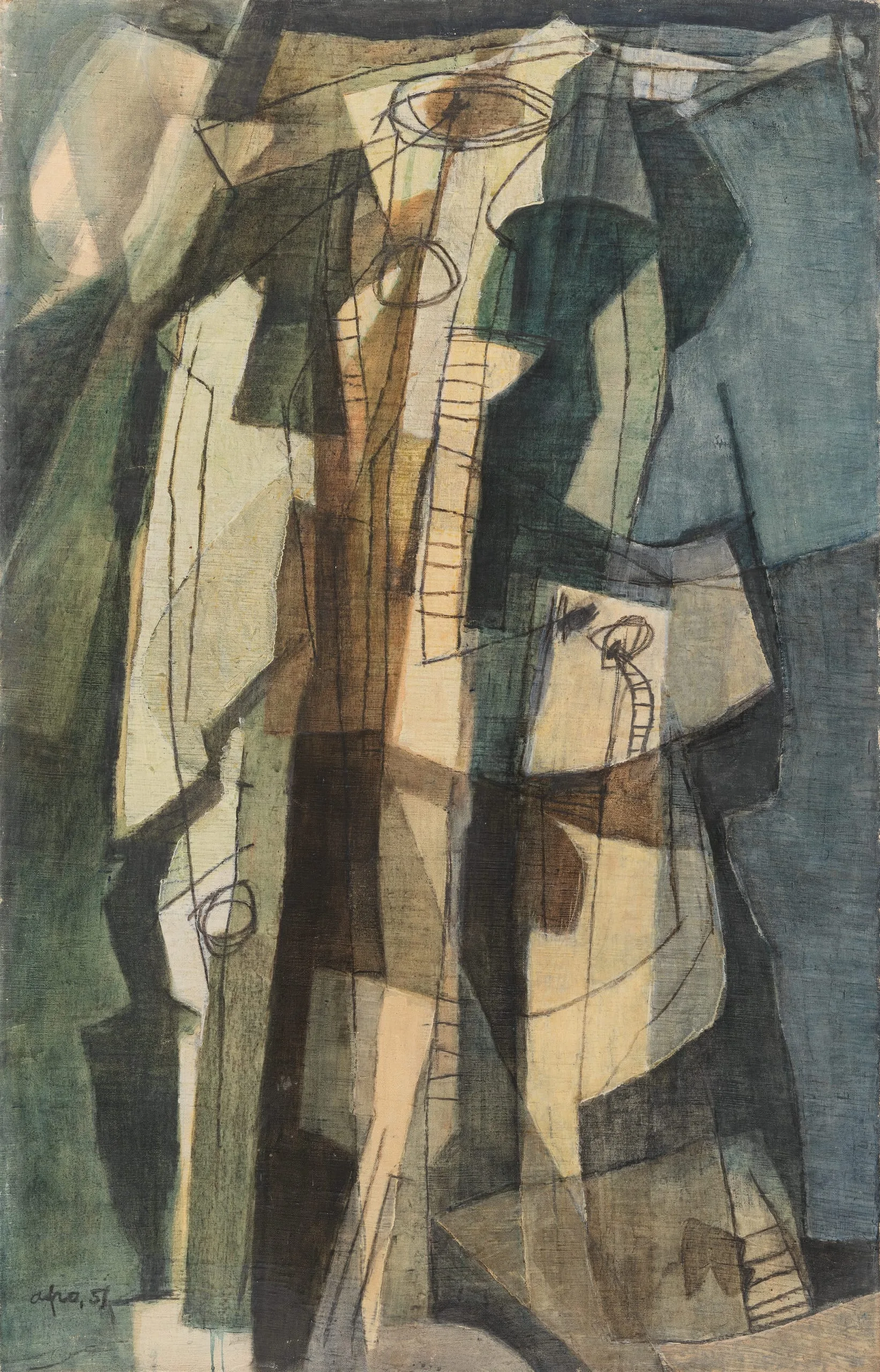 #40
#40
Afro Basaldella
Afro Basaldella composes floating shapes, transparencies and calligraphic accents which sometimes preserve the memory of a landscape or a figure. His stays in the United States enrich his palette without erasing Italian light. His lyricism bridges the gap between European informality and American abstraction.
Read the biography of Afro Basaldella on WikipediaChapter IV · Ranks 41 to 50
Italy, Germany and Japan: the informal sector is changing scale
From the repeated sign of Capogrossi to the actions of Gutaï, painting becomes mineral surface, writing, body trace, projection and sometimes performance.
 #41
#41
Giuseppe Capogrossi
Giuseppe Capogrossi abandons the figure for a forked sign which he repeats, turns over and superimposes on colored backgrounds. This simple element functions as writing without a message, capable of producing density, rhythm and depth. Its constancy gives a very constructed version of informal art.
Read the biography of Giuseppe Capogrossi on Wikipedia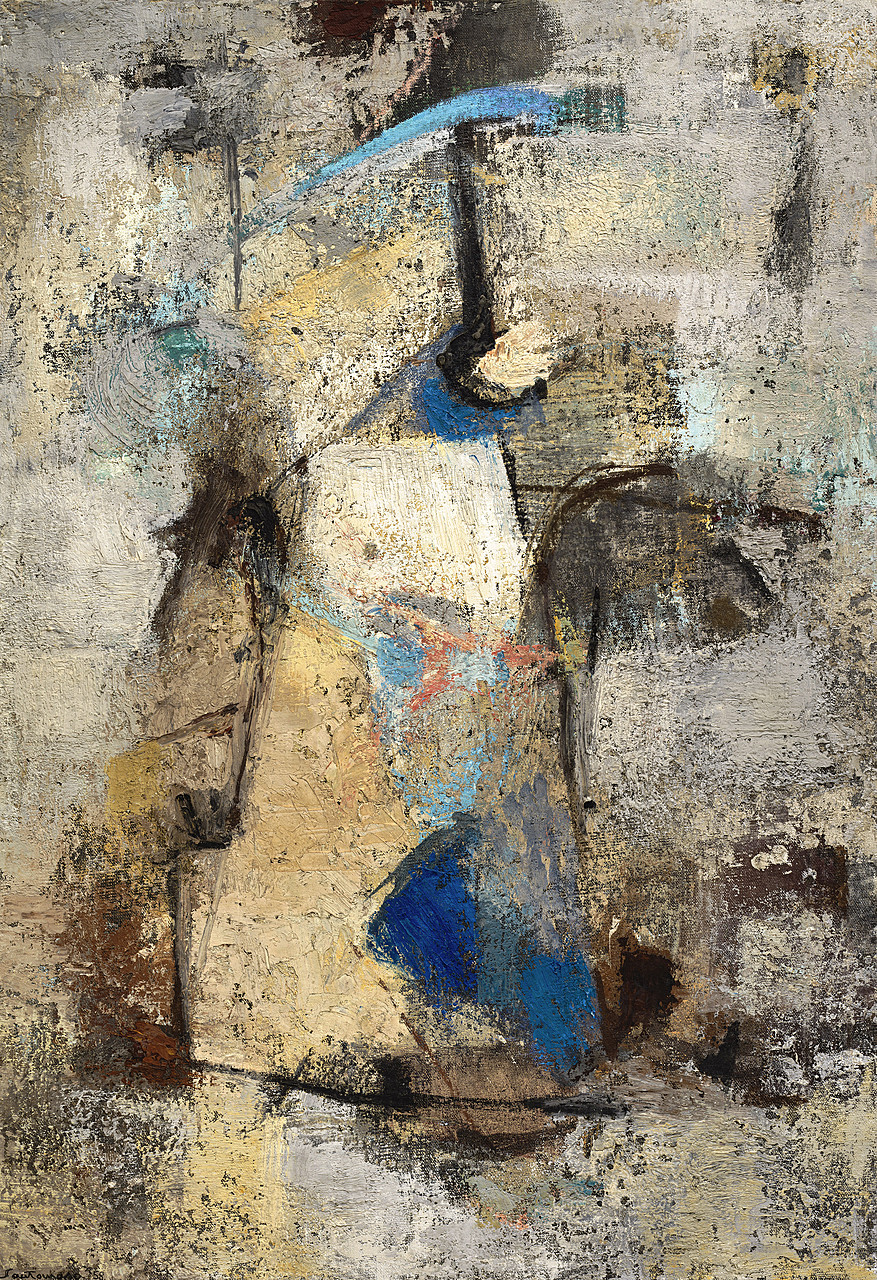 #42
#42
Giuseppe Santomaso
Giuseppe Santomaso transforms windows, facades, lagoon and Venetian architecture into networks of transparent signs and colors. The canvas remains open, luminous, crossed by lines that suggest without describing. Its abstraction reconciles the heritage of the place and the freedom of gesture of the post-war period.
Read Giuseppe Santomaso's biography on Wikipedia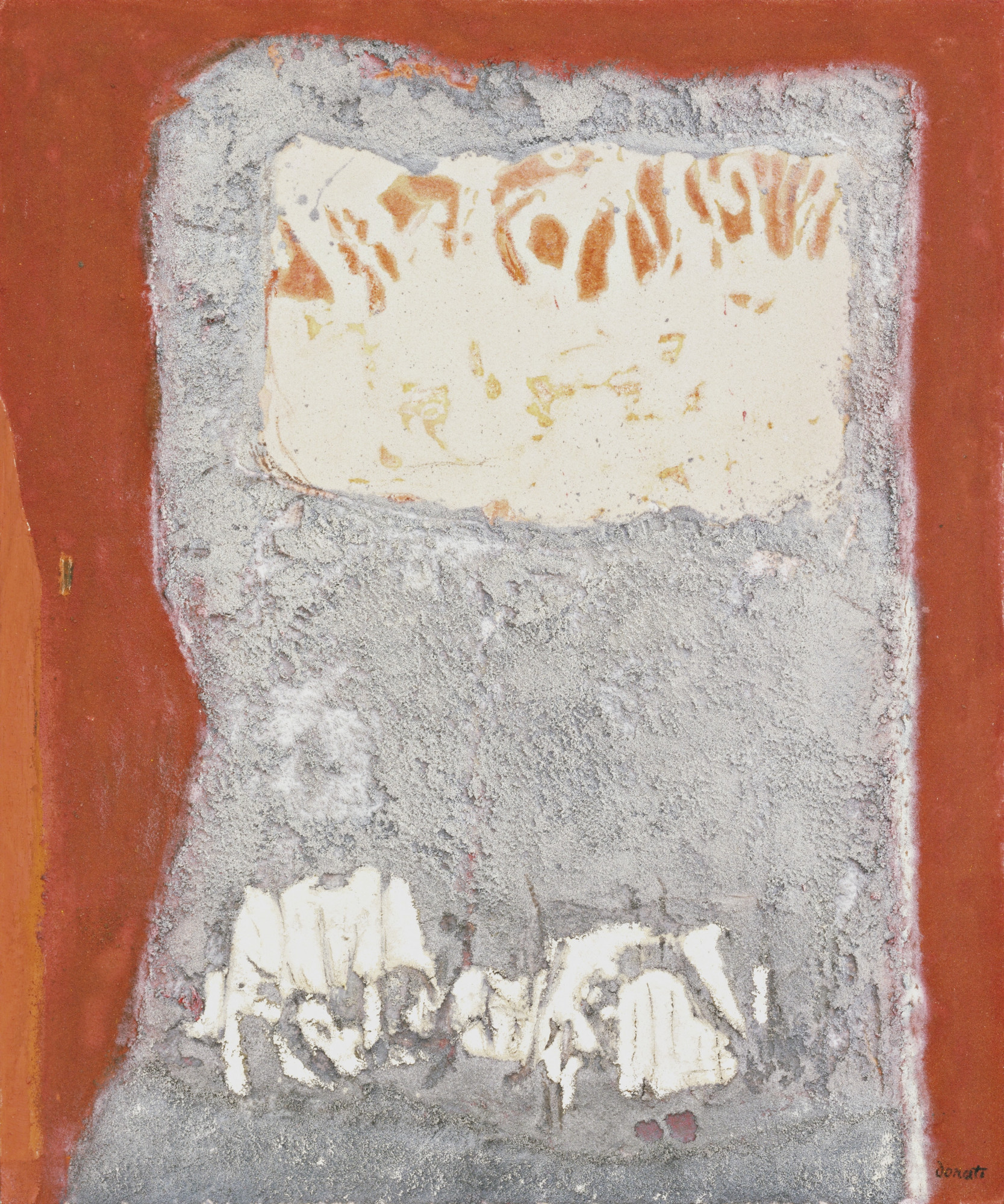 #43
#43
Enrico Donati
Enrico Donati moves from surrealism to thick surfaces that evoke desert, lava, fossil or lunar landscape. Sand, dust and cracked textures make the canvas a geological object. His work recalls how the informal also extends certain research on automatism and the unconscious.
Read Enrico Donati's biography on Wikipedia #44
#44
Emil Schumacher
Emil Schumacher digs, scratches and loads the paint until it is the thickness of a skin or floor. The lines appear incised in brown, red or blue material rather than drawn on its surface. He is one of the major figures of informal art in West Germany.
Read Emil Schumacher's biography on Wikipedia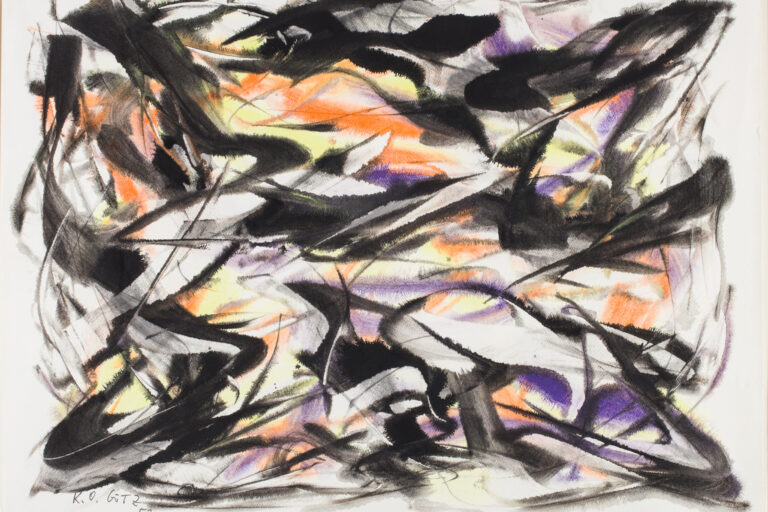 #45
#45
Karl Otto Goetz
Karl Otto Götz spreads a fluid paint with a brush, moves it with a squeegee then intervenes in the still damp surface. This process produces very rapid swirls where blacks, whites and colors interpenetrate. His teaching transmits the informal to a decisive generation of German artists.
Read the biography of Karl Otto Götz on Wikipedia #46
#46
Kumi Sugai
Based in Paris, Kumi Sugai starts from signs close to the ideogram and dark materials before evolving towards clean shapes and bold colors. His work shows a transformation rather than a simple fusion of traditions. He is one of the Central Asian artists of international informal art.
Read Kumi Sugai's biography on Wikipedia #47
#47
Toshimitsu Imai
Toshimitsu Imai discovered lyrical abstraction in Paris and became an essential conduit for Japanese artists. His paintings accumulate drips, projections and colored thicknesses in a very physical movement. Later, flowers, letters and traditional motifs reappear within this energy.
Read Toshimitsu Imai's biography on Wikipedia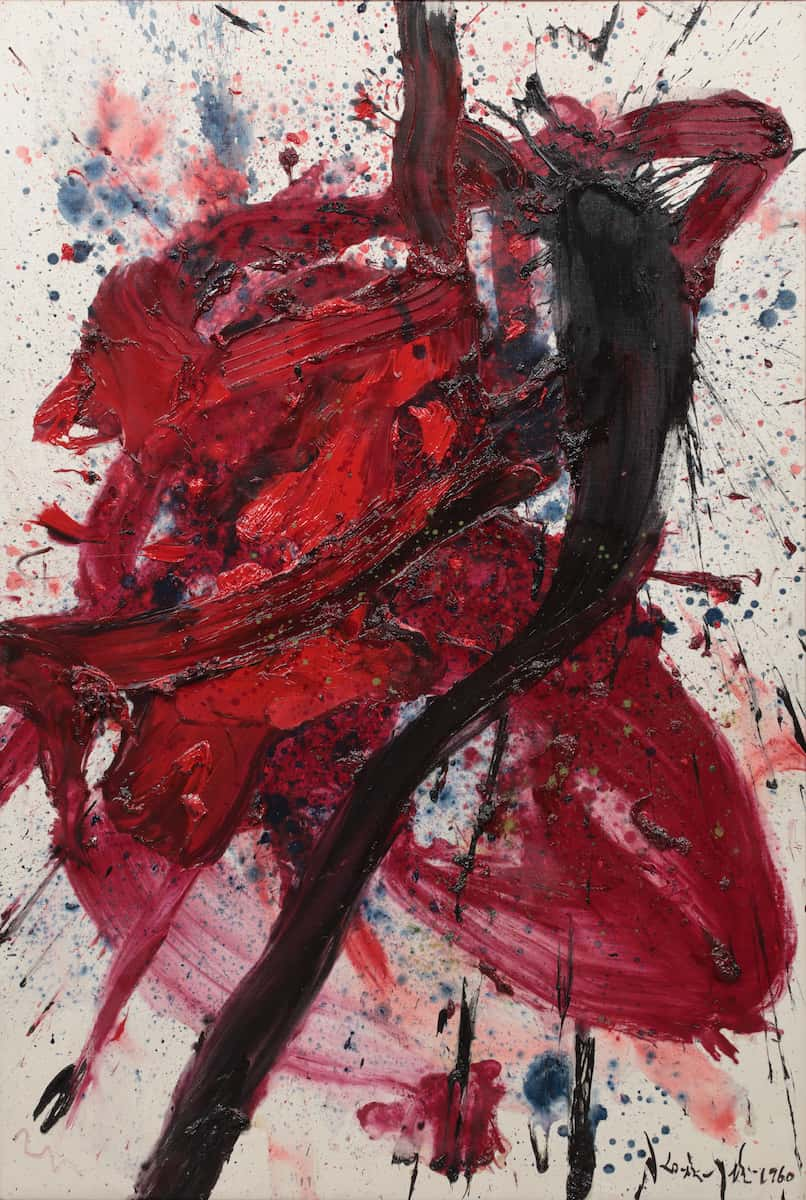 #48
#48
Kazuo Shiraga
Hanging from a rope, Kazuo Shiraga paints with his feet and engages his entire body in the material. The furrows, clusters and mixtures of color preserve the trajectory of the action. Member of Gutaï, he pushes the identification between painting, performance and physical event further than European tachism.
Read Kazuo Shiraga's biography on Wikipedia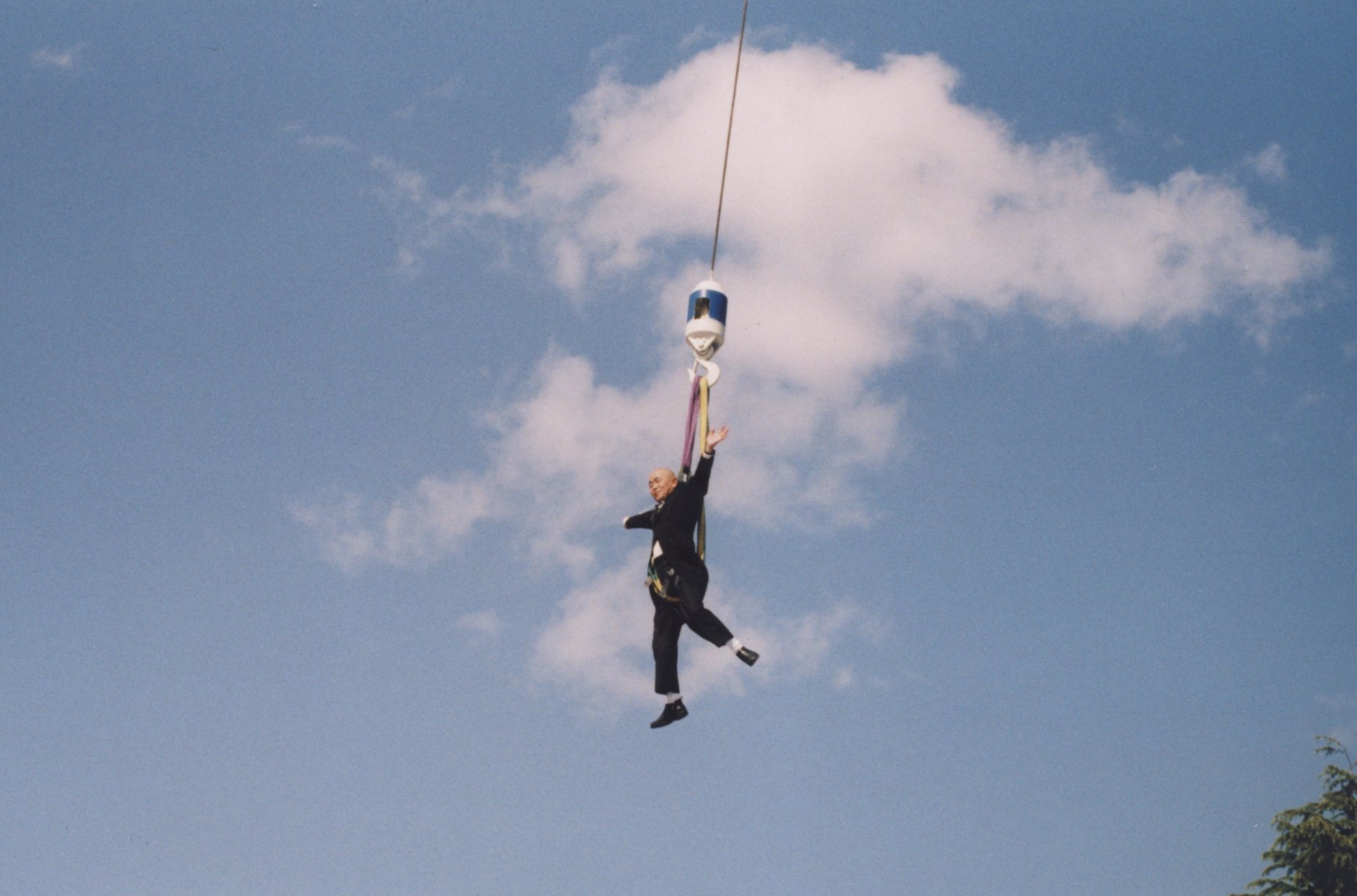 #49
#49
Shozo Shimamoto
Shôzô Shimamoto throws or breaks bottles filled with color on supports placed on the ground. The explosion distributes the paint according to an element of chance impossible to reproduce exactly. His Gutai actions give the stain a concrete, sonorous and collective origin.
Read the biography of Shôzô Shimamoto on Wikipedia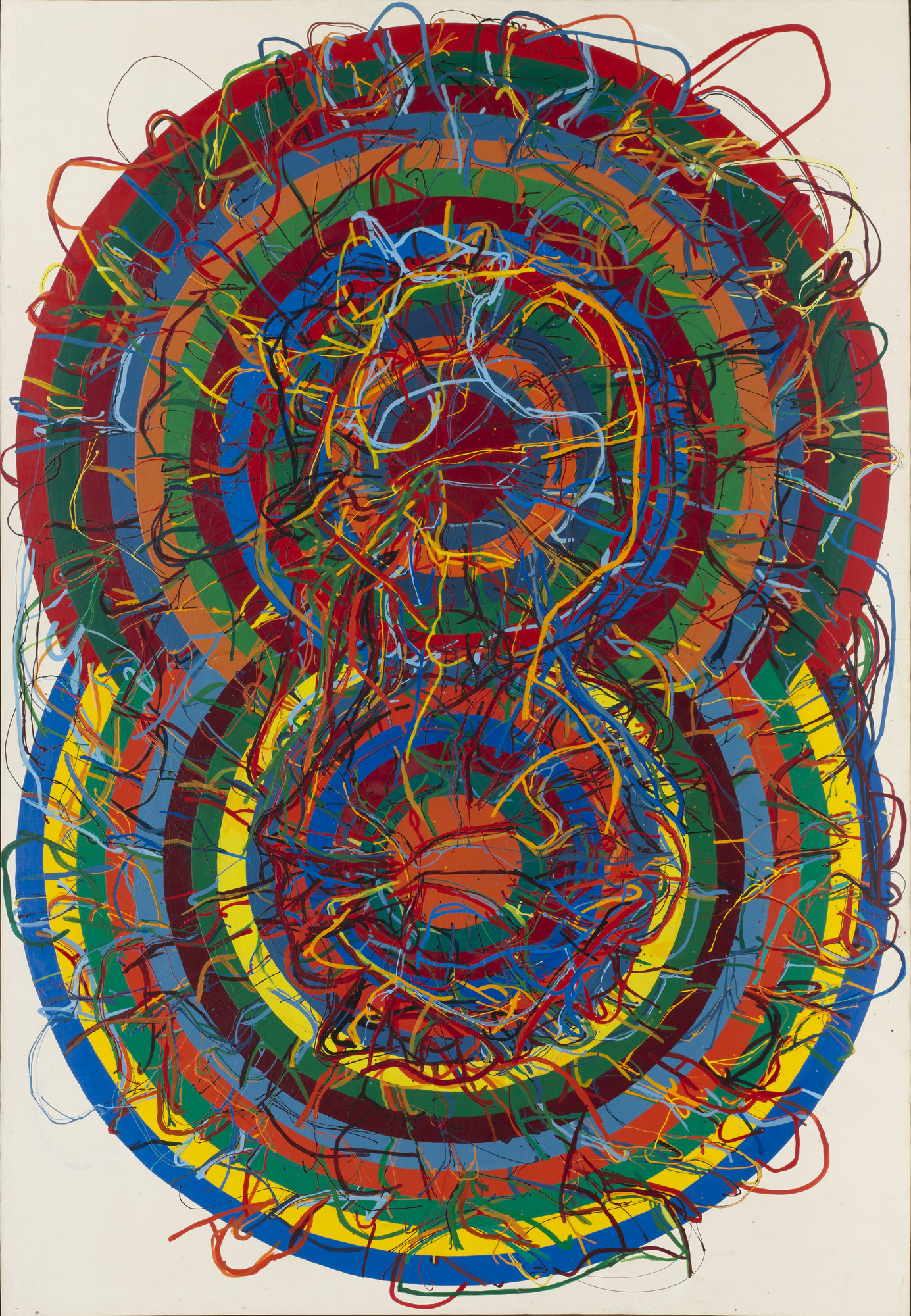 #50
#50
Atsuko Tanaka
Atsuko Tanaka transforms wires, bulbs, ringtones and electrical circuits into performances and then into paintings. Colorful circles and tangled lines preserve the memory of the connections of the "Electric Dress". His work expands the informal towards the technological body and networks.
Read Atsuko Tanaka's biography on WikipediaSources and routes
Deepen informal art at the museum and on Alpha Reproduction
Explore Alpha Reproduction
The informal is not the absence of form, but a form in the process of being born
This Top 50 reveals a more diverse story than the image of a simple spontaneous painting. Fautrier and Burri make a wounded surface speak; Wols and Bryen invent microcosms of spots; Hartung, Mathieu and Schneider organize the energy of the line; Soulages and Vedova face black; Vieira da Silva, Zao Wou-Ki and Chu Teh-Chun construct spaces where color, memory and breath remain inseparable. Even when it appears immediate, this painting is often based on precise decisions of rhythm, support, tool and duration.
His heritage is also measured by his movements. Hantaï transforms chance into a method of folding, Tàpies and Millares make the material a historical witness, CoBrA keeps the figure unstable, and Gutaï engages the body to the point of converting the painting into action. To reread the classification, compare styles less than verbs: scratch, flow, press, burn, sew, fold, sweep, project. It is in these concrete operations that informal art regains all its strength today.
0 comments