

HISTORY · OUTDOORS · VISION · ABSTRACTION
100 essential Hungarian paintings
A century of Hungarian inventions
Hungarian painting transforms the defeats and heroes of national history into images, then conquers the light of the outdoors, decorative intimacy and abstraction. From Madarász to Munkácsy, from Nagybanya to Csontváry, from the Bauhaus of Moholy-Nagy to the optical art of Vasarely, it dialogues with Europe without losing its own tension.
A modernity born between several worlds
From national memory to pure perception
In the 19th century, Viktor Madarász gave the dramas of Hungarian history political power, while Mihály Munkácsy imposed a social and religious realism of European scope. Pál Szinyei Merse discovered the color of the outdoors early on; Ferenczy, Mednyánszky and Iványi-Grünwald then renewed the landscape around Nagybanya.
Hungarian singularity does not come from a unique style, but from an ability to transform history, territory and perception into radically new visual experiences.
Rippl-Rónai returns from France with the heritage of the Nabis, Csontváry makes travel a cosmic vision and Aba-Novák populates modernity with expressive crowds. Moholy-Nagy builds with light at the Bauhaus; Vasarely continues this research to an optical art intended to act directly on the viewer.
Enter the rankingOne hundred paintings to understand Hungarian art
Ten documentary paintings show how geometry becomes movement, volume and experience of the gaze.
#1
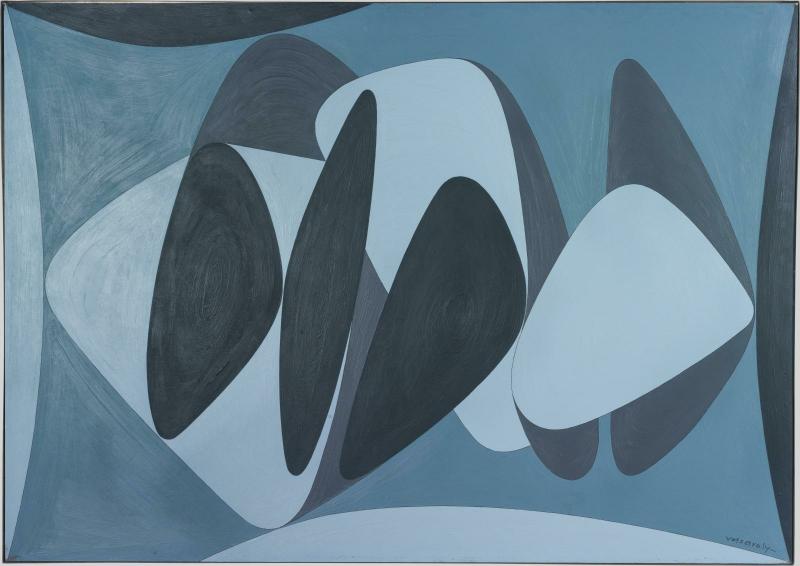
Belle Isle GP
Belle-Île's polished pebbles and glass are reduced to black and white ellipses. Vasarely moves from natural observation to geometry that physiologically activates the gaze. This image is presented for documentary purposes and opens the museum notice; the work is not offered for reproduction.
See the institution's notice →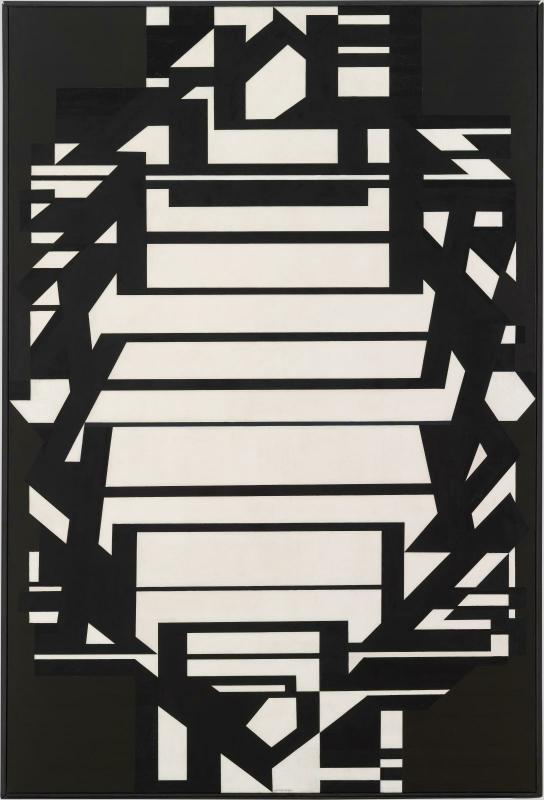 #2
#2
Mindoro II
Flexible forms and oppositions of values construct a depth without perspective. This pivotal period transforms organic motifs into abstract vocabulary. This image is presented for documentary purposes and opens the museum notice; the work is not offered for reproduction.
See the institution's notice → #3
#3
Poprad
The black and white frame derives from observed and then simplified shapes. Vasarely is already looking for an image capable of producing his own optical movement. This image is presented for documentary purposes and opens the museum notice; the work is not offered for reproduction.
See the institution's notice →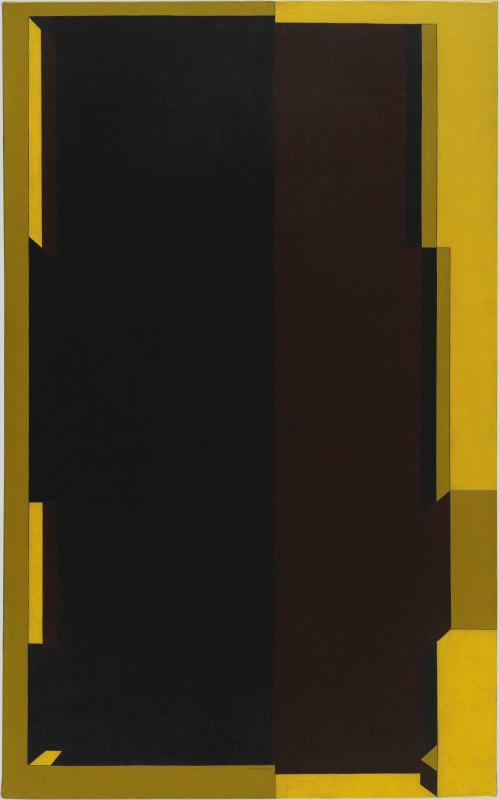 #4
#4
Ho II
Positive and negative contrasts make the surface vibrate. The work belongs to the research that leads Vasarely from geometric abstraction to optical art. This image is presented for documentary purposes and opens the museum notice; the work is not offered for reproduction.
See the institution's notice →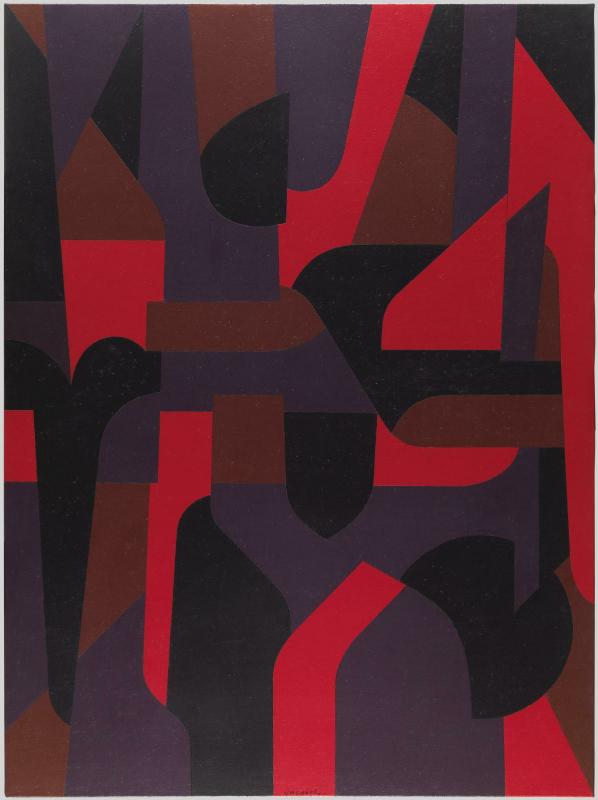 #5
#5
Our IV
Repeated units gradually change their size and value. The grid ceases to be stable and becomes a visual field subject to the viewer's perception. This image is presented for documentary purposes and opens the museum notice; the work is not offered for reproduction.
See the institution's notice →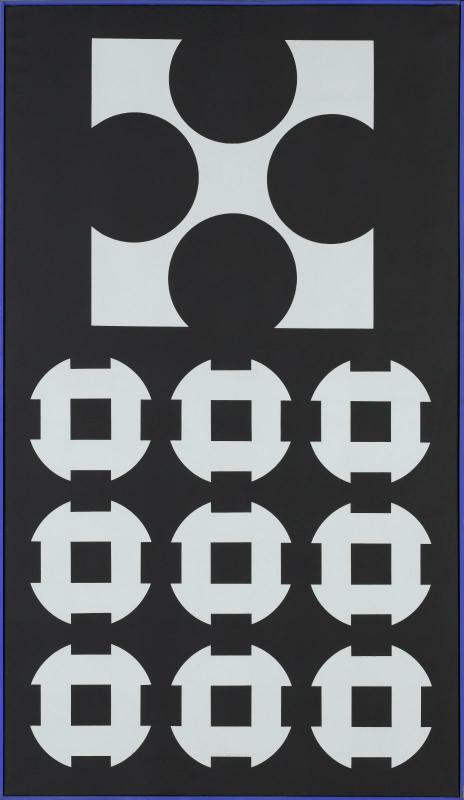 #6
#6
Procion-neg
Squares and circles oppose each other according to a logic of positive and negative. Vasarely tests a reproducible language where each unit can generate multiple combinations. This image is presented for documentary purposes and opens the museum notice; the work is not offered for reproduction.
See the institution's notice →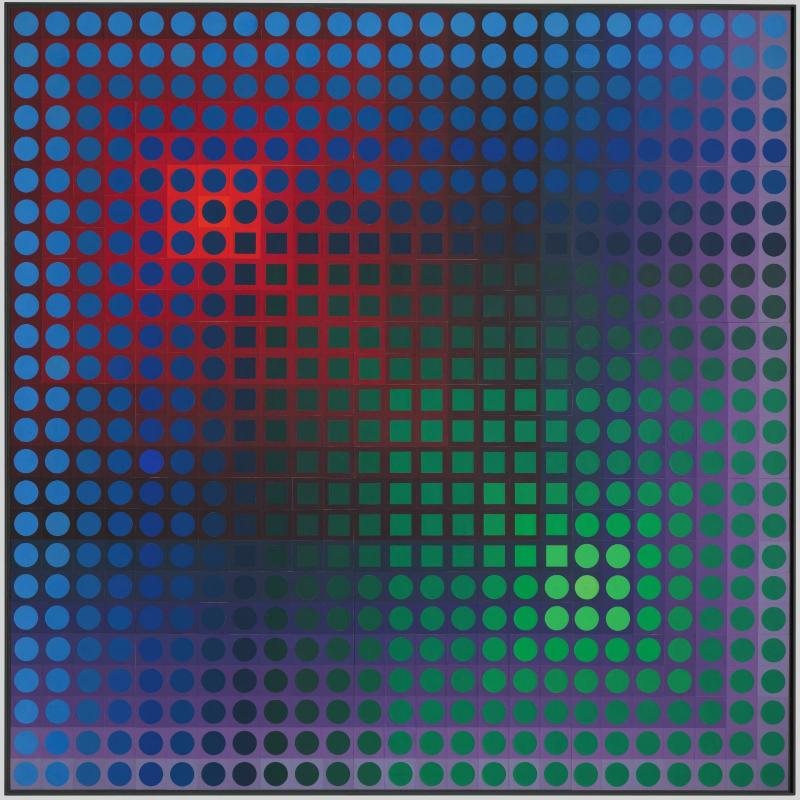 #7
#7
Arny (Shadow)
Inverted chromatic gradients move the grid forward and backward. The Hungarian title means "shadow" and reminds us that color produces an unstable space here. This image is presented for documentary purposes and opens the museum notice; the work is not offered for reproduction.
See the institution's notice →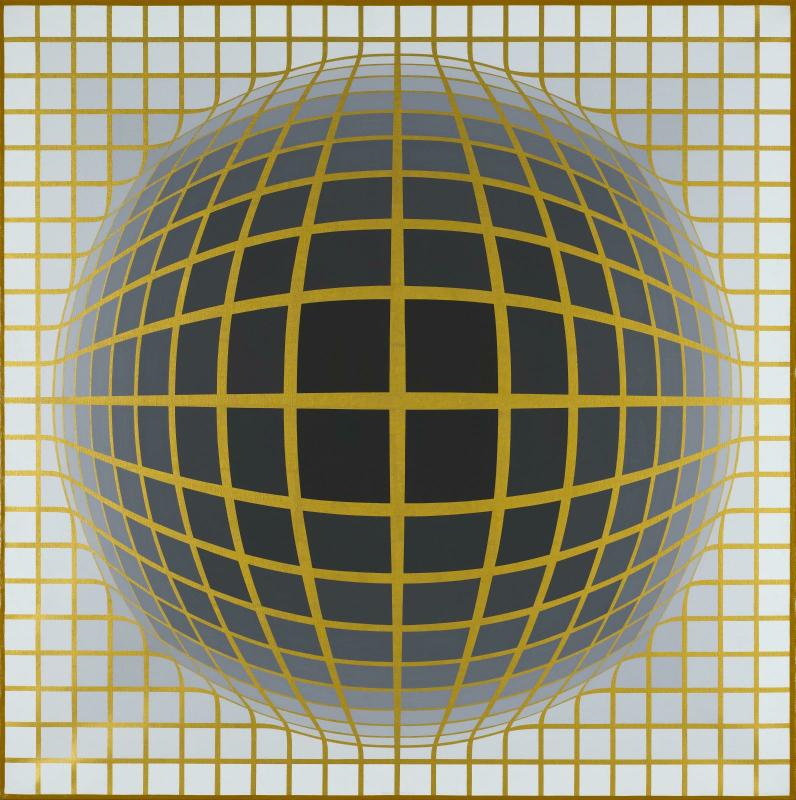 #8
#8
Re.Na II A
The regular grid seems to swell into a sphere under the effect of colors and deformations. The painting transforms a flat surface into perceptual volume. This image is presented for documentary purposes and opens the museum notice; the work is not offered for reproduction.
See the institution's notice →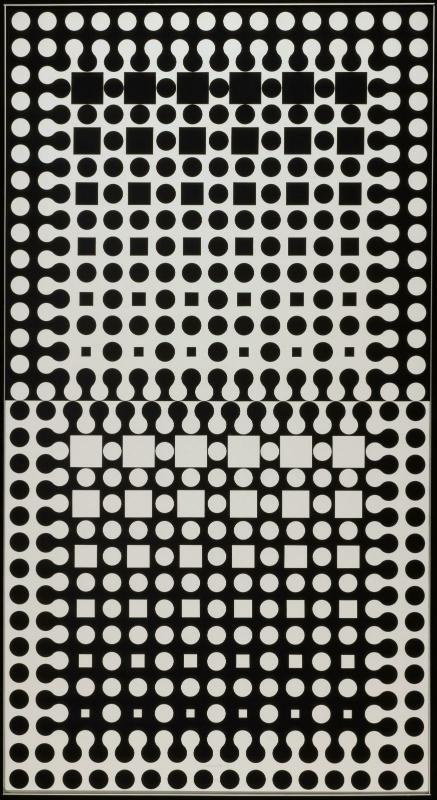 #9
#9
Tauri-R
Geometric units produce an illusion of relief that changes with distance. Vasarely imagines painting as a universal language based on the reaction of the gaze. This image is presented for documentary purposes and opens the museum notice; the work is not offered for reproduction.
See the institution's notice →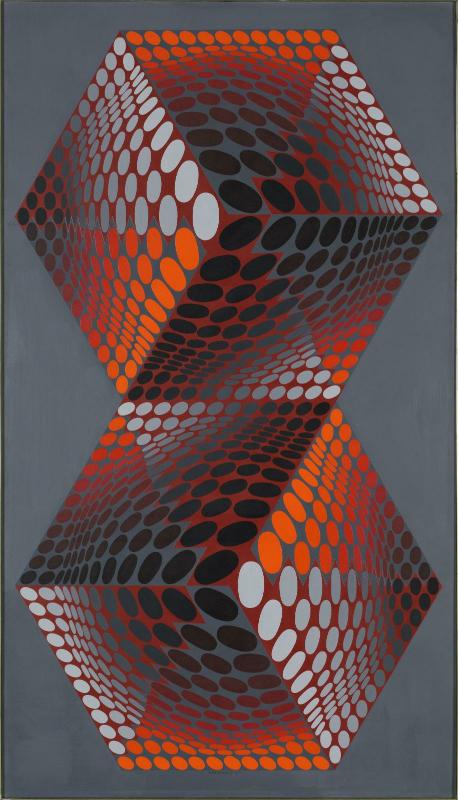 #10
#10
Bi-tupa
Cubes, spheres and alternating colors construct a vertical optical architecture. The large format brings the viewer into a space that appears to expand and contract. This image is presented for documentary purposes and opens the museum notice; the work is not offered for reproduction.
See the institution's notice →Executions, revolts and resistance build a national memory where the drama remains profoundly human.
 #11
#11
Self-portrait
Madarasz presents himself with a sobriety that contrasts with his great historical scenes. The direct gaze affirms the role of the painter as a witness to national memory.
See this reproduction → #12
#12
Dobozi
The legend of Mihály Dobozi recounts the flight from the Ottomans and the tragic sacrifice of his wife. Madarász condenses love, honor and catastrophe into an irreversible gesture.
See this reproduction → #13
#13
Felician Zach
Felician Zach attacked the family of King Charles I in 1330 before being killed. The painting questions revenge and the collective price of a political act.
See this reproduction → #14
#14
Ilona Zrínyi before the investigating judge
Defender of Munkacs Castle against the Habsburgs, Ilona Zrínyi appears before the judicial authority. Her dress and calm transform the interrogation into an image of resistance.
See this reproduction → #15
#15
The Mourning of Laszló Hunyadi
After the execution of Laszló Hunyadi in 1457, his family watched over the body. The funeral whites, closed faces and dark space make loss a political accusation.
See this reproduction → #16
#16
The Dream of Exile
The exiled figure surrenders to sleep while the lost homeland returns as a vision. Madarasz makes national history an inner and melancholy experience.
See this reproduction → #17
#17
The Supporters of Dózsa
The peasant revolt led by György Dózsa in 1514 became a scene of solidarity and tension. The faces show less an anonymous crowd than a committed group.
See this reproduction → #18
#18
Péter Zrínyi and Kristóf Frangepân in prison
The two nobles await their execution after the failure of the conspiracy against the Habsburgs in 1671. The closed session transforms the prison into a theater of loyalty and disillusionment.
See this reproduction → #19
#19
Portrait of Miklos Izso
The sculptor Miklôs Izso, author of figures that have become emblematic, is represented as a concentrated creator. The portrait connects two actors of Hungarian national romanticism.
See this reproduction → #20
#20
Portrait of the artist's wife
The marital portrait favors presence and expression rather than pageantry. Madarász reveals an intimacy rarely visible in his historical compositions, even in the restraint of the gaze.
See this reproduction →Prisoners, workers, religion and worldly society reveal the full breadth of his work.
 #21
#21
Apotheosis of the Renaissance
Designed for the ceiling of the Kunsthistorisches Museum in Vienna, this vast allegory celebrates Renaissance artists and the cultural authority of the Imperial Museum.
See this reproduction → #22
#22
Levite in prayer
The character in prayer belongs to Munkácsy's religious research. Light isolates the face and hands to make faith a bodily tension.
See this reproduction → #23
#23
Christ before Pilate
The first part of the Christ trilogy contrasts the calm of the condemned with the crowd and Roman power. Each look contributes to the moral process of the scene.
See this reproduction → #24
#24
The Drinker
The man and his glass are observed without caricature. The heavy posture and dark interior give alcohol a social as well as a psychological dimension, reinforced by the silence of the place.
See this reproduction → #25
#25
In front of the hostel
The scene in front of the inn brings together conversation, waiting and daily fatigue. Munkácsy finds in an ordinary place the structure of a small collective drama, readable in every attitude.
See this reproduction → #26
#26
Self-portrait of Munkacsy
The painter shows himself at the height of his international recognition, but the face retains a worried gravity. The image combines public success and self-examination.
See this reproduction → #27
#27
Hungarian village scene
The village is not treated as a folkloric setting: gestures, clothing and relationships between figures organize a precise chronicle of rural life.
See this reproduction → #28
#28
Picnic in May
Friends lie in the grass in bright light. Painted in 1873, the work anticipates impressionist research and becomes a late-recognized manifesto of Hungarian modernity.
See this reproduction → #29
#29
Lazarine and Anella
Lazarine, wife of the painter, and Anella are brought together in an interior where decorative areas count as much as people. Family intimacy becomes a structure of color.
See this reproduction → #30
#30
Self-portrait of Csontvâry
The frontal face and intense gaze affirm Csontvâry's almost prophetic conviction. The self-portrait explains the visionary dimension that he attributed to his vocation.
See this reproduction → #31
#31
Pilgrimage to the cedars of Lebanon
Around the thousand-year-old cedars, a procession transforms into a cosmic dance. The tree connects sacred history, real landscape and dream of a universal harmony carried by color.
See this reproduction → #32
#32
Hail Mary
Evening prayer suspends work and brings together figures in the landscape. The light of Nagybanya gives the daily rite a monumental simplicity.
See this reproduction → #33
#33
AM 3
Planes, circles and transparencies seem to float in a gravity-free space. Painting treats light as a constructive material rather than a natural effect.
See this reproduction → #34
#34
Z VIII
The diagonal, discs and translucent elements organize mechanical tension. Moholy-Nagy transforms the painting into a visual device close to architecture and photography.
See this reproduction → #35
#35
Storm in the puszta
The plain is crossed by a violent sky which reduces the figures to the scale of natural forces. The storm gives the puszta a dramatic intensity without recourse to history. Munkácsy gives Hungarian realism an international scope by uniting social drama, mastery of light and monumental ambition.
See this reproduction →The garden, meadow and sky release an outdoor color ahead of its critical recognition.
 #36
#36
The Isaszeg Battlefield
The site refers to the Hungarian victory of April 6, 1849 during the War of Independence. Munkácsy prefers traces and terrain to military triumph. Munkácsy gives Hungarian realism an international scope by uniting social drama, mastery of light and monumental ambition.
See this reproduction → #37
#37
The yawning Apprentice
Yawning breaks the codes of posing and reveals the fatigue of the young worker. This banal gesture becomes a striking image of the apprentice condition. Munkácsy gives Hungarian realism an international scope by uniting social drama, mastery of light and monumental ambition.
See this reproduction → #38
#38
The Convict's Cell
Family, guards and curious people surround the prisoner before the execution. The composition does not only judge the man: it observes society coming to witness his misfortune. Munkácsy gives Hungarian realism an international scope by uniting social drama, mastery of light and monumental ambition.
See this reproduction → #39
#39
Dark street
The almost empty street is built by faint passages of light. Munkácsy transforms the nocturnal city into a space of solitude and social uncertainty. Munkácsy gives Hungarian realism an international scope by uniting social drama, mastery of light and monumental ambition.
See this reproduction → #40
#40
Lint manufacturing
Women prepare lint for the wounded, a humble task linked to the wars of the century. Collective work unites domestic necessity and national history. Munkácsy gives Hungarian realism an international scope by uniting social drama, mastery of light and monumental ambition.
See this reproduction → #41
#41
Woman wearing a bundle
The weight of the wood determines the posture and step of the woman. Munkácsy gives rural work a physical presence without idealizing it. Munkácsy gives Hungarian realism an international scope by uniting social drama, mastery of light and monumental ambition.
See this reproduction → #42
#42
The Music Room
The luxurious interior, instruments and worldly exchanges show the other side of Munkácsy's career. Bourgeois sociability becomes a finely tuned spectacle. Munkácsy gives Hungarian realism an international scope by uniting social drama, mastery of light and monumental ambition.
See this reproduction → #43
#43
Zsigmond Szinyei Merse smoking chibouk
The artist's brother smokes a long pipe in a relaxed pose. The portrait captures a family presence while studying the contrasts of face, clothing and smoke. Szinyei Merse released color and light from the outdoors early on, even before Impressionism was recognized in Hungary.
See this reproduction → #44
#44
Wildlife and lovers
On both sides of the canvas, Szinyei confronts mythology and modern intimacy. Fauna and lovers bear witness to a still open research into desire and nature. Szinyei Merse released color and light from the open air very early on, even before Impressionism was recognized in Hungary.
See this reproduction → #45
#45
Lovers
The couple is absorbed by its proximity while the landscape becomes a luminous envelope. Szinyei makes feeling a concrete relationship between body, air and color. Szinyei Merse released color and outdoor light very early on, even before impressionism was recognized in Hungary.
See this reproduction →Figures and landscapes unite in a constructed light, attentive to gestures and the passage of the seasons.
 #46
#46
Woman sitting in a garden
The figure is not separated from the garden: dress, bench and foliage share the same light. This unity announces the conquest of the outdoors in his painting. Szinyei Merse released color and outdoor light very early, even before Impressionism was recognized in Hungary.
See this reproduction → #47
#47
The Artist's Workshop
The workshop shows the place where images and professional identity are produced. Objects, walls and natural light make up an indirect self-portrait of the painter. Szinyei Merse released color and outdoor light very early, even before impressionism was recognized in Hungary.
See this reproduction → #48
#48
Woman in purple
Bold purple structures the silhouette and changes the surrounding tones. Szinyei treats color as a standalone force rather than just an attribute of clothing. Szinyei Merse released color and outdoor light early on, even before Impressionism was recognized in Hungary.
See this reproduction → #49
#49
The Balloon
The tiny balloon floats above a huge landscape. This confrontation between technical invention, sky and earth produces one of the most original images of 19th century European painting. Szinyei Merse released color and outdoor light very early on, even before Impressionism was recognized in Hungary.
See this reproduction → #50
#50
The Lark
A young woman lying down listens to the invisible bird in the sky. The body, grass and light make listening a physical experience of spring. Szinyei Merse released color and outdoor light very early, even before impressionism was recognized in Hungary.
See this reproduction → #51
#51
Poppy meadow
Poppies disperse red accents in the green expanse. Szinyei constructs depth through the color and vibration of the field rather than through a rigid design. Szinyei Merse released color and outdoor light early on, even before Impressionism was recognized in Hungary.
See this reproduction → #52
#52
Woman lying in bed
The elongated figure, textiles and close framing transform the room into an autonomous world. Rippl-Rónai prefers the intimacy observed to the conventions of official portraiture. Close to the Nabis in France, Rippl-Rónai simplifies shapes and builds its interiors with flat areas, contours and decorative accords.
See this reproduction → #53
#53
Ball players
The silhouettes are cut out in a simplified space where the game provides rhythm and distance. Outdoor activity becomes an almost decorative composition. Close to the Nabis in France, Rippl-Rónai simplifies shapes and builds its interiors with flat areas, contours and decorative accords.
See this reproduction → #54
#54
Young girl with birdcage
The cage introduces a fragile geometry between the young girl and the background. The invisible bird suggests domestic presence, expectation and desire for freedom. Close to the Nabis in France, Rippl-Rónai simplifies shapes and builds its interiors with flat areas, contours and decorative accords.
See this reproduction → #55
#55
My grandmother
The dominant black, the profile and the white headdress give the grandmother a silent dignity. This economy of means marks the artist's Nabi period. Close to the Nabis in France, Rippl-Rónai simplifies shapes and builds its interiors with flat areas, contours and decorative accords.
See this reproduction →Roads, vagabonds and climates transform the landscape into an interior state.
 #56
#56
Slender woman with a vase
The silhouette and the vase respond to the same logic of curved lines. The portrait becomes a decorative accord without losing the singularity of the model. Close to the Nabis in France, Rippl-Rónai simplifies shapes and builds its interiors with flat areas, contours and decorative accords.
See this reproduction → #57
#57
Self-portrait of Rippl-Ronai
The painter represents himself in large masses and assured contours. The self-portrait boasts a modern language built in Paris but now fully personal. Close to the Nabis in France, Rippl-Rónai simplifies shapes and builds its interiors with flat areas, contours and decorative accords.
See this reproduction → #58
#58
Aristide Maillol
The portrait of the sculptor Aristide Maillol recalls the friendship born in the circle of the Nabis. The face and background condense a dialogue between decorative painting and sculpture. Close to the Nabis in France, Rippl-Rónai simplifies shapes and builds its interiors with flat areas, contours and decorative accords.
See this reproduction → #59
#59
Christmas
The festival takes place in a family interior without religious emphasis. The characters, furniture and warm colors give the rite a daily truth. Close to the Nabis in France, Rippl-Rónai simplifies shapes and builds its interiors with flat areas, contours and decorative accords.
See this reproduction → #60
#60
My father and Piacsek in red wine
The two men sitting around the wine embody the life of Kaposvár's house. The table and the flat reds organize a silent conversation that has become emblematic. Close to the Nabis in France, Rippl-Rónai simplifies shapes and builds its interiors with flat areas, contours and decorative accords.
See this reproduction → #61
#61
Young girls caring for flowers
The care given to flowers combines work, learning and gardening. Ferenczy constructs the scene with soft light which connects gestures to the natural environment. A major figure in the Nagybânya colony, Ferenczy combines naturalism, the outdoors and meditated construction of the figure.
See this reproduction → #62
#62
Boys throwing stones into the river
Throwing stones fragments the movement into successive attitudes. The water, bodies and bank make this game a precise study of time and youth. A major figure in the Nagybanya colony, Ferenczy combines naturalism, the outdoors and the meditated construction of the figure.
See this reproduction → #63
#63
Bird song
The title shifts attention to a sound that painting cannot show. Figures and landscape seem suspended in a common listening to nature. A major figure in the Nagybanya colony, Ferenczy combines naturalism, the outdoors and the meditated construction of the figure.
See this reproduction → #64
#64
Adam
The male nude is presented without abundant narrative decor. Ferenczy renews the biblical subject through observation of the body and outdoor light. A major figure in the Nagybânya colony, Ferenczy combines naturalism, the outdoors and meditated construction of the figure.
See this reproduction → #65
#65
Archeology
The figures gathered around the remains confront present and past. The painting questions both the modern view of Antiquity and the object discovered. A major figure in the Nagybânya colony, Ferenczy combines naturalism, the outdoors and the meditated construction of the figure.
See this reproduction →The circle of Nabis nourishes a personal painting of the family, the interior and the portrait.
 #66
#66
Loggers returning home
The workers advance after the day in a landscape that shares their fatigue. The collective march gives the naturalist scene its serious rhythm. A major figure in the Nagybânya colony, Ferenczy combines naturalism, the outdoors and the meditated construction of the figure.
See this reproduction → #67
#67
March evening
The season still hesitates between winter and spring. Ferenczy constructs this transition through low light, cold lands and humid atmosphere. A major figure in the Nagybanya colony, Ferenczy combines naturalism, the outdoors and meditated construction of the figure.
See this reproduction → #68
#68
October
Autumn colors are not a setting but the very subject of the painting. They organize the depth and give the landscape a meditative intensity. A major figure in the Nagybanya colony, Ferenczy combines naturalism, the outdoors and the meditated construction of the figure.
See this reproduction → #69
#69
Archers
The outstretched bodies, arches and direction of gaze produce a composition of forces. Ferenczy unites ancient subject and modern analysis of movement. A major figure in the Nagybanya colony, Ferenczy combines naturalism, the outdoors and meditated construction of the figure.
See this reproduction → #70
#70
Brother and sister - the artist's children
Béni and Noémi appear as two distinct presences united by family proximity. The double portrait avoids sentimentality and observes their relationship. A major figure in the Nagybânya colony, Ferenczy combines naturalism, the outdoors and the meditated construction of the figure.
See this reproduction → #71
#71
After a spring rain
Water darkens the ground and makes the air more transparent. Mednyanszky paints less of the downpour than the change in perception that follows it. Mednyanszky transforms forests, roads and marginal figures into atmospheric visions where nature carries deep emotion.
See this reproduction → #72
#72
Autumn afternoon
Late light passes through the foliage and stretches the shadows. The landscape becomes a duration, located between the brilliance of the season and its imminent erasure. Mednyanszky transforms forests, roads and marginal figures into atmospheric visions where nature carries deep emotion.
See this reproduction → #73
#73
Birch forest
The white trunks punctuate the depth without closing the undergrowth. Repetition transforms the observed forest into an almost abstract rhythm. Mednyanszky transforms forests, roads and marginal figures into atmospheric visions where nature carries deep emotion.
See this reproduction → #74
#74
The Infinite
An open horizon and reduced shapes give the landscape a mental extension. The title invites us to read space as a metaphysical experience rather than as a topography. Mednyanszky transforms forests, roads and marginal figures into atmospheric visions where nature carries deep emotion.
See this reproduction → #75
#75
Old woman peeling potatoes
The domestic gesture is painted with an attention that refuses the picturesque. The solitude of women gives repetitive work a human gravity. Mednyanszky transforms forests, roads and marginal figures into atmospheric visions where nature carries deep emotion.
See this reproduction →From the Adriatic to Lebanon, each site becomes a luminous and monumental vision.
 #76
#76
Wanderer
Mednyanszky was interested all his life in the marginalized people encountered on the roads. The face and worn clothing make visible an individuality that society ignores. Mednyanszky transforms forests, roads and marginal figures into atmospheric visions where nature carries deep emotion.
See this reproduction → #77
#77
Winter Street
Snow and sky reduce the street to a few dark masses. Cold becomes a condition of space as much as a meteorological sensation. Mednyanszky transforms forests, roads and marginal figures into atmospheric visions where nature carries deep emotion.
See this reproduction → #78
#78
Forest in autumn
The red foliage and deep shade transform the undergrowth into colorful material. The uncertain path catches the eye without giving it a destination. Mednyanszky transforms forests, roads and marginal figures into atmospheric visions where nature carries deep emotion.
See this reproduction → #79
#79
Loneliness in the woods, moonlit night
The moon only partially illuminates the forest and leaves the space open to worry. The solitude of the title belongs as much to the landscape as to the viewer. Mednyanszky transforms forests, roads and marginal figures into atmospheric visions where nature carries deep emotion.
See this reproduction → #80
#80
Fishing on the Tisza
The Tisza River organizes the lives of fishermen and the depth of the landscape. Mednyanszky unites human activity, reflections and slow water. Mednyanszky transforms forests, roads and marginal figures into atmospheric visions where nature carries deep emotion.
See this reproduction → #81
#81
Traù at sunset
The Dalmatian city and the sea are ablaze in unreal light. Csontváry transforms the observation of the journey into a cosmic vision of the evening. Csontváry travels from the Adriatic to Lebanon and constructs a visionary painting, saturated with light and monumental scales.
See this reproduction → #82
#82
The Old Fisherman
The weathered face and fisherman's hands carry the experience of the coastline. The potential symmetry of the image has nourished numerous readings on its duality. Csontváry travels from the Adriatic to Lebanon and constructs a visionary painting, saturated with light and monumental scales.
See this reproduction → #83
#83
Jajce Waterfall
Water flows through the Bosnian city with power that shakes up architecture. Csontváry builds a balance between natural movement and the historical presence of the site. Csontváry travels from the Adriatic to Lebanon and constructs a visionary painting, saturated with light and monumental scales.
See this reproduction → #84
#84
The Mysterious Island
The island emerges like an isolated mass between water and sky. The title opens the real landscape to a mental, almost dreamlike interpretation. Csontváry travels from the Adriatic to Lebanon and constructs a visionary painting, saturated with light and monumental scales.
See this reproduction → #85
#85
Ottoman bridge in Mostar
The bridge arch connects the two banks and organizes the entire composition. Architecture, water and relief become parts of the same luminous organism. Csontváry travels from the Adriatic to Lebanon and constructs a visionary painting, saturated with light and monumental scales.
See this reproduction →The outdoor tradition is evolving towards more synthetic and decorative rhythms.
 #86
#86
Ruins of Greek theater in Taormina
Ancient ruins dominate the sea and Etna in a very wide-ranging view. The human past seems tiny compared to geological time. Csontváry travels from the Adriatic to Lebanon and constructs a visionary painting, saturated with light and monumental scales.
See this reproduction → #87
#87
Baalbek
The Baalbek shrine is treated on the monumental scale of a panorama. Light unites columns, mountains and sky in a vision that goes beyond simple archaeological accuracy. Csontváry travels from the Adriatic to Lebanon and constructs a visionary painting, saturated with light and monumental scales.
See this reproduction → #88
#88
The Lonely Cedar
The twisted cedar stands as a symbolic self-portrait of the artist. Its shape resists wind, time and isolation in an almost sacred landscape. Csontváry travels from the Adriatic to Lebanon and constructs a visionary painting, saturated with light and monumental scales.
See this reproduction → #89
#89
Young girls by the river
The figures stand out near the water in a clear light. Iványi-Grünwald transforms rural leisure into a composition of bold colors. From Nagybanya to Kecskemét, Iványi-Grünwald evolves the Hungarian outdoors towards a more decorative and synthetic color.
See this reproduction → #90
#90
Kecskemét windmill
The mill structures the flat horizon and recalls the identity of the Hungarian plain. The simplification of shapes gives the site an almost emblematic value. From Nagybanya to Kecskemét, Iványi-Grünwald evolves the Hungarian outdoors towards a more decorative and synthetic color.
See this reproduction →Plans, transparencies and geometry make the painting a Bauhaus laboratory.
 #91
#91
Market under the snow in Kecskemét
The snow unifies stalls, passers-by and architecture while the colorful accents keep the market lively. The cold does not suppress collective life. From Nagybanya to Kecskemét, Iványi-Grünwald evolves the Hungarian outdoors towards a more decorative and synthetic color.
See this reproduction → #92
#92
Self-portrait with a model
The painter and model share the space of artistic work. The image shows the concrete relationship between gaze, pose and painting making. From Nagybanya to Kecskemét, Iványi-Grünwald evolves the Hungarian outdoors towards a more decorative and synthetic color.
See this reproduction → #93
#93
E IV - Construction VII
The transparent plans intersect like architectural elements. The work transposes into painting the Bauhaus' taste for materials, precision and modern production. Moholy-Nagy makes the painted surface a Bauhaus laboratory where light, transparency and geometry replace the traditional narrative.
See this reproduction → #94
#94
READ
Circles, bars and colored surfaces build a balance without a fixed center. The non-descriptive title frees the eye from any imposed narration. Moholy-Nagy makes the painted surface a Bauhaus laboratory where light, transparency and geometry replace the traditional story.
See this reproduction → #95
#95
On a white background
The white background acts as a luminous space where shapes seem to move. Contrasts, transparencies and overlaps produce depth without classical perspective. Moholy-Nagy makes the painted surface a Bauhaus laboratory where light, transparency and geometry replace the traditional narrative.
See this reproduction →Clowns, markets, musicians and sacred stories take on an expressive and popular energy.
 #96
#96
Clowns
Clowns allow Aba-Novák to combine spectacle and worry. Makeup, gestures and color show the gap between public persona and inner fatigue. Aba-Novák combines nervous drawing, frank color and showmanship in a modern painting attentive to popular crowds.
See this reproduction → #97
#97
Ceramics market
Pots, vendors and customers fill the space with a dense rhythm. The popular material of the objects becomes the driving force behind a modern and lively composition. Aba-Novák combines nervous drawing, frank color and showmanship in a modern painting attentive to popular crowds.
See this reproduction → #98
#98
Musicians
The instruments extend the bodies and organize the movement of the group. Aba-Novák translates music through diagonals, colors and accentuated gestures. Aba-Novák combines nervous drawing, frank color and showmanship in a modern painting attentive to popular crowds.
See this reproduction → #99
#99
Life
The ambitious title brings together several ages and activities in the same composition. The painting condenses daily existence, work and the passage of time without a single story. Aba-Novák combines nervous drawing, frank color and showmanship in a modern painting attentive to popular crowds.
See this reproduction → #100
#100
Saint Francis preaching to birds
The saint addresses birds in a simplified landscape. Aba-Novák renews the Franciscan episode with expressive color and deliberately direct drawing. Aba-Novák combines nervous drawing, frank color and showmanship in a modern painting attentive to popular crowds.
See this reproduction →Sources and links
Alpha and Center Pompidou sheets
The 90 historical paintings use their Alpha Reproduction images and links. The ten works of Victor Vasarely are presented for documentary purposes only: each image opens the exact notice of the Center Pompidou, and none of these works are offered for reproduction.
History painting and realism
The Mourning of Laszló Hunyadi - MadaraszA major image of Hungarian political memory.The Convict's Cell - MunkácsyHungarian social realism brought to an international intensity.Frequently asked questions
Questions about Hungarian painting
Some benchmarks to situate the artists, movements and documentary status of protected works.
Why is Munkácsy central to Hungarian painting?
He gives Hungarian realism international recognition thanks to his social scenes, his portraits, his worldly interiors and his Christ trilogy. His sense of drama always remains linked to a very concrete observation of the figures.
What is Nagybanya Colony?
Founded at the end of the 19th century in what is now Baia Mare, it brings together artists determined to work in front of nature. Ferenczy and Iványi-Grünwald developed an outdoor painting there which played a founding role in Hungarian modernity.
Why does Csontváry seem so different from his contemporaries?
Self-taught and traveling, he gives real sites visionary light, color and scale. Its landscapes of Taormina, Mostar, Baalbek and Lebanon are neither naturalism nor traditional symbolism.
What role does Moholy-Nagy play at the Bauhaus?
He taught at the Bauhaus from 1923 and defended an open-plan practice between painting, photography, typography, cinema and design. His paintings study light and space like modern materials.
Are Vasarely's works offered for reproduction?
No. They are protected and appear solely for documentary purposes to extend the history of Hungarian painting to optical art. Images and buttons open the Center Pompidou notices.
0 comments