

Top 100 - René Magritte
The 100 famous paintings by René Magritte
One hundred paintings, one hundred distinct images and one hundred direct links to the museums that document them.
Magritte paints the world with calm precision, then moves a word, a ladder or a window. The pipe ceases to be a pipe, the night coexists with broad daylight and a face disappears behind what should reveal it.
The mystery in broad daylight
René Magritte: painting thought with ordinary things
Magritte does not blur the world: he paints it with almost impersonal clarity. It is precisely this clarity that makes a train in a fireplace, an eye filled with sky or lovers deprived of faces impossible.
In Magritte, the visible is never a setting; it becomes a question posed to our habits.Enter the tables
Classification in images
Veiled lovers, eyes filled with sky, nocturnal cities and disproportionate objects: twenty-five paintings where Magritte makes the evidence profoundly unstable.
#1
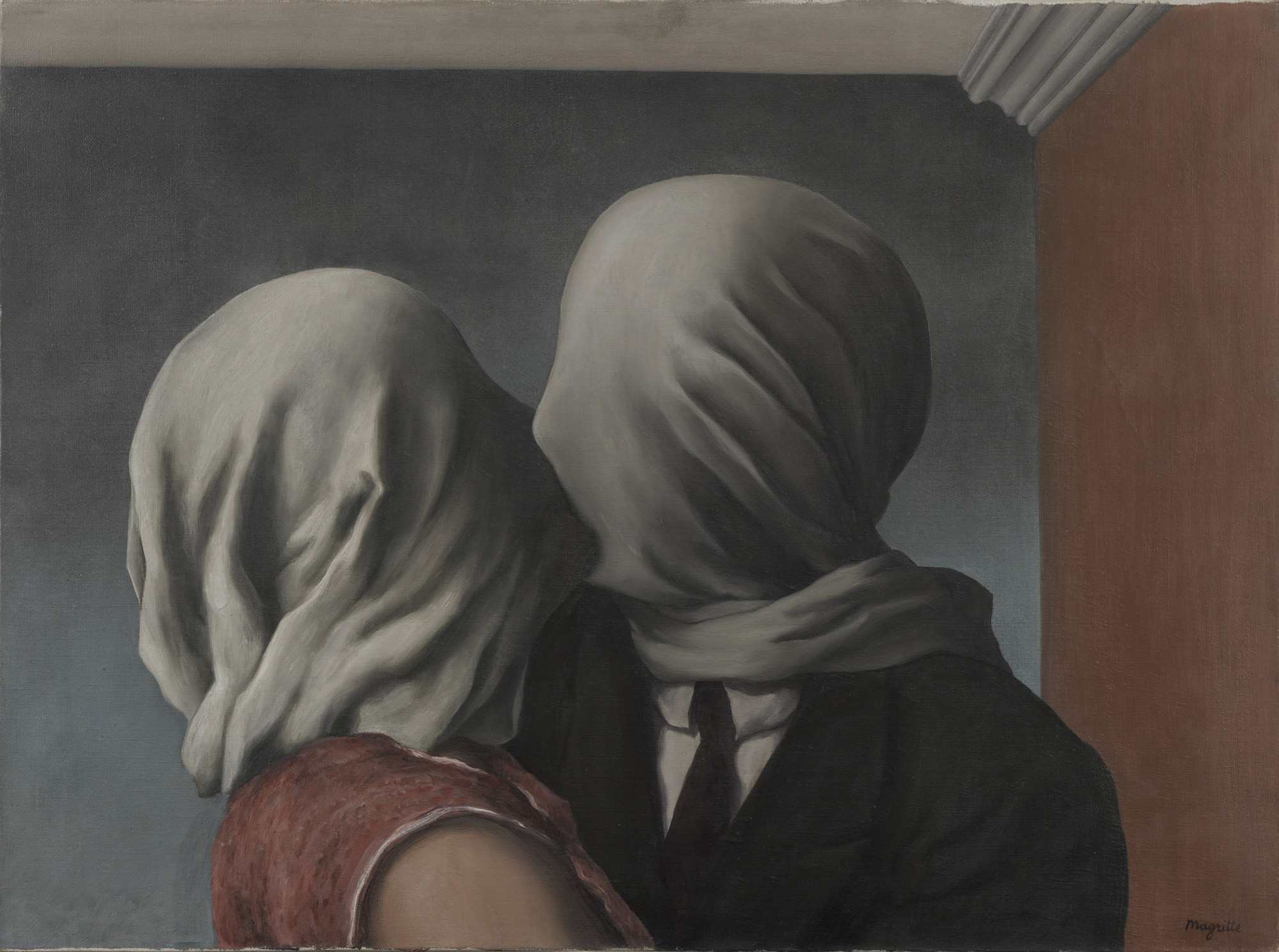
The Lovers (The Lovers)
With "Les Amants (The Lovers)", Magritte constructs a clear image whose logic slips away at the very moment we think we grasp it. The human figure remains recognizable, but its identity slips away behind a screen, a movement or a substitution. Produced during the years when the painter fixed his surrealist vocabulary, the work favors the shock of a visible association over the evocation of an indistinct dream. The technique - oil on canvas - supports this voluntary clarity: contours, surfaces and transitions remain precise enough for the impossible to appear objectively observed. The technique - oil on canvas - supports this voluntary sharpness: contours, surfaces and transitions remain precise enough for the impossible to appear objectively observed. The technique - oil on canvas - supports this voluntary sharpness: contours, surfaces and transitions remain precise enough for the impossible to appear objectively observed. The technique - oil on canvas - supports this voluntary sharpness: contours, surfaces and transitions remain precise enough for the impossible to appear objectively observed. The Museum of Modern Art, New York notice documents the work, dated 1928 and measuring 21 3/8 × 28 7/8 in. (54 × 73.4 cm). This institutional link makes it possible to find collection data, the available provenance and the conditions of use of the image. The painting therefore does not provide an enigma to be solved: it keeps the gaze in the fruitful moment when seeing and understanding cease to coincide.
Image: The Museum of Modern Art, New York · © C. Herscovici, Brussels /Artists Rights Society (ARS), New York
See the museum notice →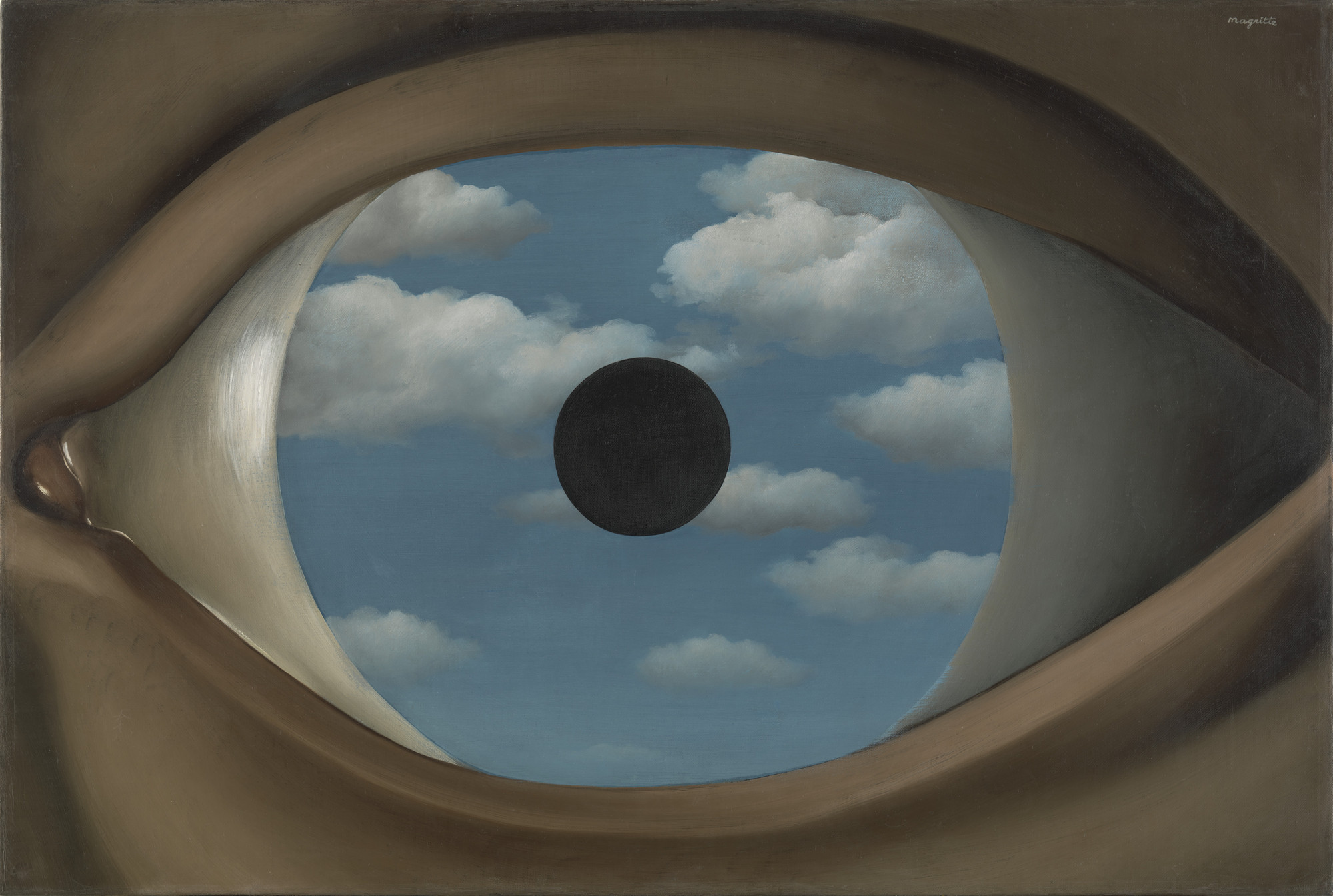 #2
#2
The False Mirror (The False Mirror)
"The False Mirror (The False Mirror)" shows Magritte's method at its most direct point: painting with precision to make reality less certain. The bringing together of incompatible elements transforms the scene into a visual proposition rather than a closed story. Produced during the years when the painter fixed his surrealist vocabulary, the work favors the shock of a visible association over the evocation of an indistinct dream. The technique - oil on canvas - supports this voluntary clarity: contours, surfaces and transitions remain precise enough for the impossible to appear objectively observed. The technique - oil on canvas - supports this voluntary sharpness: contours, surfaces and transitions remain precise enough for the impossible to appear objectively observed. The technique - oil on canvas - supports this voluntary sharpness: contours, surfaces and transitions remain precise enough for the impossible to appear objectively observed. The technique - oil on canvas - supports this voluntary sharpness: contours, surfaces and transitions remain precise enough for the impossible to appear objectively observed. The Museum of Modern Art, New York notice documents the work, dated 1929 and measuring 21 1/4 × 31 7/8 in. (54 × 80.9 cm). This institutional link makes it possible to find collection data, the available provenance and the conditions of use of the image. This suspension of meaning explains the lasting force of the image: it appears immediately readable, then becomes more unstable with each look.
Image: The Museum of Modern Art, New York · © C. Herscovici, Brussels /Artists Rights Society (ARS), New York
See the museum notice → #3
#3
The empire of lights
In "The Empire of Lights", nothing is blurry, and yet the whole thing resists a single explanation. Light does not only describe an hour: it puts the coherence of the visible world in crisis. In the post-war period, Magritte returned to his smooth style and the paradoxes which made him unique, while multiplying the repetitions and shifts of scale. The technique - oil on canvas - supports this voluntary clarity: contours, surfaces and transitions remain precise enough for the impossible to appear objectively observed. The notice from the Royal Museums of Fine Arts of Belgium, Brussels documents the work, dated 1954 and measuring 146 x 114. This institutional link makes it possible to find collection data, available provenance and conditions of use of the image. Magritte thus leaves the viewer with an active task: to see what is painted, then to measure everything that this evidence is not enough to explain.
Image: Royal Museums of Fine Arts of Belgium, Brussels /photo: J. Geleyns - Art Photography · © Ch. Herscovici, with kind permission c/o SABAM Belgium
See the museum notice →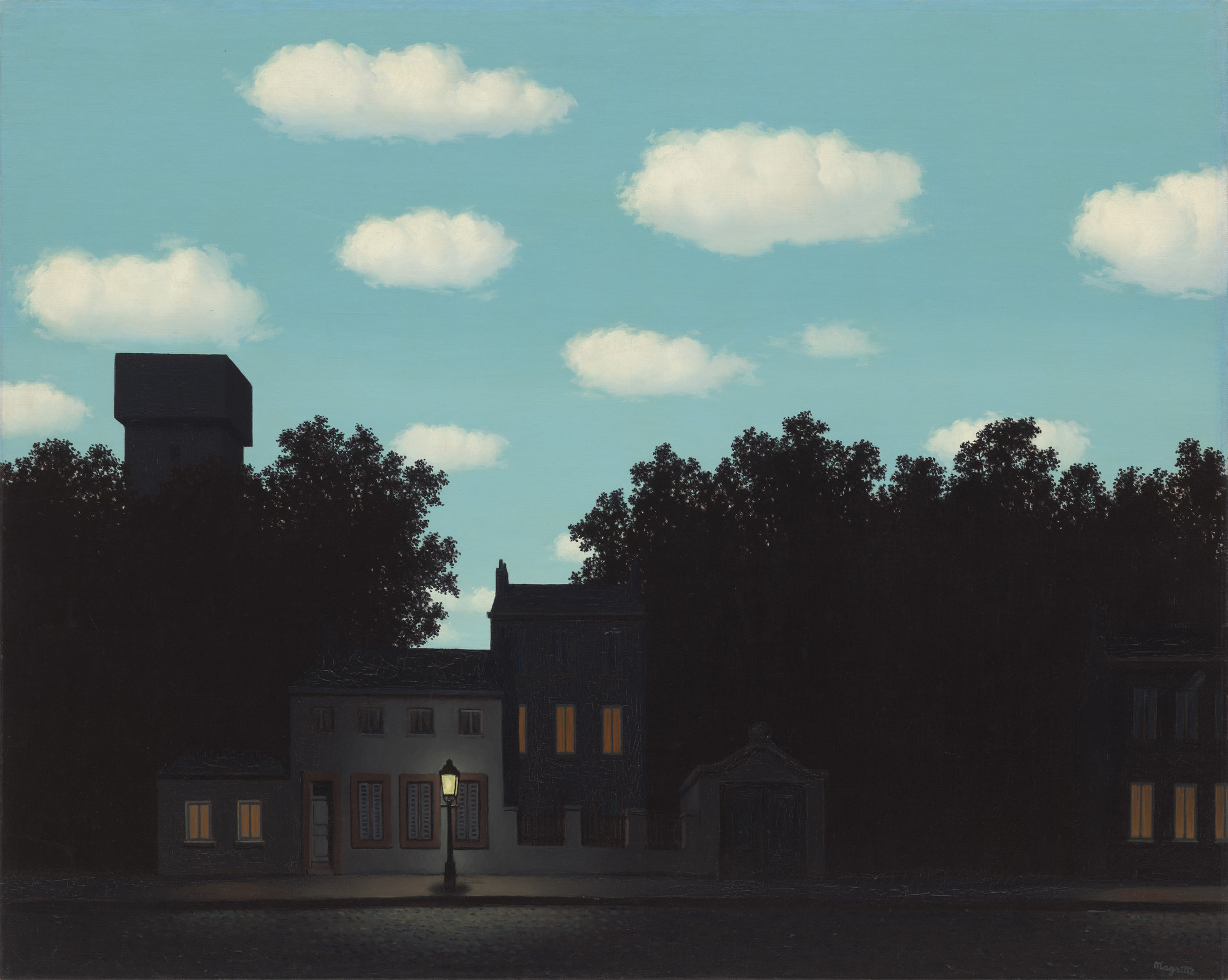 #4
#4
The Empire of Light II (The Empire of Light, II)
Under the apparent simplicity of "The Empire of Light II (II)", Magritte organizes a silent collision between familiar elements. Light does not only describe an hour: it puts the coherence of the visible world in crisis. In the post-war period, Magritte returned to his smooth style and the paradoxes which made him unique, while multiplying the repetitions and shifts of scale. The technique - oil on canvas - supports this voluntary sharpness: contours, surfaces and transitions remain precise enough for the impossible to appear objectively observed. The technique - oil on canvas - supports this voluntary sharpness: contours, surfaces and transitions remain precise enough for the impossible to appear objectively observed. The technique - oil on canvas - supports this voluntary sharpness: contours, surfaces and transitions remain precise enough for the impossible to appear objectively observed. The technique - oil on canvas - supports this voluntary sharpness: contours, surfaces and transitions remain precise enough for the impossible to appear objectively observed. The technique - oil on canvas - supports this voluntary sharpness: contours, surfaces and transitions remain precise enough for the impossible to appear objectively observed. The technique - oil on canvas - supports this voluntary sharpness: contours, surfaces and transitions remain precise enough for the impossible to appear objectively observed. The Museum of Modern Art, New York notice documents the work, dated 1950 and measuring in. (78.8 × 99.1 cm). This institutional link makes it possible to find collection data, the available provenance and the conditions of use of the image. The work remains memorable because its strangeness never abolishes everyday life; on the contrary, it reveals how much it depends on our reading habits.
Image: The Museum of Modern Art, New York · © C. Herscovici, Brussels /Artists Rights Society (ARS), New York
See the museum notice → #5
#5
Golconda (Golconda)
"Golconda (Golconda)" belongs to these images where Magritte transforms descriptive clarity into a true instrument of mystery. The bringing together of incompatible elements transforms the scene into a visual proposition rather than a closed story. In the post-war period, Magritte returned to his smooth style and the paradoxes which made him unique, while multiplying the repetitions and shifts in scale. The technique - oil on canvas - supports this voluntary clarity: contours, surfaces and transitions remain precise enough for the impossible to appear objectively observed. The Menil Collection, Houston - maintains this voluntary sharpness: contours, surfaces and transitions remain precise enough for the impossible to appear objectively observed. The Menil Collection, Houston - maintains this voluntary sharpness: contours, surfaces and transitions remain precise enough for the impossible to appear objectively observed. The Menil Collection, Houston's notice documents the work, dated 1953 and measuring 31 1/2 × 39 1/2 in. (80 × 100.3 cm). This institutional link makes it possible to find collection data, the available provenance and the conditions of use of the image. The painting therefore does not provide a riddle to solve: it keeps the gaze in the fruitful moment when seeing and understanding cease to coincide.
Image: null · © C. Herscovici /Artists Rights Society (ARS), New York
See the museum notice →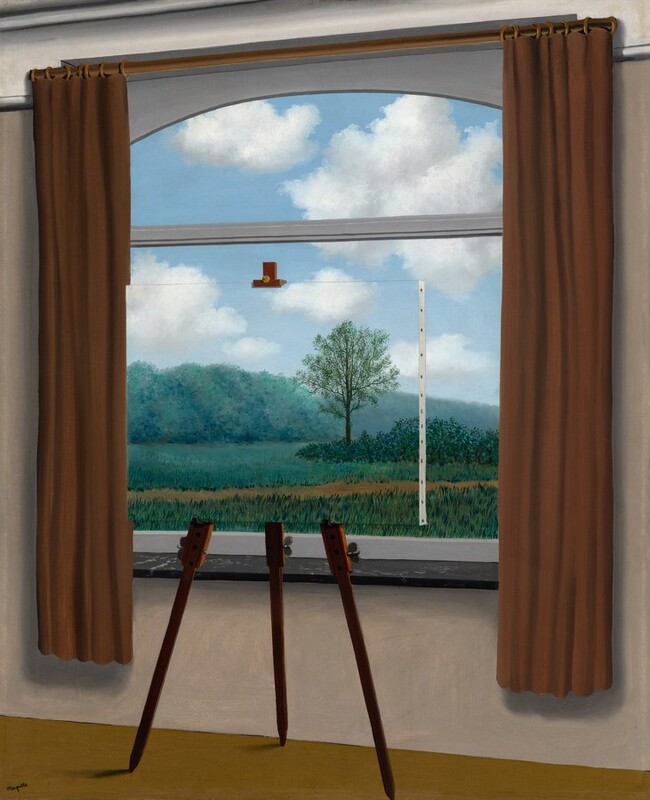 #6
#6
The human condition
With "The Human Condition", Magritte constructs a clear image whose logic slips away at the very moment we think we grasp it. The bringing together of incompatible elements transforms the scene into a visual proposition rather than a closed story. During this period, Magritte took up his motifs in series and variations, convinced that the same idea can produce several pictorial solutions. The technique - oil on canvas - supports this voluntary sharpness: contours, surfaces and transitions remain precise enough for the impossible to appear objectively observed. The technique - oil on canvas - supports this voluntary sharpness: contours, surfaces and transitions remain precise enough for the impossible to appear objectively observed. The technique - oil on canvas - supports this voluntary sharpness: contours, surfaces and transitions remain precise enough for the impossible to appear objectively observed. The technique - oil on canvas - supports this voluntary sharpness: contours, surfaces and transitions remain precise enough for the impossible to appear objectively observed. The technique - oil on canvas - supports this voluntary sharpness: contours, surfaces and transitions remain precise enough for the impossible to appear objectively observed. The National Gallery of Art, Washington notice documents the work, dated 1933 and measuring 100 × 81 × 1.6 cm. This link institutional makes it possible to find collection data, available provenance and conditions of use of the image. This suspension of meaning explains the lasting force of the image: it appears immediately readable, then becomes more unstable with each look.
Image: National Gallery of Art, Washington · Media not downloadable; contact the NGA for image use
See the museum notice → #7
#7
The stabbed duration (Time Transfixed)
"The Stabbed Duration (Time Transfixed)" shows Magritte's method at its most direct point: painting with precision to make reality less certain. The bringing together of incompatible elements transforms the scene into a visual proposition rather than a closed story. During this period, Magritte took up his motifs in series and variations, convinced that the same idea can produce several pictorial solutions. The technique - oil on canvas - supports this voluntary sharpness: contours, surfaces and transitions remain precise enough for the impossible to appear objectively observed. The technique - oil on canvas - supports this voluntary sharpness: contours, surfaces and transitions remain precise enough for the impossible to appear objectively observed. The technique - oil on canvas - supports this voluntary sharpness: contours, surfaces and transitions remain precise enough for the impossible to appear objectively observed. The art Institute of Chicago notice documents the work, dated 1938 and measuring 147 × 98.7 cm (57 7/8 × 38 7/8 in.). This institutional link makes it possible to find collection data, the available provenance and the conditions of use of the image. Magritte thus leaves the viewer with an active task: to note what is painted, then to measure everything that this evidence is not enough to explain.
Image: The Art Institute of Chicago · © 2018 C. Herscovici, London /Artists Rights Society (ARS), New York
See the museum notice →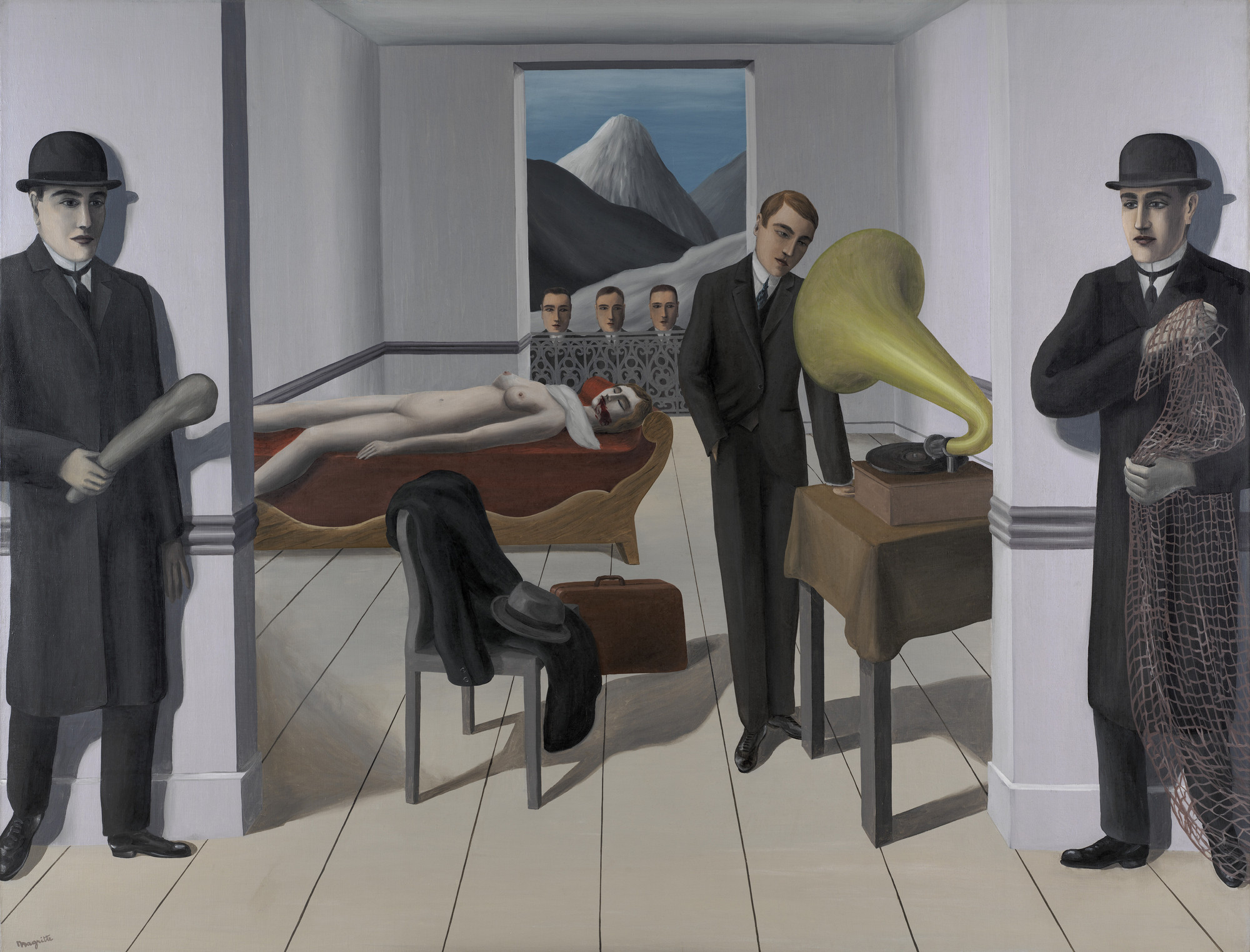 #8
#8
The Threatened Assassin (The Threatened Assassin)
In "The Threatened Assassin (The Threatened Assassin)", nothing is blurry, and yet the whole thing resists a single explanation. The bringing together of incompatible elements transforms the scene into a visual proposition rather than a closed story. Produced during the years when the painter established his surrealist vocabulary, the work favors the shock of a visible association over the evocation of an indistinct dream. The technique - oil on canvas - supports this voluntary clarity: contours, surfaces and transitions remain precise enough for the impossible to appear objectively observed. The technique - oil on canvas - supports this voluntary clarity: contours, surfaces and transitions remain precise enough for the impossible to appear objectively observed. The technique - oil on canvas - supports this voluntary sharpness: contours, surfaces and transitions remain precise enough for the impossible to appear objectively observed. The Museum of Modern Art, New York notice documents the work, dated 1927 and measuring 59 1/4 × 76 7/8 in. (150.4 × 195.2 cm). This institutional link makes it possible to find collection data, the available provenance and the conditions of use of the image. The work remains memorable because its strangeness never abolishes everyday life; on the contrary, it reveals how much it depends on our reading habits.
Image: The Museum of Modern Art, New York · © C. Herscovici, Brussels /Artists Rights Society (ARS), New York
See the museum notice → #9
#9
The Listening Room (The listening room)
Under the apparent simplicity of "The Listening Room (The Listening Room)", Magritte organizes a silent collision between familiar elements. An ordinary object becomes the focus of an enigma as soon as its scale, place or function ceases to be self-evident. In the post-war period, Magritte returned to his smooth style and the paradoxes that made him unique, while multiplying the repeats and shifts in scale. The technique - oil on canvas - supports this voluntary clarity: contours, surfaces and transitions remain precise enough for the impossible to appear objectively observed. The - oil on canvas - technique supports this voluntary clarity: contours, surfaces and transitions remain precise enough for the impossible to appear objectively observed. The Menil Collection, Houston's notice documents the work, dated 1952 and measuring 17 13/16 × 21 3/4 in. (45.2 × 55.2 cm). This institutional link makes it possible to find collection data, the available provenance and the conditions of use of the image. The painting therefore does not provide an enigma to be solved: it keeps the gaze in the fruitful moment when seeing and understanding cease to coincide.
Image: Gift of Fariha Friedrich · © C. Herscovici /Artists Rights Society (ARS), New York
See the museum notice → #10
#10
The Treachery of Images (The betrayal of images)
"The Treachery of Images (The Betrayal of Images)" belongs to those images where Magritte transforms descriptive clarity into a true instrument of mystery. Magritte here questions the gap between a thing, its image and the word which claims to designate it. In the post-war period, Magritte returned to his smooth style and the paradoxes which made it unique, while multiplying the repetitions and shifts in scale. The technique - gouache on card - supports this voluntary sharpness: contours, surfaces and transitions remain precise enough for the impossible to appear objectively observed. The technique - gouache on card - supports this voluntary sharpness: contours, surfaces and transitions remain precise enough for the impossible to appear objectively observed. The Menil Collection, Houston - document documents the work, dated 1952 and measuring 5 3/4 × 7 in. (14.6 × 17.8 cm). This institutional link makes it possible to find collection data, the available provenance and the conditions of use of the image. This suspension of meaning explains the lasting force of the image: it appears immediately readable, then becomes more unstable with each look.
Image: Gift of Alexander Iolas · © C. Herscovici /Artists Rights Society (ARS), New York
See the museum notice →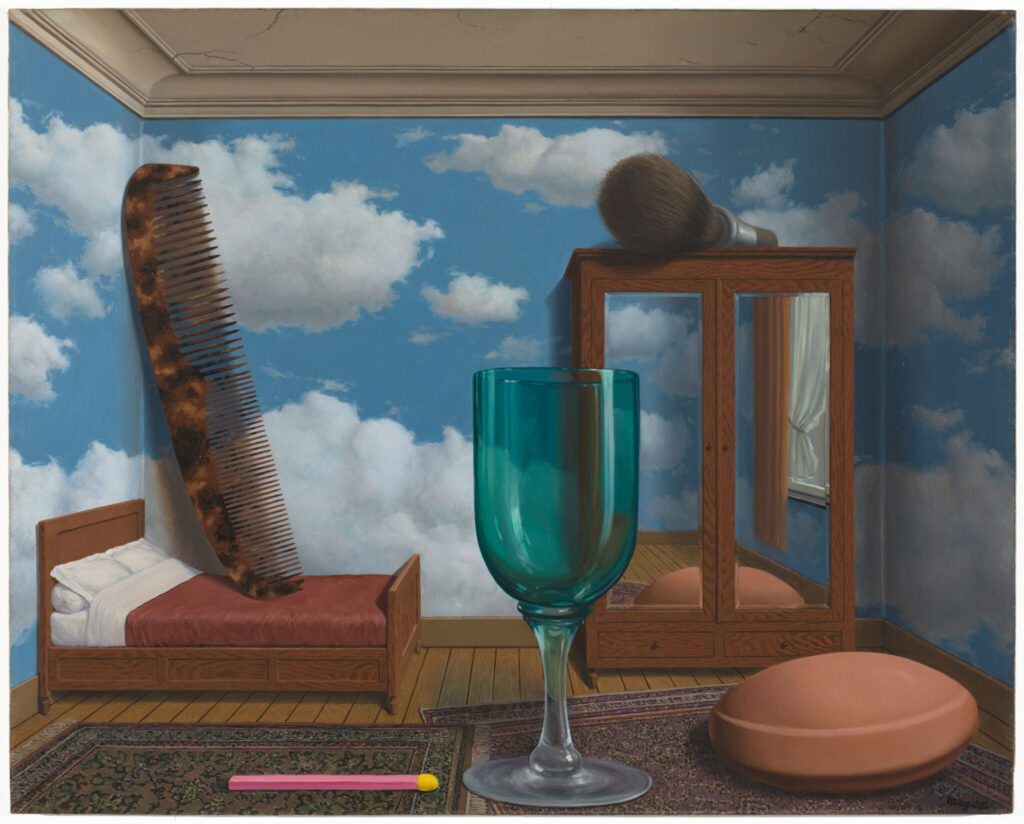 #11
#11
Personal Values (Personal Values)
With "Personal Values (Personal Values)", Magritte constructs a clear image whose logic slips away at the very moment we think we grasp it. The bringing together of incompatible elements transforms the scene into a visual proposition rather than a closed story. In the post-war period, Magritte returned to his smooth style and the paradoxes which made him unique, while multiplying the repetitions and shifts of scale. The technique - oil on canvas - supports this voluntary clarity: contours, surfaces and transitions remain precise enough for the impossible to appear objectively observed. The technique - oil on canvas - supports this voluntary sharpness: contours, surfaces and transitions remain precise enough for the impossible to appear objectively observed. The technique - oil on canvas - supports this voluntary sharpness: contours, surfaces and transitions remain precise enough for the impossible to appear objectively observed. The San Francisco Museum of Modern Art notice documents the work, dated 1952 and measuring 80 × 100.1 cm. This institutional link makes it possible to find collection data, the available provenance and the conditions of use of the image. Magritte thus leaves the viewer with an active task: to see what is painted, then to measure everything that this evidence is not enough to explain.
Image: SFMOMA · © Charly Herscovici, Brussels /Artists Rights Society (ARS), New York
See the museum notice →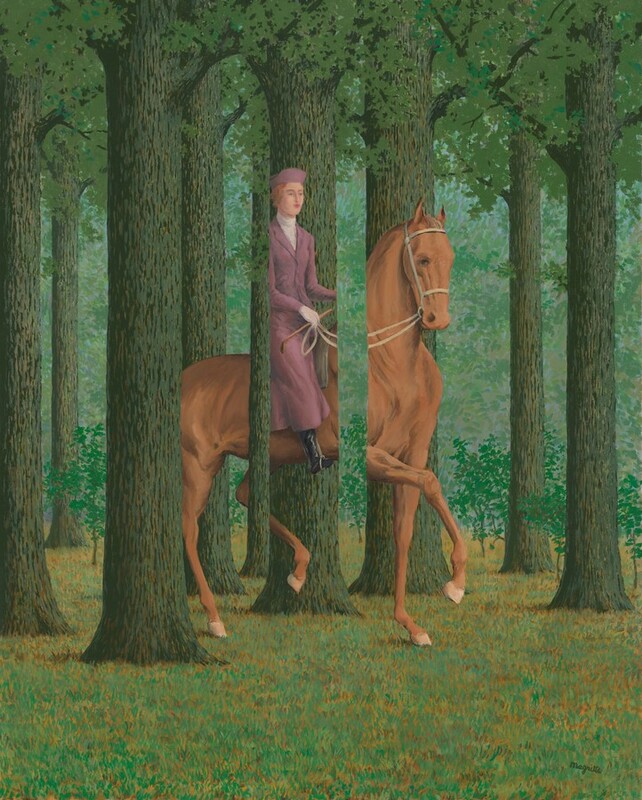 #12
#12
The Signature in White (The Blank Signature)
"The Signature in White (The Blank Signature)" shows Magritte's method at its most direct point: painting with precision to make reality less certain. Magritte here questions the gap between a thing, its image and the word which claims to designate it. In recent years, ancient motifs return with increased economy: the image focuses on a few relationships capable of immediately disturbing perception. The technique - oil on canvas - supports this voluntary sharpness: the image focuses on a few relationships capable of immediately disturbing perception. The technique - oil on canvas - supports this voluntary sharpness: the image focuses on a few relationships capable of immediately disturbing perception. The technique - oil on canvas - supports this voluntary sharpness: the image focuses on a few relationships capable of immediately disturbing perception. The technique - oil on canvas - supports this voluntary sharpness: the image focuses on a few relationships capable of immediately disturbing perception. The technique - oil on canvas - supports this voluntary sharpness: the contours, surfaces and transitions remain precise enough for the impossible to appear objectively observed. The technique - oil on canvas - supports this voluntary sharpness: contours, surfaces and transitions remain precise enough for the impossible to appear objectively observed. The technique - oil on canvas - supports this voluntary sharpness: the image focuses on a few relationships capable of immediately disturbing perception. The technique - oil on canvas - supports this voluntary sharpness: the image focuses on a few relationships capable of immediately institutional link allows you to find collection data, available provenance and conditions of use of the image. The work remains memorable because its strangeness never abolishes everyday life; on the contrary, it reveals how much it depends on our reading habits.
Image: National Gallery of Art, Washington · Media not downloadable; contact the NGA for image use
See the museum notice → #13
#13
On the Threshold of Liberty
In "On the Threshold of Liberty", nothing is blurry, and yet the whole thing resists a single explanation. The bringing together of incompatible elements transforms the scene into a visual proposition rather than a closed story. During this period, Magritte took up his motifs in series and variations, convinced that the same idea can produce several pictorial solutions. The technique - oil on canvas - supports this voluntary sharpness: contours, surfaces and transitions remain precise enough for the impossible to appear objectively observed. The technique - oil on canvas - supports this voluntary sharpness: contours, surfaces and transitions remain precise enough for the impossible to appear objectively observed. The technique - oil on canvas - supports this voluntary sharpness: contours, surfaces and transitions remain precise enough for the impossible to appear objectively observed. The art Institute of Chicago's notice documents the work, dated 1937 and measuring 238.8 × 185.4 cm (94 × 73 in.). This institutional link allows you to find collection data, available provenance and conditions of use of the image. The painting therefore does not provide a riddle to solve: it keeps the gaze in the fruitful moment when seeing and understanding cease to coincide.
Image: The Art Institute of Chicago · © 2018 C. Herscovici, London /Artists Rights Society (ARS), New York
See the museum notice → #14
#14
The Six Elements (The Six Elements)
Under the apparent simplicity of "The Six Elements (The Six Elements)", Magritte organizes a silent collision between familiar elements. The bringing together of incompatible elements transforms the scene into a visual proposition rather than a closed story. Produced during the years when the painter fixed his surrealist vocabulary, the work favors the shock of a visible association over the evocation of an indistinct dream. The technique - oil on canvas - supports this voluntary clarity: contours, surfaces and transitions remain precise enough for the impossible to appear objectively observed. The technique - oil on canvas - supports this voluntary clarity: contours, surfaces and transitions remain precise enough for the impossible to appear objectively observed. The technique - oil on canvas - supports this voluntary clarity: contours, surfaces and transitions remain precise enough for the impossible to appear objectively observed. The Philadelphia Museum of Art notice documents the work, dated 1929. This institutional link allows you to find collection data, available provenance and conditions of use of the image. This suspension of meaning explains the lasting force of the image: it appears immediately readable, then becomes more unstable with each glance.
Image: Philadelphia Museum of Art · Image reserved for educational use; rights to check with the museum
See the museum notice →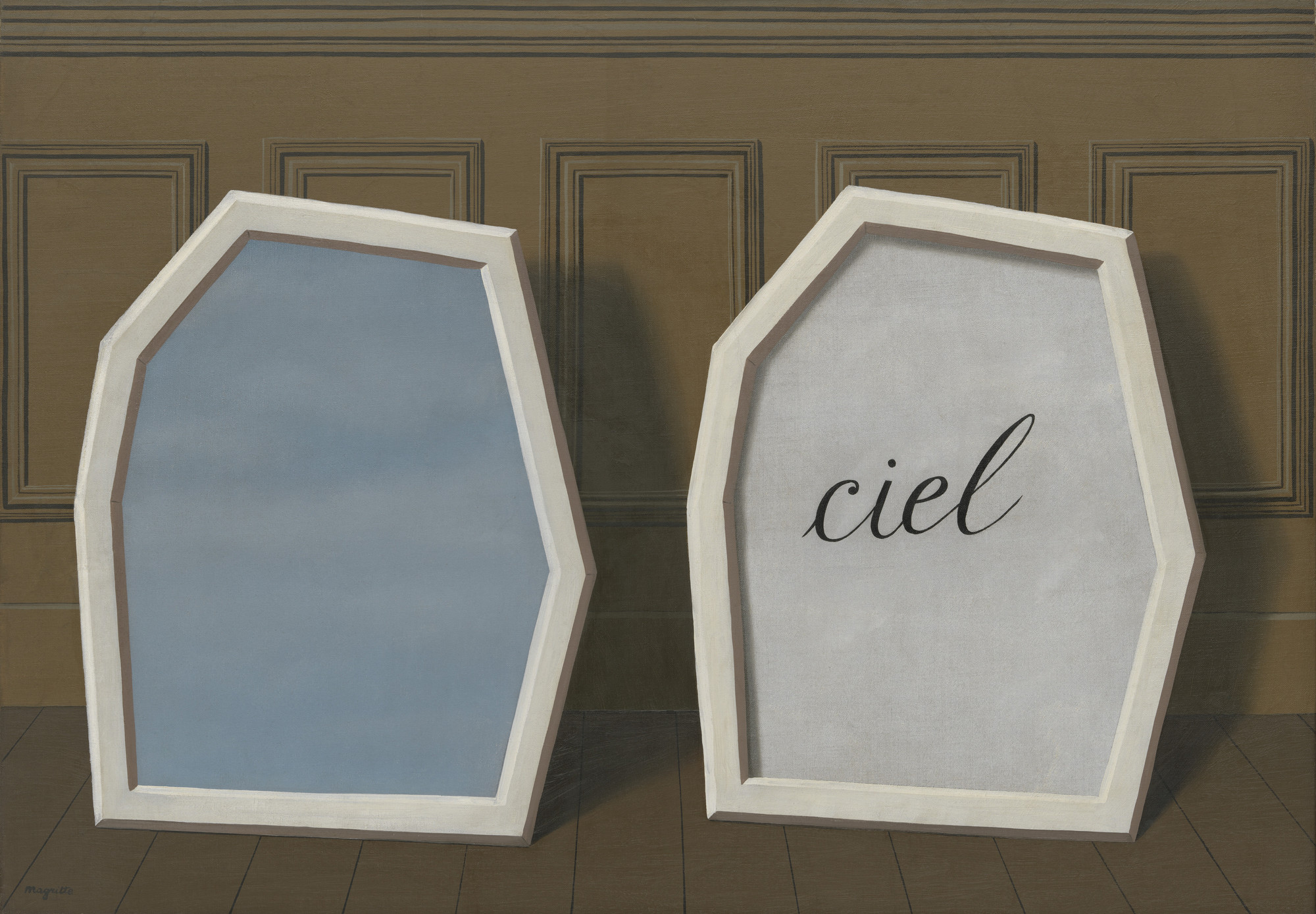 #15
#15
The Palace of Curtains III (The Palace of Curtains, III)
"The Palace of Curtains III (The Palace of Curtains, III)" belongs to these images where Magritte transforms descriptive clarity into a true instrument of mystery. Magritte here questions the gap between a thing, its image and the word that claims to designate it. Produced during the years when the painter fixed his surrealist vocabulary, the work favors the shock of a visible association over the evocation of an indistinct dream. The technique - oil on canvas - supports this voluntary clarity: contours, surfaces and transitions remain precise enough for the impossible to appear objectively observed. The technique - oil on canvas - supports this voluntary sharpness: contours, surfaces and transitions remain precise enough for the impossible to appear objectively observed. The technique - oil on canvas - supports this voluntary sharpness: contours, surfaces and transitions remain precise enough for the impossible to appear objectively observed. The Museum of Modern Art, New York notice documents the work, dated 1928 - 1929 and measuring 32 × 45 7/8 in. (81.2 × 116.4 cm). This institutional link makes it possible to find collection data, the available provenance and the conditions of use of the image. Magritte thus leaves the viewer with an active task: to note what is painted, then to measure everything that this evidence is not enough to explain.
Image: The Museum of Modern Art, New York · © C. Herscovici, Brussels /Artists Rights Society (ARS), New York
See the museum notice →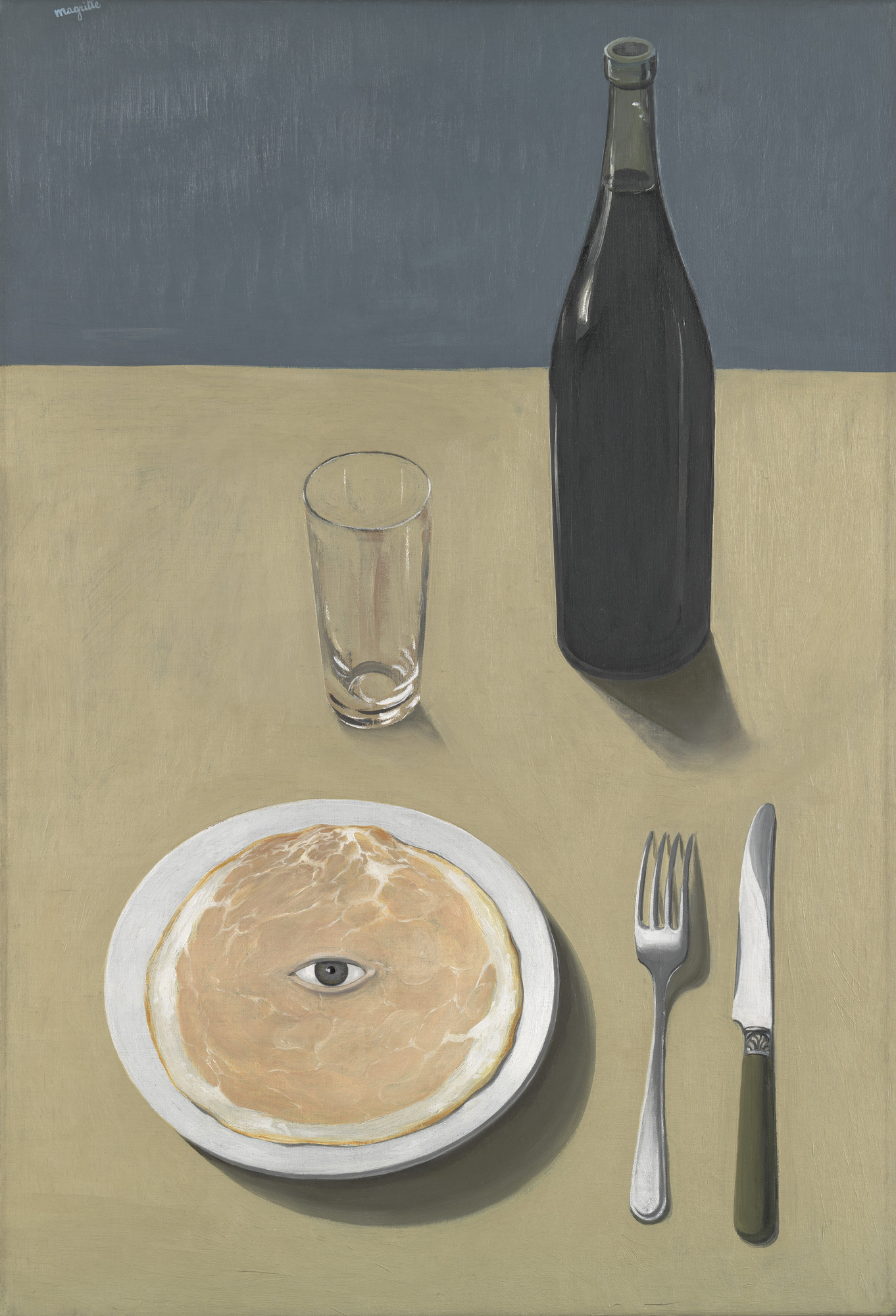 #16
#16
The Portrait (The Portrait)
With "Le Portrait (The Portrait)", Magritte constructs a clear image whose logic slips away at the very moment we think we grasp it. The human figure remains recognizable, but its identity slips away behind a screen, a movement or a substitution. During this period, Magritte took up his motifs in series and variations, convinced that the same idea can produce several pictorial solutions. The technique - oil on canvas - supports this voluntary sharpness: contours, surfaces and transitions remain precise enough for the impossible to appear objectively observed. The technique - oil on canvas - supports this voluntary sharpness: contours, surfaces and transitions remain precise enough for the impossible to appear objectively observed. The technique - oil on canvas - supports this voluntary sharpness: contours, surfaces and transitions remain precise enough for the impossible to appear objectively observed. The technique - oil on canvas - supports this voluntary sharpness: contours, surfaces and transitions remain precise enough for the impossible to appear objectively observed. The technique - oil on canvas - supports this voluntary sharpness: contours, surfaces and transitions remain precise enough for the impossible to appear objectively observed. The Museum of Modern Art, New York notice documents the work, dated 1935 and measuring 28 7/8 × 19 7/8 in. (73.3 × 50.2 cm). This institutional link makes it possible to find collection data, the available provenance and the conditions of use of the image. The work remains memorable because its strangeness never abolishes everyday life; on the contrary, it reveals how much it depends on our reading habits.
Image: The Museum of Modern Art, New York · © C. Herscovici, Brussels /Artists Rights Society (ARS), New York
See the museum notice → #17
#17
The Rape (Rape)
"The Rape (The Rape)" shows Magritte's method at its most direct point: painting with precision to make reality less certain. The human figure remains recognizable, but its identity slips away behind a screen, a movement or a substitution. During this period, Magritte took up his motifs in series and variations, convinced that the same idea can produce several pictorial solutions. The technique - oil on canvas - supports this voluntary sharpness: contours, surfaces and transitions remain precise enough for the impossible to appear objectively observed. The technique - oil on canvas - supports this voluntary sharpness: contours, surfaces and transitions remain precise enough for the impossible to appear objectively observed. The technique - oil on canvas - supports this voluntary sharpness: contours, surfaces and transitions remain precise enough for the impossible to appear objectively observed. The technique - oil on canvas - supports this voluntary sharpness: contours, surfaces and transitions remain precise enough for the impossible to appear objectively observed. The Menil Collection, Houston's notice documents the work, dated 1934 and measuring 28 7/8 × 21 1/2 in. (73.3 × 54.6 cm). This institutional link makes it possible to find collection data, the available provenance and the conditions of use of the image. The painting therefore does not provide a riddle to solve: it keeps the gaze in the fruitful moment when seeing and understanding cease to coincide.
Image: null · © C. Herscovici /Artists Rights Society (ARS), New York
See the museum notice → #18
#18
The Arnheim Estate
In "Le Domaine d'Arnheim", nothing is vague, and yet the whole thing resists a single explanation. The landscape maintains a precise appearance while obeying mental logic rather than natural continuity. In recent years, old motifs return with increased economy: the image focuses on a few relationships capable of immediately disturbing perception. The technique - oil on canvas - supports this voluntary sharpness: the image focuses on a few relationships capable of immediately disturbing perception. The technique - oil on canvas - supports this voluntary sharpness: the contours, surfaces and transitions remain precise enough for the impossible to appear objectively observed. The technique - oil on canvas - supports this voluntary sharpness: contours, surfaces and transitions remain precise enough for the impossible to appear objectively observed. The notice from the Royal Museums of Fine Arts of Belgium, Brussels documents the work, dated 1962 and measuring 146 x 114; 174 x 141.9 x 5.5 (with frame). This institutional link makes it possible to find collection data, the available provenance and the conditions of use of the image. This suspension of meaning explains the lasting force of the image: it appears immediately readable, then becomes more unstable with each look.
Image: Royal Museums of Fine Arts of Belgium, Brussels /photo: J. Geleyns - Art Photography · © Ch. Herscovici, with kind permission c/o SABAM Belgium
See the museum notice → #19
#19
Black magic
Under the apparent simplicity of "Black Magic", Magritte organizes a silent collision between familiar elements. The bringing together of incompatible elements transforms the scene into a visual proposition rather than a closed story. During this period, Magritte took up his motifs in series and variations, convinced that the same idea can produce several pictorial solutions. The technique - oil on canvas - supports this voluntary sharpness: contours, surfaces and transitions remain precise enough for the impossible to appear objectively observed. The technique - oil on canvas - supports this voluntary sharpness: contours, surfaces and transitions remain precise enough for the impossible to appear objectively observed. The notice from the Royal Museums of Fine Arts of Belgium, Brussels documents the work, dated 1945 and measuring 79 x 59; 94.9 x 74.7 x 6.2 (with frame). This institutional link makes it possible to find the collection data, the available provenance and the conditions of use of the image. Magritte thus leaves the viewer with an active task: to note what is painted, then to measure everything that this evidence is not enough to explain.
Image: Royal Museums of Fine Arts of Belgium, Brussels /photo: J. Geleyns - Art Photography · © Ch. Herscovici, with kind permission c/o SABAM Belgium
See the museum notice → #20
#20
The unexpected response
"The unexpected response" belongs to these images where Magritte transforms descriptive clarity into a true instrument of mystery. The bringing together of incompatible elements transforms the scene into a visual proposition rather than a closed story. During this period, Magritte took up his motifs in series and variations, convinced that the same idea can produce several pictorial solutions. The technique - oil on canvas - supports this voluntary clarity: contours, surfaces and transitions remain precise enough for the impossible to appear objectively observed. The technique - oil on canvas - supports this voluntary sharpness: contours, surfaces and transitions remain precise enough for the impossible to appear objectively observed. The notice from the Royal Museums of Fine Arts of Belgium, Brussels documents the work, dated 1932 and measuring 82 x 54.4; 91.4 x 64.3 x 3.6 (with frame). This institutional link makes it possible to find collection data, the available provenance and the conditions of use of the image. The work remains memorable because its strangeness never abolishes everyday life; on the contrary, it reveals how much it depends on our reading habits.
Image: Royal Museums of Fine Arts of Belgium, Brussels /photo: J. Geleyns - Art Photography · © Ch. Herscovici, with kind permission c/o SABAM Belgium
See the museum notice → #21
#21
The Dominion of Light (The Empire of Lights)
With "The Dominion of Light (The Empire of Lights)", Magritte constructs a clear image whose logic slips away at the very moment we think we grasp it. Light does not only describe an hour: it puts the coherence of the visible world in crisis. In the post-war period, Magritte returned to his smooth style and the paradoxes which made him unique, while multiplying the repetitions and shifts of scale. The technique - oil on canvas - supports this voluntary clarity: contours, surfaces and transitions remain precise enough for the impossible to appear objectively observed. The - oil on canvas - technique supports this voluntary sharpness: contours, surfaces and transitions remain precise enough for the impossible to appear objectively observed. The Menil Collection, Houston's notice documents the work, dated 1954 and measuring 51 1/8 × 37 1/4 in. (129.9 × 94.6 cm). This institutional link makes it possible to find collection data, the available provenance and the conditions of use of the image. The painting therefore does not provide a riddle to solve: it keeps the gaze in the fruitful moment when seeing and understanding cease to coincide.
Image: null · © C. Herscovici /Artists Rights Society (ARS), New York
See the museum notice → #22
#22
The Eternally Obvious (The Eternal Evidence)
"The Eternally Obvious (Eternal Evidence)" shows Magritte's method at its most direct point: painting with precision to make reality less certain. The bringing together of incompatible elements transforms the scene into a visual proposition rather than a closed story. Produced during the years when the painter fixed his surrealist vocabulary, the work favors the shock of a visible association over the evocation of an indistinct dream. The technique - oil on five separately stretched and framed canvases mounted on acrylic sheet - supports this voluntary sharpness: contours, surfaces and transitions remain precise enough for the impossible to appear objectively observed. The notice of The Menil Collection, Houston documents the work, dated 1930 and measuring Installed: 66 × 15 × 22 in. (167.6 × 38.1 × 55.9 cm). This institutional link makes it possible to find collection data, the available provenance and the conditions of use of the image. This suspension of meaning explains the lasting force of the image: it appears immediately readable, then becomes more unstable with each look.
Image: null · © C. Herscovici /Artists Rights Society (ARS), New York
See the museum notice → #23
#23
The Telescope (The telescope)
In "The Telescope (The Approach Glasses)", nothing is blurry, and yet the whole thing resists a single explanation. An ordinary object becomes the focus of an enigma as soon as its scale, place or function ceases to be self-evident. In recent years, old motifs return with increased economy: the image focuses on a few relationships capable of immediately disturbing perception. The technique - oil on canvas - supports this voluntary sharpness: the image focuses on a few relationships capable of immediately disturbing perception. The technique - oil on canvas - supports this voluntary sharpness: the image focuses on a few relationships capable of immediately disturbing perception. The technique - oil on canvas - supports this voluntary sharpness: contours, surfaces and transitions remain precise enough for the impossible to appear objectively observed. The technique - oil on canvas - supports this voluntary sharpness: contours, surfaces and transitions remain precise enough for the impossible to appear objectively observed. The technique - oil on canvas - supports this voluntary sharpness: contours, surfaces and transitions remain precise enough for the impossible to appear objectively observed. The technique - oil on canvas - supports this voluntary sharpness: contours, surfaces and transitions remain precise enough for the impossible to appear objectively observed. The technique - oil on canvas - supports this voluntary sharpness: contours, surfaces and transitions remain precise enough for the impossible to appear objectively observed. The technique - oil on canvas - supports this voluntary sharp (176.1 × 114.9 cm). This institutional link makes it possible to find collection data, the available provenance and the conditions of use of the image. Magritte thus leaves the viewer with an active task: to see what is painted, then to measure everything that this evidence is not enough to explain.
Image: null · © C. Herscovici /Artists Rights Society (ARS), New York
See the museum notice → #24
#24
Reading forbidden
Under the apparent simplicity of "Forbidden Reading", Magritte organizes a silent collision between familiar elements. The bringing together of incompatible elements transforms the scene into a visual proposition rather than a closed story. During this period, Magritte took up his motifs in series and variations, convinced that the same idea can produce several pictorial solutions. The technique - oil on canvas - supports this voluntary sharpness: contours, surfaces and transitions remain precise enough for the impossible to appear objectively observed. The technique - oil on canvas - supports this voluntary sharpness: contours, surfaces and transitions remain precise enough for the impossible to appear objectively observed. The notice from the Royal Museums of Fine Arts of Belgium, Brussels documents the work, dated 1936 and measuring 54.4 x 73.4. This institutional link allows you to find collection data, available provenance and conditions of use of the image. The work remains memorable because its strangeness never abolishes everyday life; on the contrary, it reveals how much it depends on our reading habits.
Image: Royal Museums of Fine Arts of Belgium, Brussels /photo: J. Geleyns - Art Photography · © Ch. Herscovici, with kind permission c/o SABAM Belgium
See the museum notice → #25
#25
The secret player
"The Secret Player" belongs to these images where Magritte transforms descriptive clarity into a true instrument of mystery. The bringing together of incompatible elements transforms the scene into a visual proposition rather than a closed story. Produced during the years when the painter established his surrealist vocabulary, the work favors the shock of a visible association over the evocation of an indistinct dream. The technique - oil on canvas - supports this voluntary clarity: contours, surfaces and transitions remain precise enough for the impossible to appear objectively observed. The notice from the Royal Museums of Fine Arts of Belgium, Brussels documents the work, dated 1927 and measuring 152 x 195. This institutional link makes it possible to find collection data, the available provenance and the conditions of use of the image. The painting therefore does not provide a riddle to solve: it keeps the gaze in the fruitful moment when seeing and understanding cease to coincide.
Image: Royal Museums of Fine Arts of Belgium, Brussels /photo: J. Geleyns - Art Photography · © Ch. Herscovici, with kind permission c/o SABAM Belgium
See the museum notice →From the 1920s to the great compositions of the interwar period, words, windows, bodies and objects learned to no longer coincide with themselves.
 #26
#26
The flavor of tears
With "The Flavor of Tears", Magritte constructs a clear image whose logic slips away at the very moment we think we grasp it. The bringing together of incompatible elements transforms the scene into a visual proposition rather than a closed story. In the post-war period, Magritte returned to his smooth style and the paradoxes which made him unique, while multiplying the repetitions and shifts of scale. The technique - oil on canvas - supports this voluntary clarity: contours, surfaces and transitions remain precise enough for the impossible to appear objectively observed. The notice from the Royal Museums of Fine Arts of Belgium, Brussels documents the work, dated 1948 and measuring 60 x 50; 73.1 x 63 x 6.5 (with frame). This institutional link makes it possible to find collection data, the available provenance and the conditions of use of the image. This suspension of meaning explains the lasting force of the image: it appears immediately readable, then becomes more unstable with each look.
Image: Royal Museums of Fine Arts of Belgium, Brussels /photo: J. Geleyns - Art Photography · © Ch. Herscovici, with kind permission c/o SABAM Belgium
See the museum notice → #27
#27
The Squire
"The Squire" shows Magritte's method at its most direct point: painting with precision to make reality less certain. The bringing together of incompatible elements transforms the scene into a visual proposition rather than a closed story. Produced during the years when the painter fixed his surrealist vocabulary, the work favors the shock of a visible association over the evocation of an indistinct dream. The technique - oil on cardboard, mounted on wood - supports this voluntary clarity: contours, surfaces and transitions remain precise enough for the impossible to appear objectively observed. The notice from the Royal Museums of Fine Arts of Belgium, Brussels documents the work, dated 1922 and measuring 63 x 90. This institutional link makes it possible to find the collection data, the available provenance and the conditions of use of the image. Magritte thus leaves the viewer with an active task: to see what is painted, then to measure everything that this evidence is not enough to explain.
Image: Royal Museums of Fine Arts of Belgium, Brussels /photo: J. Geleyns - Art Photography · © Ch. Herscovici, with kind permission c/o SABAM Belgium
See the museum notice → #28
#28
The Midnight Wedding
In "The Midnight Wedding", nothing is blurry, and yet the whole thing resists a single explanation. Light does not only describe an hour: it puts the coherence of the visible world in crisis. Produced during the years when the painter fixed his surrealist vocabulary, the work favors the shock of a visible association over the evocation of an indistinct dream. The technique - oil on canvas - supports this voluntary clarity: contours, surfaces and transitions remain precise enough for the impossible to appear objectively observed. The notice from the Royal Museums of Fine Arts of Belgium, Brussels documents this voluntary clarity: contours, surfaces and transitions remain precise enough for the impossible to appear objectively observed. The technique - oil on canvas - supports this voluntary clarity: contours, surfaces and transitions remain precise enough for the impossible to appear objectively observed. The notice from the Royal Museums of Fine Arts of Belgium, Brussels documents this work, dated 1926 and measuring 139.5 x 105.5. This institutional link allows to find the collection data, the available origin and the conditions of use of the image. The work remains memorable because its strangeness never abolishes everyday life; on the contrary, it reveals how much it depends on our reading habits.
Image: Royal Museums of Fine Arts of Belgium, Brussels /photo: J. Geleyns - Art Photography · © Ch. Herscovici, with kind permission c/o SABAM Belgium
See the museum notice → #29
#29
The Dead Bird (The Dead Bird)
Under the apparent simplicity of "The Dead Bird (The Dead Bird)", Magritte organizes a silent collision between familiar elements. The animal acts as a hinge between the kingdoms, familiar enough to be named and strange enough to move the scene. Produced during the years when the painter fixed his surrealist vocabulary, the work favors the shock of a visible association over the evocation of an indistinct dream. The technique - oil on canvas - supports this voluntary clarity: contours, surfaces and transitions remain precise enough for the impossible to appear objectively observed. The technique - oil on canvas - supports this voluntary sharpness: contours, surfaces and transitions remain precise enough for the impossible to appear objectively observed. The Menil Collection, Houston's notice documents the work, dated 1926 and measuring 25 5/8 × 29 1/2 in. (65.1 × 74.9 cm). This institutional link makes it possible to find collection data, the available provenance and the conditions of use of the image. The painting therefore does not provide an enigma to be solved: it keeps the gaze in the fruitful moment when seeing and understanding cease to coincide.
Image: null · © C. Herscovici /Artists Rights Society (ARS), New York
See the museum notice → #30
#30
An End to Contemplation (The end of contemplations)
"An End to Contemplation (The End of Contemplations)" belongs to these images where Magritte transforms descriptive clarity into a true instrument of mystery. The bringing together of incompatible elements transforms the scene into a visual proposition rather than a closed story. Produced during the years when the painter established his surrealist vocabulary, the work favors the shock of a visible association over the evocation of an indistinct dream. The technique - oil on canvas with metal snap fasteners - supports this voluntary clarity: contours, surfaces and transitions remain precise enough for the impossible to appear objectively observed. The notice from The Menil Collection, Houston documents the work, dated 1927 and measuring 28 5/8 × 39 3/8 in. (72.7 × 100 cm). This institutional link makes it possible to find collection data, the available provenance and the conditions of use of the image. This suspension of meaning explains the lasting force of the image: it appears immediately readable, then becomes more unstable with each look.
Image: null · © C. Herscovici /Artists Rights Society (ARS), New York
See the museum notice → #31
#31
Discovery
With "Découverte", Magritte constructs a clear image whose logic slips away at the very moment we think we grasp it. The bringing together of incompatible elements transforms the scene into a visual proposition rather than a closed story. Produced during the years when the painter established his surrealist vocabulary, the work favors the shock of a visible association over the evocation of an indistinct dream. The technique - oil on canvas - supports this voluntary clarity: contours, surfaces and transitions remain precise enough for the impossible to appear objectively observed. The notice from the Royal Museums of Fine Arts of Belgium, Brussels documents the work, dated 1927 and measuring 65.2 x 50.3. This institutional link makes it possible to find collection data, the available provenance and the conditions of use of the image. Magritte thus leaves the viewer with an active task: to note what is painted, then to measure everything that this evidence is not enough to explain.
Image: Royal Museums of Fine Arts of Belgium, Brussels /photo: J. Geleyns - Art Photography · © Ch. Herscovici, with kind permission c/o SABAM Belgium
See the museum notice → #32
#32
The man from the open sea
"The Man of the Sea" shows Magritte's method at its most direct point: painting with precision to make reality less certain. The human figure remains recognizable, but its identity slips away behind a screen, a movement or a substitution. Produced during the years when the painter fixed his surrealist vocabulary, the work favors the shock of a visible association over the evocation of an indistinct dream. The technique - oil on canvas - supports this voluntary clarity: contours, surfaces and transitions remain precise enough for the impossible to appear objectively observed. The notice from the Royal Museums of Fine Arts of Belgium, Brussels documents the work, dated 1927 and measuring 139 x 105. This institutional link makes it possible to find collection data, the available provenance and the conditions of use of the image. The work remains memorable because its strangeness never abolishes everyday life; on the contrary, it reveals how much it depends on our reading habits.
Image: Royal Museums of Fine Arts of Belgium, Brussels /photo: J. Geleyns - Art Photography · © Ch. Herscovici, with kind permission c/o SABAM Belgium
See the museum notice → #33
#33
The use of speech
In "The Use of Speech", nothing is vague, and yet the whole thing resists a single explanation. Magritte questions here the gap between a thing, its image and the word which claims to designate it. Produced during the years when the painter fixed his surrealist vocabulary, the work favors the shock of a visible association over the evocation of an indistinct dream. The technique - oil on canvas - supports this voluntary clarity: contours, surfaces and transitions remain precise enough for the impossible to appear objectively observed. The notice from the Royal Museums of Fine Arts of Belgium, Brussels documents this voluntary clarity: contours, surfaces and transitions remain precise enough for the impossible to appear objectively observed. The notice from the Royal Museums of Fine Arts of Belgium, Brussels documents this voluntary clarity: contours, surfaces and transitions remain precise enough for the impossible to appear objectively observed. The technique - oil on canvas - supports this voluntary clarity: contours, surfaces and transitions remain precise enough for the impossible to appear objectively observed. The notice from the Royal Museums of Fine Arts of Belgium, Brussels documents this work, dated 1927 and measuring 41.8 x 27.3. This institutional link makes it possible to find collection data, available provenance and conditions of use of the image. The painting therefore does not provide a riddle to solve: it keeps the gaze in the fruitful moment when seeing and understanding cease to coincide.
Image: Royal Museums of Fine Arts of Belgium, Brussels /photo: J. Geleyns - Art Photography · © Ch. Herscovici, with kind permission c/o SABAM Belgium
See the museum notice → #34
#34
The thief
Under the apparent simplicity of "The Thief", Magritte organizes a silent collision between familiar elements. The bringing together of incompatible elements transforms the scene into a visual proposition rather than a closed story. Produced during the years when the painter fixed his surrealist vocabulary, the work favors the shock of a visible association over the evocation of an indistinct dream. The technique - oil on canvas - supports this voluntary clarity: contours, surfaces and transitions remain precise enough for the impossible to appear objectively observed. The notice from the Royal Museums of Fine Arts of Belgium, Brussels documents the work, dated 1927 and measuring 101 x 72.6. This institutional link allows you to find collection data, available provenance and conditions of use of the image. This suspension of meaning explains the lasting force of the image: it appears immediately readable, then becomes more unstable with each look.
Image: Royal Museums of Fine Arts of Belgium, Brussels /photo: J. Geleyns - Art Photography · © Ch. Herscovici, with kind permission c/o SABAM Belgium
See the museum notice → #35
#35
The Meaning of Night (The Meaning of the Night)
"The Meaning of Night (The Meaning of the Night)" belongs to these images where Magritte transforms descriptive clarity into a true instrument of mystery. Light does not only describe an hour: it puts the coherence of the visible world in crisis. Produced during the years when the painter fixed his surrealist vocabulary, the work favors the shock of a visible association over the evocation of an indistinct dream. The technique - oil on canvas - supports this voluntary clarity: contours, surfaces and transitions remain precise enough for the impossible to appear objectively observed. The Menil Collection, Houston technique documents this voluntary sharpness: contours, surfaces and transitions remain precise enough for the impossible to appear objectively observed. The Menil Collection, Houston's notice documents this work, dated 1927 and measuring 54 1/2 × 41 1/2 in. (138.4 × 105.4 cm). This institutional link makes it possible to find collection data, the available provenance and the conditions of use of the image. Magritte thus leaves the viewer with an active task: to note what is painted, then to measure everything that this evidence is not enough to explain.
Image: null · © C. Herscovici /Artists Rights Society (ARS), New York
See the museum notice → #36
#36
At Courtesan's Palace (A Courtesan's Palace)
With "A Courtesan's Palace (The Palace of a Courtesan)", Magritte constructs a clear image whose logic slips away at the very moment we think we grasp it. An ordinary object becomes the focus of an enigma as soon as its scale, its place or its function ceases to be self-evident. Created during the years when the painter established his surrealist vocabulary, the work favors the shock of a visible association over the evocation of an indistinct dream. The technique - oil on canvas - supports this voluntary clarity: contours, surfaces and transitions remain precise enough for the impossible to appear objectively observed. The notice from The Menil Collection, Houston documents the work, dated 1928 and measuring 21 1/4 × 28 3/4 in. (54 × 73 cm). This institutional link makes it possible to find collection data, the available provenance and the conditions of use of the image. The work remains memorable because its strangeness never abolishes everyday life; on the contrary, it reveals how much it depends on our reading habits.
Image: null · © C. Herscovici /Artists Rights Society (ARS), New York
See the museum notice → #37
#37
The demon of perversity
"The Demon of Perversity" shows Magritte's method at its most direct point: painting with precision to make reality less certain. The bringing together of incompatible elements transforms the scene into a visual proposition rather than a closed story. Produced during the years when the painter fixed his surrealist vocabulary, the work favors the shock of a visible association over the evocation of an indistinct dream. The technique - oil on canvas - supports this voluntary clarity: contours, surfaces and transitions remain precise enough for the impossible to appear objectively observed. The notice from the Royal Museums of Fine Arts of Belgium, Brussels documents the work, dated 1928 and measuring 81.3 x 116. This institutional link makes it possible to find the collection data, the available provenance and the conditions of use of the image. The painting therefore does not provide a riddle to solve: it keeps the gaze in the fruitful moment when seeing and understanding cease to coincide.
Image: Royal Museums of Fine Arts of Belgium, Brussels /photo: J. Geleyns - Art Photography · © Ch. Herscovici, with kind permission c/o SABAM Belgium
See the museum notice → #38
#38
The Good News (The good news)
In "The Good News (The Good News)", nothing is blurry, and yet the whole thing resists a single explanation. The bringing together of incompatible elements transforms the scene into a visual proposition rather than a closed story. Produced during the years when the painter fixed his surrealist vocabulary, the work favors the shock of a visible association over the evocation of an indistinct dream. The technique - oil and graphite on canvas and wood frame with painted inscription - supports this voluntary clarity: contours, surfaces and transitions remain precise enough for the impossible to appear objectively observed. The notice from The Menil Collection, Houston documents the work, dated 1928 and measuring 31 1/4 × 24 in. (79.4 × 61 cm). This institutional link makes it possible to find collection data, the available provenance and the conditions of use of the image. This suspension of meaning explains the lasting force of the image: it appears immediately readable, then becomes more unstable with each look.
Image: null · © C. Herscovici /Artists Rights Society (ARS), New York
See the museum notice → #39
#39
The Law of Gravity (The Law of Gravity)
Under the apparent simplicity of "The Law of Gravity (The Law of Gravity)", Magritte organizes a silent collision between familiar elements. The bringing together of incompatible elements transforms the scene into a visual proposition rather than a closed story. Produced during the years when the painter fixed his surrealist vocabulary, the work favors the shock of a visible association over the evocation of an indistinct dream. The technique - oil on canvas - supports this voluntary clarity: contours, surfaces and transitions remain precise enough for the impossible to appear objectively observed. The technique - oil on canvas - supports this voluntary sharpness: contours, surfaces and transitions remain precise enough for the impossible to appear objectively observed. The Menil Collection, Houston's notice documents the work, dated 1928 and measuring 21 3/4 × 15 in. (55.2 × 38.1 cm). This institutional link makes it possible to find collection data, the available provenance and the conditions of use of the image. Magritte thus leaves the viewer with an active task: to note what is painted, then to measure everything that this evidence is not enough to explain.
Image: null · © C. Herscovici /Artists Rights Society (ARS), New York
See the museum notice → #40
#40
The Legend of the Guitars (The legend of guitars)
"The Legend of the Guitars (The Legend of the Guitars)" belongs to these images where Magritte transforms descriptive clarity into a true instrument of mystery. The bringing together of incompatible elements transforms the scene into a visual proposition rather than a closed story. Produced during the years when the painter fixed his surrealist vocabulary, the work favors the shock of a visible association over the evocation of an indistinct dream. The technique - oil on canvas - supports this voluntary clarity: contours, surfaces and transitions remain precise enough for the impossible to appear objectively observed. The Menil Collection, Houston's notice documents the work, dated 1928 and measuring 28 3/4 × 36 1/8 in. (73 × 91.8 cm). This institutional link makes it possible to find collection data, the available provenance and the conditions of use of the image. The work remains memorable because its strangeness never abolishes everyday life; on the contrary, it reveals how much it depends on our reading habits.
Image: null · © C. Herscovici /Artists Rights Society (ARS), New York
See the museum notice → #41
#41
Surrender (Abandonment)
With "Surrender (Abandonment)", Magritte constructs a clear image whose logic slips away at the very moment we think we grasp it. The bringing together of incompatible elements transforms the scene into a visual proposition rather than a closed story. Produced during the years when the painter established his surrealist vocabulary, the work favors the shock of a visible association over the evocation of an indistinct dream. The technique - oil on canvas - supports this voluntary clarity: contours, surfaces and transitions remain precise enough for the impossible to appear objectively observed. The Menil Collection, Houston's, case supports this voluntary sharpness: contours, surfaces and transitions remain precise enough for the impossible to appear objectively observed. The Menil Collection, Houston's, case supports this voluntary sharpness: contours, surfaces and transitions remain precise enough for the impossible to appear objectively observed. The technique - oil on canvas - supports this voluntary sharpness: contours, surfaces and transitions remain precise enough for the impossible to appear objectively observed. The Menil Collection, Houston's, casework documents the work, dated 1929 and measuring 21 1/4 × 28 5/8 in. (54 × 72.7 cm). This institutional link makes it possible to find collection data, the available provenance and the conditions of use of the image. The painting therefore does not provide a riddle to solve: it keeps the gaze in the fruitful moment when seeing and understanding cease to coincide.
Image: null · © C. Herscovici /Artists Rights Society (ARS), New York
See the museum notice → #42
#42
The Eye
"The Eye" shows Magritte's method at its most direct point: painting with precision to make reality less certain. The bringing together of incompatible elements transforms the scene into a visual proposition rather than a closed story. During this period, Magritte took up his motifs in series and variations, convinced that the same idea could produce several pictorial solutions. The technique - oil on canvas - supports this voluntary sharpness: contours, surfaces and transitions remain precise enough for the impossible to appear objectively observed. The technique - oil on canvas - supports this voluntary sharpness: contours, surfaces and transitions remain precise enough for the impossible to appear objectively observed. The art Institute of Chicago notice documents the work, dated 1932 and measuring 27 × 24.8 × 14.4 cm (10 1/2 × 10 × 2 1/2 in.). This institutional link makes it possible to find collection data, the available origin and the conditions of use of the image. This suspension of meaning explains the lasting force of the image: it appears immediately readable, then becomes more unstable with each look.
Image: The Art Institute of Chicago · © 2018 C. Herscovici, London /Artists Rights Society (ARS), New York
See the museum notice → #43
#43
God is not a saint
In "God is not a saint", nothing is vague, and yet the whole thing resists a single explanation. The bringing together of incompatible elements transforms the scene into a visual proposition rather than a closed story. During this period, Magritte took up his motifs in series and variations, convinced that the same idea can produce several pictorial solutions. The technique - oil on canvas - supports this voluntary clarity: contours, surfaces and transitions remain precise enough for the same idea to appear objectively observed. The technique - oil on canvas - supports this voluntary sharpness: contours, surfaces and transitions remain precise enough for the impossible to appear objectively observed. The notice from the Royal Museums of Fine Arts of Belgium, Brussels documents the work, dated 1935 and measuring 67.2 x 43. This institutional link allows you to find collection data, available provenance and conditions of use of the image. Magritte thus leaves the viewer with an active task: to note what is painted, then to measure everything that this evidence is not enough to explain.
Image: Royal Museums of Fine Arts of Belgium, Brussels /photo: J. Geleyns - Art Photography · © Ch. Herscovici, with kind permission c/o SABAM Belgium
See the museum notice → #44
#44
Study for "The Giantess": Leaf tree inscribed in a rectangle
Under the apparent simplicity of "Study for "The Giantess": Leaf Tree inscribed in a rectangle", Magritte organizes a silent collision between familiar elements. Bringing together incompatible elements transforms the scene into a visual proposition rather than a closed story. During this period, Magritte took up his motifs in series and variations, convinced that the same idea could produce several pictorial solutions. The technique - back: gouache, ink on paper; front: pencil, watercolor, gouache on paper - supports this voluntary sharpness: contours, surfaces and transitions remain precise enough for the impossible to appear objectively observed. The notice of Royal Museums of Fine Arts of Belgium, Brussels documents the work, dated 1935 and measuring 130 x 93 mm. This institutional link makes it possible to find collection data, the available provenance and the conditions of use of the image. The work remains memorable because its strangeness never abolishes everyday life; on the contrary, it reveals how much it depends on our reading habits.
Image: Royal Museums of Fine Arts of Belgium, Brussels /photo: J. Geleyns - Art Photography · © Ch. Herscovici, with kind permission c/o SABAM Belgium
See the museum notice → #45
#45
Georgette
"Georgette" belongs to these images where Magritte transforms descriptive clarity into a true instrument of mystery. The bringing together of incompatible elements transforms the scene into a visual proposition rather than a closed story. During this period, Magritte took up his motifs in series and variations, convinced that the same idea can produce several pictorial solutions. The technique - oil on canvas - supports this voluntary clarity: contours, surfaces and transitions remain precise enough for the impossible to appear objectively observed. The technique - oil on canvas - supports this voluntary sharpness: contours, surfaces and transitions remain precise enough for the impossible to appear objectively observed. The notice from the Royal Museums of Fine Arts of Belgium, Brussels documents the work, dated 1937 and measuring 65 x 54; 83.9 x 73 x 5 (with frame). This institutional link makes it possible to find the collection data, the available provenance and the conditions of use of the image. The painting therefore does not provide a riddle to solve: it keeps the gaze in the fruitful moment when seeing and understanding cease to coincide.
Image: Royal Museums of Fine Arts of Belgium, Brussels /photo: J. Geleyns - Art Photography · © Ch. Herscovici, with kind permission c/o SABAM Belgium
See the museum notice → #46
#46
The Song of the Storm (The Song of the Storm)
With "The Song of the Storm (The Song of the Storm)", Magritte constructs a clear image whose logic slips away at the very moment we think we grasp it. Light does not only describe an hour: it puts the coherence of the visible world in crisis. During this period, Magritte took up his motifs in series and variations, convinced that the same idea can produce several pictorial solutions. The technique - oil on canvas - supports this voluntary sharpness: contours, surfaces and transitions remain precise enough for the impossible to appear objectively observed. The technique - oil on canvas - supports this voluntary sharpness: contours, surfaces and transitions remain precise enough for the impossible to appear objectively observed. The technique - oil on canvas - supports this voluntary sharpness: contours, surfaces and transitions remain precise enough for the impossible to appear objectively observed. The technique - oil on canvas - supports this voluntary sharpness: contours, surfaces and transitions remain precise enough for the impossible to appear objectively observed. The technique - oil on canvas - supports this voluntary sharpness: contours, surfaces and transitions remain precise enough for the impossible to appear objectively observed. The technique - oil on canvas - supports this voluntary sharpness: contours, surfaces and transitions remain precise enough for the impossible to appear objectively observed. The technique - oil on canvas - supports this voluntary sharpness: contours, surfaces and transitions remain precise enough for the impossible to appear objectively observed. The technique - oil on canvas - supports this voluntary sharp 54.3 cm). This institutional link makes it possible to find collection data, the available provenance and the conditions of use of the image. This suspension of meaning explains the lasting force of the image: it appears immediately readable, then becomes more unstable with each look.
Image: null · © C. Herscovici /Artists Rights Society (ARS), New York
See the museum notice → #47
#47
The White Race
"The White Race" shows Magritte's method at its most direct point: painting with precision to make reality less certain. The bringing together of incompatible elements transforms the scene into a visual proposition rather than a closed story. During this period, Magritte took up his motifs in series and variations, convinced that the same idea can produce several pictorial solutions. The technique - oil on canvas - supports this voluntary sharpness: contours, surfaces and transitions remain precise enough for the impossible to appear objectively observed. The technique - oil on canvas - supports this voluntary sharpness: contours, surfaces and transitions remain precise enough for the impossible to appear objectively observed. The technique - oil on canvas - supports this voluntary sharpness: contours, surfaces and transitions remain precise enough for the impossible to appear objectively observed. The art Institute of Chicago's notice documents the work, dated 1937 and measuring 81 × 60 cm (31 7/8 × 23 5/8 in.). This institutional link makes it possible to find collection data, the available provenance and the conditions of use of the image. Magritte thus leaves the viewer with an active task: to note what is painted, then to measure everything that this evidence is not enough to explain.
Image: The Art Institute of Chicago · © 2018 C. Herscovici, London /Artists Rights Society (ARS), New York
See the museum notice → #48
#48
Bel canto
In "Bel canto", nothing is vague, and yet the whole thing resists a single explanation. The bringing together of incompatible elements transforms the scene into a visual proposition rather than a closed story. During this period, Magritte took up his motifs in series and variations, convinced that the same idea can produce several pictorial solutions. The technique - oil on canvas - supports this voluntary clarity: contours, surfaces and transitions remain precise enough for the impossible to appear objectively observed. The technique - oil on canvas - supports this voluntary sharpness: contours, surfaces and transitions remain precise enough for the impossible to appear objectively observed. The notice from the Royal Museums of Fine Arts of Belgium, Brussels documents the work, dated 1938 and measuring 73.5 x 54.7. This institutional link makes it possible to find collection data, available provenance and conditions of use of the image. The work remains memorable because its strangeness never abolishes everyday life; on the contrary, it reveals how much it depends on our reading habits.
Image: Royal Museums of Fine Arts of Belgium, Brussels /photo: J. Geleyns - Art Photography · © Ch. Herscovici, with kind permission c/o SABAM Belgium
See the museum notice → #49
#49
The kiss
Under the apparent simplicity of "The Kiss", Magritte organizes a silent collision between familiar elements. The bringing together of incompatible elements transforms the scene into a visual proposition rather than a closed story. During this period, Magritte took up his motifs in series and variations, convinced that the same idea can produce several pictorial solutions. The technique - oil on canvas - supports this voluntary sharpness: contours, surfaces and transitions remain precise enough for the impossible to appear objectively observed. The technique - oil on canvas - supports this voluntary sharpness: contours, surfaces and transitions remain precise enough for the impossible to appear objectively observed. The notice from the Royal Museums of Fine Arts of Belgium, Brussels documents the work, dated 1938 and measuring 60 x 74. This link institutional makes it possible to find collection data, the available provenance and the conditions of use of the image. The painting therefore does not provide a riddle to solve: it keeps the gaze in the fruitful moment when seeing and understanding cease to coincide.
Image: Royal Museums of Fine Arts of Belgium, Brussels /photo: J. Geleyns - Art Photography · © Ch. Herscovici, with kind permission c/o SABAM Belgium
See the museum notice → #50
#50
The return
"The Return" belongs to these images where Magritte transforms descriptive clarity into a true instrument of mystery. The bringing together of incompatible elements transforms the scene into a visual proposition rather than a closed story. During this period, Magritte took up his motifs in series and variations, convinced that the same idea can produce several pictorial solutions. The technique - oil on canvas - supports this voluntary clarity: contours, surfaces and transitions remain precise enough for the impossible to appear objectively observed. The notice from the Royal Museums of Fine Arts of Belgium, Brussels documents this work, dated 1940 and measuring 50.2 x 65. This link institutional makes it possible to find collection data, available provenance and conditions of use of the image. This suspension of meaning explains the lasting force of the image: it appears immediately readable, then becomes more unstable with each look.
Image: Royal Museums of Fine Arts of Belgium, Brussels /photo: J. Geleyns - Art Photography · © Ch. Herscovici, with kind permission c/o SABAM Belgium
See the museum notice →Gouaches and oils show how the same idea - light, stone, bird or face - changes meaning depending on its format, color and collection.
 #51
#51
Treasure Island
With "Treasure Island", Magritte constructs a clear image whose logic slips away at the very moment we think we grasp it. The landscape maintains a precise appearance while obeying mental logic rather than natural continuity. During this period, Magritte took up his motifs in series and variations, convinced that the same idea can produce several pictorial solutions. The technique - gouache on paper - supports this voluntary clarity: contours, surfaces and transitions remain precise enough for the same idea to appear objectively observed. The technique - gouache on paper - supports this voluntary sharpness: contours, surfaces and transitions remain precise enough for the impossible to appear objectively observed. The notice from the Royal Museums of Fine Arts of Belgium, Brussels documents the work, dated 1942 and measuring 330 x 487 mm. This institutional link makes it possible to find collection data, the available provenance and the conditions of use of the image. Magritte thus leaves the viewer with an active task: to note what is painted, then to measure everything that this evidence is not enough to explain.
Image: Royal Museums of Fine Arts of Belgium, Brussels /photo: J. Geleyns - Art Photography · © Ch. Herscovici, with kind permission c/o SABAM Belgium
See the museum notice → #52
#52
Treasure Island - MRBAB version, 1942
"Treasure Island - MRBAB version, 1942" shows Magritte's method at its most direct point: painting with precision to make reality less certain. The landscape maintains a precise appearance while obeying mental logic rather than natural continuity. During this period, Magritte took up his motifs in series and variations, convinced that the same idea can produce several pictorial solutions. The technique - oil on canvas - supports this voluntary sharpness: contours, surfaces and transitions remain precise enough for the impossible to appear objectively observed. The technique - oil on canvas - supports this voluntary sharpness: contours, surfaces and transitions remain precise enough for the impossible to appear objectively observed. The technique - oil on canvas - supports this voluntary sharpness: contours, surfaces and transitions remain precise enough for the impossible to appear objectively observed. The notice from the Royal Museums of Fine Arts of Belgium, Brussels documents the work, dated 1942 and measuring 60 x 80; 79.1 x 98.8 x 5.8 (with frame). This institutional link makes it possible to find collection data, the available provenance and the conditions of use of the image. The work remains memorable because its strangeness never abolishes everyday life; on the contrary, it reveals how much it depends on our reading habits.
Image: Royal Museums of Fine Arts of Belgium, Brussels /photo: J. Geleyns - Art Photography · © Ch. Herscovici, with kind permission c/o SABAM Belgium
See the museum notice → #53
#53
The Companions of Fear
In "The Companions of Fear", nothing is blurry, and yet the whole thing resists a single explanation. The bringing together of incompatible elements transforms the scene into a visual proposition rather than a closed story. During this period, Magritte took up his motifs in series and variations, convinced that the same idea can produce several pictorial solutions. The technique - gouache on paper - supports this voluntary sharpness: contours, surfaces and transitions remain precise enough for the impossible to appear objectively observed. The notice from the Royal Museums of Fine Arts of Belgium, Brussels documents the work, dated 1942 and measuring 330 x 485 mm. This link institutional makes it possible to find collection data, the available provenance and the conditions of use of the image. The painting therefore does not provide a riddle to solve: it keeps the gaze in the fruitful moment when seeing and understanding cease to coincide.
Image: Royal Museums of Fine Arts of Belgium, Brussels /photo: Grafisch Buro Lefevre, Heule · © Ch. Herscovici, with kind permission c/o SABAM Belgium
See the museum notice → #54
#54
The fire
Under the apparent simplicity of "The Fire", Magritte organizes a silent collision between familiar elements. The landscape maintains a precise appearance while obeying mental logic rather than natural continuity. During this period, Magritte took up his motifs in series and variations, convinced that the same idea can produce several pictorial solutions. The technique - oil on canvas - supports this voluntary sharpness: contours, surfaces and transitions remain precise enough for the impossible to appear objectively observed. The technique - oil on canvas - supports this voluntary sharpness: contours, surfaces and transitions remain precise enough for the impossible to appear objectively observed. The notice from the Royal Museums of Fine Arts of Belgium, Brussels documents the work, dated 1943 and measuring 54 x 65; 74.1 x 85 x 5.3 (with frame). This institutional link makes it possible to find collection data, the available provenance and the conditions of use of the image. This suspension of meaning explains the lasting force of the image: it appears immediately readable, then becomes more unstable with each look.
Image: Royal Museums of Fine Arts of Belgium, Brussels /photo: J. Geleyns - Art Photography · © Ch. Herscovici, with kind permission c/o SABAM Belgium
See the museum notice → #55
#55
The fifth season
"The fifth season" belongs to these images where Magritte transforms descriptive clarity into a true instrument of mystery. The bringing together of incompatible elements transforms the scene into a visual proposition rather than a closed story. During this period, Magritte took up his motifs in series and variations, convinced that the same idea can produce several pictorial solutions. The technique - oil on canvas - supports this voluntary sharpness: contours, surfaces and transitions remain precise enough for the impossible to appear objectively observed. The technique - oil on canvas - supports this voluntary sharpness: contours, surfaces and transitions remain precise enough for the impossible to appear objectively observed. The notice from the Royal Museums of Fine Arts of Belgium, Brussels documents the work, dated 1943 and measuring 50.5 x 60. This institutional link allows you to find collection data, available provenance and conditions of use of the image. Magritte thus leaves the viewer with an active task: to note what is painted, then measure everything that this evidence is not enough to explain.
Image: Royal Museums of Fine Arts of Belgium, Brussels /photo: J. Geleyns - Art Photography · © Ch. Herscovici, with kind permission c/o SABAM Belgium
See the museum notice → #56
#56
The harvest
With "The Harvest", Magritte constructs a clear image whose logic slips away at the very moment we think we grasp it. The landscape maintains a precise appearance while obeying mental logic rather than natural continuity. During this period, Magritte took up his motifs in series and variations, convinced that the same idea can produce several pictorial solutions. The technique - oil on canvas - supports this voluntary sharpness: contours, surfaces and transitions remain precise enough for the same idea to appear objectively observed. The technique - oil on canvas - supports this voluntary sharpness: contours, surfaces and transitions remain precise enough for the impossible to appear objectively observed. The technique - oil on canvas - supports this voluntary sharpness: contours, surfaces and transitions remain precise enough for the impossible to appear objectively observed. The notice from the Royal Museums of Fine Arts of Belgium, Brussels documents the work, dated 1943 and measuring 59.7 x 80. This institutional link allows you to find collection data, available provenance and conditions of use of the image. The work remains memorable because its strangeness never abolishes everyday life; on the contrary, it reveals how much it depends on our reading habits.
Image: Royal Museums of Fine Arts of Belgium, Brussels /photo: J. Geleyns - Art Photography · © Ch. Herscovici, with kind permission c/o SABAM Belgium
See the museum notice → #57
#57
The smile
"The smile" shows Magritte's method at its most direct point: painting with precision to make reality less certain. The bringing together of incompatible elements transforms the scene into a visual proposition rather than a closed story. During this period, Magritte took up his motifs in series and variations, convinced that the same idea could produce several pictorial solutions. The technique - oil on canvas - supports this voluntary sharpness: contours, surfaces and transitions remain precise enough for the impossible to appear objectively observed. The technique - oil on canvas - supports this voluntary sharpness: contours, surfaces and transitions remain precise enough for the impossible to appear objectively observed. The notice from the Royal Museums of Fine Arts of Belgium, Brussels documents the work, dated 1943 and measuring 54 x 65. This institutional link allows you to find collection data, available provenance and conditions of use of the image. The painting therefore does not provide a riddle to solve: it keeps the gaze in the fruitful moment when seeing and understanding cease to coincide.
Image: Royal Museums of Fine Arts of Belgium, Brussels /photo: J. Geleyns - Art Photography · © Ch. Herscovici, with kind permission c/o SABAM Belgium
See the museum notice → #58
#58
Good fortune
In "Good Fortune", nothing is vague, and yet the whole thing resists a single explanation. The bringing together of incompatible elements transforms the scene into a visual proposition rather than a closed story. During this period, Magritte took up his motifs in series and variations, convinced that the same idea can produce several pictorial solutions. The technique - oil on canvas - supports this voluntary clarity: contours, surfaces and transitions remain precise enough for the impossible to appear objectively observed. The technique - oil on canvas - supports this voluntary sharpness: contours, surfaces and transitions remain precise enough for the impossible to appear objectively observed. The notice from the Royal Museums of Fine Arts of Belgium, Brussels documents the work, dated 1945 and measuring 60 x 80. This institutional link makes it possible to find collection data, available provenance and conditions of use of the image. This suspension of meaning explains the lasting force of the image: it appears immediately readable, then becomes more unstable with each glance.
Image: Royal Museums of Fine Arts of Belgium, Brussels /photo: J. Geleyns - Art Photography · © Ch. Herscovici, with kind permission c/o SABAM Belgium
See the museum notice → #59
#59
Intelligence
Under the apparent simplicity of "Intelligence", Magritte organizes a silent collision between familiar elements. The bringing together of incompatible elements transforms the scene into a visual proposition rather than a closed story. In the post-war period, Magritte returned to his smooth style and the paradoxes which made him unique, while multiplying the repetitions and shifts of scale. The technique - oil on cardboard - supports this voluntary clarity: contours, surfaces and transitions remain precise enough for the impossible to appear objectively observed. The notice from the Royal Museums of Fine Arts of Belgium, Brussels documents the work, dated 1946 and measuring 54 x 65. This institutional link makes it possible to find collection data, the available provenance and the conditions of use of the image. Magritte thus leaves the viewer with an active task: to note what is painted, then to measure everything that this evidence is not enough to explain.
Image: Royal Museums of Fine Arts of Belgium, Brussels /photo: J. Geleyns - Art Photography · © Ch. Herscovici, with kind permission c/o SABAM Belgium
See the museum notice → #60
#60
The Song of Love
"The Song of Love" belongs to these images where Magritte transforms descriptive clarity into a true instrument of mystery. The bringing together of incompatible elements transforms the scene into a visual proposition rather than a closed story. In the post-war period, Magritte returned to his smooth style and the paradoxes which made him unique, while multiplying the repetitions and shifts of scale. The technique - pencil, gouache, watercolor, colored pencil on paper - supports this voluntary sharpness: contours, surfaces and transitions remain precise enough for the impossible to appear objectively observed. The notice from the Royal Museums of Fine Arts of Belgium, Brussels documents the work, dated 1946 and measuring 415 x 324 mm. This institutional link makes it possible to find collection data, available provenance and conditions of use of the image. The work remains memorable because its strangeness never abolishes everyday life; on the contrary, it reveals how much it depends on our reading habits.
Image: Royal Museums of Fine Arts of Belgium, Brussels /photo: Grafisch Buro Lefevre, Heule · © Ch. Herscovici, with kind permission c/o SABAM Belgium
See the museum notice → #61
#61
Happy New Year
With "The Good Year", Magritte constructs a clear image whose logic slips away at the very moment we think we grasp it. The bringing together of incompatible elements transforms the scene into a visual proposition rather than a closed story. In the post-war period, Magritte returned to his smooth style and the paradoxes which made him unique, while multiplying the repetitions and shifts of scale. The technique - gouache on paper glued right on cardboard - supports this voluntary clarity: contours, surfaces and transitions remain precise enough for the impossible to appear objectively observed. The notice from the Royal Museums of Fine Arts of Belgium, Brussels documents the work, dated 1947 and measuring 143 x 127 mm. This institutional link makes it possible to find collection data, the available provenance and the conditions of use of the image. The painting therefore does not provide a riddle to solve: it keeps the gaze in the fruitful moment when seeing and understanding cease to coincide.
Image: Royal Museums of Fine Arts of Belgium, Brussels /photo: J. Geleyns - Art Photography · © Ch. Herscovici, with kind permission c/o SABAM Belgium
See the museum notice → #62
#62
The part of the fire
"The Part of Fire" shows Magritte's method at its most direct point: painting with precision to make reality less certain. The bringing together of incompatible elements transforms the scene into a visual proposition rather than a closed story. In the post-war period, Magritte returned to his smooth style and the paradoxes which made him unique, while multiplying the repetitions and shifts of scale. The technique - oil on canvas - supports this voluntary clarity: contours, surfaces and transitions remain precise enough for the impossible to appear objectively observed. The notice from the Royal Museums of Fine Arts of Belgium, Brussels documents the work, dated 1947 and measuring 65 x 54. This institutional link makes it possible to find collection data, the available provenance and the conditions of use of the image. This suspension of meaning explains the lasting force of the image: it appears immediately readable, then becomes more unstable with each look.
Image: Royal Museums of Fine Arts of Belgium, Brussels /photo: J. Geleyns - Art Photography · © Ch. Herscovici, with kind permission c/o SABAM Belgium
See the museum notice → #63
#63
The life of insects
In "The Life of Insects", nothing is blurry, and yet the whole thing resists a single explanation. The animal acts as a hinge between the kingdoms, familiar enough to be named and strange enough to move the scene. In the post-war period, Magritte returned to his smooth style and the paradoxes which made him unique, while multiplying the repetitions and shifts of scale. The technique - oil on canvas - supports this voluntary clarity: contours, surfaces and transitions remain precise enough for the impossible to appear objectively observed. The technique - oil on canvas - supports this voluntary sharpness: contours, surfaces and transitions remain precise enough for the impossible to appear objectively observed. The notice from the Royal Museums of Fine Arts of Belgium, Brussels documents the work, dated 1947 and measuring 81.5 x 100. This institutional link allows you to find collection data, available provenance and conditions of use of the image. Magritte thus leaves the viewer with an active task: to note what is painted, then measure everything that this evidence is not enough to explain.
Image: Royal Museums of Fine Arts of Belgium, Brussels /photo: J. Geleyns - Art Photography · © Ch. Herscovici, with kind permission c/o SABAM Belgium
See the museum notice → #64
#64
Lyricism
Under the apparent simplicity of "Lyrism", Magritte organizes a silent collision between familiar elements. The bringing together of incompatible elements transforms the scene into a visual proposition rather than a closed story. In the post-war period, Magritte returned to his smooth style and the paradoxes which made him unique, while multiplying the repetitions and shifts of scale. The technique - oil on canvas - supports this voluntary clarity: contours, surfaces and transitions remain precise enough for the impossible to appear objectively observed. The notice from the Royal Museums of Fine Arts of Belgium, Brussels documents the work, dated 1947 and measuring 50.5 x 65. This institutional link makes it possible to find collection data, the available origin and the conditions of use of the image. The work remains memorable because its strangeness never abolishes everyday life; on the contrary, it reveals how much it depends on our reading habits.
Image: Royal Museums of Fine Arts of Belgium, Brussels /photo: J. Geleyns - Art Photography · © Ch. Herscovici, with kind permission c/o SABAM Belgium
See the museum notice → #65
#65
Seasickness (Seasickness)
"Seasickness (Seasickness)" belongs to these images where Magritte transforms descriptive clarity into a true instrument of mystery. The bringing together of incompatible elements transforms the scene into a visual proposition rather than a closed story. In the post-war period, Magritte returned to his smooth style and the paradoxes which made him unique, while multiplying the repetitions and shifts of scale. The technique - oil on canvas - supports this voluntary clarity: contours, surfaces and transitions remain precise enough for the impossible to appear objectively observed. The art institute of Chicago documents the work, dated 1947 and measuring 54 × 65 cm (21 1/4 × 25 1/2 in.). This institutional link makes it possible to find the collection data, the available provenance and the conditions of use of the image. The painting therefore does not provide a riddle to solve: it keeps the gaze in the fruitful moment when seeing and understanding cease to coincide.
Image: The Art Institute of Chicago · In Copyright
See the museum notice → #66
#66
The Smile (The smile)
With "The Smile (The Smile)", Magritte constructs a clear image whose logic slips away at the very moment we think we grasp it. The landscape maintains a precise appearance while obeying mental logic rather than natural continuity. In the post-war period, Magritte returned to his smooth style and the paradoxes which made him unique, while multiplying the repetitions and shifts of scale. The technique - gouache on paper - supports this voluntary clarity: contours, surfaces and transitions remain precise enough for the impossible to appear objectively observed. The technique - gouache on paper - supports this voluntary sharpness: contours, surfaces and transitions remain precise enough for the impossible to appear objectively observed. The Menil Collection, Houston - case documents this work, dated 1947 and measuring 14 1/2 × 18 1/8 in. (36.8 × 46 cm). This institutional link makes it possible to find collection data, the available provenance and the conditions of use of the image. This suspension of meaning explains the lasting force of the image: it appears immediately readable, then becomes more unstable with each glance.
Image: null · © C. Herscovici /Artists Rights Society (ARS), New York
See the museum notice → #67
#67
Homesickness
"Homesickness" shows Magritte's method at its most direct point: painting with precision to make reality less certain. The bringing together of incompatible elements transforms the scene into a visual proposition rather than a closed story. In the post-war period, Magritte returned to his smooth style and the paradoxes that made him unique, while multiplying the repetitions and shifts in scale. The technique - watercolor and gouache, over touches of graphite, on cream wool paper - supports this voluntary sharpness: contours, surfaces and transitions remain precise enough for the impossible to appear objectively observed. The notice from The Art Institute of Chicago documents the work, dated 1948 and measuring 45.5 × 35.1 cm (17 15/16 × 13 7/8 in.). This institutional link makes it possible to find collection data, the available provenance and the conditions of use of the image. Magritte thus leaves the viewer with an active task: to note what is painted, then to measure everything that this evidence is not enough to explain.
Image: The Art Institute of Chicago · © 2018 C. Herscovici, London /Artists Rights Society (ARS), New York
See the museum notice → #68
#68
The Art of Living
In "The Art of Living", nothing is vague, and yet the whole thing resists a single explanation. The bringing together of incompatible elements transforms the scene into a visual proposition rather than a closed story. In the post-war period, Magritte returned to his smooth style and the paradoxes which made him unique, while multiplying the repetitions and shifts of scale. The technique - gouache on paper - supports this voluntary clarity: contours, surfaces and transitions remain precise enough for the impossible to appear objectively observed. The notice from the Royal Museums of Fine Arts of Belgium, Brussels documents the work, dated 1948 and measuring 572 x 741 mm. This link institutional allows you to find collection data, available provenance and conditions of use of the image. The work remains memorable because its strangeness never abolishes everyday life; on the contrary, it reveals how much it depends on our reading habits.
Image: Royal Museums of Fine Arts of Belgium, Brussels /photo: Grafisch Buro Lefevre, Heule · © Ch. Herscovici, with kind permission c/o SABAM Belgium
See the museum notice → #69
#69
The ellipse
Under the apparent simplicity of "The Ellipse", Magritte organizes a silent collision between familiar elements. The bringing together of incompatible elements transforms the scene into a visual proposition rather than a closed story. In the post-war period, Magritte returned to his smooth style and the paradoxes which made him unique, while multiplying the repetitions and shifts of scale. The technique - oil on canvas - supports this voluntary clarity: contours, surfaces and transitions remain precise enough for the impossible to appear objectively observed. The notice from the Royal Museums of Fine Arts of Belgium, Brussels documents the work, dated 1948 and measuring 50.3 x 73. This institutional link allows you to find collection data, available provenance and conditions of use of the image. The painting therefore does not provide a riddle to solve: it keeps the gaze in the fruitful moment when seeing and understanding cease to coincide.
Image: Royal Museums of Fine Arts of Belgium, Brussels /photo: J. Geleyns - Art Photography · © Ch. Herscovici, with kind permission c/o SABAM Belgium
See the museum notice → #70
#70
Famine
"The Famine" belongs to these images where Magritte transforms descriptive clarity into a true instrument of mystery. The bringing together of incompatible elements transforms the scene into a visual proposition rather than a closed story. In the post-war period, Magritte returned to his smooth style and the paradoxes which made him unique, while multiplying the repetitions and shifts of scale. The technique - oil on canvas - supports this voluntary clarity: contours, surfaces and transitions remain precise enough for the impossible to appear objectively observed. The notice from the Royal Museums of Fine Arts of Belgium, Brussels documents the work, dated 1948 and measuring 46.5 x 55.5. This institutional link makes it possible to find collection data, the available origin and the conditions of use of the image. This suspension of meaning explains the lasting force of the image: it appears immediately readable, then becomes more unstable with each look.
Image: Royal Museums of Fine Arts of Belgium, Brussels /photo: J. Geleyns - Art Photography · © Ch. Herscovici, with kind permission c/o SABAM Belgium
See the museum notice → #71
#71
The Pope's crime
With "The Pope's Crime", Magritte constructs a clear image whose logic slips away at the very moment we think we grasp it. The bringing together of incompatible elements transforms the scene into a visual proposition rather than a closed story. In the post-war period, Magritte returned to his smooth style and the paradoxes which made him unique, while multiplying the repetitions and shifts in scale. The technique - pencil, watercolor, gouache on paper - supports this voluntary clarity: contours, surfaces and transitions remain precise enough for the impossible to appear objectively observed. The notice from the Royal Museums of Fine Arts of Belgium, Brussels documents the work, dated 1948 and measuring 460 x 378 mm. This institutional link makes it possible to find collection data, the available provenance and the conditions of use of the image. Magritte thus leaves the viewer with an active task: to see what is painted, then to measure everything that this evidence is not enough to explain.
Image: Royal Museums of Fine Arts of Belgium, Brussels /photo: Grafisch Buro Lefevre, Heule · © Ch. Herscovici, with kind permission c/o SABAM Belgium
See the museum notice → #72
#72
The pebble
"The pebble" shows Magritte's method at its most direct point: painting with precision to make reality less certain. An ordinary object becomes the focus of an enigma as soon as its scale, its place or its function ceases to be self-evident. In the post-war period, Magritte returned to his smooth style and the paradoxes which made him unique, while multiplying the repetitions and shifts of scale. The technique - oil on canvas - supports this voluntary clarity: contours, surfaces and transitions remain precise enough for the impossible to appear objectively observed. The notice from the Royal Museums of Fine Arts of Belgium, Brussels documents the work, dated 1948 and measuring 100 x 81; 123.9 x 103.9 x 7.9 (with frame). This institutional link makes it possible to find collection data, the available provenance and the conditions of use of the image. The work remains memorable because its strangeness never abolishes everyday life; on the contrary, it reveals how much it depends on our reading habits.
Image: Royal Museums of Fine Arts of Belgium, Brussels /photo: J. Geleyns - Art Photography · © Ch. Herscovici, with kind permission c/o SABAM Belgium
See the museum notice → #73
#73
Le Galet - MRBAB version, 1948
In "Le Galet - MRBAB version, 1948", nothing is vague, and yet the whole thing resists a single explanation. An ordinary object becomes the focus of an enigma as soon as its scale, its place or its function ceases to be self-evident. In the post-war period, Magritte returned to his smooth style and the paradoxes which made him unique, while multiplying the repetitions and shifts of scale. The technique - pencil, watercolor, gouache, gold gouache on paper - supports this voluntary clarity: contours, surfaces and transitions remain precise enough for the impossible to appear objectively observed. The notice from the Royal Museums of Fine Arts of Belgium, Brussels documents the work, dated 1948 and measuring 408 x 328 mm. This institutional link makes it possible to find collection data, the available provenance and the conditions of use of the image. The painting therefore does not provide a riddle to solve: it keeps the gaze in the fruitful moment when seeing and understanding cease to coincide.
Image: Royal Museums of Fine Arts of Belgium, Brussels /photo: Grafisch Buro Lefevre, Heule · © Ch. Herscovici, with kind permission c/o SABAM Belgium
See the museum notice → #74
#74
Prince Charming
Under the apparent simplicity of "Prince Charming", Magritte organizes a silent collision between familiar elements. The bringing together of incompatible elements transforms the scene into a visual proposition rather than a closed story. In the post-war period, Magritte returned to his smooth style and the paradoxes which made him unique, while multiplying the repetitions and shifts of scale. The technique - pencil, gouache, gold gouache on paper - supports this voluntary clarity: contours, surfaces and transitions remain precise enough for the impossible to appear objectively observed. The notice from the Royal Museums of Fine Arts of Belgium, Brussels documents the work, dated 1948 and measuring 458 x 327 mm. This institutional link makes it possible to find collection data, the available provenance and the conditions of use of the image. This suspension of meaning explains the lasting force of the image: it appears immediately readable, then becomes more unstable with each glance.
Image: Royal Museums of Fine Arts of Belgium, Brussels /photo: Grafisch Buro Lefevre, Heule · © Ch. Herscovici, with kind permission c/o SABAM Belgium
See the museum notice → #75
#75
The psychologist
"The psychologist" belongs to these images where Magritte transforms descriptive clarity into a true instrument of mystery. The bringing together of incompatible elements transforms the scene into a visual proposition rather than a closed story. In the post-war period, Magritte returned to his smooth style and the paradoxes which made him unique, while multiplying the repetitions and shifts of scale. The technique - pencil, watercolor, gouache, gold gouache on paper - supports this voluntary clarity: contours, surfaces and transitions remain precise enough for the impossible to appear objectively observed. The notice from the Royal Museums of Fine Arts of Belgium, Brussels documents the work, dated 1948 and measuring 407 x 328 mm. This institutional link makes it possible to find collection data, the available provenance and the conditions of use of the image. Magritte thus leaves the viewer with an active task: to note what is painted, then to measure everything that this evidence is not enough to explain.
Image: Royal Museums of Fine Arts of Belgium, Brussels /photo: Grafisch Buro Lefevre, Heule · © Ch. Herscovici, with kind permission c/o SABAM Belgium
See the museum notice →Late works narrow the paradoxes: an object remains perfectly recognizable, but its presence is now enough to disrupt the entire space.
 #76
#76
The Fair Captive (The Beautiful Captive)
With "The Fair Captive (The Beautiful Captive)", Magritte constructs a clear image whose logic slips away at the very moment we think we grasp it. The bringing together of incompatible elements transforms the scene into a visual proposition rather than a closed story. In the post-war period, Magritte returned to his smooth style and the paradoxes which made him unique, while multiplying the repetitions and shifts in scale. The technique - gouache and pencil on paper - supports this voluntary clarity: contours, surfaces and transitions remain precise enough for the impossible to appear objectively observed. The notice from The Menil Collection, Houston documents the work, dated 1949 and measuring 13 7/8 × 17 7/8 in. (35.2 × 45.4 cm). This institutional link makes it possible to find collection data, the available provenance and the conditions of use of the image. The work remains memorable because its strangeness never abolishes everyday life; on the contrary, it reveals how much it depends on our reading habits.
Image: Gift of Alexander Iolas · © C. Herscovici /Artists Rights Society (ARS), New York
See the museum notice → #77
#77
The Survivor (The Survivor)
"The Survivor (The Survivor)" shows Magritte's method at its most direct point: painting with precision to make reality less certain. The bringing together of incompatible elements transforms the scene into a visual proposition rather than a closed story. In the post-war period, Magritte returned to his smooth style and the paradoxes which made him unique, while multiplying the repetitions and shifts of scale. The technique - oil on canvas - supports this voluntary clarity: contours, surfaces and transitions remain precise enough for the impossible to appear objectively observed. The Menil Collection, Houston - case supports this voluntary sharpness: contours, surfaces and transitions remain precise enough for the impossible to appear objectively observed. The technique - oil on canvas - supports this voluntary sharpness: contours, surfaces and transitions remain precise enough for the impossible to appear objectively observed. The Menil Collection, Houston's notice documents the work, dated 1950 and measuring 31 1/2 × 23 3/4 in. (80 × 60.3 cm). This institutional link makes it possible to find collection data, the available provenance and the conditions of use of the image. The painting therefore does not provide a riddle to solve: it keeps the gaze in the fruitful moment when seeing and understanding cease to coincide.
Image: null · © C. Herscovici /Artists Rights Society (ARS), New York
See the museum notice → #78
#78
Memory of a Journey (Travel souvenir)
In "Memory of a Journey (Memory of Travel)", nothing is vague, and yet the whole thing resists a single explanation. The bringing together of incompatible elements transforms the scene into a visual proposition rather than a closed story. In the post-war period, Magritte returned to his smooth style and the paradoxes which made him unique, while multiplying the repetitions and shifts of scale. The technique - oil on canvas - supports this voluntary clarity: contours, surfaces and transitions remain precise enough for the impossible to appear objectively observed. The Menil Collection, Houston - technique supports this voluntary sharpness: contours, surfaces and transitions remain precise enough for the impossible to appear objectively observed. The Menil Collection, Houston - technique supports this voluntary sharpness: contours, surfaces and transitions remain precise enough for the impossible to appear objectively observed. The Menil Collection, Houston's notice documents the work, dated 1951 and measuring 31 9/16 × 25 5/8 × 1/2 in. (80.2 × 65.1 × 1.3 cm). This institutional link makes it possible to find collection data, the available provenance and the conditions of use of the image. This suspension of meaning explains the lasting force of the image: it appears immediately readable, then becomes more unstable with each look.
Image: Gift of Adelaide by Menil Carpenter in honor of John and Dominique de Menil · © C. Herscovici /Artists Rights Society (ARS), New York
See the museum notice → #79
#79
The Great Style (The Great Style)
Under the apparent simplicity of "The Great Style (The Great Style)", Magritte organizes a silent collision between familiar elements. The bringing together of incompatible elements transforms the scene into a visual proposition rather than a closed story. In the post-war period, Magritte returned to his smooth style and the paradoxes which made him unique, while multiplying the repetitions and shifts of scale. The technique - oil on canvas - supports this voluntary clarity: contours, surfaces and transitions remain precise enough for the impossible to appear objectively observed. The technique - oil on canvas - supports this voluntary sharpness: contours, surfaces and transitions remain precise enough for the impossible to appear objectively observed. The Menil Collection, Houston's notice documents the work, dated 1951 and measuring 31 1/2 × 23 5/8 in. (80 × 60 cm). This institutional link makes it possible to find collection data, the available provenance and the conditions of use of the image. Magritte thus leaves the viewer with an active task: to note what is painted, then to measure everything that this evidence is not enough to explain.
Image: Gift of Schlumberger Ltd. · © C. Herscovici /Artists Rights Society (ARS), New York
See the museum notice → #80
#80
The Legend of the Centuries (The Legend of the Centuries)
"The Legend of the Centuries (The Legend of the Centuries)" belongs to these images where Magritte transforms descriptive clarity into a true instrument of mystery. The bringing together of incompatible elements transforms the scene into a visual proposition rather than a closed story. In the post-war period, Magritte returned to his smooth style and the paradoxes which made him unique, while multiplying the repetitions and shifts of scale. The technique - gouache on card - supports this voluntary clarity: contours, surfaces and transitions remain precise enough for the impossible to appear objectively observed. The technique - gouache on card - supports this voluntary sharpness: contours, surfaces and transitions remain precise enough for the impossible to appear objectively observed. The Menil Collection, Houston's notice documents the work, dated 1952 and measuring 7 × 5 7/8 in. (17.8 × 14.9 cm). This institutional link makes it possible to find collection data, the available provenance and the conditions of use of the image. The work remains memorable because its strangeness never abolishes everyday life; on the contrary, it reveals how much it depends on our reading habits.
Image: null · © C. Herscovici /Artists Rights Society (ARS), New York
See the museum notice → #81
#81
The Sirens' Song (The Song of the Sirens)
With "The Sirens' Song (The Song of the Sirens)", Magritte constructs a clear image whose logic slips away at the very moment we think we grasp it. The animal acts as a hinge between the kingdoms, familiar enough to be named and strange enough to move the scene. In the post-war period, Magritte returned to his smooth style and the paradoxes that made him unique, while multiplying the repetitions and shifts in scale. The technique - oil on canvas - supports this voluntary clarity: contours, surfaces and transitions remain precise enough for the impossible to appear objectively observed. The notice from The Menil Collection, Houston documents the work, dated 1952 and measuring 18 1/4 × 14 1/4 in. (46.4 × 36.2 cm). This institutional link makes it possible to find collection data, the available provenance and the conditions of use of the image. The painting therefore does not provide an enigma to be solved: it keeps the gaze in the fruitful moment when seeing and understanding cease to coincide.
Image: null · © C. Herscovici /Artists Rights Society (ARS), New York
See the museum notice → #82
#82
Golconda
"Golconda" shows Magritte's method at its most direct point: painting with precision to make reality less certain. The bringing together of incompatible elements transforms the scene into a visual proposition rather than a closed story. In the post-war period, Magritte returned to his smooth style and the paradoxes which made him unique, while multiplying the repetitions and shifts of scale. The technique - gouache on cardboard; reverse: pencil - supports this voluntary sharpness: contours, surfaces and transitions remain precise enough for the impossible to appear objectively observed. The notice from the Royal Museums of Fine Arts of Belgium, Brussels documents the work, dated 1953 and measuring 158 x 184 mm. This institutional link makes it possible to find collection data, the available provenance and the conditions of use of the image. This suspension of meaning explains the lasting force of the image: it appears immediately readable, then becomes more unstable with each look.
Image: Royal Museums of Fine Arts of Belgium, Brussels /photo: J. Geleyns - Art Photography · © Ch. Herscovici, with kind permission c/o SABAM Belgium
See the museum notice → #83
#83
Pascal's Coat (Pascal's coat)
In "Pascal's Coat (Pascal's Coat)", nothing is vague, and yet the whole thing resists a single explanation. The bringing together of incompatible elements transforms the scene into a visual proposition rather than a closed story. In the post-war period, Magritte returned to his smooth style and the paradoxes which made him unique, while multiplying the repetitions and shifts of scale. The technique - oil on canvas - supports this voluntary clarity: contours, surfaces and transitions remain precise enough for the impossible to appear objectively observed. The - oil on canvas - technique supports this voluntary sharpness: contours, surfaces and transitions remain precise enough for the impossible to appear objectively observed. The Menil Collection, Houston's notice documents the work, dated 1954 and measuring 23 1/2 × 19 5/8 in. (59.7 × 49.8 cm). This institutional link makes it possible to find the collection data, the available provenance and the conditions of use of the image. Magritte thus leaves the viewer with an active task: to see what is painted, then to measure everything that this evidence is not enough to explain.
Image: Gift of Heiner and Fariha Friedrich · © C. Herscovici /Artists Rights Society (ARS), New York
See the museum notice →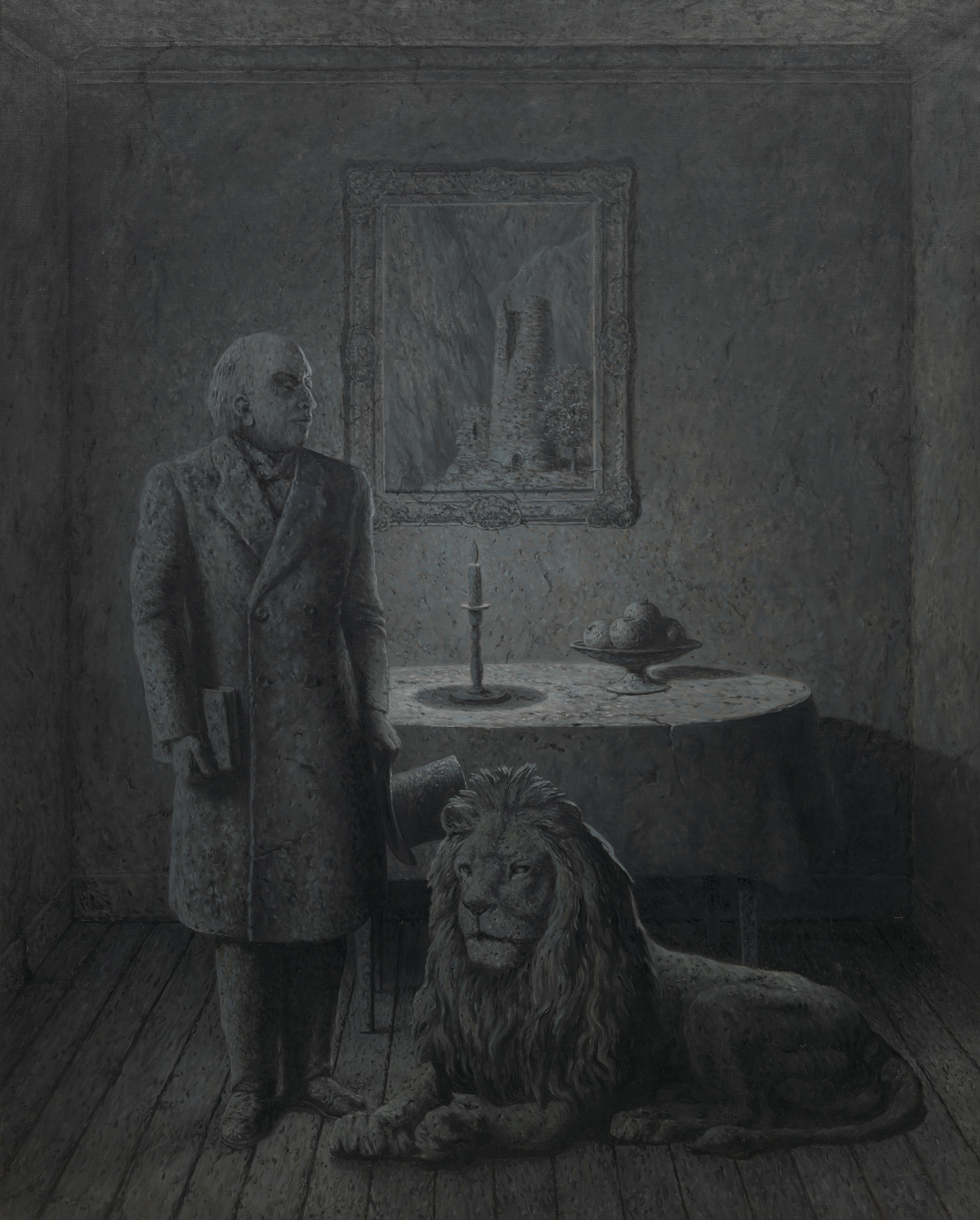 #84
#84
Travel memory (Memory of a Voyage)
Under the apparent simplicity of "Memory of a Voyage (Memory of a Voyage)", Magritte organizes a silent collision between familiar elements. The bringing together of incompatible elements transforms the scene into a visual proposition rather than a closed story. In recent years, ancient motifs return with increased economy: the image focuses on a few relationships capable of immediately disturbing perception. The technique - oil on canvas - supports this voluntary sharpness: the image focuses on a few relationships capable of immediately disturbing perception. The technique - oil on canvas - supports this voluntary sharpness: contours, surfaces and transitions remain precise enough for the impossible to appear objectively observed. The technique - oil on canvas - supports this voluntary sharpness: contours, surfaces and transitions remain precise enough for the impossible to appear objectively observed. The technique - oil on canvas - supports this voluntary sharpness: contours, surfaces and transitions remain precise enough for the impossible to appear objectively observed. The technique - oil on canvas - supports this voluntary sharpness: contours, surfaces and transitions remain precise enough for the impossible to appear objectively observed. The Museum of Modern Art, New York notice documents the work, dated 1955 and measuring 63 7/8 × 51 1/4 in. (162.2 × 130.2 cm). This institutional link makes it possible to find collection data, the available provenance and the conditions of use of the image. The work remains memorable because its strangeness never abolishes everyday life; on the contrary, it reveals how much it depends on our reading habits.
Image: The Museum of Modern Art, New York · © C. Herscovici, Brussels /Artists Rights Society (ARS), New York
See the museum notice → #85
#85
The Origins of Language (The origins of language)
"The Origins of Language (The Origins of Language)" belongs to these images where Magritte transforms descriptive clarity into a true instrument of mystery. Magritte here questions the gap between a thing, its image and the word which claims to designate it. In recent years, ancient motifs return with increased economy: the image focuses on a few relationships capable of immediately disturbing perception. The technique - oil on canvas - supports this voluntary sharpness: the image focuses on a few relationships capable of immediately disturbing perception. The technique - oil on canvas - supports this voluntary sharpness: the image focuses on a few relationships capable of immediately disturbing perception. The technique - oil on canvas - supports this voluntary sharpness: contours, surfaces and transitions remain precise enough for the impossible to appear objectively observed. The technique - oil on canvas - supports this voluntary sharpness: contours, surfaces and transitions remain precise enough for the impossible to appear objectively observed. The technique - oil on canvas - supports this voluntary sharpness: contours, surfaces and transitions remain precise enough for the impossible to appear objectively observed. The technique - oil on canvas - supports this voluntary sharpness: contours, surfaces and transitions remain precise enough for the impossible to appear objectively observed. The technique - oil on canvas - supports this voluntary sharpness: contours, surfaces and transitions remain precise enough for the impossible to appear objectively observed. The Menil Collection, Houston, documents the work, dated 1955 and measuring 45 1/2 × 35 1/4 in. (115.6 × 89.5 cm). This institutional link makes it possible to find collection data, the available provenance and the conditions of use of the image. The painting therefore does not provide an enigma to be solved: it keeps the gaze in the fruitful moment when seeing and understanding cease to coincide.
Image: null · © C. Herscovici /Artists Rights Society (ARS), New York
See the museum notice → #86
#86
The Sitting Woman. Place in the Sun III
With "The Seated Woman. Place au Soleil III", Magritte constructs a clear image whose logic slips away at the very moment we think we grasp it. Light does not only describe an hour: it puts the coherence of the visible world in crisis. In recent years, old motifs return with increased economy: the image focuses on a few relationships capable of immediately disturbing perception. The technique - gouache on paper glued to cardboard - supports this voluntary sharpness: the image focuses on a few relationships capable of immediately disturbing perception. The technique - gouache on paper glued to cardboard - supports this voluntary sharpness: the image focuses on a few relationships capable of immediately disturbing perception. The technique - gouache on paper glued to cardboard - supports this voluntary sharpness: the image focuses on a few relationships capable of immediately disturbing perception. The technique - gouache on paper glued to cardboard - supports this voluntary sharpness: contours, surfaces and transitions remain precise enough for the impossible to appear objectively observed. The notice from the Royal Museums of Fine Arts of Belgium, Brussels documents the work, dated 1956 and measuring 242 x 186 mm. This institutional link makes it possible to find collection data, the available provenance and the conditions of use of the image. This suspension of meaning explains the lasting force of the image: it appears immediately readable, then becomes more unstable with each look.
Image: Royal Museums of Fine Arts of Belgium, Brussels /photo: J. Geleyns - Art Photography · © Ch. Herscovici, with kind permission c/o SABAM Belgium
See the museum notice → #87
#87
Force of Circumstance (The Force of Things)
"Force of Circumstance (The Force of Things)" shows Magritte's method at its most direct point: painting with precision to make reality less certain. The bringing together of incompatible elements transforms the scene into a visual proposition rather than a closed story. In recent years, old motifs return with increased economy: the image focuses on a few relationships capable of immediately disturbing perception. The technique - oil on canvas - supports this voluntary sharpness: the image focuses on a few relationships capable of immediately disturbing perception. The technique - oil on canvas - supports this voluntary sharpness: contours, surfaces and transitions remain precise enough for the impossible to appear objectively observed. The technique - oil on canvas - supports this voluntary sharpness: contours, surfaces and transitions remain precise enough for the impossible to appear objectively observed. The Menil Collection, Houston, documents the work, dated 1958 and measuring 19 1/2 × 23 1/2 in. (49.5 × 59.7 cm). This institutional link makes it possible to find collection data, the available provenance and the conditions of use of the image. Magritte thus leaves the viewer with an active task: to note what is painted, then to measure everything that this evidence is not enough to explain.
Image: Gift of Alexander Iolas · © C. Herscovici /Artists Rights Society (ARS), New York
See the museum notice → #88
#88
Penelope's canvas
In "Penelope's Canvas", nothing is blurry, and yet the whole thing resists a single explanation. The landscape maintains a precise appearance while obeying mental logic rather than natural continuity. In recent years, old motifs return with increased economy: the image focuses on a few relationships capable of immediately disturbing perception. The technique - oil on canvas - supports this voluntary sharpness: the image focuses on a few relationships capable of immediately disturbing perception. The technique - oil on canvas - supports this voluntary sharpness: the image focuses on a few relationships capable of immediately disturbing perception. The technique - oil on canvas - supports this voluntary sharpness: contours, surfaces and transitions remain precise enough for the impossible to appear objectively observed. The technique - oil on canvas - supports this voluntary sharpness: contours, surfaces and transitions remain precise enough for the impossible to appear objectively observed. The notice from the Royal Museums of Fine Arts of Belgium, Brussels documents the work, dated 1958 and measuring 24.6 x 14.8 ; 26.2 x 16.5 x 2.5 (with frame). This institutional link makes it possible to find collection data, the available provenance and the conditions of use of the image. The work remains memorable because its strangeness never abolishes everyday life; on the contrary, it reveals how much it depends on our reading habits.
Image: Royal Museums of Fine Arts of Belgium, Brussels /photo: J. Geleyns - Art Photography · © Ch. Herscovici, with kind permission c/o SABAM Belgium
See the museum notice → #89
#89
The Banquet
Under the apparent simplicity of "The Banquet", Magritte organizes a silent collision between familiar elements. The bringing together of incompatible elements transforms the scene into a visual proposition rather than a closed story. In recent years, old motifs return with increased economy: the image focuses on a few relationships capable of immediately disturbing perception. The technique - oil on canvas - supports this voluntary sharpness: contours, surfaces and transitions remain precise enough for the impossible to appear objectively observed. The technique - oil on canvas - supports this voluntary sharpness: contours, surfaces and transitions remain precise enough for the impossible to appear objectively observed. The technique - oil on canvas - supports this voluntary sharpness: contours, surfaces and transitions remain precise enough for the impossible to appear objectively observed. The art Institute of Chicago's notice documents the work, dated 1958 and measuring 97.3 × 130.3 cm (38 1/4 × 51 1/4 in.). This institutional link makes it possible to find the collection data, the available provenance and the conditions of use of the image. The painting therefore does not provide a riddle to solve: it keeps the gaze in the fruitful moment when seeing and understanding cease to coincide.
Image: The Art Institute of Chicago · © 2018 C. Herscovici, London /Artists Rights Society (ARS), New York
See the museum notice → #90
#90
The Glass Key (The Glass Key)
"The Glass Key (The Glass Key)" belongs to these images where Magritte transforms descriptive clarity into a true instrument of mystery. An ordinary object becomes the focus of an enigma as soon as its scale, place or function ceases to be self-evident. In recent years, ancient motifs return with increased economy: the image focuses on a few relationships capable of immediately disturbing perception. The technique - oil on canvas - supports this voluntary sharpness: the image focuses on a few relationships capable of immediately disturbing perception. The technique - oil on canvas - supports this voluntary sharpness: the image focuses on a few relationships capable of immediately disturbing perception. The technique - oil on canvas - supports this voluntary sharpness: contours, surfaces and transitions remain precise enough for the impossible to appear objectively observed. The technique - oil on canvas - supports this voluntary sharpness: contours, surfaces and transitions remain precise enough for the impossible to appear objectively observed. The technique - oil on canvas - supports this voluntary sharpness: contours, surfaces and transitions remain precise enough for the impossible to appear objectively observed. The technique - oil on canvas - supports this voluntary sharpness: contours, surfaces and transitions remain precise enough for the impossible to appear objectively observed. The Menil Collection, Houston, documents the work, dated 1959 and measuring 51 1/8 × 63 3/4 in. (129.9 × 161.9 cm). This institutional link makes it possible to find collection data, the available provenance and the conditions of use of the image. This suspension of meaning explains the lasting force of the image: it appears immediately readable, then becomes more unstable with each look.
Image: null · © C. Herscovici /Artists Rights Society (ARS), New York
See the museum notice → #91
#91
The Memoirs of a Saint (The Memoirs of a Saint)
With "The Memoirs of a Saint (The Memoirs of a Saint)", Magritte constructs a clear image whose logic slips away at the very moment we think we grasp it. The bringing together of incompatible elements transforms the scene into a visual proposition rather than a closed story. In recent years, old motifs return with increased economy: the image focuses on a few relationships capable of immediately disturbing perception. The technique - oil on canvas - supports this voluntary sharpness: the image focuses on a few relationships capable of immediately disturbing perception. The technique - oil on canvas - supports this voluntary sharpness: contours, surfaces and transitions remain precise enough for the impossible to appear objectively observed. The technique - oil on canvas - supports this voluntary sharpness: contours, surfaces and transitions remain precise enough for the impossible to appear objectively observed. The technique - oil on canvas - supports this voluntary sharpness: contours, surfaces and transitions remain precise enough for the impossible to appear objectively observed. The technique - oil on canvas - supports this voluntary sharpness: contours, surfaces and transitions remain precise enough for the impossible to appear objectively observed. The Menil Collection, Houston, documents the work, dated 1960 and measuring 31 1/2 × 39 1/4 in. (80 × 99.7 cm). This institutional link makes it possible to find collection data, the available provenance and the conditions of use of the image. Magritte thus leaves the viewer with an active task: to note what is painted, then to measure everything that this evidence is not enough to explain.
Image: null · © C. Herscovici /Artists Rights Society (ARS), New York
See the museum notice → #92
#92
Megalomania (Madness of Grandeur)
"Megalomania (The Madness of Grandeur)" shows Magritte's method at its most direct point: painting with precision to make reality less certain. The bringing together of incompatible elements transforms the scene into a visual proposition rather than a closed story. In recent years, old motifs return with increased economy: the image focuses on a few relationships capable of immediately disturbing perception. The technique - oil on canvas - supports this voluntary sharpness: the image focuses on a few relationships capable of immediately disturbing perception. The technique - oil on canvas - supports this voluntary sharpness: contours, surfaces and transitions remain precise enough for the impossible to appear objectively observed. The technique - oil on canvas - supports this voluntary sharpness: contours, surfaces and transitions remain precise enough for the impossible to appear objectively observed. The technique - oil on canvas - supports this voluntary sharpness: contours, surfaces and transitions remain precise enough for the impossible to appear objectively observed. The Menil Collection, Houston, documents the work, dated 1962 and measuring 39 1/2 × 32 in. (100.3 × 81.3 cm). This institutional link makes it possible to find collection data, the available provenance and the conditions of use of the image. The work remains memorable because its strangeness never abolishes everyday life; on the contrary, it reveals how much it depends on our reading habits.
Image: null · © C. Herscovici /Artists Rights Society (ARS), New York
See the museum notice → #93
#93
The search for truth
In "The Search for Truth", nothing is vague, and yet the whole thing resists a single explanation. The bringing together of incompatible elements transforms the scene into a visual proposition rather than a closed story. In recent years, old motifs return with increased economy: the image focuses on a few relationships capable of immediately disturbing perception. The technique - oil on canvas - supports this voluntary clarity: the image focuses on a few relationships capable of immediately disturbing perception. The technique - oil on canvas - supports this voluntary sharpness: contours, surfaces and transitions remain precise enough for the impossible to appear objectively observed. The technique - oil on canvas - supports this voluntary sharpness: contours, surfaces and transitions remain precise enough for the impossible to appear objectively observed. The notice from the Royal Museums of Fine Arts of Belgium, Brussels documents the work, dated 1963 and measuring 130.5 x 97.2 ; 142.9 x 110 x 5.5 (with frame). This institutional link makes it possible to find collection data, the available provenance and the conditions of use of the image. The painting therefore does not provide a riddle to solve: it keeps the gaze in the fruitful moment when seeing and understanding cease to coincide.
Image: Royal Museums of Fine Arts of Belgium, Brussels /photo: J. Geleyns - Art Photography · © Ch. Herscovici, with kind permission c/o SABAM Belgium
See the museum notice → #94
#94
The Fanatics (The Fanatics)
Under the apparent simplicity of "The Fanatics (The Fanatics)", Magritte organizes a silent collision between familiar elements. The bringing together of incompatible elements transforms the scene into a visual proposition rather than a closed story. In recent years, old motifs return with increased economy: the image focuses on a few relationships capable of immediately disturbing perception. The technique - gouache on paper - supports this voluntary sharpness: contours, surfaces and transitions remain precise enough for the impossible to appear objectively observed. The technique - gouache on paper - supports this voluntary sharpness: contours, surfaces and transitions remain precise enough for the impossible to appear objectively observed. The technique - gouache on paper - supports this voluntary sharpness: contours, surfaces and transitions remain precise enough for the impossible to appear objectively observed. The technique - gouache on paper - supports this voluntary sharpness: contours, surfaces and transitions remain precise enough for the impossible to appear objectively observed. The technique - gouache on paper - supports this voluntary sharpness: contours, surfaces and transitions remain precise enough for the impossible to appear objectively observed. The Menil Collection, Houston, documents the work, dated 1963 and measuring 14 1/2 × 11 1/4 in. (36.8 × 28.6 cm). This institutional link makes it possible to find collection data, the available provenance and the conditions of use of the image. This suspension of meaning explains the lasting force of the image: it appears immediately readable, then becomes more unstable with each look.
Image: Anonymous gift · © C. Herscovici /Artists Rights Society (ARS), New York
See the museum notice → #95
#95
Evening Falls (Evening Falling)
"Evening Falls (Evening Fall)" belongs to these images where Magritte transforms descriptive clarity into a true instrument of mystery. Light does not only describe an hour: it puts the coherence of the visible world in crisis. In recent years, ancient motifs return with increased economy: the image focuses on a few relationships capable of immediately disturbing perception. The technique - oil on canvas - supports this voluntary sharpness: the contours, surfaces and transitions remain precise enough for the impossible to immediately appear observed. The technique - oil on canvas - supports this voluntary sharpness: contours, surfaces and transitions remain precise enough for the impossible to appear objectively observed. The technique - oil on canvas - supports this voluntary sharpness: contours, surfaces and transitions remain precise enough for the impossible to appear objectively observed. The technique - oil on canvas - supports this voluntary sharpness: contours, surfaces and transitions remain precise enough for the impossible to appear objectively observed. The technique - oil on canvas - supports this voluntary sharpness: contours, surfaces and transitions remain precise enough for the impossible to appear objectively observed. The Menil Collection, Houston's notice documents the work, dated 1964 and measuring 63 3/4 × 51 1/4 in. (161.9 × 130.2 cm). This institutional link makes it possible to find collection data, the available provenance and the conditions of use of the image. Magritte thus leaves the viewer with an active task: to see what is painted, then to measure everything that this evidence is not enough to explain.
Image: null · © C. Herscovici /Artists Rights Society (ARS), New York
See the museum notice → #96
#96
The Tune and Also the Words
With "The Tune and Also the Words", Magritte constructs a clear image whose logic slips away at the very moment we think we grasp it. The bringing together of incompatible elements transforms the scene into a visual proposition rather than a closed story. In recent years, old motifs return with increased economy: the image focuses on a few relationships capable of immediately disturbing perception. The technique - gouache over traces of graphite on cream wool paper - supports this voluntary sharpness: the image focuses on a few relationships capable of immediately disturbing perception. The technique - gouache over traces of graphite on cream wool paper - supports this voluntary sharpness: contours, surfaces and transitions remain precise enough for the impossible to appear objectively observed. The notice from The Art Institute of Chicago documents the work, dated 1964 and measuring 36.2 × 54.8 cm (14 5/16 × 21 5/8 in.). This institutional link makes it possible to find collection data, the available provenance and the conditions of use of the image. The work remains memorable because its strangeness never abolishes everyday life; on the contrary, it reveals how much it depends on our reading habits.
Image: The Art Institute of Chicago · © 2018 C. Herscovici, London /Artists Rights Society (ARS), New York
See the museum notice → #97
#97
In the Airy Glades (Among the Light Groves)
"In the Airy Glades (Among the Light Groves)" shows Magritte's method at its most direct point: painting with precision to make reality less certain. The landscape maintains a precise appearance while obeying mental logic rather than natural continuity. In recent years, ancient motifs return with increased economy: the image focuses on a few relationships capable of immediately disturbing perception. The technique - oil on canvas - supports this voluntary sharpness: the image focuses on a few relationships capable of immediately disturbing perception. The technique - oil on canvas - supports this voluntary sharpness: the image focuses on a few relationships capable of immediately disturbing perception. The technique - oil on canvas - supports this voluntary sharpness: contours, surfaces and transitions remain precise enough for the impossible to appear objectively observed. The Menil Collection, Houston's notice documents the work, dated 1965 and measuring 32 × 25 1/2 in. (81.3 × 64.8 cm). This institutional link makes it possible to find collection data, the available provenance and the conditions of use of the image. The painting therefore does not provide an enigma to be solved: it keeps the gaze in the fruitful moment when seeing and understanding cease to coincide.
Image: null · © C. Herscovici /Artists Rights Society (ARS), New York
See the museum notice → #98
#98
Baucis's Landscape (The landscape of Baucis)
In "Baucis's Landscape (The Landscape of Baucis)", nothing is blurred, and yet the whole thing resists a single explanation. The landscape maintains a precise appearance while obeying mental logic rather than natural continuity. In recent years, ancient motifs return with increased economy: the image focuses on a few relationships capable of immediately disturbing perception. The technique - oil on canvas - supports this voluntary sharpness: the image focuses on a few relationships capable of immediately disturbing perception. The technique - oil on canvas - supports this voluntary sharpness: the contours, surfaces and transitions remain precise enough for the impossible to appear objectively observed. The technique - oil on canvas - supports this voluntary sharpness: contours, surfaces and transitions remain precise enough for the impossible to appear objectively observed. The technique - oil on canvas - supports this voluntary sharpness: contours, surfaces and transitions remain precise enough for the impossible to appear objectively observed. The technique - oil on canvas - supports this voluntary sharpness: contours, surfaces and transitions remain precise enough for the impossible to appear objectively observed. The technique - oil on canvas - supports this voluntary sharpness: contours, surfaces and transitions remain precise enough for the impossible to appear objectively observed. The technique - oil on canvas - supports this voluntary sharpness: contours, surfaces and transitions remain precise enough for in. (55.6 × 45.7 cm). This institutional link makes it possible to find collection data, the available provenance and the conditions of use of the image. This suspension of meaning explains the lasting force of the image: it appears immediately readable, then becomes more unstable with each look.
Image: null · © C. Herscovici /Artists Rights Society (ARS), New York
See the museum notice → #99
#99
The Endearing Truth (The Amiable Truth)
Under the apparent simplicity of "The Endearing Truth (The Amiable Truth)", Magritte organizes a silent collision between familiar elements. The bringing together of incompatible elements transforms the scene into a visual proposition rather than a closed narrative. In recent years, old motifs return with increased economy: the image focuses on a few relationships capable of immediately disturbing perception. The technique - oil on canvas - supports this voluntary sharpness: contours, surfaces and transitions remain precise enough for the impossible to appear objectively observed. The technique - oil on canvas - supports this voluntary sharpness: contours, surfaces and transitions remain precise enough for the impossible to appear objectively observed. The technique - oil on canvas - supports this voluntary sharpness: contours, surfaces and transitions remain precise enough for the impossible to appear objectively observed. The technique - oil on canvas - supports this voluntary sharpness: contours, surfaces and transitions remain precise enough for the impossible to appear objectively observed. The Menil Collection, Houston, documents the work, dated 1966 and measuring 35 × 51 1/4 in. (88.9 × 130.2 cm). This institutional link makes it possible to find collection data, the available provenance and the conditions of use of the image. Magritte thus leaves the viewer with an active task: to see what is painted, then to measure everything that this evidence is not enough to explain.
Image: null · © C. Herscovici /Artists Rights Society (ARS), New York
See the museum notice → #100
#100
The blank page
"The blank page" belongs to these images where Magritte transforms descriptive clarity into a true instrument of mystery. The bringing together of incompatible elements transforms the scene into a visual proposition rather than a closed story. In recent years, old motifs return with increased economy: the image focuses on a few relationships capable of immediately disturbing perception. The technique - oil on canvas - supports this voluntary clarity: the image focuses on a few relationships capable of immediately disturbing perception. The technique - oil on canvas - supports this voluntary sharpness: contours, surfaces and transitions remain precise enough for the impossible to appear objectively observed. The notice from the Royal Museums of Fine Arts of Belgium, Brussels documents the work, dated 1967 and measuring 54 x 65; 75.4 x 86.8 x 7.8 (with frame). This institutional link makes it possible to find collection data, the available provenance and the conditions of use of the image. The work remains memorable because its strangeness never abolishes everyday life; on the contrary, it reveals how much it depends on our reading habits.
Image: Royal Museums of Fine Arts of Belgium, Brussels /photo: J. Geleyns - Art Photography · © Ch. Herscovici, with kind permission c/o SABAM Belgium
See the museum notice →What the ranking reveals
Three operations behind the mystery
Magritte acts on reality without making it unrecognizable: he moves, enlarges and names differently.
Move
A train leaves the tracks to cross a chimney; the context changes and the object begins to surprise again.
Scale change
An apple or a rose invades the room and reveals how size organizes our certainties.
Name
The word no longer explains the image: it opens a visible distance between language and the thing.
A Belgian life, an international work
Five benchmarks to follow René Magritte
René François Ghislain Magritte was born in Belgium and then studied at the Royal Academy of Fine Arts in Brussels.
The encounter with the metaphysical painting of Giorgio de Chirico accompanies the emergence of his surrealist language.
In Le Perreux-sur-Marne, he got closer to André Breton's group while maintaining a unique method.
Magritte develops his series, also works for advertising and patiently builds international recognition.
When he died, his images had already permanently displaced painting, photography, cinema and visual culture.
Magritte in depth
Painting as an experience of language and reality
Magritte trained in Brussels before working in graphic arts and advertising. These professions reinforce his taste for readable images, clear contours and immediately perceptible associations.
Giorgio de Chirico's discovery shows him that a painting can bring together ordinary objects without telling a continuous story. It is not a question of painting the dream, but of making mysterious what habit had made invisible.
The Parisian years from 1927 to 1930 focused experiments on words, fragmented bodies and paintings within painting. The Lovers, The False Mirror and The Palace of Curtains belong to this decisive phase.
Back in Belgium, Magritte works in series. An idea comes back in oil, gouache or another format; it changes title, scale or environment. Repetition is not a copy, but a method of thinking.
The titles, often found with friends, do not describe the scenes. They prevent too rapid reading and create a second focus of meaning, parallel to the image. The viewer must maintain both without reducing them to each other.
In the post-war decades, stone birds, overgrown chambers and nocturnal landscapes became international emblems. Their effectiveness is due to a constant contradiction: everything is visible, nothing is definitively explained.
Four reading keys
How to look at a Magritte painting
Start by describing exactly what is painted before looking for a hidden meaning.
Compare sizes
An impossible dimension ratio is often enough to transform a room or a landscape.
Identify the thresholds
Windows, doors, curtains and paintings in the painting blur the line between image and world.
Read without translating
The title and the painted words do not give the solution; they deliberately complicate the relationship with things.
Compare versions
The same discovery circulates between oils and gouaches, and each cover modifies the rhythm.
Works and institutions
Continue after the hundredth work
Each card directly opens the notice of the institution that keeps the table and documents its collection data.
Frequently asked questions
René Magritte, between image, object and language
The essential benchmarks on its motifs, its series, its museums and the rights of images.
What is René Magritte's most famous painting?
The Lovers, The False Mirror, The Betrayal of Images, Golconda and The Empire of Lights are among his most famous images. The Son of Man is also iconic, but it belongs to a private collection and does not enter into this corpus based on museum records.
Why is René Magritte important in art history?
Magritte has renewed the relationship between image, language and reality. His precise painting does not seek to illustrate dreams: it shows how ordinary objects become mysterious when their scale, context or name changes.
Was René Magritte surreal?
Yes. He joined the Belgian surrealist group in the 1920s and stayed near Paris from 1927 to 1930. However, he retained a very personal path, based on descriptive clarity, words and visual paradoxes.
Why does Magritte paint men in bowler hats?
The bowler hat designates an anonymous, conventional and reproducible figure. Magritte uses it as a social mask: the character seems banal, but his identity remains inaccessible or multiplies as in Golconda.
What does The Betrayal of Images mean?
The phrase "This is not a pipe" reminds us that an image is not the object it represents. The painting deliberately separates the thing, its name and its representation in order to make visible a convention usually forgotten.
Where to see the main works of René Magritte?
The Royal Museums of Fine Arts of Belgium preserve the largest ensemble in the world. Other major works can be found at the Menil Collection, MoMA, National Gallery of Art, Art Institute of Chicago, SFMOMA and Philadelphia.
Why are there multiple versions of certain tables?
Magritte worked by ideas and series. He used an oil or gouache pattern, modified the format and moved certain elements. Two works with the same title can therefore be separate paintings preserved by different museums.
Are Magritte's images royalty-free?
No, in most countries they remain protected. The maps on this page refer to official notices and indicate the available rights notices. Any commercial reproduction must be authorized by the rights holders and, as the case may be, by the institution holding the image.
0 comments