

History of art · Illustrated guide
Artistic movements: the great chronology of styles
From Renaissance balance to surreal dreams, thirteen benchmarks to recognize what we're looking at - without transforming art history into a catalog of labels.
Dates, visual signs, major artists, differences to no longer confuse and advice for choosing a work: this guide connects five centuries of painting in a single readable journey.

Before the timeline
A movement is not a closed box
An artistic movement designates a group of artists who share, during a given period, concerns, processes or a certain vision of the world. Sometimes they come together and publish a manifesto. Sometimes the label is invented after the fact by critics and historians. The boundaries therefore remain porous: the same painter can cross several currents, and two styles can coexist in neighboring towns.
The dates in this guide are landmarks, not switches. The Baroque does not go out the morning the Rococo begins; Realism continues while the Impressionists expose. The interest of chronology is to understand the successive responses: the classical order is followed by the dramatic impulse, the ideal by ordinary life, and the illusion of depth by the assumed surface.
Observation method
Four clues to recognize an artistic movement
A signature helps, but the image already speaks. These four questions give a stronger diagnosis than a simple "that reminds me of..."
The subject
Religion, mythology, national history, modern life, work, dreams or pure forms: what the artist chooses to show is already a position taken.
Space
Stable perspective, theatrical diagonal, instantaneous framing or fragmented shots: the construction guides the body as much as the eye.
The color
Light-dark, pastel tones, colored shadows, arbitrary contrasts or reduced palette indicate a particular conception of light.
The touch
Smooth surface, visible material, small divided touches, ample gesture or geometric shapes: the artist's hand leaves a grammar.
From 1400 to the 20th century
The chronology of the 13 major artistic movements
The route favors the most useful trends for reading European and modern collections. The periods overlap: the dates indicated remain deliberately approximate.
-1600
1. Renaissance
Humanism, the study of Antiquity and the observation of the world renew representation. Linear perspective constructs a coherent space, anatomy gives weight to bodies and portraiture affirms the individual. Leonardo da Vinci, Raphael, Botticelli, Titian and Michelangelo do not have a unique style, but share this ambition to make the visible intelligible.
Not to be confused: unlike the Baroque, the Renaissance generally favored stability, measure and a light that explained more than it dramatized. Explore the Renaissance.
-1750
2. Baroque
The Baroque transforms the image into an event. Diagonals, interrupted gestures, chiaroscuro and overflowing settings seek an immediate reaction. In Caravaggio, light cuts through the stage like a projector; in Rubens, the bodies and fabrics seem carried away by the same movement. The current varies depending on the country, from Roman theatricality to Dutch intimacy.
Not to be confused: baroque aims for intensity and immersion, where contemporary classicism seeks more mastered architecture. Explore the Baroque.
- 1780
3. Rococo
In the aristocratic interiors of the 18th century, Rococo lightens the baroque pomp. Curves, gardens, love games, pearly skin tones and pastel palettes make up a world of mobile grace. Watteau, Boucher and Fragonard love gallant parties and equivocal stories. Virtuosity remains, but religious or political tension gives way to the pleasure of conversation and decor.
Not to be confused: rococo is more intimate, decorative and frivolous than monumental Baroque. Explore Rococo.
-1830
4. Neoclassicism
In reaction to Rococo seductions, Neoclassicism returned to line, ancient example and civic virtue. Archaeological excavations, the Enlightenment and then revolutionary upheavals nourished a painting with clear contours, sculptural poses and readable compositions. Jacques-Louis David becomes the great French figure; Ingres extends its linear precision.
Not to be confused: neoclassicism disciplines emotion; the Romanticism which responds to it places it at the forefront. Exploring Neoclassicism.
‘1850
5. Romanticism
Romanticism prefers the storm to the rule. Sublime nature, political news, exoticism, ruins and individual passions become its great territories. Delacroix makes color vibrate, Géricault transforms a shipwreck into a monument, Turner dissolves the landscape in light and Friedrich confronts the human silhouette with immensity.
Not to be confused: a romantic historical scene often seeks dizziness and empathy; neoclassical painting first organizes a moral example. Explore Romanticism.
-1880
6. Realism
Realism gives an ambitious scale to contemporary life: workers, countryside, cities and ordinary bodies enter the great painting. Courbet refuses idealization and Millet looks at the rural world without dressing it in pastoral care. The term therefore does not only mean "resembling"; it also designates a choice of subjects and an attitude towards society.
Not to be confused: impressionism shares interest in the present, but shifts the issue toward luminous perception and fleeting sensation. Exploring Realism.
‘1886
7. Impressionism
In 1874, Monet, Renoir, Degas, Morisot, Pissarro and their companions exhibited outside the Official Salon. They paint modern life, leisure, streets and landscapes, favoring the changing effects of the atmosphere. The touch remains visible, the shadows become colored, the framing sometimes seems captured on the fly. It is not a vague painting: each tone relationship is carefully observed.
Not to be confused: the post-impressionists start from these conquests but reconstruct the image according to a more personal logic. See the impressionist landscapes or the Claude Monet collection.
- 1905
8. Post-impressionism
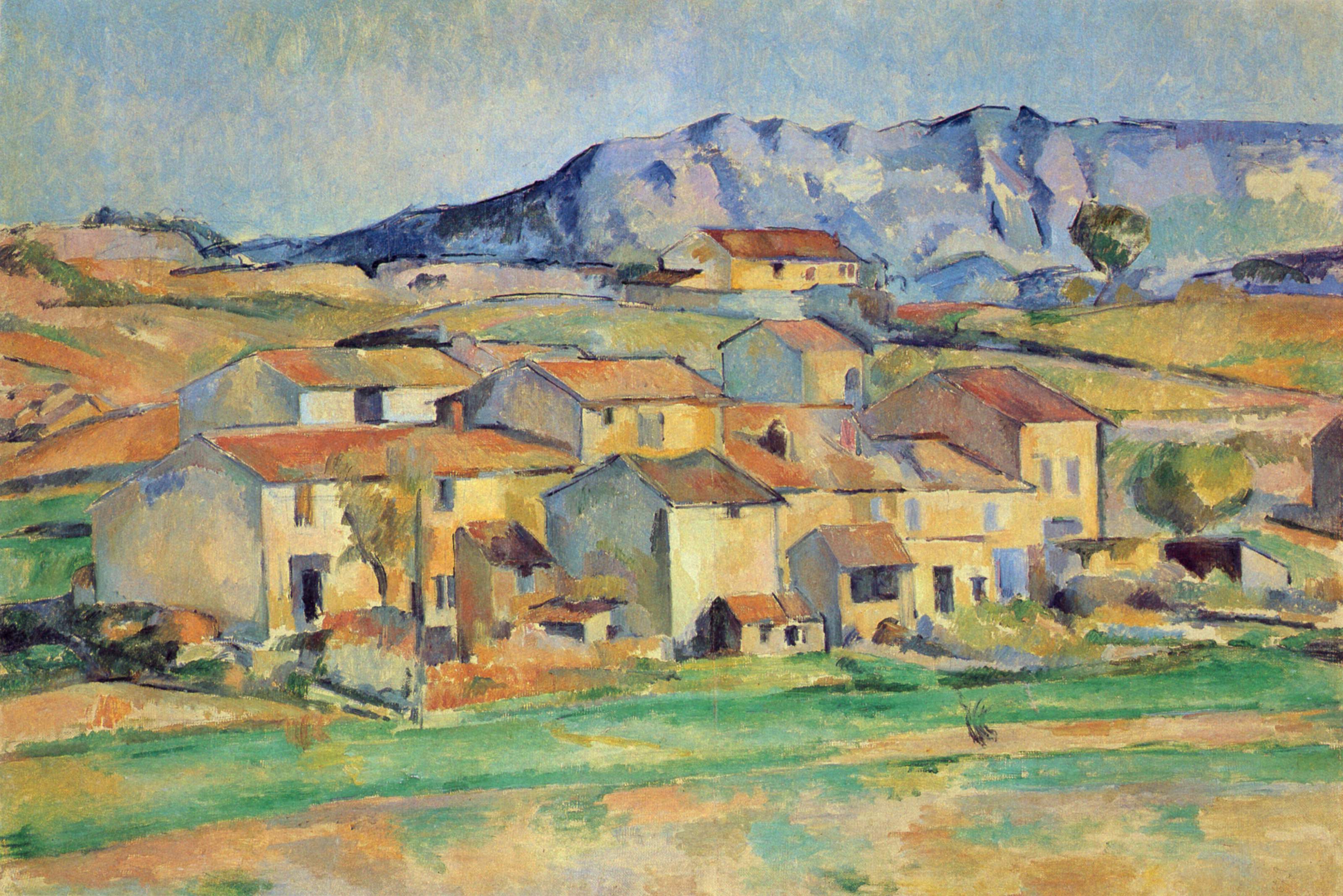
The term brings together different research rather than a unified school. Cézanne consolidates nature through volumes, Seurat systematizes colored contrasts, Van Gogh intensifies the touch and Gauguin simplifies flat shapes. All inherit impressionist color, but refuse to limit painting to immediate optical printing.
Not to be confused: in Monet, light transforms the motif; in Cézanne or Van Gogh, the motif becomes the framework of a language. Exploring Post-Impressionism.
-1910
9. Art Nouveau
Art Nouveau wants to abolish the border between fine and applied arts. Posters, glass roofs, furniture, architecture and illustration share an organic line inspired by stems, flowers, hair and insects. Mucha, Klimt, Horta and Gallé show how much the style varies between Paris, Brussels, Vienna or Prague.
Not to be confused: art Nouveau favors the living curve; Art Deco from the 1920s favored a sharper and more luxurious geometry. Explore Art Nouveau.
-1914
10. Cubism
Picasso and Braque challenge the unique point of view inherited from the Renaissance. Objects, faces and instruments are analyzed in facets; several aspects of the same thing seem to coexist on the surface. Analytical Cubism fragments, synthetic Cubism reassembles and introduces glued papers, letters and ordinary materials.
Not to be confused: cubism often retains an identifiable motif, while some abstractions abandon any direct reference to the visible. Explore Cubism.
-1920
11. Expressionism
Expressionism distorts the world to make an inner experience more acute. Acidic colors, nervous lines, unstable perspectives and tense figures respond to the concerns of modern life. The term notably covers Die Brücke, Der Blaue Reiter and several independent artists; Munch constitutes an important precursor.
Not to be confused: fauvism also releases color, but its effect is often brighter; Expressionism readily gives it a psychological charge. Explore Expressionism.
v. 1910
12. Abstraction
Abstraction does not follow a single route. Kandinsky associates colors and tensions with a spiritual experience; Mondrian reduces the image to relationships of lines and planes; Malevich seeks a radically autonomous form. Some works still start from landscape or music before moving away from it, others work straight away with geometry without a referent.
Not to be confused: "abstract" does not mean random. The relationships of scale, balance and rhythm are often as constructed as in a figurative composition. Explore Abstract Art.
1924
13. Surrealism
Around the manifesto published by André Breton in 1924, the surrealists explored dreams, desire, chance and the unconscious. Dalí paints the impossible with almost academic precision; Magritte disrupts the relationship between words and things; Ernst, Miro and Tanguy invent other automatisms. The movement therefore does not define a single aspect, but a strategy of change of scenery.
Not to be confused: surrealism can be very figurative. It is not resemblance that disappears, but ordinary logic that goes wrong. Exploring Surrealism.
A museum in eight images
See breakups rather than memorizing dates
The chronology becomes clearer when we observe what changes from one image to another: the scene comes to life, the line is disciplined, the light fragments, then the form claims its autonomy.




Face-to-face
The differences that are most often confused
These oppositions are useful shortcuts, provided you remember that each movement contains exceptions.
| Comparison | First movement | Second movement | Decisive index |
|---|---|---|---|
| Renaissance/Baroque | Balance, stable perspective, measured gestures. | Diagonals, action, dramatic chiaroscuro. | Ask if the scene exposes an order or draws you into an event. |
| Neoclassicism/Romanticism | Primate of the line, ancient example, mastery. | Primate of color, topicality, passion and sublime. | See if the emotion is disciplined or goes beyond the moral framework. |
| Impressionism/Post-impressionism | Bright sensation, quick touch, modern moment. | Structure, symbolism or expressive color depending on the artist. | Find out if light is the subject or starting point of a personal language. |
| Cubism/Abstraction | Fragmented object but often still identifiable. | Forms that can become fully autonomous. | Try to identify a violin, a face, a table: Cubism likes to leave clues. |
Practical exercise
How to approximately date an unknown painting?
It is not a question of replacing expertise, provenance or material analysis. This method is used to formulate a coherent visual hypothesis before consulting the cartel.
Ignore the frame
A frame can be posterior or chosen for decoration. First look only at the image.
Test space
Deep perspective, theatrical scene, photographic framing or flattened surface give a probable first century.
Read the key
A smooth style does not tell the same ambition as a divided, muddy or gestural touch.
Identify the world
Costumes, furniture, transport and leisure provide information on the subject, even if the artist looks at a past era.
Cross the clues
Compare subject, technique and composition. A single detail deceives; three matching clues become useful.
From the museum to the home
Which artistic movement should you choose for your decoration?
The best choice isn't necessarily the style already present in the room. A well-balanced contrast often gives more character than a perfect match.
Classic interior
Renaissance, Baroque, Rococo or Neoclassicism accompany moldings, wood, stone and deep textiles. To avoid the effect of historical decor, isolate a strong work rather than an accumulation of small formats.
See famous paintings →Bright room
Impressionism and Post-Impressionism extend natural light. The landscapes visually open the room; the figure scenes bring a more social and colorful rhythm.
See the impressionist landscapes →Contemporary space
Cubism, Expressionism, abstraction and Surrealism create graphic tension with sober lines. Scale matters: a large format lets shapes and colors breathe better.
See abstract art →Continue exploring
Artistic movements in the collections
Browse reproductions by era and directly compare compositions, palettes and ways of painting.
Renaissance
Perspective, humanism and harmony.
17th centuryBaroque
Chiaroscuro, movement and intensity.
19th centuryRomanticism
Passion, sublime and great landscapes.
18th centuryRococo
Grace and pastel colors.
Around 1760 -1830Neoclassicism
Line, order and Antiquity.
19th centuryRealism
The present and ordinary life.
From 1874Impressionism
Changing atmosphere and light.
Around 1886 -1905Post-impressionism
Structure and expressive color.
Belle ÉpoqueArt Nouveau
Vegetable curves and total art.
Avant-gardesCubism
Multiple facets and points of view.
20th centuryExpressionism
Deformation and inner strength.
Modern artAbstract art
Rhythm, geometry and color.
From 1924Surrealism
Dream and unexpected associations.
Master of LightClaude Monet
A work at the heart of Impressionism.
The essentialsFamous paintings
Works that have spanned the ages.
Complete catalogAll works
Explore the entire store.
Frequently asked questions
Understanding artistic movements
What's an art movement?
It is a set of artists, works or practices brought together by common concerns, processes or context. The group may have named itself, published a manifesto, or later been critically defined.
What movement came after the Renaissance?
In a simplified chronology of European art, the Baroque asserted itself around 1600 after the late phases of the Renaissance and Mannerism. However, transitions differ depending on the country.
What is the difference between Baroque and Rococo?
Baroque often favors drama, movement and monumentality. Rococo, which developed in the 18th century, takes up curves but makes them lighter, intimate, decorative and pastel.
Why is 1874 an important date for Impressionism?
Because the first exhibition of the group that we would call impressionist was held that year in Paris, outside the official Salon. It notably brings together Monet, Renoir, Degas, Morisot, Pissarro and Sisley.
Is Art Nouveau a painting movement?
Yes, but not only that. It is a transversal movement that touches architecture, posters, furniture, glass, jewelry and decorative arts, with the ambition of an art integrated into daily life.
Is Cubism abstract?
It opens an essential path to abstraction, but many Cubist works retain an identifiable subject - face, instrument, bottle or table - which they fragment and show from several angles.
What is the first abstract art movement?
There is no single starting point. Around 1910, Kandinsky, Kupka, Malevich, Mondrian and others developed, in different contexts, languages that moved away from representation.
How to choose a reproduction according to an artistic movement?
First look at the desired effect: classical depth, impressionist light, expressionist tension or abstract rhythm. Then consider the room palette, recoil distance and available format.
To go further: definitions and files of Museum of Modern Art, especially on the Cubism, l'Expressionism and the Surrealism ; National Gallery of Art files on the Baroque and theImpressionism. Accessed July 2026.
0 comments