

Van Gogh's Olive Trees • Art & Decoration Guide
Van Gogh's Olive Trees: Saint-Rémy, Light and Spirituality – The Guide That Looks Beneath the Varnish
Van Gogh's Olive Trees told from the questions readers really ask: life, works, details, context, sources and decor choices, with a cultured tone that's not stuck in a display case.
Van Gogh's Olive Trees deserves an in-depth article because this style engages both an era, a way of painting, and a very concrete way of living with images. The thread is simple: follow the subject from its biographical or artistic details, then answer frequent curiosities with rich, precise, and lively chapters. We unfold the subject in depth: the places, the ruptures, the artists, the symbols, the works to look at closely, and what all that changes when a reproduction arrives in a living room. Promise, we stay cultured, but we keep our feet out of the dusty museum.
 Free image
Van Gogh's Olive Trees told from the questions readers really ask: life, works, details, context, sources and decor choices, with a cultured tone that's not stuck in a display case.
Reading method
How to read Van Gogh's Olive Trees without pulling out a professor's magnifying glass?
We proceed like in front of a work: context first, then details, then effect in the room. The goal is not to look scholarly in front of the frame, but to see more accurately, which is much more chic.
Context before prestige
We place Van Gogh's Olive Trees in its era, its studios, its exhibitions and its small revolts. A work without context is sometimes just a very beautiful person who forgot their history.
The signs that betray the style
We identify composition, palette, texture. These clues often say more than grand speeches, especially when they carry gold or nervous brushstrokes.
The work in a real room
We finish with the useful question: does this image breathe in your home, or does it just pose like a poster that read two books?
Historical context
Where does Van Gogh's Olive Trees come from, and why isn't it just a pretty label?

This iconic series was born in the courtyard of the asylum in Saint-Rémy, between May and November 1889, where Vincent desperately sought comfort from the torments of his mind. Far from being a mere decorative label, these canvases embody a physical struggle against nature, where each thick brushstroke, loaded with chrome yellow and cobalt blue, conveys an almost painful inner vibration. You see the twisted trunks like protruding muscles and the ground seeming to move under the oppressive heat of the Midi. This is not a docile landscape, but a visual confession where the pictorial material becomes the very language of suffering and hope.
Reducing these works to a rural motif would be to forget that they furiously engage with the cycle of life and the artist's spiritual quest. Van Gogh wrote to Theo that olive trees were inseparable from the Provencal sun, capturing a light that does not merely illuminate but sculpts space. The swirling composition, far from classical calm, imposes a breathless rhythm that turns your living room into an extension of the artist's studio. Hanging a reproduction here is to invite a raw and telluric energy, reminding that every painted leaf was wrested from anguish to become a vibrant celebration of existence.
Artistic style
Why do Van Gogh's Olive Trees still interest us so much?
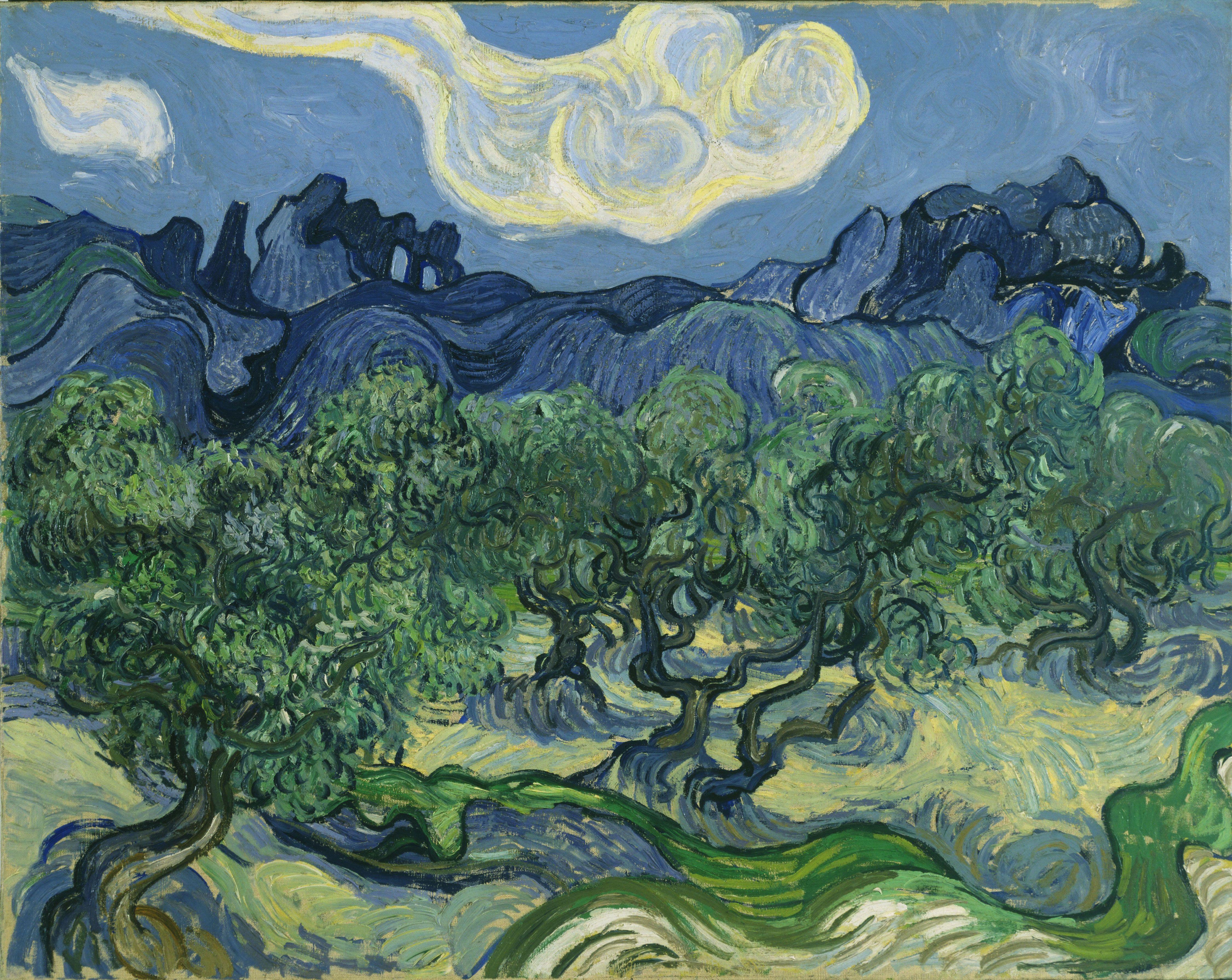
The enduring appeal of Van Gogh's olive trees lies in this unique ability to transform a mundane Provencal motif into a spiritual storm. In Saint-Rémy, the artist does not just copy nature; he twists it with a frenzy that makes every leaf vibrate like a musical note. Observe how the gnarled trunks embrace like ancient wrestlers, while the ground undulates under the effect of an invisible telluric energy. This agitation is not a mere stylistic effect, but the reflection of a soul seeking redemption in the face of inner turmoil. The modern viewer, lost in an overly smooth digital world, finds in these swirls of paint a raw and reassuring humanity.
Beyond the personal drama, it is the technical mastery of light that continues to fascinate art lovers and decorators. Van Gogh uses a palette where emerald green violently dialogues with touches of lemon yellow and cobalt blue, creating a luminosity that seems to emanate from the canvas itself. The texture is so thick, worked with a knife or through vigorous impasto, that the shadow becomes almost palpable under certain lighting angles. In a contemporary living room, hanging a reproduction of these works not only brings color, but introduces a breath, a wild rhythm that delightfully contrasts with the rigidity of our modern, sanitized architectures.

The Starry Night
A reproduction related to Van Gogh's Olive Trees, useful for comparing ambiance, palette and wall presence.

Café Terrace at Night
A reproduction related to Van Gogh's Olive Trees, useful for comparing ambiance, palette and wall presence.

The Vision After the Sermon
A reproduction related to Van Gogh's Olive Trees, useful for comparing ambiance, palette and wall presence.
Art & details
The visual signs that betray the style

At first glance, Van Gogh's tormented touch imposes an almost hypnotic rhythm, transforming the olive trees of Saint-Rémy into real green flames frozen in oil. Observe how the comma-like brushstrokes wrap around the gnarled trunks, creating a texture so thick it seems palpable under the midday light. This visual agitation is not a mere technical whim, but the faithful translation of a living nature, where every leaf vibrates with its own energy. The cobalt blue of the sky violently contrasts with the ochres of the ground, a chromatic audacity that defies photographic reality to achieve a raw and immediate emotional truth.
The atmosphere emanating from these canvases goes beyond simple botanical representation to touch a tangible, almost mystical spirituality. Van Gogh does not paint an isolated tree, but a network of roots and branches that seem to dance a celestial waltz under an implacable sun. The composition, often lacking a stable horizon, gives the viewer a dizzying impression of being sucked into the foliage, as if the Provencal wind were blowing directly from the canvas. These concrete details, from the lumpy texture to the saturated palette, betray a unique style where madness and genius combine to reinvent light itself.
Art & details
The works to look at as if they might answer

Faced with these canvases, one sometimes forgets that the oil is still wet, so immediate is the vibration. The olive trees of Saint-Rémy are not simple trees, but entities twisted by an invisible wind, their bluish trunks entwining like exhausted Greek wrestlers. Looking at a work like The Olive Pickers, you can almost hear the cracking of branches under the fingers of bent peasant women. Van Gogh impasted the material with such fury that the light of the Provencal midday seems to burst directly from the canvas, forcing you to squint as if you were there, in that golden dust that sticks to the skin.
You must get close enough to see the trace of the palette knife, that brilliant scar where chrome yellow meets olive green with almost insolent audacity. These paintings do not simply allow themselves to be looked at; they demand a silent conversation, as if each painted leaf were waiting for your approval to continue trembling. In the intimacy of a living room, hanging such a reproduction transforms the wall into a window open onto a tumultuous spirituality, far from the flat calm of classical still lifes. One detects a vital urgency, that of a man who painted to keep from sinking, making each olive tree a silent but terribly eloquent guardian of his own madness.
Art & details
Symbols, details and small visual quirks

In these canvases, the olive tree is not a simple tree, but a tormented figure that seems to dance under the pressure of an invisible wind. Van Gogh uses touches of cobalt blue and emerald green to sculpt the foliage, creating an optical vibration that gives the impression that the branches are actually shivering. One often notices this small visual quirk where the ground undulates with the same frenetic energy as the sky, abolishing any stable horizon line. This technique transforms the Provencal landscape into an intense spiritual scene, where each thick, almost palpable brushstroke tells the artist's inner struggle with the wild nature of Saint-Rémy.
The light here does not merely illuminate; it shapes the material with an almost tactile violence, reminiscent of the stained glass of a modern cathedral. Observe how the silvery-gray trunks coil like ancient snakes, anchoring the composition in a terrestrial reality while the sky swirls in chrome yellow and pure white. This opposition creates an electric atmosphere, typical of his internment period, where the apparent serenity of the subject is contradicted by the feverish execution. It is this concrete detail, this friction between the supposed calm of the olive tree and the agitation of the line, that makes these works much more than mere decoration: a raw and hypnotic pictorial confession.
Works to know
Famous works of Van Gogh's Olive Trees to look at before choosing
For a hand-painted reproduction of Van Gogh's Olive Trees, an oil painting of Van Gogh's Olive Trees, or a copy of the painting Van Gogh's Olive Trees, the most useful thing is to compare several images: the gilding, the faces, the density of patterns, and how each work holds the wall.
- The Bedroom at ArlesA visual entry point to understand Van Gogh's Olive Trees without turning the article into an inventory.
- The Starry NightA reproduction related to Van Gogh's Olive Trees, useful for comparing ambiance, palette and wall presence.
- Café Terrace at NightA reproduction related to Van Gogh's Olive Trees, useful for comparing ambiance, palette and wall presence.
- The Vision After the SermonA reproduction related to Van Gogh's Olive Trees, useful for comparing ambiance, palette and wall presence.
- Mont Sainte-VictoireA reproduction related to Van Gogh's Olive Trees, useful for comparing ambiance, palette and wall presence.
Art & details
Neighbors, allies and turbulent cousins

Around the tormented olive trees of Saint-Rémy, nature is not a passive backdrop but a restless family where everyone pulls the blanket to themselves. The cypresses, those green flames rising toward the sky, play the protective older brothers while the Alpilles, in the background, offer a mineral and bluish base that contrasts with the frenetic dance of the foliage. Van Gogh does not paint an isolated tree; he captures the electricity of an entire ecosystem where the wind seems to howl through every twisted branch. This proximity creates a striking visual tension, as if the earth itself were holding its breath before the storm, transforming the Provencal landscape into a cosmic theater scene where each element has its precise role.
If we look more closely, we discover that these olive trees have turbulent cousins in art history, notably with Cézanne, who dissected their forms with an almost architectural geometric rigor. Where the master of Aix sought the eternal structure beneath the rough bark, our Vincent favored perpetual motion, using touches of chrome yellow and emerald green to make the midday light vibrate. Imagine these canvases hanging in a modern living room: they do not soothe the gaze, they gently jostle it, reminding us that nature is alive, unpredictable, and sometimes slightly hysterical. It is this alliance between the stability of the ground and the madness of the sky that makes the series so essential for anyone who dares to live with powerful images.
Art & details
What museums confirm when shortcuts go too fast

Museums, those silent guardians of posterity, often remind us that the frenzy of digital shortcuts crushes the complexity of the Van Gogh gesture. In Saint-Rémy, Vincent was not seeking efficiency, but the vibrant truth of an olive tree twisted under the mistral. X-ray analyses reveal layers of impasto paint, sometimes several millimeters thick, that no Instagram filter could faithfully reproduce. This raw material, mixed with sand and pure pigments, creates a mental topography where each brushstroke is a physical struggle against erasure. Reducing this work to a decorative icon is to ignore the sweat and anguish that presided over its birth in the Provencal asylum.
When exhibitions bring originals face to face with hasty reproductions, the difference in light becomes almost palpable, even spiritual. The chrome yellow used by the master to capture the midday sun has a radioactive intensity that LCD screens struggle to reproduce without betraying the nuance. In the rooms of the MoMA or the Musée d'Orsay, one notes that the swirling composition of the branches acts like a vortex drawing the gaze far beyond the mere flat surface. This electric atmosphere, born from an obsessive observation of nature, demands a time of contemplation that the rapid consumption of images formally forbids. The olive tree is not a motif; it is a living testimony of lucid madness.
Art & details
How to choose a reproduction without panicking the wall?

Choosing a reproduction of the Olive Trees is first about taming that Mediterranean light that still seems to vibrate on the canvas. In Saint-Rémy, Van Gogh captured the trembling of the wind in the twisted branches with such intensity that the work risks devouring your living room if it is poorly calibrated. Opt for a textured canvas print rather than glossy paper; only the material can reproduce those furious impastoes where olive green struggles against cobalt blue. Imagine your wall not as a passive support, but as an extension of that tormented sky. Too small a format would stifle the gesture, while an excessive size would turn your bedroom into a life-sized psychiatric asylum, which is not always the desired ambiance for breakfast.
The balance then rests on the dialogue between the saturated palette and your own decor. These paintings are full of chromatic yellows and deep greens that require a neutral environment to avoid creating a visual argument with your floral curtains. If your interior bathes in pastel tones or light woods, let the olive tree impose its dramatic law without competition. Conversely, in a space already filled with patterns, opt for a reproduction with slightly softened contrasts, remembering that even genius must sometimes compromise with domestic reality. Do not forget that Van Gogh painted to soothe his soul, not to panic your guests during cocktails; the spirituality of the work must breathe, not attack.
Interior decoration
Mistakes to avoid before hanging the painting

Avoid at all costs exposing this tormented canvas under cold white LED lighting, as you would turn the golden vibration of the leaves into a sad metallic surface. Van Gogh captured the trembling light of Provence with yellows and greens so intense they seem to pulse; smothering them under an office neon would be a crime against the very atmosphere of Saint-Rémy. Imagine the disaster: the thick brushstrokes, those impastoes that give relief to the gnarled trunks, would lose all their soul to resemble a lifeless digital print. The warmth of the Mediterranean sun demands a warm-spectrum bulb capable of awakening the ochre of the earth and the deep blue of the sky.
Do not make the fatal mistake of hanging this masterpiece above a sofa that is too low or in a narrow hallway where the eye cannot step back. The composition of the Olive Trees is an energetic vortex that requires distance, about three meters, so that the eye can grasp the frenetic dance of the branches reaching toward the sky. If you place the painting in a confined space, you risk suffocating this wild spirituality and giving the visitor vertigo rather than ecstasy. Furthermore, ensure the wall is perfectly neutral; a patterned wallpaper or a bright color would directly conflict with the already saturated palette, creating a visual cacophony worthy of a bad carnival reproduction.
| Room | Suggestion | Decorative effect |
|---|---|---|
| Living room | A work related to Van Gogh's Olive Trees with a strong composition | Cultured focal point, warm, and easy to comment on without reciting a label. |
| Bedroom | A soft palette or a more intimate scene | Calm atmosphere, visual presence without unnecessary agitation. |
| Office | A structured, colorful, or graphically sharp image | Creative energy and a little reminder that the wall can also work. |
| Entrance | A vertical format or an immediately readable work | Clear, elegant first impression, and much less timid than an empty white space. |

Mont Sainte-Victoire
A reproduction related to Van Gogh's Olive Trees, useful for comparing ambiance, palette and wall presence.

A Sunday Afternoon on the Island of La Grande Jatte
A reproduction related to Van Gogh's Olive Trees, useful for comparing ambiance, palette and wall presence.
To continue the visit
Sources, collections and paths truly related to the subject
A few useful references to verify the information, compare free images, and extend the reading without going to a museum that didn't ask for anything.
Related articles to read next
Verified collections
Useful blog hubs
Useful sources on this subject
- Wikipedia - Les Oliviers (Van Gogh)
- Wikidata - The Olive Trees (Van Gogh, MoMA)
- Wikidata - Vincent van Gogh
- MoMA - The Olive Trees (1889)
- Wikimedia Commons - The Olive Trees
- Wikipedia - Olive Grove
- Wikidata - Olive Grove (Kröller-Müller)
- Van Gogh Museum - Letters
- The Met - Olive Trees (Van Gogh)
- Wikipedia - Saint-Paul-de-Mausole
FAQ
Frequently asked questions about Van Gogh's Olive Trees
What is Van Gogh's Olive Trees in painting?
Van Gogh's Olive Trees deserves an in-depth article because this style engages both an era, a way of painting, and a very concrete way of living with images.
How to recognize this style quickly?
Observe especially composition, palette, texture, light and atmosphere, then how the composition organizes the gaze. If the work holds your attention longer than expected, it's probably not an accident.
Which artists should you know?
You need to cross-reference the central artists of the movement with museums and reliable sources to avoid hasty attributions.
Does this style suit modern decoration?
Yes, provided you choose the right format, a palette consistent with the room, and a work whose presence remains pleasant daily.
Should you choose the most famous work?
Not necessarily. The most well-known work can be perfect, but the right choice depends especially on the room, format, palette, and desired atmosphere.
Where to verify the information?
Start with museum notes, Wikipedia/Wikidata for general orientation, then Wikimedia Commons when a free image is needed.
Van Gogh's Olive Trees: see better, choose stronger
Van Gogh's Olive Trees is best approached as a real story: a context, artists, visual choices, obsessions, works, and a decorative presence. A good reproduction isn't just for filling an empty rectangle: it sets an ambiance, a visual culture, and sometimes a little extra spirit. That's not nothing for a wall that, until then, had mostly been wallpaper with admirable patience.
0 comments