

Vienna Around 1900
Gold, desire and Viennese modernity.
Gustav Klimt (14 July 1862–6 February 1918) was an Austrian painter and one of the founders of the Vienna Secession in 1897. His style combines realistic figures, decorative patterns and symbolism. His golden period, in the early 1900s, culminated in Portrait of Adele Bloch-Bauer I and The Kiss. Ten major works, his portraits and his landscapes help explain his development.


Gustav Klimt brings two worlds into opposition within a single image. The face, hands and sometimes feet retain a bodily presence; around them, clothing, space and setting turn into signs. Circles, spirals, rectangles, eyes, flowers and gold leaf transform the body into an apparition.
This tension explains the power of his paintings. Klimt is neither merely a decorator nor solely a painter of fin-de-siècle eroticism. Trained in large official decorative commissions, he mastered academic illusion before abandoning it. Through the Vienna Secession, he championed a modernity in which painting, architecture, typography and applied arts could form part of a shared environment.
This biography of Gustav Klimt traces his life, major works and stylistic development, from academic decoration to the golden period and then to his late portraits and landscapes. The French form “Gustave Klimt” is sometimes encountered; the Austrian painter’s correct name is Gustav Klimt.
Four Keys to Recognising Klimt’s Visual Language
Line
A supple outline isolates a silhouette, follows a head of hair or encloses a profile. Drawing gives the body a clear presence amid decorative abundance.
Ornament
Rectangles, spirals, flowers and signs are not arbitrary additions. They give surfaces rhythm and suggest identities, tensions or roles.
Frontality
Reduced depth, monumental figures and saturated backgrounds bring painting closer to mosaics, icons, posters and tapestries.
Contradiction
Beauty and unease coexist. Gold can magnify an embrace but also immobilise the body; flowers often surround themes of time and mortality.

Vienna 1900: A Brilliant, Unstable and Modern City
At the end of the nineteenth century, Vienna was the capital of a vast empire and an intellectual laboratory. The palaces of the Ring stood alongside industrial transformation, national tensions, antisemitism and new research in medicine, psychology, music and architecture.
In 1897, Klimt left the conservative Künstlerhaus with other artists and founded the Vienna Secession. He became its first president. Their ambition was not to impose a single style but to open Vienna to international contemporary art and bring fine art, architecture and applied design closer together.
Joseph Maria Olbrich’s building, its golden dome and the journal Ver Sacrum gave this project a visual identity. There, Klimt found a space to develop his large allegories without submitting to academic conventions.
Break with conservative juries and present the European avant-gardes.
Bring painting, architecture, furniture, sculpture, music and graphic design into dialogue.
Respond to the contradictions of the modern city with a new aesthetic.
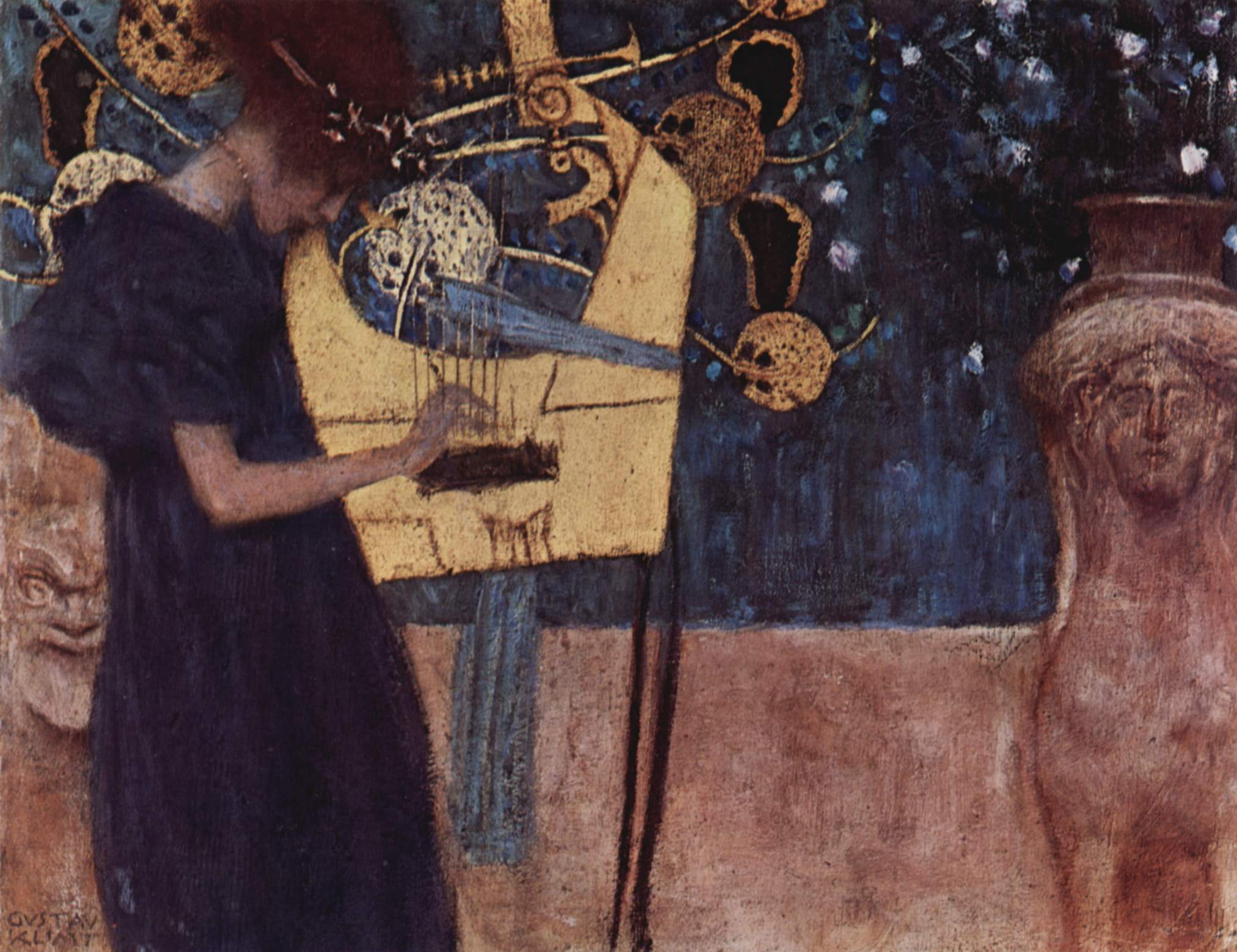
Gustav Klimt in Photographs: The Man, the Studio and His World
Period photographs counter the image of a painter associated only with gold. They show a sturdy man in a working smock, an almost bare studio, the cultural world of the Secession and summers spent with Emilie Flöge beside the Attersee.


From an Official Decorator to the Painter of the Secession
Academic Mastery
Klimt studied at the Vienna School of Applied Arts. With his brother Ernst and Franz Matsch, he formed the Company of Artists, specialising in decoration for theatres and public buildings. This period gave him virtuoso technique and an intimate understanding of architecture.
The University Scandal
Commissioned to decorate the ceiling of the University of Vienna, Klimt proposed dark, sensual visions for Philosophy, Medicine and Jurisprudence that scarcely matched institutional optimism. The controversy became so fierce that he returned his fee and took back the works.
Organising the Break
Klimt helped found the association and became its first president. Pallas Athena and then Nuda Veritas gave this new artistic freedom a combative image.
The Beethoven Frieze
For an exhibition conceived as a total work of art around Beethoven, Klimt created a monumental cycle across three walls. Humanity seeks happiness, confronts hostile forces and finds fulfilment through the arts. Line, monumentality and gold anticipate his most famous period.
Modern Icons
Gold is already present in Judith I in 1901. His visits to Ravenna in 1903 then reinforced his interest in mosaics and the meeting of the figure with a precious surface. Judith, Portrait of Adele Bloch-Bauer I and The Kiss turn portraiture, biblical narrative and the couple into almost liturgical visions.
After Gold
The palette becomes brighter and the patterns open to Asian influences and bold colours. Portraits of Friederike Maria Beer and Johanna Staude, landscapes and large allegories continue the exploration until Klimt’s death in February 1918.
The Golden Period: When Painting Becomes a Precious Surface
Why Gold?
Klimt was the son of a gold engraver. Yet his use of metal leaf goes beyond family history. The Byzantine mosaics he saw in Ravenna, icons, medieval art and decorative arts offered models in which light does not describe volume: it emanates from the surface.
- Gold removes the scene from ordinary time.
- It turns clothing into a field of signs.
- It catches the room’s actual light.
- It brings painting, mosaic and precious objects closer together.
Beauty Is Never Neutral
In The Kiss, the two bodies seem protected by a shared mantle, yet they stand at the edge of a flowered carpet suspended in an undefined space. The rectangular patterns of the man’s clothing and the circular forms of the woman’s have often been read as signs of difference, without exhausting the ambiguity of the embrace.
- Realism is concentrated in the faces and hands.
- The decoration almost entirely absorbs the bodies.
- Space becomes frontal and horizonless.
- Sensuality becomes a universal image.
Ten Masterpieces to Understand Klimt’s Development
From the hieratic sensuality of Judith I to the almost Fauvist colours of Lady with a Fan, this gallery traces the passage from Symbolism to the golden period and then to the chromatic freedom of the final years. The paintings are accompanied by dates and collection details. The Beethoven Frieze, designed across three walls, is illustrated by a detail: this image does not show the entire cycle.
The Kiss
A monumental embrace at the edge of a flowered meadow. Gold suspends the couple outside time while faces, hands and feet preserve contact with reality.
Image: Belvedere · public domain · source

Portrait of Adele Bloch-Bauer I
The face and hands emerge from an architecture of gold, eyes, triangles and spirals. The society portrait becomes a modern icon.
Public domain · source

Judith I
The biblical narrative focuses on an ecstatic face, a bare chest and Holofernes’s almost concealed head. Seduction and violence remain inseparable.
Belvedere · public domain · source

The Three Ages of Woman
Childhood, motherhood and old age come together within a single square. The decorative pattern embraces the bodies without erasing their vulnerability.
Public domain · source

Danaë
The curled body occupies almost the entire square. The myth’s golden rain becomes a sensual flow through violet veils and red hair.
Public domain · source

The Beethoven Frieze
Designed to surround the visitor, the frieze turns the search for happiness into a procession of figures, hostile forces and rhythmic ornaments.
Public domain · source
The image shows a detail of the frieze of 1902. The complete work is preserved in the Secession Building in Vienna.

Portrait of Fritza Riedler
The geometric armchair forms a secular halo around the sitter. The painting anticipates the golden portraits without sacrificing the restraint of the face.
Belvedere · public domain · source

Lady with a Fan
Flowers, phoenixes and bright colours reveal the late Klimt: less metallic, more open to East Asian art and a freer approach to painting.
Public domain · source

Death and Life
Death, isolated on the left, watches a closely grouped humanity. The empty space between the two groups gives the painting its silent tension.
Public domain · source

Portrait of Emilie Flöge
The fashion designer appears in a flowing dress that almost dissolves the body. Her silhouette unites portraiture, textiles and dress reform.
Public domain · source
Four Visions of Woman, the Body and Symbol

Hygieia in Medicine
The goddess faces the viewer, holding a snake and a cup. The figure’s decorative authority contrasts with the pessimistic vision of the human condition that scandalised the university.
This illustration is a detail of Medicine, one of the Faculty Paintings. The original painting was destroyed by fire at Immendorf Castle in 1945; Hygieia is therefore not an independent canvas preserved today.

Hope I
Pregnancy is shown frontally, between the promise of life and threatening figures. Klimt refuses reassuring sentimentality.
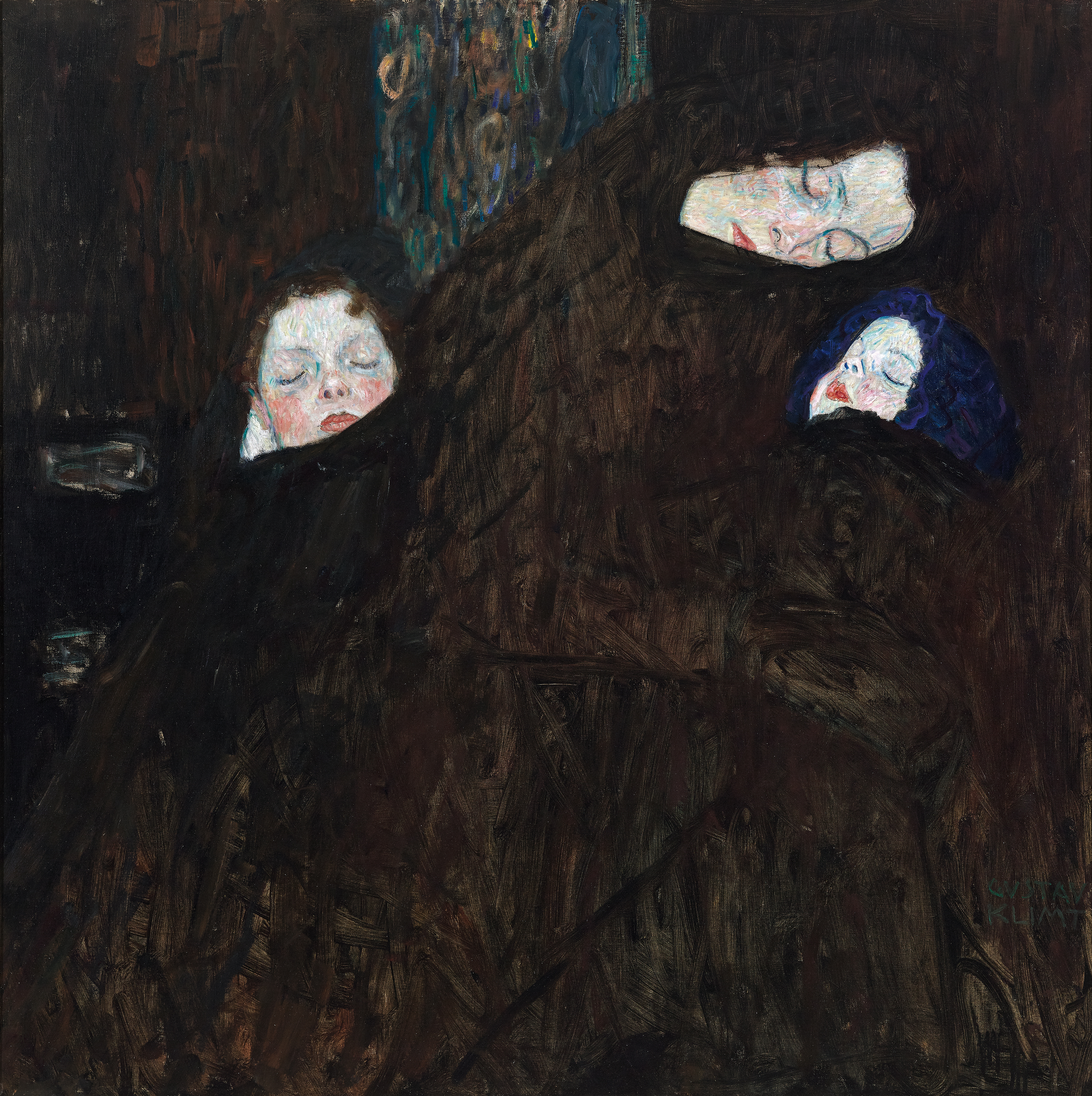
Mother with Two Children
The closely grouped figures make sleep a refuge. Faces emerge from an environment of coloured paint that is almost abstract.

Friederike Maria Beer
The late portrait replaces gold with acidic colours, Eastern motifs and an almost theatrical energy. The society figure becomes a modern presence.
In Klimt, ornament does not surround the subject: it reveals what realism alone cannot say.
Social status, desire, threat, fertility and disappearance take the form of patterns. Decoration becomes a psychological and symbolic language without ever providing a single interpretation.
The Landscapes: Klimt’s Secret Garden
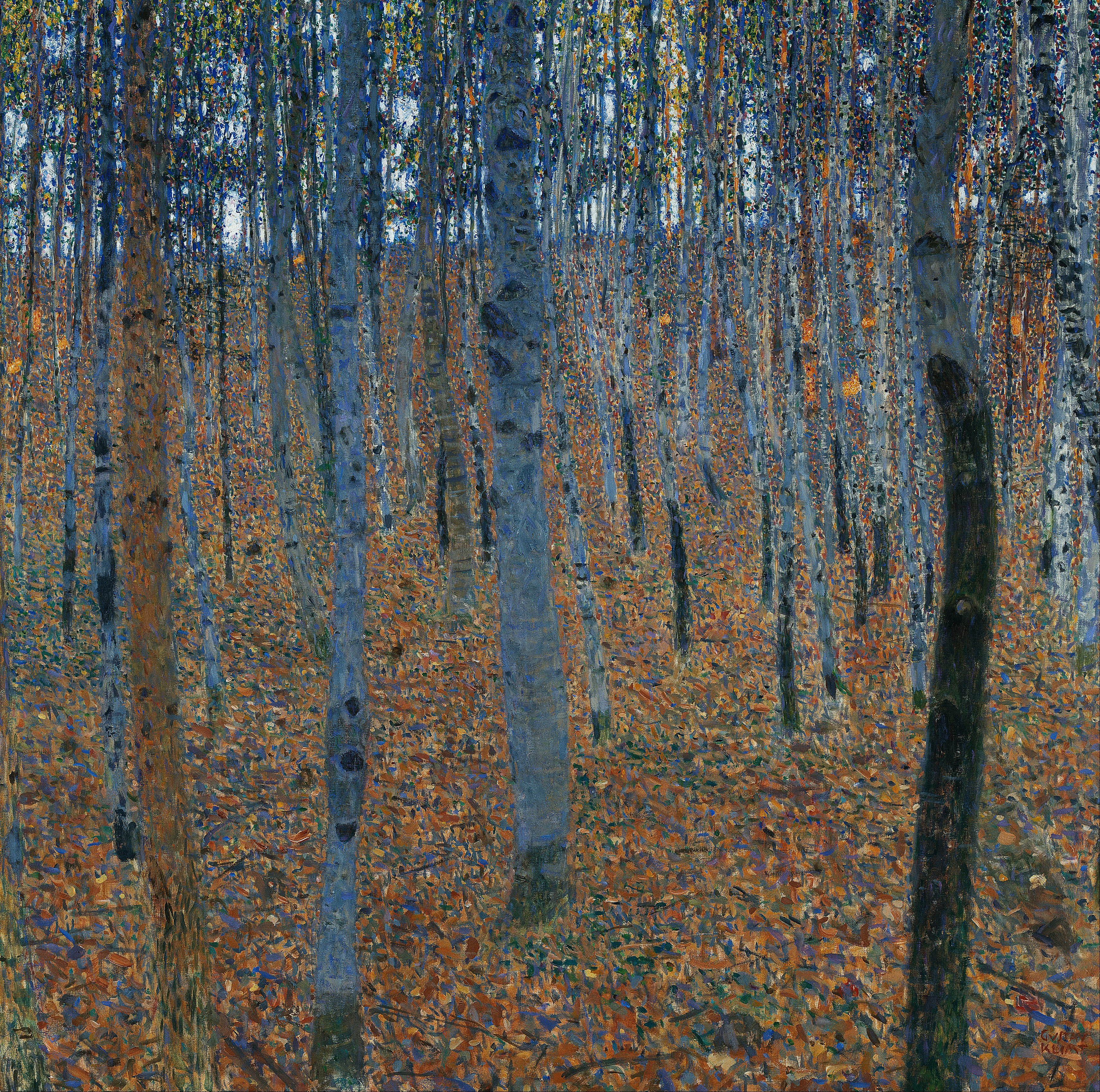
Beech Forest I
Vertical trunks form a grid while the ground is covered in coloured brushstrokes. Natural space becomes an immersive tapestry.

Quiet Pond
A high horizon, reflections and a square format reduce depth. Water becomes a meditative surface close to abstraction.
After the Rain (Garden with Hens in St Agatha), 1898, belongs to the Belvedere. Its vertical dimensions of 80 × 40 cm remind us that not all Klimt’s landscapes are square.
Klimt painted regularly during his summer stays, especially around the Attersee. He often used a viewfinder to select an almost square fragment of the landscape. Without human figures, these works nevertheless retain his essential principles: frontality, density, repetitive rhythm and uncertainty between depth and surface.

Portraits, Sitters and Women of Viennese Modernity
Klimt became a sought-after portraitist of the Viennese bourgeoisie, particularly of women from families of collectors, industrialists and intellectuals. These commissions gave him financial independence and created spaces for experimentation in which clothing, furniture and background expressed as much as the face.
He also produced thousands of drawings, often of nude women, in a practice separate from official portraiture. Their erotic frankness contributed to the controversies of his time. Looking at them today requires considering together their graphic freedom, the social asymmetries between sitter and artist, and the active role of many female patrons and commissioners in Viennese culture.
Features, hands and posture preserve the person’s presence amid the decoration.
Patterns, fabrics and jewellery construct a public image as much as they indicate fashion.
Furniture, colour and gold place the sitter within a culture of taste and collecting.
Four Ideas for Understanding Gustav Klimt
“Klimt always painted in gold”
The golden period is an essential but limited phase. His early work is academic, his landscapes explore colour and his late portraits often abandon gold for vivid patterns.
Decoration Is Thought
Patterns organise the composition, distinguish or merge bodies, indicate tension and transform the perception of space. They are never mere filling.
“The Kiss is an unambiguous image”
The embrace seems protective, but the kneeling position, the edge of the flowered meadow and the merging clothes preserve a tension. Its fame does not close down the work’s meaning.
Klimt Belongs to a Network
The Secession, Josef Hoffmann, Koloman Moser, the Wiener Werkstätte, patrons and sitters contribute to the ecosystem in which his art takes shape.
Choosing a Klimt for Your Décor
The yellows and ochres of a Klimt reproduction can visually brighten a room. A print reproduces the colours of gold without guaranteeing metal leaf or the original’s reflections: check the medium and finish stated on the product page. Portraits create a vertical presence; landscapes can bring a calmer atmosphere.
Avoid surrounding the painting with too many gold objects. One or two echoes are enough: a brass lamp, an ochre cushion or a dark frame. Let matt materials—linen, wool, wood and limewash—balance the golden tones.
| Atmosphere | Artwork | Room | Complementary Materials and Colours |
|---|---|---|---|
| Precious and intimate | The Kiss, golden portraits | Living room, bedroom | Velvet, walnut, brass, off-white |
| Powerful and symbolic | Judith, Pallas Athena, Hygieia | Entrance hall, study | Black, burgundy, aged metal |
| Calm and botanical | Forests, gardens, ponds | Living room, reading area | Oak, linen, moss green |
| Vibrant and modern | Late portraits | Large living room, dressing room | Bold colours against a neutral background |
Klimt, Art Nouveau and Symbolist Collections
Start with the full Gustav Klimt collection, then refine your search by atmosphere: golden, Symbolist, floral, feminine or connected with Viennese modernity.
Explore these collections to compare artworks, then consult each product page for available sizes, supports and finishes.
Continue Your Exploration
- Belvedere, ViennaThe Gustav Klimt Collection
- Vienna SecessionThe Beethoven Frieze
- Leopold MuseumGustav Klimt and His Work
- Leopold MuseumVienna 1900
- BelvedereThe Kiss in the Collection
- Leopold MuseumOnline Klimt Collection
- Wien MuseumArtworks and Photographs Relating to Klimt
- Wikimedia CommonsPublic-Domain Images and Provenance Entries
- Gustav Klimt’s Biography and Dates — Klimt Foundation
- Death and Life: Dating and Revisions — Leopold Museum
- The Beethoven Frieze of 1902 — Secession
- The Faculty Paintings and Their Destruction — Klimt Foundation
- Portrait of Adele Bloch-Bauer I — Neue Galerie
Frequently Asked Questions
Gustav Klimt FAQ
Should the Name Be Written Gustav Klimt or Gustave Klimt?
The Austrian painter’s correct name is Gustav Klimt, without an “e”. The form “Gustave Klimt” sometimes appears in searches and older French texts, but it is not his official name.
What Are the Dates of Klimt’s Golden Period?
It is generally placed in the early 1900s, from Judith I in 1901 to The Kiss of 1908–1909. His visits to Ravenna in 1903 informed his explorations of gold and mosaics. This is a stylistic reference period whose boundaries may vary among historians.
What Is Gustav Klimt’s Style and Which Movement Does He Belong To?
Gustav Klimt’s style combines precise drawing, realistic figures, decorative flat areas, symbols and sometimes gold leaf. He is the major figure of the Vienna Secession and engages with Symbolism, Jugendstil and Art Nouveau.
Why Did Gustav Klimt Use Gold?
Gold brings his paintings closer to mosaics, icons and precious objects. Klimt also knew metalworking through his father, a gold engraver. His visits to Ravenna reinforced his interest in luminous Byzantine surfaces.
When Did Klimt Paint The Kiss?
The Belvedere dates The Kiss to approximately 1907–1909. The work belongs to Klimt’s golden period and was acquired by the Austrian state during the artist’s lifetime. It is now housed at the Belvedere in Vienna.
What Is the Vienna Secession?
Founded in 1897 by Klimt and other artists, the Secession sought to break with the conservatism of the Künstlerhaus, present modern international art and bring painting, architecture, design and applied arts closer together.
Did Klimt Also Paint Landscapes?
Yes. His landscapes, often square and painted during summer stays, depict forests, gardens, ponds and shores. Their reduced depth and decorative density sometimes bring them close to abstraction.
Which Klimt Painting Should I Choose for a Living Room?
The Kiss or a golden portrait creates a luminous focal point. For a calmer atmosphere, choose a square landscape. A Symbolist work such as Pallas Athena or Hygieia suits darker, more theatrical décor.
0 comments