

Van Gogh's Yellow House • Art & Decor Guide
Van Gogh's Yellow House: The Studio Dream That Changed History
Dive into the heart of 2 Place Lamartine, between artistic utopia, sulfur yellow, and tips for bringing Arles into your home without falling into cliché.
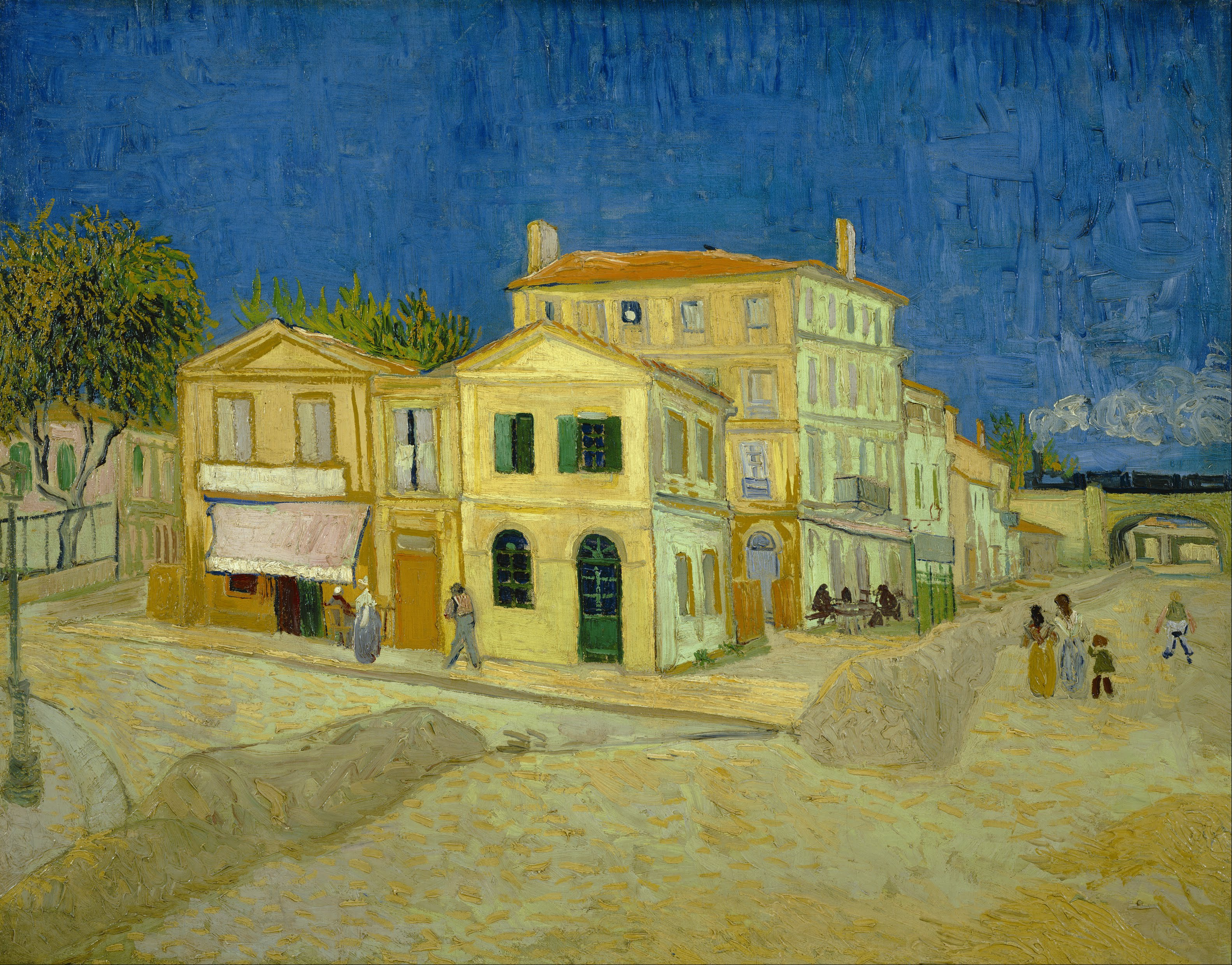
In September 1888, Vincent van Gogh did not simply paint a facade; he captured on canvas a fragile hope under the cobalt blue sky of Arles. This building at 2 Place Lamartine, with its right wing slathered in a yellow so violent it almost becomes audible, embodies the crazy project of a "studio of the South." Far from being a simple architectural study, the work captures the precise moment when the artist still believed in a common life among creators, before reality shattered this golden dream. Today preserved at the Van Gogh Museum in Amsterdam, this image remains the unique testimony of a place destroyed by the bombs of 1944, turning the canvas into the only possible monument to a failed but visually indestructible utopia.
 Free image
Dive into the heart of 2 Place Lamartine, between artistic utopia, sulfur yellow, and tips for bringing Arles into your home without falling into cliché.
Reading Method
Reading the Light Before the Walls
To appreciate this work or choose its reproduction, you must forget the academic perspective and let yourself be caught up in the chromatic vibration. Observe how yellow is not a filling color, but a luminous material that dictates the rhythm of the entire composition, while the green shutters offer the only fresh breath in this visual furnace.
Context before prestige
We place Van Gogh's Yellow House back in its era, its studios, its exhibitions and its small rebellions. A work without context is sometimes just a very beautiful person who has forgotten their history.
The signs that betray the style
We identify composition, palette, texture. These clues often say more than grand speeches, especially when they carry gold or nervous brushstrokes.
The work in a real room
We end with the useful question: does this image breathe in your home, or is it just posing like a poster that has read two books?
Historical Context
Where does Van Gogh's Yellow House come from, and why is it not just a pretty label?

When Vincent arrived in Arles in February 1888, he fled the grayness of Paris to seek a light capable of purifying his palette and his spirit. He dreamed of a community of artists—a kind of pictorial phalanstery where they would share canvases, meals, and passion, far from the social whirl of the capital. The house he found on Place Lamartine was not an architectural masterpiece, but a modest four-room building whose right wing, painted bright yellow, seemed to absorb and reflect the southern light with an almost blinding intensity. In this ordinary setting, he projected an aesthetic revolution, turning a modest rent into a sanctuary dedicated to collective creation.
Moving in May 1888 marked the beginning of a period of feverish euphoria where every brushstroke served to prepare for the arrival of the long-awaited guests. Van Gogh spared no expense in furnishing the guest room, already imagining Gauguin setting up his easel there, while he himself occupied the small white-walled bedroom. This house became the main character in his correspondence with Theo, far more than just a shelter; it was the physical foundation of his boundless ambition. The painting done in September immortalizes this suspended moment, just before the real cohabitation revealed the unbearable friction between two brilliant but incompatible egos.
Artistic Style
Why does Van Gogh's Yellow House still captivate us?

The persistence of this image in the collective imagination lies in its unique ability to tell a magnificent failure with triumphant colors. We know today that the Studio of the South ended with the December crisis, the severed ear, and Gauguin's hasty departure, yet the canvas itself radiates a deceptive serenity. This contrast between the violence of historical events and the apparent stability of the yellow facade creates a narrative tension that captivates both historians and art lovers alike. The house becomes the symbol of all broken artistic utopias, made eternal by the painting while the stone was reduced to dust by the bombings of World War II.
Beyond the biographical anecdote, the work fascinates because it proposes a radical vision of color as a structural element rather than merely a descriptive one. Van Gogh does not hesitate to sacrifice topographical accuracy to amplify the emotional impact of sulfur yellow against the deep blue of the sky. This chromatic audacity resonates particularly in our modern interiors, where we often seek to introduce a centerpiece capable of transforming the atmosphere of an entire room. Looking at this painting means accepting that reality can be sublimated, twisted, and reinvented to serve an inner truth more powerful than mere photographic accuracy.

The Starry Night
A reproduction related to Van Gogh's Yellow House, useful for comparing atmosphere, palette, and wall presence.

Cafe Terrace at Night
A reproduction related to Van Gogh's Yellow House, useful for comparing atmosphere, palette, and wall presence.

The Vision After the Sermon
A reproduction related to Van Gogh's Yellow House, useful for comparing atmosphere, palette, and wall presence.
Art & Details
The visual signs that betray the style

What immediately strikes the trained eye is this deliberately distorted perspective that seems to tilt the street towards the viewer, as if the ground were sloping. The vanishing lines of the pavement and facade do not converge according to Renaissance academic rules, but obey an emotional logic that accentuates the monumental presence of the house. The deserted sidewalk, swept by harsh light, reinforces the feeling of isolation of the building, while the small human silhouettes in the foreground seem crushed by the colorful immensity of the edifice. This distortion is not clumsiness, but a deliberate choice to give the scene a theatrical gravity unusual for such an everyday subject.
The palette relies on a frontal duel between the chrome yellow of the facade and the ultramarine blue of the sky, two complementary colors that exalt each other through their juxtaposition. Van Gogh uses the theory of simultaneous contrasts here with such mastery that the yellow appears to vibrate, almost emitting its own solar warmth. The green shutters bring a touch of implicit complementary red, creating a dynamic balance that prevents the image from becoming monotonous despite the dominance of a single hue. The very matter of the paint, thick and turbulent, adds a palpable texture that suggests the walls themselves are alive and breathing under the effect of the Arlesian heat.
Art & Details
The works to look at as if they were about to reply

To grasp the full scope of this project, it is essential to put this canvas in dialogue with The Bedroom, painted a few months later inside those very walls. Where the exterior facade asserts a public and welcoming ambition, the interior reveals a spartan intimacy, simply furnished with straw chairs and a massive bed with red sheets. These two works function like the two sides of the same coin: the social shell of the artistic dream and the private refuge where the personal drama of the artist unfolds. Comparing the two allows us to understand how Van Gogh used color to define the use and atmosphere of each living space.
One must also observe the portraits made during this period, especially that of Gauguin or the famous Self-Portrait with Bandaged Ear, to measure the rapid evolution of the atmosphere in this ephemeral studio. The psychological tension that sets in between the two painters can be read in the increasing harshness of the features and the progressive darkening of the palettes, far from the luminous euphoria of the Yellow House. These neighboring works tell the rest of the story, transforming the house painted in September into a nostalgic memory of a time when everything still seemed possible. They provide an essential narrative context that greatly enriches the reading of the solitary facade.
Art & Details
Symbols, details, and small visual quirks

A detail often overlooked is the total absence of lush vegetation around the house, even though Arles is known for its trees and gardens. Van Gogh chooses to show a mineral place, swept by the wind, which reinforces the idea of an exposed site, vulnerable to the elements and to gazes. This environmental nudity isolates the building like a lighthouse or a unique refuge in a hostile landscape, highlighting the fundamental solitude of the artist despite his desire for community. The sky, devoid of any cloud, acts as a perfect dome that encloses the scene in a static eternity, suspended outside real time.
The open windows on the ground floor suggest an invitation, a transparency offered to the passerby, while the upper floor remains more mysterious with its half-closed shutters. This visual hierarchy clearly indicates the distinction between the welcoming space, the dreamed communal studio, and the private spaces reserved for rest or introspection. Van Gogh uses architecture to symbolize his own psyche: an open and colorful facade hiding intimate rooms where silent dramas unfold. Every brushstroke around the window frames testifies to a maniacal attention to structure, as if the solidity of the building could guarantee that of his mind.
Works to know
Famous works of Van Gogh's Yellow House to look at before choosing
For a hand-painted reproduction of Van Gogh's Yellow House, an oil painting of Van Gogh's Yellow House, or a copy of Van Gogh's Yellow House, the most useful is to compare several images: the gilding, the faces, the density of patterns, and how each work holds the wall.
- The Bedroom at ArlesA visual entry point to understand Van Gogh's Yellow House without turning the article into an inventory.
- The Starry NightA reproduction related to Van Gogh's Yellow House, useful for comparing atmosphere, palette, and wall presence.
- Cafe Terrace at NightA reproduction related to Van Gogh's Yellow House, useful for comparing atmosphere, palette, and wall presence.
- The Vision After the SermonA reproduction related to Van Gogh's Yellow House, useful for comparing atmosphere, palette, and wall presence.
- Where Do We Come From? What Are We? Where Are We Going?A reproduction related to Van Gogh's Yellow House, useful for comparing atmosphere, palette, and wall presence.
Art & Details
Neighbors, allies, and turbulent cousins

Although Van Gogh is often perceived as a total solitary, this Arlesian period places him at the heart of a complex network of influences and rivalries, mainly embodied by Paul Gauguin. The latter's arrival in October 1888 was meant to fulfill the dream of the communal studio, transforming the Yellow House into a crucible of a new synthetist aesthetic. However, their approaches diverged radically: where Vincent sought truth in nature and raw emotion, Gauguin favored imagination and symbolist stylization. This creative friction, briefly fertile, eventually consumed their relationship, making the house the stage for a historic rupture in modern art.
One can also mention the distant but perceptible influence of Japanese prints that Vincent passionately collected and which dictated his choices of framing and flat colors. The absence of traditional modeling and the use of dark outlines to define forms directly recall the engravings of Hiroshige or Hokusai that he admired so much. The Yellow House is thus also a homage to this imaginary Orient, transposed to the south of France with a rare audacity for the time. These cultural references enrich the reading of the work, showing how the artist fused Western traditions and exotic inspirations to create an entirely new visual language.
Art & Details
What the museums confirm when shortcuts go too fast

Going to the Van Gogh Museum in Amsterdam allows you to realize the actual scale of the work, often underestimated in digital reproductions or large-format art books. In front of the original canvas, one discovers the physicality of the paint, these impastos that capture the light differently depending on the angle of view, creating a moving and living surface. The museum also preserves the original letters where Vincent minutely describes his chromatic intentions, offering an indispensable key to understanding why he insisted on such and such a nuance of yellow. These documents prove that every technical decision was carefully thought out, far from the romantic image of the mad painter acting on pure impulse.
Other institutions such as the Musée d'Orsay in Paris or the Tate Modern in London possess works from the same period that shed a different light on this Arlesian adventure. Comparing the Yellow House with the surrounding landscapes or the portraits of the Roulin family allows us to reconstruct the complete puzzle of this pivotal year. Curators often highlight the fragility of the pigments used, especially certain yellows that may have varied slightly over time, reminding us that we see the work as it has survived, not exactly as it left the studio. This material dimension adds a layer of historical depth to the aesthetic experience.
Art & Details
How to choose a reproduction without panicking the wall?

Integrating a reproduction of the Yellow House into a contemporary interior requires respecting the dominant power of its palette, otherwise the room risks visual saturation. Opt for a neutral wall, off-white or very light gray, to let the sulfur yellow fulfill its role as a focal point without conflicting with other bright colors. The horizontal format of the original fits perfectly above a sofa or in an office, where it can stimulate creativity without overwhelming the space with its verticality. A canvas print with relief will partially restore the texture of van Gogh's touch, adding a tactile dimension absent on smooth paper.
Lighting plays a crucial role in highlighting this work, because Van Gogh's yellow needs warm light to reveal its full chromatic richness. Avoid cold spots that could green the facade or extinguish the vibration of the blue sky; prefer indirect natural light or bulbs with a soft color temperature. In a bright living room, place the painting facing a window so it can dialogue with real light, while in a darker space, targeted lighting will recreate the natural spotlight effect dear to the artist. The goal is to bring the sun of Arles into your home without turning the living room into a tropical greenhouse.
Interior Decoration
Mistakes to avoid before hanging the painting

The first common mistake is to associate this work with overly literal decorative accessories, such as matching yellow cushions or sunflower vases, which quickly falls into kitsch. The strength of the painting lies in its solitary assertion; it must breathe alone on the wall without being surrounded by objects that try to mimic its color in a forced way. Keep the surroundings clean so that the eye can travel freely from the deserted street to the infinite sky, without being stopped by superfluous details that dilute the visual impact of the composition. The sobriety of the environment will highlight the controlled exuberance of the painting.
You should also be wary of low-quality reproductions where colors are desaturated or unbalanced, turning the vibrant yellow into a dull mustard hue. Such an alteration betrays Van Gogh's fundamental intention to precisely shock and amaze with luminous intensity. Take the time to check color fidelity before purchase, because a bad print can make the work depressing instead of energizing. Finally, do not forget that this image carries a heavy history; hanging it in a high-traffic area honors its narrative dimension, rather than relegating it to a dark corner where it would lose its raison d'être.
| Room | Suggestion | Decorative effect |
|---|---|---|
| Living room | A work related to Van Gogh's Yellow House with a strong composition | Cultivated focal point, warm and easy to comment on without reciting a label. |
| Bedroom | A soft palette or a more intimate scene | Calm atmosphere, visual presence without unnecessary agitation. |
| Office | An image structured, colorful, or graphically sharp | Creative energy and a small reminder that the wall can also work. |
| Entrance | A vertical format or an immediately readable work | Clear first impression, elegant, and decidedly less shy than a white void. |

Where Do We Come From? What Are We? Where Are We Going?
A reproduction related to Van Gogh's Yellow House, useful for comparing atmosphere, palette, and wall presence.

A Sunday Afternoon on the Island of La Grande Jatte
A reproduction related to Van Gogh's Yellow House, useful for comparing atmosphere, palette, and wall presence.
To continue the visit
Sources, collections, and truly related paths
A few useful references to verify information, compare free images, and extend the reading without setting off for a museum that didn't ask for anything.
Useful sources on this subject
FAQ
Frequently asked questions about Van Gogh's Yellow House
What is Van Gogh's Yellow House in painting?
Van Gogh's Yellow House deserves an in-depth article because this style engages both an era, a way of painting, and a very concrete way of living with images.
How to quickly recognize this style?
Observe especially composition, palette, texture, light and atmosphere, then how the composition organizes the gaze. If the work holds your attention longer than expected, it is probably not an accident.
Which artists should one know?
You need to cross-reference the central artists of the movement with museums and reliable sources to avoid hasty attributions.
Is this style suitable for modern decoration?
Yes, provided you choose the right format, a palette consistent with the room, and a work whose presence remains pleasant on a daily basis.
Should one choose the most famous work?
Not necessarily. The most famous work can be perfect, but the right choice depends especially on the room, format, palette, and desired atmosphere.
Where to verify the information?
Start with museum notices, Wikipedia/Wikidata for general orientation, then Wikimedia Commons when a free image is needed.
A facade for eternity
The Yellow House remains much more than a simple picturesque subject; it is the painted manifesto of a human hope in the face of adversity. Although the real walls at 2 Place Lamartine disappeared in the clamor of war, Van Gogh's vision endures, intact and luminous, in the halls of Amsterdam and now on our own walls. Choosing to welcome this image into your home means accepting to house a fragment of that studio dream, a permanent invitation to see the world with more color and courage. As long as sulfur yellow continues to vibrate against cobalt blue, Vincent's utopia will remain alive, proving that art possesses the unique power to rebuild what time and men have destroyed.
0 comments