

Monet in Le Havre: when Norman mist invents a new light
A dive into Claude Monet's formative years, between caricatures, Boudin's advice and the tumultuous birth of impressionism on the quays of Le Havre.
We often picture Claude Monet settled in his garden at Giverny, surrounded by water lilies and Japanese bridges, forgetting that his aesthetic revolution was born much earlier, on the windy quays of Le Havre. It was here, facing the English Channel and its shifting skies, that the Parisian child turned Norman learned to see not the objects themselves, but the atmosphere enveloping them. The industrial port, with its smoke and dancing reflections, became his first true studio, far from the dusty academies. Understanding Monet in Le Havre means grasping the precise moment when painting decided to capture the movement of air rather than the solidity of stone, transforming a simple maritime view into an artistic manifesto.
 Free image
Overview of Le Havre: basins, jetties, sea and port city, the ideal terrain to understand the light Monet came to seek.
Reading method
Reading light the way you read a landscape
To fully appreciate these works, the goal is not to seek photographic sharpness, but to observe how the brushstroke suggests the shimmering of water or the density of fog. Let your gaze drift across the surface of the canvas like a boat on the harbor, without trying to fix on any detail too rigidly.
Context before prestige
We place Monet in Le Havre within his era, his studios, his exhibitions, and his small rebellions. A work without context is sometimes just a very beautiful person who has forgotten their story.
The signs that betray the style
We spot Le Havre, the port, the mist. These clues often say more than grand speeches, especially when they carry gold or nervous brushstrokes.
The work in a real room
We end with the useful question: does this image breathe in your home, or is it merely posing like a poster that has read two books?
Historical context
Le Havre: before the Water Lilies, Monet learns light where the mist works early

Arriving in Le Havre around the age of five, the young Claude Oscar Monet grew up in a rapidly expanding city, where the horizon was dominated by the masts of ships and the salty smell of the Seine estuary. Unlike the idyllic landscapes often painted in the studio, the Norman sky offers a perpetually shifting spectacle, made of low clouds, fine rains, and that thick mist that dissolves the contours of the nearby cliffs of Étretat. This childhood spent observing the tides and atmospheric variations forged in him a particular sensitivity to the fleeting moment, long before he ever held a brush with ambition.
The port city, rebuilt and modernized under the Second Empire, became the natural laboratory where he understood that light is never fixed, but a living entity that alters the color of things with every hour. While his schoolmates play on the beach at Sainte-Adresse, future major canvas, Monet is already absorbing the fundamental lesson of the coast: reality lies not in the solid form of buildings or boats, but in the vibrant envelope of air and humidity that surrounds them. It is this keen perception of visual instability that will prepare the ground for his future break with traditional painting.
Artistic style
Youthful caricatures: Monet begins by sketching people before sketching light

Before becoming the master of light, Monet made himself known locally as a talented and ruthless caricaturist, selling his humorous drawings at the Robillard stationery shop on Boulevard de Strasbourg. His sketches vividly capture the notables of Le Havre, distorting their features with a graphic confidence that already reveals a quick eye and an ability to grasp the essence of a face in a few black strokes. This youthful period reveals a sharp observer of human nature, capable of synthesizing an entire personality in a comical exaggeration, a skill that would later translate into his ability to summarize a landscape in essential brushstrokes.
It is thanks to the local fame of these caricatures that he caught the attention of Eugène Boudin, who also frequented the shop and immediately recognized the young man's potential beyond simple humor. Boudin saw in this quickness of execution and boldness of simplification the qualities needed to capture modern life, far from frozen historical compositions. If Monet first mocked bourgeois in their suits, he quickly learned, under the impulse of his elder, that the true satire of his era might well be to paint the world as it is seen, without academic pretense, with the same spontaneity he applied to drawing the foibles of his fellow citizens.
Eugène Boudin: the man who pushes Monet outside, literally

Eugène Boudin, nicknamed the "king of skies" by Courbet, plays a decisive role by convincing the young Monet to leave the safety of the studio to face the elements directly on the motif. He imposed an iron discipline on him: paint outside, regardless of the weather, accepting that the wind knocks over the canvas or that the rain threatens the equipment, because only this direct confrontation allows one to grasp the truth of the moment. Boudin taught him that the sky is not a flat, uniform blue decorative background, but the main protagonist of any seascape, dictating the mood and coloring of the terrestrial scene below.
This mentorship marked a radical turning point where Monet gradually abandoned black and sharp outlines to embrace the light palette and the fragmentation of the brushstroke necessary to capture atmosphere. Under Boudin's kindly but demanding eye, he learned to work fast, to note fleeting effects before they disappeared, turning each painting session into a race against time with the sun. It is this alliance between the rigor of meteorological observation and the freedom of gesture that lays the technical foundations of what would become Impressionism, making plein air no longer a preparatory sketch, but the final work itself.
The Port of Le Havre: boats, smoke, water, and light in full negotiation

The Port of Le Havre in the 19th century is a fascinating spectacle of industrial modernity where traditional sailing ships coexist with steamships spewing thick columns of black smoke that mingle with the low clouds. For Monet, this apparent chaos became a unique opportunity to study how light interacts with complex surfaces: the oily water reflecting the smokestacks, the damp wood of the quays, and the metal of the cranes in a symphony of grays, blues, and ochres. He did not seek to document commercial activity with topographical precision, but to translate the visual vibration of this place where nature and industry clash and blend beneath the changing sky.
In these port views, the smoke of the ships is not a pollution to hide, but a pictorial element in its own right that diffuses the light and softens the edges of the urban setting, creating zones of artistic blur ahead of their time. Monet observed how reflections shatter on the short waves of the basin, fragmenting the image of masts and buildings into a thousand colored shards that dance with the movement of the swell. This permanent negotiation between the solidity of port infrastructure and the fluidity of the marine air allowed him to develop a visual syntax where matter seems to dissolve purely into luminous sensation.
Impression, Sunrise: a modest title, a far less modest career

Painted in 1872 from a window of the Admiralty hotel overlooking the old harbor basin of Le Havre, "Impression, Sunrise" captures a precise moment of daybreak, when the orange disc of the sun struggles to pierce a dense, purplish mist. The painting is a masterclass in suggestion: the silhouettes of fishing boats and the indistinct shapes of ships in the background are nothing more than floating shadows on water shimmering with vertical reflections. Monet used rapid, juxtaposed brushstrokes to convey the way light filters through the morning dampness, creating a harmony of cool tones crossed only by the intense warmth of the rising star.
What strikes the viewer about this work is its boldness in presenting what looked, to contemporary eyes, like an unfinished subject, favoring overall effect over anecdotal detail, as if the painting were a note jotted down hastily before the sun could burn away the mist. The very title, chosen almost out of modesty or for lack of anything better to name this study of atmosphere, would unintentionally become the christening of an entire movement. By reducing the landscape to its essential components of color and light, Monet asserts that the truth of a scene lies not in its literal description but in the sensory impression it leaves on the viewer.
Louis Leroy mocks, art history takes notes

During the 1874 exhibition organized by the Société anonyme des artistes peintres, sculpteurs et graveurs, the critic Louis Leroy of the newspaper "Le Charivari" decided to ridicule Monet's painting, publishing a satirical article titled "The Exhibition of the Impressionists." He feigned astonishment at what he considered a mere sketch, claiming that unfinished wallpaper was more finished than this seascape, in which nothing resembled the tangible reality expected by the bourgeois public of the time. His mockery aimed to highlight the apparent negligence of the technique, turning the word "impression" into an insult meant to disqualify those artists who dared to paint their sensation rather than the objective world.
Yet, far from discouraging the group, this frontal attack paradoxically provided the perfect label they needed to unite and define themselves against the rigid academicism of the official Living room. The artists, understanding the irony of the situation, reclaimed the term "Impressionists" with pride, turning the insult into a manifesto and the trademark of a new way of seeing. What was meant to be a first-class funeral for Monet's career thus became the official birth certificate of a movement that would redefine the history of Western art, proving that aesthetic provocation, when backed by a true vision, always ends up triumphing over conservatism.
After Le Havre: cliffs, train stations, and series, Normandy continues to keep Monet working

If Le Havre was the cradle of his vision, Monet then ceaselessly explored the many facets of Normandy, heading up to the white cliffs of Étretat to paint the violence of waves crashing against the natural arches sculpted by the wind. There he developed his ability to treat the same motif under different lighting conditions, already anticipating the serial work that would occupy the maturity of his career, as with the Rouen Cathedral or the haystacks. The Norman coast remained for him an inexhaustible playground where geology meets meteorology, offering constant challenges to render the texture of wet stone or the transparency of sea foam.
Even when he moved away toward Paris to capture the urban modernity of the Gare Saint-Lazare with its clouds of industrial steam reminiscent of those in the harbor at Le Havre, he kept the lessons of the sea in mind. His fascination with atmospheric effects, born facing the English Channel, accompanied him everywhere, whether he was painting the Thames in London or his own garden at Giverny. Normandy is therefore not a surpassed stage, but the deep root of his art, the place where he learned that to paint is to record duration and the passage of time through the infinite modulation of light on natural and built elements.
Interior decoration
Choosing a Monet born in Le Havre: inviting the mist, but with real structure
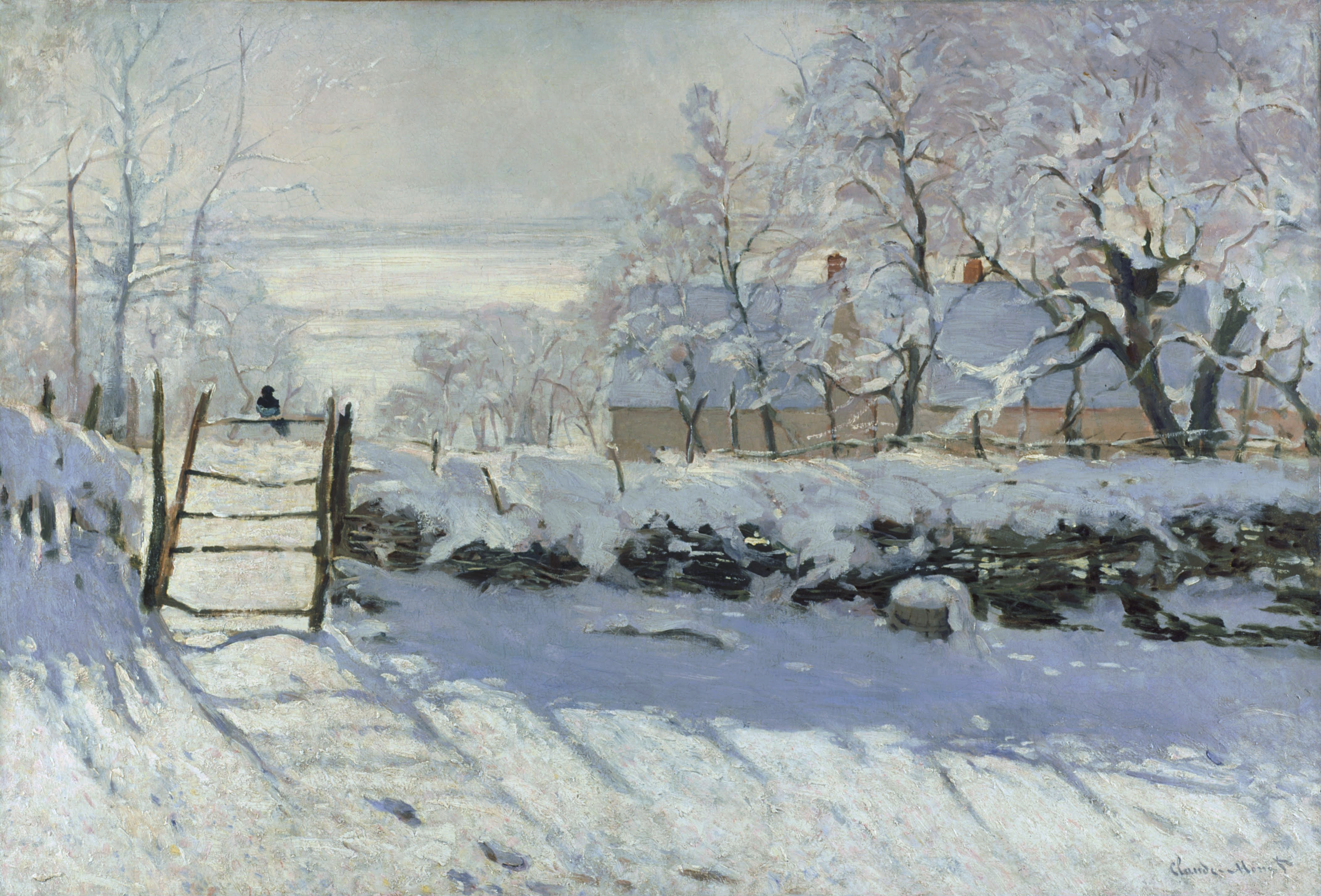
To integrate a reproduction from this period into a contemporary interior, it is essential to consider how the palette dominated by bluish grays, watery greens, and touches of orange will converse with the natural light of your room. A work like "Impression, Sunrise" brings a contemplative depth to a minimalist space, its pared-down composition and blurred contours creating an open window onto a calm morning that soothes the eye without imposing a heavy narrative. These canvases should be avoided in places that are too dark, where the subtlety of the nuances would be lost; they need a certain ambient brightness to reveal the full richness of their chromatic vibrations.
Opt for generous formats that allow the eye to lose itself in the texture of the brushstroke, for it is in the detail of the stroke that the magic of the Impressionist effect resides, rather than in the overall vision from a distance. Whether it is a view of the harbor with its silhouettes of ships or a more abstract seascape, the goal is to invite that Norman atmosphere, made of softness and luminous melancholy, to become a structuring element of your décor. Such a reproduction acts as a mood regulator, bringing visual breathing room and a tangible historical connection to one of the most exciting moments of the modern artistic adventure.
| Room | Suggestion | Decorative effect |
|---|---|---|
| Living room | A work related to Monet in Le Havre with a strong composition | A cultivated, warm focal point that's easy to comment on without reciting a wall label. |
| Bedroom | A soft palette or a more intimate scene | A calm atmosphere, visual presence without unnecessary busyness. |
| Office | A structured, colorful, or graphically crisp image | Creative energy and a small reminder that the wall can also work. |
| Entryway | A vertical format or a work that reads instantly | A clear, elegant first impression, and far less shy than a blank white wall. |
To continue the visit
Sources, collections, and paths truly related to the subject
A few useful references to verify information, compare public-domain images, and extend the reading without wandering off to a museum that never asked for the visit.
FAQ
Frequently asked questions about Monet in Le Havre
What is Monet in Le Havre in painting?
Monet in Le Havre tells the birth of a way of seeing: a Norman childhood, caricatures, Eugène Boudin, the harbor, the sea, the mist, and Impression, soleil levant— that little haze that ended up baptizing an entire movement.
How can you quickly recognize this style?
Look especially for Le Havre, the harbor, the mist, plein air, and Eugène Boudin, then notice how the composition guides the eye. If the work holds your attention longer than expected, it’s probably no accident.
Which artists should you know?
The key references are Claude Monet, Eugène Boudin, Johan Barthold Jongkind, Camille Pissarro, and Louis Leroy.
Does this style suit a modern interior?
Yes, provided you choose the right format, a palette that harmonizes with the room, and a work whose presence remains a pleasure to live with day after day.
Should you pick the most famous work?
Not necessarily. The best-known piece may be perfect, but the right choice depends above all on the room, the format, the palette, and the atmosphere you are after.
Where should you check the information?
Start with museum descriptions, use Wikipedia/Wikidata for general guidance, then turn to Wikimedia Commons when you need a rights-cleared image.
The lasting legacy of a Le Havre morning
Ultimately, to look at Monet in Le Havre is to witness the birth of a visual freedom in which painting finally consents to being nothing more than painting itself, freed from the obligation to copy reality word for word. From the caricature shop to the misty quays, and through the insistent advice of Boudin, every step of this Norman youth helped forge the intellectual and technical tool that would make it possible to capture the present moment. Today, when we contemplate these canvases, we do not merely see a 19th-century port, but the dazzling proof that an artist can change the way we perceive the world simply by choosing to paint light rather than shadow. Le Havre thus remains, in the collective imagination, the sacred place where modern art drew its first breath, wrapped in that famous mist that has never truly lifted.
0 comments