

Van Gogh Landscapes: fields, cypresses, and a sky that refuses to stay still
A journey through Vincent's horizons, from the Flemish soil to the Provençal whirlwinds, to understand how to choose a reproduction that truly vibrates in your home.
Van Gogh's landscapes are often imagined as simple postcards of southern France, blown up to monumental scale and saturated with vivid colors. Yet reducing his work to an explosion of chrome yellow and cobalt blue means ignoring the slow maturation of a gaze that first learned to see in the dim light of Flanders. Each canvas tells a precise geography, a specific weather moment, and above all a nervous state in which nature ceases to be a backdrop and becomes a leading actor, even an antagonist. Understanding these evolutions helps avoid hanging just any reproduction just anywhere, because the energy released by a wheat field beneath the storm at Auvers has nothing to do with the apparent serenity of the blossoming orchards in Arles.
 Free image
Wheatfield with Crows keeps its heavy sky, its open paths, and enough mystery to resist easy shortcuts.
Reading method
Reading the landscape like a musical score
To fully appreciate these works, you must abandon the idea of a static view and accept that every brushstroke is a note in a complex visual melody. Observe the direction of the strokes, the density of the paint, and the way the sky dialogues with the ground before deciding which work to invite into your home.
Context before prestige
We place Van Gogh's Landscapes in its era, its studios, its exhibitions, and its small revolts. A work without context is sometimes just a very beautiful person who has forgotten their story.
The signs that betray the style
We spot swirling skies, cypresses, wheat fields. These clues often say more than grand speeches, especially when they carry gold or nervous brushstrokes.
The work in a real room
We end with the useful question: does this image breathe in your home, or does it merely pose like a poster that has read two books?
Historical context
For Van Gogh, the landscape doesn't pose: it breathes, trembles, and insists
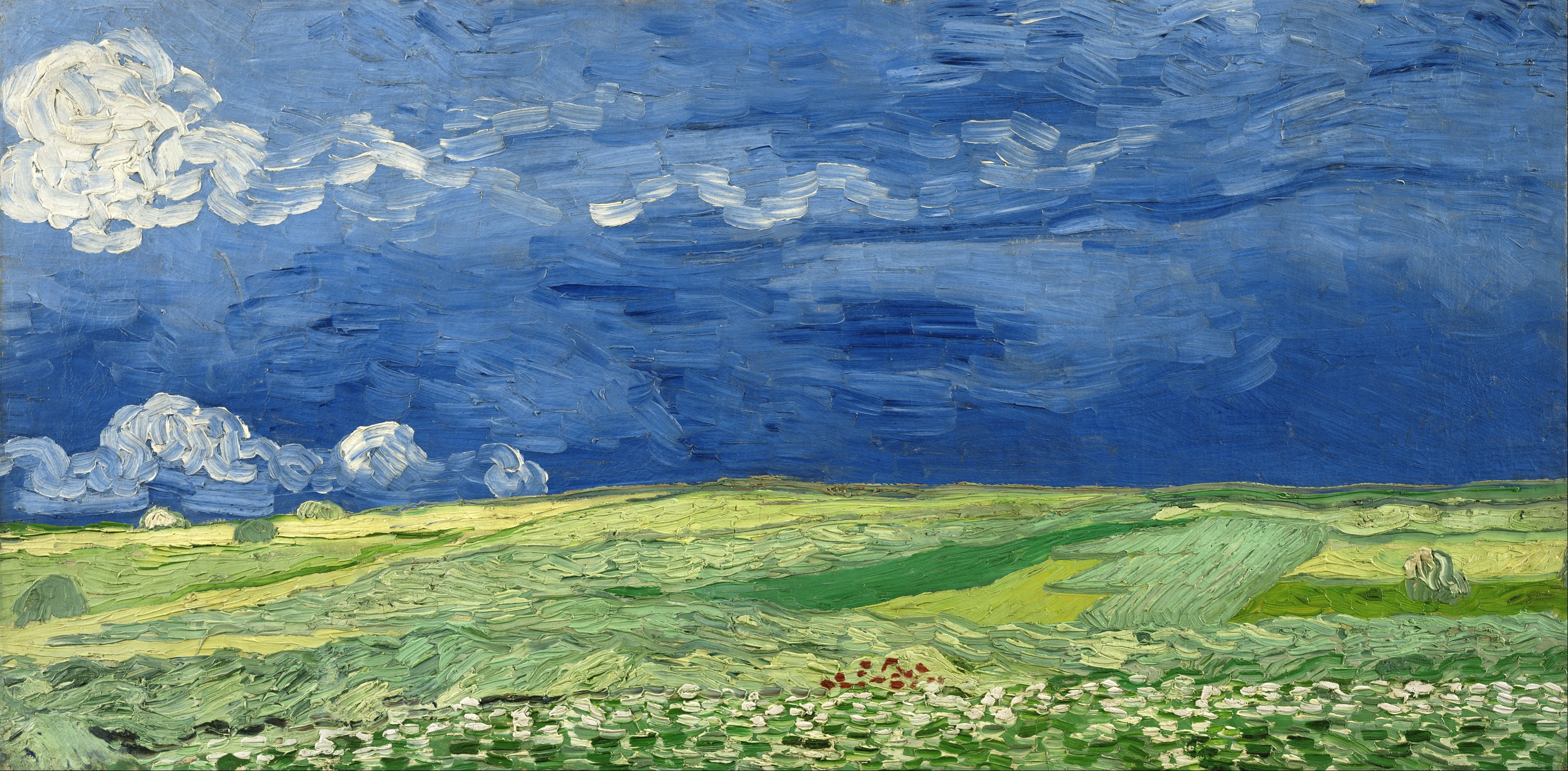
Unlike the academic painters of his time who smoothed the surface to imitate the perfection of glass, Vincent applies paint with a physical violence that gives the landscape an almost tactile presence. This impasto technique, visible from his early Paris years but pushed to its paroxysm in the South of France, transforms a simple country path into a river of thick matter where light clashes and rebounds. The viewer does not watch a scene frozen in time, but witnesses the very genesis of the painting, almost feeling the pressure of the knife or the haste of the brush seeking to capture the moment before it escapes. It is this vital urgency that makes each reproduction so captivating: the wall seems animated by an inner breath that defies the traditional stillness of landscape painting.
Emotion in Van Gogh is not added afterward through obscure symbols, it is built structurally through the tension between complementary colors and the direction of the strokes. A cypress is not simply a dark green tree, it is a black flame rising toward the sky through insistent vertical movements, while the wheat undulates under horizontal curves that suggest the wind more than they show it. This approach turns every natural element into a character with its own will, capable of dialoguing, opposing, or supporting the other forms of the composition. For the decorator or the enthusiast, this means that choosing such a painting implies accepting this turbulent dynamic that can transform a calm room into a space charged with permanent electric energy.
Artistic style
Before the electric skies: dark fields, heavy soil, and realism in clogs

Long before arriving in Provence, Vincent spent his early years as an artist in the Netherlands, notably in Nuenen, where his palette was dominated by earth tones, bitumen, and dark olive green. Works such as The Potato Eaters or certain landscapes of this period show a harsh nature crushed beneath a low, gray sky, reflecting the difficult lives of the peasants he observed with deep social empathy. There is no trace here of Mediterranean sun, but rather an almost religious gravity in the face of a nourishing yet ungrateful earth. These paintings remind us that his genius lies not only in the brilliance of color, but in his ability to extract a poignant beauty from the most austere reality, a useful lesson for those seeking more introspective, muted atmospheres.
This Dutch period is crucial to understanding what followed, as it anchors his art in a material truth that even the brightest colors of Arles will never fully erase. The muddy paths, thatch-roofed cottages, and figures bent with labor form the foundation on which he will later build his colorful language. When we look at these works today, often held at the Van Gogh Museum in Amsterdam, we discover an artist who already masterfully handled composition and chiaroscuro with classical rigor before letting everything explode. For a modern interior, incorporating a reproduction from this period brings a historical depth and elegant sobriety that contrasts pleasantly with the overly bright clichés associated with his name.

Café Terrace at Night
A reproduction linked to Van Gogh Landscapes, useful for comparing mood, palette, and wall presence.

Bedroom in Arles
A reproduction linked to Van Gogh Landscapes, useful for comparing mood, palette, and wall presence.
Paris lightens the touch: even the landscape starts getting some vitamins

Vincent's arrival in Paris in 1886 marks a decisive turning point, when his palette suddenly brightens under the influence of the Impressionists and Neo-Impressionists such as Pissarro and Signac. He sets aside his bituminous browns to explore violets, pinks, and pale blues, transforming views of Montmartre, public gardens, and quarries into laboratories of optical experimentation. His brushstroke fragments, becoming shorter and faster, capturing the vibration of urban light and the burgeoning modernity of the French capital. It is an essential period of transition in which the artist learns to break down color, preparing his mind and hand for the chromatic revolution awaiting him under the southern sun.
During these two Parisian years, Vincent paints nearly two hundred canvases, absorbing the lessons of his contemporaries with incredible voracity while progressively asserting his own singularity. The landscapes of this period, less known to the general public than those of Arles, nevertheless offer a delightful freshness and a fascinating technical complexity where pointillism and personal touch mingle. For an art lover, choosing a reproduction from this period brings a touch of intellectual sophistication and gentle luminosity, far from the sometimes overwhelming intensity of his later works. It is the ideal choice to brighten an office or living room without imposing too strong a dramatic tension, while showing a fine knowledge of art history.
Arles: the landscape turns yellow, and yellow isn't the shy type

In February 1888, Vincent arrives in Arles with the hope of founding an artists' colony and immediately finds in the light of the South a catalyst for his colorful genius. The landscape transforms radically: the blossoming orchards explode with white and pink, the wheat fields become oceans of liquid gold, and the sky takes on intense turquoise hues. He uses chrome yellow and lemon yellow extensively, colors he boldly pairs with cobalt blue to create simultaneous contrasts that make the retina vibrate. The Yellow House, which he rents to set up his studio, becomes the symbol of this quest for light, while the night itself adorns itself with gigantic stars and yellow reflections on the Rhône.
This Arles period is one of frenzied productivity, during which Vincent paints outdoors with dizzying speed to capture the moment before the light changes. Works like La Berceuse or the numerous views of the Alyscamps testify to a new confidence in the expressive power of pure color, freed from the necessity of faithfully describing reality. For interior decoration, a landscape of Arles acts as a visual radiator, capable of instantly warming a north-facing room or energizing a neutral space. However, this solar energy must be dosed with caution, for the chromatic intensity of these paintings demands an environment that can withstand their radiance without entering into visual competition.
Saint-Rémy: cypresses, olive trees, and a sky that swirls with great conviction

After the crisis that follows the ear incident, Vincent voluntarily admits himself to Saint-Paul-de-Mausole, near Saint-Rémy-de-Provence, where the landscape becomes the theater of his inner torments and mystical ecstasies. From his window or during supervised outings, he tirelessly paints the cypresses, those dark, slender trees he compares to Egyptian obelisks, as well as the olive trees with tortured trunks and silvery foliage. The sky, in particular, takes on a hypnotic mobility, structured by great spirals and cosmic waves that seem to carry the earth into a movement of universal dance. It is here that nature ceases to be a simple subject and becomes the direct reflection of a consciousness in turmoil, seeking order within chaos.
The landscapes of Saint-Rémy, including the famous Wheat Field with Cypresses held at the Metropolitan Museum of Art, display exceptional technical mastery where every form is built through parallel and interwoven rhythms. The vegetation seems alive, animated by a telluric force that links it to the stars and clouds, creating a fascinating cosmic unity. For a collector, these works offer a rare emotional depth, inviting contemplation and inner journey rather than simple aesthetic admiration. Hanging such a reproduction in a library or reading nook allows one to create a bubble of meditative intensity, provided one accepts that the gaze is constantly drawn in and carried away by the perpetual movement of the painting.
Works to know
Famous Van Gogh Landscape works to look at before choosing
For a hand-painted Van Gogh Landscape reproduction, an oil painting of a Van Gogh Landscape, or a copy of a Van Gogh Landscape painting, the most useful thing is to compare several images: the gilding, the faces, the density of the patterns, and the way each work holds the wall.
- The Starry NightA visual gateway to understanding Van Gogh Landscapes without turning the article into an inventory.
- Café Terrace at NightA reproduction related to Van Gogh Landscapes, useful for comparing atmosphere, palette, and wall presence.
- Bedroom in ArlesA reproduction related to Van Gogh Landscapes, useful for comparing atmosphere, palette, and wall presence.
The Starry Night: when a village sleeps and the sky does all the showing

Painted in June 1889, The Starry Night is undoubtedly Van Gogh's most iconic work, the one that defined in the collective imagination what a Van Gogh sky is, even though it is largely a reconstruction of memory and imagination. The sleeping village in the foreground, with its church featuring a pointed steeple typical of the Netherlands rather than Provence, serves as a stable earthly landmark against the celestial unleashed power. A massive blue wave sweeps across the sky, carrying eleven bright stars and an orange crescent moon, while a monumental cypress in the foreground connects the earth to the firmament like a black, vertical flame. Held at MoMA in New York, this canvas continues to fascinate with its boldness in twisting reality to express a spiritual vision of the universe.
This painting perfectly illustrates Vincent's ability to synthesize direct observation and pure invention, creating a landscape that exists more in the mind than in actual geography. The swirls are not merely decorative; they suggest atmospheric currents and a cosmic energy that surpasses human understanding. For a decoration project, The Starry Night is a bold choice that immediately imposes its character and dominates the surrounding space. It works particularly well in rooms where one wishes to create a dramatic focal point, but requires enough distance to allow the eye to grasp the full movement without being overwhelmed by the density of details.
Auvers: church, paths and fields under a heavy sky, without pre-digested melodrama

In the final months of his life, spent in Auvers-sur-Oise under the watchful care of Doctor Gachet, Vincent produced a series of landscapes of stunning intensity and formal originality. He often adopted very elongated, almost panoramic formats to capture the immensity of the wheat fields under threatening skies heavy with indigo blue and black. The Church at Auvers, painted in June 1890 and held at the Musée d'Orsay, shows a building that seems to float on a vibrating ground, destabilized by touches of color that cancel out any classical perspective. These works are not necessarily cries of distress, but rather the expression of a sharp lucidity in the face of a nature that seems on the verge of tipping over.
The speed of execution of these final paintings is astonishing, with sometimes several canvases completed in a single day, testifying to a creative urgency that did not wane until the end. The wheat fields with crows, with their paths leading nowhere and their scattered black birds, have often been read retrospectively as premonitions, but they remain above all masterful studies of light and movement. Choosing a reproduction from this period for an interior means opting for a modern, bold aesthetic, where composition defies conventions and color expresses a raw psychological truth. It is an art that questions the viewer and refuses to serve as a simple, soothing decorative backdrop.
Interior decoration
Choosing a Van Gogh landscape: measure the energy before letting the wall sign a lease
Selecting a reproduction of a Van Gogh landscape for your interior requires considering not only the dominant colors, but above all the visual rhythm and emotional energy emanating from the work. A poppy field from Arles will bring a sunny, joyful warmth ideal for a kitchen or dining room, while a stormy sky from Auvers will suit a space for reflection or an office where one wishes to stimulate thought. It is crucial to assess the available viewing distance in the room: large swirling compositions like The Starry Night require several meters of visual field to reveal their full power, whereas details of flowers or small paths can be appreciated from closer up.
One must also consider the existing lighting, as Van Gogh's colors, often based on complementary contrasts, react differently depending on whether they are bathed in natural or artificial light. A high-quality reproduction, respecting the texture of the impasto, will make it possible to rediscover that tactile dimension essential to the Van Gogh experience, avoiding the flat effect of a simple digital image. Finally, do not hesitate to mix periods: pairing the sobriety of a Dutch landscape with the brilliance of a Provençal canvas can create an interesting dialogue within a single room, thus telling the complete evolution of the artist and offering a visual richness that renews itself with every glance.
| Room | Suggestion | Decorative effect |
|---|---|---|
| Living room | A work related to Van Gogh Landscapes with a strong composition | A cultivated, warm focal point that's easy to talk about without reading a label. |
| Bedroom | A soft palette or a more intimate scene | A calm atmosphere, visual presence without unnecessary fuss. |
| Office | A structured, colorful, or graphically sharp image | Creative energy and a small reminder that the wall can also do some work. |
| Entryway | A vertical format or an immediately readable work | A clear, elegant first impression, and decidedly less shy than a blank white wall. |
To continue the visit
Sources, collections, and paths truly connected to the subject
A few useful references to verify information, compare open-access images, and keep reading without wandering off to a museum that didn't ask for it.
Validated Van Gogh collections
Landscapes and nights to compare
Van Gogh Timeline
Useful sources on this topic
FAQ
Frequently asked questions about Van Gogh's Landscapes
What are Van Gogh's Landscapes in painting?
Van Gogh's landscapes shift from the dark soil of Nuenen to the starry nights of Arles, the cypresses of Saint-Rémy, and the fields of Auvers: each place transforms nature into rhythm, color, and matter under tension.
How to recognize this style quickly?
Look especially for swirling skies, cypresses, wheat fields, paths, and the yellows of the South, then the way the composition guides the eye. If the work holds your attention longer than expected, it's probably no accident.
Which artists should you know?
The main references are Vincent van Gogh, Claude Monet, Camille Pissarro, Paul Signac, and Paul Gauguin.
Does this style suit a modern interior?
Yes, provided you choose the right format, a palette that harmonizes with the room, and a work whose presence remains pleasant day after day.
Should you pick the most famous work?
Not necessarily. The best-known piece may be perfect, but the right choice depends above all on the room, the format, the palette, and the atmosphere you're after.
Where can you verify the information?
Start with museum descriptions, Wikipedia/Wikidata for general orientation, then turn to Wikimedia Commons when a freely usable image is needed.
Bringing the movement of nature into your living room
Ultimately, bringing a Van Gogh landscape into your home is far more than an aesthetic choice—it's the adoption of a philosophy of seeing that embraces the world in all its turbulence and vibrant beauty. Whether you're drawn to the earthen gravity of Nuenen, the explosive light of Arles, or the cosmic skies of Saint-Rémy, each work carries a unique ability to transform the atmosphere of a room and to stimulate the minds of those who live with it. Far from being mere decorative images, these paintings are open windows onto an extraordinary sensibility, a reminder that nature is never still and that art has the power to make the invisible visible. By choosing carefully the period and mood of the piece, you don't just decorate a wall—you invite a demanding and fascinating companion who will never cease to surprise you.
0 comments