

Van Gogh · Arles · June 1888
The Sower at Sunset: Van Gogh transforms Millet into solar vision
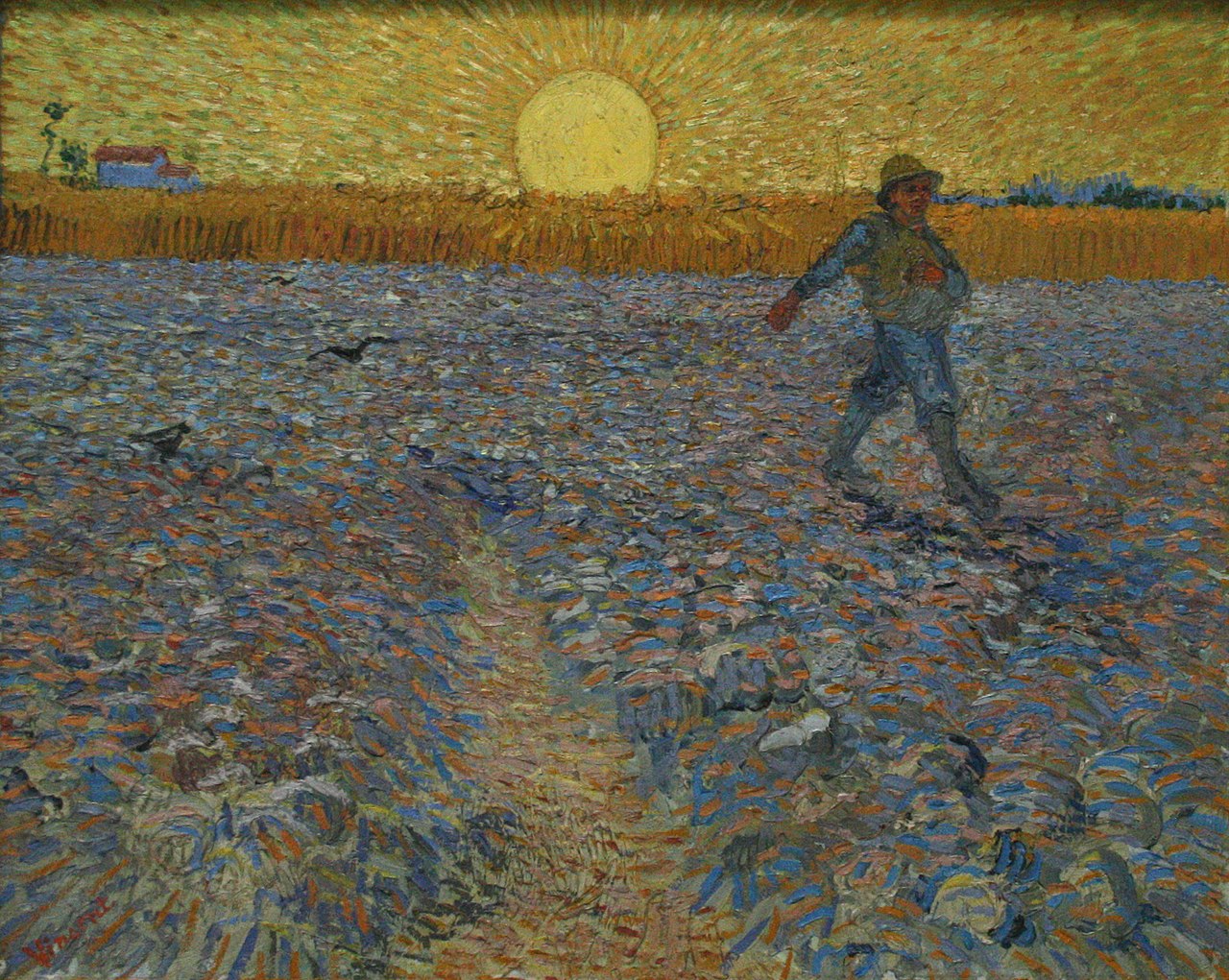
With The Sower at sunset, Van Gogh does not copy Millet: he recharges it. The peasant gesture becomes an almost cosmic apparition, crossed by an immense yellow sun, a purple field and a blue tree which cuts through space.
The subject comes from Millet, Van Gogh's admired master. But in Arles, in 1888, the scene changed its nature: the earth was no longer just social or moral, it became color, rhythm, symbol of life and beginning again.
Quick response
Why is this Sower so important?
Because it condenses three Van Gogh obsessions: admiration for Millet, the spiritual power of peasant work and color as an autonomous language. The sower is no longer just a man who throws seeds: he becomes an active silhouette between earth and sun.
A tribute
Van Gogh takes up a theme from Millet that he has meditated on since his beginnings: the humble man, the ancient gesture, the nourishing earth.
A breakup
In Arles, color emancipates itself: yellow, purple, blue and green no longer only describe reality, they produce an emotion.
A vision
The enormous sun transforms the landscape into an almost sacred scene: sowing becomes an act of faith in the cycle of nature.
Work sheet
A transition table: Millet behind, Van Gogh in front
The version from the Kroeller-Müller Museum is generally dated to the second half of June 1888. Van Gogh had been in Arles for several months at the time. He has already understood that the South can give him what he is looking for: more frank contrasts, harder light, a less cautious palette.
The sower advances in a field in the foreground. Behind him, the sun is not an atmospheric detail: it is the energy center of the image. The tree with its blue trunk crosses the canvas diagonally and prevents any reading that is too peaceful.
- Artist
- Vincent van Gogh
- Date
- june 1888
- Location
- Arles
- Museum
- Kroeller-Müller Museum
- Technique
- oil on canvas
- Theme
- sower, sun, field

Composition
Six details to look at in the table
What seems simple at first glance is actually very constructed: each color zone pushes against another.
The sun
He is almost too big: Van Gogh treats him like a force, not like a simple star in the distance.
The purple field
The ground is not realistic brown. Purple responds to the yellow of the sun by complementary contrast.
The sower
The silhouette is dark, compact, dynamic. The gesture counts more than the face.
The Blue Tree
He crosses the canvas and gives an almost Japanese structure to the composition.
The seeds
The open arm connects man to the field: sowing means giving to the future.
The rhythm
The short, oblique touches make the earth, sky and vegetation vibrate.
Millet → Van Gogh
From monumental peasant to solar icon
Millet gives the sower a social and almost biblical gravity. Van Gogh retains this dignity, but he shifts it towards color: with him, the sower belongs to a world of ardent contrasts.

The moral model
In Millet, the sower is massive, earthly, almost heroic. He embodies the harsh dignity of peasant work.

Van Gogh learns from Millet
Long before Arles, Van Gogh drew after Millet. The sower the “hante”: he is a founding figure of his imagination.

Solar metamorphosis
Millet's figure becomes an experience of light: Van Gogh keeps the gesture, but replaces brown gravity with a yellow/purple/blue confrontation.
Millet in several images
The model is not a single image: sower, gleaners and Angelus
To understand what Van Gogh transforms, we must look at Millet as a family of images. The same sower exists in painting, pastel, drawing or engraving: leaning posture, bag on the hip, arm thrown, leg forward. Van Gogh takes up this grammar, then switches it to color.

The same peasant gravity
With the gleaners as with the sower, Millet gives modest gestures a monumental magnitude. Van Gogh regains this dignity, but burns it with color.

A more vibrant version
Pastel makes the pattern less compact: the surface breathes more. This is useful to see that the Millet sower is not only brown and austere.

Work becomes meditation
Millet transforms the fields into a moral and silent scene. Van Gogh keeps this intensity, but shifts it from brown meditation to sunlight.
No more sowers
The sower, the reaper and the cycle of the earth
For Van Gogh, sowing and harvesting are not simple agricultural activities. These are two images of the cycle of life: promise on one side, end and beginning again on the other. The motif returns in drawing, in painting, in direct homage to Millet and in the landscapes of Arles.

The Sower, another cover
Van Gogh returns to the theme several times: each cover tests another balance between ancient model and modern language.

The reverse cycle
The reaper responds to the sower: one throws the seeds, the other cuts the wheat. Van Gogh sees the natural cycle, not just a rural scene.

The Arles Sunsets
The setting sun motif crosses the landscapes of Arles: Van Gogh uses it to push the contrasts to the point of incandescence.

The sower as silhouette
In this variant, the figure seems almost swallowed by the landscape. The sower becomes a sign: a body in motion, readable even before the detail of the face.

The series as a laboratory
Van Gogh is not looking for “la” final version. It moves light, color and mass balance to measure what else the pattern can give.

Millet resumed after Arles
Even after the solar experiments in Arles, Van Gogh returned to Millet. The subject remains for him a matrix: a form to meditate on, take up and move.
Compare
Millet and Van Gogh: what really changes
The subject is the same, but the painting no longer tells the same thing.
| Element | Millet's | Van Gogh's | Product effect |
|---|---|---|---|
| Figure | The peasant is monumental, almost sculptural. | The figure is more nervous, caught in a field of colored forces. | We move from social monument to dynamic appearance. |
| Scale | The sower dominates the scene: the man appears heavy, close, frontal. | Man remains important, but the sun and the field take on the same visual power. | The subject becomes less “constituent peasant portrait than complete vision of the world. |
| Gesture | The arm that sows is ample, regular, almost ritualistic. | The gesture becomes more nervous, crossed by the keys and diagonals. | The march seems to continue out of frame. |
| Earth | The earth is dark, heavy, a matter of work and fatigue. | The purple and yellow field is a vibrant, almost electric surface. | Earth is no longer just soil: it becomes active color. |
| Color | Earthy, serious, realistic palette. | Lemon yellow, purple, blue, green: expressive color. | Color becomes the emotional engine of the image. |
| Sun | Bright context, often discreet. | Huge, frontal, almost symbolic disk. | The landscape takes on a cosmic dimension. |
| Horizon | The landscape accompanies the figure without taking up the entire scene. | The horizon, the tree and the sun structure the image like architecture. | The composition becomes more tense, almost decorative. |
| Relationship to the sacred | The sower can evoke the biblical parable and the humble dignity of work. | The sacred passes through light: sun, growth, energy of nature. | Van Gogh replaces religious gravity with solar spirituality. |
| Meaning | Dignity of rural work. | Cycle of life, solar energy, faith in nature. | The sower becomes a modern spiritual figure. |
In the store
Extend Van Gogh: fields, suns, Arles and peasants
The Sower understands himself better with Van Gogh's great visual families: Arles, wheat fields, sunsets, peasant figures and tributes to Millet.


Sources
Useful sources to go further
The main information comes from museums and work bases: Kroeller-Müller, Van Gogh Museum, Wikimedia Commons and Bührle collection.
The Sower, Van Gogh
Image sheet, date, dimensions, Kroeller-Müller collection.
Van Gogh MuseumThe Sower
Composition, unnatural colors and possible influence of Japanese printmaking.
Kroeller-MuellerReaper and sun
Cycle of nature, wheat, sun and symbolism of the harvest in Van Gogh.
BuhrleThe Sower, another version
An 1888 version that helps understand the importance of pattern.
MilletThe Boston Model
Reference image to compare Millet gravity and Van Gogh solar transformation.
FAQs
Frequently asked questions about The Sower by Van Gogh
Quick answers to situate the painting, its model and its meaning.
When did Van Gogh paint The Sower at Sunset?
The version from the Kroeller-Müller Museum is dated June 1888, during the Arles period.
Why are we talking about Millet?
Because Jean-François Millet gave the sower a famous and monumental form. Van Gogh admires Millet deeply and takes up this motif from its beginnings.
Did Van Gogh just copy Millet?
No. He copies Millet to learn, then he transforms the model. The posture and gesture come from Millet, but the color, scale of the sun and tension of the landscape fully belong to Van Gogh.
Are there several Van Gogh Sowers?
Yes. Van Gogh works on the motif at several moments: drawings after Millet, versions painted in Arles, variants with setting sun and similar works around wheat, the harvester and the cycle of the earth.
What does the bright yellow sun mean?
It gives the scene a symbolic force: the sower acts under solar energy which evokes life, growth and the natural cycle.
Why is the field purple?
Van Gogh uses purple as a contrast to the yellow of the sun. Color is not just descriptive: it creates emotional tension.
Where to see the work?
The June 1888 version is kept at the Kroeller-Müller Museum, Otterlo, the Netherlands.
Conclusion
Van Gogh keeps Millet's gesture, but he changes the sun
In The Sower at sunset, the peasant is not only a worker: he becomes a figure of energy. Van Gogh transforms a realistic theme into solar vision, and this is precisely where homage becomes invention.
See the Vincent van Gogh collection
0 comments