

Van Gogh in Auvers-sur-Oise: final paintings, heavy sky, and urgent brushwork
A dive into the painter's final seventy days, blending precise biography, analysis of major works, and tips for bringing this raw energy into a contemporary interior.
Art history loves tragic endings, but it sometimes forgets that painting itself keeps vibrating long after the last breath. When Vincent van Gogh set down his bags at the Ravoux inn on May 20, 1890, he wasn't trying to write a dramatic epilogue—he was aiming to paint with a new fury, far from the confinement of Saint-Rémy. This village of Auvers-sur-Oise, located just thirty kilometers from Paris and his brother Theo, became the stage for a body of work as dense as it was dazzling. In barely two months, the painter produced nearly eighty canvases, transforming every thatched roof, every wheat field, and every face into a powerful visual statement. Far from the legend of the lonely madman, we discover here a lucid artist, mastering his gesture with surgical precision while the world around him seems to warp under the pressure of his vision.
 Free image
Adeline Ravoux anchors Auvers in real faces: the inn, the final days, and a portrait that doesn't reduce the village to a mere backdrop.
Reading method
How to read these final weeks without giving in to the myth
To fully appreciate this period, one must set aside the hasty judgment that reduces every brushstroke to a symptom of madness. Instead, observe the technique, the mastery of elongated formats, and the constant dialogue with nature that animates these works. The key lies in the concrete detail: the direction of the hatching, the choice of a specific blue, or the tension of an architectural line. It is by dissecting these elements that we understand why these paintings remain so modern and so difficult to hang without thinking twice.
Context before prestige
We place Van Gogh in Auvers-sur-Oise within his era, his studios, his exhibitions, and his small acts of rebellion. A work without context is sometimes just a very beautiful person who has forgotten their story.
The signs that betray the style
We spot the Auvers church, Doctor Gachet, fields. These clues often say more than grand speeches, especially when they carry gold or nervous brushstrokes.
The artwork in a real room
We end with the useful question: does this image breathe in your home, or does it merely pose like a poster that has read two books?
Historical context
Auvers-sur-Oise: Van Gogh arrives with a suitcase, canvases, and very little time to waste

Vincent's arrival in this small Val-d'Oise town marks a radical change of atmosphere after the oppressive walls of the Saint-Rémy-de-Provence asylum. Recommended by Camille Pissarro to his brother Theo, the painter finds here an essential freedom of movement, lodging with innkeeper Arthur Ravoux for a modest price that preserves his meager budget. From the first days, he tackles the thatched roofs and gardens overrun with flowers, capturing a softer Northern light, just as demanding as that of Arles. This period is not a passive retreat, but a race against time where every hour of daylight is used to capture on canvas the overflowing vitality of the French countryside.
The proximity to Paris allows Theo to visit regularly, bringing with him tubes of fresh paint and news from the burgeoning art market. Vincent describes in his letters this sensation of returning to the real world, far from the hallucinations that had tormented him before, although this lull is crossed by a dull anxiety about the future of his work. He paints the nascent harvests and old sunken lanes with a staggering speed of execution, as if he instinctively knew that time was running out for him. Each painting thus becomes a silent testament, not of despair, but of a fierce determination to translate the ephemeral beauty of the seasons before summer consumes everything.
Artistic style
Dr. Gachet: doctor, collector, and a face that carries the century on its elbow
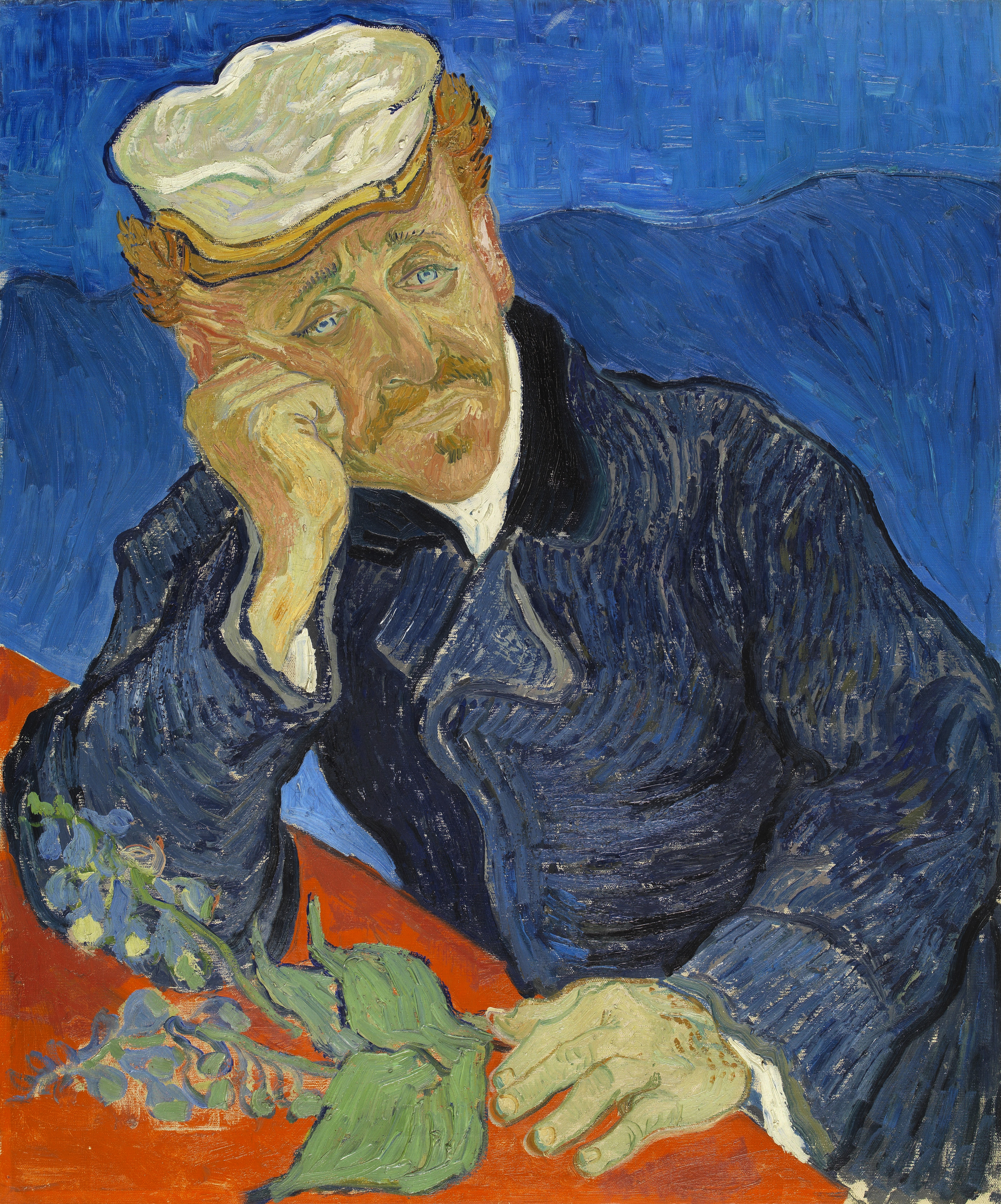
Paul Gachet is not a simple family doctor, but a discerning art lover who treated many Impressionists and intimately understood the torments of creation. Vincent met him quickly and seized the opportunity to paint his portrait, a work now held at the musée d'Orsay that remains one of the most famous and controversial of his career. The doctor is depicted with his head resting on his elbow, a classic posture of melancholy reinforced by the weary expression of his gaze and the cobalt blue of his jacket. Beside him, two books and a branch of purple foxglove recall his dual role as healer of the body and protector of the artistic spirit, anchoring the subject in a precise intellectual reality.
This portrait goes beyond mere physical resemblance to become a psychological study in which the fatigue of the century seems to weigh on the practitioner's shoulders. Van Gogh uses vivid orange tones for the face and hands, creating a vibrant contrast with the blue background that literally makes the surface of the canvas vibrate. Some critics of the time found the image too crude, almost caricatured, but it mainly reveals the painter's deep empathy for this man who tries to contain the uncontainable. Gachet thus becomes Vincent's mirror image: where the painter explodes in color, the doctor absorbs the pain with a silent resignation, both united by a mutual understanding of human fragility.
The Church at Auvers: a solid building, not exactly a tranquil painting

At the heart of the village stands the Gothic church, a massive edifice of pale stone that Vincent transforms into a swirling vision now displayed at the musée d'Orsay. Far from respecting the architectural rigidity of straight lines, the painter curves the contours of the building and the sky, giving the impression that the entire structure undulates under the pressure of an invisible inner force. The foreground is occupied by a beaten-earth path that divides into two branches, creating a receding perspective that irresistibly draws the eye toward the dark entrance of the religious edifice. This bold composition refuses the traditional stillness of church views, preferring to breathe an organic and almost unsettling life into the secular stone.
The palette used here is dominated by deep blues and intense violets that contrast with the orange touches of the tiled roof, creating a complementary harmony typical of Van Gogh's artistic maturity. The sky, treated with tight vertical hatching, seems to push the building toward the ground, while the total absence of human figures heightens the sense of solitude and mystery. This is not a pious postcard, but an emotional interpretation where architecture becomes the reflection of a complex state of mind. Looking closely, one notices how the paint seems to move, each brushstroke contributing to that sensation of controlled instability that defies gravity and reason.
The elongated fields: when the landscape becomes wide like a nervous breath
During these final weeks, Vincent massively adopted the "double square" format, a very wide horizontal canvas that allowed him to embrace the horizon with an unprecedented breadth. These wheat field landscapes, like the famous Wheatfield with Crows held at the Van Gogh Museum, use this width to create a sense of total immersion, as if the viewer were standing in the middle of the golden ears. The composition is often devoid of a traditional vanishing point, the ground rising to the upper edge of the canvas to abolish distance and confront the viewer directly with the plant matter. This radical approach transforms the landscape into a physical experience, where the eye can no longer rest but must travel across the surface in a continuous movement.
The speed of execution on these large formats testifies to absolute technical confidence, the painter covering the canvas with an impressive economy of means despite the apparent complexity. The furrows of the fields are traced by energetic parallel lines that rhythm the space, while the sky often occupies a third or half of the surface, laden with heavy and threatening clouds. In some works, black birds cross the frame, adding a note of dramatic tension without turning the scene into a literal illustration of death. These paintings prove that the horizontal format is not a simple aesthetic choice, but a necessary tool to express the immensity and turbulence of nature as Vincent felt it.
Heavy blues, acid greens, dry yellows: Auvers is not a restful postcard

The chromatic palette of Auvers-sur-Oise stands out clearly from the solar yellows of Arles through a predominance of cold greens, night blues, and paler, almost lemony yellows. These colors are not trying to flatter the eye or decorate a parlor; they argue with a visual intensity that can unsettle viewers unaccustomed to such frankness. The greens of the vegetation are often heightened with acidic touches that suggest violent growth, a nature pushing upward with uncontrollable vigor beneath a low, heavy sky. This use of pure color, laid directly on the canvas without excessive prior mixing, creates optical vibrations that bring every blade of grass and every cloud to life.
The contrast between these cool tones and the warm touches of rooftops or paths creates a dynamic tension that keeps the viewer's attention constantly alert. Vincent uses Prussian blue and cobalt to sculpt the atmosphere, giving the skies a material density that seems to announce the storm even in clear weather. This coloristic approach reflects a keen perception of the light in northern France, more diffuse and changeable than that of the South. In interior decoration, reproducing these nuances requires special care, as a green that is too soft or a blue that is too sky-like would immediately betray the original spirit of the work, stripping it of its raw emotional power.
In Auvers, Van Gogh paints quickly, prolifically, and with a lucidity that exhausts one merely to read about

The correspondence with Theo during this period reveals a mind of crystalline clarity, far from the ramblings often wrongly attributed to cursed geniuses. Vincent details his plans with precision, speaking of his canvases as a craft requiring discipline and reflection, specifically mentioning his studies of ivy-covered houses or flowered gardens. He discusses the value of his works, their potential placement, and the need to keep producing despite financial and health uncertainties. These letters, accessible through the Van Gogh Foundation, show a man fully aware of his art, analyzing his own progress and failures with disarming honesty that commands respect.
This lucidity makes all the more poignant the industrial quantity of work completed in such a short time, as if each day had to count double to justify his existence. He speaks of painting as a universal language capable of offering comfort, a mission he pursues with an almost religious seriousness despite his personal doubts. Reading these texts radically changes the way we look at the paintings: we no longer see the spasms of a sick man, but the steady hand of a laborer of art who knows exactly where he is going. This intellectual dimension is often obscured by the morbid fascination with his end, yet it is the keystone supporting the entire architecture of these final creations.
The end at Auvers: speaking of death without letting the news story steal the paintings

It is impossible to evoke Auvers without mentioning the events of July 1890, but it is crucial not to let the date of July 29 erase the richness of the preceding weeks. Wounded on July 27 in a field, probably following an accident or a desperate act whose exact circumstances remain debated by historians, Vincent died two days later in his room at the Ravoux inn, surrounded by Theo. This personal tragedy tends to retrospectively color every painting of the period with a funereal hue, transforming joyful wheat fields into harbingers of death and blue skies into shrouds. Yet reducing these works to mere illustrations of a suicide would be a major interpretive error that impoverishes their meaning.
The paintings made just before the tragedy, such as the Daubigny Gardens or the Houses at Auvers, often overflow with a serenity and technical mastery that contradict the idea of an inevitable decline. Vincent was still working on several unfinished canvases, even planning new series, which testifies to an intact will to live and create until the last moment. Death arrives as a brutal rupture in a creative momentum that was still active, not as the logical outcome of a gradual descent into hell. Respecting the work therefore implies looking at these images for what they are: celebrations of light and form, regardless of the tragic fate of the one who signed them.
Interior decoration
Choosing an Auvers Van Gogh: the drama, yes, but with room to breathe

Integrating a reproduction of this period into a modern interior requires choosing the work wisely based on the energy you wish to bring to the room. Elongated formats such as the Wheat Fields work wonderfully above a sofa or a low console, bringing a visual breadth that enlarges the space without weighing it down, provided you have enough distance. On the other hand, more concentrated subjects like the Portrait of Dr. Gachet or the Church require a clear wall and targeted lighting to allow the eye to plunge into the details of the brushwork without being distracted. The goal is to create a dialogue between the controlled violence of the painting and the calm of your domestic environment.
Be careful not to turn your living room into a macabre museum: favor works where light dominates, such as the Gardens or the rooftop views, which bring color and movement without the heavy emotional weight of the raven scenes. A quality reproduction must restore the thick texture and the vibration of the colors, because it is in the very matter of the painting that Van Gogh's magic resides. Pair these images with natural materials like raw wood or linen to echo the rurality of Auvers, avoiding overly gilded or baroque frames that would clash with the radical modernity of the style. The goal is to live with the art, not to endure its story.
| Room | Suggestion | Decorative effect |
|---|---|---|
| Living room | A work related to Van Gogh in Auvers-sur-Oise with a strong composition | A cultivated, warm focal point that's easy to comment on without reciting a wall label. |
| Bedroom | A soft palette or a more intimate scene | A calm atmosphere, visual presence without unnecessary bustle. |
| Office | A structured, colorful or graphically sharp image | Creative energy and a small reminder that the wall can work too. |
| Entryway | A vertical format or an immediately readable work | A clear, elegant first impression, and far less shy than a blank wall. |
To continue the visit
Sources, collections and paths truly linked to the subject
A few useful references to verify the information, compare open-access images, and keep reading without dragging a museum into something it never asked for.
Curated Van Gogh collections
Van Gogh key dates
Useful sources on this topic
- Wikipedia - Vincent van Gogh
- Van Gogh Museum - Letters
- Wikipedia - The Church at Auvers
- Wikipedia - Portrait of Dr. Gachet
- Wikipedia - Wheatfield with Crows
- Musée d'Orsay - Vincent van Gogh
- Wikidata - Paul Gachet
- Wikimedia Commons - Auvers-sur-Oise by Van Gogh
- Wikidata - Vincent van Gogh
- Van Gogh Museum - Collection
FAQ
Frequently Asked Questions about Van Gogh in Auvers-sur-Oise
What is Van Gogh in Auvers-sur-Oise in painting?
In Auvers-sur-Oise, from May to July 1890, Van Gogh painted with dazzling intensity: Doctor Gachet, church, fields, paths, and elongated formats shaped his final weeks, without these works needing to be reduced to a simple omen.
How can you quickly recognize this style?
Look especially at the church of Auvers, Doctor Gachet, fields, elongated formats, and heavy sky, then notice how the composition guides the eye. If the piece holds your attention longer than expected, it's probably not an accident.
Which artists should you know?
The main references are Vincent van Gogh, Paul Gachet, Theo van Gogh, Paul Cézanne, and Camille Pissarro.
Is this style suitable for modern decor?
Yes, provided you choose the right format, a palette that fits the room, and a piece whose presence remains pleasant day after day.
Should you choose the most famous work?
Not necessarily. The best-known piece may be perfect, but the right choice depends above all on the room, format, palette, and atmosphere you're looking for.
Where can you verify the information?
Start with museum entries, Wikipedia/Wikidata for general orientation, then turn to Wikimedia Commons when a rights-free image is needed.
The Living Legacy of an Unfinished Summer
Auvers-sur-Oise will forever remain inseparable from the name of Van Gogh, not as the site of an ending, but as the crucible of a creative intensity rarely matched in the history of art. Those seventy days produced a concentration of major works that continue to question our relationship with nature, color, and pure emotion. Choosing to hang one of these images in your home means accepting an invitation to bring a share of that magnificent turbulence, that deep blue, and that vital urgency into your daily life. Far from the myth of the cursed painter, it is the lucid man, the passionate observer, and the master of the brushstroke who reaches out to us across time, reminding us that beauty can arise—even, and especially—in the most fleeting moments.
0 comments