


Klimt outside Vienna · Attersee, gardens and forests
Landscapes by Gustav Klimt attersee gardens, forests and lakes
Klimt is known for gold, portraits and the Viennese Secession. His landscapes tell the story of another revolution: a world without human figures, cut into squares, where water, trees and flowers almost become natural mosaics.
Attersee, Gustav Klimt · a lake painting that has become a vibrant surface, between reflection, color and emerging abstraction.
The short answer
Why are Klimt landscapes so important?
Gustav Klimt's landscapes are not a relaxing interlude in the painter's career. They form an essential laboratory. Between the late 1890s and World War I, Klimt painted gardens, orchards, forests, rural houses and the banks of the Attersee with the same surface obsession as in his golden portraits.
The difference is radical: the bodies disappear. All that remains is rhythm. The trunks become columns, the foliage thousands of touches, the houses colorful blocks, the reflections of the lake an almost abstract framework. At Klimt, nature does not open up like a deep perspective; it stands before us like a carpet, a tapestry, a living screen.
These paintings help to understand a less worldly, quieter Klimt. Far from Viennese controls, he looks at nature as a total motif: dense, decorative, frontal, capable of absorbing the gaze for a long time.

Austrian summers
Attersee: the large outdoor workshop
From his summer stays in Upper Austria, Klimt found ideal terrain around the Attersee. He does not look for the picturesque in the tourist sense. He selects fragments: a shore, a facade, a garden, an alley, a piece of lake. He selects fragments: a shore, a facade, a garden, an alley, a piece of lake. The pattern is often seen from afar, stabilized, almost immobilized.
This distance gives the landscapes a strange quality. Houses are not places of story; they become shapes. The banks do not guide the walker; they close the surface. The lake is not a space where the eye is lost; it becomes a colored field.
Rest as a method
Far from Vienna, Klimt never ceases to be modern. It only changes intensity: instead of gold and symbol, it works on repetition, density, framing and plant color.
Klimt's square
A nature framed like a mosaic
The square format is one of the keys to Klimt's landscapes. It blocks space escape and transforms the landscape into a surface to contemplate.
Little horizon
The horizon is often high, discreet or almost absent. The eye does not escape into the distance: it remains in matter.
A full frame pattern
Trees, flowers or facades fill the canvas. Klimt favors density over the classic visual walk.
A decorative surface
Each key counts as a tessera. The painting can be read up close as a texture and from afar as a stable pattern.

Avenue in Schloss Kammer Park
Here, perspective exists, but it is almost absorbed by the regularity of the trunks and the plant mass.
See reproduction →How to watch
Four gestures to enter a Klimt landscape
These paintings appear calm. In reality, they are extremely constructed: tight framing, repetition, color and disappearance of depth.
Locate the frame
Ask yourself what Klimt cuts: sky, horizon, path, shore. The image often begins with a framing decision.
Follow the repetition
Trunks, leaves, flowers or windows return like notes. The landscape becomes rhythm before becoming a place.
Compare greens
Green is never unique: moss, olive, blue-green, acidic yellow, black shadow. All depth passes through these variations.
Change distance
From a distance, the composition stabilizes. Up close, it unravels into touches. This is where the landscape becomes almost abstract.
Commented gallery
Ten major landscapes of Klimt to know
Lakes, gardens, forests and houses: a selection to understand how Klimt replaces narration with density of motif.
Attersee
The lake becomes a blue and green material, almost without landmarks. It is one of the best examples of landscape as a surface.
See Attersee →
Sunflower garden
The flower is not isolated as a still life: it emerges from a saturated, almost wall-mounted garden.
See table →
Beech forest
The repeated trunks rise like a grid. The spotted ground becomes a shower of leaves and colors.
See forests →
Poppy field
The red touches enliven the meadow like a textile. The field becomes a decorative motif.
See table →
After the rain
A rarer, vertical composition, where the gaze rises in bands: damp ground, vegetation, trees, light.
See After the Rain →
Park at Kammer Castle
The facade almost disappears behind the vegetation. Architecture becomes a motif among the trees.
See the park →
Lake shore with birches
Trees act like a curtain. The lake does not open the space: it holds it.
See the shore →
The Sunflower
Almost a portrait of a flower: a dark stem, a yellow crown, an isolated presence in the middle of a plant world.
See The Sunflower →
Country house on Lake Attersee
The house, the garden and the water make up a puzzle of colorful plans. The place becomes an almost textile image.
See the house →
Pear tree
The fruit tree fills the square like a living motif. Klimt views the tree less as a botanist than as a composer.
See Poirier →In his landscapes, Klimt does not paint nature like a window: he paints it like a breathing surface.
This is why these paintings dialogue so well with Art Nouveau. Leaves, flowers, trunks and reflections are not simple naturalistic details: they organize the entire composition, just as geometric patterns organize golden portraits.
Gardens and flowers
When the garden becomes a living tapestry
Klimt Gardens are less places for walks than fields of color. You don't enter by a path: you dive into it from the surface.

Flowers, orchards, sunflowers: Klimt's other gold
In gardens, gold from the Viennese period transforms into petal yellows, luminous greens, poppy reds. Nature becomes precious without metal. Klimt thus constructs an organic decor where the eye constantly moves from detail to everything.
The garden is also a very modern pattern: it appears decorative, but it threatens readability. The more beautiful the surface, the more the subject dissolves. The viewer no longer knows whether he is looking at a field, embroidery or abstraction in formation.
Forests
Trees as silent architecture
In the forests, Klimt does not look for the anecdote. It reduces the landscape to a vertical play: trunks, clearings, carpets of leaves.
Trunk columns
Trees function like the uprights of a decor. They stabilize the composition and prevent the eye from spinning too quickly.
A carpet of touches
The ground is often as important as the trunks. It welcomes color, dead leaves, shadows and breaths of light.
No characters
Human absence makes the landscape more mental. The painting is not a scene, but a presence.
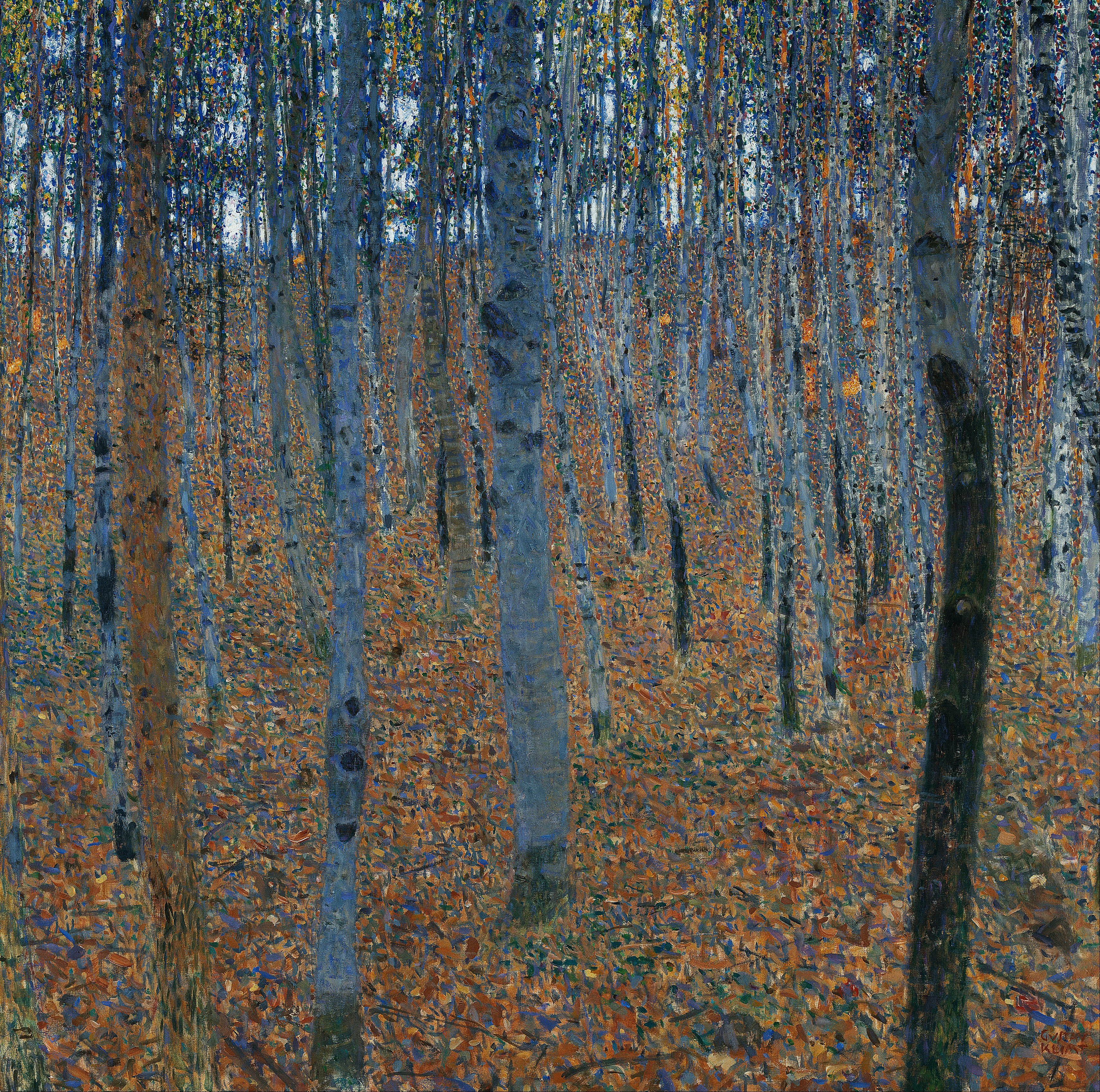
A landscape without escape
The repetition of trunks and the speckled ground transform the forest into an almost musical structure.
Water and reflections
The Attersee: a lake seen as a colorful surface
Klimt paints water without marine drama. It becomes calm, dense, vertical with its reflections, almost mural.

Quiet pond
Water is a thick mirror: reflections do not describe, they densify.
See Quiet Pond →
Kammer Castle Pond
The motif of the castle is absorbed by its environment, between park and reflecting pool.
See the pond →
Malcesine on Lake Garda
Another lake, more architectural, where the compact city huddles against the water.
See Malcesine →Real photos
The places of the Attersee behind the landscapes
These photos place the paintings in their real geography: the lake, Schloss Kammer, Schörfling, Villa Paulick and the Klimt center. They do not replace painting; they show what Klimt chooses to transform.

The real Attersee
The lake seen from Schörfling allows us to understand what Klimt narrows in his paintings: a vast expanse becomes a dense square for him, almost without horizon.

The castle painted by Klimt
Schloss Kammer is one of the iconic motifs in the Attersee series. The painting simplifies the facade and pushes the reflections towards ornament.

Kammer from the marina
The presence of water in front of the castle reminds us why Klimt could slide the motif between architecture, bank and colored mirror.

A vacation spot
Villa Paulick, in Seewalchen, belongs to the social geography of Klimt's stays around the lake: rest, relationships, framing and long observations.

The Gustav Klimt Zentrum
In Schörfling, the Klimt center allows you to place landscapes in the territory: Attersee, resort, walks, motifs and local memory of the artist.
Decoration
Integrate a Klimt landscape into an interior
Klimt's landscapes have a calmer presence than the golden works, but they are very visually rich. The secret is to give them air.
| Atmosphere | Recommended works | Where to place them | Agreements |
|---|---|---|---|
| Quiet lake | Attersee, Quiet pond, Lake shore with birches | Living room, bedroom, office | Linen, light wood, blue gray, sage green |
| Dense garden | Sunflower garden, Rose bushes under the trees, Poppy field | Main wall, dining room, bright entrance | Ocher, terracotta, moss green, wooden frame |
| Graphic forest | Beech Forest, Avenue in Schloss Kammer Park | Wide corridor, office, library | Fine black, dark oak, wool, matte ceramic |
| House and shore | Schloss Kammer, Country house on Lake Attersee | Living room, reading area, holiday home | Warm white, stone, rattan, olive green |
Simple advice
Avoid surrounding a Klimt landscape with too many competing patterns. A plain wall, soft light and a sober frame allow the plant vibration to do its job.
Shop selection
Twelve landscapes of Klimt to explore
A selection directly linked to the store's collections: Attersee, forests, gardens, flowers, houses and lakes.
Attersee
See the tableKammer III Castle
See the tableSunflower garden
See the tableThe Sunflower
See the tablePoppy field
See the tableRose bushes under the trees
See the tableLake shore with birches
See the tableQuiet pond
See the tableAvenue in the park
See the tableHouse on the Attersee
See the tableAfter the rain
See the tablePear tree
See the tableInternal mesh
Important collections around Klimt
To extend the article by subject: landscape, Attersee, forest, gardens, flowers, Art Nouveau and Viennese Secession.
Landscapes by Gustav Klimt
Austrian lakeAttersee seen by Klimt
Trees and undergrowthForests by Gustav Klimt
Water and reflectionsLakes and ponds
Nature Art NouveauGardens and flowers
Floral patternsKlimt Flowers
Fruit treesKlimt Orchards
140 worksGustav Klimt
Art NouveauFlowers, gardens and nature
Vienna 1900Viennese secession
MovementArt Nouveau
SymbolsSymbolism
Frequently asked questions
Landscapes of Klimt: eight useful answers
Attersee, square format, absence of characters, relationship to abstraction and choice of reproduction.
Did Gustav Klimt paint a lot of landscapes?
Yes. Landscapes constitute an important part of his work, especially from the end of the 1890s. They represent forests, gardens, orchards, rural houses, banks and lakes, particularly around the Attersee.
Why is the Attersee important to Klimt?
The Attersee is one of its great summer places. Klimt paints the lake, houses, parks and banks there. This setting allows him to work far from Viennese orders, in a quieter search for framing and color.
Why are Klimt landscapes often square?
The square format stabilizes the image and reduces the effect of walking in depth. It transforms the landscape into a frontal surface, close to a tapestry or a natural mosaic.
Are there characters in his landscapes?
Very rarely. Human absence is one of the most striking features of these works. It allows the natural pattern, trees, flowers and reflections to become the real protagonists.
Are Klimt's landscapes impressionistic?
They share an attention to color and light with Impressionism, but their construction is different. Klimt favors frontality, decorative density and repeated pattern rather than an instant outdoor feel.
Can we say that Klimt announces abstraction?
Some landscapes approach it by their saturated surface and reduced depth. They are not abstract in the strict sense, because the pattern remains identifiable, but they show how a landscape can almost become pure rhythm.
Which Klimt landscape to choose for a quiet interior?
For a peaceful atmosphere, choose Attersee, Quiet pond or Lake shore with birches. For a more solar and decorative effect, choose Sunflower Garden, Poppy Field or Sunflower.
Which Alpha Reproduction collection to explore first?
Start with Landscapes by Gustav Klimt, then refine with it Attersee, Klimt Forests or Klimt gardens and flowers.
Sources
Sources and extensions
Museum references and resources to place landscapes in the whole of Klimt's work.
Who was Gustav Klimt?
Biographical landmarks and context of Viennese modernity.
BelvedereKlimt Collection
Major works preserved in Vienna, including several landscapes.
Leopold MuseumGustav Klimt
Resources on Klimt, the Secession and Vienna around 1900.
Klimt FoundationArchives and research
Specialized documentation on the artist, his work and his network.
Wikimedia CommonsSchloss Kammer
Real photos of the castle, shore and lake around the pattern painted by Klimt.
Wikimedia CommonsVilla Paulick
Photographs of the vacation spot linked to Klimt's stays at the Attersee.
Alpha GuideBiography of Klimt
Life, style, major works and the golden period.
Alpha GuideKlimt's Kiss
Complete analysis of Klimt's most famous work.
0 comments