

Vincent van Gogh · Arles · October 1888
Van Gogh's Room in Arles: history, colors and 3 versions
A yellow bed, two chairs, an inclined perspective and colors designed for rest: behind this almost empty room hides one of Van Gogh's most intimate self-portraits.
The bedroom is not an invented scene. She was in the Yellow House, Place Lamartine in Arles. But Van Gogh transforms the space with flat areas, contours and contrasts, to the point of making the walls breathe and the furniture tilt.

The table in an idea
A portrait of the faceless artist
At first glance, nothing happens. The bed is made, the chairs are empty, the window remains closed and no character crosses the room. However, everything speaks of its occupant. The hanging clothes, the hanging portraits, the bowl placed on the table and the deliberately simple furniture make up a hollow presence. Van Gogh paints less a room than a way of inhabiting the world.
This place matters because it represents new stability. At thirty-five, the artist rents rooms in the Yellow House that he can organize as he wishes. After years of pensions, hotels and borrowed accommodation, he dreams of a home, a collective workshop and a community of painters in the South. His room becomes the silent core of this project.
The image seems naive, almost childish, but its simplicity is constructed. The large colored surfaces, the absence of modeled shadows and the firm contours reduce the volume. On the contrary, perspective leads the gaze towards the background. Between announced calm and unstable space, the canvas holds together thanks to a tension that we feel before even analyzing it.
The Yellow House
In Arles, Van Gogh finally wants to create an artists' home
Van Gogh arrived in Arles in February 1888, attracted by the southern light and the idea of finding the modern equivalent of the Japanese colors he admired. In the spring, he rented the right wing of a house located on Place Lamartine. Its ocher facade earned it the nickname Yellow House. He first used the rooms as a workshop, then was able to settle there after some work.
The arrival of Paul Gauguin gives particular urgency to the development. Van Gogh bought beds, hung his works and painted the famous ones Sunflowers to decorate his guest's room. Gauguin arrived on October 23, 1888; the first Bedroom has then just been conceived. The dream of the "Atelier du Midi" will be brief, but the picture retains the desire for order and hospitality.
Arrival
Van Gogh leaves Paris for Arles and discovers the light, orchards and landscapes of Provence.
The rental
He rents part of the Yellow House, first as a workshop, then as accommodation.
The bedroom
He painted the first version and drew its composition in a letter addressed to Theo.
Gauguin arrives
The two artists live and work together for approximately nine weeks.
Anatomy of a room
Six details tell the story of Van Gogh's life
The furniture is poor, but no object is trivial. The repetition of shapes and colors transforms this domestic inventory into a very personal composition.
 123456
Portraits
Two framed faces introduce a human presence. In the first version, they represent Eugène Boch and Paul-Eugène Milliet.
The window
Closed and slightly off-center, it brings a cold blue-green between the warm masses of the bed and the floor.
The yellow bed
Its heavy diagonal advances towards the viewer. Monumental on the scale of the room, it evokes rest, security and intimacy.
The two chairs
Their simplicity responds to the bed. One chair turns towards us, the other towards the table, like the silent traces of two possible positions.
The toilet
Carafe, glass, bottle, bowl and pitcher recall the daily actions of a room without a modern bathroom.
The doors
One leads to the stairs, the other to the next bedroom. Their original purple framed the room with two vertical flat areas.
A very controlled error
Why does the room seem to lean?
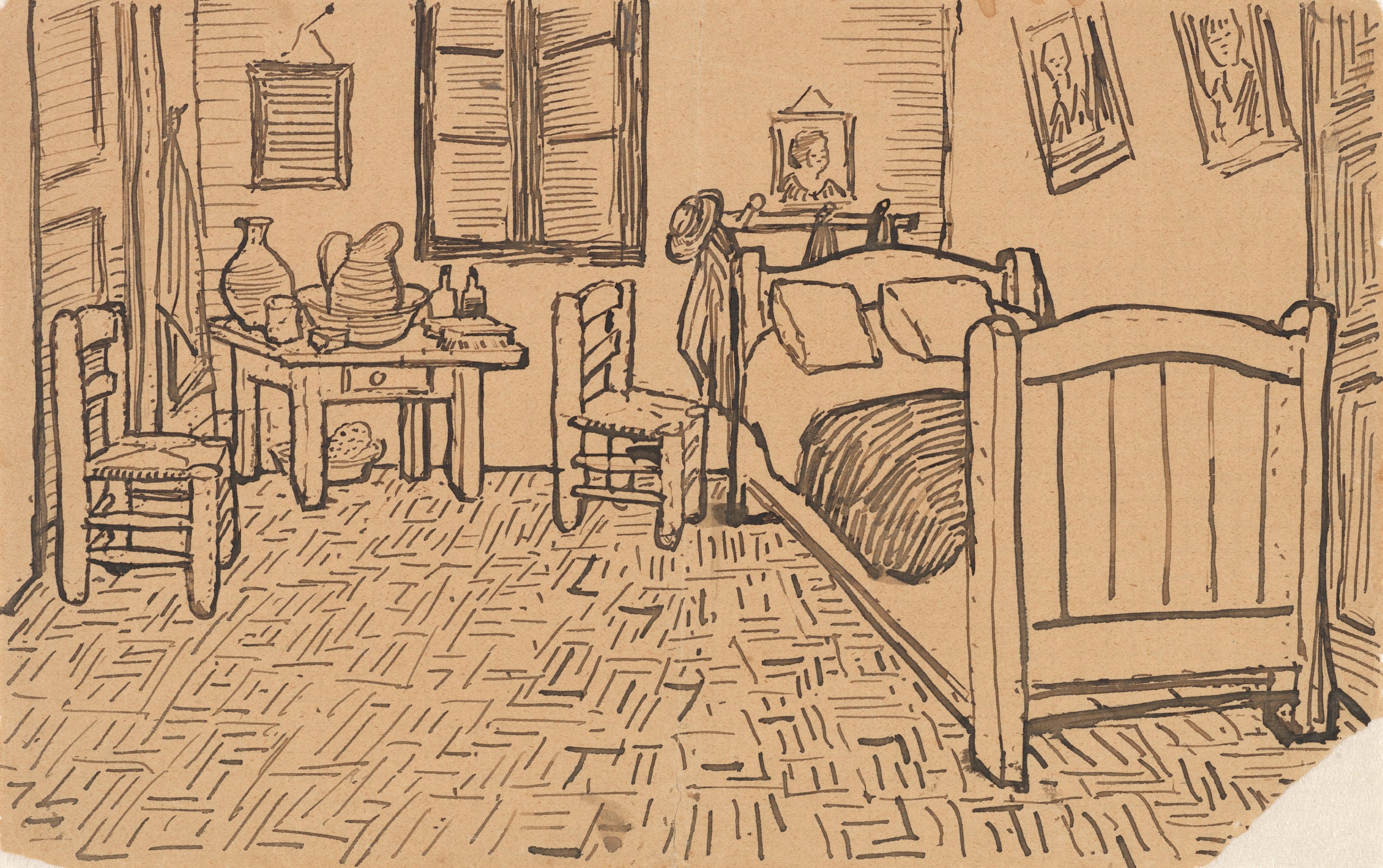
The back wall was really oblique
The irregular shape of the room is not an invention. The back wall of the Yellow House met the side walls at an unusual angle. Van Gogh therefore shows an existing architecture. However, it accentuates the experience of this space by combining several escape directions that do not converge academically.
The bed, floorboards, table and chairs each seem to move forward according to their own logic. The objects are slightly straightened to remain readable. This freedom avoids a cold and mathematical depth: the spectator does not look at the room from the outside, he has the impression of entering into his fragile balance.
The painter also removes cast shadows and flattens the volumes. This simplification is reminiscent of the Japanese prints he collects: visible contours, widely laid colors and space less subject to Western modeling.
Van Gogh seeks less to reproduce a piece than to make color the language of rest, with simplified shapes and almost no shadows.
Paraphrase of the letter to Theo dated October 16, 1888 and the notice from the Van Gogh Museum.
Color before realism
The blue room was lilac
In his letter, Van Gogh carefully describes the color relationships: pale purple walls, red floor, chrome yellow bed and chairs, lime green sheet, blood red blanket, orange table, blue bowl and green window. He does not seek discreet harmony. It does not seek discreet harmony. It juxtaposes complements and gives each object a clear chromatic identity.
Over time, some red pigments faded. The purple of the walls has shifted towards the light blue that we associate with the painting today. This evolution changes the temperature of the scene: the original had to be more contrasted, the lilac responding more to yellows and oranges. A serious reproduction must therefore choose between the current visible state and an interpreted restitution of the original colors.
Lilac
The original color of the walls, now bluer.
Red
Floor and blanket give a warm base to the room.
Yellow
Bed and chairs structure the painting with their brilliance.
Green
Window and linen balance the complementary reds.
Blue
Bowl and cold accents bring visual pauses.
Orange
The table connects the yellows of the furniture to the reds of the floor.
Amsterdam, Chicago, Paris
Why are there three Van Gogh Chambers?
Van Gogh did not paint three preparatory studies, but three independent paintings. The first canvas, made in Arles in October 1888, was damaged by humidity during a flood. In 1889, while he was staying in Saint Ragémy, Theo recommended that he have it re-coiled before handling it. Vincent decides to paint a copy of the same format, then a reduction intended for his mother and sister.
| Version | Date and dimensions | What sets it apart | Conservation |
|---|---|---|---|
| First | Arles, October 1888 72.4 × 91.3 cm |
Original composition, painted directly in the Yellow House. Damaged after flooding. | Van Gogh Museum, Amsterdam |
| Second | Saint-Rémy, September 1889 73.6 × 92.3 cm |
Copying almost on the same scale. Some portraits and details change, as do color ratios. | Art Institute of Chicago |
| Third | Saint-Rémy, September 1889 57.3 × 73.5 cm |
Smaller version, intended for the artist's family and sent to her mother and sister. | Musée d'Orsay, Paris |
What remains
The bed on the right, the two chairs, the central window, the dressing table and the general layout allow you to immediately recognize the room.
Van Gogh above all preserves the idea of composition: large, simple, surrounded masses, pushed towards the spectator.
What changes
The hanging works, portraits, touch and several nuances differ. The covers are therefore not mechanical copies.
Comparing the three versions allows us to see how the artist reconstructs his own painting from memory, the first canvas and new decisions.
Desired rest, vibrant space
A calm picture that refuses to stay still

Rest is not silence
Van Gogh explains that he wants the mere sight of the painting to soothe the mind. The basic furniture, the absence of a narrative scene and the large areas of color serve this ambition well. Nothing obliges us to look for an anecdote: the room immediately catches the eye.
But the rest represented is not yet acquired. The bed moves forward, the floor rises, the frames shift and the contours undulate. Complementary colors maintain a constant vibration. The room appears solid and precarious at the same time, welcoming but narrow, personal while remaining empty.
This contradiction makes the modernity of the painting. A modest interior becomes a mental landscape without complicated symbols. Emotion arises from the way things occupy space: too close, slightly inclined, each carrying the artist's touch.
Arles around the room
Three works to find the same world
The room is not isolated in Arlesian production. It dialogues with the facade of the dream home, the colorful nights of the city and the portraits of the people met by the painter.


Choose a reproduction
How to install Van Gogh's Room at home
The subject is an interior, which creates a natural mise en abyme when entering a real room. Its strong palette works particularly well as a focal point, provided you leave enough breathing space around the canvas.
Keep horizontal
The landscape relationship is essential: it maintains the dialogue between the bed, the window and the toilet area.
Choose the material
An oil-painted reproduction restores the irregular contours and vibration that the print tends to even out.
Avoid overloading
The painting already contains many contrasts. A calm wall and a few well-chosen objects are enough to accompany it.
Light gently
Warm light, directed without reflection, reveals yellows and reds without hardening the blue areas.
Recommended palette
The broken whites, sand tones, light clay and greiges let the canvas dominate. A gray blue or sage green wall can extend its cool tones, while a discreet reminder of ocher in a cushion or object connects the painting to the room.
For the frame, natural wood evokes the simplicity of painted furniture. A dark brown frame reinforces the contours; matte gilding wakes up the yellow bed, but it is better to avoid a finish that is too shiny.
Discover reproductionLounge
Generous format above a low piece of furniture, on a lightly loaded wall.
Bedroom
Medium format, light wood and plain textiles for a more intimate reading.
Office
An energetic and structured image, ideal for the eye.
Entrance
The domestic subject immediately welcomes and sets the tone from within.
Continue the visit
Van Gogh's Room and related collections
Find the work, the artist, his movement and the landscapes which allow you to extend this visit to the Yellow House.
The Room in Arles
Hand painted reproduction from the famous 1888 interior.
784 worksVincent van Gogh
Interiors, portraits, flowers, landscapes and nights of the painter.
The movementPost-impressionism
Expressive colors, strong structures and personal visions.
IconsFamous paintings
Explore instantly recognizable masterpieces.
Light and horizonImpressionist landscapes
Comparing ways of constructing space and atmosphere.
Complete catalogAll works
Browse all available reproductions.
Frequently asked questions
Everything you need to know about Van Gogh's Room
When did Van Gogh paint The Room in Arles?
He painted the first version in Arles in October 1888, shortly before the arrival of Paul Gauguin at the Maison jaune. He produced two new versions in Saint-Rémy in September 1889.
Where is the room shown?
It was located on the first floor of the Maison jaune, place Lamartine in Arles. The building was damaged during World War II and then demolished.
Why is Van Gogh's bed yellow?
The chrome yellow gives the bed a warm and very readable presence. It contrasts with the original lilac of the walls and contributes to the effect of colorful simplicity sought by the painter.
Why does the perspective seem wrong?
The back wall was actually oblique, but Van Gogh also uses several escape directions, straightens objects, removes shadows and flattens volumes. The deformation is therefore partly architectural and partly voluntary.
Were the walls really blue?
No, analyzes show that walls and doors originally had purple or lilac tones. Red pigments have discolored, giving a bluer impression today.
How many versions of Van Gogh's Room are there?
There are three versions painted by Van Gogh: the first at the Van Gogh Museum in Amsterdam, the second at the Art Institute of Chicago and the third, smaller, at the Musée d'Orsay in Paris.
What did Van Gogh want to express in this painting?
In his letter to Theo, he presents color and the simplification of shapes as means of evoking rest. The result, however, retains a visual tension created by diagonals, contours and contrasts.
What format should I choose for a reproduction of La Chambre à Arles?
A medium or large horizontal format respects the ratio of the composition. The choice depends on the available distance: measure the wall and keep free space around the canvas.
Main sources: notice of the first version and illustrated letter of Van Gogh Museum ; notice of the second version atArt Institute of Chicago ; notice of the third version in orsay Museum. Accessed July 2026.
0 comments