

Vincent van Gogh • Art & decoration guide
Van Gogh FAQ: works, style and sunflowers
A living guide to the life, brushstrokes and decorative choices inspired by Vincent, far from museum clichés.
Vincent van Gogh is not just a name you pronounce with reverence in front of a canvas; he is a telluric force that revolutionized the way we see light and matter. Between the wheat fields of Brabant and the blinding sun of Arles, this man transformed his distress into an explosion of color that continues to fascinate a century and a half later. This text does not aim to give you a masterclass, but to answer the real questions that arise when you fall in love with a reproduction or finally visit the Musée d'Orsay. We will explore why his sunflowers seem ready to wilt in your living room, how his nervous touch captures the wind, and which work to choose to warm up a too-tame interior.
 Free image
A living guide to the life, brushstrokes and decorative choices inspired by Vincent, far from museum clichés.
Reading method
Reading Van Gogh with eyes and heart
Approaching Vincent's work requires forgetting the coldness of dates in favor of the intensity of the gaze. It is about understanding that every brushstroke is an emotional decision, not just a technical one.
Context before prestige
We place Vincent van Gogh in his era, his studios, his exhibitions and his small revolts. A work without context is sometimes just a very beautiful person who forgot their story.
The signs that betray the style
We identify composition, palette, texture. These clues often say more than grand speeches, especially when they carry gold or nervous brushstrokes.
The work in a real room
We end with the useful question: does this image breathe in your home, or is it just posing like a poster that has read two books?
Historical context
Who is Van Gogh, in short but not stripped-down version?

Born in 1853 in Zundert, Netherlands, Vincent was not destined to become the world's most famous painter, having first failed as a preacher in the dark mines of the Borinage. It was only around the age of twenty-seven, financially and morally supported by his brother Theo, that he devoted himself entirely to painting, accumulating canvases with a frenzy that would frighten any modern artist. His journey took him from the earthy tones of Nuenen, visible in The Potato Eaters, to the dazzling discovery of Parisian light where he met the Impressionists and discovered the Japanese prints that would change his vision of composition.
The most intense and well-known period began when he traveled south, settling in Arles in 1888 in the famous Yellow House, dreaming of a studio of artists from the Midi. After the tragic crisis involving Gauguin and his own voluntary stay at the asylum of Saint-Rémy-de-Provence, where he painted The Starry Night behind the bars of his window, he ended his life in Auvers-sur-Oise. There, under the benevolent supervision of Dr. Gachet, he produced his last tormented masterpieces before passing away in July 1890, leaving behind a correspondence with Theo that remains the most poignant testimony of a life dedicated to art.
Artistic style
Which Van Gogh works should you know first?

If you only need to remember three paintings to understand the evolution of his genius, start imperatively with The Potato Eaters from 1885, a dark and powerful work that celebrates the rough dignity of Dutch peasants. Then, let yourself be carried away by the chromatic vibration of the Sunflowers, painted in Arles to decorate the guest room intended for Gauguin, where yellow becomes almost a visual religion. Finally, The Starry Night, created in Saint-Rémy in 1889, offers a swirling sky that seems alive, proving that for Vincent, the night was often more colorful and rich than the day, thus defying all the realistic conventions of his time.
We must not neglect The Bedroom in Arles, whose deliberately distorted perspective creates an immediate sense of intimacy, as if the viewer could sit on the raw wooden chair. The Irises, painted during his confinement, show an incredible mastery of purple and green, while The Night Café uses blood red and acid green to express, in his own words, the terrible human passions. His many self-portraits, often painted for lack of paid models, constitute a fascinating visual autobiography where we see his gaze sharpen and his style assert itself year after year, up to the last Wheatfield with Crows.

The Starry Night
A reproduction related to Vincent van Gogh, useful for comparing atmosphere, palette and wall presence.
Art & details
How to recognize his style without reciting a laminated card?
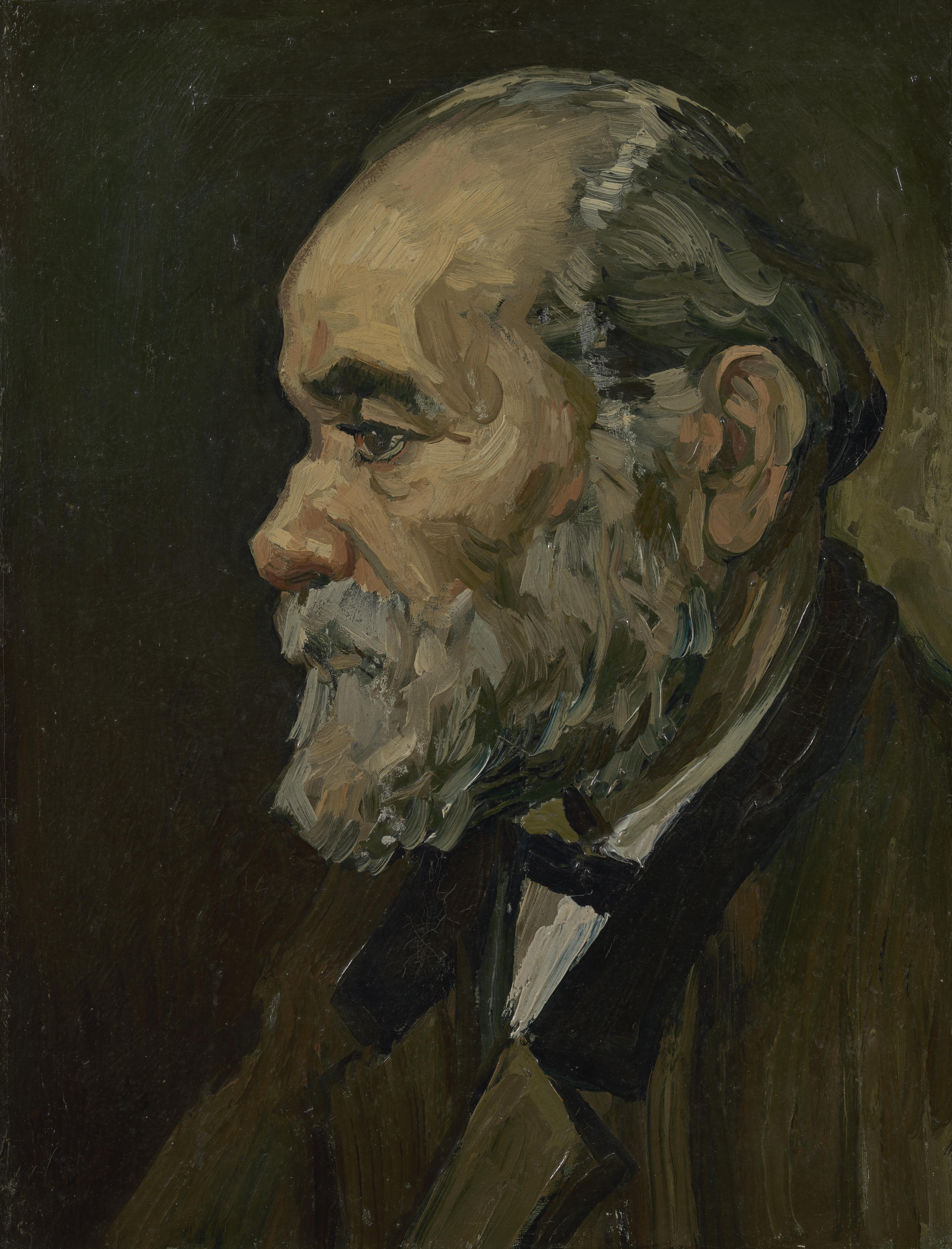
The first distinctive sign is impasto, that technique where paint is applied so thickly that it creates a tangible relief on the canvas, capturing real light like a miniature sculpture. Vincent often used paint straight from the tube, without diluting it, tracing parallel furrows or energetic spirals that give his cypresses and skies a perpetual movement. This visible touch, sometimes called 'hatching', does not seek to smooth reality but to translate the vibration of the air and the emotional intensity of the moment, making every surface alive and palpable under the gaze of the attentive viewer.
His mastery of complementary colors is another infallible marker: he systematically juxtaposed blue and orange, red and green, or purple and yellow to create maximum contrast that makes the image vibrate. Influenced by Japonism, he often abandoned traditional perspective in favor of black outlines surrounding forms, reminiscent of the woodblock prints of Hiroshige that he loved to collect. This style does not aim for photographic likeness but for pure expression, transforming a simple wheat field or a vase of flowers into an intense psychological experience where color dictates the overall mood of the work.
Art & details
Why are the Sunflowers everywhere, even when nobody asked for a bouquet?

The Sunflowers did not become iconic by chance, but because they represent the culmination of Vincent's quest for the color yellow, which he associated with gratitude and the divine light of the Midi. Painted as a series in Arles in 1888 and 1889, this set of still lifes was meant to welcome Paul Gauguin to the Yellow House, serving as a symbol of artistic hospitality and hoped-for friendship. The massive use of chrome yellow, a then-new and very luminous pigment, allowed Vincent to explore all the nuances of a single hue, from pale lemon to burnt ochre, creating a monochrome symphony of incredible richness that defies time.
These flowers, some fresh and upright, others withered and bent, tell the cycle of life with a raw honesty that universally touches contemporary audiences. Unlike the perfect, static bouquets of academic painting, Vincent's sunflowers seem to struggle against their own weight, their knotted stems and ruffled petals testifying to a wild, untamed nature. It is this vegetal humanity, combined with a painting technique so vigorous that the seeds seem ready to fall from the canvas, that has propelled these images into global popular culture, far beyond the specialized circles of art history.
Art & details
The cut ear: answering without turning suffering into a spectacle

The episode of the cut ear, which occurred in December 1888 in Arles, remains the most famous and often most misunderstood anecdote of the artist's biography, sometimes reducing his complex genius to a simple bloody news item. Historical reality suggests an acute mental health crisis, probably exacerbated by alcohol, absinthe, and the unbearable tension of living with Gauguin, whose authoritarian personality clashed with Vincent's heightened sensitivity. During that tragic night, he allegedly mutilated his left ear before entrusting the fragment to a local woman, a desperate act that marked the beginning of his series of hospitalizations and his gradual withdrawal from normal social life.
It is crucial not to see this event as a morbid curiosity, but as a symptom of deep suffering that nevertheless continued to nourish his art with frightening lucidity. Shortly after this incident, he painted the Self-Portrait with Bandaged Ear, a stoic work where he depicts himself as a working painter, refusing to be defined solely by his injury. His artistic production during and after this period, notably the tormented cypresses of Saint-Rémy, proves that his creativity was not the fruit of madness, but persisted despite it, transforming pain into a visual beauty of an intensity rarely equaled in the history of Western painting.
Works to know
Famous works by Vincent van Gogh to look at before choosing
For a hand-painted Vincent van Gogh reproduction, an oil painting Vincent van Gogh, or a copy of a Vincent van Gogh painting, the most useful thing is to compare several images: the gilding, the faces, the density of the patterns, and how each work holds the wall.
- The Bedroom in ArlesA visual entry point to understand Vincent van Gogh without turning the article into an inventory.
- The Starry NightA reproduction related to Vincent van Gogh, useful for comparing atmosphere, palette and wall presence.
Art & details
Where to see his works today?

For a total immersion, the Van Gogh Museum in Amsterdam is essential, housing the largest collection in the world with over two hundred paintings and five hundred drawings covering all periods of his career. In France, the Musée d'Orsay in Paris holds absolute treasures such as The Bedroom in Arles and the Self-Portrait of 1889, allowing you to see up close the vibrant texture of his paint in a magnificent architectural setting. The Kröller-Müller Museum, nestled in a national park in the Netherlands, offers a unique outdoor experience with its sculpture garden and possesses an exceptional collection including The Starry Night over the Rhône and Café Terrace at Night.
In the United States, the Museum of Modern Art (MoMA) in New York jealously guards The Starry Night, attracting huge crowds in front of this swirling sky that has become emblematic of pop culture. The National Gallery in London, meanwhile, exhibits the famous Sunflowers, offering British visitors direct access to this brilliant yellow series, while the Metropolitan Museum of Art and the Getty Center complete the panorama with major works such as the Irises or Provençal landscapes. Traveling in Vincent's footsteps therefore means accepting to cross oceans, because his legacy is now scattered across the greatest sanctuaries of world art, each bringing a different piece to the puzzle of his life.
Art & details
Why is Van Gogh so expensive?

The astronomical value of Vincent's paintings on the art market is first explained by absolute rarity: having sold very few works during his lifetime, the majority of his production is now locked away in non-sellable public museums. When an authentic canvas appears at auction, such as the Portrait of Dr. Gachet or a view of the Wheat Fields, it triggers an international bidding war between private collectors and foundations, sending prices soaring to hundreds of millions of dollars. This rarity is amplified by the artist's global fame, whose name is recognized even by those who know nothing about painting, creating constant and inelastic demand.
Beyond financial speculation, these prices reflect the immense cultural impact of his work, which redefined Expressionism and influenced generations of modern artists. Each sold work carries with it a fragment of history, the physical proof of a tragic and brilliant existence, which adds an irreplaceable narrative dimension to the aesthetic value. However, it is important to note that this financial frenzy concerns exclusively historical originals; for the common mortal, the beauty of Van Gogh remains accessible through high-quality reproductions that capture the spirit of the work without requiring a billionaire's budget.
Art & details
Which Van Gogh reproduction to choose for your home?

The choice of a reproduction depends above all on the atmosphere you wish to create: to energize a neutral living room, opt for the solar intensity of the Sunflowers or the blue vibration of The Starry Night, which immediately bring character to the wall. If you are looking to create a calming and intimate ambiance in a bedroom, The Bedroom in Arles, with its woody tones and soft perspectives, acts as a reassuring visual cocoon, while the Irises offer a more discreet but equally sophisticated floral elegance. You should also consider size: large formats work better for landscape scenes like the Wheat Fields, allowing the eye to get lost in the details of the brushstroke, while self-portraits benefit from being seen in more human dimensions.
The quality of the reproduction is paramount to do justice to Van Gogh's unique texture; prefer canvas prints with relief or high-definition giclée techniques that restore the depth of the impasto. Avoid flat posters that smooth out his painting and betray his intention, because it is precisely in the grain and texture that the soul of his style resides. Also think about the lighting of your room: works dominated by yellow and orange react wonderfully to warm evening light, while nocturnal compositions can become the dramatic focal point of a space lit by discreet directional spotlights.
Interior decoration
Questions everyone asks, even people who pretend to know
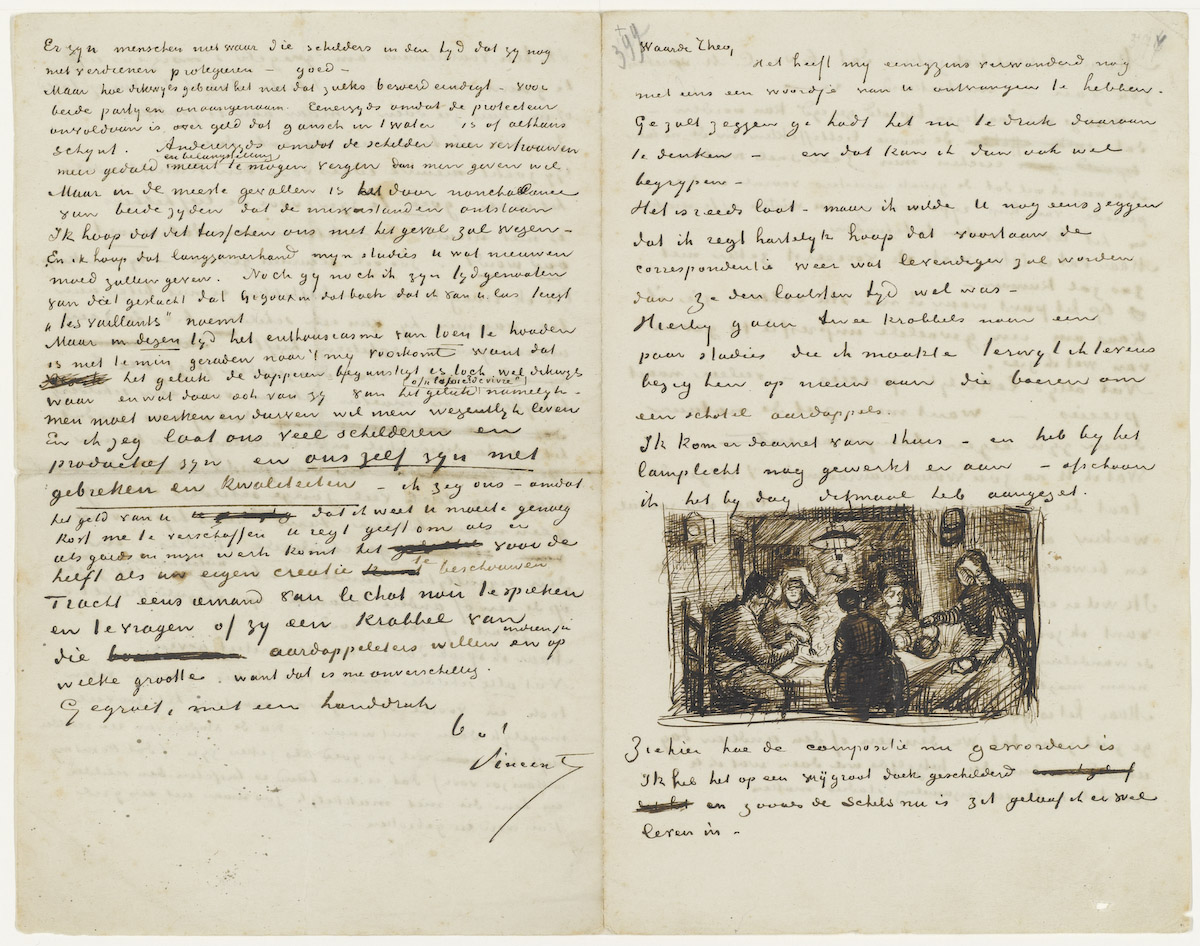
Yes, Vincent sold a few paintings during his lifetime, contrary to the persistent legend that he died in total misery without ever selling a single canvas; he notably sold The Red Vineyard and several drawings thanks to the help of Theo and a few enlightened critics. No, he did not paint The Starry Night in a single night under a flash of inspiration, but created it from memory in his studio in Saint-Rémy, based on sketches and his memories of the Provençal landscape. These details, often distorted by cinema or bar anecdotes, deserve to be corrected to appreciate the rigor and consistency of his daily work, far from the myth of the mad artist touched by instant divine grace.
Many also wonder why his letters to Theo are as important as his paintings: they constitute an exceptional intimate diary that sheds light on his technical choices, his readings and his doubts, offering an indispensable key to understanding his stylistic evolution. As for the question of whether he could have been cured with modern medicine, it is an open debate among historians and psychiatrists, but it does not change the power of his visual legacy. Ultimately, what really matters is not the pathology, but the ability of this man to transform his unique vision of the world into universal images that continue to move us today.
| Room | Suggestion | Decorative effect |
|---|---|---|
| Living room | A work related to Vincent van Gogh with a strong composition | Cultivated focal point, warm and easy to comment on without reciting a label. |
| Bedroom | A soft palette or a more intimate scene | Calm atmosphere, visual presence without unnecessary agitation. |
| Office | A structured, colorful or graphically sharp image | Creative energy and a small reminder that the wall can also work. |
| Entryway | A vertical format or an immediately readable work | Clear first impression, elegant, and decidedly less timid than a blank white space. |
To continue the visit
Sources, collections and paths truly related to the subject
A few useful references to verify information, compare free images and extend reading without going to a museum that didn't ask for anything.
Related articles to read next
Verified collections
Useful blog hubs
FAQ
Frequently asked questions about Van Gogh
What is Vincent van Gogh in painting?
Vincent van Gogh deserves an in-depth article because this style engages both an era, a way of painting, and a very concrete way of living with images.
How to quickly recognize this style?
Observe especially composition, palette, texture, light and atmosphere, then the way the composition organizes the gaze. If the work holds your attention longer than expected, it is probably not an accident.
Which artists should you know?
You need to cross-reference the central artists of the movement with museums and reliable sources to avoid too hasty attributions.
Is this style suitable for modern decoration?
Yes, provided you choose the right format, a palette consistent with the room, and a work whose presence remains pleasant on a daily basis.
Should you choose the most famous work?
Not necessarily. The most famous work can be perfect, but the right choice depends above all on the room, the format, the palette and the desired atmosphere.
Where to verify the information?
Start with museum notices, Wikipedia/Wikidata for general orientation, then Wikimedia Commons when a free image is needed.
Living with Van Gogh every day
Integrating Van Gogh into your interior or personal culture does not simply mean hanging a famous image, but accepting an invitation to see the world with more intensity and compassion. Whether through the vibrant yellow of a sunflower or the deep blue of a starry night, his work reminds us that beauty can emerge even from the most difficult circumstances. By choosing a reproduction or visiting a museum, you are not just admiring a past style; you are dialoguing with a spirit that sought, until his last breath, to capture human truth through color and light. So let these images live in your home, not as mere decorations, but as silent companions capable of transforming an ordinary wall into a window open to infinity.
0 comments