

Café Terrace at Night by Van Gogh • Art & Decoration Guide
Café Terrace at Night by Van Gogh: Arles, Yellow Light and Night Without Black
Dive into the heart of the Place du Forum to understand how Vincent reinvented the night, between lucid correspondence and bold decorative choices.
It is rare that a canvas manages to capture the essence of a summer evening as accurately as the one painted by Vincent van Gogh in September 1888. Far from the clichés about the artist's madness, this work reveals exceptional technical mastery and a keen observation of Arlésien life. The viewer is immediately drawn in by the receding perspective that guides the eye toward a deep sky, while the terrace bathes in a warm artificial glow. Understanding this painting means accepting to set aside preconceived ideas about the cursed painter to discover a strategist of color, capable of transforming an ordinary street corner into a timeless theatrical scene where light becomes the true subject.
 Free image
Dive into the heart of the Place du Forum to understand how Vincent reinvented the night, between lucid correspondence and bold decorative choices.
Reading method
Reading the night like an architect of light
To fully appreciate this artwork, you must forget simple passive contemplation and observe how Van Gogh constructs space. Each brushstroke follows a precise logic: opposing the cold of the sky with the warmth of the ground, structuring perspective through the lines of the rooftops, and animating the scene with discreet silhouettes. This approach helps understand why a reproduction can radically change the atmosphere of a living room, depending on whether it respects these subtle balances between cobalt blue and chrome yellow.
Context before prestige
We place Van Gogh's 'Terrasse du café le soir' back in its era, its studios, its exhibitions, and its little revolts. An artwork without context is sometimes just a very beautiful person who forgot their history.
The signs that reveal the style
We spot composition, palette, texture. These clues often say more than grand speeches, especially when they carry gold or nervous brushstrokes.
The artwork in a real room
We end with the useful question: does this image breathe in your home, or does it just pose like a poster that has read two books?
Historical context
Place du Forum, September 1888: Van Gogh sets up the night outdoors

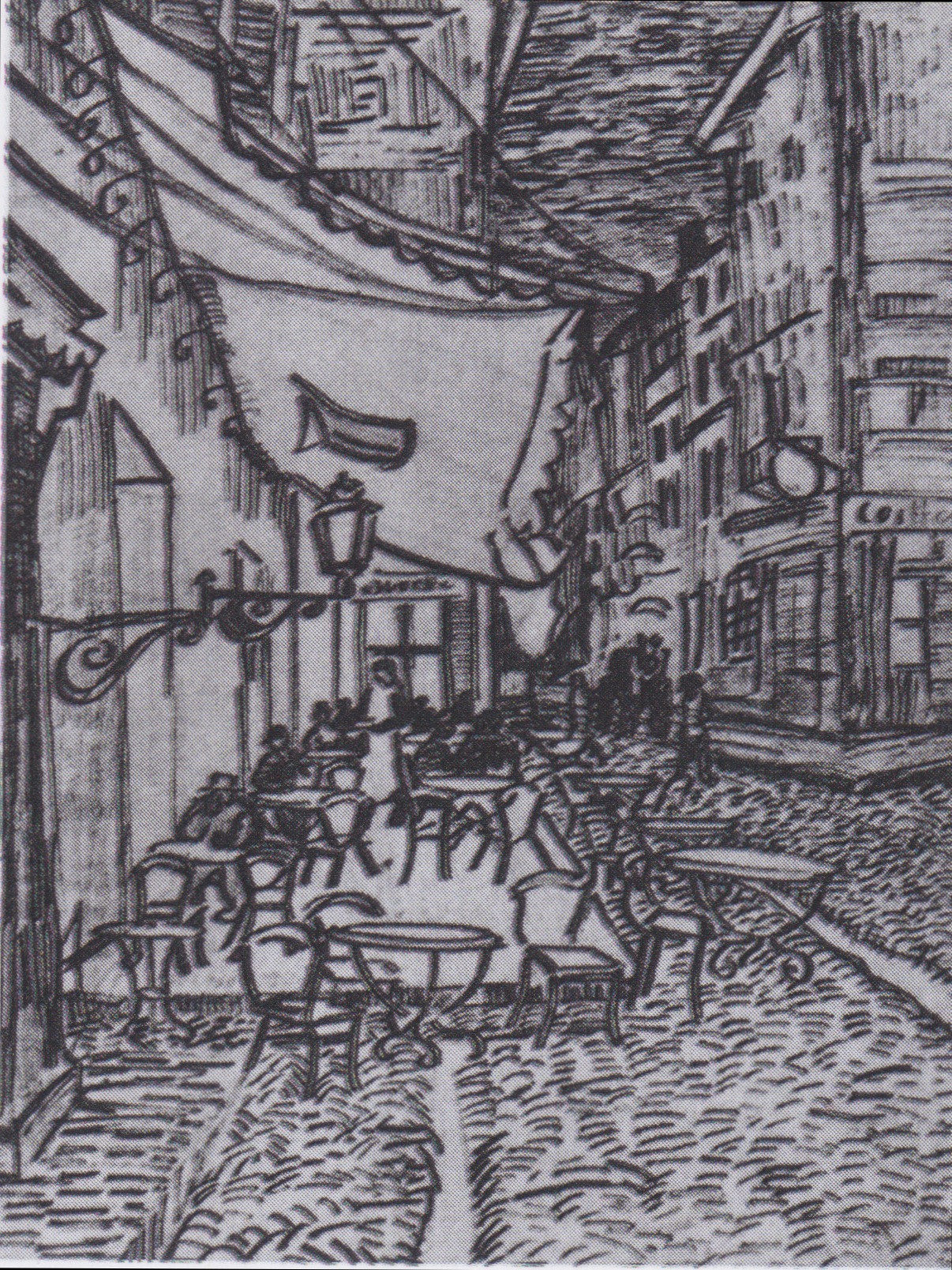
It was in September 1888, shortly after his arrival in the south of France, that Vincent sat down in front of the Café de la Gare, located on the Place du Forum in Arles. He was not trying to paint an enclosed interior, but wished to capture the specific atmosphere of a terrace lit by gas lamps—a technical challenge that few artists had dared to tackle before. In his letters to his brother Theo, he describes at length this ambition to paint the night outdoors, without resorting to the usual dark conventions of the time. The city is almost asleep, but life continues under the striped awnings, creating a striking contrast between the surrounding calm and the social activity concentrated under the artificial light.
The painter works directly on the motif, facing the difficulties of night vision and the need to simplify forms to maintain strong readability. He chooses a slightly elevated viewpoint that allows him to embrace both the irregular cobblestones, the ochre facades, and this immense sky that occupies nearly half of the composition. This decision is not trivial: it transforms a local genre scene into a universal experience of the southern night. The empty tables in the foreground invite the viewer to sit down, while the buildings in the background serve as a rigorous architectural frame for this explosion of yellow brightness.
Artistic style
From Café Terrace to Starry Night: Painting the Night Without Black

What immediately strikes the viewer about this work is the total absence of black to define shadows or the night sky—a radical break with academic traditions. Van Gogh replaces the darkness with deep blues, ranging from cobalt to ultramarine, which he violently contrasts with the orange-yellows of the gas lamp and the illuminated facades. This complementary palette creates an optical vibration that gives the impression that light is actually trembling in the warm air of Provence. A few months later, in Saint-Rémy, he would push this research even further with Starry Night, but here in Arles, the priority remains fidelity to a tangible urban light, not a tormented sky.
The technique employed relies on impasto and the juxtaposition of distinct brushstrokes that do not blend on the canvas, leaving the viewer's eye to synthesize the colors. The stars themselves are not simple white dots, but luminous halos integrated into a dense, textured celestial fabric. Van Gogh intuitively understands that the night is not the absence of light, but a colored space where artificial sources modify the perception of objects. This aesthetic choice foreshadows the research of the Fauves and the Expressionists, proving that his so-called impulsiveness actually concealed a very sophisticated reflection on the physics of color.
Art & Details
Silhouettes, Passersby, and Faces of Arles: The Terrace Is Not an Empty Set

Contrary to what one might believe when seeing a poor-quality reproduction, the terrace is not deserted; it is animated by about a dozen small silhouettes sitting or strolling near the columns. These figures are treated with a remarkable economy of means: a few dabs of paint are enough to suggest a hat, a posture, or a conversation, without ever going into precise anatomical detail. They embody the local population of Arles, these Arlésiens whom Vincent would later try to portray individually, as in the famous series of Madame Ginoux. Their human presence anchors the painting in social reality and prevents the scene from becoming a cold architectural study.
One can notably distinguish a group seated at the center, probably regulars enjoying the relative coolness after a scorching day. On the right, a figure seems to be heading toward the exit, adding a dynamic of movement that counterbalances the stability of the vertical lines of the buildings. These narrative details are essential because they transform the work into a slice of life captured on the spot. Ignoring these elements in a copy would mean considerably impoverishing the visual narrative, reducing a living scene to an empty theatrical set where only yellow would dominate for no apparent reason.
Art & Details
Café Terrace at Night and The Night Café: two cafés, two moods

It is fascinating to compare this painting with The Night Café, painted a few days later inside the same establishment on Rue de la Cavalerie. While the terrace bathes in a soothing harmony of blues and yellows, the interior explodes in a violent dissonance of blood reds and acidic greens, intended to express human passions and potential distress. Van Gogh described this interior as a place where one could ruin oneself, go mad, or commit a crime, while the outdoor terrace rather evokes conviviality and rest under the stars. This duality shows his ability to use color as a powerful psychological language, adapted to each spatial context.
The difference also lies in the light source: outside, the gaslight uniformly illuminates the scene, creating an open and welcoming space, while inside, the hanging lamp projects menacing shadows and distorts perspectives. The customers on the terrace seem free; those inside appear trapped in a heavy atmosphere. For an art lover wishing to acquire a reproduction, it is crucial not to confuse these two radically opposite moods. One invites nighttime reverie, the other confronts the viewer with a dramatic tension that can be difficult to bear in a living room designed for family relaxation.
Art & Details
Place du Forum today: finding the setting without mistaking a postcard for a painting

If you stroll today on Place du Forum in Arles, you will easily find the exact location of the café, still operated under the name Café Van Gogh, with its characteristic striped awnings. However, the urban setting has changed a lot since 1888: the facades have been repainted, public lighting has modernized, and the tourist crowd has replaced the rare passersby of the time. It would be naive to look for a perfect photographic correspondence between the real place and the canvas, because Vincent took liberties with the topography to serve his composition. He notably accentuated the slope of the street and modified the alignment of the roofs to strengthen the perspective receding toward the sky.
The artist transformed an ordinary corner of the city into an almost theatrical scene, stripping away superfluous details to focus attention on the interaction between architecture and light. The buildings are not rendered with an architect's precision but suggested by colored masses that rhythm the space. This pictorial transformation is what gives the painting its timeless power: it does not simply document a place, it extracts its soul. Visiting Arles allows you to feel the general atmosphere, but it is in the canvas that the emotional truth of the place resides, sublimated by the interpretative genius of the Dutch painter.
Paintings to Know
Famous paintings of Van Gogh's Café Terrace at Night to look at before choosing
For a hand-painted reproduction of Van Gogh's Café Terrace at Night, an oil painting of Van Gogh's Café Terrace at Night, or a copy of the painting Van Gogh's Café Terrace at Night, the most useful thing is to compare several images: the gilding, the faces, the density of the patterns, and how each artwork holds the wall.
- Café Terrace at NightA visual gateway to understand Van Gogh's Café Terrace at Night without turning the article into an inventory.
Art & Details
The letters to Theo: Van Gogh explains the night better than a hurried museum label

The correspondence between Vincent and his brother Theo is an invaluable source for understanding the intentions behind this artwork, far from the hasty analyses often offered in museums. In a letter dated September 9, 1888, Vincent details his creative process with astonishing clarity, explaining that he needs to paint the night without black, using only blue, violet, and green. He describes the difficulty of working outdoors with artificial lighting, forcing his eye to constantly adapt to harsh contrasts. These writings reveal an artist extremely conscious of his technical choices, far from the romantic image of a painter acting only under the impulse of feverish inspiration.
He also mentions his desire to create an effect of infinite depth, where the sky seems to extend far beyond the edges of the canvas. Theo, who was an art dealer, perfectly understood these issues and financially supported these risky experiments. Thanks to these documents, we know that every touch of paint was considered to achieve a specific vibration. Reading these letters changes our view of the painting: we no longer see just a beautiful night scene, but the result of a carefully thought-out visual strategy, where color becomes the main tool for conveying a complex sensory experience.
Art & Details
From Sunflowers to the terrace: the yellow of Arles doesn't know silent mode

The yellow that floods the terrace is not isolated; it is part of a broader chromatic obsession that marks Van Gogh's entire stay in Arles in 1888. It is the same year he painted the famous Sunflowers and rented the Yellow House, seeking to create a shared studio with Gauguin bathed in this intense southern light. For him, chrome yellow symbolizes warmth, friendship, and the vital energy of the Provençal sun, a natural force he tries to capture even in the direct absence of the daytime star. On the terrace, this color becomes artificial thanks to gas, but retains all its symbolic and emotional power, acting as a replacement sun.
This massive use of yellow strongly contrasts with his earlier Dutch periods, dominated by dark earths and peat grays. In Arles, the palette lightens radically, influenced by Japanese prints he admires, which favor flat areas of bright colors. The yellow of the terrace dialogues with the blues of the sky to create a dynamic harmony that refuses the usual melancholy associated with night. Choosing a reproduction of this artwork is therefore inviting that solar energy into your interior, even when day falls, creating a luminous focal point that defies the gravity of the neutral tones often present in contemporary decoration.
Interior Decoration
Choosing a reproduction: keep the light without turning the wall into a sign

When selecting a hand-painted reproduction of this artwork for a modern interior, the quality of the rendering of the blue shades is as crucial as that of the yellows. A cheap copy will tend to flatten the sky's gradients, turning that deep vault into a uniform, sad background that loses all its vibrant magic. It is essential to check that the copyist artist has properly respected the texture of the original impasto, because it is this material that gives relief to the light and prevents the image from resembling a mere advertising poster for a café. The vertical format of the original should be preferred to preserve the soaring perspective and the dominance of the sky.
Place the artwork in a space where it can breathe, ideally facing a soft light source that will not create annoying reflections on the most textured areas. Avoid overly ornate or gilded frames that could compete with the yellow already present in the canvas; a thin frame in natural wood or discreet black will be enough to highlight the composition without weighing it down. The goal is to allow the gaze to travel freely from the cobblestones to the stars, recreating at home that feeling of nocturnal calm characteristic of Arles. A good reproduction does not merely show an image; it conveys an atmosphere capable of transforming the mood of an entire room at twilight.
| Room | Suggestion | Decorative Effect |
|---|---|---|
| Living Room | An artwork related to Terrasse du café le soir de Van Gogh with a strong composition | Cultivated, warm focal point that is easy to comment on without reciting a label. |
| Bedroom | A soft palette or a more intimate scene | Calm atmosphere, visual presence without unnecessary agitation. |
| Home Office | A structured, colorful, or graphically sharp image | Creative energy and a little reminder that the wall can also work. |
| Entryway | A vertical format or an immediately readable artwork | A clear, elegant first impression, and distinctly less shy than a white void. |
To continue the visit
Sources, collections, and paths truly related to the subject
A few useful references to verify information, compare free images, and extend reading without going to a museum that didn't ask for it.
Related articles to read next
Verified Collections
Useful Blog Hubs
Useful Sources on This Topic
FAQ
Frequently asked questions about Van Gogh's Café Terrace at Night
What is Van Gogh's Café Terrace at Night in painting?
Van Gogh's Café Terrace at Night deserves an in-depth article because this style engages both an era, a way of painting, and a very concrete way of living with images.
How to quickly recognize this style?
Observe especially composition, palette, texture, light and atmosphere, then how the composition organizes the gaze. If the artwork holds your attention longer than expected, it's probably not an accident.
Which artists should you know?
You need to cross-reference the central artists of the movement with museums and reliable sources to avoid hasty attributions.
Is this style suitable for a modern décor?
Yes, provided you choose the right size, a palette consistent with the room, and an artwork whose presence remains pleasant in daily life.
Should you choose the most famous artwork?
Not necessarily. The best-known artwork can be perfect, but the right choice depends above all on the room, the size, the palette, and the desired atmosphere.
Where to check the information?
Start with museum notices, Wikipedia/Wikidata for general orientation, then Wikimedia Commons when a royalty-free image is needed.
An eternal night under the stars of Arles
Terrasse du café le soir remains much more than a picturesque illustration of French provincial life; it is an artistic manifesto where color triumphs over darkness. Van Gogh succeeded in the difficult challenge of making the night luminous, warm, and welcoming, reversing the traditional codes of night painting. Whether contemplating the original kept at the Kröller-Müller Museum or a carefully chosen reproduction for one's living room, the artwork continues to exert a powerful fascination. It reminds us that beauty can arise from the most ordinary moments, provided one has the gaze capable of transforming a simple gas lamp into a terrestrial constellation.
0 comments