

Tournesols de Van Gogh • Guide art & décoration
Tournesols de Van Gogh : jaunes en feu et bouquet pas si sage
Plongée au cœur d'une série solaire où la peinture devient architecture, amitié et manifeste chromatique, loin des clichés de la carte postale.
On croit souvent connaître les Tournesols de Van Gogh pour les avoir vus imprimés sur des tasses à café ou des sacs en toile bon marché. Pourtant, réduire cette série à un motif décoratif revient à oublier qu'elle fut le cœur battant d'un projet artistique ambitieux né sous le soleil d'Arles. Vincent ne peignait pas simplement des fleurs ; il construisait un langage visuel où le jaune devenait une force tellurique, capable de rivaliser avec la lumière du Midi. Ces toiles, nées entre 1888 et 1889, racontent une histoire de solitude, d'espoir fraternel et d'audace technique qui dépasse largement le cadre de la nature morte traditionnelle. Comprendre ces œuvres, c'est accepter de regarder au-delà de la couleur dominante pour saisir la tension vitale qui anime chaque pétale.
 Image libre
The Sunflowers set up the subject without preamble: vase, layered yellows, and flowers bold enough to make us forget they don't speak.
Méthode de lecture
How to read this series without getting lost in yellow
To fully appreciate the Sunflowers, you need to let go of the idea of a single, static image. Instead, observe the material, the variety of floral states, and the spatial context Vincent wanted to create. Each version has its own vibration, its own story tied to Gauguin's arrival or to the doubts of the following winter.
Context before prestige
We place Van Gogh's Sunflowers back in their era, his studios, his exhibitions, and his small rebellions. A work without context is sometimes just a very beautiful person who has forgotten their story.
The telltale signs of style
We spot sunflowers, a vase, yellow on yellow. These clues often say more than grand speeches, especially when they're dressed in gold or nervous brushstrokes.
The artwork in a real room
Finally, the real question: does this image breathe in your space, or is it just posing like a print that's skimmed two books?
Contexte historique
Sunflowers: a yellow bouquet, but certainly not a wallflower vase

When Vincent van Gogh arrived in Arles in February 1888, he was fascinated by the intense light of the South of France, which transformed the landscape into an almost hallucinatory vision. Sunflowers—those sturdy flowers capable of following the sun's path—quickly became his pictorial obsession, because they perfectly embodied the luminosity he sought to capture on canvas. Unlike classic floral bouquets often associated with fragility or vanity, his sunflowers possess a heavy, almost sculptural physical presence, thanks to the generous application of paint. They are not meant to adorn a bourgeois parlor table, but to assert a new way of seeing in which still life acquires a monumental dignity and raw energy.
What strikes you immediately in these compositions is the total absence of any neutral or soothing background that would allow the eye to rest for a moment. Vincent deliberately chooses to immerse the viewer in a symphony of yellows, ranging from pale lemon to burnt ochre, creating an intense optical vibration that seems to make the image tremble. The vase itself, often a simple earthenware pot or modest container, nearly disappears in this chromatic tide, emphasizing that the real subject is not the vessel but the vital force of the flowers. This radical approach breaks with the academic conventions of the time and foreshadows expressionism by making color the primary vehicle of emotion and meaning.
Style artistique
The Yellow House: Van Gogh Prepares a Guest Room with Sunflowers in a Vase

The summer of 1888 marked a decisive turning point when Vincent rented two rooms at 2 Place Lamartine, a building he affectionately nicknamed the Yellow House because of the color of its facade and shutters. His outsized ambition was to transform this place into a shared studio, a space of collective creation where artists could live and work together away from the bustle of Paris. To prepare for the arrival of Paul Gauguin, whom he hoped to convince to join him, Vincent decided to decorate the guest room with his own works, thus turning the domestic space into a living art gallery. The Sunflowers were specifically designed to hang above Gauguin's bed, serving as an artistic welcome and an aesthetic manifesto to win over his future housemate.
In his correspondence with his brother Theo, Vincent describes this decorative project at length as an attempt to create total harmony between the walls, the furniture, and the paintings. He imagines that the repetition of sunflower motifs across several canvases will create an immersive environment, a kind of solar cocoon capable of inspiring creativity and dispelling the melancholies of the Provençal winter. This approach shows that for Van Gogh, painting was not an object to be carefully preserved in a museum, but a functional element of everyday life, as essential as an armchair or a lamp. Unfortunately, the reality of their cohabitation would prove far more tumultuous than this idyllic dream of artistic fraternity bathed in light.
Art & détails
Paris, Arles, variations: there isn't one Sunflowers, there is a whole solar family

It is crucial to distinguish the different production phases of these flowers, as they chronicle the artist's stylistic evolution across two pivotal years. As early as 1887, during his Parisian stay, Van Gogh was already painting sunflowers, but these were cut blooms laid flat on a surface, influenced by Japanese woodblock prints and the darker palette of the capital. It is only in Arles, beginning in August 1888, that he developed his famous series of bouquets in vases, exploring flowers at various stages of their life cycle—from the closed bud to the ripe seed. This geographical transition was accompanied by a radical brightening of his palette and a bold assertion of his personal style, freed from the constraints of urban life.
Faced with the mixed critical reception but the sincere admiration of Gauguin for these works, Vincent decided in January 1889 to create repetitions of his best paintings from the previous summer. He wished to strengthen his reputation and offer additional versions to his friends, including Émile Bernard, while perfecting his mastery of composition. These copies are not simple mercantile duplicates, but rather subtle variations in which he adjusts the contours, intensifies the contrasts, and reworks the material to achieve formal perfection. Today, five major versions survive, scattered between London, Amsterdam, Munich, Philadelphia, and Tokyo, each bearing the unique imprint of the artist's hand at a specific moment in his existence.
Art & détails
Chrome yellow, lemon yellow, obstinate yellow: Van Gogh tests whether a single color can carry an entire orchestra
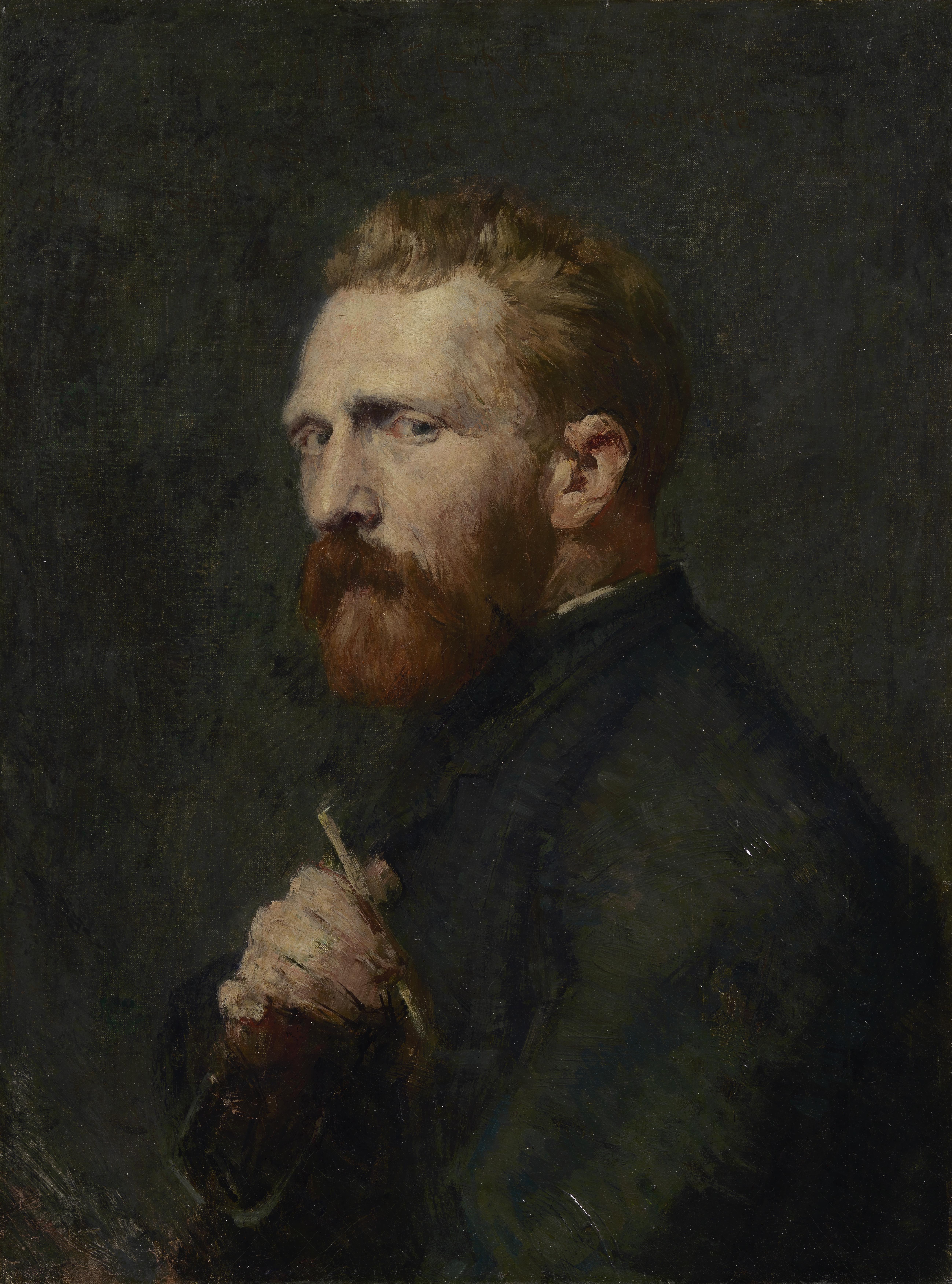
The major technical feat of this series lies in the bold use of chrome yellow, a modern pigment recently synthesized that offered painters of the era an unprecedented luminosity. Van Gogh pushed the experiment to its limits by constructing nearly monochromatic paintings where only variations in tone and saturation allow the forms to be distinguished from one another. He sometimes uses up to three different shades of yellow in the same area, layering thick coats to create effects of transparency and depth that defy the flatness of the two-dimensional surface. This chemical and optical mastery demonstrates his conviction that a single color, if orchestrated with enough nuances, can suffice to express the complexity of the visible world.
To prevent this abundance of yellow from becoming uniform or blinding, the artist introduces subtle touches of green, blue, and orange that serve as necessary counterpoints to the overall harmony. The black or dark blue outlines that frame certain petals recall the influence of cloisonnism and stained glass, structuring the apparent chaos of the vegetation into a rigorous composition. Every brushstroke is visible, directional, and charged with precise intention, transforming the canvas surface into an uneven terrain where light seems to spring from the matter itself. It is a masterclass in how chromatic constraint can generate infinite expressive richness.
Art & détails
Gauguin loves sunflowers, which doesn't stop the housemates from sensing a storm brewing

When Paul Gauguin finally arrived in Arles in October 1888, he was immediately captivated by the power of the Sunflowers, recognizing in them a work of absolute originality that surpassed everything being created at the time. In a letter to Émile Schuffenecker, he went so far as to describe these paintings as perfect, asserting that they essentially encapsulate Van Gogh's art in all its wild and generous splendor. To seal this mutual admiration, Gauguin even created a portrait of his host in the act of painting one of these bouquets, immortalizing Vincent focused before his easel, brush in hand. This gesture testifies to a deep respect and an intuitive understanding of his friend's genius, despite their radically different temperaments.
However, this initial aesthetic understanding will not be enough to ease the growing tensions between the two men, whose visions of art and life diverge more and more with each passing day. The close quarters in the Yellow House, coupled with alcohol and Vincent's feverish excitement, quickly transform the dream of the Studio of the South into a psychological nightmare. While the Sunflowers were meant to symbolize friendship and shared light, they would end up being the silent witnesses of the famous December 1888 crisis that would lead to the mutilation of Vincent's ear. Ironically, these flowers designed to unite would become the emblem of a tragic rupture, even though their artistic value survived the turmoil.
Art & détails
Dream triptych: Sunflowers with La Berceuse, or the art of decorating without buying a beige cushion

Beyond Gauguin's room, Vincent was nurturing an even larger decorative project involving the pairing of the Sunflowers with his portrait of Madame Roulin, nicknamed La Berceuse. He envisioned hanging these canvases on either side of the maternal portrait, thus creating a secular triptych in which the flowers would act as luminous candelabra framing a reassuring human figure. In his mind, sailors entering a drinking establishment or visiting the studio would find in this ensemble a form of visual comfort, a kind of colorful refuge against the harshness of existence. This idea reveals a deeply social and utilitarian conception of art, far removed from the elitism of Parisian salons.
Although this triptych was never physically realized in its ideal configuration during the artist's lifetime, the intention behind this project sheds light on how we should integrate these works into our interiors today. Vincent was not seeking to isolate the painting as a sacred relic, but to make it dialogue with the space and the people who inhabit it, in order to create a specific atmosphere. Choosing to hang Sunflowers in your home is therefore to embrace this desire to create a warm and stimulating environment, where painting plays an active role in the moral and visual comfort of everyday life. It is an invitation to think of decoration not as mere wall-filling, but as an emotional scenography.
Art & détails
Wilted petals, dark hearts, and thick paste: flowers have more muscle than a fancy bouquet

By carefully observing the details of these paintings, one realizes that Van Gogh never sought to idealize the conventional beauty of flowers in full bloom. He readily depicted heads weighed down by seeds, petals shriveled by drought, or stems bent under their own weight, thereby celebrating every stage of the life cycle. This brutal honesty lends the sunflowers a troubling humanity, as if each flower bore the weight of its own existence and its struggle against the passage of time. The viewer is confronted with a living, imperfect, and resilient nature—far removed from the sanitized floral arrangements of academic painting.
The impasto technique plays a central role here, with layers of paint applied so thickly that they cast real shadows on the canvas depending on the room's lighting. Van Gogh sometimes uses the paint tube directly to deposit the material, creating textured reliefs that mimic the roughness of seeds or the velvety softness of petals. This physicality of the paint compels the eye to move across the surface, to visually touch these irregularities that give the painting an almost tactile presence. It is this material density that prevents the image from becoming flat and that maintains, more than a century later, a striking freshness and vigor.
Art & détails
London, Amsterdam, Munich, Philadelphia, Tokyo: the bouquet has traveled far for a still life
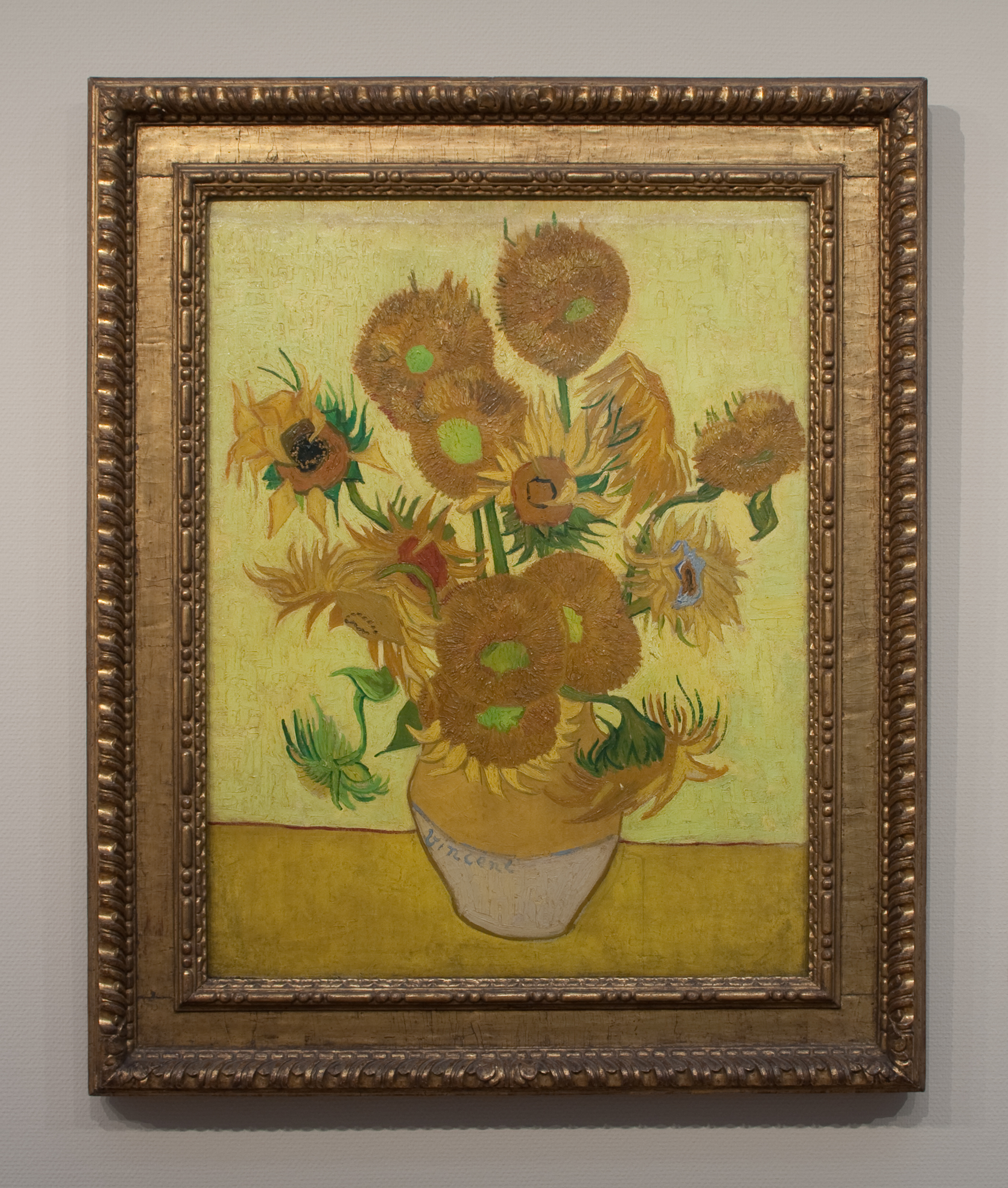
The posthumous fate of the Sunflowers series is one of worldwide acclaim, although its journey has been marked by tragedies and controversies linked to its conservation. The most famous version, housed at the National Gallery in London, survived a bombing during World War II and is today the object of near-religious veneration from visitors. Other major versions are spread across prestigious institutions such as the Van Gogh Museum in Amsterdam, the Neue Pinakothek in Munich, the Philadelphia Museum of Art, and the Sompo Museum in Tokyo. This geographical dispersion testifies to the immeasurable value accorded to these works, which have become universal icons recognized beyond cultural borders.
However, the fragility of the pigments used—particularly chrome yellow, which tends to darken over time when exposed to light—poses ongoing challenges for museum conservators. Extensive scientific studies and meticulous restorations have been required to preserve the original brilliance of these paintings and to understand the alterations they have undergone over the decades. Today, exhibition conditions are strictly controlled to limit light exposure, serving as a reminder that these explosions of sunlight on canvas remain delicate objects requiring careful protection. Seeing an original is therefore a rare and privileged experience, distinct from digital reproduction.
Décoration intérieure
Choosing Tournesols at home: inviting the sun in, without turning your living room into a Provençal oven

If you want to incorporate a reproduction of the Sunflowers into your interior, the first rule is to prioritize the quality of the print or painted copy to capture the richness of the original material. A cheap poster tends to flatten the nuances of yellow and erase the textures, reducing the work to a uniform, soulless, and shallow blob. Opt for high-definition canvas prints or hand-painted reproductions that capture the subtle tonal variations and the thickness of the brushstrokes characteristic of Van Gogh's style. The goal is to recapture that luminous vibration that gives the original its full power, even at a reduced scale.
Regarding placement, avoid rooms already saturated with warm colors or busy patterns that would visually compete with the painting's yellow dominance. A neutral wall—off-white or very light gray—will serve as the ideal backdrop, allowing the bouquet to shine without conflict, while good natural light or suitable directional lighting will bring out the gilding in the painting. Also consider the format: a large vertical version can structure a spacious living room, while a more intimate format will suit an office or entryway better. The idea isn't to recreate the Yellow House, but to invite a fraction of that solar energy to illuminate your daily life with elegance.
| Pièce | Suggestion | Effet décoratif |
|---|---|---|
| Salon | Une oeuvre liée à Tournesols de Van Gogh avec une composition forte | Point focal cultivé, chaleureux et facile à commenter sans réciter un cartel. |
| Chambre | Une palette douce ou une scène plus intime | Atmosphère calme, présence visuelle sans agitation inutile. |
| Bureau | Une image structurée, colorée ou graphiquement nette | Énergie créative et petit rappel que le mur peut aussi travailler. |
| Entrée | Un format vertical ou une oeuvre immédiatement lisible | Première impression claire, élégante, et nettement moins timide qu'un vide blanc. |
Pour continuer la visite
Sources, collections, and paths truly related to the topic
A few useful references to verify the information, compare free images, and keep reading without going off to a museum that never asked for it.
Related articles to read next
Artist and movement guides
Verified collections
Useful blog hubs
Useful resources on this topic
- Wikipedia FR - Les Tournesols
- Wikipedia - Sunflowers series
- Wikidata - Les Tournesols
- Wikimedia Commons - Sunflowers by Van Gogh
- National Gallery - Sunflowers
- Van Gogh Museum - Sunflowers
- Van Gogh Museum - Letters
- Wikipedia - The Painter of Sunflowers
- Wikipedia - The Yellow House
- Wikidata - Vincent van Gogh
FAQ
Frequently Asked Questions about Van Gogh's Sunflowers
What are Van Gogh's Sunflowers in painting?
Van Gogh's Sunflowers form a series of still lifes connected to Arles, to the Yellow House, to the arrival of Gauguin, and to a radical experimentation with yellow, where a vase of flowers becomes almost a manifesto of painting.
How to quickly recognize this style?
Notice especially the sunflowers, the vase, yellow on yellow, chrome yellow and impasto, then the way the composition guides the eye. If the work holds you longer than expected, it's probably no accident.
Which artists should you know?
The main references are Vincent van Gogh, Paul Gauguin, Theo van Gogh, Émile Bernard, and Paul Cézanne.
Does this style suit a modern décor?
Yes, as long as you choose the right format, a color palette that fits the room, and a piece you can enjoy living with day after day.
Should one choose the most famous work?
Not necessarily. The most well-known piece may be perfect, but the right choice mostly depends on the room, the format, the palette, and the atmosphere you're looking for.
Where to check the information?
Start with museum records, Wikipedia/Wikidata for general orientation, then turn to Wikimedia Commons when a royalty-free image is needed.
A sun that never truly sets
Van Gogh's Sunflowers remain far more than a popular subject in art history; they are a vibrant testament to an artist who managed to transform his suffering and hopes into lasting light. From Paris to Arles, from his friendship with Gauguin to his unfinished decorative projects, every brushstroke tells the story of a relentless quest for beauty and truth. Whether you admire them in the respectful silence of a museum or hanging on the wall of your living room, these flowers continue to fulfill their original mission: to bring warmth, comfort, and a vital intensity to those who take the time to look at them. They remind us that even in the darkest periods, it is possible to paint our own sun.
0 comments