

Correspondence · workshop · method
Vincent's letters to Théo: what they really reveal about his work
Behind the myth of the swept away painter, the letters show an artist who calculates his formats, orders his colors, prepares his series, compares his results and explains each decision to his brother.
This guide returns to manuscripts and scientific publishing to read correspondence like a workshop notebook remotely - without transforming every sentence into a confession or every painting into a symptom.
to Theo
1872 - 1890

Short answer
These are not just confidences: this is Van Gogh's written workshop
The correspondence documents the choices that are not seen on the web: essays, materials, costs, readings, exhibition ambition, discouragement and repetitions.
Reading Vincent van Gogh's letters to his brother Théo changes the way he looks at his paintings. There we encounter less a passive genius in the face of uncontrollable inspiration than an extremely conscious worker. He observes the effects of a neighboring color, compares tubes, plans a canvas before painting it, starts a pattern again, examines what has failed and imagines the future place of the works in a series.
The relationship with Théo gives this archive its density. An art dealer in Paris, Théo is the family contact who best understands Vincent's ambitions. He sends the money that pays the rent, models, canvases and colors; he receives packages of paintings, keeps the works and informs his brother about the artists and exhibitions. Correspondence therefore simultaneously becomes emotional dialogue, workshop account, aesthetic laboratory and discussion on career.
However, it does not deliver a raw truth. Most of Théo's answers have disappeared, the exchanges are unevenly preserved and Vincent often writes to explain an expense or defend a decision. The best reading always crosses the letter, its date, the table mentioned and the historical annotations.

Two brothers, a work system
Théo receives much more than news
Vincent sends him lists of supplies, sketches, titles, dimensions, hanging projects and evaluations of his own paintings. He also asks him to look at the works of contemporaries and talk about them.
The dialogue organizes remote production: the money leaves Paris; the paintings and letters return from Arles, Saint-Rémy or Auvers. Between the two circulate prints, books, portraits, reviews and hopes of sale.
Correspondence is where painting becomes explainable before becoming famous.
Count correctly
820, 651 or 902 letters: why do we find several numbers?
The numbers do not designate the same corpus. Distinguishing them allows us not to artificially inflate the correspondence written by Vincent.
Letters written by Vincent
This is the total of Vincent's letters preserved and listed by the scientific edition.
To Théo alone
The vast majority of the corpus. Added to this are seven letters addressed jointly to Théo and Jo.
Letters received
The edition also includes preserved letters received by Vincent, including thirty-nine from Théo and two from Théo and Jo.
Online edition
The site brings together 902 letters written and received, plus 25 related manuscripts: drafts, notes and documents.
The number 902 is sometimes presented as the number of letters "from Van Gogh". This is incorrect: it designates the editorial set of letters sent and received. To talk about Vincent's epistolary activity, the precise number is 820; to talk about letters to Théo, 651.
This asymmetry has a historical consequence. We know Vincent's argument extensively, but much less the questions, objections and advice he answers. A sentence that seems spontaneous can actually prolong a vanished exchange. We must therefore resist the illusion of a continuous diary.
Eight revelations
What the letters change in our view of his work
Each theme is verified in dated letters and in concrete works - from the peasant studies of Nuenen to the series of Auvers.

A large picture arises from dozens of studies
In Nuenen, Vincent doesn't jump straight to the final scene. During the winter he works on the heads, hands, figures, lamp and interior. Letter 497 defends this patient construction and compares broken colors to wires that vibrate together.
Potato Eaters so is neither an improvisation nor a simple scene seen. It is an ambitious composition which aims to condense peasant work into a memorable image.
Read letter 497 ↗
Color expresses, it does not copy
In letter 676, the red and green of coffee must make "terrible human passions" smell. The color may deviate from the local hue to produce a psychological sensation.
Letter 676 ↗
The painting is thought out before the first public glance
The letter 705 describes the room color by color, explains the absence of shadows and attaches a sketch. "Color must do the thing here": the desired calm depends on deliberately simplified flat areas.
Letter 705 ↗
Millet becomes an invention in color
Van Gogh does not hide his models. He studied Millet, Delacroix and Japanese prints. In Saint-Rémy, he described his covers of Millet as translations into another language: that of color.
Letter 839 ↗
The works are designed to live together
Orchards, harvests, sunflowers, portraits of the Roulin family: Vincent thinks in campaigns, rehearsals and decorative ensembles. The pattern varies, but the unity of format and color builds a sequence.
Explore Sunflowers →
Painting on site does not prohibit preparation or invention
For Starry Night on the Rhône, the letter situates the nocturnal work and details the blues, yellows and reflections. But other letters also show compositions planned, remembered or recomposed in the workshop.
The opposition between "nature" and "imagination" is therefore not enough. Van Gogh can observe in front of the pattern, simplify, shift the accent and pursue a pre-designed color agreement.
Read letter 691 ↗
The material decides the rhythm
The letters give tube orders, canvas prices, rent and expenses. In April 1888, Vincent requested supplies in quantity and admitted to devoting more to canvas and colors than to himself.
Letter 593 ↗
He judges, classifies and starts again
Vincent distinguishes between studies, completed paintings, repetitions and essays. Even very productive, he knows that a painting can miss its target. His enthusiastic formulas alternate with harsh evaluations and recovery projects.
Letter 805 ↗A repeated method
Five gestures come from one city to another
The style changes radically between The Hague, Nuenen, Paris, Arles, Saint-Rémy and Auvers; work discipline retains a structure.
Look
Observe the figure, landscape, light or reproduction of a work and identify the specific problem to be solved.
To study
Draw, try a head, hand, perspective or color scheme before ambitious composition.
Paint
Work quickly when the pattern requires it, but within a framework prepared by the format, the available tubes and the guiding idea.
Compare
Put the paintings side by side, think in series and explain to Théo what differentiates one version from another.
Resume
Repeat a painting, translate a master, change scale or reinvent from memory what has not yet found its form.
The letters in front of the paintings
Four case studies: from the sketch sent to the color program
Letters do not replace the gaze. However, they indicate what Van Gogh wanted to experience, modify or make understood.
Nuenen · letter 497
The Eaters: constructing a work of figures
Vincent wants to show that the same hands that take food have worked the land. To make this idea credible, he studied peasant models for months. The light of the lamp, the arrangement of the bodies and the earthy palette unify the group.
The letter also illuminates his conception of dark color: it is not the absence of color. Broken tones should reinforce each other, like threads of different shades in a fabric.
Arles · letter 676
Night Coffee: distorting the color to create an atmosphere
Van Gogh works three nights and sleeps during the day. He does not seek to calmly reproduce the color of the walls or the billiards table. The contrast of red and green, the yellow of the gas and the plunging perspective must give the place a moral intensity.
The letter is decisive because it formulates a principle: fidelity to sensation can require infidelity to local color. This brings the canvas closer to an expressive painting, without removing the observation of real coffee.
Arles · letter 705
The Room: an image explained color by color
Vincent draws the piece in his letter and associates each element with a shade: walls, floor, bed, sheet, blanket, doors, portraits. The enumeration is not a neutral inventory. It shows that the objects were coordinated to produce an impression of rest.
He specifies that the shadows are removed and the shapes remain flat, like Japanese prints. The visibly inflected perspective is therefore not a clumsiness to be corrected; it contributes to expressive simplicity.
Auvers · letter 898
The fields: painting solitude without writing a confession
In July 1890, Vincent announced three large field paintings under turbulent skies and spoke of extreme solitude. The passage helps to situate his search for space, horizon and atmospheric tension. However, it does not allow each painting to be mechanically identified as a farewell.
The same letter also mentions the Daubigny garden and a sustained pace of work. Sadness coexists with an active pictorial program. This is precisely why the letter should be read in full, not reduced to a dramatic sentence.
The visible document
Sketches in letters: showing Theo what words are not enough to describe
Epistolary drawings are not always preparatory studies in the strict sense. They are often retrospective diagrams, precise enough to convey composition, format and organization.
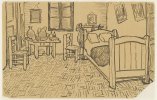
A drawing in a letter is not a neutral reproduction. Vincent selects the necessary lines, accentuates a rhythm and simplifies the masses. The sketch has its own economy: complete enough for an absent correspondent to understand the image, but fast enough to remain linked to the flow of writing.
These sheets also show how visual the exchange with Théo is. The Parisian brother must not only take Vincent's word for it; he must be able to imagine the work, recognize it in the package and grasp the overall project. The letter thus becomes a small transportable exhibition.
Ten key letters
A chronology of work, from The Hague to Auvers
This selection is not a "best of" famous phrases. It follows workshop problems: learning, preparing, buying, composing, translating and evaluating.
| Letter | Date and place | What she reveals | Work or problem |
|---|---|---|---|
| 252 | July 31, 1882 · The Hague | Structured reflection on primary colors, mixtures, grays and the need for drawing. | Technical foundations: perspective, anatomy, color. |
| 497 | April 30, 1885 · Nuenen | Defense of preparation by head and hand studies; broken tones compared to a fabric. | Potato Eaters. |
| 593 | April 5, 1888 · Arles | Detailed ordering of colors and material dependence on Theo. | Orchards in bloom and spring countryside. |
| 597 | April 13, 1888 · Arles | Quality of tubes, prices, repetitions and grouping of canvases. | Orchards as a whole. |
| 628 | June 19, 1888 · Arles | Purple-yellow accord of the Sower, non-servile color and project of starry sky. | The Sower and the nights to come. |
| 676 | September 8, 1888 · Arles | Three nights of work; expressive use of red and green. | The Night Café. |
| 691 | September 29, 1888 · Arles | Night painting, gas light and blue-yellow ratio inventory. | Starry Night on the Rhône. |
| 705 | October 16, 1888 · Arles | Sketch, chromatic program, solid colors and desire for rest. | The Room in Arles. |
| 839 | January 1890 · Saint-Rémy | Millet's copies are thought of as personal color translations. | Series after Millet. |
| 898 | Around July 10, 1890 · Auvers | Large fields under troubled skies, solitude and simultaneous production of the Daubigny garden. | Latest Auvers campaigns. |
Read without creating a new myth
Four misinterpretations that letters allow you to correct
An exceptional archive can illuminate painting; poorly read, it can also reduce it to a spectacular biography.
"He only painted under the influence of madness"
The crises profoundly affected his life and interrupted his work. They alone do not explain years of learning, material orders, studies, coordinated formats, artistic references and corrections visible in letters.
"Each sentence directly describes a table"
A letter may speak of a project, a completed painting, a repetition or a memory. Some identifications remain discussed. You must follow the editorial notes and not hang an attractive quote on the first similar image.
"Correspondence is a complete private newspaper"
Letters are addressed to someone, respond to circumstances and sometimes pursue a goal: to reassure, ask for money, justify an expense or defend an orientation. Theo's loss of many answers makes the dialogue incomplete.
"The last letter explains Van Gogh’s death"
Letter 902 sent to Théo on July 23, 1890 and the unfinished draft found on Vincent are major documents. None transforms the latest works into a unambiguous message. The fields of Auvers do not form a perfectly ordered autobiographical sequence.
Reading method
How to consult the letters without losing sight of the table?
Online publishing allows you to work almost like an art historian: manuscript, original text, translation, notes and related works come together.
Start from the number
A letter has a stable number. This is more precise than an isolated quote or an approximate date repeated on the networks.
Read the original
Vincent writes mainly in Dutch and French. The translation helps, but the original text allows you to verify a decisive word.
Open notes
Annotations identify people, books, pigments, places, works cited, lost documents and uncertainties.
Compare images
Looking at the facsimile, sketch and table together shows what Vincent selects, modifies or omits.

A good reflex
Read a passage before and after the famous phrase
The immediate context often contains the essential data: a delivery of paint, the fatigue of a session, a comparison with another artist, the format of a canvas or the following painting.
This continuous reading avoids transforming Vincent into a distributor of maxims. It reveals a thought that advances through repetitions, associations and contradictions - much closer to the reality of a workshop.
The best quote is the one that remains attached to its date, its recipient and the work it illuminates.
Correspondence in images
Eight works to reread in the light of letters
Each reproduction refers to a specific problem described by Vincent: preparation, expressive color, series, translation or night work.
Potato Eaters
The strongest proof that Van Gogh prepares his figures at length and constructs his dark palette.
See the work →Starry Night on the Rhône
Blues, gas yellows and reflections are detailed to Théo almost at the time of execution.
See the work →The Room in Arles
A composition drawn in letter 705 and explained tint by tint.
See the work →The Night Café
Red and green reflect a psychological intensity more than a descriptive fidelity.
See the work →The Sower
An ancient motif redesigned by the purple-yellow contrast and the solar disk.
See the work →Fifteen Sunflowers
The yellows are linked to Gauguin's reception project and the decorative ensemble of the Yellow House.
See the work →Wheat field with crows
A large painting late to look at without reducing it to the myth of the last painting.
See the work →The Daubigny Garden
A motif admired, declined and mentioned in the latest exchanges since Auvers.
See the work →Important collections
Explore Van Gogh by period and pattern
Letters circulate between places. These collections make it possible to follow the transformation of the style in the same order.
Frequently asked questions
FAQ about Vincent's letters to Théo
How many letters did Vincent van Gogh write to Theo?
651 preserved letters are addressed directly to Théo. Seven others are addressed jointly to Théo and his wife Jo. In total, 820 letters written by Vincent are preserved.
Why do we sometimes see the number 902 letters?
The online scientific edition brings together 902 letters written and received. This number therefore includes letters sent to Vincent. It should not be confused with the 820 letters written by the artist.
In what language did Van Gogh write to Theo?
Correspondence is mainly in Dutch and French. The choice of language varies depending on the periods, locations and recipients. Online editing allows you to read the original text and a translation.
Do the letters prove that Van Gogh painted spontaneously?
They show moments of rapid work, but also methodical preparation: studies, ordering materials, choice of formats, sketches, series, repetitions and evaluations after the fact.
Did Théo even finance Vincent?
No. His financial support is essential, but Théo is also an art dealer, critical interlocutor, recipient of the paintings and link with Parisian artistic life. The emotional and professional relationship is inseparable.
Were the sketches of the letters made before the paintings?
Not always. Some set a project, others explain a painting in progress or completed. They are mainly used to transmit the visual organization of a work to a correspondent who cannot see it.
Do letters help diagnose Van Gogh's disease?
They document symptoms, seizures, care and the words used at the time. They are not sufficient to establish with certainty a single retrospective diagnosis, and they should not reduce the entire work to the disease.
What is the last letter to Theo?
The last letter sent is letter 902, dated July 23, 1890 in Auvers-sur-Oise. An unfinished and unsent draft was found on Vincent on July 27; the edition classifies it as RM25.
Where to read Van Gogh's letters for free?
The site Vincent van Gogh - The Letters, produced by the Van Gogh Museum and the Huygens Institute, provides access to facsimiles, transcriptions, translations, annotations and associated works.
Verified sources
A scientific edition rather than a collection of quotes
The references below allow you to check the figures, find the manuscripts and place each passage in its context.
Van Gogh - The Letters
Facsimiles, original texts, translations, annotations, sketches and works cited.
CorpusThe exact figures
Distribution of the 820 letters written by Vincent and the letters received preserved.
Scientific essayVan Gogh letter writer
Artistic development, drawing, color, literature, modern art and projects.
Instructions for usePublishing Guide
Site operation, numbering, search, images and document status.
Letter 705The Room in Arles
Sketch and detailed chromatic program, sent from Arles in October 1888.
Letter 676The Night Café
Night work and formulation of the expressive red-green color.
Letter 839Translate Millet
Explanation of covers after Millet as personal color translations.
Van Gogh MuseumLife and work
Biographical and artistic landmarks of the institution which preserves the largest Van Gogh collection.
The letters take nothing away from the mystery of the paintings. They replace the easy miracle with real work.
We see Vincent learning, spending, doubting, starting again, reading the masters, looking at his contemporaries and inventing color relationships that belong only to him. Theo is the recipient of this moving thought - and the reason why we can still follow it.
Explore the Vincent van Gogh collection
0 comments