

Van Gogh's The Potato Eaters • Art & Decoration Guide
Van Gogh's The Potato Eaters: The Guide That Looks Under the Varnish
Dive into the heart of the dark Nuenen work, between peasant truth and chromatic revolution, to understand how to choose your reproduction wisely.
Before the sunflowers exploded in chrome yellow and the cypresses swirled under the Arles sun, Vincent van Gogh spent months observing mud, soot, and human fatigue. Painted in April 1885 in Nuenen, in the Dutch Brabant, The Potato Eaters marks the culmination of his dark period, a time when the artist sought to capture the rustic soul without the slightest cosmetic idealization. This painting is not a simple genre scene, but a social manifesto where five peasants with gnarled hands share their meager meal under the flickering light of an oil lamp. Understanding this work means accepting to face reality, far from the Parisian glitter that would later transform his palette.
 Free image
Dive into the heart of the dark Nuenen work, between peasant truth and chromatic revolution, to understand how to choose your reproduction wisely.
Reading method
How to Read This Work Like an Art Historian
To fully appreciate this canvas, you must forget the codes of classical beauty and focus on the density of the material and the psychology of the faces. The approach consists of analyzing how artificial light sculpts the features and how the composition encloses the characters in their common destiny, creating an almost suffocating but deeply human intimacy.
Context before prestige
We place Van Gogh's The Potato Eaters in its era, its studios, its exhibitions, and its small revolts. A work without context is sometimes just a very beautiful person who forgot their history.
The signs that betray the style
We identify composition, palette, material. These clues often say more than grand speeches, especially when they carry gold or nervous brushstrokes.
The work in a real room
We end with the useful question: does this image breathe in your home, or does it just pose like a poster that has read two books?
Historical context
Where does Van Gogh's The Potato Eaters come from, and why is it not just a pretty label?
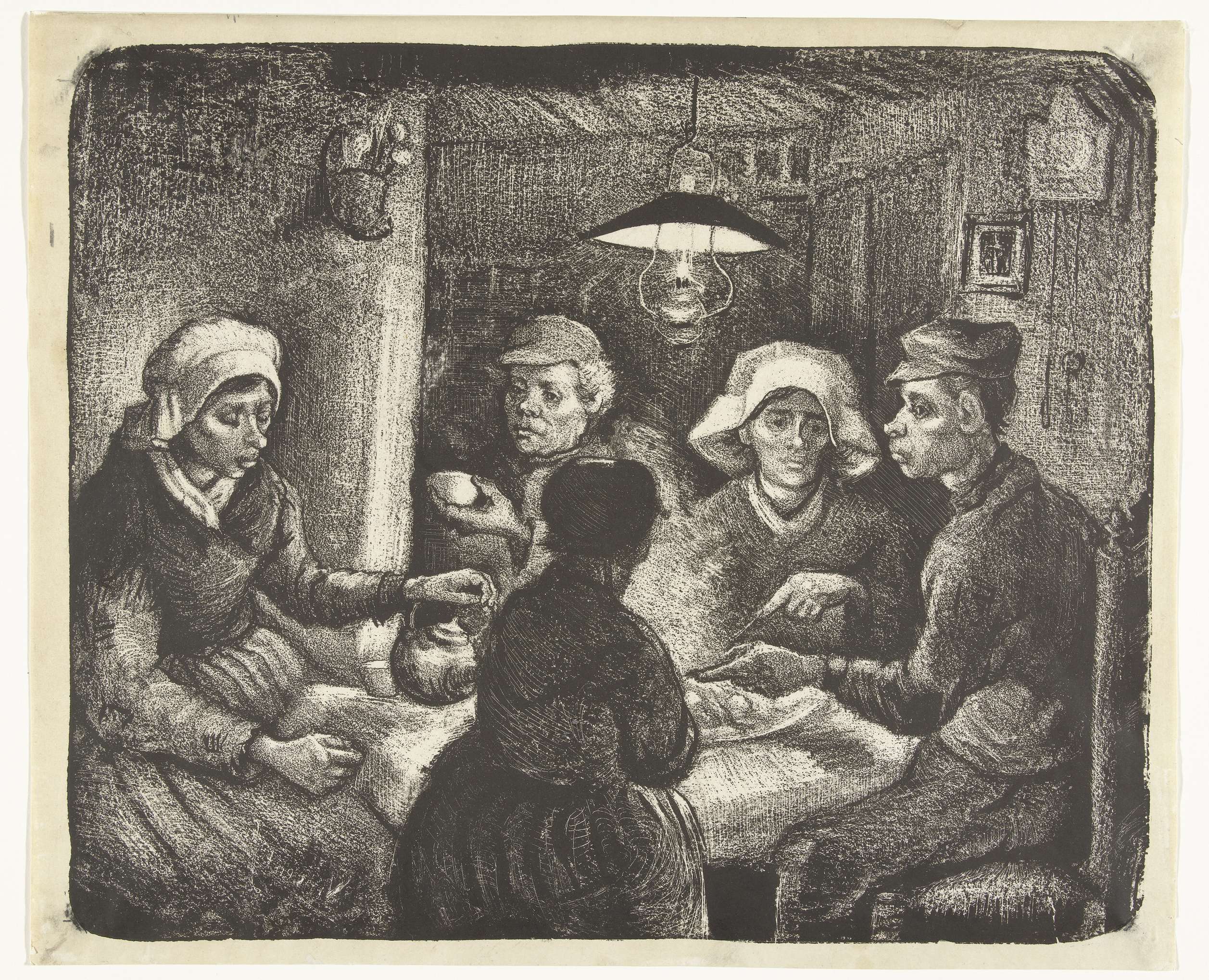
The story of this masterpiece begins in the Nuenen parsonage, where Vincent settled with his parents between 1883 and 1885, obsessed with the lives of local weavers and farmers. He was not seeking tourist picturesque, but wanted to show the dignity of those who had worked the land with their own hands to earn their food. For months, he made dozens of preparatory studies, drawing the heads of peasants wrinkled by wind and worry, accumulating an intimate knowledge of his models, notably the De Groot family who would pose for the final scene. This total immersion in the rural Brabant world is fundamental to understanding the gravity of the final result.
Van Gogh wrote to his brother Theo that his ambition was to make people feel that these people, who eat their potatoes by the light of their lamp, have themselves plowed the earth with those same hands they reach toward the plate. He deliberately rejected the academic conventions of the time that required sharp outlines and idealized colors, preferring a raw, almost crude execution in the eyes of his contemporaries. The painting thus becomes a silent political act, affirming that beauty lies in the truth of labor and not in the smoothing of imperfections. It is a violent break with the bourgeois art that decorated the Amsterdam salons of the time.
Artistic style
Why does Van Gogh's The Potato Eaters still fascinate?
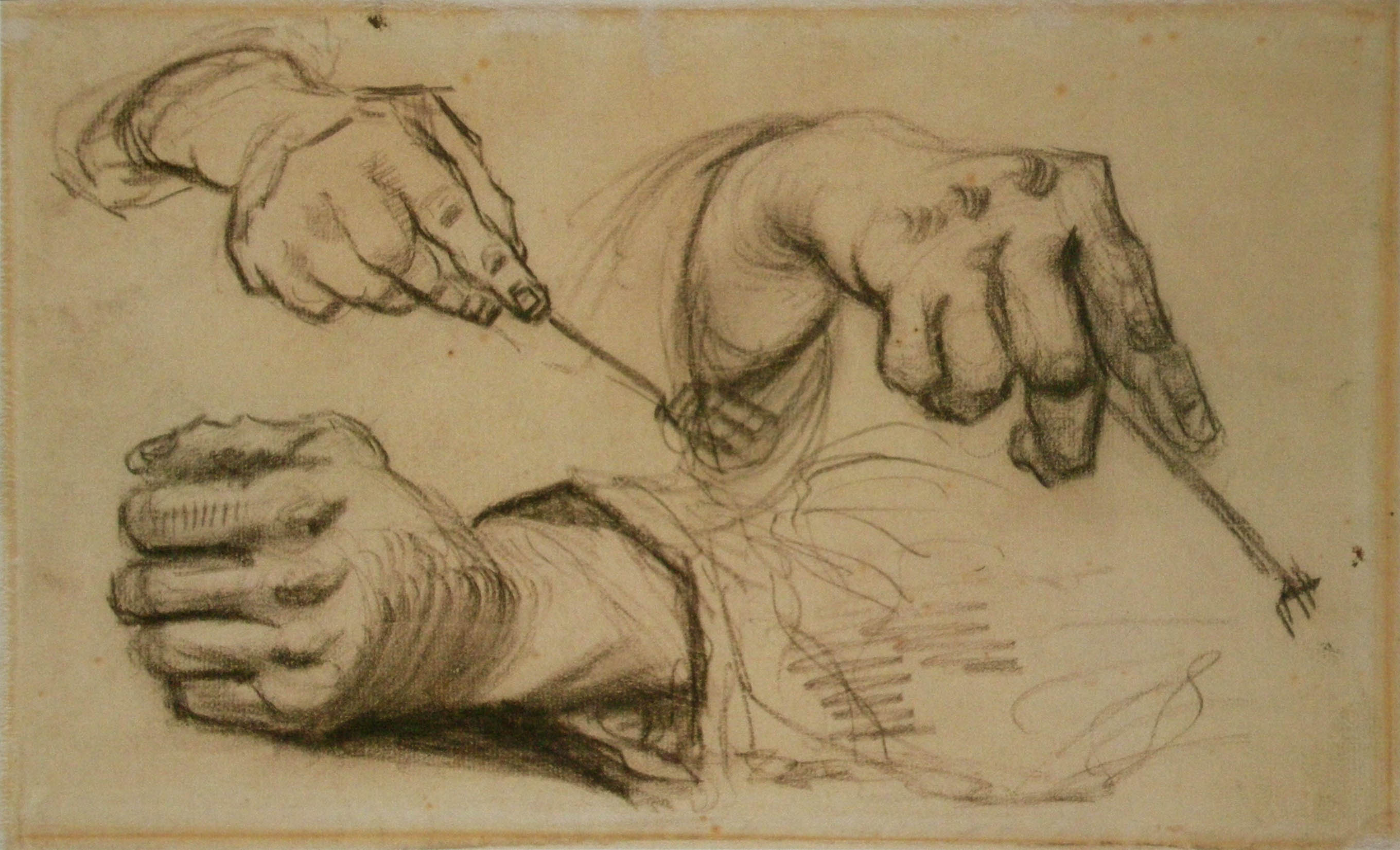
The persistence of fascination with this work lies in its unique ability to convey a universal emotion of solidarity and shared fatigue, transcending centuries and cultural boundaries. Unlike the luxurious banquet scenes of the Renaissance where abundance overflowed, here the frugality of the meal creates a dramatic tension that captivates the modern viewer as much as the 19th-century one. The simplicity of the subject – five people around a rough wooden table – allows immediate identification, while Van Gogh's technical mastery elevates this everyday banality to the rank of sacred ritual. We see our own humanity reflected in these faces marked by effort.
Moreover, this painting represents a crucial pivot in Van Gogh's artistic biography, serving as a necessary bridge between his hesitant beginnings and the colorist explosion that would follow his arrival in Paris. Without this phase of rigorous learning of low light and earthy tones, the vibrant yellows and blues of his Arles period might never have had such contrasting power. Critics of the time, like Albert Aurier, took time to grasp the brilliant audacity of this dark palette, sometimes judging it too crude, but history has since restored its central place. It remains a poignant testimony to a bygone era where survival depended directly on the connection with the soil.
Art & details
The visual signs that betray the style

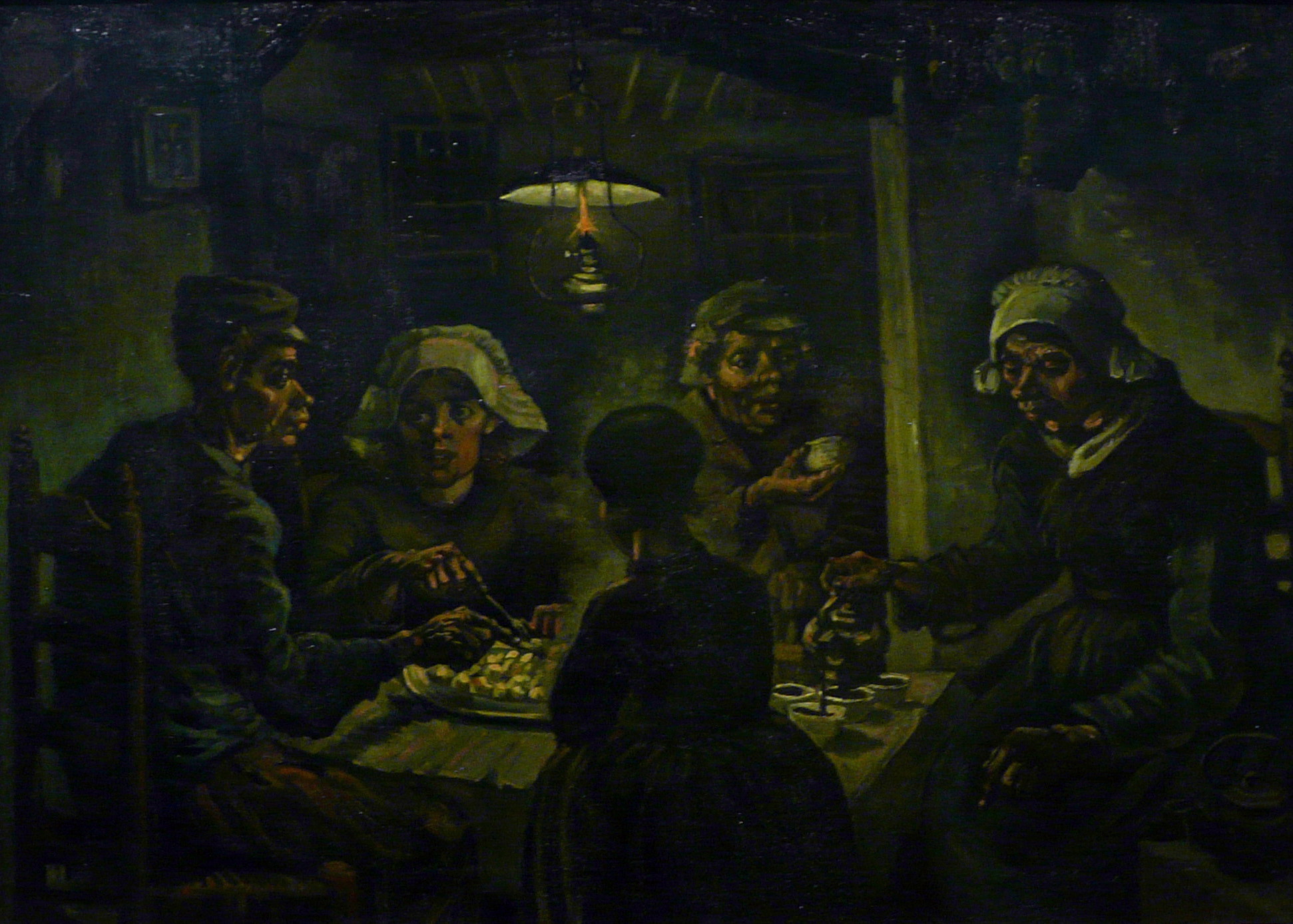
The first thing that strikes the eye is the masterful use of a single light source, a lamp suspended above the table, which casts hard, modeling shadows on the faces of the diners. This theatrical lighting, reminiscent of Rembrandt's chiaroscuro, isolates each character in their own bubble of fatigue while uniting them in a circle of precarious warmth. The dominant colors are verdigris, raw sienna browns, and muted ochres, applied with a thick paste that gives the canvas an almost tactile texture, as if the mud of the fields had been mixed into the paint. Nothing here is smooth or airy; everything breathes the heaviness of material and destiny.
The composition itself is an exercise in dynamic balance where the arms and hands of the peasants form lines of force that all converge toward the central dish of steaming potatoes. Van Gogh deliberately distorted the anatomies, lengthening the fingers and accentuating the prominent cheekbones to reinforce the expression of rural roughness, refusing any conventional aesthetic correction. The low ceiling, suggested by the dark beams at the top of the frame, accentuates the feeling of confinement and claustrophobic intimacy of the cottage. Every visible brushstroke contributes to this atmosphere of contained vibration, already announcing the tormented style that would characterize his later works.
Art & details
Works to look at as if they were about to answer

To fully grasp the scope of The Potato Eaters, it is essential to compare it with Jean-François Millet's The Gleaners, painted nearly thirty years earlier, which shares the same will to dignify agricultural work. Van Gogh deeply admired Millet, whom he considered a spiritual father, and he took up the theme of the peasant meal while pushing expressiveness much further than the calm realism of his predecessor. Where Millet observes with a certain poetic distance, Van Gogh plunges the viewer into the heart of the table, forcing us to become the sixth diner in this austere scene. This artistic filiation shows how Van Gogh inscribes himself in a tradition while radically overturning it.
One must also examine the numerous studies of peasant heads made by Van Gogh during the winter of 1884-1885, now preserved in various museums such as the Van Gogh Museum in Amsterdam or the Neue Pinakothek in Munich. These individual portraits, often painted on small wooden panels, reveal the patience with which the artist studied every wrinkle, every gaze dimmed by weariness before assembling them in the final composition. By comparing these isolated studies with the finished painting, we understand how he synthesized strong individualities into a coherent group, creating a visual chorus of noble misery. These pieces are the essential building blocks that allowed the construction of the great work.
Art & details
Symbols, details, and little visual quirks

At the center of the table, the potatoes are not simply food, but symbolize the direct fruit of the work of the land, a tangible link between the ungrateful soil and the subsistence of men. Van Gogh insists on their rustic, imperfect, earthy appearance, refusing to wash or embellish them, because they represent the raw truth of the peasant condition he wishes to honor. The steam rising from them, suggested by lighter paint touches, brings the only note of living warmth in this cold interior, highlighting the contrast between the harshness of life and the minimal comfort of the shared meal. It is a symbol of survival more than gastronomic pleasure.
A detail often overlooked is the presence of a small child sitting on the right, asleep or absorbed, which reminds us of the continuity of the cycle of life and work in these rural families where everyone, from a very young age, participates in the common effort. The disproportionately large and gnarled hands of the adults tell of years of handling agricultural tools and struggling against the elements, becoming the true silent protagonists of the scene. Even the pewter coffee pot, tarnished by use, testifies to a long domestic history and an absolute economy of means. Every object present was chosen for its narrative charge and its ability to evoke a specific way of life.
Art & details
Neighbors, allies, and turbulent cousins

Although Van Gogh is often perceived as a solitary genius, this Nuenen period places him in constant dialogue with the Dutch realists of the 17th century and the French naturalists of his time. One can trace a direct line between the social consciousness of this painting and the works of Honoré Daumier or Gustave Courbet, who also chose to paint the people without makeup or mythological heroism. However, Van Gogh adds an intense spiritual and emotional dimension that goes beyond the simple sociological observation of his artistic neighbors, transforming the scene into a kind of secular and modern Last Supper. He shares the subject with them but imposes his own feverish and empathetic vision.
It is also interesting to note that this work shortly precedes the discovery of Impressionism in Paris, thus marking the end of a personal era before the influences of Pissarro or Seurat came to lighten his palette. In Nuenen, Van Gogh is still anchored in the northern tradition, with its low skies and dark interiors, far from the outdoor light games that would define his maturity. Yet, one can already detect in the vibrant touch and the energy of the brush the beginnings of the stylistic revolution to come. This painting is therefore the last great cry of his Dutch period before the colorful metamorphosis that awaited him under the southern sun.
Art & details
What museums confirm when shortcuts go too fast

The original painting is now preserved at the Van Gogh Museum in Amsterdam, where it occupies a central place, allowing visitors to appreciate the fineness of the cracks and the richness of the dark nuances that digital reproductions often struggle to faithfully render. Scientific analyses conducted by conservators have revealed that Van Gogh used specific pigments such as Scheele's green and various natural earths, some of which have slightly changed chemically over time, subtly altering the balance of the original tones. Seeing the work in person allows one to understand the real scale of the composition and the physical impact of the pictorial material accumulated layer after layer. It is a sensory experience that the screen cannot replace.
Other major institutions such as the Musée d'Orsay in Paris or the Metropolitan Museum of Art in New York possess preparatory studies or lithographic versions that shed light on the complex creative process behind this masterpiece. These collections remind us that Van Gogh worked on this image with an almost religious obsession, redoing the composition several times until he achieved the perfect harmony between the figures and the surrounding space. Archival documents, notably the correspondence with Theo, preserved in these museums, confirm that the artist considered this canvas his best work of the time, despite the virulent criticism it provoked. These historical testimonies anchor the work in a precise documentary reality.
Art & details
How to choose a reproduction without making the wall panic?
Integrating a reproduction of The Potato Eaters into a modern interior requires careful consideration of lighting, because the work loses all its substance if it is drowned in too white or too diffuse light. Prefer warm directional lighting, such as an adjustable spot with a color temperature around 2700K, to recreate the atmosphere of the original oil lamp and bring out the reliefs of the painting. Absolutely avoid placing this painting in a room that is already very dark or with walls painted in cold gray tones, as this would risk weighing down the general atmosphere in a depressive rather than warm way. The goal is to create an intimate focal point, not a visual black hole.
Regarding format and framing, opt for a fairly massive frame, perhaps in dark wood or antique gold, that can dialogue with the rusticity of the subject without conflicting with a clean contemporary decor. A large size is preferable to allow the viewer to get lost in the details of the faces and hands, because reduced to a small size, these figures risk becoming illegible and losing their powerful emotional impact. Place the work in a living room, library, or office where one takes the time to sit and reflect, avoiding high-traffic areas like the entrance or a too bright modern kitchen. It demands time and silence to be truly understood.
Interior decoration
Mistakes to avoid before hanging the painting

The most common mistake is to choose a reproduction printed on a glossy or plasticized support, which will create parasitic reflections that immediately destroy the illusion of depth and the softness of the shadow transitions dear to Van Gogh. Always prefer a print on textured canvas or on high-quality matte paper, possibly a hand-painted reproduction if your budget allows, to respect the organic nature of the original. The matte finish is essential to preserve the powdery and earthy aspect of the palette, while a glossy finish would transform this serious scene into a kitsch and soulless advertising image. The quality of the support is as important as the image itself.
One must also avoid associating this work with overly playful or colorful decorative elements that would be in total dissonance with its historical and social gravity. Hanging this painting above a sofa with multicolored cushions or next to pop art posters would create an unpleasant aesthetic shock that would trivialize the artist's powerful message. Respect the integrity of the work by giving it breathing space on the wall and surrounding it with sober, natural, or antique objects that echo its rural universe. A bad staging can transform a masterpiece into a simple bad taste accessory, which would be an affront to Van Gogh's memory.
| Room | Suggestion | Decorative effect |
|---|---|---|
| Living room | A work related to Van Gogh's The Potato Eaters with a strong composition | Cultured, warm focal point, easy to comment on without reciting a label. |
| Bedroom | A soft palette or a more intimate scene | Calm atmosphere, visual presence without unnecessary agitation. |
| Office | A structured, colorful, or graphically sharp image | Creative energy and a little reminder that the wall can also work. |
| Entrance | A vertical format or an immediately readable work | Clear, elegant first impression, and decidedly less shy than a white void. |
To continue the visit
Sources, collections, and paths truly related to the subject
Some useful references to verify information, compare free images, and extend the reading without going to a museum that didn't ask for anything.
Related articles to read next
Verified collections
Useful blog hubs
FAQ
Frequently asked questions about Van Gogh's The Potato Eaters
What is Van Gogh's The Potato Eaters in painting?
Van Gogh's The Potato Eaters deserves an in-depth article because this style engages both an era, a way of painting, and a very concrete way of living with images.
How to quickly recognize this style?
Observe especially composition, palette, material, light, and atmosphere, then the way the composition organizes the gaze. If the work holds your attention longer than expected, it is probably not an accident.
Which artists should you know?
You need to cross-reference the central artists of the movement with museums and reliable sources to avoid too hasty attributions.
Is this style suitable for modern decoration?
Yes, provided you choose the right format, a palette consistent with the room, and a work whose presence remains pleasant on a daily basis.
Should you choose the most famous work?
Not necessarily. The most famous work can be perfect, but the right choice depends above all on the room, the format, the palette, and the desired atmosphere.
Where to verify the information?
Start with museum notices, Wikipedia/Wikidata for general orientation, then Wikimedia Commons when a free image is needed.
A lesson in humanity hanging on the wall
The Potato Eaters remains much more than a technical step in Van Gogh's career; it is a declaration of love to the human condition in its most humble and most resilient form. Choosing to welcome this image into your home means accepting to live daily with a reminder of the value of work, family solidarity, and the hidden beauty in the simplicity of things. Whether in the form of a careful reproduction or a visit to the Amsterdam museum, this work continues to challenge us, asking us to slow down, look at our own hands, and recognize the silent dignity that inhabits our ordinary lives. It remains, more than a century later, a dark but essential beacon in the history of art.
0 comments