

Monet's Haystacks: the guide that looks beneath the varnish
Monet's Haystacks told through the questions readers really ask: life, works, details, context, sources, and decor choices, with a cultured tone that never feels trapped in a display case.
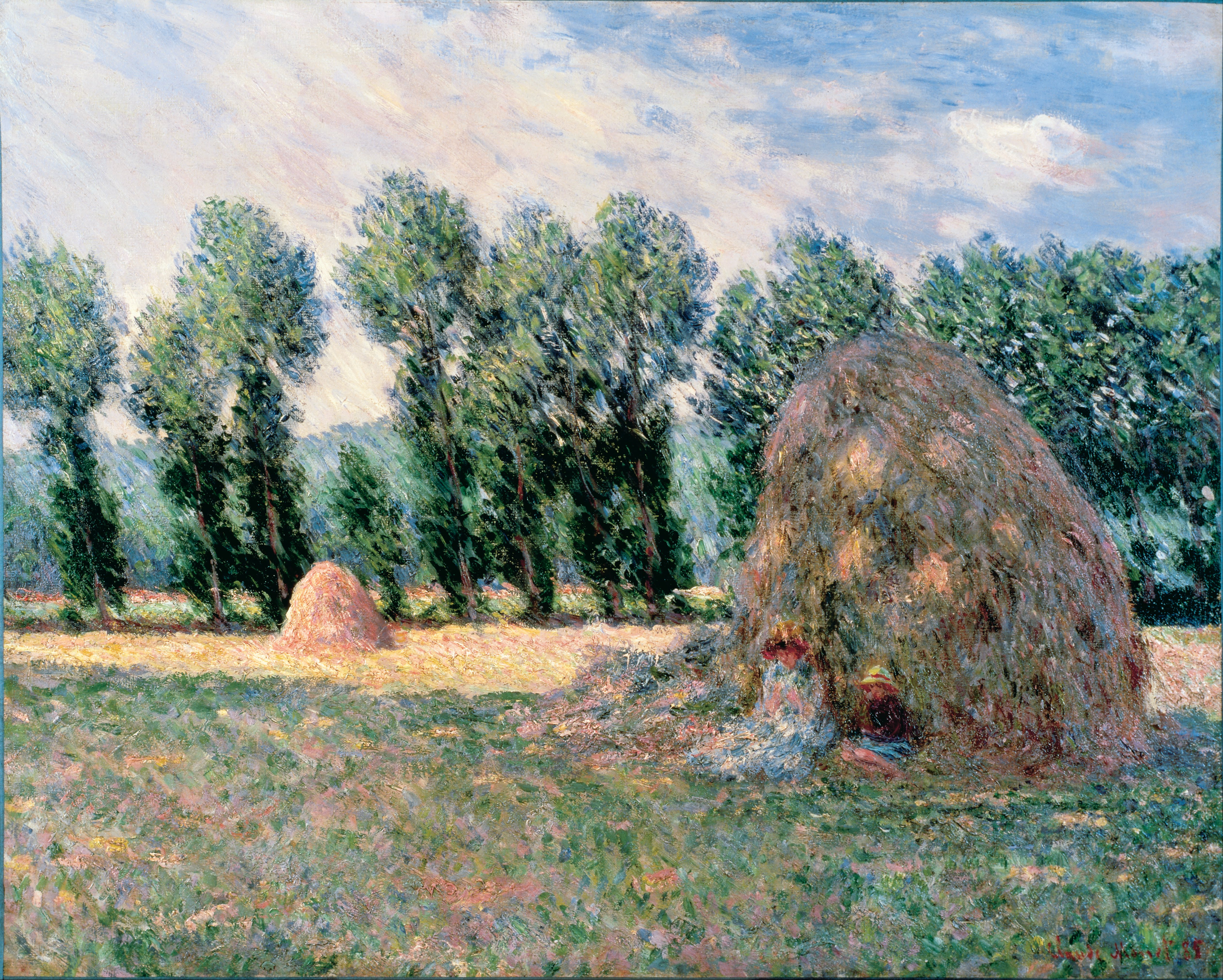
Picture a haystack. Nothing too glamorous, right? Yet it was this humble rural subject that Claude Monet chose to shake the foundations of modern painting between 1890 and 1891, in the fields near his property at Giverny. Far from a simple agricultural study, this series of twenty-five canvases turns a bale of straw into an optical laboratory where light itself becomes the true subject. Monet is no longer trying to paint the haystack itself, but the vibrant atmosphere enveloping it, capturing the setting sun or the morning mist with a frenzy that leaves little room for rest. These works, exhibited at Durand-Ruel's in 1891, marked a decisive turning point: the shift from classical Impressionism toward an almost abstract quest for pure perception.
 Free image
Monet's Haystacks told through the questions readers really ask: life, works, details, context, sources, and decor choices, with a cultured tone that never feels trapped in a display case.
Reading method
A reading method through light
To appreciate these paintings, you must set aside the idea of a fixed subject and accept that reality changes with every hour. Observe how the color of shadow is never black, but composed of blues, violets, and pinks that respond to the dominant hue of the sky. This approach will allow you to choose a reproduction that dialogues with your own space, depending on the natural light available to you.
Context before prestige
We place Monet's Haystacks in its era, its studios, its exhibitions, and its small rebellions. A work without context is sometimes just a very beautiful person who has forgotten their story.
The signs that betray style
We identify composition, palette, material. These clues often say more than grand speeches, especially when they carry gold or nervous brushstrokes.
The artwork in a real room
We end with the useful question: does this image breathe in your home, or does it merely pose like a poster that has read two books?
Historical context
Where does Monet's Haystacks come from, and why is it more than just a pretty label?

It is tempting to reduce this series to the whim of a wealthy painter settled in Normandy, but Monet's approach stems from an unprecedented methodical obsession. Settled in Giverny for some years, the artist noticed that the light changes so quickly that he had to work on several canvases simultaneously, asking his stepdaughter Blanche to bring him the stretchers according to the time of day. This is not a simple decorative series, but a scientific investigation into the fugacity of time, where each brushstroke attempts to capture the instant before it evaporates. The local peasants must have found it quite strange, this man who tirelessly stared at the same haystacks in the driving rain or the brilliant snow.
The context of the era is crucial: as Impressionism was beginning to be accepted, Monet pushed things even further by neglecting narrative in favor of pure sensation. In 1890, he even bought exclusive rights to certain haystacks to ensure they would not be brought in before the end of his work, treating the landscape as a living model that had to be immobilized. This rigor transforms a banal motif, often considered unworthy of great academic painting, into a universal subject. The series thus becomes the manifesto of a new way of seeing, where the object matters less than the luminous imprint it leaves on the viewer's retina.
Artistic style
Why does Monet's Haystacks still interest us so much?

The persistence of the fascination for these paintings lies in their unique ability to speak directly to our visual sensitivity, well beyond the historical codes of art. Unlike frozen portraits or dusty mythological scenes, the Haystacks offer an immediate experience of nature in motion. When looking at a snowy version, one physically feels the bluish cold of the air, while a harvest scene exhales the golden warmth of late summer. This emotional universality explains why these works move through the ages without aging a bit, speaking as much to a 19th-century critic as to a contemporary art lover seeking serenity.
Moreover, this series embodies the precise moment when painting tilts toward the radical modernity of the 20th century. By tirelessly repeating the same motif, Monet already foreshadows industrial series or conceptual art, while remaining anchored in the organic beauty of the rural world. There is something deeply reassuring in this constancy of the subject in the face of the infinite variability of light. It is a lesson in visual philosophy: everything changes, nothing endures, except perhaps this human capacity to marvel at a simple ray of sunlight striking a haystack in the middle of a wheat field.
Visual signs that betray the style

Recognizing a Monet Haystack at first glance relies on identifying its bold color palette and fragmented brushwork. Forget the sharp outlines and traditional black shadows; here, the cast shadow of the haystack is often an intense violet or a vibrant cobalt blue, creating a striking complementary contrast with the ochres and oranges of the sun. The pictorial matter is thick, almost sculptural, applied in juxtaposed strokes that vibrate when one steps back a few paces. This technique allows the viewer's eye to mix the colors itself, thus recreating the shimmer of the real atmosphere rather than a flat copy of reality.
The composition generally follows a strong horizontal structure, dividing the canvas between the sky often occupying the upper two-thirds and the earth anchoring the bottom, with the haystack standing as a massive central pillar. However, this apparent geometric simplicity is deceptive, for Monet subtly plays with horizon lines and perspective to amplify the effect of depth. Sometimes, a second haystack appears in the background, smaller and more blurred, serving as a spatial marker while accentuating the immensity of the sky. It is this mastery of space and color that gives the image its sense of breathing, as if the painting captured not an object, but an entire climatic moment.
Works to look at as if they were about to answer

Among the twenty-five versions, some stand out for their dramatic intensity and deserve special attention during your contemplation. The version held at the Musée d'Orsay, depicting the haystacks under snow with a pink and mauve sky, is a masterpiece of subtlety where the white is never uniform but tinted with complex environmental reflections. Conversely, the paintings at the Metropolitan Museum of Art showing the sunset explode with saturated reds and violets, giving the straw an almost incandescent appearance, as if the haystack were gently burning in the twilight. Each work tells a different weather story, offering a variety of moods ranging from winter melancholy to summer euphoria.
It is fascinating to compare these variations to understand how Monet exhausts the subject to the core. Take for example the difference between a haystack seen in morning mist, where the shapes dissolve into a soft pearly gray, and one struck by a leaden midday sun, where the contrasts are violent and the colors almost acidic. This diversity proves that the artist's genius lies not in the invention of a new subject, but in his ability to reveal the infinite contained within the finite. Looking at these canvases side by side, virtually or in museums like the Tate or MoMA, is attending a concert of luminous variations where the theme remains identical but the music changes with every measure.
Symbols, details and small visual quirks

Beyond aesthetic beauty, the Haystacks conceal symbolic details tied to the agrarian cycle and the passage of time, themes dear to the late 19th century. The haystack itself represents the fruit of human labor, the harvest stored for winter, a symbol of permanence in the face of cyclical nature. Yet Monet often paints it isolated, detached from any visible human context, which gives it a monumental, almost sacred presence, like an ancient statue erected in the fields. One can see in it a meditation on solitude and permanence, where the agricultural object becomes a silent guardian of the landscape, an immutable witness to the seasons that follow one another around it.
A small recurring visual tic of Monet's in this series is his use of the signature integrated into the composition, sometimes painted in tones that harmonize with the sky or the ground rather than in pure black. Moreover, he pays manic attention to the crown of the haystack, that spot where the light strikes hardest, often treated with very textured white and yellow impastos that truly catch the light in the museum. These details betray the artist's obsession with optical truth: he does not paint what he knows to be a haystack, but strictly what his eye perceives at that precise moment, even if it means distorting physical reality to serve sensory truth.
Neighbors, allies and turbulent cousins

Although Monet is the sole master of this specific series, it is impossible to isolate him completely from the web of influences surrounding late Impressionism. One can trace tenuous links with Camille Pissarro's research on rural atmospheric effects, although Pissarro often included more human figures and social activity in his fields. Similarly, Monet's serial approach directly prefigures his later work on the Rouen Cathedral and the Water Lilies, pushing the logic of repetition to the total dissolution of form. His friends and rivals, like Renoir or Cézanne, explored other paths, but none took the systematic study of a single motif under all its luminous facets as far as he did.
It is also interesting to note how this series engages in dialogue with the nascent photography of the time, which was beginning to capture the instantaneous, although Monet's painting offers an accumulated duration that photography could not then reproduce. Some critics of the era saw in these repetitions a form of laziness or the industrialization of art, an ironic accusation when one knows the colossal physical effort required to paint outdoors. Today, we perceive these works rather as spiritual cousins of minimalist art or abstract expressionism, proving that Monet was a visionary whose roots plunged into the Norman soil but whose gaze anticipated the future of world art.
What museums confirm when shortcuts go too fast

Visiting major museums such as the Musée d'Orsay in Paris or the Metropolitan Museum of Art in New York allows one to grasp the true scope of the series, well beyond the often compressed digital reproductions. Before the original, one discovers that the size of the canvases, often imposing, engulfs the gaze and creates a total immersion that the screen cannot simulate. The texture of the paint, those reliefs of dry matter that capture the ambient light of the museum, adds an essential tactile dimension to the experience. Curators often highlight these works in rooms dedicated to Impressionism, allowing visitors to see several versions aligned, thus revealing the chronological and meteorological progression that Monet had conceived.
Institutions like the Tate Modern or MoMA, when they exhibit these pieces, also emphasize their importance in the trajectory toward abstraction. The wall labels and analyses offered confirm that these paintings are not simple landscapes, but scientific studies of perception validated by more than a century of art history. Seeing a Monet Haystack hung alongside a Rothko or a Pollock in certain modern thematic exhibitions perfectly illustrates this lineage. It reminds the visitor that what seemed to be a faithful representation of the French countryside was in reality a silent revolution that freed color and form from their duty of literal representation.
How to choose a reproduction without panicking the wall?

When it comes to integrating a reproduction of the Haystacks into your home, the first rule is to observe the natural light in the room, because it is that light that will dictate the harmony of the whole. If your living room is bathed in warm, southern light, opt for a summery version or a sunset with orange and golden tones, which will reinforce the conviviality of the space without creating chromatic conflict. Conversely, for a bedroom or office requiring calm, choose a wintery or misty scene with dominant blues and grays, which will bring a soothing freshness and visually push the walls back. Format matters too: a wide, horizontal canvas will structure a wall above a sofa, while a more vertical format can energize a narrow hallway.
It is crucial to consider the quality of the reproduction, notably the fidelity of the colors and the rendering of texture, because a flat print risks betraying the very essence of Monet's work. Favor canvas prints or high-definition giclée techniques that respect the vibration of the original brushstrokes. Avoid overly ornate or gilded frames that might compete with the richness already present in the painting; a light wood frame or a raw finish will let the image breathe. The goal is for the reproduction to become a window open onto the fields of Giverny, bringing with it the serenity and temporal depth that only Monet knew how to capture in a simple haystack.
Interior decoration
Mistakes to avoid before hanging the painting

The most common mistake is placing a Monet reproduction in a dark corner where the light cannot play its revealing role, thus turning a vibrant work into a muddy, indistinct blot. Remember that these paintings were designed to celebrate light; depriving them of this vital element amounts to suffocating their very reason for being. Make sure you have direct or indirect quality lighting, ideally with a neutral or slightly warm color temperature, which will allow the purples and ochres to sing properly. A Monet work in shadow is like fireworks in broad daylight: technically present, but visually disappointing and stripped of its magic.
Another frequent misstep is trying to perfectly match the painting's colors to those of the cushions or the carpet, creating a decor-catalog effect that is too literal and rigid. Monet's art possesses a chromatic complexity that does not take well to excessive simplification; let it bring its own palette to the room rather than submitting it to a strict visual charter. Also, avoid hanging the painting too high: the horizon of the haystack should sit roughly at eye level to recreate the sensation of standing in the field, face to face with the subject. Respecting this viewing height ensures an immersive connection and prevents the work from floating sadly out of the gaze's reach.
| Room | Suggestion | Decorative effect |
|---|---|---|
| Living room | A work related to Monet's Haystacks with a strong composition | A cultured, warm focal point that's easy to comment on without reciting a wall label. |
| Bedroom | A soft palette or a more intimate scene | A calm atmosphere, visual presence without unnecessary bustle. |
| Office | A structured, colorful or graphically sharp image | Creative energy and a small reminder that the wall can also work. |
| Entryway | A vertical format or an immediately readable work | First impression: clear, elegant, and noticeably less shy than an empty white wall. |
To continue the visit
Sources, collections, and paths truly related to the subject
A few useful references to verify information, compare royalty-free images, and keep reading without wandering into a museum that didn't ask for the visit.
Related articles to read next
Useful blog hubs
FAQ
Frequently asked questions about Monet's Haystacks
What are Monet's Haystacks in painting?
Monet's Haystacks deserve a in-depth article because this style engages with an era, a way of painting, and a very concrete way of living with images.
How can you quickly recognize this style?
Look especially at composition, palette, texture, light, and atmosphere, then at how the composition guides the eye. If the work holds your attention longer than expected, it's probably no accident.
Which artists should you know?
You should cross-reference the central artists of the movement with museums and reliable sources to avoid hasty attributions.
Is this style suitable for modern décor?
Yes, provided you choose the right format, a palette consistent with the room, and a work whose presence remains pleasant on a daily basis.
Should you choose the most famous work?
Not necessarily. The best-known work can be perfect, but the right choice depends above all on the room, the format, the palette, and the atmosphere you're after.
Where can you verify the information?
Start with museum descriptions, Wikipedia/Wikidata for general orientation, then turn to Wikimedia Commons when a freely usable image is needed.
Eternity in a haystack
Ultimately, Monet's Haystacks teach us that grandeur lies not in the monumentality of the subject, but in the intensity of the gaze we bring to it. These haystacks, simple features of the French rural landscape, have become global icons because they embody our relationship with time and light. Choosing to welcome one of these images into your home means accepting to live with a daily invitation to slow down, to observe the changing nuances of the day, and to find beauty in the ephemeral. Whether under sparkling snow or in the gold of evening, the haystack remains there, still and ever-changing, reminding us that even the most ordinary things can touch the sublime when seen through the eyes of a genius.
0 comments