

Van Gogh's Shoes • Art & Decoration Guide
Van Gogh's Shoes: When Mud Becomes a Monument
A deep dive into a pair of worn shoes that divided philosophers, captivated museums, and found its place in our modern interiors.
It is rare that a simple pair of leather boots, muddy and deformed by use, manages to stop the flow of visitors in a museum. Yet, before the 1886 canvas preserved at the Van Gogh Museum in Amsterdam, silence falls, almost religious. Vincent van Gogh did not paint shoes to look pretty or to decorate a bourgeois living room; he painted fatigue, the endless walk, and the human condition reduced to its most trivial object. These shoes, often described as a still life, vibrate with an absent human presence, as if the owner had just taken them off after a day of labor under the gray sky of Paris or the fields of Brabant. Understanding this work means accepting that art can emerge from material poverty and transform an old sole into a tragic hero.
 Free image
A deep dive into a pair of worn shoes that divided philosophers, captivated museums, and found its place in our modern interiors.
Reading Method
Reading the Canvas Like a Wordless Novel
To fully appreciate these shoes, do not look for perfect technique but feel the life that wore the leather. Observe the material before the subject, and let the historical context illuminate each brushstroke.
Context Before Prestige
We place Van Gogh's Shoes in its era, its studios, its exhibitions, and its small revolts. A work without context is sometimes just a very beautiful person who forgot their history.
The Signs That Betray the Style
We identify composition, palette, material. These clues often say more than grand speeches, especially when they carry gold or nervous brushstrokes.
The Work in a Real Room
We end with the useful question: does this image breathe in your home, or does it just pose like a poster that has read two books?
Historical Context
Where does this famous pair come from, and why is it not just a label?
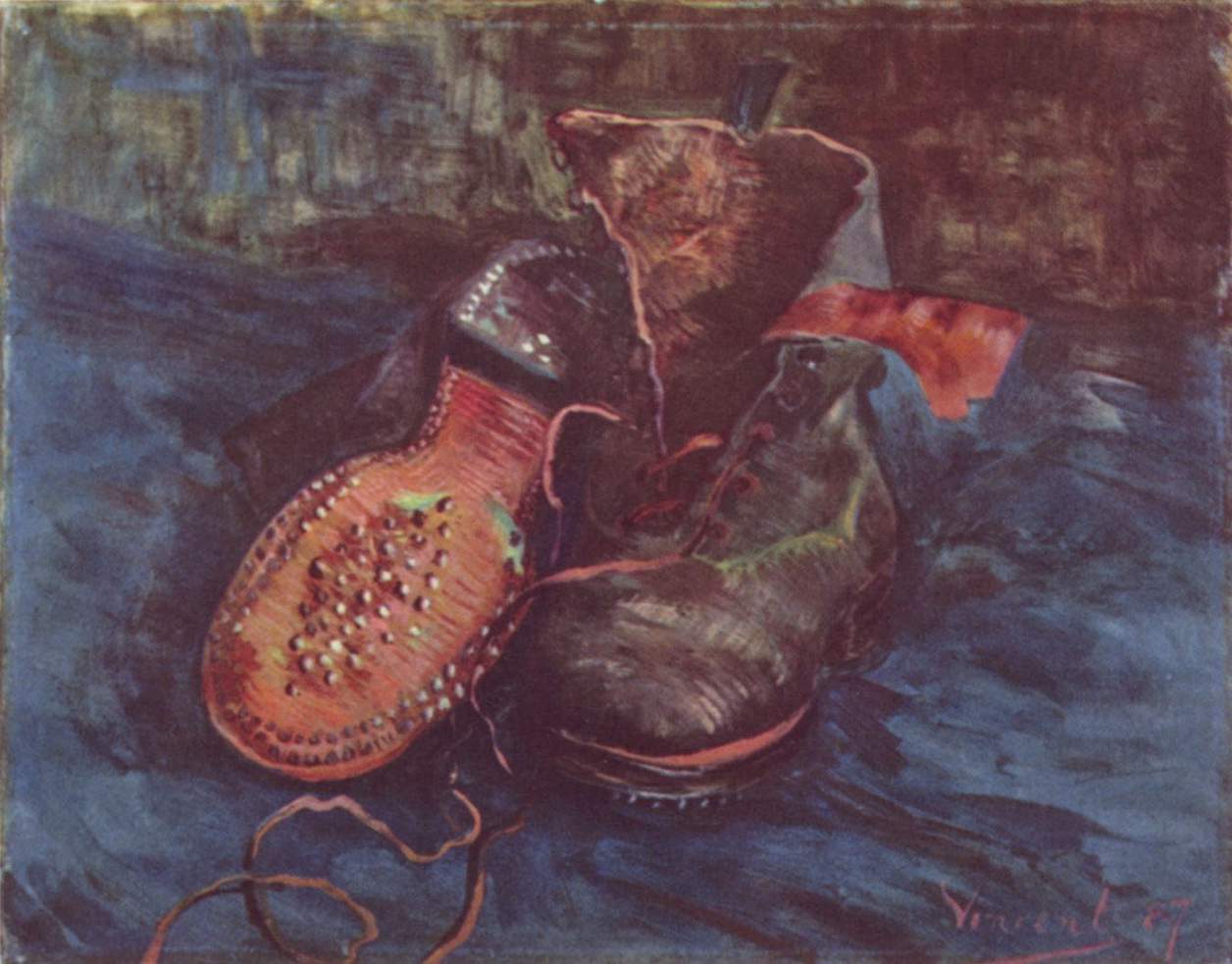
The story of these shoes truly begins during Vincent's Parisian stay, between 1886 and 1888, a crucial transitional period where his palette gradually lightened without losing its initial gravity. Unlike the luxurious still lifes of the 17th century depicting silverware and exotic fruits, Van Gogh here chooses a poor object, probably bought at a flea market or picked up, to make it the sole subject of a radical composition. This choice is rooted in his fascination with peasant life, inherited from his early days in Nuenen with The Potato Eaters, where earth clung to clothes and souls. In Paris, far from the fields, he recreates this visceral connection to the ground by painting worn objects, transforming a vulgar shoe into a silent testimony of the working and artistic condition.
This painting should not be read as a simple stylistic exercise, but as a political and aesthetic statement against the academicism of the time that favored noble subjects. By isolating these boots on a neutral background, almost floating in an indefinite space, the artist gives them an unprecedented monumentality, elevating them to the rank of a psychological portrait without a face. Historians agree that several versions exist, some showing a single shoe, others a laced pair, each varying slightly in the wear of the leather and the shade of the loose laces. This repetition of the motif proves that Vincent tirelessly sought to capture the soul of the object, convinced that the truth of a life lies in the folds of old leather rather than in the frozen smile of a notable.
Artistic Style
Why do these old boots still fascinate so much today?

The persistence of our fascination lies in the strange ability of this image to evoke a human presence without showing any body, creating a void that our imagination rushes to fill. Each crack in the leather, each dried mud stain tells a journey, a distance traveled, an accumulated fatigue that resonates universally with our own experience of walking and working. It is not just a painted object, it is the receptacle of an existence, a kind of secular relic that touches the spirituality of everyday life. The modern viewer, often saturated with smooth digital images, finds in this raw and uneven material a reassuring authenticity, a tangible proof that someone lived, suffered, and advanced step by step on this solid earth.
Beyond pure emotion, the work has gained intellectual fame thanks to the philosophical debates it has generated, becoming the favorite playground of 20th-century thinkers. Martin Heidegger saw in it the symbol of the fundamental relationship between man and the earth, while Meyer Schapiro read it as the hidden self-portrait of the bohemian artist walking the streets of Paris. Later, Jacques Derrida further complicated the reading by questioning the very ownership of these shoes, transforming a simple still life into a conceptual battlefield. This interpretative richness ensures the painting an exceptional cultural longevity, as each generation can project its own existential anxieties onto it while admiring the technical mastery of a vigorous brushstroke.
Art & Details
The visual signs that immediately betray Vincent's style

At first glance, what strikes in this composition is the way light seems to emanate from the object itself rather than falling on it from an identifiable external source. Van Gogh uses tones of ochre brown, burnt sienna, and deep black to model the volume, applying paint in thick layers, a technique known as impasto, which gives the leather an almost tactile texture. The nails of the sole are clearly visible, some missing, others shiny from rubbing against the pavement, details rendered with an obsessive precision that contrasts with the freedom of the background treatment. This material approach transforms the flat surface of the canvas into a rugged relief, inviting the gaze to caress the roughness of a real and unidealized wear.
The composition, of disconcerting simplicity, places the shoes slightly askew, creating a subtle dynamic that prevents the image from appearing static or boring despite the immobility of the subject. The laces, undone and hanging limply, draw organic curves that respond to the rigid lines of the seams and heels, introducing a visual rhythm close to that of a minimalist musical score. The total absence of accessories or decor around forces the eye to focus exclusively on the morphology of the shoe, its deformations due to the foot that inhabited it, and the traces of its history. It is this economy of means, coupled with a contained but powerful chromatic intensity, that immediately signs the master's touch of the Dutch artist in full stylistic mutation.
Art & Details
The works to look at as if they were finally going to answer
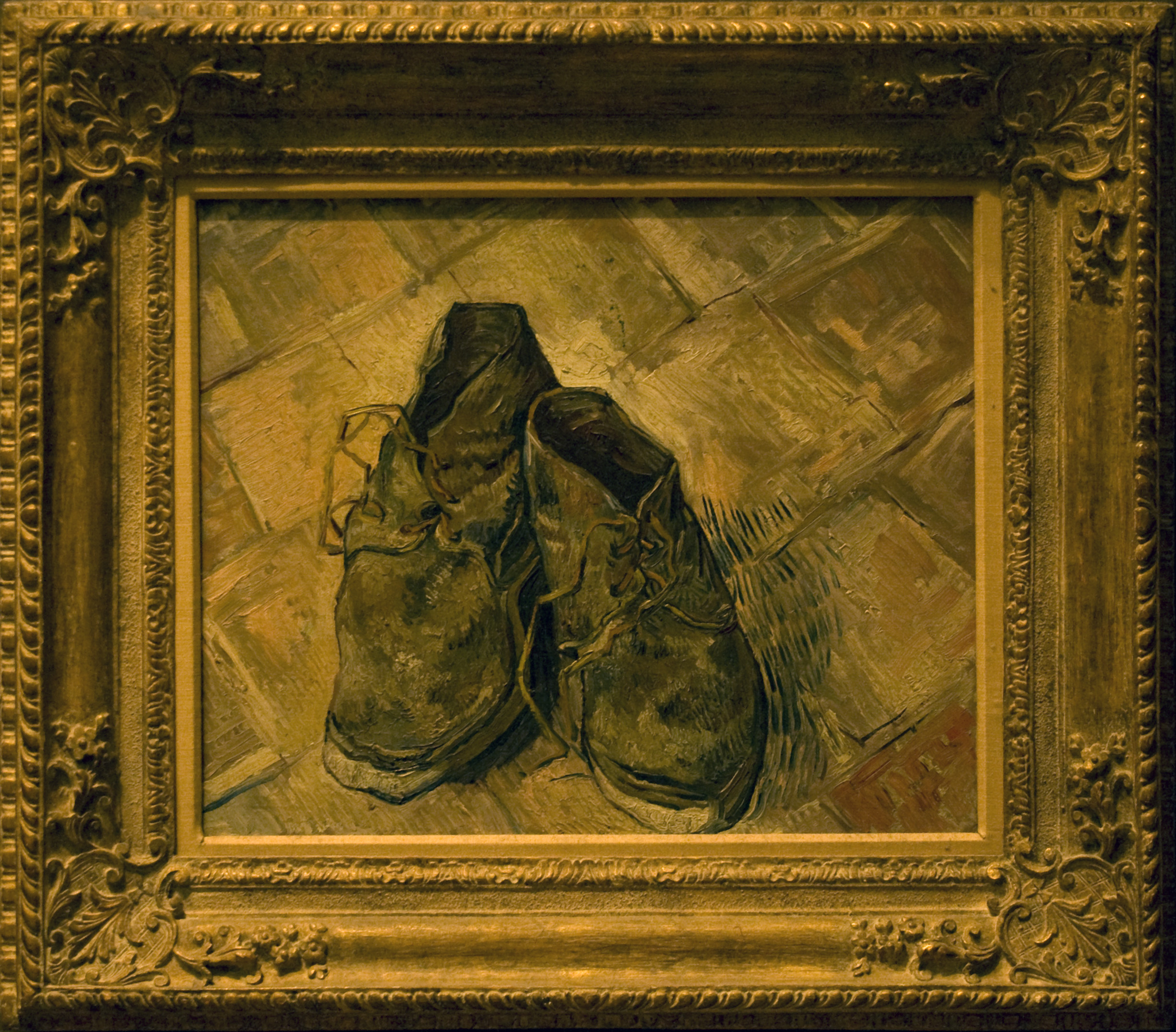
To grasp the full scope of this series, it is essential to put it in dialogue with The Potato Eaters, painted shortly before in Nuenen, where the same dark and earthy palette already permeates the faces and modest interiors. In both cases, Van Gogh refuses idealization in favor of a raw, almost rough truth, where dirt and poverty are elevated to the rank of moral dignity. Observing these paintings side by side reveals a strong thematic continuity: that of the indissoluble link between man, his tool of work, and the earth he treads, whether it be a fork holding a tuber or a foot slipped into a boot. This coherence shows that the Parisian shoes are not a break, but the logical evolution of an artistic quest centered on social reality.
It is also necessary to compare these shoes with other still lifes from the same period, such as those depicting worn books, clay pipes, or straw chairs, which populate the artist's studio in Arles shortly after. Each of these objects, carefully selected, acts as a substitute portrait, revealing the absence of their owner while affirming his personality through the choice and use of the object. Gauguin's chair, empty but loaded with intellectual symbols, thus responds to the empty shoes, loaded with physical memory and fatigue. By browsing these works, we understand that for Vincent, every ordinary object has its own soul, an ability to tell a story deeper than many official portraits of the time.
Art & Details
Hidden symbols, tiny details, and small visual quirks

If we look very closely, we notice that the shoes are not simply placed, but seem to have been recently inhabited, still retaining the shape of the foot that martyred them for years. This specific deformation, visible at the level of the raised toe and the sagging of the upper, suggests a heavy walk, perhaps that of a peasant or an artist tirelessly pacing the roads in search of motifs. Van Gogh deliberately accentuates these signs of wear to underline the notion of passing time and endured hardship, making the shoe a metaphor for premature aging and resilience. Nothing is left to chance in this representation of decrepitude, which paradoxically becomes a celebration of human perseverance in the face of material adversity.
Another fascinating detail lies in the way the background is treated, often with quick horizontal strokes that create a kind of abstract ground, neither table nor earth, suspending the object in an indeterminate temporal space. This spatial ambiguity allows the shoes to transcend their immediate utilitarian function to become a timeless icon, detached from any precise geographical context while remaining anchored in reality. Sometimes, a slight trace of green or blue appears in the shadows, recalling the palette that will soon explode in Provence, a sign that even in his darkest works, Vincent was already preparing his color revolution. These small chromatic intrusions are like silent promises of the light to come.
Art & Details
Neighbors, allies, and turbulent cousins of this aesthetic

Although unique, this approach to still life finds echoes among certain contemporaries, notably Jean-François Millet, whose respectful and heroic representation of agricultural workers Van Gogh deeply admired. Millet painted tools, baskets, and clothes with the same gravity, laying the foundations of a social realism that Vincent would push to its expressive peak. However, where Millet remains in a clear illustrative narrative, Van Gogh isolates the object to make it an autonomous entity, suppressing explicit narrative in favor of a pure and intense presence. This distinction marks the passage from 19th-century realism to nascent modernism, where the painted object is valuable for itself and for the emotion it arouses, independently of its narrative utility.
One can also trace an invisible line connecting these shoes to Marcel Duchamp's ready-mades that would appear a few decades later, although the intention is radically opposite. Where Duchamp presents a manufactured object as is to question the definition of art, Van Gogh patiently reconstructs the object through painting to infuse it with a new humanity. Between these two poles, art history has seen many artists fascinated by the shoe, from Andy Warhol to Rebecca Horn, each exploring different facets of this intimate accessory. Yet, no other work has managed to capture with such accuracy and pain the symbiotic relationship between the human foot and the ground, making the 1886 pair an essential ancestor of modern object art.
Art & Details
What museums confirm when shortcuts go too fast
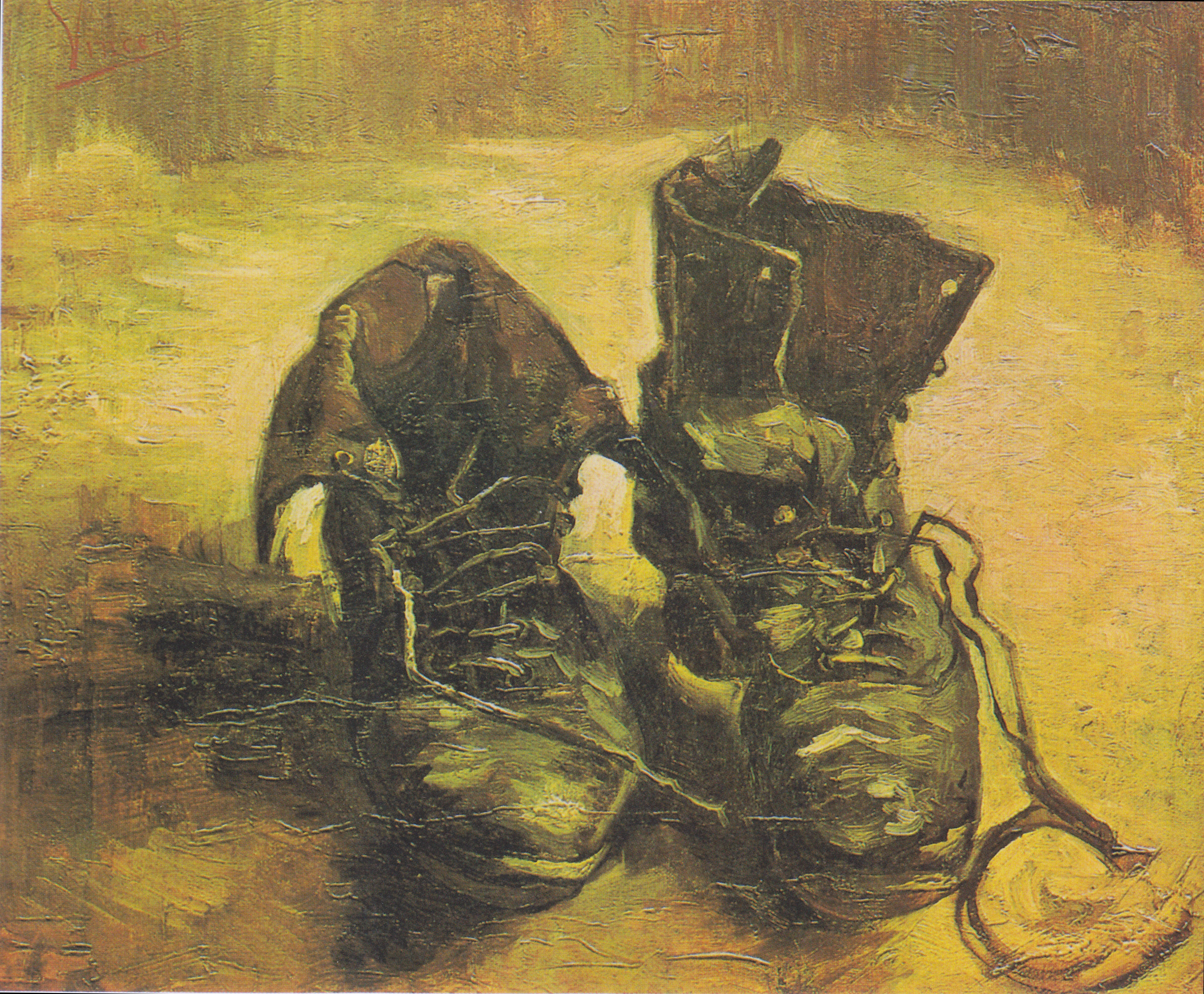
The archives of the Van Gogh Museum in Amsterdam, guardian of the most famous version, specify that this canvas is part of a larger set made during the Parisian years, contradicting the received idea that it is an isolated work born of a whim. Technical analyses reveal overlapping layers and minor pentimenti, proof that Vincent worked on this composition for a long time to find the perfect balance between the dark mass of the shoes and the ambient luminosity. These scientific data remind us that behind the apparent spontaneity of the Van Gogh gesture lies a structured reflection and a progressive mastery of pictorial matter, far from the myth of the mad artist painting in pure trance. The museum thus provides an essential material context that enriches the emotional reading of the work without cooling it.
Other major institutions such as the Musée d'Orsay in Paris or the Metropolitan Museum of Art in New York preserve similar still lifes that allow us to measure the evolution of his touch and palette during this pivotal period. By confronting these works in temporary exhibitions, curators highlight the diversity of Vincent's approaches to the everyday object, showing how he moved from Dutch rigor to Impressionist and then Post-Impressionist freedom. These in situ comparisons confirm that the shoes are not an accident of the journey, but an essential milestone in the construction of his visual language, a laboratory where he experimented with the expressive power of color and line before launching into the great landscapes of Provence.
Art & Details
How to choose a reproduction without making the wall panic?
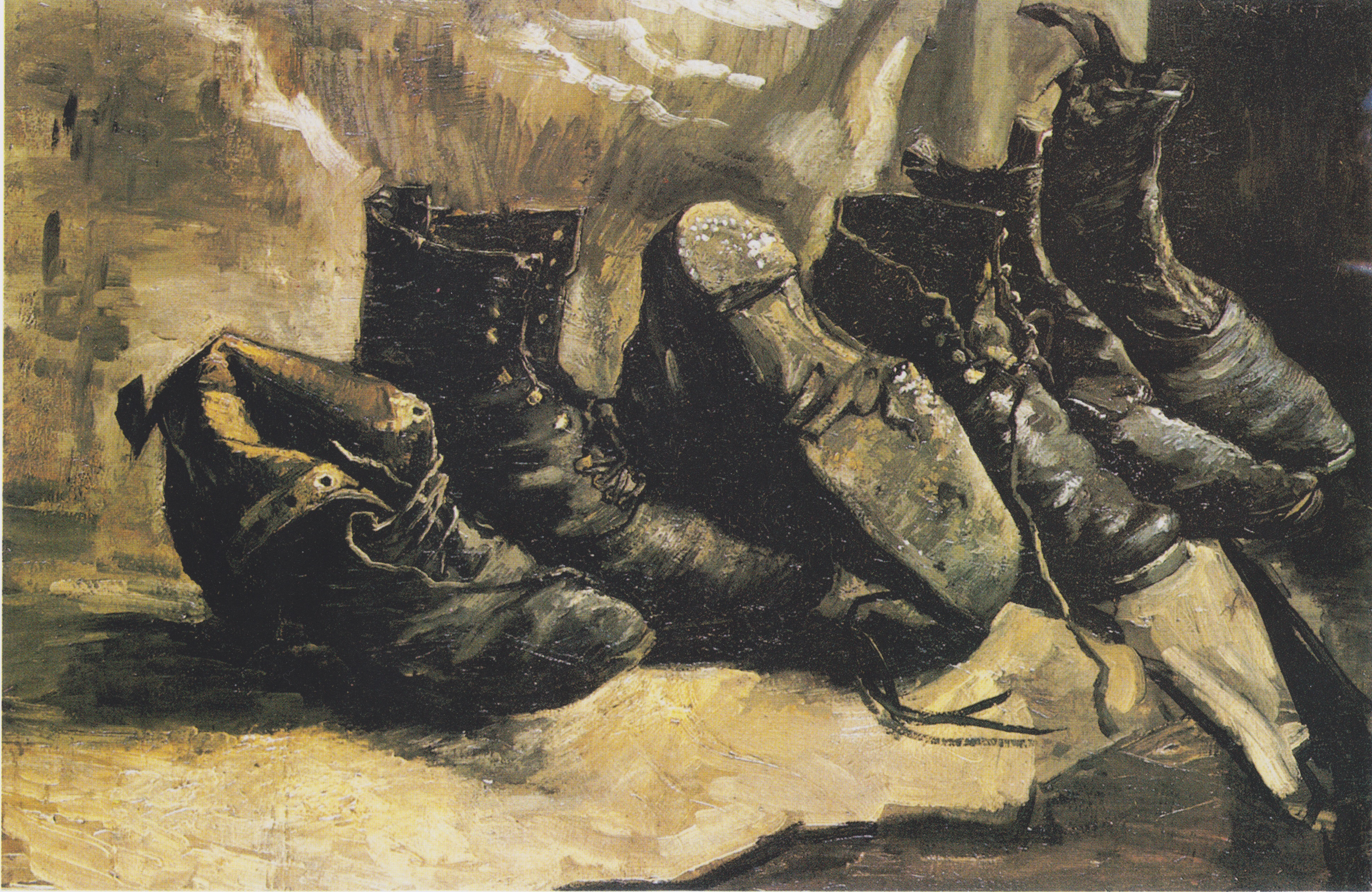
Integrating a reproduction of Van Gogh's Shoes into a modern interior requires a certain audacity, as the work imposes its dark and textured presence with rare authority. It works particularly well in an office, an entrance, or a living room with an industrial or minimalist style, where white or light gray walls will serve as an ideal setting to bring out the deep browns and warm ochres of the painting. Absolutely avoid hanging it in a room already saturated with complex patterns or bright colors, as the telluric power of the image could create a visual discordance tiring for the eye. The ideal is to give it breathing space, as if the shoes should be able to continue their imaginary journey without bumping into a too busy frame or bulky furniture.
The choice of format is also crucial: a large size will allow appreciation of the richness of the material and the details of the leather wear, transforming the wall into a window open onto the artist's studio. Opt for a high-quality print on canvas or a thick grain paper that reproduces the impasto effect characteristic of Van Gogh's touch, as a flat print on glossy paper would betray the very essence of the work. Also think about lighting: a soft, slightly grazing directional light will accentuate the reliefs of the reproduction and revive that impression of volume that is the genius of the original. Thus, the copy becomes less a simple decoration than a true homage to the quiet strength of the painted object.
Interior Decoration
Mistakes to avoid before hanging the painting

The first fatal mistake would be to treat this work as a banal decorative element, a simple rustic motif intended to fill a wall void without consideration for its dramatic intensity. Hanging these shoes above a comfortable sofa in a kitschy country style would create a total contradiction, transforming a symbol of labor and solitude into a gardening catalog illustration. One must respect the gravity of the subject and understand that this image carries an existential tension that does not tolerate frivolity or proximity to too light or humorous objects. The hanging context must reflect the depth of the work, otherwise the painting risks losing all its strength and becoming inexplicably depressing out of place.
Next, beware of overly ornate or gilded frames that would violently conflict with the raw simplicity and assumed poverty of the subject. A raw wood frame, a fine black metal frame, or even no frame (stretched canvas) will be much better suited to maintain the visual integrity of the composition and let the gaze plunge directly into the material. Finally, do not neglect the hanging height: place the painting at eye level, as if you were to put on these shoes, to restore that physical and empathetic connection that Vincent so sought. An installation too high would divert the object from its earthly function and break the intimate bond established between the viewer and the worn pair.
| Room | Suggestion | Decorative effect |
|---|---|---|
| Living room | A work related to Van Gogh's Shoes with a strong composition | Cultured focal point, warm, and easy to comment on without reciting a label. |
| Bedroom | A soft palette or a more intimate scene | Calm atmosphere, visual presence without unnecessary agitation. |
| Office | A structured, colorful, or graphically sharp image | Creative energy and a small reminder that the wall can also work. |
| Entrance | A vertical format or an immediately readable work | Clear, elegant first impression, and decidedly less shy than a white void. |
To continue the visit
Sources, collections, and paths truly related to the subject
Some useful references to verify information, compare free images, and extend the reading without going to a museum that didn't ask for anything.
Related articles to read next
Verified collections
Useful blog hubs
FAQ
Frequently asked questions about Van Gogh's Shoes
What is Van Gogh's Shoes in painting?
Van Gogh's Shoes deserves an in-depth article because this style engages both an era, a way of painting, and a very concrete way of living with images.
How to quickly recognize this style?
Observe especially composition, palette, material, light, and atmosphere, then the way the composition organizes the gaze. If the work holds you longer than expected, it's probably not an accident.
Which artists should you know?
You need to cross-reference the central artists of the movement with museums and reliable sources to avoid too hasty attributions.
Does this style suit modern decoration?
Yes, provided you choose the right format, a palette consistent with the room, and a work whose presence remains pleasant on a daily basis.
Should you choose the most famous work?
Not necessarily. The most famous work can be perfect, but the right choice depends above all on the room, the format, the palette, and the desired atmosphere.
Where to verify the information?
Start with museum notices, Wikipedia/Wikidata for general orientation, then Wikimedia Commons when a free image is needed.
A walk that never stops
Ultimately, Van Gogh's Shoes remain much more than a famous still life or a subject of philosophical essay; they are a permanent invitation to look at the world with attention and humility. In an era where everything goes fast and objects are disposable, this pair of boots reminds us of the value of time, use, and the trace left by our steps. Whether hung in a prestigious museum or carefully reproduced in a contemporary interior, they continue to walk symbolically, carrying with them the weight of history and the lightness of a truth finally painted. Choosing to live with this image means accepting to keep your feet on the ground, even when the spirit travels to the heights of art.
0 comments