

Paper · Line · Experience
How Leonard was he drawing?
Disciplined metallic tip, sensual sanguine, quick pen and atmospheric wash: Leonardo changes tools depending on whether he observes, invents, demonstrates or prepares a painting.
The short answer
He drew to think, not just to prepare
A Leonardo leaf can look for the twist of an arm, record a dissection, compare ten profiles, calculate a mechanism or allow a composition to emerge. Mirroring, diagrams and images share the same search space.
Drawing is a method of knowledge
Precision does not mean immobility. Even in his most rigorous anatomical studies, Leonardo multiplies points of view, sections, notes and variants in order to understand how it works.
The toolbox
Five mediums, five behaviors
Metal tip
Fine gray line on prepared paper, difficult to erase and not very sensitive to pressure.
Sanguine
Natural red chalk, fine or wide, ideal for flesh, faces and anatomy.
Blackstone
Modular black for shadows, head studies and preparatory compositions.
Pen and ink
Sharp line, hatching, notes and rapid inventions; ferro-gallic ink has browned over time.
Wash and white
Ink diluted with brush for masses; light highlights on tinted paper.
I · Silver tip
A line that is unforgiving
Paper must first become abrasive
A silver stylus does not mark an ordinary sheet. The paper is coated with a preparation, often based on finely ground and sometimes colored bone powder. The metal then deposits a gray mark on contact with this slightly abrasive surface.
- the line practically does not fade;
- the pressure changes its intensity little;
- the modeling is constructed by networks of lines and hatching;
- a pen cover can reinforce certain contours.
This medium, common in the Florentine formation of the 15th century, requires us to anticipate the gesture. Leonardo used it especially in his younger years.
II · Sanguine and black stone
Chalk releases pressure, tone and volume
From line to mass
From the 1490s, natural red and black chalks took on an increasing role. They can be cut for a thin line, tilted for a wide area, reinforced, blended and combined.
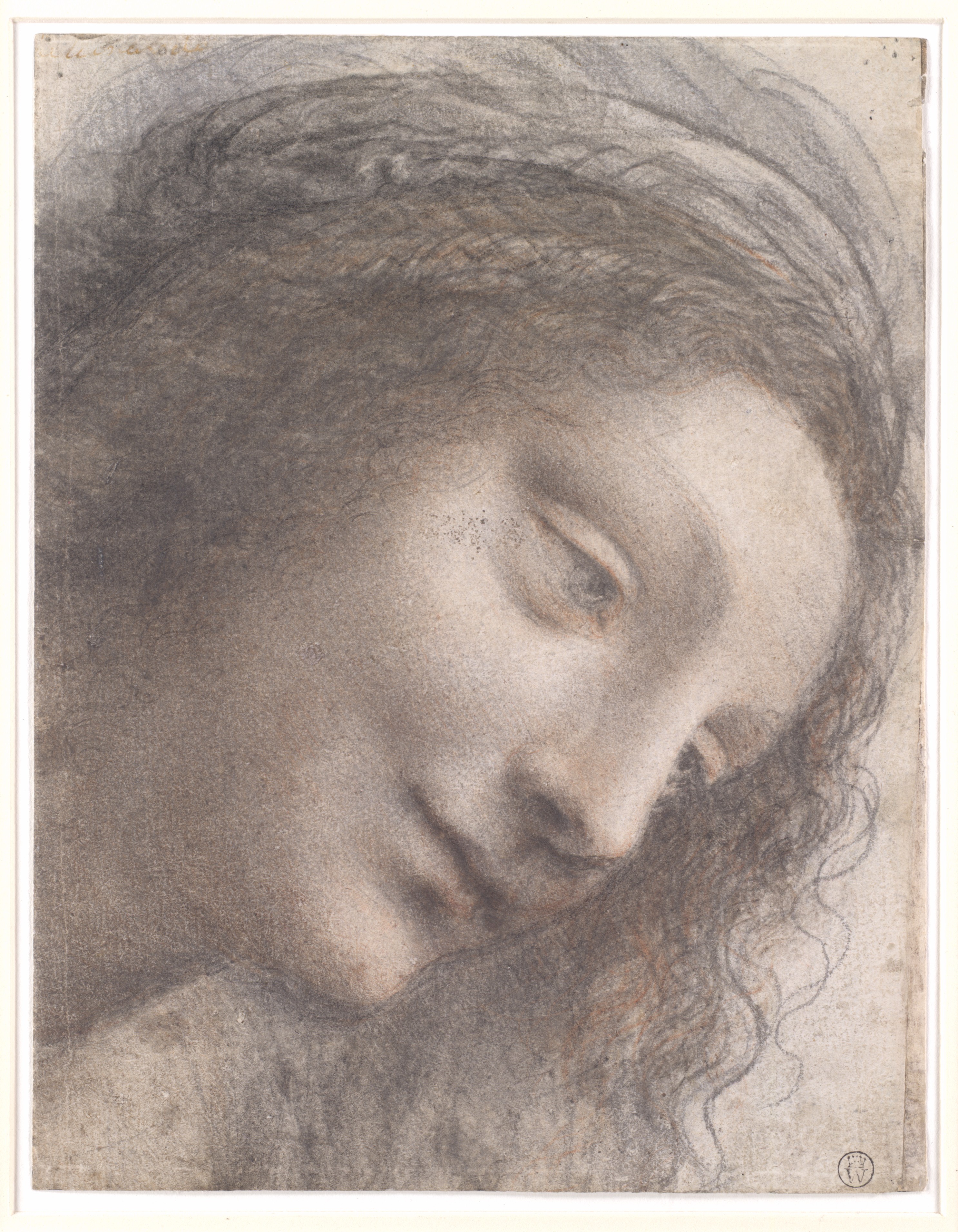
On tinted paper, Leonardo can reserve the average shade of the support, deepen the shadows with black stone or charcoal, warm the flesh with red chalk and add a few white lights. The leaf no longer fills only with contours: it becomes a luminous field.

Blood and the elderly face
The famous Turin head, often called a "self-portrait", shows the ability of the sanguine to pass from incisive wrinkles to almost vaporous hair. The identity of the model remains debated: the technique is certain, the status of self-portrait is not.
III · Pen, ink and wash
A line to invent and explain

The pen accelerates thought
Cut from a bird's feather, it produces a line that varies depending on the cut, angle and ink load. Leonardo uses it to write, go around, hatch, compare and multiply variations on the same page.
Ferro-gallic ink, originally black, has often taken on a brown tint. Diluted and applied with a brush, it becomes wash: a transparent mass capable of placing a shadow, a cloud or the volume of an organ.

Draw, caption, demonstrate
In anatomical sheets, sectional images, exterior views, diagrams and text work together. The pen not only copies what is observed: it constructs a spatial demonstration.
IV · Paper and preparation
The support is already part of the drawing
| Support | Preparation | Advantage | Usage |
|---|---|---|---|
| White paper | None or slight preparation depending on the medium. | Readability of lines and notes. | Pen, ink, scientific studies. |
| Pink or red-brown paper | Applied colored background or tinted paper. | The shade serves as an average value. | Red, black and white chalks. |
| Blue-gray paper | Prepared colored surface. | Contrast between metalpoint, ink and white highlights. | Particularly completed studies. |
| Paper prepared for metalpoint | Abrasive layer based on mineral or bone powder. | The metal stylus leaves its mark. | Early studies and drawings from nature. |
Leonardo's paper: usually made from hemp or linen rags. Its cost fell during the 15th century, which favored more daily and experimental use.
Eight leaves to observe
The same artist, eight functions of drawing
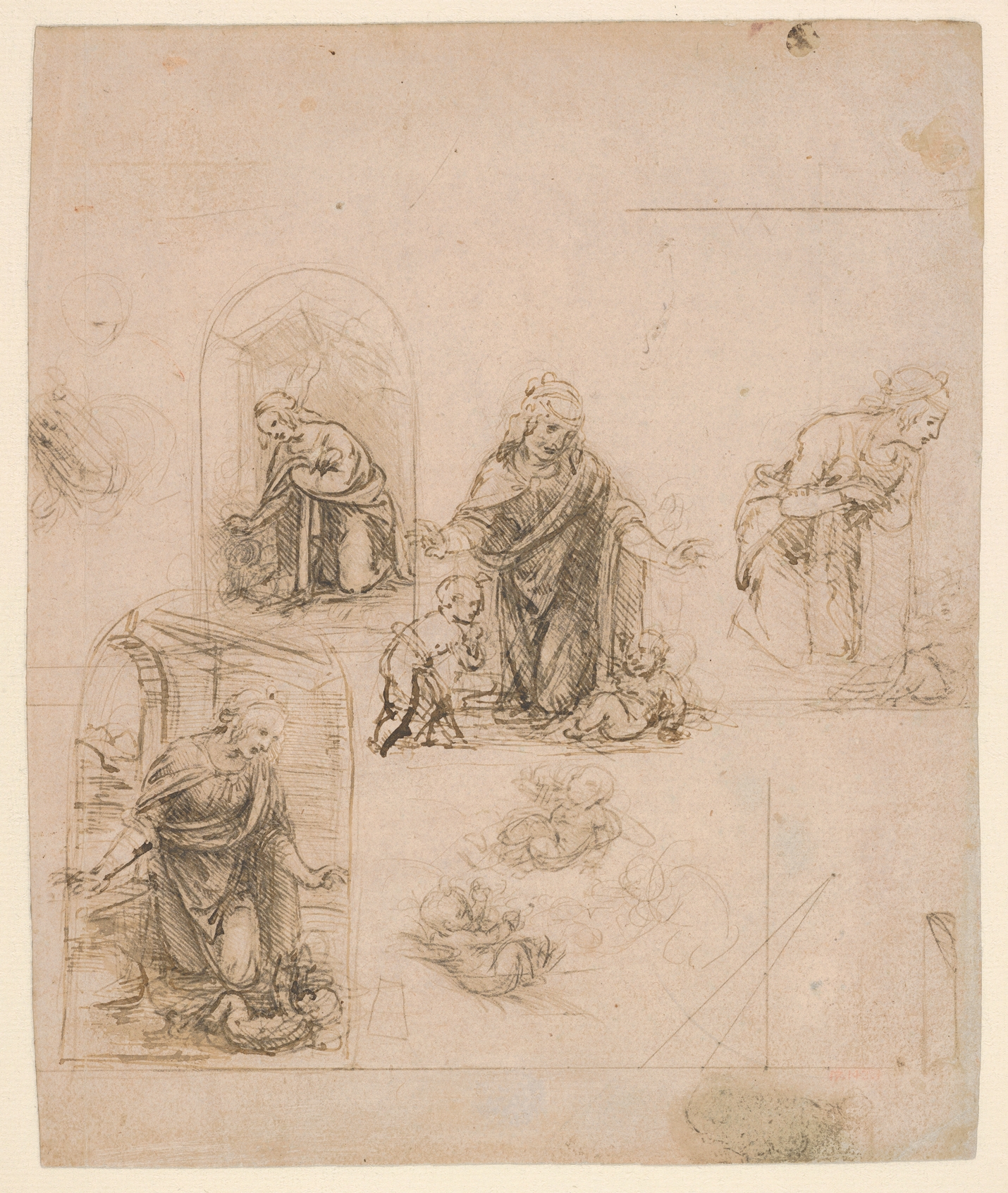
Composition studies
Silver tip taken in ink on pink preparation.
Head of the Virgin
Three tones of chalk for an almost pictorial presence.

Horse studies
Observation, movement and variations on the same sheet.
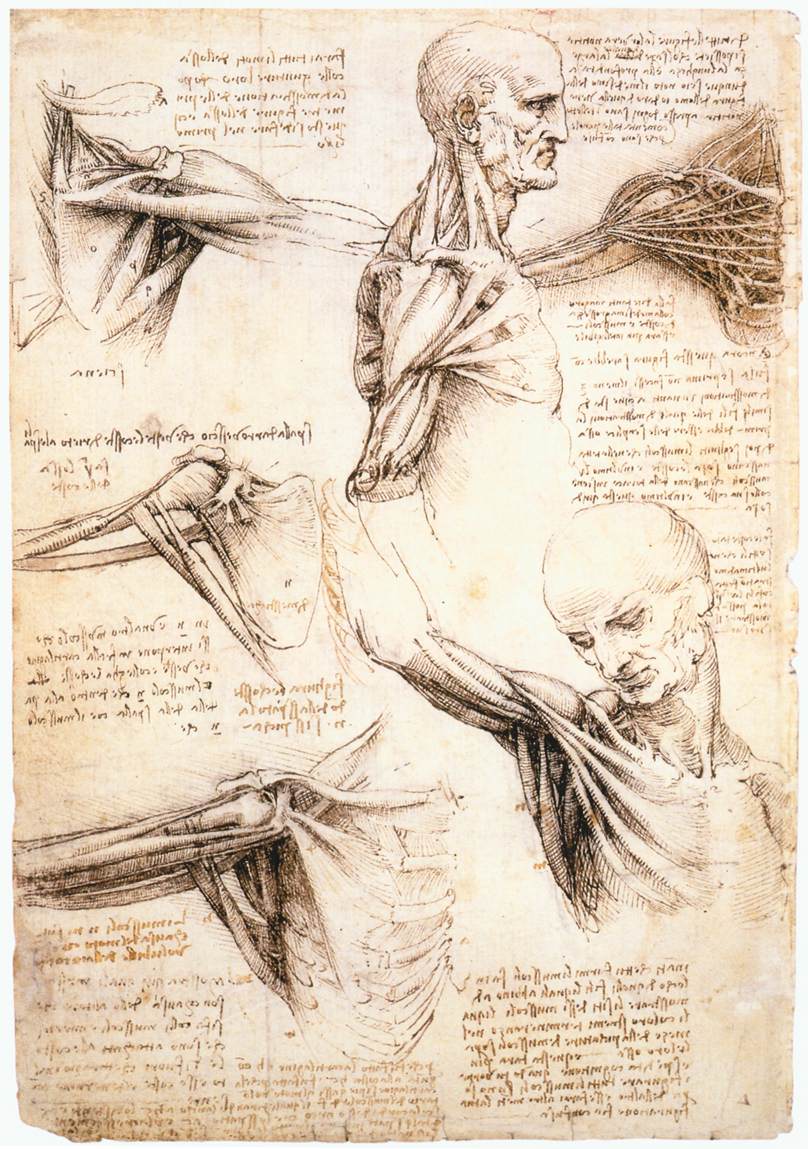
Shoulder anatomy
Hatching and comparative views to explain the structure.
Water movements
The line transforms a fluid phenomenon into an analyzable rhythm.
Fetus in the uterus
Anatomical section, volume, notes and hypotheses.

Vitruvian Man
Measurement, geometry, body and text combined.

Codex on the flight
Bird observation, mechanics and mirror writing.
Choose the medium
Which tool for which question?
| If Leonard wants... | Dominant tool | Why |
|---|---|---|
| Form your hand | Metal tip | The indelible line imposes control and economy. |
| Quickly search for a composition | Black feather or stone | Speed allows variations, overlays and corrections. |
| Model a face | Sanguine, black stone, sometimes white | Pressure, width and blending build the flesh. |
| Describe a dissection | Pen, ink and wash on chalk marks | Precision, legends and volumes coexist. |
| Study an atmosphere | Chalk, diluted ink, wash | Masses and values matter as much as contour. |
Institutional sources
Techniques and collections
Leonardo Materials
Paper, metalpoint, chalks, quill and inks.
Scientific analysisA Closer Look
Papers, preparations and specialized photography.
Metropolitan MuseumThe metalpoint
Technical principle and example of Leonardo.
British MuseumAnatomical study
Sanguine on prepared red-orange paper.
Continue
From drawing to painting
FAQs
Questions about drawing
What is silver tip?
A metal stylus tracing on specially prepared, slightly abrasive paper.
Why doesn't the line fade?
The metal deposits a trace in the preparation; unlike graphite, it practically does not erase.
Did Leonardo draw in red chalk?
Yes, especially from the 1490s, for heads, anatomy, hair and models on tinted paper.
What ink was he using?
In particular a ferro-gallic ink, originally black and often turned brown over time.
Why did he write in mirror?
Left-handed, Leonardo commonly wrote from right to left. This operation does not mean that all his notebooks were a secret code.
Was he using black stone?
Yes, alone or combined with red chalk, charcoal, ink, wash and sometimes white highlights.
0 comments