

Milan · Rome · Amboise
Leonardo's students in the workshop
Salaikh, Melzi, Boltraffio, Giampietrino: who painted, copied, posed, traveled and preserved the master's ideas?


The short answer
A laboratory more than an ordinary school
Leonardo da Vinci does not run a stable and productive workshop on the model of a great Florentine entrepreneur. His entourage changes with his movements, his protections and his projects. Young painters copy models, experiment with variations, prepare panels, observe the master's research and sometimes execute works under his direction.
Salaikh is the very long-term companion, ambiguous and difficult to grasp as a painter. Melzi is the cultured assistant of recent years and the guardian of the written heritage. Around them, Boltraffio, Marco d'Oggiono, Giampietrino, Cesare da Sesto and others each develop a version of Leonardo language.
The two relatives
Salaikh and Melzi: two very different loyalties
One accompanied Leonardo for almost thirty years; the other organizes his memory after his death.

Salaikh, the indocile
Entering Leonardo in 1490, he received the nickname Salaikh, "little devil". The master's notes describe him as a thief, liar, stubborn and greedy, but he remained in his entourage for decades.
- assistant, companion and punctual manager;
- possible model of curly male types;
- painter activity difficult to document;
- receives a Milanese vine by will.

Melzi, the heir
A young Milanese nobleman, Melzi joined Leonardo no later than the 1500s, accompanied him to Rome then to France and remained with him during his illness.
- cultured artist and precise designer;
- probable author of the late portrait of the master;
- heir to manuscripts and drawings;
- organizer of the future Treatise on painting.
Milan orbit
Six names to understand the Leonardesque circle
Not everyone is a "student" in the same sense: some work directly with the master, others assimilate his inventions and then start their own careers.
Salaigh
Entering the entourage in 1490, still a child. Possible model of several types of young men, lasting assistant, beneficiary of a vineyard in the will. His pictorial activity remains difficult to isolate with certainty.
Francesco Melzi
Coming from a Milanese family, he accompanied Leonardo to Rome then to France, took care of him in his last years and received his drawings and manuscripts. Its role is decisive in transmission.
Giovanni Antonio Boltraffio
Trained in the Milanese circle, he transformed Leonardo's lessons - gentle modeling, inner looks, dark backgrounds - into a personally identifiable career.
Marco d'Oggiono
It uses Leonardo models, notably the Last Supper, and contributes to circulating the master's inventions in Lombard churches and collections.
Giampietrino
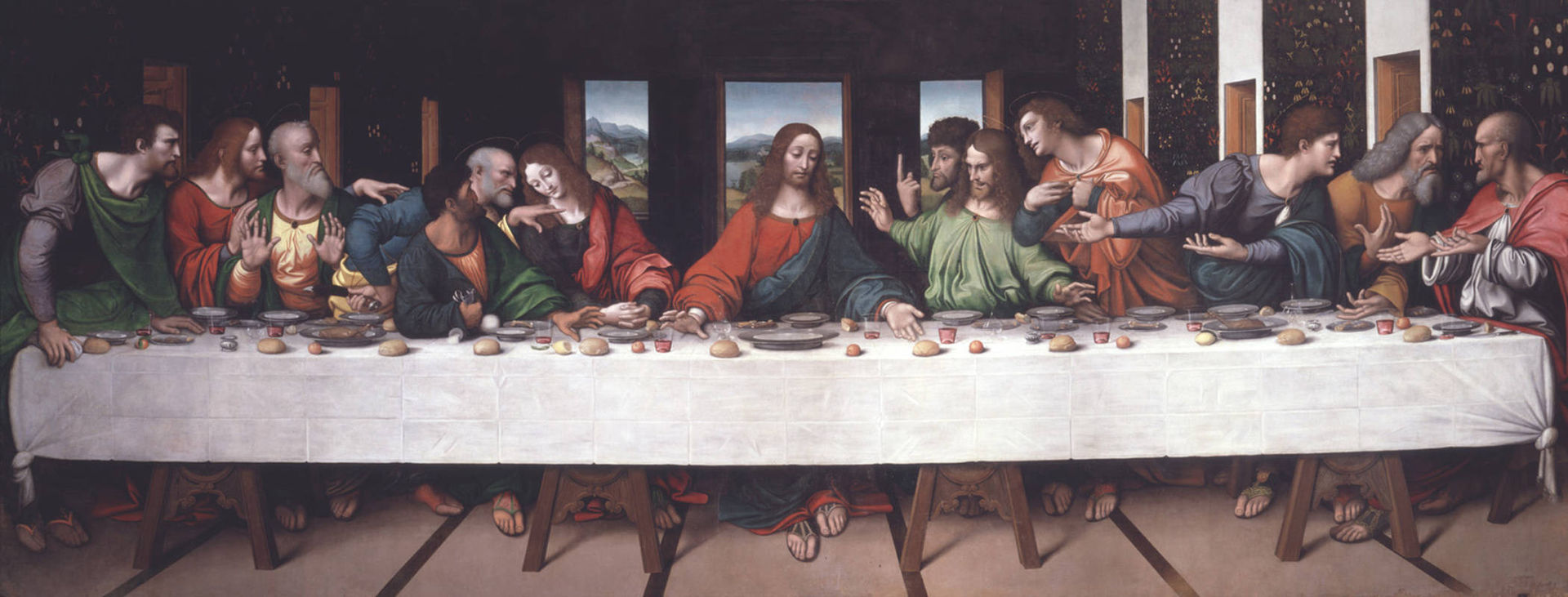
His large copy of the Last Supper retains missing details from the original mural. It has become a major document for understanding Leonardo's composition.
Cesare da Sesto
He mixes Leonardo's legacy with other Italian experiences. His work shows that "Leonardism" is not a fixed formula but a mobile language.
Francesco Melzi
This sheet of the Biblioteca Ambrosiana is traditionally identified as a portrait of the young Francesco Melzi. It replaces the portrait of Leonardo previously placed in his biography.
Salaigh
No portrait of Salaikh is accepted without reservation. This often reproduced image is presented as a traditional identification, not as a certainty.

Boltraffio
Boltraffio transforms Leonardo's gentle modeling and psychological concentration into a personal, autonomous language.

Marco d'Oggiono
The sharpness of the contours and the symmetrical organization show a more explicit and decorative appropriation of Leonardesque vocabulary.

Cesare da Sesto
Cesare combines types inherited from Leonardo with the experiences gained during his travels, far from mechanical imitation.

Bernardino Luini
Luini belongs more to followers than to documented assistants. His serene figures have long been confused with works by Leonardo.
In the workshop
How Leonardo's idea becomes several paintings
Technical analyzes replaced the romantic image of solitary genius with that of experimental and distributed production.
Cardboards and plots
A life-size drawing could be transferred to several panels. The prototype circulated independently of a finished painting.
Simultaneous variants
Several students tried different solutions while Leonardo observed and corrected the composition.
Interventions by the master
A work could be largely executed by an assistant and then receive alterations, advice or finishing touches from Leonardo.
Formative copies
Taking a face, a gesture or an entire work allowed you to learn modeling, transitions and the construction of the gaze.
Reused models
Leda, the Virgin with the Spindle, Saint John or Saint Anne become families of images rather than isolated originals.
Moving attributions
Cleaning, reflectography and material analysis can move a painting from "Leonardo" to "workshop", or vice versa.
| Name | Relationship with Leonardo | Special strength | After 1519 |
|---|---|---|---|
| Salaigh | Companion since 1490 | Presence, possible model, workshop | Return to Milan, died in 1524 |
| Melzi | Late assistant and heir | Drawing, painting, classification | Preserves and organizes papers |
| Boltraffio | Milanese first circle | Portrait and modeling | Autonomous career before 1516 |
| Marco d'Oggiono | Disciple and broadcaster | Monumental copies | Propagates the compositions |
| Giampietrino | Painter of the Lombard circle | Faithful replicas | Keeps lost details |
| Cesare da Sesto | Cosmopolitan follower | Synthesis of styles | Broadcast Leonardo out of Milan |
Look at the hands
Five works to see the workshop work
Complete, clickable images: portraits, copies, variations, and standalone works reveal varying degrees of proximity to the master.
Enlarge ↗Portrait traditionally identified as Salaikh
The image often used as a portrait of Salaikh is not a certain document. It should be viewed as a traditional attribution and identification, not as a biographical photograph.
 Enlarge ↗
Flora
The smile, the gentle transitions and the relationship between figure and vegetation extend Leonardo's universe while revealing Melzi's clean hand.
Enlarge ↗Portrait of a young man
Boltraffio translates the psychological concentration and modeling learned in Leonardo's Milanese orbit into an autonomous portrait.
 Enlarge ↗
The Prado Mona Lisa
The underlying design follows several stages of the Louvre original. The copy was therefore painted near the master, during the development of his Mona Lisa.
 Enlarge ↗
The Last Supper
Made on a large scale, this copy preserves details now lost on the Milan mural and helps to read the original invention.
After the death of the master
Melzi saves the papers, then the whole thing disperses
From living workshop to archive
Leonardo bequeathed Melzi his books, instruments, drawings and manuscripts. He attempts to classify them by subject, annotates certain sheets and extracts passages intended to compose the future Treatise on painting. Without this work, an even greater part of Leonardo's thought could have disappeared.
After Melzi's death, the papers were less monitored. Sheets are given, sold, cut or reassembled. The sculptor Pompeo Leoni creates large collections; ensembles then reach Milan, Madrid, Paris and England. The Royal Collection today preserves nearly six hundred drawings from this history.
Pictorial transmission follows another path: copies, variants and Leonardo faces multiply. This abundance explains why modern catalogs cautiously use the terms "Leonardo", "Leonardo's workshop", "Leonardo's circle" and "follower".
Continue
Guides, works and collection
Sources
Institutional references
FAQs
Leonardo's students
Who was Leonardo da Vinci's best student?
The question depends on the criterion. Melzi was the closest late collaborator and intellectual heir; Boltraffio is often considered one of the most accomplished painters of the Milanese inner circle.
Was Salaikh the model of Saint John the Baptist?
This is a common hypothesis, fueled by descriptions of her beauty and the curly young faces in the drawings. However, no document allows Salaigh to be identified with certainty in this table.
Did Francesco Melzi paint any works?
Yes. Several paintings are attributed to him, notably Flora. He was also a designer, copyist, organizer of the papers and probably the author of a famous late portrait of Leonardo.
Was the Prado Mona Lisa painted by Salaigh or Melzi?
The Prado classifies it as a work of the workshop authorized and supervised by Leonardo. The individual author is not identified with certainty, even if Salaikh and Melzi were proposed.
Why are so many works attributed to the workshop?
Because production was collective, models circulated and the master could intervene to varying degrees. Documents are rare and technical analyzes continue to change attributions.
What happened to Leonardo's manuscripts?
Melzi inherited them in 1519, tried to classify them and used part of the notes for the Treatise on Painting. After his death, the whole gradually dispersed between European collections.
0 comments