

Vincent van Gogh • Art & Décor Guide
Van Gogh's Langlois Bridge: Arles, Canal and Southern Light
Vincent van Gogh told through the questions readers really ask: life, works, details, context, sources and decor choices, with a cultured but not stuffy tone.
In art history, there are those precise moments when an artist, changing latitude, radically changes their palette. For Vincent van Gogh, that moment was his arrival in Arles in February 1888, a planned escape from the gray Parisian skies toward what he called the Japan of France. At the heart of this luminous transformation stands a modest yet haunting structure: the drawbridge over the canal from Arles to Bouc. It is not an ancient monument, nor a romantic ruin, but a functional piece of engineering guarded by a certain Mr. Langlois. Yet, under the Dutchman's brush, this mechanism of wood and chains becomes the stage for a reconciliation between his Nordic roots and his new Southern passion. The work invites us to understand how a simple industrial setting can capture the essence of an aesthetic revolution.
 Free image
The Langlois Bridge sets the real subject from the start: drawbridge, Arles canal and Southern sun that doesn't hold back.
Reading method
Reading the canvas like a living landscape
Approaching this painting means setting aside the tragic biography to focus on the painter's technical joy. It's about observing how light hits the materials, how perspective is constructed, and why this ordinary scene still resonates in our modern interiors. Every brushstroke tells a conscious decision faced with the Provencal sun.
Context before prestige
We place Vincent van Gogh in his era, his studios, his exhibitions and his small rebellions. A work without context is sometimes just a very beautiful person who forgot their story.
The signs that betray the style
We spot the swirling touch, visible impasto, intense yellows. These clues often say more than grand speeches, especially when they carry gold or nervous brushstrokes.
The work in a real room
We end with the useful question: does this image breathe in your home, or is it just posing like a poster that has read two books?
Historical context
A Dutch bridge in Provence — the scene that recalls the Netherlands

As soon as Vincent sets foot in Provence, he desperately seeks familiar landmarks amid the lush vegetation that destabilizes him as much as it intoxicates him. The drawbridge with its counterweights that he discovers on the canal from Arles to Bouc appears like a miraculous apparition: it is exactly the type of hydraulic architecture he knew well in the Netherlands, with its wooden counterweights and heavy chains suspended in the void. This striking resemblance offers the painter an immediate psychological anchor, allowing him to paint the South with the topographic precision of the North without losing chromatic intensity. The bridge keeper, a certain Mr. Langlois whose name will remain attached to the structure for artistic eternity, watches over this border between two geographical worlds fused on the canvas.
The architecture of the bridge is not just a picturesque pretext but becomes the rigid skeleton around which the explosive nature of the Midi wraps itself. Van Gogh uses the strict geometry of the beams and cables to structure a composition that might otherwise dissolve in the vibrating heat of the atmosphere. Notice how the vertical lines of the pilings respond to the horizontals of the calm water, creating a classical balance that the artist respects before subverting it with color. This setting strongly recalls the canals of Amsterdam or Dordrecht, except that the air here is not foggy but crystalline, transforming the dark wood into a material gilded by a relentless sun. It is this involuntary cultural hybridization that gives the work its unique flavor of happy nostalgia.
Artistic style
Van Gogh in Arles — the revelation of Southern light

Leaving Paris in February 1888, Vincent was not only fleeing the city, but also a way of seeing the world where color was often subjected to the gray tonality of the sky. His arrival in Arles marks the beginning of a quasi-mystical quest for pure light, capable of revealing colors as they exist in their absolute truth, without the filters of urban melancholy. He writes to his brother Theo with feverish excitement, describing this country as a place where the effects of light are so sharp that they remind him of the Japanese prints he avidly collects. This optical revelation transforms his touch: where he once piled up dark earth tones, he now begins to juxtapose cobalt blues and chrome yellows with a boldness that would scandalize Parisian academicians.
The discovery of this Southern clarity liberates in the painter a new graphic energy, visible in the way he treats shadow and reflection on the water. The Arles sun does not create soft penumbras but violent contrasts that force the eye to work harder to grasp forms, a challenge that Vincent takes up with enthusiasm. Every surface becomes a potential mirror, reflecting light with an intensity that seems electric, almost anticipating the research of the Fauves a few years later. In this context, painting the Langlois Bridge is not an exercise in style but an affirmation of faith in this new vision of the world where matter itself seems to radiate from within, thanks to the power of the solar spectrum.

Cafe Terrace at Night
Another scene from Arles, close by the city, the nocturnal color and this Southern light that refuses to stay tame.

The Starry Night
A reproduction related to Vincent van Gogh, useful for comparing atmosphere, palette and wall presence.

Where Do We Come From? What Are We? Where Are We Going?
A reproduction related to Vincent van Gogh, useful for comparing atmosphere, palette and wall presence.
Art & Details
The Langlois Bridge — analysis of the painting

The main work, housed in the Kröller-Müller Museum in Otterlo, measures 54 by 65 centimeters, an intimate format that contrasts with the immense ambition of the depicted scene. Van Gogh displays a remarkable technical mastery where the deep blue of the sky and water dialogues with the pale yellow of the sand and wooden structures, creating a perfectly balanced harmony of complementary colors. The impasto, that technique of thick layering characteristic of his maturity, is used here with surgical precision: the paint layers physically sculpt the reflections on the water and the rough texture of the aged beams. The perspective is handled with a surprising rigor, using the receding lines of the bridge to draw the eye toward the background, where the light seems to explode into a blinding whiteness.
What immediately strikes in the detailed analysis is the way the artist manages to render the still movement of the water and the static tension of the lifting chains. The brushstrokes, sometimes long and fluid for the canal, sometimes short and hatched for the riverside vegetation, create a visual rhythm that guides the observer through the composition. We also note the absence of pure black, replaced by mixtures of blue and brown that give the shadows a vibrating transparency, typical of his Arles period. Every detail, from the small moored boat to the wild grasses on the bank, participates in this complex orchestration where documentary reality transforms into pure sensory experience through the density of the applied pictorial matter.
Art & Details
The washerwomen and life along the canal
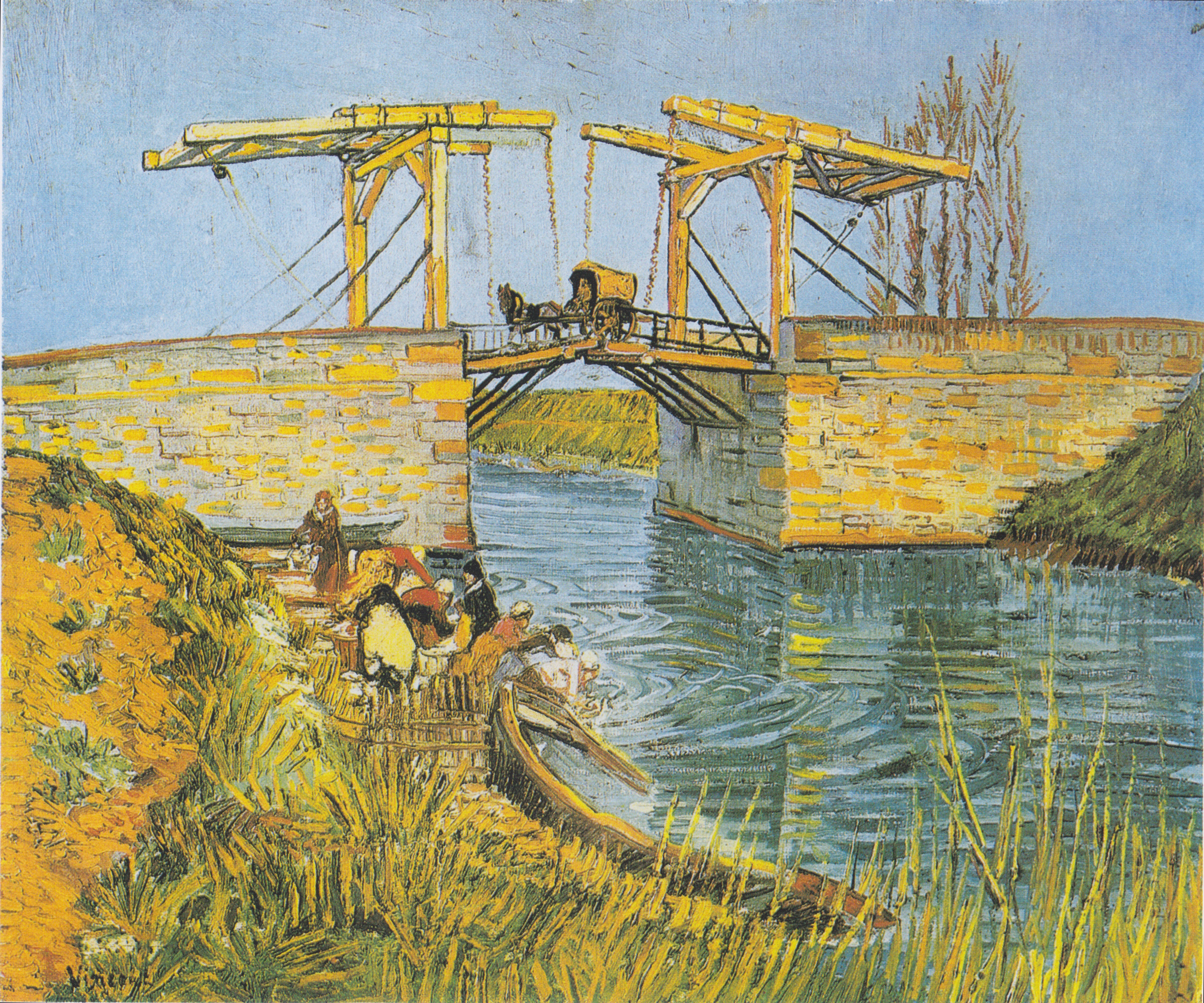
Beyond the architecture, it is the human presence that truly animates this series, particularly through the figures of washerwomen busy along the canal banks. These women, bent under the sun or kneeling in the shallow water, embody a timeless daily activity that anchors the painting in a tangible social reality far from symbolist reveries. Van Gogh paints them with a rapid execution that captures the professional gesture, the movement of the arm beating the laundry or wringing the wet cloth, adding an almost palpable auditory dimension to the silent scene of the canvas. Their presence reminds us that this place is a living work space, an essential meeting point for the local community where news circulates as fast as the current of the Rhone.
There are several versions of this theme in the artist's production during that spring of 1888, each exploring a different angle of the same laborious reality. Some sketches focus on the social group, showing female solidarity in the face of the harsh task, while others isolate a single figure to make a character study in the harsh light. These genre scenes, perhaps inspired by his readings of Zola or his admiration for Millet, show a Van Gogh attentive to the dignity of manual labor. The women's colorful clothes, often enhanced with touches of red or green, punctuate the dominant blue-yellow of the landscape, adding a note of popular cheerfulness that counterbalances the geometric severity of the industrial bridge.
Interior decoration
Where to see the Langlois Bridge today — museums and decoration

To admire the original in all its material splendor, you must travel to Otterlo in the Netherlands, where the Kröller-Müller Museum carefully preserves this testimony of the Arles period. Located in the heart of a wooded national park, the museum offers an ideal setting for contemplation that resonates with the artist's search for nature, allowing the work to be seen in lighting conditions often superior to those of large, crowded urban museums. However, for those who cannot undertake this artistic pilgrimage, high-quality reproductions offer a credible alternative to integrate this colorful vibration into a private space. The key lies in choosing a print capable of rendering the depth of the impasto and the accuracy of the tones, because a faded copy would betray Van Gogh's very intention.
Integrating a reproduction of the Langlois Bridge into a modern interior requires playing on contrasts rather than perfect matching. Place the work in a living room with white or very light gray walls to let the blues and yellows of the canvas explode, creating a dynamic focal point that instantly warms the room's atmosphere. Avoid overly ornate or gilded frames that would compete with the chromatic richness of the painting; a simple frame in natural wood or matte black will suffice to frame this open window onto Provence. As with the Yellow House or the Cafe Terrace at Night, this work brings a vital energy that works particularly well in living spaces where you want to stimulate conversation and creativity through the quiet power of a great master.
Works to know
Famous works by Vincent van Gogh to look at before choosing
For a hand-painted Vincent van Gogh reproduction, an oil Vincent van Gogh painting or a copy of a Vincent van Gogh painting, the most useful thing is to compare several images: the gilding, the faces, the density of the patterns and the way each work holds the wall.
- The Bedroom at ArlesAnother work from Arles, useful for comparing the atmosphere of the Midi, the yellows, the blues and the decorative presence of Van Gogh.
- Cafe Terrace at NightAnother scene from Arles, close by the city, the nocturnal color and this Southern light that refuses to stay tame.
- The Starry NightA reproduction related to Vincent van Gogh, useful for comparing atmosphere, palette and wall presence.
- Where Do We Come From? What Are We? Where Are We Going?A reproduction related to Vincent van Gogh, useful for comparing atmosphere, palette and wall presence.
- The Vision after the SermonA reproduction related to Vincent van Gogh, useful for comparing atmosphere, palette and wall presence.
| Room | Suggestion | Decorative effect |
|---|---|---|
| Living room | A work related to Vincent van Gogh with a strong composition | Cultured focal point, warm and easy to comment on without reciting a label. |
| Bedroom | A soft palette or a more intimate scene | Calm atmosphere, visual presence without unnecessary agitation. |
| Office | A structured, colorful or graphically sharp image | Creative energy and a little reminder that the wall can also work. |
| Entrance | A vertical format or an immediately readable work | Clear, elegant first impression, and definitely less timid than an empty white wall. |

The Vision after the Sermon
A reproduction related to Vincent van Gogh, useful for comparing atmosphere, palette and wall presence.

The Card Players
A reproduction related to Vincent van Gogh, useful for comparing atmosphere, palette and wall presence.
To continue the visit
Sources, collections and paths truly related to the subject
A few useful references to verify information, compare free images and extend the reading without going to a museum that didn't ask for anything.
Useful sources on this subject
FAQ
Frequently asked questions about Vincent van Gogh
What is Vincent van Gogh in painting?
Vincent van Gogh transforms a short, anxious and extraordinarily lucid life into electric painting: Zundert, Nuenen, Paris, Arles, Saint-Rémy, Auvers, letters to Theo, sunflowers, cypresses, blue nights and colors that seem to have plugged the canvas into the mains.
How to recognize this style quickly?
Observe especially the swirling touch, visible impasto, intense yellows, nocturnal blues and complementary colors, then the way the composition organizes the gaze. If the work holds you longer than expected, it's probably no accident.
Which artists should you know?
The main references are Vincent van Gogh, Theo van Gogh, Paul Gauguin, Émile Bernard and Camille Pissarro.
Does this style suit modern decoration?
Yes, provided you choose the right format, a palette consistent with the room and a work whose presence remains pleasant on a daily basis.
Should you choose the most famous work?
Not necessarily. The most famous work can be perfect, but the right choice depends above all on the room, the format, the palette and the desired atmosphere.
Where to verify the information?
Start with museum notes, Wikipedia/Wikidata for general orientation, then Wikimedia Commons when a free image is needed.
An open window onto Provencal eternity
The Langlois Bridge remains much more than a simple topographic view of Arles; it is the silent manifesto of an artist who managed to tame the Southern light without renouncing his Nordic soul. By transforming a piece of hydraulic engineering into a symphony of complementary colors, Vincent van Gogh teaches us that beauty lies not in the nobility of the subject, but in the intensity of the gaze upon it. Whether contemplating the original in Otterlo or a reproduction hung in a contemporary living room, the effect remains identical: an invitation to see the world with more clarity, more courage and above all, with more color. This bridge, ultimately, not only connects two banks of a canal, but permanently unites the modern viewer to that pure and electrifying joy that the painter captured one day in February 1888.
0 comments