

Milan · Drawing · Sculpture
Horses by Leonardo da Vinci
From nostrils to hooves, from calm steps to battle pranks: Leonardo measures real horses to design the most ambitious equestrian monument of the Renaissance.


The short answer
Why did Leonardo draw so many horses?
Because a monument three times larger than life could not be improvised. He observes specific individuals, compares breeds, draws the same animal from multiple angles, measures limbs and checks how weight passes through the skeleton to the ground.
Identify
Each horse has its proportions, its neck and its temperament.
Measure
Dimensions are added to drawings made first freehand.
Compare
Face, profile, back and leg details control volume consistency.
Animate
Step, twist, prune and struggle turn anatomy into action.
I · In the stables
Drawing real horses, not an abstract ideal
A leaf as the animal's tower
The same page brings together a front horse, a hindquarters, a slightly receding profile and small movement studies. According to the Royal Collection, several sheets linked to the monument represent specific animals from the stables of the Milanese army.
Leonardo first draws freely then adds the measurements. These probably serve to control the large clay model: working very close to a gigantic sculpture, he would have difficulty judging the proportions with a single glance.
Horse's not Vitruvian Man
Leonardo does not seek a universal and "divine" horse proportion. He notes that races and individuals differ, then empirically records their dimensions.
II · Movement
From the motionless horse to the battle corps


Movement never erases structure
A prancing horse is not just a spectacular silhouette. Leonardo observes the thrust of the hindquarters, the flexion of the joints, the abdominal tension, the head posture and the reaction of the rider.
This knowledge makes expressive exaggeration possible: the animal can become more powerful or more furious without losing all mechanical credibility.
III · The Great Cavallo
The monument to Francesco Sforza
Dynastic commission, sculptor challenge and engineer operation.
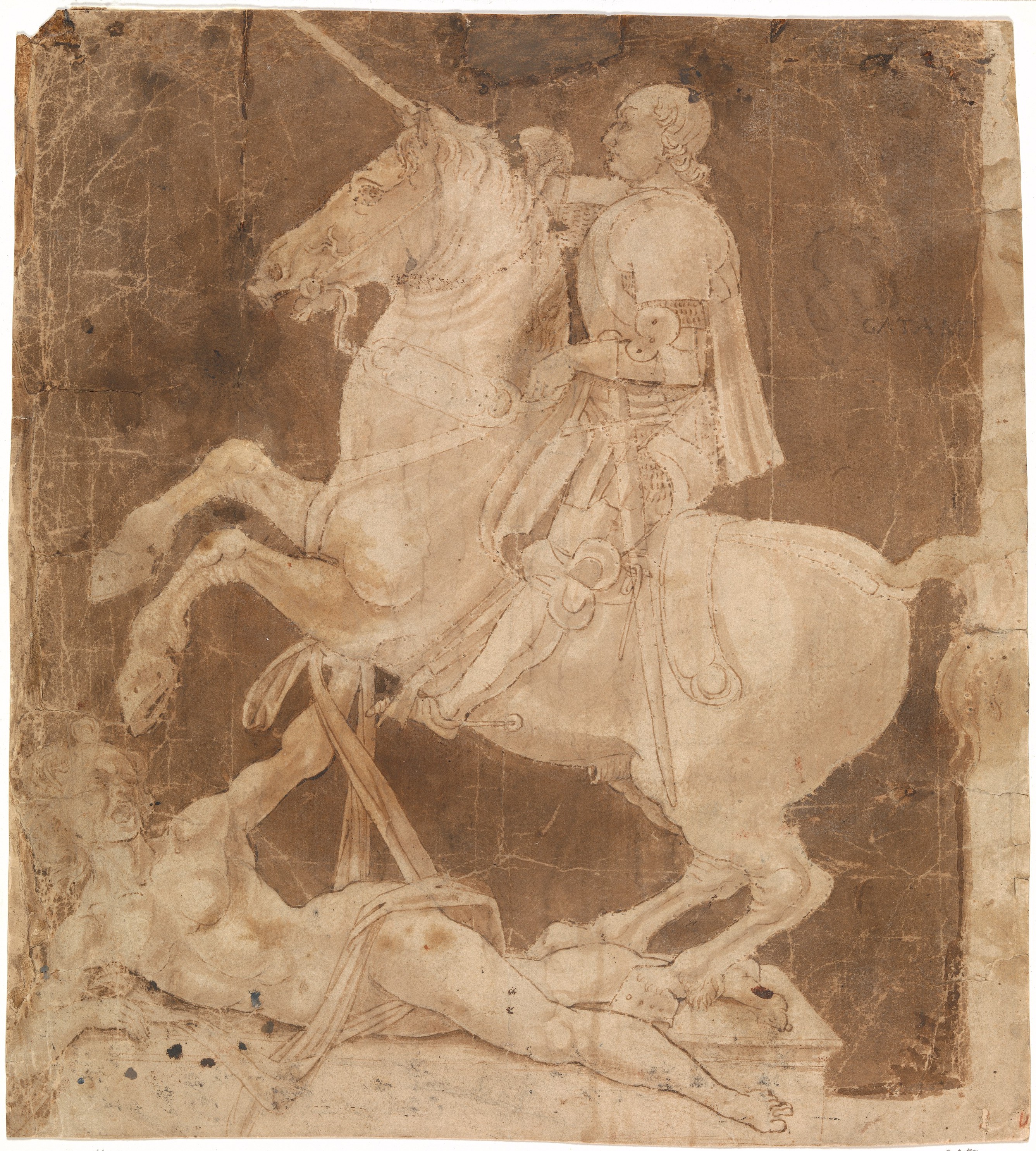
Before Leonard
Pollaiuolo and Florentine competition
The Metropolitan Museum drawing shows Francesco Sforza on a prancing horse trampling an enemy. It could be a competing proposal presented to Ludovico. Leonardo also initially adopted a prancing pose, but the problem of balance and melting was considerable.
The project finally evolves towards a horse advancing with a raised front, more stable and more compatible with a colossal sculpture.
IV · Engineering
How to sink a gigantic horse?

From modeling to foundry
Leonardo does not stop at the external shape. Its leaves study molds, cores, metal inlet channels, pits, pulleys and handling mechanisms. He plans an entire foundry to control the operation.
- a clay model much larger than actual size;
- a mold capable of recording surface;
- a core maintaining a controlled bronze thickness;
- metal circulation limiting cooling and defects;
- devices for moving masses.
Bronze never hits the mold: war transforms the material of the monument into artillery.
| Problem | Response from Leonardo | Risk |
|---|---|---|
| Scale | Detailed measurements and model approximately three times life size. | Invisible deformations when working too close. |
| Balance | Probable abandonment of the nose-up for a three-support installation. | Concentrated weight and limb rupture. |
| Cast iron | Study of channels, molds, core and devices. | Premature cooling, bubbles and incomplete casting. |
| Logistic | Pulleys, pits and transport structures. | Mass impossible to handle in one piece. |
V · What exists today
Milan horse is not Leonard's original
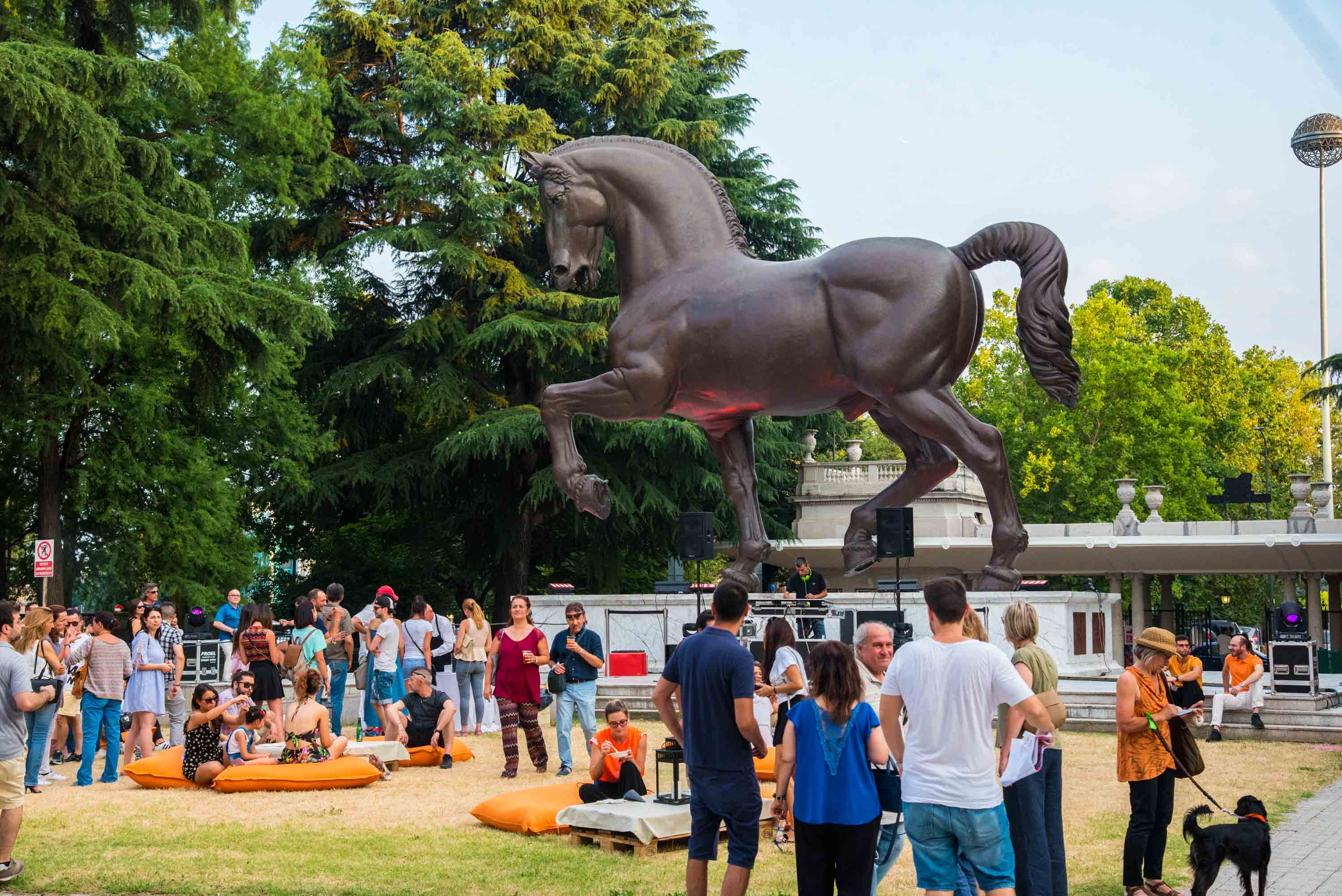
A modern interpretation by Nina Akamu
The bronze installed in 1999 near the San Siro racecourse is a modern creation inspired by Leonardo's drawings and research, carried out by the sculptor Nina Akamu. This is neither a cast of the destroyed model nor the certain execution of a fully documented final project.
Its value is commemorative: it gives an idea of the dream scale, while belonging to the contemporary history of Leonardo's reception.
Controlled sources
Drawings and history of the project
Continue
Drawing, anatomy and movement
FAQs
Questions about the Grand Cavallo
Why did Leonardo study horses?
For his paintings and especially to design the colossal equestrian monument dedicated to Francesco Sforza.
Has the Sforza monument been built?
No. A large clay model was built, but bronze was diverted for cannons and the model destroyed in 1499.
How big should he be?
The horse must have been about three times larger than life; precise figures vary according to modern reconstructions.
Why was bronze requisitioned?
The military situation required artillery manufacturing before the French invasion of Milan.
Is the horse of San Siro by Leonardo?
No. It is a modern interpretation created by Nina Akamu and inaugurated in 1999.
Did Leonardo dissect horses?
Drawings indicate that he studied the internal anatomy of a large quadruped probably horse-drawn, but the direct connection to the monument must be formulated carefully.
0 comments