

Rembrandt · 1660 · biblical scene
The Denial of Saint Peter
A candle, a raised hand and a look from the depths of the night.
Rembrandt not only recounts a betrayal. He constructs the moment when Peter still tries to deny while the gaze of Christ already transforms his gesture into a recognized fault.

The short answer
An inner drama painted like a night scene
The servant's light reveals Peter at the very moment he refuses to be recognized. His face and open hand occupy the focus of the composition; Christ, almost erased in the right background, turns towards him.
This distance is the heart of the painting. Two events take place simultaneously: in the foreground, a seemingly familiar confrontation around a table; at the bottom, the passage of the prisoner who gives each gesture its significance spiritual. Depth transforms a nocturnal anecdote into tragedy.
Rembrandt avoids emphasis. Pierre does not shout, the servant does not throw herself at him, the soldiers do not necessarily understand the importance of what is at stake. The fault arises in the middle of ordinary gestures, metal, fabric and a small flame protected by a hand.
Watch first: the diagonal that connects the candle, Peter's raised hand, his face then Christ turned back to the bottom.
I · Read the scene
Five actors, five degrees of consciousness
She recognizes
The candle lights his profile and his hand. She looks at Pierre and pronounces the accusation that sets the story in motion.
He denies
His palm pushes away the words. But his hidden gaze and heavy face indicate that certainty is already cracking.
He observes
Helmet and armor capture light. His presence transforms domestic speech into a physical threat.
He continues
Sitting on the left, he drinks. His indifference makes the scene more credible and reminds us that the drama can remain invisible to witnesses.
He knows
Small, distant, chained, he turns around. His gaze crosses the depth and gives denial its moral dimension.
Composition genius: the physically smallest character is the one who gives meaning to the entire scene.

Candle · metal · skin
The flame does not show everything: it selects
The light source is almost hidden by the servant's hand. Rembrandt paints less of a candle than a field of effects: the yellow of the veil, the cheek, the palm, Pierre's fingers and the broken reflections on the armor.
Light does not propagate evenly. It encounters surfaces: matte skin, absorbent fabric, reflective metal. Each material therefore receives a different intensity and quality. The spectator reconstitutes the flame from its consequences.
This light also has a narrative function. It exposes those who would like to escape the gaze. Pierre denies verbally, but his body is highlighted. The lighting acts as a second accusation, silent and impossible to refute.
A local light
The candle produces a close circle, not general lighting. The outside world remains in the night.
Discontinuous reflections
The helmet and armor shatter the clarity, opposed to the velvety passages of the faces.
An active shadow
Dark areas separate groups and make possible the gradual discovery of Christ.
A moral light
To be enlightened here means to be recognized. Pierre appears before accepting what he has just done.
II · The story without words
Peter's hand says "no"; his body already says something else
The open palm can be read as a denial, a defense or a refused oath. It is large and bright enough to become the true optical center of the painting.
Pierre does not look frankly at the servant. His gaze slides, his forehead hollows and his mouth remains almost closed. Rembrandt paints less the eloquence of a lie than the moment when the liar feels his own words turning against him.
The servant moves her face forward slightly but protects the flame. Her gesture is precise, almost professional. She does not embody evil: she simply recognizes someone. This neutrality makes the fall of Pierre more human.
- The hand protects the flameThe servant retains the source of visibility.
- The finger pointsThe accusation circulates from his gaze towards Pierre.
- The palm grows backPierre denies with a gesture more visible than his words.
- Christ turns aroundThe background responds to the foreground and completes the story.

Background · memory · repentance
Why is Christ so small?
Christ is not reduced because he would be secondary. His smallness measures the distance created by Peter's fear. The viewer must look for this figure on the right, as he must reconstruct the scope of the denial behind the appearance of a conversation.
The painting brings two stages together: the words of Peter in the foreground and, almost simultaneously, the gaze of Christ led by his guards. This construction particularly corresponds to Luke's account, where Jesus turns around after the third denial and provokes the memory of the prediction.
Rembrandt paints neither the rooster crowing nor the tears that will follow. He chooses the threshold: Peter is not yet collapsed, but the relationship of looks makes repentance inevitable. The work of 1645, Saint Peter in penance, shows the other side of the same story: loneliness, keys and remorse.

Bible · interiority · late period
A biblical story without spectacular theater
Rembrandt's latest religious paintings do not renounce drama, but they displace it. Miracle or heroic action often gives way to hesitation, the weight of a face, the fatigue of a body and the difficulty of believing.
This orientation does not mean that the artist paints a directly readable personal confession. Rather, it shows how he makes contemporary biblical figures: fallible, closely observed, and subject to psychological duration.
In the Denial, no character has total control of the scene. Even the soldiers remain partially absorbed in their occupations. The spectator becomes the one who connects the scattered signs.
III · A European scene
Rembrandt after Caravaggio
Pierre's denial was a privileged subject of Caravaggesque painters: darkness, candles, soldiers, close figures and counted gestures. Rembrandt knows this visual culture, but he transforms it through depth and psychological ambiguity.


Decisive difference: in Rembrandt, Christ belongs to a second space. The depth makes the distant gaze a response to the denial of the foreground.
IV · Material history
A large late painting, purchased by the Rijksmuseum in 1933
The painting is painted in oil on canvas and measures 154.5 × 169.5 cm. This scale gives the characters in the foreground an almost life-size presence, while retaining enough space for the second scene.
The Rijksmuseum file mentions the work in the inventory of Marten Davidsz van Ceulen in the 17th century, then several French collections. The museum acquired it in 1933 with the support of the Vereniging Rembrandt.
Preserving dark passages is always tricky: abrasion, varnish and retouching can change the shades that initially separate the shapes. Look at an old reproduction, a very bright screen or a photograph overexposed can therefore make part of the night work disappear.
To read the work, two excesses must be avoided: blackening the shadows until you lose Christ or lightening the entire canvas until you transform the night into a uniform setting.
Inventory number: SK-A-3137. The Rijksmuseum also gives a persistent address: id.rijksmuseum.nl/200107933.
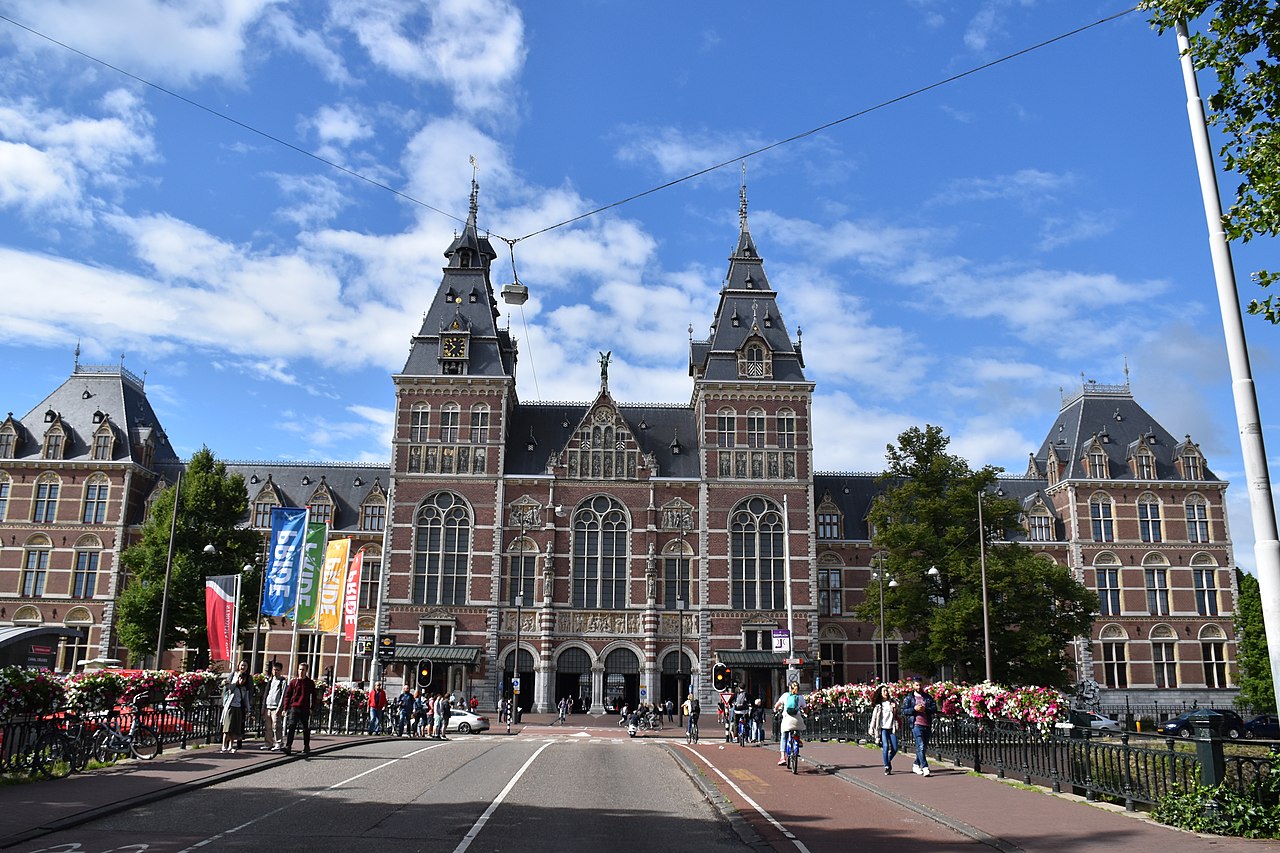
Amsterdam · collection · visit
Where to see The Denial of Saint Peter?
The work belongs to the Rijksmuseum. It is not necessarily located in the Gallery of Honor: the hanging of religious and late paintings can change depending on loans, restorations and exhibitions.
Before the visit, consult the official sheet and use the number SK-A-3137 in the museum search. The sheet allows the painting to be unambiguously identified, even if its title varies between The Denial of St Peter, By verloochening van Petrus and The Denial of Saint Peter.
On site, start a few meters away to spot Christ at the bottom, then move closer to observe the transitions around the candle and the reflections on the armor. Finally step back: the little figure of Christ must continue to act despite the distance.
The museum photograph is used under the Creative Commons license; Rembrandt's painting is in the public domain.
Reproduction and Rembrandt journey
Extend analysis in store
The Denial of Saint Peter
Oil reproduction, customizable formats and finishes.
CollectionRembrandt's paintings
Portraits, biblical scenes, chiaroscuro and late works.
Biblical paintingSelf-portrait as an apostle Paul
Compare two religious works from the late period.
CompareThe Denial of Caravaggio
A tighter drama, constructed by gestures and counting.
NocturneHonthorst's version
The Caravaggesque flame as the visible center of action.
CandleGeorges de La Tour's version
Silence, slow light and meditation around the same episode.
Frequently asked questions
The table in twelve answers
When did Rembrandt paint The Denial of Saint Peter?
The painting is dated 1660, in the late Rembrandt period.
Where is the painting located?
It belongs to the Rijksmuseum Amsterdam, under inventory number SK-A-3137.
What are its dimensions?
The canvas measures 154.5 cm high by 169.5 cm wide. Its format is therefore slightly horizontal.
What moment in the Gospel does Rembrandt represent?
The servant recognizes Peter as a disciple of Christ. Peter denies knowing him, fulfilling the prediction that he would deny him three times before the rooster crows.
Why is the scene nocturnal?
The story takes place during the night interrogation of Jesus. Rembrandt uses this darkness to isolate faces, contrast ignorance with recognition, and make light a moral instrument.
Where is Jesus in the painting?
Christ appears in the background, right. Led by guards, he turns his head towards Peter at the moment of denial.
Who holds the candle?
A servant of the high priest's house. She enlightens Peter and points him out, becoming at the same time witness, accuser and light source of the scene.
Why does Peter raise his hand?
Her open hand materializes the negation: she pushes away the accusation while drawing our gaze towards her troubled face.
Does the rooster appear in the table?
No. Rembrandt does not literally represent the rooster associated with the story. It focuses on the psychological moment that precedes awareness and repentance.
Is the painting inspired by Caravaggio?
He belongs to a European culture of nocturnal and chiaroscuro marked by Caravaggio, but Rembrandt transforms the tavern scene into an inner drama, multiplies the depths and connects Peter to the distant Christ.
Is there a reproduction of the painting?
Yes. Alpha Reproduction offers an oil reproduction of Rembrandt's Denial of Saint Peter, with choice of format and finish.
Can we see the painting permanently at the Rijksmuseum?
It belongs to the museum's collections, but a change of hanging or loan remains possible. It is prudent to check the official sheet before the visit.
Sources and notices consulted
Rijksmuseum - The Denial of St Peter, official notice.
Rijksmuseum - persistent address of the work.
Rijksmuseum - Saint Peter in Penitence, 1645.
Wikimedia Commons - public table file and metadata.
Wikimedia Commons - photograph of the Rijksmuseum by Vasyatka1.
Article verified on August 11, 2026.
0 comments