

Monet's Japanese Bridge • Art & Decoration Guide
Monet's Japanese Bridge: Chronicle of an Arch That Changed Painting
Dive into the heart of the Giverny water garden, where a small green wooden bridge became the stage for a visual revolution among water lilies and reflections.
There are engineering works that cross rivers, and then there is this small wooden bridge painted bottle green that crossed the history of modern painting without even getting its ankles wet. Located at the heart of the water garden that Claude Monet patiently shaped in Giverny from 1893, this modest structure was not meant to connect two practical banks, but to unite the observer with a new vision of the world. It is not simply a garden accessory for strollers in bowler hats; it is the vanishing point where reality begins to dissolve into light. By buying Japanese prints and diverting the course of the Epte, Monet did not build a set; he forged an optical laboratory where each cedar plank became a question posed to pure color.
 Free Image
Dive into the heart of the Giverny water garden, where a small green wooden bridge became the stage for a visual revolution among water lilies and reflections.
Reading Method
Reading the Bridge Like a Score of Light
To appreciate these works, you must forget the architectural structure and let yourself be carried by the rhythm of the brushstrokes. Observe how the arch gradually disappears in favor of the vibration of the water, transforming a static subject into a unique temporal experience.
Context Before Prestige
We place Monet's Japanese Bridge in its era, its studios, its exhibitions, and its small rebellions. A work without context is sometimes just a very beautiful person who forgot their history.
The Signs That Betray the Style
We identify composition, palette, texture. These clues often say more than grand speeches, especially when they carry gold or nervous brushstrokes.
The Work in a Real Room
We end with the useful question: does this image breathe in your home, or does it just pose like a poster that has read two books?
Historical Context
Where Does Monet's Japanese Bridge Come From, and Why Is It Not Just a Pretty Label?

It all begins with a territorial and aesthetic obsession when Monet acquires a marshy plot opposite his Norman property in 1890. He obtains permission with difficulty to divert a branch of the Epte to create an enclosed basin, a true artificial mirror designed to capture the sky and vegetation without the slightest external disturbance. Above this stagnant body of water, carefully maintained to encourage the growth of water lilies, he had a bridge erected in 1895, directly inspired by the prints of Hiroshige and Hokusai that he had been fervently collecting for decades. It is not a servile copy, but a Western reinterpretation of an Eastern form, painted in that intense green that violently contrasts with the pinks of the azaleas and the tender greens of the surrounding weeping willows.
This garden was not open to the public like a municipal park, but constituted the most complex open-air studio ever imagined by an artist. Monet employed up to seven gardeners working daily to dust the lily leaves and trim the wisteria, transforming nature into a malleable raw material for his painting. The bridge itself, with its high, narrow arch, serves as a natural frame that forces the gaze to focus on the water's surface rather than the distant horizon. In this context, the bridge motif becomes less an architectural object than a pretext to study how light passes through the foliage and breaks on the water, already heralding the total dissolution of forms that would characterize his later creative years.
Artistic Style
Why Does Monet's Japanese Bridge Still Fascinate?

The persistence of fascination with these paintings lies in their unique ability to suspend time, freezing a precise second of a Norman summer day for eternity. Unlike classical landscapes that seek geological permanence, Monet captures the fleeting instant when a cloud's shadow radically alters the perception of colors under the bridge's arch. Each painted version, whether from 1899 or 1924, tells a different meteorological story, showing how the same object can become unrecognizable under a fine rain or burst into a thousand flames in the full midday August sun. This approach overturned the hierarchy of genres by proving that a simple corner of a garden could contain as much dramatic complexity as a historical battle or a traditional religious scene.
Beyond the historical anecdote, it is the radical modernity of the composition that continues to speak to contemporary viewers accustomed to fragmented images. By progressively eliminating the horizon line and filling the canvas to the edges with water and flowers, Monet anticipates the lyrical abstraction of the 20th century without ever completely renouncing the real subject. The bridge acts as a familiar visual anchor in an ocean of pure colors applied in distinct strokes, offering the eye a reference point before inviting it to lose itself in chromatic vibration. It is this tension between the immediate recognition of the motif and the delightful confusion of the pictorial matter that makes each encounter with the work as fresh and surprising as in the days of the first Impressionist exhibitions.
Art & Details
The Visual Signs That Betray the Style

Recognizing a version of the Japanese Bridge requires looking for the absence of sharp outlines and the absolute primacy given to light reflection over physical structure. The bridge's arch is often only suggested by a curve of dark greens and blues, while the railings are reduced to horizontal white or red strokes that seem to float in an indefinite space. The palette is dominated by a symphony of greens, ranging from the deep emerald green of calm waters to the acidic chartreuse green of young spring shoots, enhanced by the pink, mauve, and white spots of blooming water lilies. The matter itself is palpable, with generous impasto that gives relief to the water, transforming a liquid surface into a textured fabric almost tangible under the viewer's imaginary fingers.
Another distinctive sign lies in the tight framing that systematically excludes the direct sky, forcing the sky to exist only through its inverted reflections in the basin. This inversion creates a sensation of gentle vertigo where up and down exchange places, destabilizing the usual gravity of the traditional landscape. The weeping trees fall like stage curtains on the sides, framing the view and reinforcing the intimacy of the scene, as if the viewer were hidden in the reeds. The light does not come from a single identifiable source but seems to emanate from the canvas itself, created by the juxtaposition of complementary strokes that vibrate optically when one steps back a few paces from the painting.
Art & Details
The Works to Look at as If They Were About to Answer

Among the twenty or so existing versions, the one preserved at the Musée d'Orsay, painted around 1899, offers a perfect balance between the legibility of the bridge and the poetry of aquatic reflections. The wooden structure with its precise architectural details is still clearly visible, while the water is already beginning to become a carpet of colors where the shapes of the plants gently dissolve. Conversely, the late canvases created after 1918, visible in certain private collections or at the Musée Marmottan, push the logic to its peak: the bridge becomes a simple arched suggestion, almost ghostly, drowned in an explosion of greens and violets. These late works directly foreshadow the great decorations of the Water Lilies at the Orangerie, where the architectural subject finally disappears entirely in favor of total immersion in the liquid element.
It is also fascinating to observe the variations according to the hours, like the series painted early in the morning where a light mist envelops the bridge, softening contrasts and unifying the scene in subtle gray-blue tones. Conversely, the midday versions present harsh shadows and saturated colors that give the garden an almost tropical intensity, far from the expected Norman softness. Each painting responds to a specific atmospheric condition, proving that Monet was not painting a place, but an infinite succession of luminous moments. Looking at these works side by side is like flipping through a notebook of artistic meteorology where each page reveals a different mood of the same secret garden.
Art & Details
Symbols, Details, and Little Visual Quirks
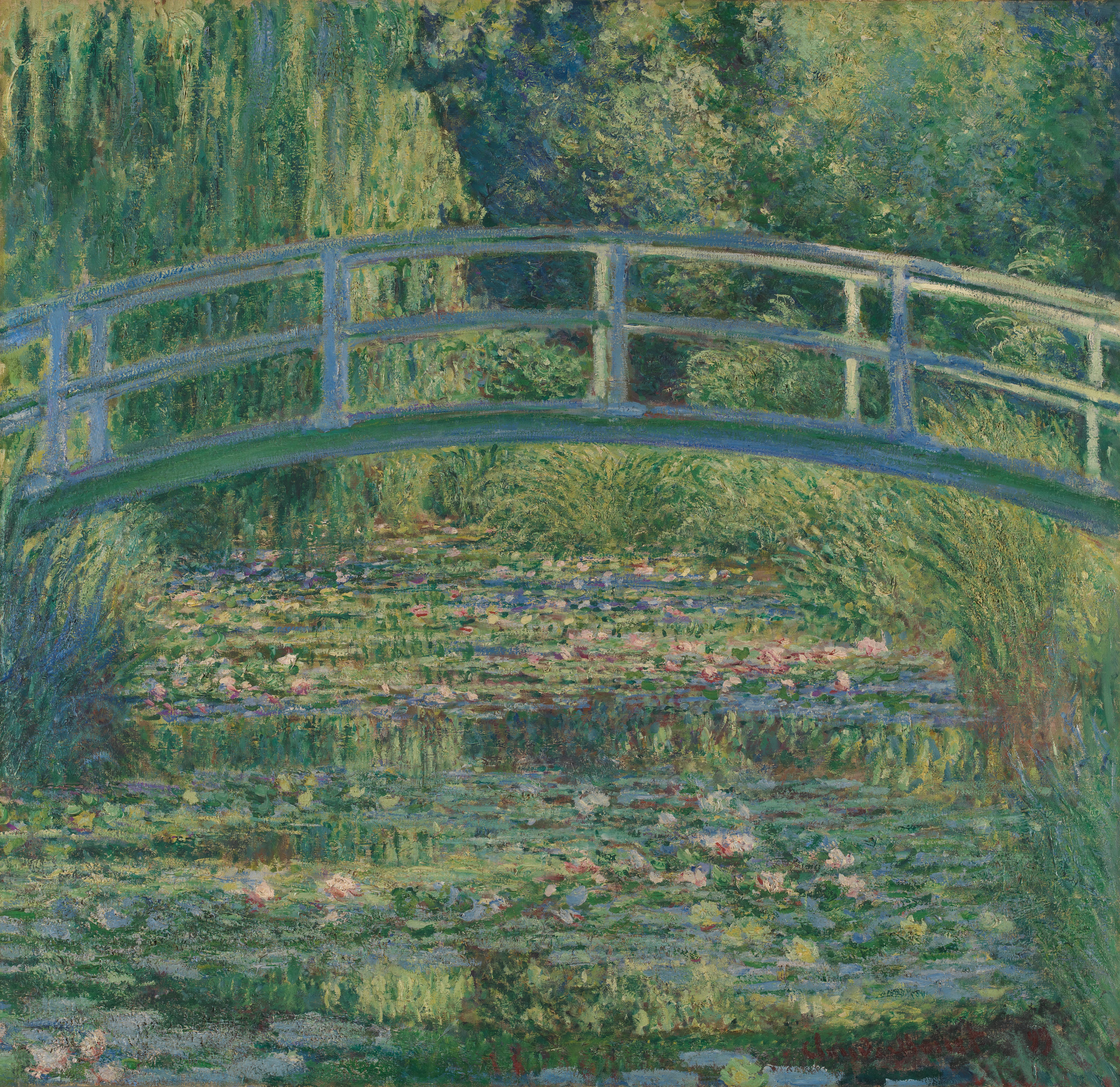
The bridge is not just a decorative element; it symbolizes the passage between the real world, that of solid ground and daily worries, and the contemplative world of the basin, the realm of the mind and art. This arch functions as an initiatory threshold, recalling the curved bridges of Japanese Zen gardens designed to slow the walk and invite meditation on perpetual change. Monet, a great lover of prints, integrated this Eastern philosophy into his Western practice, using the bridge as a central axis that structures the apparent chaos of the lush vegetation. The wisteria that falls in violet clusters on the sides adds a vertical dimension that counterbalances the dominant horizontality of the water, creating a dynamic balance typical of mastered Asian compositions.
In the details, one often notices the total absence of human presence, despite the fact that the garden was constantly maintained by numerous teams. This deliberate solitude reinforces the impression of being alone facing nature, in a silent tête-à-tête with the elements. The reflections are sometimes treated with more precision than the real objects themselves, inverting the usual hierarchy of perception to suggest that the image in the water is truer than tangible reality. Monet also plays with the seasons, painting the bridge under snow or surrounded by russet autumn leaves, showing that even the most fixed structure is subject to the relentless cycles of time and changing light.
Art & Details
Neighbors, Allies, and Turbulent Cousins

Although Monet is the only one to have made this specific bridge a serial obsession, the influence of Japonisme permeated all of Impressionism, touching artists like Mary Cassatt or Edgar Degas in their choices of off-center framing. However, where Degas used these principles to capture urban life and the abrupt movements of dancers, Monet applied them to still nature, seeking permanence in the transient. His painter friends often came to Giverny, but none adopted this motif with the same devotion, often preferring cathedrals, haystacks, or cliffs for their own studies of light. The bridge thus remains the exclusive signature of Monet's universe, a strong identity marker that immediately distinguishes his work from that of even his closest contemporaries.
The legacy of this approach is later found among American Abstract Expressionists like Jackson Pollock or Mark Rothko, who visited the Orangerie and were overwhelmed by the total immersion offered by the large water lily panels. They understood that Monet had freed color from the obligation to faithfully describe form, paving the way for a painting where emotion takes precedence over literal representation. The Japanese bridge is therefore the missing link between the classical landscape of the 19th century and the triumphant abstraction of the 20th, a turbulent cousin that blurred the lines between figuration and non-figuration. It proves that a major innovation can arise from the patient observation of a simple garden structure rather than from a brutal theoretical break.
Art & Details
What Museums Confirm When Shortcuts Go Too Fast

Institutions like the Musée d'Orsay in Paris or the Metropolitan Museum of Art in New York preserve key versions that allow us to measure the stylistic evolution over several decades. A careful visit to their galleries reveals that what is often taken for lazy repetition is actually a rigorous scientific exploration of the possibilities of human perception. The labels and technical analyses show the use of specific pigments, such as emerald green or cobalt blue, whose chemical stability has allowed these works to retain their original brilliance despite time. These museums also offer the necessary distance to compare the small formats of the 1890s with the monumental canvases of the 1920s, highlighting Monet's growing ambition to create a total visual environment.
Beyond conservation, these places play a crucial role in historical contextualization, reminding us that these paintings were sometimes mocked or misunderstood at their creation before becoming universal icons. Temporary exhibitions often relate the paintings to the original Japanese prints from Monet's personal collection, visible in Giverny, thus illuminating the direct sources of his inspiration. Seeing these works in situ, under controlled lighting that respects the delicacy of the glazes, allows one to understand why digital reproductions often fail to convey the depth and real vibration of the matter. It is in the respectful silence of these galleries that the bridge regains all its evocative power.
Art & Details
How to Choose a Reproduction Without Making the Wall Panic?

To integrate a reproduction of the Japanese Bridge into a modern interior, you should favor large formats that allow the eye to get lost in the details of the reflections, ideally in a living room or a quiet study. Versions with dominant greens and blues pair perfectly with light, cream, or pearl gray walls, creating a visual extension of the space that brings freshness and serenity. Avoid overly ornate or gilded frames that would compete with the complexity of the painting; a thin natural wood frame or a canvas mounted on a stretcher without a border works better to respect the immersive spirit of the work. Lighting should be soft and diffuse, mimicking the natural light of an overcast day, to avoid creating unwanted reflections on the surface of the reproduction that would break the illusion of depth.
If your decor already includes plant elements or natural materials like rattan, linen, or raw wood, the painting will reinforce this organic atmosphere without heaviness. However, be careful not to place the work in a high-traffic area where it would be seen too quickly: the Japanese Bridge requires time to reveal itself, like the original garden. For a bedroom, prefer the more misty or twilight versions, with cooler, more soothing tones that promote rest, while the bright midday versions will energize a workspace more. The goal is to create an illusory window onto a calm world, not to simply add a colorful object on an empty wall.
Interior Decoration
Mistakes to Avoid Before Hanging the Painting

The first mistake is to choose a poor-quality reproduction where the nuances of greens are flattened into a single uniform shade, destroying all the subtlety of Monet's light work. A pixelated or poorly printed image will turn this masterpiece of optical vibration into a muddy, incomprehensible blotch, losing the very essence of Impressionism. Always check the color fidelity and sharpness of the brushstrokes on the preview before purchasing, because the richness of the work lies precisely in these micro-chromatic variations. Similarly, avoid hanging the painting facing a direct window that would cause constant glare, making the image unreadable at certain times of the day.
Another frequent faux pas is to associate this work with overly thematic or kitschy decor, such as cheap Japanese-style accessories or garish artificial plants. The Japanese Bridge possesses a dignity and universality that suffer poorly from cultural caricature; it should dialogue with the overall architectural space rather than serve as a literal illustration of a decorative theme. Finally, do not neglect the hanging height: the center of the work should be at eye level so that the implicit horizon of the water corresponds to your own line of sight, ensuring optimal immersion. Respecting these simple principles guarantees that the painting will remain a source of lasting contemplation and not just a passing trend.
| Room | Suggestion | Decorative Effect |
|---|---|---|
| Living Room | A work related to Monet's Japanese Bridge with a strong composition | Cultivated focal point, warm, and easy to comment on without reciting a label. |
| Bedroom | A soft palette or a more intimate scene | Calm atmosphere, visual presence without unnecessary agitation. |
| Office | A structured, colorful, or graphically sharp image | Creative energy and a small reminder that the wall can also work. |
| Entryway | A vertical format or an immediately readable work | Clear, elegant first impression, and decidedly less shy than a white void. |
To Continue the Visit
Sources, Collections, and Paths Truly Related to the Subject
A few useful references to verify information, compare free images, and extend the reading without heading to a museum that didn't ask for anything.
Related Articles to Read Next
Useful Blog Hubs
FAQ
Frequently Asked Questions About Monet's Japanese Bridge
What is Monet's Japanese Bridge in painting?
Monet's Japanese Bridge deserves an in-depth article because this style engages both an era, a way of painting, and a very concrete way of living with images.
How to quickly recognize this style?
Observe especially composition, palette, texture, light, and atmosphere, then the way the composition organizes the gaze. If the work holds your attention longer than expected, it is probably not an accident.
Which artists should you know?
You need to cross-reference the central artists of the movement with museums and reliable sources to avoid too hasty attributions.
Is this style suitable for modern decoration?
Yes, provided you choose the right format, a palette consistent with the room, and a work whose presence remains pleasant on a daily basis.
Should you choose the most famous work?
Not necessarily. The most famous work can be perfect, but the right choice depends above all on the room, the format, the palette, and the desired atmosphere.
Where to verify the information?
Start with museum notices, Wikipedia/Wikidata for general orientation, then Wikimedia Commons when a free image is needed.
An Arch Open to Infinity
Ultimately, Monet's Japanese Bridge remains much more than a recurring motif or a symbol of Giverny; it is a permanent invitation to slow down the gaze and rediscover the ordinary magic of light on water. This small wooden structure, initially designed for the pleasure of a solitary walk, ended up bearing the weight of a major artistic revolution, carrying painting toward new shores where form fades in favor of sensation. Whether hung in a prestigious museum or carefully reproduced in a contemporary living room, it retains that rare power to transform a wall into a window open onto a timeless garden. By choosing to live with this image, you are not just buying a decoration; you are adopting a way of seeing the world, more attentive, more poetic, and resolutely turned toward the fleeting beauty of the present moment.
0 comments