

Monet's Magpie • Art & Decoration Guide
Monet's Magpie: The Guide That Looks Under the Varnish
A deep dive into the major 1869 work where snow becomes light, explained for those who want to understand before they hang.
Imagine a winter morning in Normandy, around 1868, where the cold is so sharp it seems to crystallize the air itself. Claude Monet, then a young man far from the glory of the Water Lilies, sets up his easel in front of a rustic gate and a solitary bird. This painting, today a treasure of the Musée d'Orsay, is not simply a charming genre scene; it is a silent revolution. Where his contemporaries painted snow in pure white or sad gray, Monet dares to see violet, blue, and even golden reflections in the shadows. This work marks the precise moment when painting stops copying reality to capture the fleeting sensation of light on matter.
 Free Image
A deep dive into the major 1869 work where snow becomes light, explained for those who want to understand before they hang.
Reading Method
How to Observe This Winter Scene
To fully appreciate The Magpie, you must abandon the preconceived idea that snow is uniform. Observe how the brushstroke varies depending on whether it describes the rough wood of the fence or the immaculate powder of the ground. Look for the light source, often low in winter, which casts long, colored shadows, transforming an ordinary landscape into an optical theater. Finally, note the presence of the animal, a tiny black dot that animates the entire composition and gives the whole piece its title, creating a perfect balance between the living and the frozen mineral.
Context Before Prestige
We place Monet's Magpie in its era, its studios, its exhibitions, and its small revolts. A work without context is sometimes just a very beautiful person who has forgotten their history.
The Signs That Betray the Style
We identify composition, palette, texture. These clues often say more than grand speeches, especially when they carry gold or nervous brushstrokes.
The Work in a Real Room
We end with the useful question: does this image breathe in your home, or does it just pose like a poster that has read two books?
Historical Context
Where Does Monet's Magpie Come From, and Why Is It Not Just a Pretty Label?

This canvas was painted during the winter of 1868-1869, while Monet was living in Étretat, Normandy, fleeing Paris and his debts. At that time, the artist was not yet the recognized leader of Impressionism; he struggled to exist in the face of a very conservative official Salon that often rejected his audacities. The context is one of real financial precariousness, but also of total creative freedom far from Parisian judges. It was in this Norman isolation, facing the cliffs and harsh winters, that he developed his unique way of capturing atmosphere, long before the term Impressionism was coined by mocking critics in 1874.
Unlike traditional studio paintings of the time, made with earthy colors and controlled lighting, The Magpie was born outdoors, directly confronting the elements. Monet had to work quickly, because the light was constantly changing and the snow was melting or getting dirty before his eyes. This urgency imposed a rapid technique, visible brushstrokes, and a light palette that scandalized purists accustomed to bituminous browns. The work thus embodies a fundamental break: it does not tell a moral or historical story, but fixes the present moment, the temperature of the air, and the vibration of light on an ordinary landscape.
Artistic Style
Why Does Monet's Magpie Still Interest Us So Much?

The enduring success of this work lies in its universal ability to evoke the absolute silence of a winter morning. Everyone knows that feeling of muffled sound when snow covers the world, and Monet succeeded in translating this acoustic phenomenon into visual language. The composition, dominated by the white immensity diagonally crossed by the cast shadow of the fence, creates a modern geometric tension that appeals as much to lovers of classical art as to contemporary minds. This balance between apparent emptiness and the hidden chromatic richness in the shadows fascinates because it invites active contemplation rather than passive consumption of the image.
Moreover, The Magpie represents a major technical turning point in the history of Western art thanks to its revolutionary handling of colored shadows. Before Monet, academicians taught that shadow was simply the absence of light, therefore gray or black. Here, the artist demonstrates that shadow is filled with reflected light, taking on bluish, purplish, and sometimes pinkish hues depending on the sky and environment. This scientific discovery applied to painting paved the way for all modern art, making this small painting a discreet but powerful manifesto. Its presence at the Musée d'Orsay attracts millions of visitors who come seeking this promise of luminous serenity.
Art & Details
The Visual Signs That Betray the Style
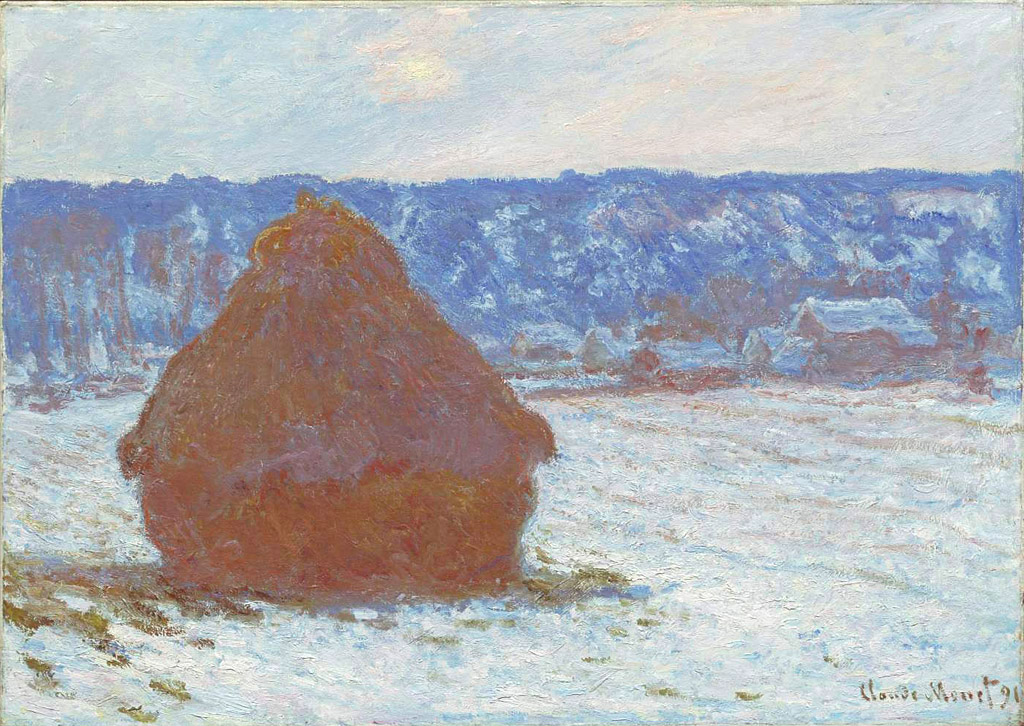
The first distinctive sign lies in the palette used for the snow, which is far from a uniform white straight from the tube. If you look closely, you will see that the shaded areas under the fence are treated with mixtures of cobalt blue, violet, and touches of pale green, while the lit areas capture subtle yellows and ochres. This chromatic diversity gives volume and depth to the ground, avoiding the flat effect of a sheet of paper. Monet uses color to model the relief of the snowy terrain, proving that white is actually the sum of all the colors of reflected sunlight.
Another major stylistic clue is found in the very texture of the paint, visible through distinct, unblended brushstrokes. Unlike the smooth, invisible finish advocated by the Academy, here the material is palpable; one can sense the speed of the artist's gesture as he tries to freeze the moment before the light shifts. The wicker fence, painted with drier, browner strokes, contrasts with the vaporous softness of the surrounding snow. This textural opposition between the rustic wood and the icy powder shows Monet's mastery in suggesting different materials without resorting to meticulous photographic realism.
Art & Details
Works to Look at as If They Might Answer
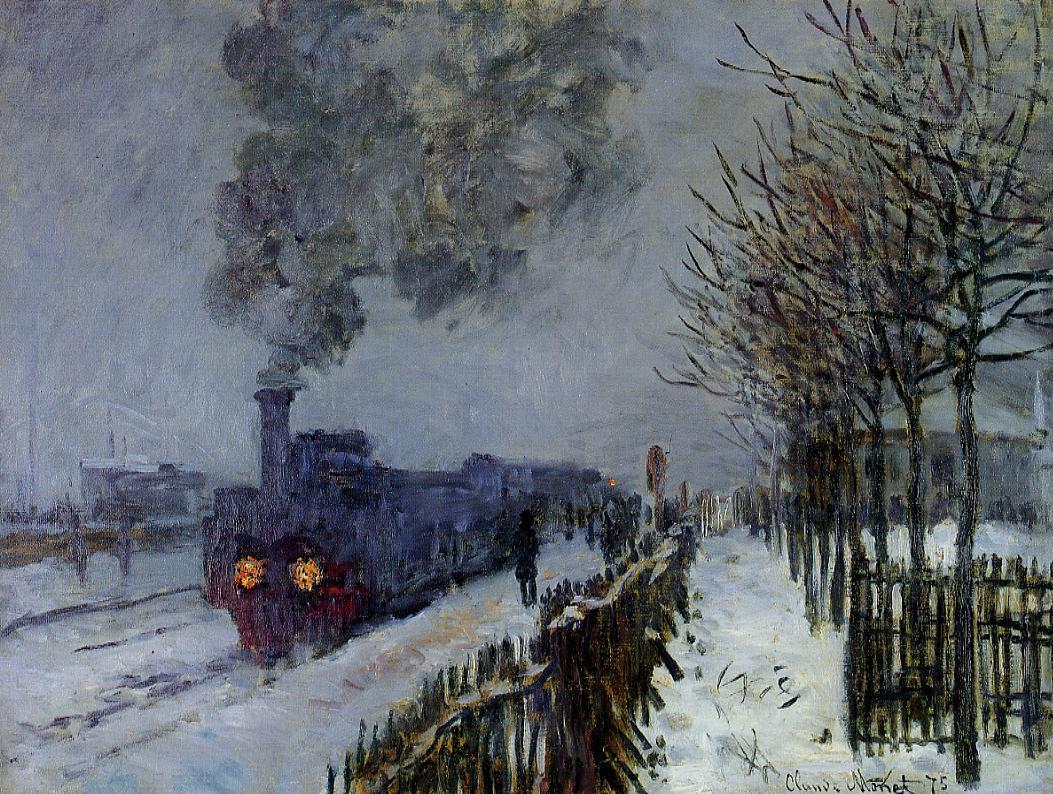
To fully understand the uniqueness of The Magpie, it is instructive to compare it with Snow Effect at Argenteuil, painted a few years later, where human presence and sled tracks animate the scene more. In The Magpie, the total absence of human figures, apart from the bird, reinforces the feeling of solitude and timelessness. The animal itself, placed with almost graphic precision, acts as a living vanishing point that immediately draws the eye before letting it wander toward the blurred horizon. This economy of means, where a single black element is enough to balance acres of white, demonstrates a compositional confidence rare in an artist still seeking recognition.
One can also compare this work with the winter landscapes of Camille Pissarro or Alfred Sisley, who shared this fascination with atmospheric effects. However, where Pissarro often includes peasants at work or animated village roads, Monet here chooses a more intimate and almost abstract subject in its starkness. The exclusive focus on the play of light on the fence and snow already foreshadows the later series like Haystacks or Rouen Cathedral. It is a pivotal work that answers the question of how to paint the invisible, that is, the changing quality of air and light, rather than the permanent solidity of objects.
Art & Details
Symbols, Details, and Little Visual Quirks

The magpie itself is not a simple decorative accessory but carries a strong symbolic charge in French and European culture. Traditionally associated with both good fortune and gossip, even considered a bird of ill omen in some regions, its presence adds a note of mystery to this otherwise peaceful scene. Some art historians see it as a metaphor for the artist himself, a solitary and marginal observer perched on the threshold of a new world. The fact that the bird is turned to the left, seemingly watching the entrance to the garden enclosed by the fence, creates an open narrative where the viewer becomes the intruder surprised in this silent domain.
A detail often overlooked but essential is the way the shadow of the fence literally structures the pictorial space. This dark line crossing the painting diagonally acts like a musical bar line, rhythmically dividing the white surface and guiding the eye from the foreground to the hazy background. Monet uses this shadow not as a defect of light, but as the central element of the composition, proving that the absence of direct sunlight can be as visually powerful as its presence. This habit of making shadow a main subject rather than an accompaniment shows how much the artist was rethinking the rules of perspective and hierarchy of subjects established since the Renaissance.
Art & Details
Neighbors, Allies, and Turbulent Cousins

Although Monet is the central figure of this aesthetic adventure, it is worth mentioning the influence of his peers like Eugène Boudin, his Norman mentor, who taught him to paint the sky and meteorological effects outdoors. Boudin already said that three direct brushstrokes from nature were worth more than two days of work in the studio, a philosophy Monet pushes to its peak here with the snow. However, Monet surpasses his master through the audacity of his cool palette and his determination to eliminate superfluous details to keep only the luminous essence of the scene. This emulation among artists of the Norman coast was crucial for the emergence of this style that would revolutionize world art.
Conversely, the turbulent cousins, the academic painters of the time, violently rejected these attempts, judging them unfinished or crude. For them, a painting had to tell a clear story with sharp outlines, not suggest a fleeting atmosphere where forms seem to dissolve. This frontal opposition explains why The Magpie took time to find its place in public collections, remaining long in private collections before triumphantly entering the Musée d'Orsay. Understanding this context of initial rejection allows us to appreciate even more the radical modernity of the work, which had to wait for the public's eye to evolve before being finally celebrated at its true value.
Art & Details
What Museums Confirm When Shortcuts Go Too Fast

The conservation of this work at the Musée d'Orsay, in the section dedicated to the birth of Impressionism, confirms its status as a historical masterpiece. Scientific analyses conducted by the museum's restorers have revealed the complexity of the paint layers and the use of specific pigments like artificial blue, then recent, which allowed these cold vibrations. These studies contradict the received idea that Impressionists painted quickly and without thought; on the contrary, the construction of space in The Magpie is the result of meticulous observation and a carefully considered chromatic strategy. The museum thus provides material proof that this apparent simplicity hides a virtuoso technicality inaccessible to superficial imitators.
Furthermore, the place given to this painting among other masterpieces of the period shows how it dialogues with contemporary research on light. Seeing it hung near works by Manet or Renoir, one better understands the overall coherence of the Impressionist movement despite their individual differences. The museum's labels and audio guides often remind that this canvas was rejected from the Salon of 1869, highlighting the courage needed to defend such an artistic vision. This current institutional validation transforms what was once a scandal into an essential classic, reminding us that the judgment of time is often the only reliable critic when faced with major aesthetic innovations.
Art & Details
How to Choose a Reproduction Without Making the Wall Panic?

When you want to incorporate a reproduction of The Magpie into an interior, the choice of support is crucial to restore the subtlety of the white nuances. A print on glossy paper risks flattening the details of the bluish shadows and making the snow too bright, thus losing the hushed atmosphere of the original. It is better to opt for a stretched canvas or a reproduction on matte fine-grain paper, which will preserve that slightly granular texture characteristic of Monet's touch. The format should also be generous to let the white immensity breathe; a small frame lost on a large wall would distort the effect of silence and space that the artist intended to create.
For placement, choose a wall with indirect natural light, as the work plays entirely on the perception of light variations. A bright living room, a calming bedroom, or even a quiet office are ideal places where this winter scene will bring a welcome visual respite. Absolutely avoid direct aggressive lighting or overly warm yellow spots that would distort the reading of the cold shadows painted by Monet. The ideal is to let the painting dialogue with the changing light of the day, thus recreating at home that dynamic experience where the painting seems to live and evolve with time, exactly as the artist intended outdoors.
Interior Decoration
Mistakes to Avoid Before Hanging the Painting

The first common mistake is choosing a frame that is too heavy or too ornate, baroque style or excessive gilding, which would violently clash with the clean modernity of the scene. The simplicity of the subject calls for a discreet frame, in light natural wood, white, or very pale gray, which extends the feeling of cold and purity without drawing attention to itself. A dark, massive frame would cut off the painting's luminosity and visually weigh down the whole, canceling the effect of airy lightness sought by Monet. Always remember that the frame should be a window open onto the landscape, not a decorative border that locks the work into a dated style.
Finally, beware of cheap reproductions with poorly adjusted white balance, turning the violet shadows into simple gray or black spots. If the colored nuances in the snow disappear, you lose the very essence of the Impressionist revolution contained in this canvas. Take the time to examine the details of the reproduction, zoom in on the fence and the bird to check the sharpness and color fidelity before purchasing. A too flat or saturated copy will give an artificial and harsh look to your wall, far from the soft, melancholic poetry that emanates from the original kept in Paris. The quality of the print is here directly linked to the emotion the work can evoke in your daily life.
| Room | Suggestion | Decorative Effect |
|---|---|---|
| Living Room | A work related to Monet's Magpie with a strong composition | Cultivated focal point, warm, and easy to comment on without reciting a label. |
| Bedroom | A soft palette or a more intimate scene | Calm atmosphere, visual presence without unnecessary agitation. |
| Office | A structured, colorful, or graphically sharp image | Creative energy and a little reminder that the wall can also work. |
| Entryway | A vertical format or an immediately readable work | Clear, elegant first impression, and decidedly less shy than a white void. |
To Continue the Visit
Sources, Collections, and Paths Truly Related to the Subject
A few useful references to verify information, compare free images, and extend the reading without going to a museum that didn't ask for anything.
Related Articles to Read Next
Useful Blog Hubs
FAQ
Frequently Asked Questions About Monet's Magpie
What is Monet's Magpie in painting?
Monet's Magpie deserves an in-depth article because this style engages both an era, a way of painting, and a very concrete way of living with images.
How to quickly recognize this style?
Observe especially composition, palette, texture, light, and atmosphere, then the way the composition organizes the gaze. If the work holds your attention longer than expected, it's probably not an accident.
Which artists should you know?
You need to cross-reference the central artists of the movement with museums and reliable sources to avoid hasty attributions.
Is this style suitable for modern decoration?
Yes, provided you choose the right format, a palette consistent with the room, and a work whose presence remains pleasant on a daily basis.
Should you choose the most famous work?
Not necessarily. The most famous work can be perfect, but the right choice depends above all on the room, the format, the palette, and the desired atmosphere.
Where to verify the information?
Start with museum notices, Wikipedia/Wikidata for general orientation, then Wikimedia Commons when a free image is needed.
The Eternal Winter of Claude Monet
Monet's Magpie remains much more than a simple representation of a Norman garden under snow; it is a lasting lesson on how to look at the world. It teaches us that beauty does not lie in the motionless perfection of objects, but in the incessant dance of light that transforms them at every moment. Whether you hang it in your living room or contemplate it at the Musée d'Orsay, this work continues to offer us that precious gift: a few minutes of silence, freshness, and wonder at the genius of a man who knew how to paint cold with so much human warmth. Ultimately, it is this ability to transform a gray, icy morning into a feast for the eyes that ensures this painting's immortality.
0 comments