

Van Gogh's The Siesta • Art & Decoration Guide
Van Gogh's The Siesta: The Great Rest Painted in the Provençal Sun
Dive into the heart of a soothing work born in Saint-Rémy, between homage to Millet and explosion of colors, to understand how to choose its reproduction wisely.
In the tormented work of Vincent van Gogh, there is an island of absolute silence, a pause where time seems to have stopped under the weight of the heat. The Siesta, painted between 1889 and 1890 during his stay at the asylum of Saint-Rémy-de-Provence, is not a simple genre scene but an act of resistance against inner turmoil. Far from the nervous whirlwinds often attributed to the artist, this painting breathes slowly, inviting the viewer to share the heavy sleep of two peasants exhausted by their task. It is a work that speaks of dignity, harsh light, and a deep admiration for the work of the land, transforming a banal moment into a monumental celebration of rest.
 Free image
The Siesta sets the subject without detour: peasant rest, heavy sun, and Van Gogh transforming Millet into a very awake Provençal afternoon.
Reading Method
Reading the Canvas Like a Breath
To fully appreciate this reproduction or the original kept at the Musée d'Orsay, you must accept to slow down your own gaze. First observe the powerful horizontality of the composition that anchors the bodies in the ground, then let your eyes glide over the paint strokes that still vibrate under the effect of the heat. Do not look for movement, but feel the density of the air and the heaviness of closed eyelids.
Context before prestige
We place Van Gogh's The Siesta in its era, its studios, its exhibitions, and its small revolts. A work without context is sometimes just a very beautiful person who forgot their history.
The signs that betray the style
We identify composition, palette, material. These clues often say more than grand speeches, especially when they carry gold or nervous brushstrokes.
The work in a real room
We end with the useful question: does this image breathe in your home, or does it just pose like a poster that has read two books?
Historical Context
Where does Van Gogh's The Siesta come from, and why is it not just a pretty label?
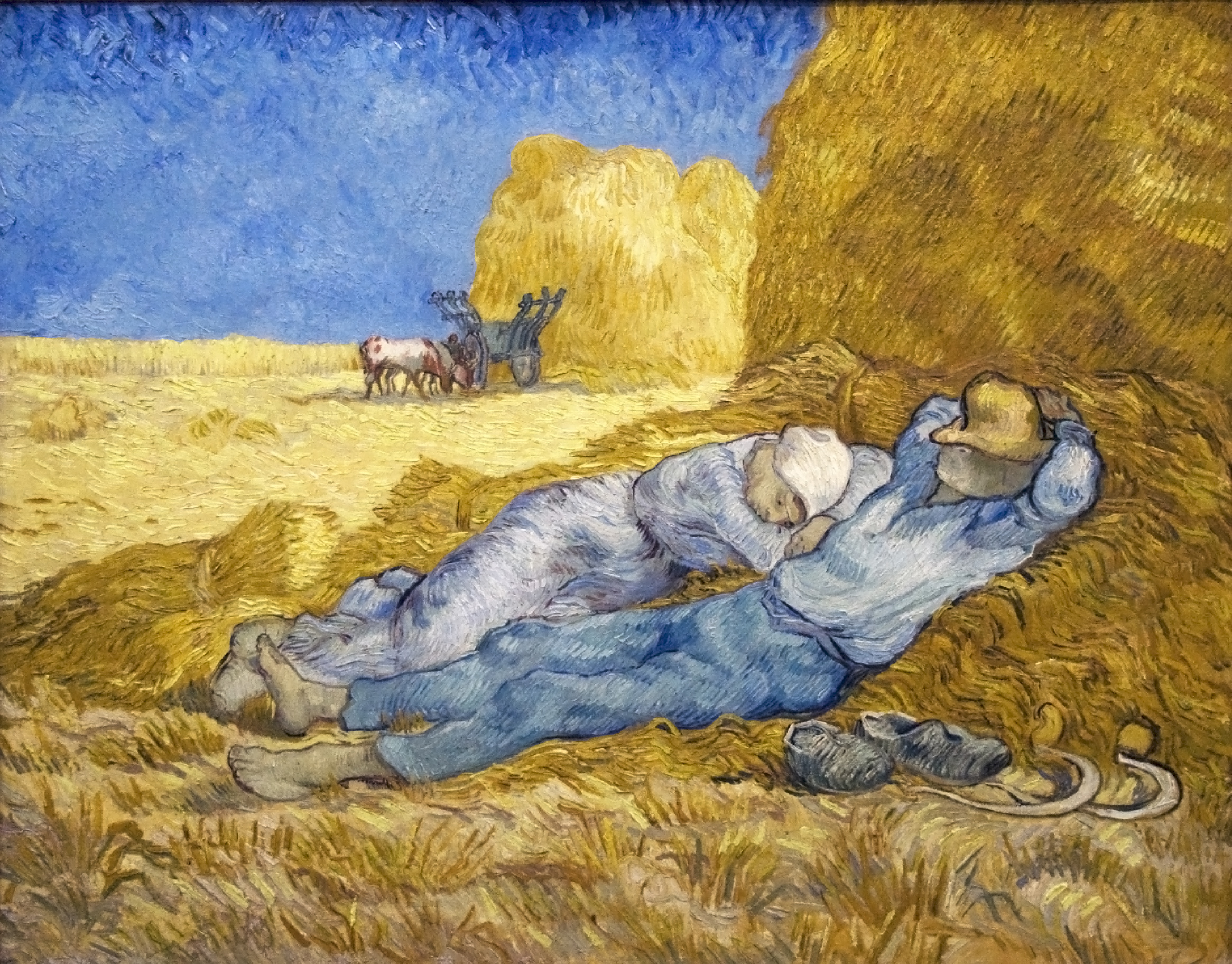
This fascinating canvas finds its direct root in an engraving by Jean-François Millet entitled The Siesta, which Vincent had discovered long before his arrival in the south of France. Voluntarily confined in Saint-Rémy after the Arles crisis, the artist desperately seeks stable structures to organize his feverish mind and then takes up several compositions of his beloved master. It is not a shameful plagiarism, but a fervent translation where Van Gogh uses Millet's lithograph as a musical score that he reorchestrates with his own violent colors and thick paste.
The context of creation is crucial: we are in 1889, a period when the painter alternates between perfect lucidity and deep troubles, finding in copying an essential therapeutic exercise. By transposing this French rural scene into the blinding light of Provence, he radically changes the atmosphere of the darker, more Nordic original. This painting thus becomes the testimony of a man who, even in turmoil, remains obsessed with the simple beauty of workers and the vital necessity of stopping in the middle of the burning day.
Artistic Style
Why does Van Gogh's The Siesta still interest us so much?

The enduring appeal of this image lies in its striking paradox: it emanates from an artist known for his swirling skies and agitated starry nights, yet it exudes an almost hypnotic calm. In a modern world saturated with notifications and perpetual motion, seeing two human figures completely abandoned to sleep offers a form of immediate and universal visual comfort. The painting acts as a mirror of our own need for disconnection, reminding us that rest is not a guilty laziness but an indispensable step in the human cycle, as noble as plowing or harvesting.
Beyond the biographical anecdote, the work continues to captivate because it succeeds in painting heat itself, that physical sensation that weighs down limbs and closes eyes. Contemporary viewers, often seeking serenity for their interiors, instinctively recognize this thermal vibration made visible by the dominant yellows and bluish shadows. It is a painting that does not just show a subject, but makes you feel a temperature, creating a direct sensory link that crosses decades without aging or losing its evocative power.

Mont Sainte-Victoire
A reproduction related to Van Gogh's The Siesta, useful for comparing atmosphere, palette, and wall presence.

A Sunday Afternoon on the Island of La Grande Jatte
A reproduction related to Van Gogh's The Siesta, useful for comparing atmosphere, palette, and wall presence.
Art & Details
The visual signs that betray the style

What immediately strikes the trained eye is the bold use of complementary color to modulate light and shadow without resorting to traditional black. Van Gogh builds the volume of the sleeping bodies and haystacks by opposing brilliant chrome yellows with deep ultramarine blues, creating an optical vibration that brings the still surface to life. The brushstroke here is characteristic of his Provençal period: short, parallel, and rhythmic strokes covering the ground and sky, suggesting a contained energy even at the heart of this apparent stillness.
The horizontal composition is another strong stylistic marker, stretching the format to accentuate the feeling of expanse and flatness of the southern landscape under the leaden sun. Unlike vertical portraits or dynamic scenes, this arrangement forces the gaze to slide laterally, following the low horizon line that presses the characters against the nourishing earth. Every element, from the unhitched cart to the lying oxen in the background, participates in this soothing geometry where nothing disturbs the straight line of absolute rest imposed by the heatwave.
Art & Details
Works to look at as if they were going to answer
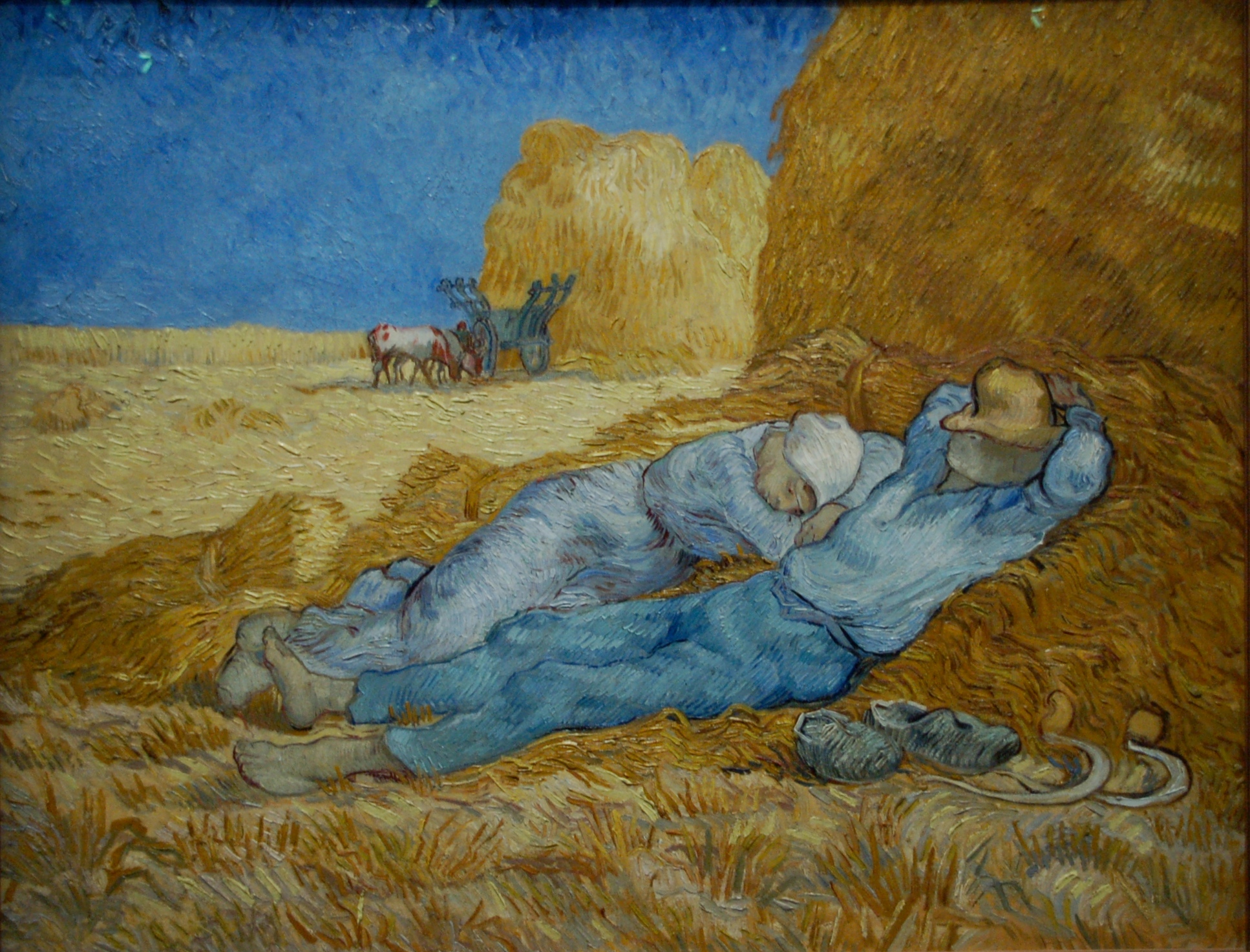
To fully grasp the scope of The Siesta, it is instructive to confront it directly with Millet's The Siesta, available in many engraved collections, in order to measure the chromatic shock operated by Vincent. Where Millet uses earthy tones, ochres, and browns to illustrate the poverty and harshness of the peasant condition in a sober realism, Van Gogh explodes the scene into a symphony of colored lights. This comparison reveals how the interpreter transformed a documentary social scene into a spiritual and sensory experience, while preserving the sacred respect due to manual workers.
One can also establish a fascinating visual dialogue with Claude Monet's Haystacks, painted around the same time, which also explore variations of light on the rural landscape. However, where Monet seeks to capture the fleeting moment and subtle atmospheric changes, Van Gogh fixes a burning eternity where time seems coagulated in the resin of oil paint. Looking at these works side by side allows us to understand the different strategies of the Impressionists and Post-Impressionists to account for the relationship between man, nature, and living light.
Art & Details
Symbols, details, and little visual quirks

A detail often overlooked but essential lies in the position of the tools and the cart, abandoned carelessly near the sleepers, signifying that the work has been completed before the well-deserved break. The pitchfork stuck in the hay and the motionless cart wheels are not mere decorative accessories, but the symbolic attributes of the worker's dignity dear to the artist since his Dutch beginnings with The Potato Eaters. These objects tell a story of accumulated fatigue and natural cycle, reminding us that this sleep is the direct and legitimate consequence of intense physical effort under the sun.
The presence of animals, notably the oxen lying in the background who also seem to succumb to the ambient torpor, reinforces the idea of a total communion between man and nature. Van Gogh treats human and animal bodies with the same pictorial material, the same thickness of paste, erasing all hierarchy to show a universal solidarity in the face of the elements. Even the haystacks, standing like golden sentinels, seem to participate in this collective breathing, becoming organic forms that protect the sleepers rather than simple agricultural products stored in the field.
Works to Know
Famous works of Van Gogh's The Siesta to look at before choosing
For a hand-painted reproduction of Van Gogh's The Siesta, an oil painting of Van Gogh's The Siesta, or a copy of Van Gogh's The Siesta, the most useful thing is to compare several images: the gilding, the faces, the density of the patterns, and how each work holds the wall.
- The Vision After the SermonA visual gateway to understand Van Gogh's The Siesta without turning the article into an inventory.
- Mont Sainte-VictoireA reproduction related to Van Gogh's The Siesta, useful for comparing atmosphere, palette, and wall presence.
- A Sunday Afternoon on the Island of La Grande JatteA reproduction related to Van Gogh's The Siesta, useful for comparing atmosphere, palette, and wall presence.
Art & Details
Neighbors, allies, and turbulent cousins

Although singular, this work is part of a network of influences and dialogues with other artists of his time who shared this interest in rural life and light. Paul Gauguin, for example, also explored themes of rest and primitive spirituality, although his approach is more synthetic and less anchored in the immediate physical reality of labor. By comparing The Siesta with works like The Vision After the Sermon, we measure how Van Gogh remains faithful to a direct observation of reality, even when he exacerbates colors, refusing to tip into a symbolism too abstract or detached from the ground.
One can also mention the distant kinship with Georges Seurat and his A Sunday Afternoon on the Island of La Grande Jatte, where the figures are also frozen in a kind of timelessness, although the social and urban atmosphere is radically different. Where Seurat organizes his characters with an almost mathematical geometric rigor in a bourgeois setting, Van Gogh lets his peasants slump with a brutal naturalness and a freedom of touch that betrays his personal emotion. These artistic neighbors help situate The Siesta not as an isolated piece, but as a unique contribution to the great debate of the late 19th century on the representation of time and rest.
Art & Details
What museums confirm when shortcuts go too fast

Major institutions like the Musée d'Orsay in Paris, which carefully preserves this version of The Siesta, remind us through their scenography of the importance of seeing the original to grasp the true texture of the work. Photographs, even high definition, often flatten the material and do not do justice to these impastos that capture the real light of the room, creating micro-shadows that would animate the canvas if Millet himself could see it. Curators insist that this painting is a physical bridge between the source engraving and the colorful Post-Impressionist explosion, a historical document of Vincent's working method.
Other international museums, such as the Metropolitan Museum of Art or the Tate, possess similar versions or preparatory studies that confirm the tenacity with which Van Gogh worked on this theme during his internment. These collections show that far from being a passive activity, copying was for him an experimental laboratory where he tested his technical and emotional limits. Consulting the catalogs of these museums allows us to understand that each brushstroke is the result of a conscious and deliberate decision, contradicting the myth of the mad painter who would daub his canvas without control or precise aesthetic intention.
Art & Details
How to choose a reproduction without panicking the wall?

To integrate a reproduction of The Siesta into a contemporary interior, it is essential to favor a large horizontal format that respects the original composition and allows the eyes to travel freely from one end of the scene to the other. This work works particularly well above a low sofa or a headboard, because its calm horizontality helps structure the space without overwhelming it, bringing a note of solar warmth ideal for a north-facing living room or a bedroom in need of softness. Avoid overly vertical formats that would cut the horizon line and destroy the effect of vast peaceful expanse sought by the artist.
Regarding the palette, ensure that the reproduction faithfully restores the contrast between the vibrant yellows and deep blues, because it is from this balance that the sensation of warmth is born without being aggressive to the eye. A canvas printed on a textured support can add an interesting tactile dimension that recalls the material of the original, while a matte paper will avoid unwanted reflections that could disturb the contemplation of fine details like the sleeping faces. Also consider the ambient lighting of the room: a warm, soft light will perfectly accompany the late afternoon atmosphere depicted by Van Gogh.
Interior Decoration
Mistakes to avoid before hanging the painting
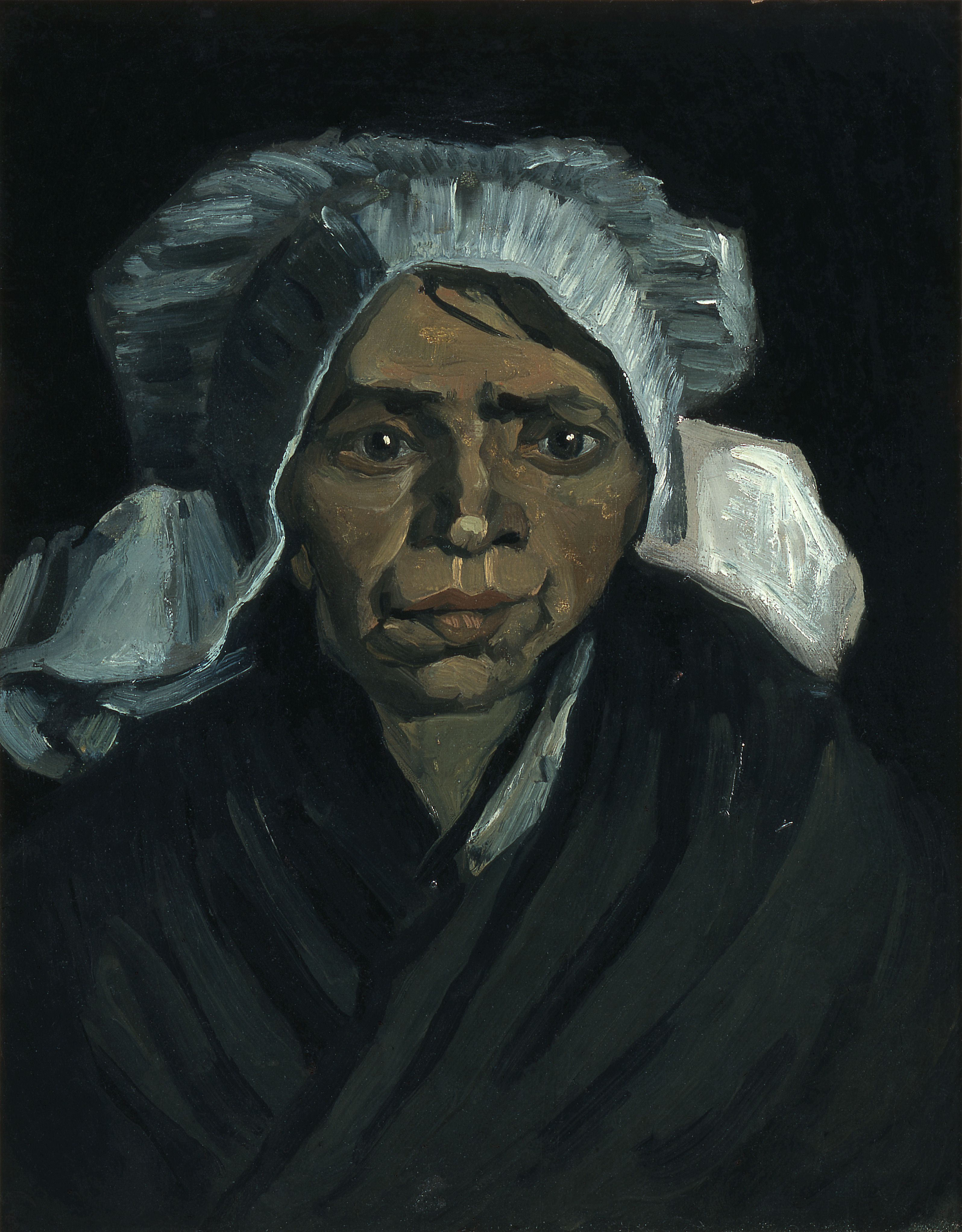
The first common mistake is to place this work in an already visually saturated environment or on very colorful walls, which would conflict with the yellow and blue dominance of the painting and create a chaotic dissonance. The Siesta needs space around it to breathe and spread its calm; it requires a clear wall, ideally white, cream, or very light gray, which will serve as a neutral setting to highlight the luminous intensity of the Provençal scene. Trying to associate it with complex floral patterns or baroque furniture would risk turning this oasis of tranquility into a tiring visual confusion.
One must also be careful not to choose a poor-quality reproduction where the details of the brushstrokes would be digitally smoothed, as this would remove the very soul of the work and its energetic vibration. An image that is too dark or desaturated would betray Van Gogh's intention to paint the harsh light of midday, reducing the painting to a simple tarnished illustration without evocative power. Take the time to check reviews on color fidelity and, if possible, request a sample to see how the reproduction reacts to the light of your own room before definitively fixing your decorative choice.
| Room | Suggestion | Decorative effect |
|---|---|---|
| Living room | A work related to Van Gogh's The Siesta with a strong composition | Cultivated focal point, warm, and easy to comment on without reciting a label. |
| Bedroom | A soft palette or a more intimate scene | Calm atmosphere, visual presence without unnecessary agitation. |
| Office | A structured, colorful, or graphically sharp image | Creative energy and a little reminder that the wall can also work. |
| Entryway | A vertical format or an immediately readable work | Clear, elegant first impression, and decidedly less shy than a white void. |
To continue the visit
Sources, collections, and paths truly related to the subject
Some useful references to verify information, compare free images, and extend reading without going to a museum that didn't ask for anything.
Related articles to read next
Verified collections
Useful blog hubs
FAQ
Frequently asked questions about Van Gogh's The Siesta
What is Van Gogh's The Siesta in painting?
Van Gogh's The Siesta deserves an in-depth article because this style engages both an era, a way of painting, and a very concrete way of living with images.
How to quickly recognize this style?
Observe especially composition, palette, material, light, and atmosphere, then the way the composition organizes the gaze. If the work holds your attention longer than expected, it is probably not an accident.
Which artists should you know?
You need to cross-reference the central artists of the movement with museums and reliable sources to avoid too hasty attributions.
Does this style suit modern decoration?
Yes, provided you choose the right format, a palette consistent with the room, and a work whose presence remains pleasant on a daily basis.
Should you choose the most famous work?
Not necessarily. The most famous work can be perfect, but the right choice depends above all on the room, the format, the palette, and the desired atmosphere.
Where to verify the information?
Start with museum notices, Wikipedia/Wikidata for general orientation, then Wikimedia Commons when a free image is needed.
An eternal rest offered to your interior
Van Gogh's The Siesta remains much more than a simple copy after Millet; it is a declaration of love for rediscovered tranquility and the raw beauty of rural life under the Provençal sun. By choosing to welcome this image into your home, you are not just installing a piece of art history, but inviting an atmosphere of temporal suspension capable of soothing the frantic pace of our modern lives. Whether for its touching history, its exceptional technical mastery, or its unique ability to convey warmth and silence, this painting offers a visual refuge where it is always good to close your eyes and let the world turn without us.
0 comments