

Van Gogh's Bedroom in Arles: history, colors and 3 versions
Painted in Arles in 1888, Van Gogh's Bedroom transforms a simple room through color and perspective. Discover its details and its three versions.
p{color:#d2d8d9}.br-shop-grid{display:grid;grid-template-columns:repeat(12,1fr);gap:13px;margin-top:38px}.br-shop-card{position:relative;display:flex;grid-column:span 3;min-height:178px;flex-direction:column;justify-content:flex-end;padding:22px;overflow:hidden;border:1px solid rgba(255,255,255,.17);color:#fff!important;text-decoration:none;transition:.2s}.br-shop-card.feature{grid-column:span 6;min-height:230px;background:radial-gradient(circle at 85% 15%,rgba(226,173,38,.24),transparent 35%)}.br-shop-card:hover{transform:translateY(-3px);border-color:rgba(255,255,255,.48)}.br-shop-card:before{content:'';position:absolute;right:-30px;top:-42px;width:130px;height:130px;border:1px solid rgba(255,255,255,.1);border-radius:50%}.br-shop-card small{position:relative;color:#e4dddd;font-size:9px;font-weight:850;letter-spacing:.11em;text-transform:uppercase}.br-shop-card h3{position:relative;margin:8px 0 6px;color:#fff;font-size:27px;line-height:1}.br-shop-card p{position:relative;margin:0;color:#d2d8d9;font-size:12px}.br-shop-card.feature h3{font-size:35px}.br-faq{max-width:930px}.br-faq details{margin-top:11px;background:#fff;border:1px solid var(--br-line)}.br-faq summary{padding:18px 20px;cursor:pointer;font:18px/1.35 Georgia,serif}.br-faq details p{padding:0 20px 19px;margin:0;color:var(--br-muted);font-size:14px}.br-sources{margin-top:30px!important;padding-top:22px;border-top:1px solid var(--br-line);color:var(--br-muted)!important;font-size:12px!important}.br-final{padding:68px 0;color:#fff;background:var(--br-yellow)}.br-final h2{color:#35281e}.br-final p{max-width:820px;margin:20px 0 0;color:#514337}.br-final .br-btn{margin-top:24px;background:#283e4d;color:#fff!important} @media(max-width:1000px){.br-story,.br-story.reverse,.br-anatomy,.br-room{grid-template-columns:1fr}.br-story.reverse .br-story-media{order:0}.br-anatomy-art{min-height:520px}.br-colors{grid-template-columns:repeat(3,1fr)}.br-choose{grid-template-columns:repeat(2,1fr)}.br-shop-card,.br-shop-card.feature{grid-column:span 6}.br-timeline{grid-template-columns:repeat(2,1fr)}.br-time:nth-child(2){border-right:0}.br-time:nth-child(n+3){border-top:1px solid rgba(255,255,255,.15)}} @media(max-width:780px){.br-in{width:min(100% - 28px,1180px)}.br-hero{padding-top:52px}.br-hero-grid,.br-intro{grid-template-columns:1fr;gap:40px}.br-stats{grid-template-columns:repeat(2,1fr)}.br-stat:nth-child(3){border-left:0;border-top:1px solid var(--br-line)}.br-stat:nth-child(4){border-top:1px solid var(--br-line)}.br-gallery{grid-template-columns:1fr}.br-figure,.br-figure.wide{grid-column:1;min-height:390px}.br-compare{display:block;overflow-x:auto}.br-section{padding:64px 0}.br-story-media img{min-height:390px}.br-tension{grid-template-columns:1fr}} @media(max-width:520px){.br-anatomy-list,.br-colors,.br-choose,.br-shop-grid,.br-room-list,.br-timeline{grid-template-columns:1fr}.br-anatomy-art{min-height:360px}.br-anatomy-item{border-right:0}.br-choice,.br-shop-card,.br-shop-card.feature{grid-column:1}.br-time{border-right:0}.br-time+.br-time{border-top:1px solid rgba(255,255,255,.15)}.br-hero h1{font-size:43px}.br-caption{left:16px;bottom:16px;max-width:88%}}
Vincent van Gogh · Arles · October 1888

3 versions
Decoration
FAQ
The painting in one idea
A portrait of the artist without a face
The image appears naive, almost childlike, but its simplicity is constructed. The large colored areas, the absence of modeled shadows, and the firm outlines reduce the volume. The perspective instead draws the eye toward the background. Between announced calm and unstable space, the painting holds together through a tension that one feels before even analyzing it.
To remember:
the famous blue bedroom was not exactly blue originally. The Van Gogh Museum's research indicates that the walls and doors had been painted in violet or lilac tones, now altered by fading.
The Yellow HouseIn Arles, Van Gogh finally wants to create a home for artistsVan Gogh arrives in Arles in February 1888, drawn by the light of the South and by the idea of finding there the modern equivalent of the Japanese colors he admires. In the spring, he rents the right wing of a house on Place Lamartine. Its ochre facade earns it the nickname the Yellow House. He first uses the rooms as a studio, then is able to move in after some renovations.The arrival of Paul Gauguin brings a particular urgency to the arrangements. Van Gogh buys beds, hangs his works, and paints the famousSunflowers
Bedroom
has just been conceived. The dream of the 'Atelier du Midi' will be short-lived, but the painting preserves the desire for order and hospitality.
The Arrival
Van Gogh leaves Paris for Arles and discovers the light, the orchards, and the landscapes of Provence.
The Rental
He rents part of the Yellow House, first as a studio, then as a home.
The Bedroom
He paints the first version and sketches the composition in a letter addressed to Theo.
October 23
Gauguin arrives
The two artists live and work together for about nine weeks.
 123456
Six details tell the story of Van Gogh's life
The furniture is sparse, but no object is incidental. The repetition of forms and colors transforms this domestic inventory into a highly personal composition.
The Portraits
Two framed faces introduce a human presence. In the first version, they depict Eugène Boch and Paul-Eugène Milliet.
The window
Closed and slightly off-center, it brings a cool blue-green between the warm masses of the bed and floor.
The yellow bed
Its heavy diagonal advances toward the viewer. Monumental in scale to the room, it evokes rest, security, and intimacy.
The Two Chairs
Their simplicity echoes the bed. One chair turns toward us, the other toward the table, like the silent traces of two possible positions.
The Dressing Table
Carafe, glass, bottle, basin and pitcher evoke the everyday gestures of a bedroom without a modern bathroom.
06
The doors
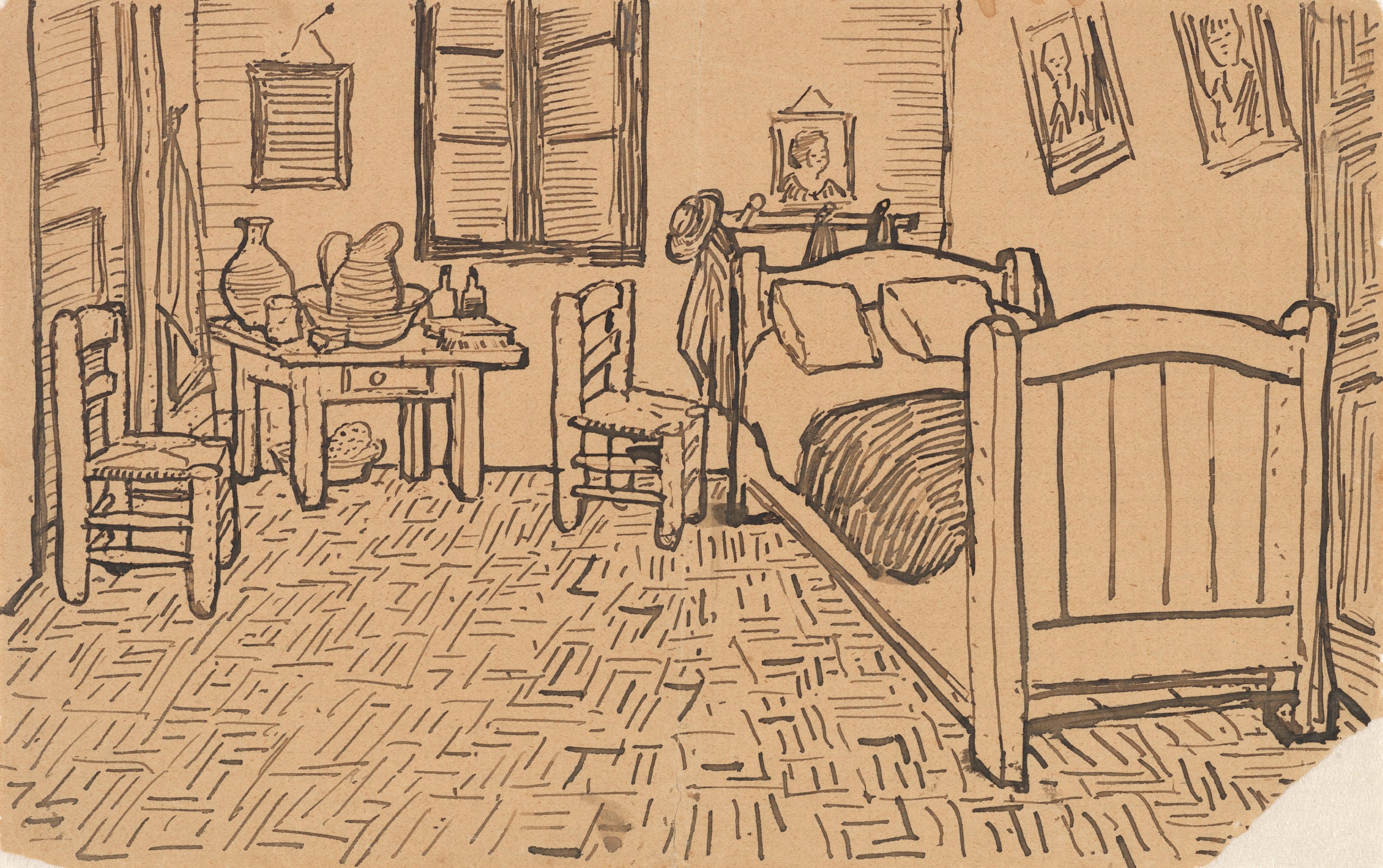
A very controlled mistake
Why does the room seem to tilt?
Sketch attached to the letter sent to Theo on October 16, 1888. Van Gogh already fixes the bed, the chairs, the frames, and the slanted recession of the floor.
The back wall was truly slanted
Multiple perspectives
Flattened volumes
Japanese influence
Van Gogh seeks less to reproduce a room than to make color the language of rest, with simplified forms and almost no shadow.
Paraphrase of the letter to Theo dated 16 October 1888 and of the Van Gogh Museum note.
Color before realism
The blue room was lilac
In his letter, Van Gogh carefully describes the color relationships: pale violet walls, red floor, chrome yellow bed and chairs, lemon-green sheet, blood-red blanket, orange table, blue basin and green window. He does not seek a discreet harmony. He juxtaposes complementary tones and gives each object a clear chromatic identity.
Over time, some of the red pigments have faded. The purple of the walls has shifted toward the pale blue we now associate with the painting. This evolution changes the temperature of the scene: the original must have been more contrasted, the lilac responding more strongly to the yellows and oranges. A faithful reproduction must therefore choose between the current visible state and an interpreted restoration of the original colors.
Lilac
The original tint of the walls, now bluer.
Red
Floor and cover provide a warm base to the room.
Yellow
The bed and chairs structure the painting through their brilliance.
Green
The window and linen balance the complementary reds.
Blue
The basin and cool accents introduce visual pauses.
Orange
The table links the yellows of the furniture to the reds of the floor.
| Amsterdam, Chicago, Paris | Why do three Van Gogh Bedrooms exist? | Van Gogh did not paint three preparatory studies, but three independent paintings. The first canvas, completed in Arles in October 1888, was damaged by humidity during a flood. In 1889, while he was staying in Saint-Rémy, Theo recommended that he have it relined before handling it. Vincent decided to paint a copy of the same format, then a smaller version intended for his mother and sister. | Version |
|---|---|---|---|
| Date and dimensions | What distinguishes it Conservation |
First | Arles, October 1888 |
| 72.4 × 91.3 cm | Original composition, painted directly in the Yellow House. Damaged after a flood. Van Gogh Museum, Amsterdam |
Second | Saint-Rémy, September 1889 |
| 73.6 × 92.3 cm | Almost the same scale. Some portraits and details change, as do the color relationships. Art Institute of Chicago |
Third | Saint-Rémy, September 1889 |
57.3 × 73.5 cm
Smaller version, intended for the artist's family and sent to his mother and sister.
Musée d'Orsay, Paris
What remains
The bed on the right, the two chairs, the central window, the washstand, and the general arrangement make the room immediately recognizable.
Van Gogh above all preserves the idea of the composition: large simple masses, outlined, pushed toward the viewer.
What changes
The hung works, the portraits, the touch and several nuances differ. The repetitions are therefore not mechanical copies.

A calm painting that refuses to stay still
The Yellow House
, September 1888. Van Gogh's room was upstairs, in the right side of the building.
Rest is not silence
Rest
Tension
An absent presence


: the painter's taste for Japan runs through contours, flat color areas, and bold color harmonies.
Armand Roulin belongs to the family of postman Joseph Roulin, a close companion of Van Gogh during his stay in Arles.
In the 1889 repetitions, the bedroom remains recognisable, but the portraits, the tonalities and the handling of paint all shift.
How to install Van Gogh's Bedroom in your home
The subject is an interior, which creates a natural mise en abyme when the work enters a real room. Its bold palette works especially well as a focal point, provided you leave enough breathing space around the canvas.
Keeping the horizontal
The relationship with the landscape is essential: it maintains the dialogue between the bed, the window, and the vanity area.
Choosing the material
An oil-painted reproduction restores the irregular contours and the vibration that the print tends to flatten.
Avoid Overloading
The painting already contains many contrasts. A calm wall and a few well-chosen objects are enough to complement it.
04
Soft lighting
A warm light, directed without glare, reveals the yellows and reds without hardening the blue areas.
Recommended paletteOff-whites, sand tones, light clay and greiges let the canvas take center stage. A grey-blue or sage green wall can extend its cool tones, while a discreet hint of ochre in a cushion or object ties the painting to the room.
For the frame, natural wood evokes the simplicity of painted furniture. A dark brown frame reinforces the outlines; a matte gilt revives the yellow tones, but it's best to avoid a finish that's too glossy.
Discover the reproduction
Living room
Generous format above a low cabinet, on an uncluttered wall.
Bedroom
Medium format, light wood and plain textiles for a more intimate feel.
Office
An energetic, structured image — ideal opposite the gaze.
Entryway
The domestic subject immediately welcomes and sets the tone of the interior.
Van Gogh's Bedroom and related collections
Discover the work, the artist, his movement, and the landscapes that extend this visit to the Yellow House.
Featured workThe Bedroom in Arles
Hand-painted reproduction after the famous 1888 interior.
784 worksVincent van Gogh
Interiors, portraits, flowers, landscapes and nights of the painter.
The movementPost-Impressionism
Expressive colors, bold structures, and personal visions.
The iconsFamous paintings
Explore the instantly recognizable masterpieces.
Light and horizonImpressionist Landscapes
Compare the ways of constructing space and atmosphere.
Full catalog
All works
Browse all available reproductions.
Frequently Asked Questions
Everything to know about Van Gogh's Bedroom
When did Van Gogh paint The Bedroom in Arles?
He painted the first version in Arles in October 1888, shortly before Paul Gauguin's arrival at the Yellow House. He produced two new versions in Saint-Rémy in September 1889.
Where is the depicted bedroom?
It was located on the first floor of the Yellow House, place Lamartine in Arles. The building was damaged during the Second World War and then demolished.
Why is Van Gogh's bed yellow?
Chrome yellow gives the bed a warm and highly readable presence. It contrasts with the original lilac of the walls and contributes to the effect of colored simplicity the painter was after.
Why does the perspective look wrong?
The back wall really was oblique, but Van Gogh also uses several directions of recession, straightens the objects, removes the shadows, and flattens the volumes. The distortion is therefore partly architectural and partly deliberate.
Were the walls really blue?
No, analyses show that the walls and doors originally featured violet or lilac tones. Red pigments have faded, giving a more bluish impression today.
How many versions of Van Gogh's Bedroom exist?
There are three versions painted by Van Gogh: the first at the Van Gogh Museum in Amsterdam, the second at the Art Institute of Chicago, and the third, smaller, at the Musée d'Orsay in Paris.
What did Van Gogh want to express in this painting?
In his letter to Theo, he presents color and the simplification of forms as means of evoking rest. The result nonetheless retains a visual tension created by the diagonals, the outlines, and the contrasts.Which format should you choose for a reproduction of Van Gogh's Bedroom in Arles?A medium or large horizontal format respects the proportions of the composition. The choice depends on the viewing distance available: measure the wall and keep clear space around the canvas.Main sources:description of the first version and illustrated letter of theVan Gogh Museum; notice for the second version at theArt Institute of Chicago
0 comments