


20 myths about Van Gogh
who still resist
Cut ear, suicide, mad genius, Starry Night painted from memory, record rating: twenty preconceived ideas about Vincent van Gogh, sorted one by one with their institutional sources. Some are true in substance but false in detail. Others are entirely invented.

Twenty myths, in four blocks
Van Gogh's popular version (the severed ear, the wheat field suicide, the mad genius) is simpler than the documented version. It was built over the course of the 20th centurye century based on partial testimonies, fictionalized biographies, and an imagination which has taken precedence over the facts.
Here are 20 of the most stubborn myths, grouped into four categories, with what institutional sources really say: Van Gogh Museum, Musée d'Orsay, MoMA, Musée Drenthe, online correspondence, and medical reports.
Ear, training, nationality, method, market.
Madness, epilepsy, condition during the ear, reflex paints.
Suicide, place, Théo, funeral, Dr Gachet.
Starry Night, Sunflowers, Bedroom, rating, 1905.
Facts 1 to 5: his life, his workshop, his nationality
From the Arles operating room to the Saint-Rémy workshop, via the academies of Brussels and Antwerp: what we imagine of our daily life does not always correspond to the sources.
Myth 1
Myth 2
Myth 3
Myth 4
Myth 5
Myth 6
Facts 6 to 10: seizures, epilepsy, condition during the ear
The romantic story is that his madness nourished his genius. Documentary reality is more cautious: he experienced crises, was treated, and produced the majority of his work in the meantime.
Myth 7
Myth 8
Myth 9
Myth 10
Myth 11
Myth 12
Facts 13 to 15: suicide, location, Dr Gachet, Théo
Most Van Goghian mythology concerns the last days: suicide, place, burial, aftermath.
Myth 13
Myth 14
Myth 15
Dr. Gachet, homeopathic doctor, friend of Cézanne and Pissarro, followed Van Gogh to Auvers - recommended by Pissarro. His family welcomed Van Gogh, who painted two portraits of Dr. Gachet and his son. Théo traveled to Auvers after the injury, arrived in time to be present at the time of death. Source: Orsay Museum.
Facts 16 to 20: works, market, heritage
Five myths that spread with the globalization of Van Gogh - and which resist despite published corrections.
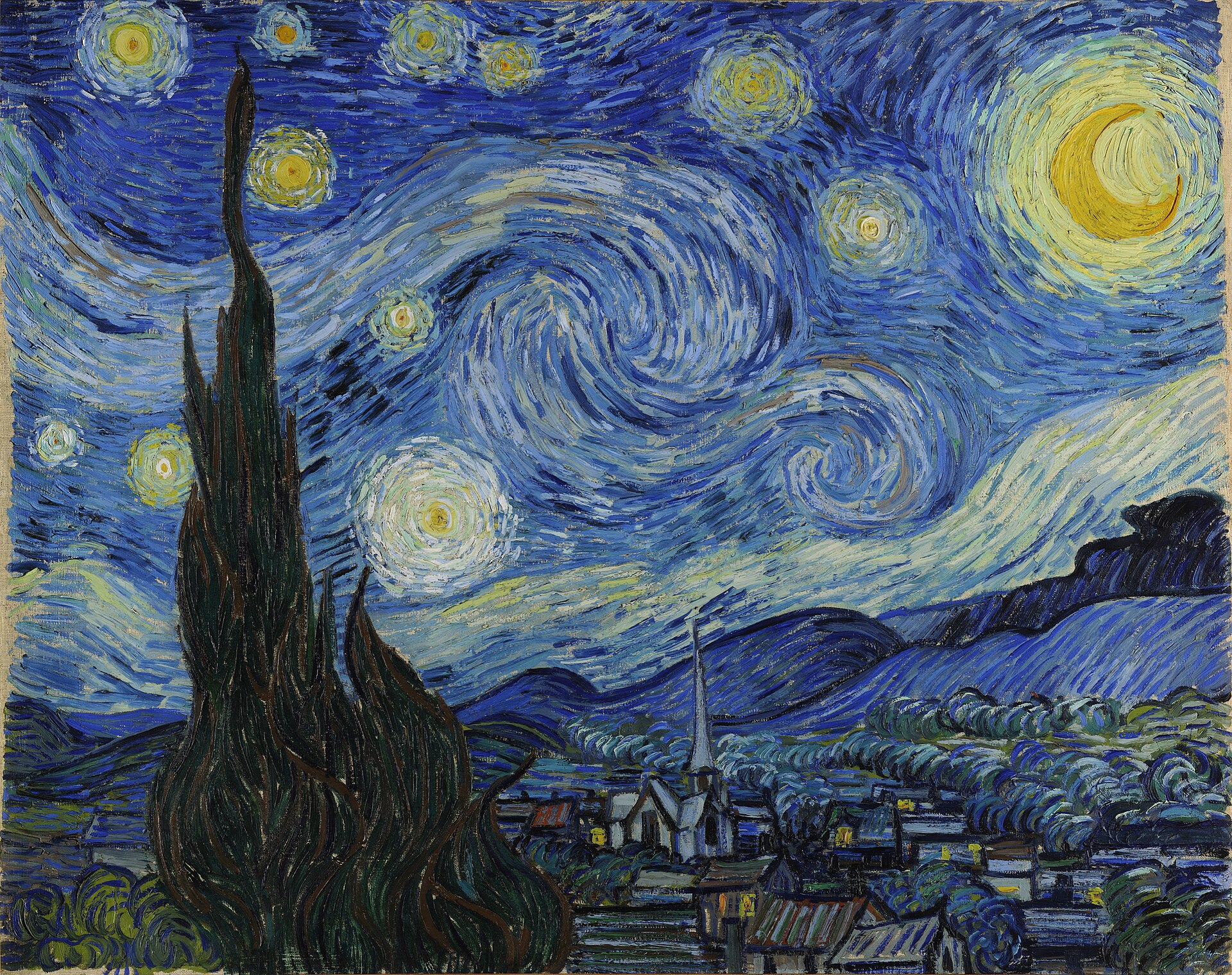
The painting was painted in the studio in June 1889, from sketches and the view from the asylum window. But the village, the hills and the sky are recomposed : no village study was done from the window. The sky configuration does not correspond to any night observable from Saint-Rémy. The painting is a deliberate assembly, not a visual recording. Source: Wikipedia (en) - The Starry Night.
At least eleven paintings. Arles Series 1888-1889 ("Vase") : 5 main vases - Van Gogh Museum Amsterdam (F458, yellow background), National Gallery London (F454, yellow background), Neue Pinakothek Munich (F456, blue-green background), Philadelphia Museum of Art (F455, blue-green background), Sompo Museum Tokyo (F457, yellow background), Sompo Museum Tokyo (F457, yellow background) - plus one sixth destroyed by an American bombing on August 6, 1945 in Ashiya, Japan (F453, first "Vase with 12 sunflowers", private collection). Paris 1887 series ("cut sunflowers") : 4 paintings of cut sunflowers - Van Gogh Museum Amsterdam (F377, study), Metropolitan Museum of Art New York (F375), Kunstmuseum Bern (F376), Kroeller-Müller Museum Otterlo (F452). + 1 "Vase with 3 sunflowers" in private collection USA. Source: National Gallery ; Wikipedia EN - Sunflowers (Van Gogh series).
The first version dates from October 1888 (Van Gogh Museum Amsterdam, F482). Van Gogh made some three oils in total : Amsterdam (October 1888), Art Institute Chicago (F484, September 1889, in Saint-Rémy - it's there "repetition" for Théo, same scale), Musée d'Orsay (F483, summer 1889, in Saint-Rémy - it's there "reduction" smaller for her mother and sister Wil). + two sketches in the letters 705 (to Théo, October 16, 1888) and 706 (to Gauguin, October 17, 1888) - i.e. 5 versions in total (3 oils + 2 sketches). The idea of a work painted "in one stroke" is false: he spent several days on each version, adjusting colors and perspectives. Source: Art Institute Chicago ; Orsay Museum.
His posthumous rating is the result of patient work: his sister-in-law Johanna van Gogh-Bonger (widow of Theo) organized exhibitions, publications and loans. The retrospective at the Stedelijk Museum in Amsterdam, from July 15 to 1er september 1905, organized and financed by Johanna, presented more than 480 works (according to the Van Gogh Museum). After the exhibition, the prices of Vincent's paintings immediately increased. Source: Van Gogh Museum - Jo van Gogh-Bonger.
The current record is $117.2M, reached on November 9, 2022 by Orchard with cypress (Orchard with Cypresses, 1888), sold at Christie's New York as part of the Paul Allen collection (co-founder of Microsoft) - anonymous buyer. Previous record: Plowman in a field (1889), $81.3 million in 2017 at Christie's. Before that: Portrait of Dr. Gachet (1890), $82.5 million at Christie's on May 15, 1990 (Ryoei Saito). Source: The Art Newspaper (Nov 11, 2022) ; Guinness World Records.
Related articles on Van Gogh
25 facts about Van Gogh
Biography, career, periods, work, heritage.
Read →Van Gogh and Gauguin in Arles
9 weeks of cohabitation, December 1888.
Read →Why Van Gogh signs "Vincent"
Signatures and conventions of the time.
Read →Van Gogh's touch
Direction, rhythm, impasto under the magnifying glass.
Read →Public domain
Images, rights, reproductions explained.
Read →Van Gogh Collection
Hand-painted reproductions of works in the file.
See →Twenty myths, in practice
Did Van Gogh really cut off his entire ear?
According to Dr. Rey's medical drawing, rediscovered in 2016 in the archives of the University of California, Berkeley, Van Gogh cut off almost the entire left ear, leaving only a small piece of the lobe. The testimony of Paul Signac (who spoke of a simple lobe) is contradicted by the medical reports of three doctors. Source: Bernadette Murphy, Van Gogh's Ear.
Was Starry Night painted from memory?
Only partly. The painting was painted in the studio, based on the view from the asylum window, but the village, the hills and the sky are deliberately recomposed. The village is not visible from the window. Source: MoMA, Wikipedia (en) - The Starry Night.
Did Van Gogh really kill himself?
This is the classic thesis (ball, July 27, 1890 in the evening in Auvers, in his room at the Auberge Ravoux), retained by the majority of historians. A alternative thesis, defended by biographers Naifeh & White Smith (2011), envisages an accidental shooting involving René Secrétan, a 16-year-old armed with a broken pistol. The alternative thesis is not universally accepted, but it has been taken up in films Loving Vincent (2017) and At Eternity's Gate (2018).
How many versions of Sunflowers are there?
At least five main versions, spread between Amsterdam, London, Munich, Philadelphia and Tokyo. The "good" one is at the Van Gogh Museum.
What is the price record for a work by Van Gogh?
The current record is $117.2M, reached on November 9, 2022 by Orchard with cypress (Orchard with Cypresses, 1888), sold at Christie's New York as part of the sale of the Paul Allen collection (co-founder of Microsoft). Anonymous buyer. Previous record: Plowman in a field, $81.3 million in 2017.
Why so many preconceived ideas about Van Gogh?
The popular narrative was constructed in the 20th centurye century by fictionalized biographies (Irving Stone, Lust for Life, 1934), films (The Passionate Life of Vincent van Gogh, 1956, with Kirk Douglas), and the media coverage of the "cursed genius". Stone's drawing for the novel had been provided by Dr. Felix Rey, but Stone published with one error (the "lobe only") which was corrected in 2016 by Bernadette Murphy, who rediscovered the original drawing in the archives of the Bancroft Library (UC Berkeley).
Go to texts
- Van Gogh Museum - biography, life, periods, official biography.
- The Letters of Vincent van Gogh, Van Gogh Museum /Huygens ING, 903 letters online.
- Bancroft Library, UC Berkeley - What actually happened to Vincent van Gogh's ear?, archives of Dr Félix Rey (1930), rediscovered by Bernadette Murphy in 2010.
- PBS - Secrets of the Dead: Van Gogh's Ear, documentary on the rediscovery of Rey's drawing in 2016.
- Wikipedia (en) - The Starry Night, sources on composition, village added (sketch F1541v), celestial identification.
- MoMA - The Starry Night, work sheet, dimensions, history.
- National Gallery, London - Sunflowers, main version of Sunflowers (F454).
- Wikipedia (en) - Sunflowers (Van Gogh series), inventory of 11 paintings (5 Arles + 4 Paris + 2 destroyed 1945).
- Art Institute of Chicago - The Bedroom (F484), rehearsal version for Théo.
- Musée d'Orsay - Van Gogh's Room in Arles (F483), discount version for mother and sister.
- Musée d'Orsay - Doctor Paul Gachet, worksheet, context of Dr Gachet.
- PMC NCBI - New vision on the mental problems of Vincent van Gogh (2020), study on comorbid disorders (bipolar, borderline, focal epilepsy).
- Van Gogh Museum - Why did Theo die so soon after Vincent?, on the dementia paralytica /neurosyphilis of Théo.
- PubMed 20051145 - De doodsoorzaak van Theo van Gogh (1857-1891), Dutch study on the cause of death.
- The Art Newspaper (June 20, 2025) - Van Gogh's suicide: ten reasons why the murder story is a myth, defense of the classic thesis against Naifeh & White Smith (2011).
- Wikipedia (en) - Death of Vincent van Gogh, primary and secondary sources on death.
- The Art Newspaper (Nov 11, 2022) - A Van Gogh record: Orchard with Cypresses soars to $117m, current record for a work by Van Gogh.
- Guinness World Records - Most expensive painting by Van Gogh sold at auction, record certification.
- Van Gogh Museum - Jo van Gogh-Bonger, the woman who made Vincent famous, on the Stedelijk retrospective 1905 (more than 480 works).
- The Art Newspaper (August 15, 2025) - The Red Vineyard, on the only public sale during Van Gogh's lifetime (Anna Boch, 400 francs, 1890).
This informative article cites public sources. It does not reproduce correspondence under law. For recent sales figures, refer to Christie's/Sotheby's catalogs; the figure of $82.5 million (1990) remains the public nominal record verified for a work by Van Gogh.
0 comments