

Which Van Gogh painting to choose for your decor • Art & decoration guide
Which Van Gogh painting to choose for your decor? The guide that looks under the varnish
Navigate between the sunflowers of Arles and the starry night of Saint-Rémy to find the work that resonates with your interior, without falling into the postcard cliché.
Vincent van Gogh is not simply a prestigious name to put on a wall to look serious; it is an ambient temperature, a sound vibration, and a mood that changes depending on the time of day. Choosing a reproduction by this Dutch artist requires more than an impulsive crush in front of a catalog: you must understand that each canvas has its own climate, from the blinding sulfur yellow of Provencal wheat fields to the deep and tormented blue of Saint-Rémy nights. Some paintings illuminate a room like a fireplace in winter, while others wake it up with the intensity of an espresso that is too strong but terribly invigorating. This article invites you to go beyond the simple fame of the artist to enter the very flesh of his painting, where the brushstroke dictates the rhythm of your interior decoration.
 Free image
Navigate between the sunflowers of Arles and the starry night of Saint-Rémy to find the work that resonates with your interior, without falling into the postcard cliché.
Reading method
The sensory approach to decoration
Before selecting a work, forget rigid chronological classifications and focus on the physical reaction the image provokes. Observe how the pictorial matter interacts with the light of your living room or the tranquility of your bedroom, because it is this visual alchemy that will transform a simple decorative object into a life companion.
Context before prestige
We place Which Van Gogh painting to choose for your decor in its era, its studios, its exhibitions, and its small revolts. A work without context is sometimes just a very beautiful person who forgot their story.
The signs that betray the style
We identify composition, palette, material. These clues often say more than grand speeches, especially when they carry gold or nervous brushstrokes.
The work in a real room
We end with the useful question: does this image breathe in your home, or does it just pose like a poster that has read two books?
Historical context
Where does the Van Gogh obsession come from, and why is it not just a pretty label?

To grasp the decorative power of Van Gogh, we must go back to his Parisian years of 1886 when he discovered Impressionism and abandoned his earthy Dutch tones for a luminous palette. It was only upon arriving in Arles in February 1888, dazzled by the light of the South, that he developed this unique style made of pure colors and outlined contours, transforming banal reality into an electric vision. Understanding this break is essential for choosing a work: a canvas painted during this explosive period will not radiate the same energy as a darker landscape from his stay in Auvers-sur-Oise in 1890.
The historical context also reveals that Van Gogh painted with a feverish urgency, often outdoors, capturing the present moment with an intensity that transcends time. His studios, whether the Yellow House rented in Arles or the room at the asylum in Saint-Rémy, were laboratories where each brushstroke was an affirmation of life in the face of inner turmoil. Thus, hanging a reproduction in your home is inviting this story of resilience and radical transformation into your private space, far beyond a simple passing aesthetic trend or a superficial decorative fashion effect.
Artistic style
Why does Van Gogh's work still interest our modern interiors so much?

The persistence of the fascination with Van Gogh in contemporary decoration lies in his unique ability to humanize space through the very material of paint. Unlike the smooth digital images that dominate our daily lives, his canvases offer a palpable texture, a relief created by impasto that gives volume to the wall and creates a play of changing shadows depending on the room's lighting. This physicality brings organic warmth to often minimalist or sterile interiors, acting as a tactile reminder of the artist's hand and his violent or caressing gesture depending on the moments of his short career.
Moreover, the universality of the subjects treated, from wheat fields to intimate bedrooms, allows everyone to project their own story onto the work without feeling excluded by intellectual hermeticism. Whether it is the soothing solitude of a starry night or the overflowing vitality of an orchard in bloom, these images speak a direct emotional language that transcends centuries and cultures. Choosing Van Gogh is therefore opting for a decoration that does not just fill a wall void, but engages a silent and profound conversation with the inhabitants of the house, day after day.
Art & details
The visual signs that betray the style and guide the choice

Recognizing a Van Gogh canvas at first glance relies on identifying his inimitable gestural signature, this divided touch that makes color vibrate rather than mixing it on the palette. We often observe short, parallel or swirling strokes, applied with such thickness that the paint seems sculpted, creating perpetual movement even in the most static subjects like cypresses or mountains. For decoration, it is crucial to note that this visual agitation can energize a room that is too calm, while a more structured composition will bring rhythm without necessarily creating nervous turbulence in the general atmosphere.
The chromatic palette constitutes the second major indicator, oscillating between bold complementary harmonies, such as cobalt blue against chrome yellow, and the more muted ranges of periods of doubt. From a decorative perspective, one must be aware that certain works, dominated by acidic greens or vermilion reds, have such saturation that they can alter the perception of surrounding colors in the room. A canvas with bluish tones will tend to visually cool the space, ideal for a bedroom, while an explosion of yellows and oranges will act as a luminous radiator in a north-facing or poorly lit living room.
Art & details
The works to look at as if they were going to respond to your space

Among the major works, The Starry Night, painted in June 1889 from the window of the asylum in Saint-Rémy, imposes a tumultuous sky where the stars become vortices of liquid light. This canvas, housed at the MoMA in New York, radiates a cosmic and almost hypnotic energy that is perfectly suited to a creative office or a reflection space where one seeks to stimulate the imagination. However, its dramatic intensity and aggressive curves could feel oppressive in a small entryway or a bathroom where one primarily seeks serenity and immediate relaxation after a long day.
Conversely, the Sunflowers series, created in Arles between 1888 and 1889, offers a celebration of Mediterranean light captured in the humble simplicity of cut flowers in a vase. These compositions, notably visible at the National Gallery in London or the Van Gogh Museum in Amsterdam, radiate a benevolent warmth and compositional stability that make them ideal candidates for a dining room or kitchen. The dominant yellow acts as an antidote to winter gloom, bringing a note of contained cheerfulness that integrates harmoniously into classic or contemporary decors without overwhelmingly dominating the space.
Art & details
Symbols, details, and little visual quirks to decipher
Beyond immediate beauty, Van Gogh's paintings are full of recurring symbols that enrich the reading of the work once installed in an interior. The cypress, for example, present in many landscapes of Saint-Rémy like Wheat Field with Cypresses, was seen by the artist as a black line connecting earth to sky, a symbol of mourning but also of eternity. Integrating such an image into a living room means accepting this melancholic and spiritual duality, adding narrative depth to the decoration that invites slow contemplation rather than a distracted and fleeting glance while passing through the room.
Clothing details in the portraits, such as those of Postman Roulin or Madame Ginoux, also reveal a particular attention to the textures of fabrics and facial expressions frozen in a rare psychological intensity. These portraits are not simple physical representations but studies of character where every fold of clothing and every facial feature tells a laborious and dignified life. Hanging such a portrait in a reception space confers a strong human presence, as if the silent guest observed the comings and goings with benevolence, anchoring the decoration in a tangible social and historical reality.
Art & details
Neighbors, allies, and turbulent cousins of the Van Gogh universe

Although Van Gogh is a singular figure, his artistic dialogue with Paul Gauguin during their tumultuous cohabitation in Arles in 1888 produced works that resonate with each other through their use of pure color. If one is looking for a slightly different alternative for decoration, Gauguin's works from this period offer larger flat areas of color and more pronounced outlines, creating a more mystical and less tormented atmosphere than that of his volcanic friend. Understanding this proximity allows for bold wall associations, juxtaposing two visions of Post-Impressionism that respond to each other while retaining their distinct strong artistic personalities.
One must also mention the influence of Japanese prints, omnipresent in Van Gogh's work after his discovery in Paris, visible in the off-center framing and the absence of cast shadows in certain canvases. This opening to the East introduces a notion of space and emptiness that can perfectly align with modern minimalist interiors, inspired by contemporary Japanese minimalism. Choosing a work where this influence is prominent, such as certain branches of almond blossoms, allows for a touch of refined exoticism and airy lightness that contrasts pleasantly with the heaviness sometimes associated with traditional 19th-century European painting.
Art & details
What museums confirm when shortcuts go too fast

Visiting virtually or physically institutions like the Musée d'Orsay in Paris or the Kröller-Müller Museum in the Netherlands allows one to realize the actual scale of the works, often more modest than imagined thanks to giant reproductions. A canvas like The Bedroom in Arles measures about 72 cm by 90 cm, an intimate format that works wonderfully in a domestic setting without overwhelming the surrounding furniture with its monumentality. This discovery is crucial to avoid the common mistake of ordering an oversized reproduction that would suffocate the room, whereas the artist conceived his paintings to be seen up close, in the proximity of the gaze.
Museums also reveal the state of color preservation, showing how certain pigments have evolved or how old varnish could yellow the whole before recent restorations. Seeing the original allows one to understand the true luminosity of blues and greens, sometimes altered in cheap prints that lean toward gray or brown. For a quality reproduction purchase, it is therefore imperative to rely on high-definition scans from these official museum collections, thus guaranteeing chromatic fidelity that respects Vincent van Gogh's original luminous intention.
Art & details
How to choose a reproduction without making the wall panic?

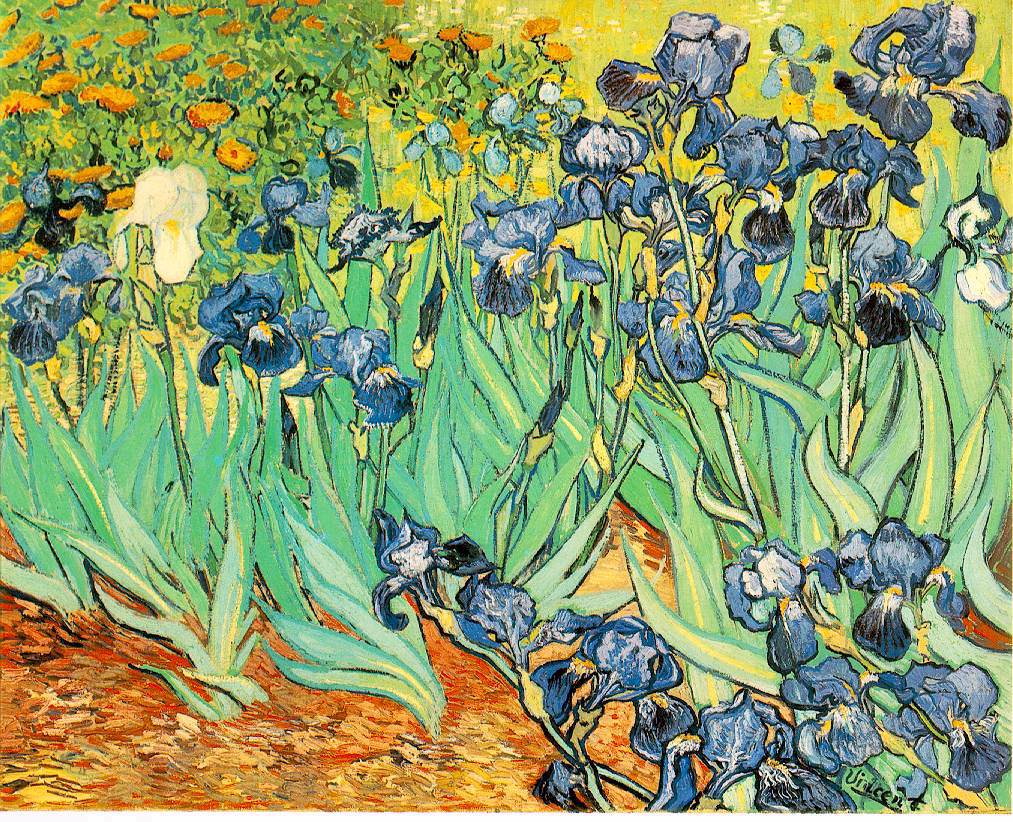
The successful integration of a Van Gogh depends above all on the harmony between the palette of the canvas and the dominant tones of the room, whether it be the color of the walls, floor, or upholstery fabric. If your living room features neutral tones like off-white, pearl gray, or sand beige, a brightly colored work like The Irises or a field of poppies will become the natural focal point, bringing the necessary touch of life without creating chaotic visual dissonance. Conversely, in a space that is already very colorful or busy with patterns, it will be wiser to opt for a more sober composition, perhaps a portrait on a solid background or a winter landscape, to avoid unpleasant sensory saturation.
The format and frame also play a determining role in the final balance: a reproduction on stretched canvas without a frame offers a modern and immersive look, while a gold or dark wooden frame will anchor the work in a classic tradition. For a bedroom, favor horizontal formats that accompany the gaze in the direction of rest, like a view of a plain, whereas for an entryway or a staircase, a vertical format with slender elements like cypresses or fruit trees will accompany the architectural verticality of the place with elegance and dynamism.
Interior decoration
Mistakes to avoid before hanging the painting for good

The most frequent mistake is choosing a work solely for its iconic fame without considering its emotional impact on a daily basis in the intimacy of the home. Living with a reproduction of Munch's The Scream is one thing, but cohabiting with the tormented version of The Starry Night or a wheat field under a stormy sky requires a certain tolerance for the visual anxiety these images can generate over time. It is wise to test the effect of the image by temporarily printing it or viewing it via an augmented reality application to ensure that the intensity of the pictorial gesture does not become a source of nervous fatigue after a few weeks of constant exposure.
Finally, neglecting the lighting dedicated to the work is a major aesthetic mistake that can transform a masterpiece into a dark spot or, conversely, create annoying reflections on the varnished surface. A Van Gogh canvas, with its impasto reliefs, deserves raking or directed lighting that accentuates the texture of the paint and makes the microscopic shadows created by the brushstrokes dance. Investing in a small adjustable spotlight or placing the work facing a source of indirect natural light will reveal all the material richness of the image, turning a simple wall decoration into a dynamic and living visual experience.
| Room | Suggestion | Decorative effect |
|---|---|---|
| Living room | A work related to Which Van Gogh painting to choose for your decor with a strong composition | Refined focal point, warm, and easy to comment on without reciting a label. |
| Bedroom | A soft palette or a more intimate scene | Calm atmosphere, visual presence without unnecessary agitation. |
| Office | A structured, colorful, or graphically sharp image | Creative energy and a small reminder that the wall can also work. |
| Entryway | A vertical format or an immediately readable work | Clear first impression, elegant, and decidedly less timid than a white void. |
To continue the visit
Sources, collections, and paths truly related to the subject
A few useful references to verify information, compare free images, and extend the reading without going to a museum that didn't ask for anything.
Related articles to read next
Verified collections
Useful blog hubs
Useful sources on this subject
- Wikipedia - art and context for Which Van Gogh painting to choose for your decor
- Wikidata - visual arts for Which Van Gogh painting to choose for your decor
- Wikimedia Commons - art for Which Van Gogh painting to choose for your decor
- The Met - Heilbrunn Timeline of Art History
- Tate - Art terms
- Musée d'Orsay - collections
FAQ
Frequently asked questions about Which Van Gogh painting to choose for your decor
What is Which Van Gogh painting to choose for your decor in painting?
Which Van Gogh painting to choose for your decor deserves an in-depth article because this style engages both an era, a way of painting, and a very concrete way of living with images.
How to quickly recognize this style?
Observe especially composition, palette, material, light, and atmosphere, then how the composition organizes the gaze. If the work holds your attention longer than expected, it is probably not an accident.
Which artists should you know?
You need to cross-reference the central artists of the movement with museums and reliable sources to avoid too hasty attributions.
Is this style suitable for modern decoration?
Yes, provided you choose the right format, a palette consistent with the room, and a work whose presence remains pleasant on a daily basis.
Should you choose the most famous work?
Not necessarily. The most famous work can be perfect, but the right choice depends above all on the room, the format, the palette, and the desired atmosphere.
Where to verify the information?
Start with museum notices, Wikipedia/Wikidata for general orientation, then Wikimedia Commons when a free image is needed.
Living with Van Gogh every day
Choosing which Van Gogh painting to integrate into your decoration is an act that goes beyond the simple acquisition of an aesthetic object; it is the invitation of a vibrant and human presence within your home. Whether you are seduced by the softness of almond trees in bloom or by the telluric force of the landscapes of Provence, the essential lies in the personal resonance that the work establishes with your living space. By paying attention to historical details, the quality of the reproduction, and chromatic harmony, you will transform your wall into a window open to one of the most brilliant and sensitive minds in art history. Then let Vincent's nervous touch dialogue with your daily life, bringing color, movement, and infinite poetry to your interior.
0 comments