

Vienna around 1900
Gustav Klimt: biography, works, style and golden period
Viennese gold, desire and modernity.
Beneath the precious mosaics, a radical painting of desire, power, life and death - born in the heart of a century-changing Vienna.


Gustav Klimt contrasts two worlds in the same image. The face, hands and sometimes feet maintain a carnal presence; all around, clothing, space and decor change into signs. Circles, spirals, rectangles, eyes, flowers and gold leaves transform the body into an apparition.
This tension explains the power of his paintings. Klimt is neither a simple decorator nor only the painter of fin de siècle eroticism. Trained in large official decorations, he mastered academic illusion before abandoning it. With the Viennese Secession, he defended a modernity where painting, architecture, typography and applied arts could participate in the same environment.
This biography of Gustav Klimt traces his life, his major works and the evolution of his style, from academic settings to the golden period, then to late portraits and landscapes. We sometimes encounter the French form "Gustave Klimt"; the correct name of the Austrian painter is Gustav Klimt.
Four keys to recognizing Klimt's language
The line
A soft outline isolates the silhouette, follows hair or closes a profile. The design gives the body a clear presence amidst decorative abundance.
The Ornament
Rectangles, spirals, flowers and signs are not free additions. They punctuate surfaces and suggest identities, tensions or roles.
Frontality
Reduced depth, monumental figures and saturated backgrounds bring the painting closer to the mosaic, the icon, the poster and the tapestry.
The contradiction
Beauty and worry coexist. Gold can magnify an embrace, but also freeze the body; flowers often surround themes of time and mortality.

Vienna 1900: a brilliant, unstable and modern city
At the end of the 19th century, Vienna was the capital of a vast empire and an intellectual laboratory. The Ring palaces rub shoulders with industrial transformations, national tensions, anti-Semitism, new research in medicine, psychology, music and architecture.
In 1897, Klimt left the conservative Künstlerhaus with other artists and founded the Viennese Secession. He becomes its first president. Their ambition is not to impose a unique style, but to open Vienna to international contemporary art and to bring together fine arts, architecture and applied creation.
Joseph Maria Olbrich's building, its golden dome and the magazine Sacrum Worm give a visual identity to this project. Klimt finds a space there to develop his great allegories without submitting to academic conventions.
Break with conservative juries and present the European avant-gardes.
Bring together painting, architecture, furniture, sculpture, music and graphics.
Respond to the contradictions of the modern city with a new aesthetic.
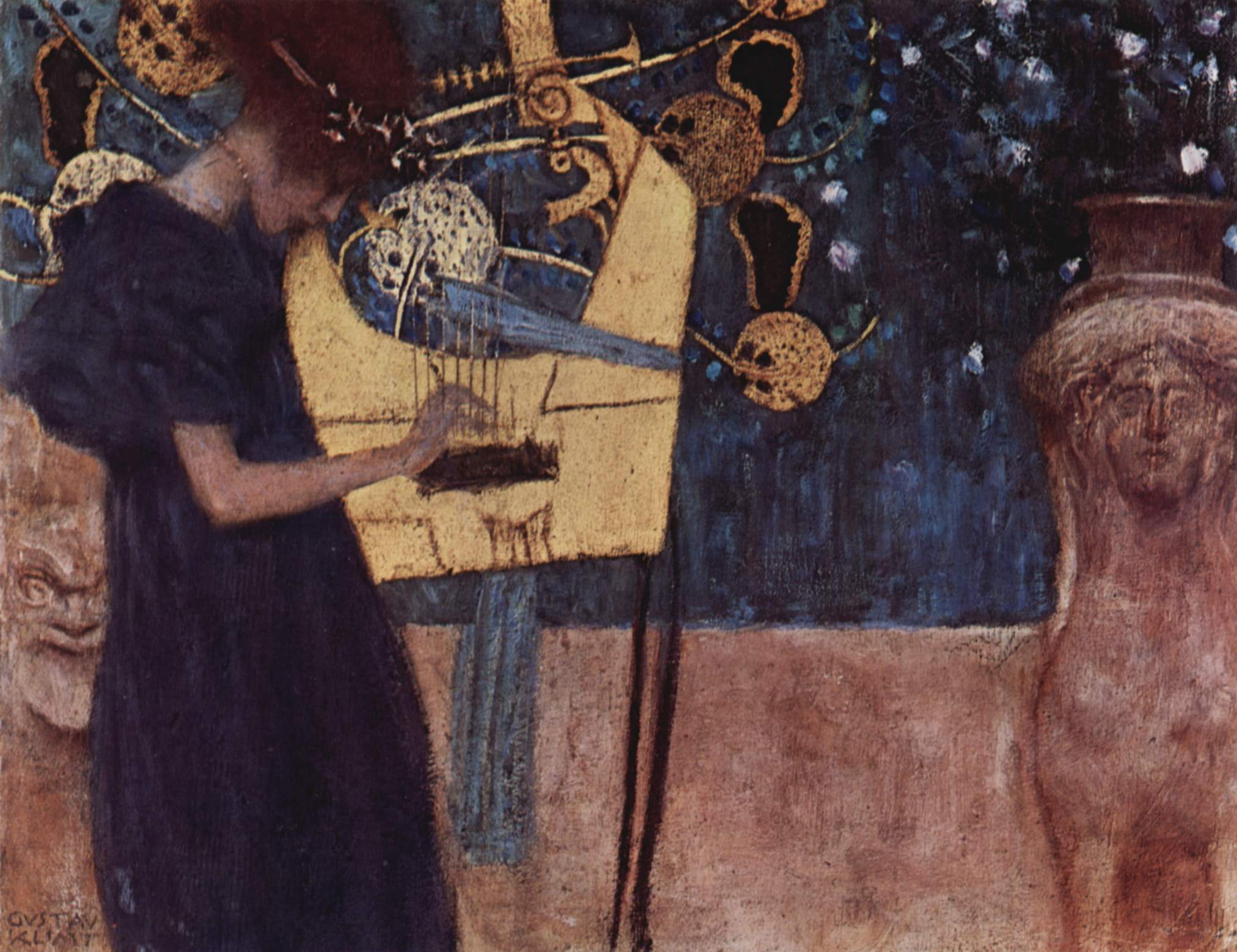
Gustav Klimt in photographs: the man, the workshop and his world
Period photographs correct the image of a painter associated only with gold. They show a massive man in his work coat, an almost bare studio, the cultural scene of the Secession and the summers spent with Emilie Flöge on the banks of the Attersee.


From an official decorator to the painter of the Secession
Academic mastery
Klimt studied at the Vienna School of Applied Arts. With his brother Ernst and Franz Matsch, he formed the Company of Artists, specializing in the sets of theaters and public buildings. This period gave him virtuoso technique and an intimate knowledge of architecture.
The university scandal
Responsible for decorating the ceiling of the University of Vienna, Klimt proposed dark, sensual visions for Philosophy, Medicine and Jurisprudence that did not conform to institutional optimism. The controversy became so violent that he paid his fees and took over the works.
Organize the breakup
Klimt participated in the founding of the association and became its first president. Pallas Athena then Nuda Veritas give a combative image to this new artistic freedom.
The Beethoven Friesland
For an exhibition designed as a total work around Beethoven, Klimt deploys a monumental cycle on three walls. Humanity seeks happiness, faces hostile forces and finds fulfillment through the arts. Line, monumentality and gold announce its most famous period.
Modern icons
After trips to Italy, notably to Ravenna, Klimt pushed the meeting between figure and precious surface further. Judith, the Portrait of Adèle Bloch-Bauer I and The Kiss transform portrait, biblical story and couple into almost liturgical visions.
After gold
The palette becomes more lively and the patterns open up to Asian influences and bold colors. The portraits of Friederike Maria Beer and Johanna Staude, the landscapes and the great allegories continued the research until Klimt's death in February 1918.
The golden period: when paint becomes a precious surface
Why gold?
Klimt is the son of a gold engraver. But his use of metal foil goes beyond family history. The Byzantine mosaics observed in Ravenna, the icon, medieval art and decorative arts offer him models where light does not describe a volume: it emanates from the surface.
- Gold takes the stage back to ordinary time.
- He transforms clothing into a field of signs.
- It captures the real light of the room.
- It brings together painting, mosaic and precious objects.
A beauty that is never neutral
In The Kiss'both bodies appear protected by a common coat, but they stand at the edge of a flowered carpet suspended in an indefinite space. The rectangular patterns of men's clothing and circular shapes of women's clothing have often been read as signs of difference, without exhausting the ambiguity of the embrace.
- Realism focuses on faces and hands.
- The decor absorbs the bodies almost entirely.
- Space becomes frontal and without horizon.
- Sensuality changes into a universal image.
Ten masterpieces to understand the evolution of Klimt
Of the hieratic sensuality of Judith I with almost tawny colors The Fan Ladythis gallery allows you to follow the transition from symbolism to the golden period, then to the chromatic freedom of recent years. Each painting is presented in its entirety in order to read the relationship between figure, decor and space.
The Kiss
A monumental embrace on the edge of a flowery meadow. Gold suspends the couple outside of time while faces, hands and feet maintain contact with reality.
Image: Belvedere · public domain · source

Portrait of Adèle Bloch-Bauer I
Face and hands emerge from architecture of gold, eyes, triangles and spirals. The worldly portrait becomes a modern icon.
Public domain · source

Judith I
The biblical account focuses on an ecstatic face, an uncovered chest, and Holofernes' almost retracted head. Seduction and violence remain inseparable.
Belvedere · public domain · source

The Three Ages of Women
Childhood, motherhood and old age are united in the same square. The decorative pattern embraces bodies without making their vulnerability disappear.
Public domain · source

Danae
The folded body occupies almost the entire square. The golden rain of myth becomes a sensual flow that passes through the purple veils and red hair.
Public domain · source

The Beethoven Friesland
Designed to surround the visitor, the frieze transforms the search for happiness into a procession of figures, hostile forces and rhythmic ornaments.
Public domain · source

Portrait of Fritza Riedler
The geometric armchair forms a profane halo around the model. The painting announces the golden portraits without sacrificing facial restraint.
Belvedere · public domain · source

The Fan Lady
Flowers, phoenixes and bright colors show the latest Klimt: less metallic, more open to East Asian arts and free painting.
Public domain · source

Death and Life
Death, isolated on the left, observes a compact humanity. The empty space between the two groups gives the painting its silent tension.
Public domain · source

Portrait of Emilie Flöge
The fashion designer appears in a flow dress that almost dissolves the body. Her silhouette unites portrait, textile and clothing reform.
Public domain · source
Four visions of woman, body and symbol

Hygia in Medicine
The goddess faces the viewer, snake and cup in hand. The decorative authority of the figure contrasts with the pessimistic vision of the human condition which scandalized the university.

Hope I
Pregnancy is shown head-on, between promise of life and threatening figures. Klimt refuses any reassuring sentimentality.
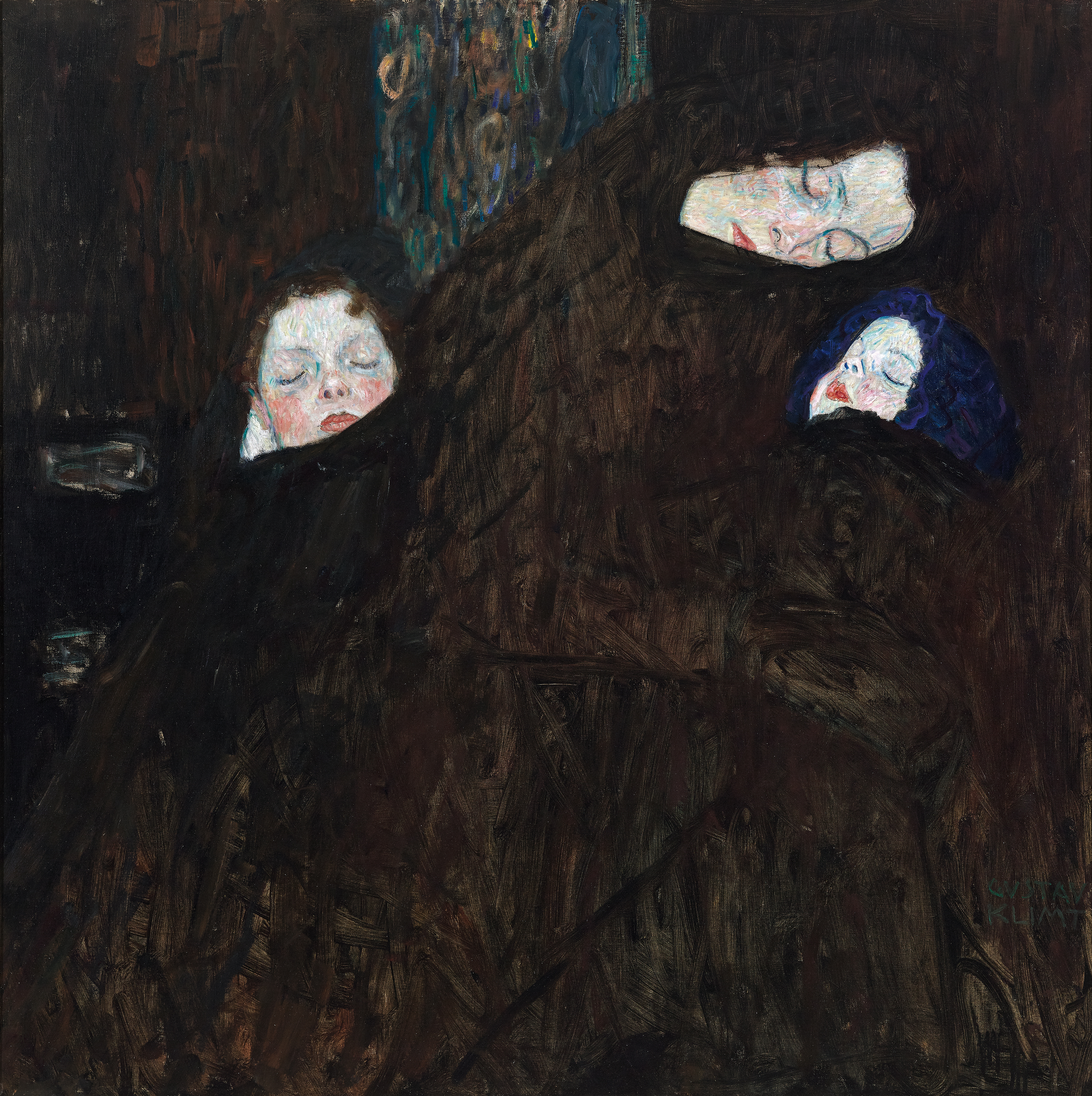
Mother with two children
The tight group makes sleep a refuge. Faces emerge from an environment of almost abstract colored matter.

Friederike Maria Beer
Late portraiture replaces gold with acidic colors, oriental motifs and almost theatrical energy. The worldly figure becomes a modern presence.
In Klimt, ornament does not surround the subject: it reveals what realism alone cannot say.
Social status, desire, threat, fertility or disappearance take the form of motives. Decoration becomes a psychological and symbolic language, without ever providing a single interpretation.
Landscapes: Klimt's secret garden
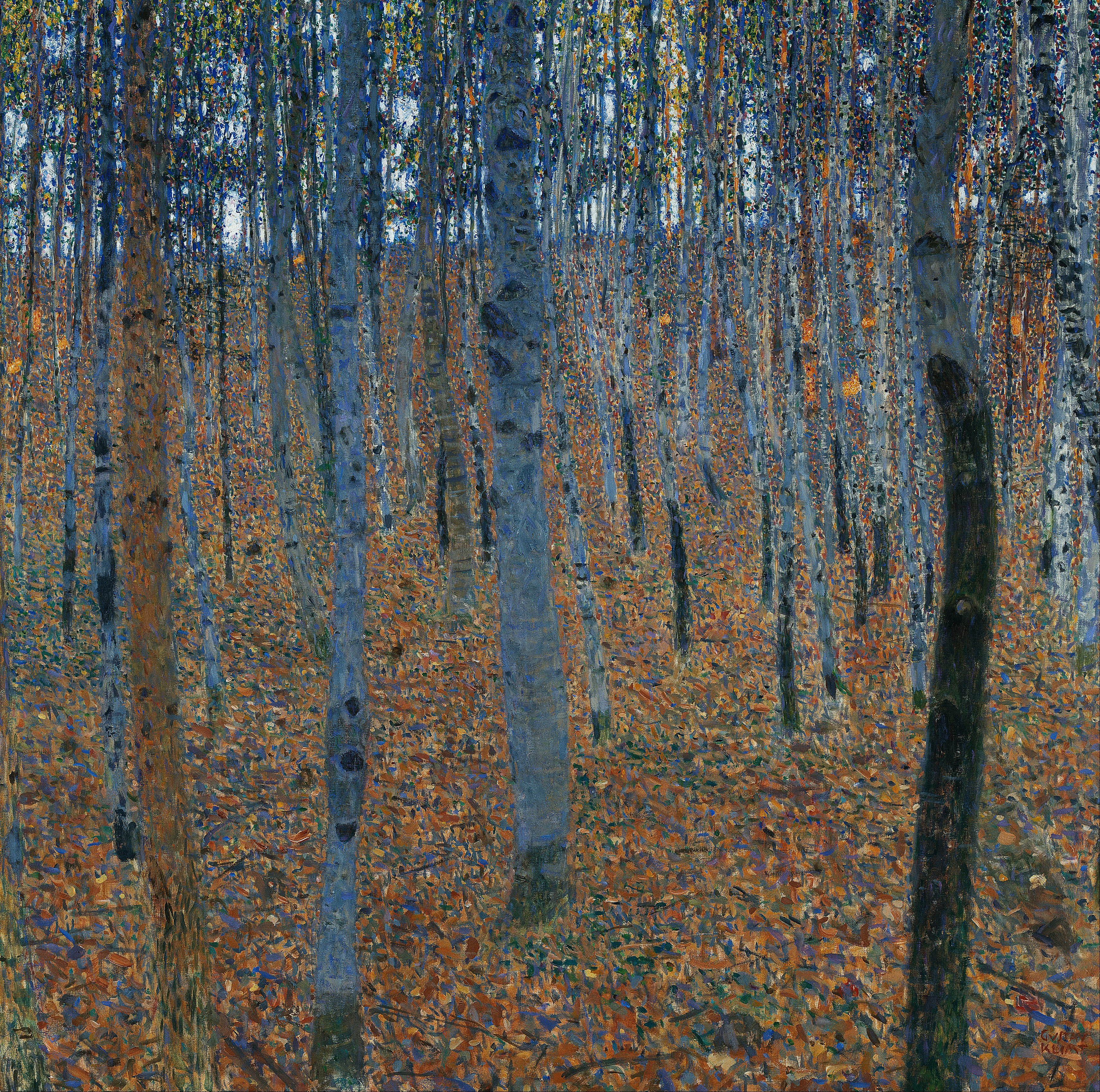
Beech wood I
The vertical trunks form a grid while the ground is covered with colorful touches. The natural space becomes an immersive tapestry.

Quiet pond
High horizon, reflections and square format reduce depth. Water becomes a meditative surface close to abstraction.
Klimt painted regularly during his summer stays, particularly around the Attersee. He often uses a viewfinder to select an almost square fragment of the landscape. Without human figures, these works nevertheless retain its essential principles: frontality, density, repetitive rhythm and hesitation between depth and surface.

Portraits, models and women of Viennese modernity
Klimt became a sought-after portraitist of the Viennese bourgeoisie, particularly women from families of collectors, industrialists and intellectuals. These orders provide financial autonomy and create spaces for experimentation where clothing, furniture and substance express as much as the face.
He also produced thousands of drawings, often of naked women, in a practice distinct from official portraiture. Their erotic frankness contributes to the controversies of his time. Looking at them today requires holding together graphic freedom, the social asymmetries of the model and the artist, as well as the active role of numerous sponsors and patrons in Viennese culture.
Features, hands and posture maintain the presence of the person in the middle of the decor.
Patterns, fabrics and jewelry build a public image as much as they indicate fashion.
Furniture, color and gold place the model in a culture of taste and collection.
Four preconceived ideas about Gustav Klimt
"Klimt always painted gold"
The golden period represents an essential but limited phase. His beginnings were academic, his landscapes explored color, and his late portraits often abandoned gold for very vivid motifs.
Decor is a thought
Patterns organize composition, distinguish or merge bodies, indicate tension and transform the perception of space. They are never a simple filling.
"The Kiss is an unambiguous image"
The embrace appears protective, but the kneeling position, the edge of the flower meadow and the fusion of the clothes maintain tension. His fame does not close the meaning of the work.
Klimt belongs to a network
The Secession, Josef Hoffmann, Koloman Moser, the Wiener Werkstätte, patrons and models contribute to the ecosystem in which his art takes shape.
Choosing a Klimt for your decoration
A reproduction of Klimt acts as a luminous surface. Golden works naturally become the focal point of a room; portraits create a more vertical presence; square landscapes create a calm and enveloping atmosphere.
Avoid multiplying golden objects around the painting. One or two times are enough: a brass lamp, an ocher cushion or a dark frame. Let matte materials - linen, wool, wood, lime - balance the shine.
| Atmosphere | Work | Piece | Agreements |
|---|---|---|---|
| Precious and intimate | The Kiss, golden portraits | Living room, bedroom | Velvet, walnut, brass, ecru |
| Strong and symbolic | Judith, Pallas Athena, Hygia | Entrance, office | Black, burgundy, patinated metal |
| Calm and vegetal | Forests, gardens, ponds | Living room, reading area | Oak, linen, moss green |
| Lively and modern | Late portraits | Large living room, dressing room | Frank colors on a neutral background |
The Klimt, Art Nouveau and Symbolist collections
Start with the Gustav Klimt set, then refine according to the atmosphere: golden, symbolist, floral, feminine or linked to Viennese modernity.
Each collection below has been verified in the Alpha Reproduction store and brings together works available in several formats.
To continue the visit
- Belvedere, ViennaThe Gustav Klimt Collection
- Vienna SecessionThe Beethoven Friesland
- Leopold MuseumGustav Klimt and his work
- Leopold MuseumVienna 1900
- BelvedereThe Kiss in the collection
- Leopold MuseumKlimt Collection Online
- Wien MuseumWorks and photographs around Klimt
- Wikimedia CommonsImages of the public domain and notices of provenance
Frequently asked questions
Gustav Klimt FAQ
Should we write Gustav Klimt or Gustave Klimt?
The Austrian painter's correct name is Gustav Klimt, without an "e". The form "Gustave Klimt" sometimes appears in research and some ancient French texts, but it does not correspond to its official name.
What is Gustav Klimt's style and what movement does he belong to?
Gustav Klimt's style combines precise drawing, realistic figures, decorative flat areas, symbols and sometimes gold leaf. He is the major figure of the Viennese Secession and dialogues with symbolism, Jugendstil and Art Nouveau.
Why was Gustav Klimt using gold?
Gold brings his paintings closer to mosaic, icon and precious object. Klimt was also familiar with metalwork from his gold engraver father. His travels to Ravenna reinforced his interest in luminous Byzantine surfaces.
When did Klimt paint The Kiss?
The Kiss was painted in 1908 and completed in 1909. The work belongs to Klimt's golden period and was acquired by the Austrian state during the artist's lifetime. It is today kept at the Belvedere in Vienna.
What is the Viennese Secession?
Founded in 1897 by Klimt and other artists, the Secession wanted to break with the conservatism of the Künstlerhaus, present modern international art and bring together painting, architecture, design and applied arts.
Did Klimt also paint landscapes?
Yes. Its landscapes, often square and created during summer stays, represent forests, gardens, ponds and banks. Their reduced depth and decorative density sometimes bring them closer to abstraction.
Which Klimt painting to choose for a living room?
The Kiss or a golden portrait creates a bright focal point. For a calmer atmosphere, choose a square landscape. A symbolist work like Pallas Athena or Hygieia is suitable for a darker and theatrical setting.
0 comments