

Claude Monet Paintings • Art & Decoration Guide
Claude Monet: Paintings, Light, and Genius That Refuses to Stay Sharp
A journey through Monet's works to understand how light transforms reality, with keys to choosing a reproduction without falling into cliché.
Following Claude Monet's work is not about flipping through an album of Norman postcards, but witnessing a stubborn investigation into how light shapes the world. Born in Paris in 1840 and raised facing the tides of Le Havre, this man spent his life trying to paint the fleeting moment, that precise second when the shadow changes sides. Many think they know Monet thanks to a few water lilies reproduced on coffee mugs, but they often ignore the almost scientific rigor that drove his brush. He did not seek to embellish reality, but to capture its vibration, even if it meant leaving his canvases unfinished in the eyes of the purists of the time. Understanding his paintings means accepting that sharpness is sometimes the enemy of visual truth.
 Free Image
Le Bloc reminds us that Monet is not content with famous gardens: even the rocks of the Creuse become, for him, a matter of light.
Reading Method
How to Look at a Monet Without Getting Lost in the Blur
To fully appreciate a reproduction or an original work, you must stop looking for precise outlines and start observing the relationships between the touches of color. The method is to step back three paces: what seems like a confused scribble from afar then becomes a palpable atmosphere, charged with humidity or warmth. Do not try to name every object depicted, but rather feel the temperature of the air and the time of day that the artist has frozen. It is in this gap between the missing detail and the overall impression that all the genius of Impressionism lies.
Context Before Prestige
We place Claude Monet's paintings in his era, his studios, his exhibitions, and his small revolts. A work without context is sometimes just a very beautiful person who forgot their history.
The Signs That Betray the Style
We spot plein air, changing light, series. These clues often say more than grand speeches, especially when they carry gold or nervous brushstrokes.
The Work in a Real Room
We end with the useful question: does this image breathe in your home, or does it just pose like a poster that has read two books?
Historical Context
Before the Series: Monet Learns to See Fast, But Not to Rush

As a young man gifted in caricature in Le Havre, Monet met Eugène Boudin, who opened his eyes to the necessity of painting outdoors, directly from the motif. This revelation was crucial: finishing a canvas in the studio is like imprisoning dead light, while the sky changes every minute. Also under the influence of the Dutchman Jongkind, he understood that the horizon should not be a hard line, but a transition zone where air and water mix. His early seascapes, painted around 1860, already show this desire to capture the moment, with tormented skies and waves that seem to truly wet the canvas.
Unlike his academic contemporaries who polished their surfaces until they were as smooth as glass, Monet accepts the trace of the brush as proof of the time spent observing. He works quickly, sometimes in a few hours, to capture an ebbing tide or a mist effect before it disappears. This urgency is not negligence, but an iron discipline: you must have a steady enough hand to place the right touch of gray-blue in the right place the first time. This is how he forged his style, far from the smoky Parisian studios, with his nose in the wind and his feet in the sand.
Artistic Style
Impression, Sunrise: The Fog That Baptized a Movement Without Asking Its Opinion

In 1872, from a window of the Hôtel de l'Amirauté in Le Havre, Monet painted a port enveloped in mist where the sun is only a trembling orange spot on the gray water. This painting, exhibited in 1874 at the first exhibition of the future Impressionists, was meant to be unremarkable, but it involuntarily became the manifesto of a revolution. The critic Louis Leroy, who came to mock, used the title of the work to label the entire exhibition as "Impressionist," believing he was insulting these painters who seemed unable to finish their paintings. The irony of history is that this mockery became the name of one of the most famous movements in art history.
What so disturbed the critics of the time was the absence of precise drawing and the priority given to atmosphere over solid form. In this port of Le Havre, the boats are suggested by a few dark strokes, and the factory chimneys blend into the sky without a clear line of separation. Monet proves here that human vision does not perceive contours before light: we first see the glow, then the forms emerge from the blur. This canvas remains today a perfect example of how a simple study of light can overturn aesthetic conventions established for centuries.
Art & Details
Argenteuil: The Seine, Modern Leisure, and Reflections That Work on Sundays

Settled in Argenteuil in the 1870s, Monet found an ideal playground where nature meets the nascent modernity of bourgeois leisure. The Seine becomes a liquid mirror reflecting colorful sailboats, metal bridges, and white houses on the banks. Unlike heroic historical landscapes, he paints scenes of everyday life: walkers, regattas, families enjoying Sunday. It is a silent revolution: the noble subject is no longer mythology, but the light playing on a sail swollen by the wind or on water stirred by a rower.
It is also in Argenteuil that he often works alongside Renoir, painting the same subjects side by side with slightly different approaches, creating a fertile emulation. The reflections in the water are treated with astonishing virtuosity, using vertical strokes to break the surface and suggest the fluid movement of the current. Monet understands that water has no color of its own, but borrows that of the sky and surrounding objects, distorting them according to its own agitation. These paintings breathe the fresh air of the waterfront and capture the spirit of an era that began to value free time.
Art & Details
Poppy Field: When a Family Walk Becomes a Lesson in Red Spots

In this iconic painting from 1873, Monet depicts his wife Camille and their son Jean walking in a poppy field near Argenteuil. The composition is bold: the figures are relegated to the background or the sides, leaving the spotlight to the red spots of the flowers that dot the canvas like a rain of vegetable confetti. The wind seems to really blow across the scene, bending the grass and lifting Camille's dress, thanks to quick, slanted brushstrokes that give direction to the movement. Nothing is frozen, everything vibrates under the midday heat.
The work perfectly illustrates the technique of plein air pushed to its peak: Monet had to work quickly, standing in the grass, to capture the intense lighting of that summer day. The faces are barely sketched, reduced to a few color indications, because what matters is not the identity of the characters but their integration into the luminous landscape. To choose a reproduction of this work, you must ensure that the reds of the poppies are not too uniform, otherwise you lose that feeling of natural abundance. It is a lesson in modesty: man is only a passing element in the great celebration of nature.
Art & Details
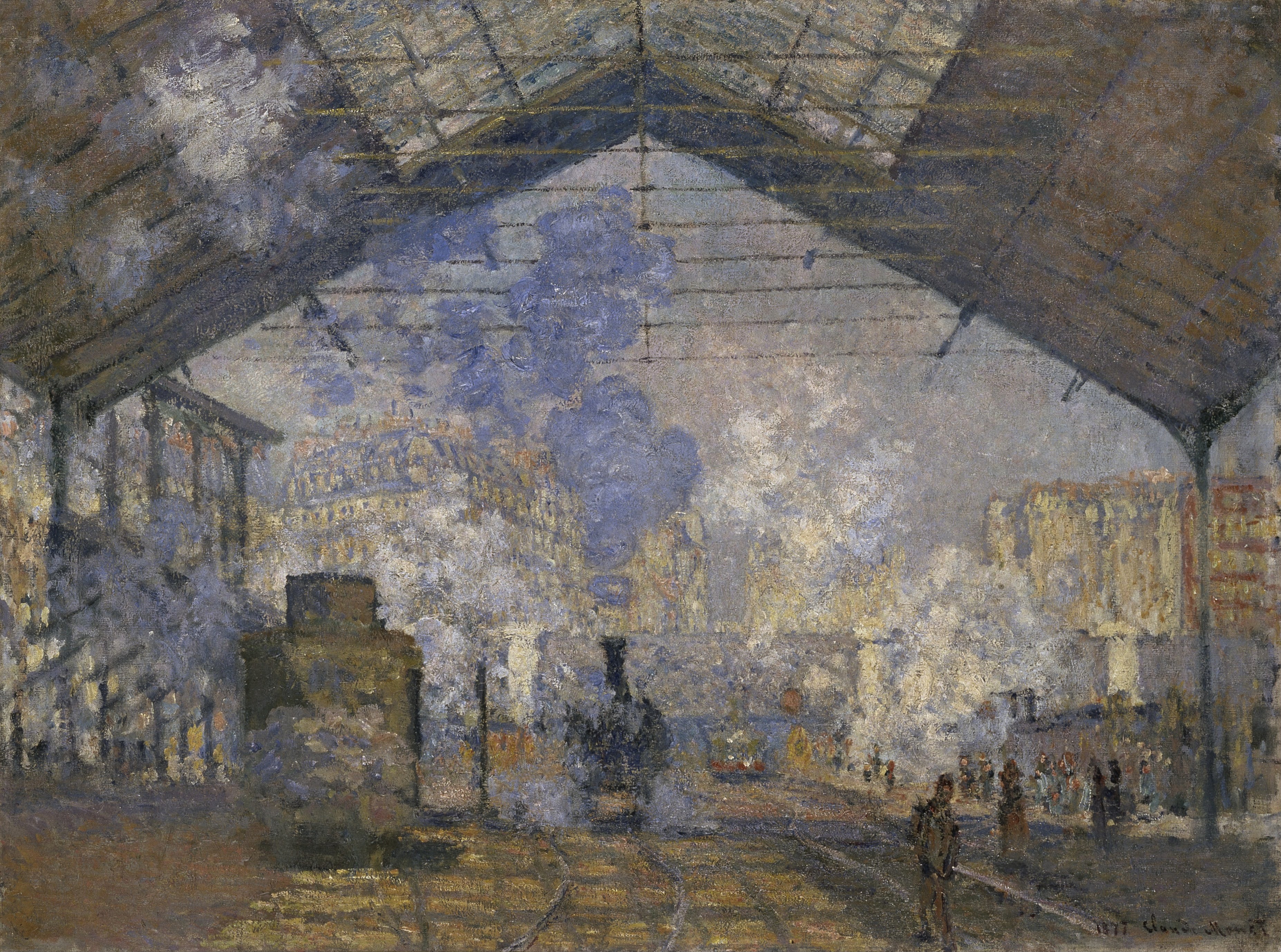
Gare Saint-Lazare: Steam, Metal, Light, and Schedules That Finally Become Poetic

In 1877, Monet decided to paint industrial modernity in its noisiest and darkest form: the Gare Saint-Lazare in Paris. He obtained permission from the railway company to stop trains and change schedules to better study the effects of steam under different lights. The result is a series of canvases where locomotive smoke mingles with the station's glass roof, creating cathedrals of artificial mist tinted with blue and gray. The metal of the trains glitters under the filtered light, transforming a functional place into a fascinating atmospheric spectacle.
This project demonstrates that Monet is not content with painting idyllic countryside; he knows how to find poetry even in urban chaos and industrial pollution. Steam becomes a pictorial subject in its own right, allowing the dissolution of heavy architecture into an ethereal and moving atmosphere. The paint strokes pile up to create the density of the smoke, while the shiny floors reflect the lights of the platforms. It is a technical feat that shows how the artist can sublimate any subject, provided there is a complex interaction between light and suspended matter.
Art & Details
Haystacks, Poplars, Rouen: Monet Repeats Because Nothing Really Repeats
From the 1890s, Monet adopted a systematic working method: he painted the same motif at different times of the day and in various seasons. The haystacks, the poplars along the Epte, or the facade of Rouen Cathedral become pretexts for an in-depth study of light variation. He sets up several easels in his studio or on location, moving from one to another as the sun advances or clouds change the quality of the lighting. Each canvas captures a unique moment, impossible to recreate, proving that the subject is not the haystack itself, but the atmosphere that envelops it.
This serial approach transforms repetition into a philosophical quest: nothing is stable, everything is changing perception. A haystack in the bluish early morning has nothing to do with the same haystack gilded by the autumn sunset. For the modern viewer, looking at these series offers an immersive experience of passing time, compressed into a succession of still images. It is a lesson in humility before nature and a demonstration that objective reality does not exist without the subjectivity of the viewer. Monet forces us to slow down our gaze to see what we usually ignore.
Art & Details
Rouen Cathedral: A Gothic Facade Under Constant Changing Weather

Between 1892 and 1894, Monet rented a room facing Rouen Cathedral to paint its Gothic facade under every possible light. He produced more than thirty versions of this same subject, ranging from the cold gray of dawn to the vibrant pink of sunset, through the deep blue of cast shadow. The sculpted stone, usually described with architectural precision, becomes here a living texture that absorbs and reflects light. The details of the statues and arcades sometimes disappear completely, drowned in a thick, granular pictorial matter.
Working later in the studio to harmonize the whole, Monet built the cathedral layer by layer, using impasto to give relief to the virtual stone. The result is striking: the millennial solidity of the building seems to dematerialize to become only a colored vibration. This series marks a turn towards abstraction, where the real subject almost fades away in favor of the pure sensation of light. Choosing a reproduction from this series requires favoring prints capable of rendering the richness of textures, because it is in the very matter of the paint that the secret of this mineral metamorphosis lies.
Interior Decoration
Water Lilies and Final Years: The Pond Swallows the Landscape, Monet Keeps the Spoon

In his garden at Giverny, arranged with the patience of a Japanese landscape designer, Monet found his ultimate subject: the water lily pond, without horizon or terrestrial landmarks. From 1914, he embarked on the creation of monumental panels intended for the Musée de l'Orangerie, plunging the viewer into the heart of the water and floating vegetation. There is no longer up or down, only a continuum of colors where the reflections of weeping willows mix with flowers and sky. It is total immersion, a sensory experience that anticipates abstract art by several decades.
Despite a cataract that altered his color vision, the aging artist continued to paint with fierce energy, adapting his palette to his modified perception. The tones become more ardent, the forms more diluted, as if the matter itself melted into light. These late works are not simple wall decorations, but a meditation on finitude and the permanence of nature. Installing a reproduction of these water lilies in your home means accepting to lose your spatial bearings to float in a space of colored peace, where the outside world ceases to exist.
| Room | Suggestion | Decorative Effect |
|---|---|---|
| Living Room | A work related to Claude Monet's paintings with a strong composition | Cultivated focal point, warm, and easy to comment on without reciting a label. |
| Bedroom | A soft palette or a more intimate scene | Calm atmosphere, visual presence without unnecessary agitation. |
| Office | A structured, colorful, or graphically sharp image | Creative energy and a small reminder that the wall can also work. |
| Entryway | A vertical format or an immediately readable work | Clear first impression, elegant, and decidedly less timid than a white void. |
To Continue the Visit
Sources, Collections, and Paths Truly Related to the Subject
A few useful references to verify information, compare free images, and extend the reading without heading to a museum that didn't ask for anything.
Related Articles to Read Next
Useful Blog Hubs
Useful Sources on This Subject
- Wikipedia - Claude Monet
- Wikidata - Claude Monet
- Wikimedia Commons - Claude Monet paintings
- Musée d'Orsay - Claude Monet
- Musée Marmottan Monet
- Musée de l'Orangerie - The Water Lilies
- The Met - Claude Monet
- Art Institute of Chicago - Claude Monet
- Wikimedia Commons - Claude Monet
- Wikipedia - Impressionism
FAQ
Frequently Asked Questions About Claude Monet's Paintings
What are Claude Monet's paintings about?
Claude Monet's paintings tell less a succession of pretty images than a continuous investigation: snow, ports, the Seine, train stations, haystacks, cathedrals, and Water Lilies each test light in a given situation.
How to quickly recognize this style?
Observe especially plein air, changing light, series, reflections, and steam, then the way the composition organizes the gaze. If the work holds your attention longer than expected, it is probably not an accident.
Which artists should you know?
The main references are Claude Monet, Eugène Boudin, Johan Barthold Jongkind, Pierre-Auguste Renoir, and Camille Pissarro.
Does this style suit modern decoration?
Yes, provided you choose the right format, a palette consistent with the room, and a work whose presence remains pleasant on a daily basis.
Should you choose the most famous work?
Not necessarily. The most famous work can be perfect, but the right choice depends above all on the room, the format, the palette, and the desired atmosphere.
Where to verify the information?
Start with museum notices, Wikipedia/Wikidata for general orientation, then Wikimedia Commons when a free image is needed.
Choosing Your Monet: Between History and Decoration
Integrating a painting by Claude Monet into a modern interior does not mean adding a touch of old style, but inviting a reflection on light to reside in the room. Whether it is a lively scene from Argenteuil to energize a living room or a soothing Water Lilies for a bedroom, the work acts as a window open to a suspended moment. The key lies in choosing a reproduction faithful to the original nuances, because it is the accuracy of the colors that carries the artist's emotion. By hanging a Monet, you are not just hanging an image, you are welcoming a way of seeing the world that refuses rigidity and celebrates the ephemeral beauty of each day.
0 comments